

NFL teams still see Big Ten as fertile ground for smash-mouth football players
On Sunday, I wrote about the Big Ten’s recent struggles in placing its talent among the elite picks in the NFL Draft and the SEC’s comparative rise in the race to hone college football’s best players.
It’s a grim picture.
Among the more dire statistics: No Big Ten players have been selected in the past 24 top-10 picks, a figure that’s expected to grow to 34 tonight when the NFL Draft begins today at 8 p.m.
Since the conference’s last top-10 pick - Ohio State’s Vernon Gholston at No. 6 in 2008 - pro teams have picked eight SEC players, seven Big 12 players and five from the ACC among top-10 selections.
But all is not lost for the Big Ten. If the overall numbers have fallen over the past decade, NFL teams still value the conference for its ability to produce power football players.
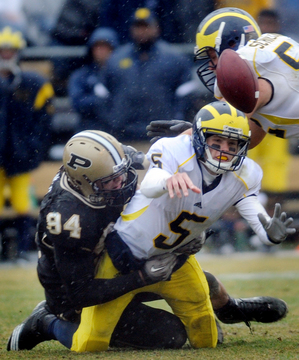
Purdue's Ryan Kerrigan, shown taking down former Michigan quarterback Tate Forcier, is a likely first-round pick in the NFL Draft.
Melanie Maxwell | AnnArbor.com
Six Big Ten defensive linemen have been selected in the draft’s first round over the past six years - a group that includes Michigan’s Brandon Graham and three Penn State players.
That number is expected to grow dramatically tonight when as many as five linemen from the conference could be selected in the first round. Iowa’s Adrian Clayborn, Ohio State’s Cam Heyward, Wisconsin’s J.J. Watt, Purdue’s Ryan Kerrigan and Illinois’ Corey Liuget are all projected first-round picks.
On the offensive side, Wisconsin offensive tackle Gabe Carimi is expected to be a mid-first round selection, continuing the conference’s run of producing first-round tackles.
Assuming Carimi’s first-round status comes to fruition, the Big Ten will have produced five first-round offensive tackles in the previous five years, a group that includes Michigan’s Jake Long and Wisconsin’s Joe Thomas, who were both top-three overall picks.
Despite some overall struggles, the Big Ten can still develop and deliver top-tier linemen on both sides of the football, and the conference’s reputation for smashmouth football is alive and well.
That’s good news for the Big Ten in general and, possibly, Michigan in particular, as the football program rediscovers its roots in a pro-style offense and 4-3 defensive systems.
Draft drought
The last time the Michigan football team didn’t have a single player picked in the NFL Draft was 1961. The last time the Wolverines had only one player selected was 1985, when defensive end Kevin Brooks was the team’s lone representative.
There’s a chance the Wolverines equal that dubious distinction this year, although there seems to be enough buzz around guard Stephen Schilling’s chances as a mid-round prospect that the 50-year streak is unlikely to be broken.
Still, it’s a possibility. Pro Football Weekly calls Schilling a “very passive, finesse, effort blocker with few redeeming qualities to warrant consideration.” Ouch.
Linebacker Jonas Mouton and tight end Martell Webb are Michigan’s other draft prospects, but are drawing considerably less pre-draft chatter.
But that’s the thing about the NFL Draft - you never really know beforehand. Last year, cornerback Donovan Warren was touted as a second or third-round pick, and didn’t get drafted.
For the mid-to-lower-round hopefuls like Schilling, Mouton and Webb, they only need to convince one team to take a chance.
What if?
Two other names to consider in the NFL Draft’s next few days are Arkansas QB Ryan Mallett and Ohio State guard Justin Boren, both of whom started their careers with the Wolverines.
Mallett may be the wildcard of the draft - he’s been projected to go anywhere between the late first and early third rounds. Boren’s in a similar position to Schilling, his former linemate, as a mid-to-late-round draft pick.
Pete Bigelow covers Michigan football for AnnArbor.com. He can be reached at (734) 623-2556, via email at petebigelow@annarbor.com and followed on Twitter @PeterCBigelow.
Comments
wolfman
Mon, May 2, 2011 : 1:57 a.m.
Smash mouth Football Teams those are whom the scouts watch
DonAZ
Fri, Apr 29, 2011 : 5:07 p.m.
Well, the dust has settled on the first round of the NFL draft. I'd say the Big 10 did well enough -- four in the first round, all four defensive linemen. In fact the first round had a lot of linemen taken. Sure, a few big name QBs, but mostly the big muscle needed to either (a) penetrate defensively, or (b) prevent defensive penetration. This concept of "speed" is really a red herring. Speed itself is not that important. Gruden on ESPN said as much -- saying he really couldn't care about someone's top-end speed. His interest is really more *quickness*. Nobody -- and I mean NOBODY -- on this site is advocating for big and slow players. Only a handful of people are trying -- not successfully, but they're trying -- to suggest the false choice of "either speedy spread or slow lumbering 1950's Big 10 play." The real objective is something more akin to what we see out of Alabama, Auburn, LSU -- big, physical players who are quick enough to do the job their position calls for them to do. One of the flaws in spread offense is that a good defensive with superior penetration skills can get into the backfield and disrupt plays before they have time to set up. Mississippi did that in spades against Michigan in the bowl game. Auburn did that against Oregon. It's interesting -- and illuminating -- that the NFL teams gobbled up the big, physical and athletic D-line and O-line players ... except for those desperate teams that simply had to roll the dice (i.e. Panthers). It seems like there's an element of the game that's returning to a focus on "in the trenches" play ... not like 30 years ago, but a new breed of swift but muscular execution at the line.
DonAZ
Fri, Apr 29, 2011 : 5:50 p.m.
Well ... six. I can't count. I should just cut-and-paste from other stories.
DonAZ
Fri, Apr 29, 2011 : 5:14 p.m.
Five players -- I missed Cameron Heyward out of OSU. Another DE.
DonAZ
Thu, Apr 28, 2011 : 10:02 p.m.
First, there's a lot of quality NFL players who were drafted lower than "Top 10." Setting the cutoff line for the measure of a conference at "Top 10" is silly. Second, there's a lot of "speed" in the college ranks that does not translate to NFL success. Third, the SEC has become the conference it is precisely BECAUSE of a relentless focus on this kind of thing. Yes, they've won five straight "Crystal Bowls." They also have a significant problem with arrests and other brushes with the law. That's not coincidence. One leads to the other -- because so much money is on the line to "win it all" they are increasingly willing to abandon adherance to rules. It will only get worse.
superbuck
Thu, Apr 28, 2011 : 9:18 p.m.
Hey Theo did we cheat every year that we have beaten you. I can think of a few years that tress put the second and third string in when he could have just ran up the score. You have had a lot of problems with the vest what are you going to do if Urban Meyer takes over which looks pretty likely.
Theo212
Thu, Apr 28, 2011 : 2:56 p.m.
Right, Pete. Without speed (or cheating aka Tressel), we will continue to get "smash-mouthed" in the games that matter. And actually, there is only ONE game that matters - The Crystal Bowl. A slow team has NEVER won a Crystal Bowl. OSU's "win" against Miami was cheating- and ref-aided.