

Concerns about Rich Rodriguez and Michigan's football program shouldn't be brushed aside
There came a moment Tuesday when incoming Michigan athletic director David Brandon stood before the assembled crowd in the Regents Room and expressed relief that he was not talking about recruiting violations, gambling or academic fraud.
“Those are scary things, and certainly we’re thankful that that’s not the kind of thing we’re talking about today,” he said.
That’s the good news for Brandon.
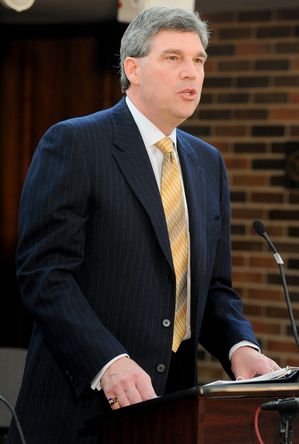
Incoming athletic director David Brandon addresses the media on Tuesday. (Photo: Angela J. Cesere | AnnArbor.com)
Which is a bit like saying he’s thankful to hear a report that he only needs a few fillings and a crown instead of a full-blown root canal.
But the NCAA equivalent of the dentist chair is still an uncomfortable and unfamiliar place for the Michigan football program.
It had never sat in such a position of scrutiny during its storied history - a point of pride for those associated with the Wolverines - until Tuesday, when the pristine legacy was tarnished.
NCAA officials outlined five potential major rules violations in a notice of allegations delivered to university officials.
Among the charges: the football program exceeded allowable time limits in practices and coaches allowed quality-control personnel to supervise and conduct workouts.
Those charges were expected. But the NCAA investigation caught more than a mere net full of minnows.
Accusations revealed Tuesday were much more than the honest mistakes of 20 exceeded minutes here or a misplaced staffer there.
In its letter, the NCAA wrote the scope and nature of violations demonstrated that football coach Rich Rodriguez failed to promote an atmosphere of compliance within the program.
That the athletics department “failed to adequately monitor its football program to assure compliance.”
That graduate assistant Alex Herron provided “false and misleading information to the institution and enforcement staff” when questioned.
Those are serious charges.
When news of possible allegations first broke in the days before the 2009 regular season began, Rodriguez adamantly defended his program and insisted he and his staff followed rules.
At the time, Rodriguez dismissed the allegations as “unnecessary drama.”
Concerns can no longer be brushed aside. Not about the NCAA charges in particular nor the way Rodriguez conducts his program in general.
In too many instances, some large and some small, Rodriguez has written his own reality to the detriment of his program and the university.
He hired lawyers and attempted to wriggle out of the $4 million buyout he owed West Virginia upon his hiring in Ann Arbor, a sum he still owed in full after a drawn-out public-relations fiasco.
He angrily insisted that U-M linebacker Jonas Mouton never punched Notre Dame center Eric Olsen, so much so the Big Ten had no choice but to suspend Mouton when video evidence showed him punching Olsen.
After quarterback Justin Feagin was kicked off the football team last August for his role in a failed cocaine deal, Rodriguez said, “Trust me, no coach in America is going to want to take a guy that has baggage or that they think is a bad guy. We certainly won’t.”
Then he recruited Demar Dorsey.
In those cases it was easy enough for Rodriguez to dismiss those who questioned his judgment as agitated outsiders who were not “all in” and ignore the mess.
It won’t be as easy for him now.
Six times, the NCAA document requests that Michigan explain whether Rodriguez knew or should have known about the problems festering on his watch.
The notice outlines a pattern of Rodriguez and those in his program ignoring requests from U-M’s own compliance department, requests that began just two months into his tenure in Ann Arbor.
- In the winter of 2008, shortly after Rodriguez’s staff was hired, “compliance services office staff members became aware that the football program employed quality control staff members and were concerned about the duties and activities of those individuals,” according to the NCAA notice.
- The notice asks Michigan for copies of an Aug. 15, 2008 memo from assistant athletic director Ann Vollano that requests job descriptions of the quality control staff - and goes on to ask whether Rodriguez knew or should have known the compliance office had not received the descriptions.
- It asks for more memos from Vollano dated Aug. 1, 2008 and Aug. 13, 2009 regarding missing Countable Athletically Related Activities (CARA) forms.
- It asks for copies of memos from associate athletic director Judy Van Horn dated March 4, 2008 and March 5, 2009 asking whether the football staff knew conditioning activities could not be used as discipline.
- The NCAA report states that in the summer of 2009, “strength and conditioning staff members failed to provide appropriate information to the compliance service office,” according to the NCAA report.
Overall, the report paints a picture of U-M’s own compliance department doing its job and asking a lot of questions and receiving nothing but silence from the football program in return.
Ignoring fans and media may be one thing, but ignoring questions from within his own department says a lot about the way Rodriguez operates his program.
For his part, Brandon said Tuesday there was nothing in the NCAA notice that led him to believe firing Rodriguez was necessary.
But the scope of the NCAA allegations and their status as the program's first-ever led the new athletic director to make one statement Tuesday he probably would have preferred to avoid during his first real remarks on the job:
“This is a tough day,” he said.
Pete Bigelow covers sports for AnnArbor.com. He can be reached at petebigelow@annarbor.com or 734-623-2556.
Comments
Jaxon5
Sat, Feb 27, 2010 : 1:35 p.m.
1bit...it's hard not to focus on the negatives when there are so many.
ScottyBoy
Sat, Feb 27, 2010 : 11:24 a.m.
Ah! The tawdry altar of sports. Staff who lied to the NCAA should be fired!
stunhsif
Fri, Feb 26, 2010 : 7:17 p.m.
Michigan practices way more than other teams and still had a horrible season. Kinda like a student that studies way more than his/her peers and still gets lousy grades. Perhaps a reflection on the coaches or the talent level of the team? Maybe a combo of the two!
Jaxon5
Fri, Feb 26, 2010 : 8:33 a.m.
Correction to Danny's post. Must be a typo... substitute the word "coaches" for "fans". Fans have nothing to do with the integrity of the program.
Michigwen
Fri, Feb 26, 2010 : 12:59 a.m.
I hope Tru2Blu76 is right that Brandon has given RR written notice that he is on thin ice although I can understand why Brandon cannot say so publicly if UM is to present the best response to the NCAA allegations to minimize sanctions. As to RR's replacement, if Brandon (unlike Martin) approaches the right people, we will have no trouble finding a better coach, one who would know that RR brought the wrath of the "old Blues" on himself even before he coached his first Michigan game (as others have described) and know better than to engage in that type of behavior. Finally, before accepting the views of those who suggest that Brandon has to fire RR immediately after the NCAA issues its conclusions to avoid paying RR a buyout, I would like to hear what a lawyer has to say about that. If the NCAA finds RR guilty of major violations, I think it is doubtful that Brandon would have to fire RR mid-season to avoid the buyout. As I understand the contract, if the violations are not major, then I think Michigan must pay to get rid of RR. Of course, I think it would be worth it.
Manitou
Thu, Feb 25, 2010 : 9:51 p.m.
Whether you call him Rich/Rick/Dick-Rod, Mr. Rodriguez has become Lightening-Rod and all the electricity he has grounded in Ann Arbor is negative. He is a Morgantown sofa couch fire......... Give him big dollars to buy back into his contract at UWV.
Danny
Thu, Feb 25, 2010 : 6:07 p.m.
A one time super power of the NCAA reduced to ashes by it's fans!
Danny
Thu, Feb 25, 2010 : 6:04 p.m.
Sour grapes, sour grapes! Who in their right mind would want to come to Michigan after RR? It's scary to read some of the comments, so disfunctional and bitter! SEC watching events unfold and can't believe what we are seeing and hearing! A one time super power of the NCAA reduced to ashes by it's fans.
MetricSU
Wed, Feb 24, 2010 : 10:58 p.m.
truebluefan: I tried to find in my post where I said or even implied that I wanted RR gone. I will say, though, that I think he could be winning lots of games in two years. Probably not next year, but he might get 7 or 8. From an MSU fan's perspective, it's not clear what we should want concerning RR. But it's clear that MSU fans should want turmoil in the UM football program, and this NCAA investigation provides that. No matter how many UM fans say that this is about 20 minutes too much here and there, it doesn't change what the NCAA report actually says. RR allowed his "quality control" coaches to run wild, players practiced much too long, and RR created a structure conducive to cheating. Go read the interview of Compliance Guy on mgoblog.com. He confirms that the violations will be concluded to be major, and there will be penalties -- likely including lost scholarships. The exact nature of the penalties is unclear at this point. What will be interesting to see is whether UM has to eventually buy out RR's contract because they wait to long to fire him. It appears that if they don't fire RR sometime in the fall -- after the NCAA concludes its investigation -- then firing him after the next season will be very costly to UM.
truebluefan
Wed, Feb 24, 2010 : 8:37 p.m.
MetricSU - Why do you pretend to care so much about Michigan Football? You are essentially calling for RR's head so Michigan can get a better coach, right? In your mind, how could this scneario be good for MSU? Trust me, MSU will never experience better times against Michigan in football than they have experienced the last two years with RR at the helm. So, why wouldn't you be in support of Michigan retaining RR?
Chrysta Cherrie
Wed, Feb 24, 2010 : 6:49 p.m.
Comments containing personal attacks and discussing the moderation guidelines have been removed. Please keep the moderation-related discussion here: http://www.annarbor.com/about/comment-moderation-guidelines-meant-to-cultivate-community-forum/
Yogi
Wed, Feb 24, 2010 : 3:31 p.m.
rjlinehan.... Fisher was on the staff when the Fab Five were recruited and lied about complimentary tickets he had given to (I believe a banned booster) and Gary Moeller who I happen to like very much bloodied UM with his drinking escapades. My point has nothing to do with the AD. It has to do with people pointing to how righteous UM has always been. You clearly have some severe issues with the coach and that's fine. I believe that RR deserves at least one more year and more likely two to prove himself. Lastly please explain to me how fans can affect the wins or losses of the UM football program. Get a grip dude!
Six In A Row
Wed, Feb 24, 2010 : 3:30 p.m.
RJ... My name is SIX IN A ROW... do you know what sarcasm is?
Six In A Row
Wed, Feb 24, 2010 : 2:36 p.m.
Clearly, this is the NCAA's fault, and not Rodriquez'. I mean, without clarification, how is he SUPPOSED to know which rules the NCAA "means", which ones they "really mean", and which ones they "don't really mean?" I mean, what's a guy to do, observe them ALL?
Yogi
Wed, Feb 24, 2010 : 1:24 p.m.
I'll say this slowly.... If RR wins, he stays if he doesn't he'll be gone. End of story. So get off his back about this and let him do his job. UM has no more integrity than any other big time school. It left a long time ago along with Bud Middaugh, Bill Freider, Gary Moeller, and Steve Fisher. Please quit beating that dead horse.
Yogi
Wed, Feb 24, 2010 : 1:24 p.m.
I'll say this slowly.... If RR wins, he stays if he doesn't he'll be gone. End of story. So get off his back about this and let him do his job. UM has no more integrity than any other big time school. It left a long time ago along with Bud Middaugh, Bill Freider, Gary Moeller, and Steve Fisher. Please quit beating that dead horse.
heartbreakM
Wed, Feb 24, 2010 : 12:31 p.m.
UM in NC: I personally have been critical of RR's hire since he signed--and while I have tried to give him the benefit of doubt over time, I have not yet seen anything change. What has always concerned me over RR is his character and his conduct. The lawsuits, the way he left WVU, the embarrassment that he has brought to our institution, the lack of connectedness and knowledge of UM--all of these things concerned me. In his first season, he made a few very public comments showing his lack of knowledge of Michigan football (after Notre Dame--he said "Michigan football will be back"--hello!!! where did we go? Just beat Tebow and Meyer in a game earlier that year), and there were other coaching conduct issues. Signed his contract the week of the MSU game, rather than concentrating on that game's prep--all of these things add up to me. His coaching record speaks for itself, only underlining the concerns--he has not only not won, but he has not developed his players and the team has not improved through the year. All of these things concern me, and have concerned me. But mostly, it is about the character. That is why I have always critized him and his conduct. And the WVU fans seem to say the same things.
UMfaninNC
Wed, Feb 24, 2010 : 11:48 a.m.
@MetricSU perhaps so... (but i see you didnt touch on the other parts I spoke about) now i pose this finaly question for those in the "RR must go" camp. Can you HONESTLY say you wanted him out when they were 4-0 earlier in the season and doing well? if you can then i can respect your stance if not... and like i said before if they had winning seasons would it be as much as an issue as it is now. if they go 10-2 in '10 does all this hate go away
BornInA2
Wed, Feb 24, 2010 : 11:42 a.m.
"We take this seriously" But the coach keeps his job? And a staffer named in the report was just promoted? It seems to me that RR likes to be the center of attention. He's created one distraction after another since he arrived, taking attention and energy and, often, goodwill away from the team. This article graciously lists only a few of the RR debacles. You fanboys can characterize the violations however you want. But the only characterization that counts is the NCAA's, and they've chosen the word "Major". I wish RR would do us a favor and go away on his own so we can get back to winning football games with integrity.
MetricSU
Wed, Feb 24, 2010 : 11:35 a.m.
Strike two, UMfaninNC. No MSU player admitted going beyond the usual practice times. What he said was that some days he worked out for many hours. On his own. Uh, that's different. You UM fans wanted to read it another way. Show me an MSU player who came out and said (1) they are practicing more than they are supposed to and (2) coaches are showing up at practices illegally. I'll check on your response this evening.
ogel1209
Wed, Feb 24, 2010 : 11:27 a.m.
RR has brought us nothing but misery. Worst coach EVER at Michigan!! Besides these violations, we had to pay millions to help bail him out of WV, and I don't have to remind anyone of his W-L record.I am ashamed to have him associated with UM. Get rid of him now before more damage is done!
The Grinch
Wed, Feb 24, 2010 : 11:24 a.m.
UMfaninNC: You say: "bet you whiners were the same ones calling for Lloyd head 5 years ago when they were 7-5... you cant have it both ways. this is a transition period and it allowed real U-M fans to see that things werent as rosey with the team as they thought." No, quite the opposite. The people who ran LC out of town (and make no mistake, he was run off) are the same ones who hailed King RichRod and, now that it has been shown that the emperor has no clothes, they refuse to admit their mistake. Indeed, they want to double down their bet. It's what's called throwing good money after bad. Time to cut our losses.
NoBowl4Blue
Wed, Feb 24, 2010 : 11:15 a.m.
Hmmm let us examine Rich Rods ( the King as some call)impact on U of M football. Aside from lawsuits he is 8-16, no bowls, 2 big losses to arch rival and now NCAA investigation and possible sanctions. All the competition sings HAIL TO THE KING. Don't you get it people, you need a change QUICKLY!
UMfaninNC
Wed, Feb 24, 2010 : 11:01 a.m.
MetricSU remember when the story first broke MSU player even admitted to going beyond regulated practice times, but then all of a sudden that was cleaned up and forgotten about. dont throw bricks when you live in a glass house... cuz some could see the issues going on up in EL as lack of institutional control, but i guess because Coach D is progressing enough for alot of MSU fans its not an issue (but lets see how patient they are if he goes 6-6 again and loses to PSU/OSU and god forbid U-M this year) yeah they may have been pushed a little but dont PLEASE dont act like this is the only program its happening at. just like i realize there were things that went on behind closed doors at U-M back in the day that werent the most legit. it happens (and the majority of this is coming out due to the issues many U-M supporters have with RR that have nothing to do with performance)
MetricSU
Wed, Feb 24, 2010 : 10:50 a.m.
UMfaninNC: I would, and often do, choose to work long hours to prepare for presentations. But I have total control over that. Would I work 60 hours a week to make sure I'm extra prepared? Maybe or maybe not. But that's my choice. If playing time for the players depended on their attending the extra practices, then they are being forced to break the rules. It is irrelevant that it might make them better. Practicing 12 hours rather than 10 would make them even better. So where should it stop? The players might not want to break the rules. (Clearly, some players did not.) Maybe they want to be well-rounded rather than spend more time on football. In any case, there are no rules governing how long I can work on a presentation. The NCAA recognizes that the players have other commitments -- such as school -- so it imposes limits. Is 8 hours the right number? Maybe not. But if the limit were, say, 10, coaches shouldn't have their players going 12. There has to be some limit, and UM has, evidently, repeatedly violated the limit. Face it, these allegations smack of trying to gain a competitive edge, and that is, by the NCAA's definition, a major violation.
TruthInNews
Wed, Feb 24, 2010 : 10:37 a.m.
unTRUTH: Michigan committed NCAA violations. TRUTH: Pete is now "part of the problem" by continuing to report on this story. I love it how the media likes to point out stories "like OMG look at this shiny thing!." And then when accused of piling on just for the $$$ they claim to have done nothing. Truth in News.
Yogi
Wed, Feb 24, 2010 : 10:36 a.m.
Pete, Nice cheap shot on Demar Dorsey and RR. Do you even know this kid? I'm sure that Jim Tressel will never recruit a kid with a past again after Maurice Clarett either. No one knows what the future will bring but I hope that people will give Demar Dorsey a chance before judging him. I guess I'm too late in your case.
Yogi
Wed, Feb 24, 2010 : 10:27 a.m.
Get off RR's back and let him try to bring UM football to a place is has rarely seen in the past 10 years a Big 10 championship(and maybe national prominence). I'm so tired of the ready, shoot, aim approach it makes me sick. Let the man coach!!! If he doesn't get to a bowl game in 2010 this will all be moot. Don't worry about the buyout of his contract because boosters will be footing that bill not the University.
UMfaninNC
Wed, Feb 24, 2010 : 10:06 a.m.
@MetricSU "For those of you who think practicing 10 instead of 8 hours is no big deal, ask yourself if you would work 50 hours a week and get paid for 40." that is a horrible analogy. because at the end of the day its helping them be a better player so their PAYMENT is being more prepared come gametime... let me ask you this, if you had a big presentation at work and preparing for it would cause you to have to work later hours, would you, even if you werent getting paid for it but it would make you more prepared, I HOPE YOU WOULD. (same scenario) and i am sooo sick of this MICHIGAN MAN talk... BO wasnt a Michigan Man when he was hired, he evolved into one. why cant RR get the same chance to do so. For a program that has ONE national championship in the past 50 years some U-M fans have a higher opinion of the program than it actually should (and this is coming from a U-M fan)
MetricSU
Wed, Feb 24, 2010 : 10:05 a.m.
Brandon may have a very tough decision ahead of him. If some violations are labeled "major," Brandon could fire RR in July or August without it costing UM in a big payout. But if Brandon waits until after another mediocre season, I doubt that Brandon can fire RR for violating the conditions of his contract: the NCAA findings will be too far in the past. If Brandon waits, it will cost UM a lot of money to make RR go away, and UM alums will not be happy. Good luck, Brandon.
Steve Kleintank
Wed, Feb 24, 2010 : 9:53 a.m.
JD what part of they changed the title to include editorial escapes you? When this was originally posted it did not say that. The charges have merit, else they would not be in an NCAA document, the university is and will take actions, and Major is not decided by a newspaper but the NCAA Infactions Committee and why is Major the only focus and potential skipped over by yourself an others? Everyone who is a U.S. citizen and meets other positional requirements is potentially the President - but it doesn't mean they will be - same is true with the allegations. That being said regardless if they are found to be major or seconday the charges are serious and the school is taking them as such.
TRIGG6
Wed, Feb 24, 2010 : 9:52 a.m.
Those who stay will be...IN VIOLATION.
Opalmerr
Wed, Feb 24, 2010 : 9:51 a.m.
I want to also state that this (the hiring of Rodriguez and the failure to keep him under control) is what happens when a business man is in charge of the athletic department. Bill Martin shares in the blame for this mess. I am not sure I am entirely comfortable with prospect of Dave Brandon leading the department either, but at least he has some experience as a student athlete at Michigan to draw upon. Think of it this way, if Canham or Bo were athletic director, do you think Rodriguez would have gotten away with ignoring the compliance department?
UMfaninNC
Wed, Feb 24, 2010 : 9:49 a.m.
Its interesting that outsiders (fairweather fans, trolling visitors) have so much negative stuff to say about this situation but you have people close to the situation (like players parents) see nothing wrong, yes the issue with the compliance officer was out of order but all that other stuff they felt was trumped up. I am soo sick of fans who have this haughty "ruining the sanctity of U-M" mentality, you actually think issues like this werent going on during the BO/Lloyd era the ONLY difference is they were winning. None of this would even be an issue if RR had been atleast 6-6 and 8-4 the past two seasons. i bet you whiners were the same ones calling for Lloyd head 5 years ago when they were 7-5... you cant have it both ways. this is a transition period and it allowed real U-M fans to see that things werent as rosey with the team as they thought. Lloyd had similar issues (large numbers of players leaving/big time players not making an impact/recruiting players with character problems) but no one wants to ever acknowledge it, they act like these issues all of a sudden came about durin the RR era. HONESTLY im more worried about the basketball program than I am football. LASTLY be glad our issue is lack of compliance with practicing instead of whats going on @ PITT (player ignorantly posting large amounts of booster money on his facebook page, thus potentially opening pandoras box to that program)
dswan
Wed, Feb 24, 2010 : 9:48 a.m.
Where has Bill Martin been since RichRod was hired and why didn't he make sure Rich addressed the concerns of the Compliance Dept? Where was Bill yesterday during the press conference? Let me guess...over at Bank of Ann Arbor or First Martin Corp counting his money. All of this could have been avoided had Bill held Rich Rod accountable. Instead, despite 25 years of coaching experience; Rich was allowed to operate under the belief that he was above the rules. Rodriguez is Bill Martin's big mistake.
Opalmerr
Wed, Feb 24, 2010 : 9:41 a.m.
The real problem is not that the practice extended 20 minutes too long or over the course of a week lasted 2 hours longer than permitted. The real problem here is that Rich Rodriguez holds himself above the university its football program represents. Ignoring the compliance departments requests was not only arrogant but assinine as well. The compliance department is there to HELP Rich Rodriguez and every other coach to not run afoul of the NCAA. Rodriguez has instead fostered an adversarial relationship with the compliance department by refusing to work cooperatively with them for his own good. At the Victor's Raly there was talk about Rich Rodriguez being a "Michigan Man". He is not a Michigan Man and his behavior clearly demonstrates this. Rich Rodriguez is a Rich Rodriguez man, everyone and everything else be damned.
MetricSU
Wed, Feb 24, 2010 : 9:31 a.m.
Pjohn3: Frankly, I didn't realize how many UM fans would enter such a strong state of denial. I guess it's human nature, but I (incorrectly) thought more UM fans would be able to distance themselves from the situation and see it objectively.
Pjohn3
Wed, Feb 24, 2010 : 9:22 a.m.
Anybody who thinks you can simply brush this off as a couple extra minutes of practice time in the off season is in complete denial. The warning signs are there and have been since this coach has come to Michigan. It sorta reminds me of the missed warning signs with the housing bubble. Martin plays the role of Greenspan and Rich Rod is Fannie Mae. And we all know how that story ended. Rich Rod has brought way too much negative publicity to this university and I fear we the fans are going wind up on the losing end. But hey, there are still some suites available so keep it coming with those checks.
voiceofreason
Wed, Feb 24, 2010 : 9:20 a.m.
Nice attempt at mimicking the Detroit Free Press, AnnArbor.com. I hope you realize the Freep is aware of its impending doom, and is alienating future readership for present gains. This is not a publication to emulate.
MetricSU
Wed, Feb 24, 2010 : 9:16 a.m.
Ted Bundy: Do you actually have anything to say about what I wrote? No? Didn't think so. What does MSU have to do with UM committing NCAA violations? Nothing? That's what I thought. For the record, I predicted MSU would win 7 games last year. So, I was off by one. I'll go with 8 this year. Try to understand the difference between an internal problem with players -- MSU's situation -- and having the NCAA accuse your program of 5 major violations. No way it would've gotten this far unless the NCAA can essentially prove the claims about too much practice time and too many coaches. For those of you who think practicing 10 instead of 8 hours is no big deal, ask yourself if you would work 50 hours a week and get paid for 40.
JD
Wed, Feb 24, 2010 : 9:12 a.m.
By the way, this is an OPINION PIECE, read the headlines!
JD
Wed, Feb 24, 2010 : 9:10 a.m.
Blow off what you will, this quote from the ESPN article says it all. If it is major its major Period. FACT not EDITORIAL. "In the letter to Rodriguez, the NCAA writes that "all of the allegations charged in the notice of allegations are considered to be potential major violations of NCAA legislation, unless designated as secondary violations." Most of the homer fans here take the little numbers and run, but it is much bigger than that, just read ESPN's article. Get your heads out of the sand. Our beloved program has tarnish, and it is probably not the first time, just the first time it was caught. Boosters used to pay for players (Fab 5) now they pay players to turn snitch. We hired a non Michigan man and are paying the price. Are we turning into ND?
MjC
Wed, Feb 24, 2010 : 9:06 a.m.
All I know is that it feels so disheartening whenever the University of Michigan doesn't come shining through as the "leaders and best." Current times make that old familiar fight song a tough song to sing...
ChelseaBob
Wed, Feb 24, 2010 : 8:57 a.m.
Character matters. I knew RR couldn't last here the day they hired him. His weasally behavior about his contract told the whole story. He's going to be fired, sooner or later. Might as well get it done and start the real rebuilding process. How did the athletic department allow him to not respond to compliance requests? Where was Martin? This season will be a disaster off the field for sure, and probably on the field. Pull the trigger Mr. Brandon.
Steve Kleintank
Wed, Feb 24, 2010 : 8:47 a.m.
aareader they changed that this morning or last evening, it did not start that way. Just as the FREEP changed their headline to "alleged" versus UM found to have commited 5 major, because they did not want to get sued for liable. I am a diehard UM fan,and yes this sucks but am willing to hear the entire picture. But just like this "Now editorial" which started out with an inference that the AD was making small of the allegations, which obviouslly they are not and the man said so as I pointed out in another comment is left out. I don't mind balanced (good and bad) reporting. If this writer had said the AD has shown quick response and commented that they are taking this seriously, because they are, and though the allegations were not "recruiting violations, gambling or academic fraud" they stillare serious failures in which the AD and RR must face and address it would be more pallatable, not because I am a UM fan - but because that is the whole picture. It is just sad that a writer does not have the skills necessary to draw attention to their efforts without sensationalism. I think the charges, though overstated by the FREEP in the two to three times allowed comments and the like, are serious, some more so then others - but am glad to see the University stepping up and taking accountability, but anyone who think firing the coach will do anything besides set the University football program back even further knows jack about football. Now, I know the OSU, MSU, and WVU faithful would like that, which is understandable in a fandom arena, but for UM fans who believe that, well that is ludicrous - try recruiting to a program in flux, and with issues and losing it'd be 10 years in recovery. "This is an OPINION article as stated in the headline."
Ted Bundy
Wed, Feb 24, 2010 : 8:16 a.m.
Hey Metric- Did you predict MSU to win 6 games last year? Are you calling for Dantonio's head for all the thugs that got suspended off of MSU's football team? At least be fair, I know you are obsessed with UM but you are redicolous man. 67-29-5...
Tim
Wed, Feb 24, 2010 : 8:03 a.m.
there is a large group of people who never wanted richrod to be hired at michigan. michael rosenberg is at the top of the list. every thing that has been reported about this scandal was brought to light by players who were disgruntled. make no mistake about it, richrod never had a chance from day one. the attacks will continue until he is gone regardless of the damage done to the program.
MetricSU
Wed, Feb 24, 2010 : 6:25 a.m.
Mitch: Please point to me where it says "on one other occasion" concerning to 10 hour practices. It mentions two periods each a couple of months long. The report doesn't break down how many weeks the players practiced 10 versus 8 hours. tater could be right, of course, and the penalties could be minor. Of course, he's been predicting Izzo to the Pistons for two years, 9-3 for UM football the last two years, and many other "predictions" that haven't quite materialized. So tater predicting minor penalties is not a good omen, UM fans. It is wishful thinking. The NCAA is on to RR, and may punish UM for hiring a coach who clearly has little integrity.
MichiganFats
Wed, Feb 24, 2010 : 1:21 a.m.
I believe I heard this on an old Firesign Theatre album where Rodriguez was in deep trouble: The judge handed out the appropriate sentence: "Bailiff whack his pp."
wersch213
Wed, Feb 24, 2010 : 1:11 a.m.
Good job tabloid media, that's what you guys try to aspire to these days anyway, am I wrong?? MSU and their 13 players found guilty has no media consequence, but "extra practice" is your perfect solution to sell more papers to a depressed Metro Detroit right?? Way to pick and choose what to "highlight" as news at the press briefing Pete Bigelow...take your 15 minutes between you, your friends, and peers because that is what your going to get in the slowest months of "sports journalism". We all know your journalistic integrity has been compromised by backing flimsy allegations. Go and cry for Jim Harbaugh, or when he turns down the job, Ron English...the fact of the matter is that Rich Rodriguez is the head coach of Michigan football for years to come. 95% of Rich Rodriguez players will see the field in 2010 and Michigan will be the first team in NCAA to make a BCS game after not making a bowl game the year before. How does it feel that your "work" resulted in nothing FREEP?? I'm glad that stu, stu, stu, studdering Drew Sharp has a talk radio show in Detroit. I mean at least they have someone who can somewhat articulate his point of view as long as A, E, I, O, U aren't involved in his commentary. Metro Detroit really does smell personally and professionally...thank god for the west side of the state.
aareader
Wed, Feb 24, 2010 : 12:56 a.m.
This is an OPINION article as stated in the headline. The REAL issue is "The notice outlines a pattern of Rodriguez and those in his program ignoring requests from U-Ms own compliance department, requests that began just two months into his tenure in Ann Arbor." If this proves to be the case I will have to change my opinion of RR. If a coach is not on the same page as his athletic department to provide OPEN COMMUNICATION about the program's compliance requirements that is a serious issue. No amount of wins or bowl appearances will offset the lost prestige of the program. And eventually the NCAA will solve the problem for Michigan by limiting recruits and bowl appearances. Since there has been so much talk about what makes a "Michigan Man" I seriously doubt this kind of implied behavior fits that mold. No AD or School President can allow this kind of conduct. I agree perhaps our incoming AD may have made his first major comments too soon. Let us hope the final NCAA report will allow Michigan to keep the rebuilding of the football program on schedule. Go Blue.
wersch213
Wed, Feb 24, 2010 : 12:50 a.m.
The story is a bunch of bull crap. Fire Rich Rodriguez and sign Jim Harbough, that is the answer...who is the next in line after Jim Harbaugh turns down the job, Ron English?? Shut the heck up and recognize the quality of coaching staff right under your nose. Anyone who thinks Rich Rodriguez is the wrong man better take a look at the candidates foaming at the mouth to fill the position of head coach at University of Michigan. What was Ron English's record at EMU btw?? Shut it Rich Rodriguez haters.
voiceofreason
Wed, Feb 24, 2010 : 12:19 a.m.
I would make an original comment, but tater said it perfectly.
stevieboy
Wed, Feb 24, 2010 : 12:11 a.m.
We're talking about practice.......
JGS
Tue, Feb 23, 2010 : 11:14 p.m.
Maybe Michigan should be more like Rutgers and Denver eh Pete? http://www.nypost.com/p/blogs/backpage/rutgers_suspends_stringer_for_practice_EbJv7m4czM95Rx1FPElO3J Still upset with Michigan after the 2004 NIT loss? http://www.cbssports.com/collegebasketball/gamecenter/recap/NCAAB_20040401_RUT@MI
azwolverine
Tue, Feb 23, 2010 : 11:05 p.m.
The allegations in the Freep were true. Period. The only "stooges" are the people who believe in this coach regardless of whether he loses, cheats, or embarrasses our proud university and program. Oh, and of course the head stooge himself, RR.
azwolverine
Tue, Feb 23, 2010 : 10:58 p.m.
Rodriguez' actions are an embarrassment to the university I graduated from. To retain him as coach only furthers that embarrassment. Fans can spin it how they want, but the bottom line is that this guy broke the rules. If we as a program are going to lower ourselves to the standards or what "everybody else" does, that's shameful. We're no better than MSU, OSU, or Miami. In fact, we're worse; at least they can beat us.
Ale
Tue, Feb 23, 2010 : 10:34 p.m.
The bottom line is that individuals got paid to do a job they didn't do. Had staff members completed their assignments, no allegations could be made. In review of the 5 listed "patterns of behavior" in the NCAA report, all should have been easily avoided... with emphasis on the word, EASILY. Compounding this unforgivable mess is the University's high level staff avoiding responsibility.
goblue52
Tue, Feb 23, 2010 : 10:33 p.m.
OK... Let's fire RR bring in Jim or Les or some other fantasy coach that some have in mind. By the time we switch schemes and players we should be back to winning 8 games a year, going to a decent bowl game and winning a Big Ten Title every once in a while in 4 or 5 years from now. Hmmmm!? Sounds like what we had and no one was happy with that situation either!? RR was a roll of the dice at National Titles! Let's ride this out and see what happens! GO BLUE! Keep up the good work Mitch!
MetricSU
Tue, Feb 23, 2010 : 10:18 p.m.
wolverine73: And if Brandon has to fire RR after a year, he can no longer cite the NCAA violations -- those will have been in the past. So a big payout would be in order for RR. How will the UM alums like that? A few million to make a slippery guy like RR go away. That won't be a good start for Brandon. And then he'll have to make a tough decision about Beilein. I know fans are supposed to be optimistic, but this isn't looking good for UM.
Jake Church
Tue, Feb 23, 2010 : 10:18 p.m.
Metric SU, the ncaa hammer? they are a joke, ask usc they get away with murder.
saginaw
Tue, Feb 23, 2010 : 10:16 p.m.
I don't know. Everybody is sounding angry.
1998pa
Tue, Feb 23, 2010 : 10:14 p.m.
isn't funny how completely biased fans are calling out a news website for not being objective? it's in the minds of these people that objective journalism can only be defined as "doing what's best for the image of michigan athletics. if not, shut your mouth and look the other way." it doesn't take a genius to see there are a plethora of reasons to question what's going on with michigan football. contrary to popular belief, you're not any more of a fan for burying your head in the sand. furthermore, it doesn't make the problems go away.
Just Blue
Tue, Feb 23, 2010 : 10:12 p.m.
You guys must be proud to apologize for that disaster of a coach from West Virginia. What a fine representative of our great University. Lets see: the lies he propogated to weasel out of his buyout that Wolverine fans are paying for, his shredding department records before he left WV, his unfathonable losses and last place finish, his recruitment of drug dealers and robbers, and now his lack of compliance with NCAA rules. Please. That's called a state of denial.
wolverine73
Tue, Feb 23, 2010 : 10:10 p.m.
How many more red flags do we need to see that this guy is BAD NEWS? He came in with baggage and he has continued to bring shame and a " whatever " attitude to any and all problems that face him and the Michigan program. Rodriguez is the head coach and is therefore responsible for what goes on and the atmosphere in which it goes on. These problems are all indicative of the larger problem which is his general lack of integrity. How much more obvious does it need to get? Martin/Brandon won't fire him yet, although he has cause and could do so, no, he'll wait until we have one more crappy season ( which we will ) and then get rid on him. Hopefully, Brandon by that time will have worked behind the scenes to line up a reputable coach who will understand what Michigan stands for instead of someone who should have never been hired in the first place and continues to show those with open eyes why.
MetricSU
Tue, Feb 23, 2010 : 10:04 p.m.
Mitch: How about reading the NCAA report rather than your UM friend's spin on it? The report says that on "multiple occasions" the practice limits were violated, with players practicing 10 hours instead of 8. That's 25% too much, over periods of months. That's trying to get a competitive edge. Also, RR's "quality control" guys are coaches, and many have been around RR. How come they don't know the rules by now? Having coaches illegally at practice is trying to gain a competitive edge. And here's the bad news: the NCAA defines a major violation as trying to gain a competitive edge. It has cited RR for not providing the proper environment for compliance, and the athletic department with looking the other way. Spin it how you want: this could be serious. Brandon and Mary Sue practically pleaded guilty to the violations during the press conference. It wouldn't have gotten this far if the NCAA didn't have a strong case. UM falls on its sword or the big NCAA hammer comes down.
81wolverine
Tue, Feb 23, 2010 : 9:55 p.m.
This whole story has been blown out of proportion from the beginning. And articles like this only serve to inflame the situation needlessly. Let's practice some good journalism, shall we? Making qualitative, judgemental statements with no explanation is NOT being objective OR fair. The media has been making a huge mountain out of a mole hill on this one for months. Now we all can see why Lloyd Carr was so tight and restrictive on allowing the media access to his program. With all the stupid nitpicking going on in articles like this, where the end goal is to sell papers or get clicks, he had NOTHING to gain by answering "charges". Coach Rodriguez, being more open to the media and being an "outsider" has been paying the price for his openess. Almost EVERY quote he has made has been twisted around and been used against him by AnnArbor.com and the Free Press mainly. The national media has been MUCH, MUCH more impartial and fair. Kind of ironic isn't it? I'm fed up and about ready to stop reading this website and cancel my subscription to the newspaper, and ONLY get my news from websites that practice professional journalism. If Bo Schembechler had been subjected to this sort of crap in his first few years, he would have left in disgust. Here's a novel concept: be fair, not jump to conclusions, and let the process play out. Meanwhile, let's give our coach a chance. Otherwise, when he leaves, we won't be able to find anyone who's stupid enough to come here and go through the ridiculous scrutiny that RR has been subjected to.
Stephen Landes
Tue, Feb 23, 2010 : 9:51 p.m.
If the author of this article is going to write an opinion piece it should be labled as an editorial. Stating his opinion about what the allegations show is editorial comment and not reported facts. Stick to the facts or move to the editorial page.
Steve Kleintank
Tue, Feb 23, 2010 : 9:50 p.m.
Way to sensationalize. How about his comment "As the incoming athletic director, I want to make clear that no accusation against our program is trivial". Many is there anyone who writes with clarity and balance these days?
tomhagan
Tue, Feb 23, 2010 : 9:50 p.m.
Spin it any way you want Mitch...but you are wrong to take the Rich Rod approach and try to sweep more garbage under the rug. There is only so much garbage that you can sweep under that Rich Rod Rug Mitch...its getting pretty darned full under there. Rich Rod has not done one single good thing for the Michigan program and has cost us in every possible way...big time. To try and deny that or spin it any other way Mitch...well one has to question the sanity in that line of thinking. The numbers and facts simply do not come close to supporting what you and your ilk have caught in the dirt under your brooms.
Jaxon5
Tue, Feb 23, 2010 : 9:35 p.m.
Pete has reported the facts. These are major violations as classified by the NCAA. Nowhere in Pete's piece is there a call for firing Rich Rodriguez or anyone else. There is a call for a response from the Athletic Director and the University.