

FOIA Friday: city charter, dioxane, historic windows and A2Fiber
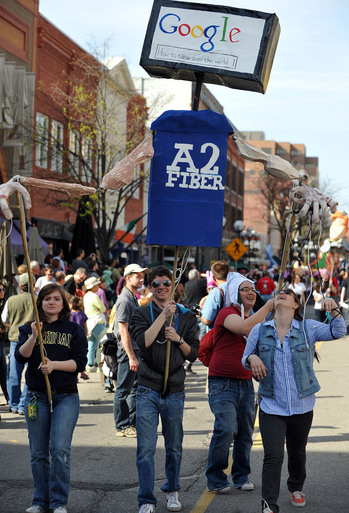
University of Michigan students carry a puppet in the annual FestiFools parade in support of the A2Fiber initiative. The text in the search box reads "How to take over the world." A request for a copy of the city's response to Google's RFI is pending.
Mark Bialek for AnnArbor.com
This week's FOIA Friday is a collection of works in progress. It starts with a public civic pronouncement - enshrined in the charter of the City of Ann Arbor - that public records are to be made available to the public. From there it all goes downhill, with legal agreements specifying that certain records not be made public except through Freedom of Information Act Requests, a continuing search for non-existent minutes of public meetings and an extended delay to a simple request for a copy of the A2Fiber proposal.
This FOIA Friday column is part of a regular series I write every Friday. My recent piece on FOIA as the worst possible search engine provides context if you are reading this for the first time.
Public access to records in the Ann Arbor City Charter
One of the documents that describes how the city works and runs its business is the Ann Arbor City Charter. The original city charter dates back to 1851, when George Sedgwick secured it for the city. From the Ann Arbor District Library's Founders Collection:

"A large, enthusiastic crowd and a brass band at the depot greeted attorney George Sedgwick's return from Lansing with the new city charter. It called for four wards, a mayor, an eight-member common council, greater taxing powers, and authority to establish a police force. Since he was primarily responsible for the passage of the charter, Sedgwick was promptly elected the first mayor, but it took another twenty years for the city to establish a paid police force."
The current text of the Ann Arbor City Charter is online, as adopted on April 9, 1956 with amendments through November 2009. On public records it is extremely clear:
"City Records to be Public
SECTION 18.2. All records of the City shall be public, shall be kept in City offices except when required for official reasons or for purposes of safekeeping to be elsewhere, and shall be available for inspection at all reasonable times. No person shall dispose of, mutilate, or destroy any record of the City, except as provided by law, and any person who shall do so contrary to law shall be guilty of a violation of this charter."
This particular piece of the city charter was called out by David Cahill as part of a comment in a larger discussion of charter requirements in an Ann Arbor Chronicle story.
A copy of the current Ann Arbor City Charter is also on the Ann Arbor Area Government Documents Repository.
Pall Gelman settlement
Notwithstanding this charter requirement, the City of Ann Arbor can and does enter into legal agreements that restrict access to, and publication of, public records.
On November 20, 2006, the City of Ann Arbor and Pall Life Sciences entered into a release of claims and settlement agreement regarding certain issues associated with the contamination of the Gelman Sciences property on Wagner Road.
As a part of this settlement, the parties agreed to this clause regarding release of well monitoring data, which explicitly prohibits some set of data sharing. Emphasis added below in bold type:
"C. Use of Information and Data. The City may manipulate data and information provided under this Section in any manner it chooses and understands. The City may release the data and any reports the City creates, in either paper or electronic format, provided, however, that any such document or electronic file shall clearly state on its face that it has been created by the City. The City wil provide PLS with copies of all reports that are released or that are subject to release to the public. The City shall not release any of the reports or data provided by PLS pursuant to this Section VIII in the form provided by PLS in either paper or electronic format except in response to a Freedom of Information Act ("FOIA") request. The City shall not publish any of the reports or data PLS provides to the City on the Internet in the form provided by PLS. PLS is responsible for marking each document that PLS asserts is protected by copyright."
A copy of the City of Ann Arbor and Pall Life Sciences 2006 settlement agreement has been added to the Ann Arbor Area Government Documents Repository.
Pall Life Sciences' permit for water discharge — part of its groundwater cleanup facility — is up for re-issuance. Public comment is accepted until May 3; contact Alvin Lam at 517-335-4132 or e-mail lama@michigan.gov for more information about the permit.
Historic District Commission and open meetings act
In previous editions of FOIA Friday, I detailed the long, long saga of getting current meeting minutes from Ann Arbor's Historic District Commission, the commission that is responsible for matters large and small regarding property owner proposals for changes to properties in the city's historic districts. From repairing a rotten window sill to building a garage to tearing down a fire-damaged home, the HDC sees it all, and it has as much authority in its domain as any zoning board.
For reference, I requested a copy of meeting minutes on Feb. 5, got an extension for the request, had the request partially rejected on the grounds that meeting minutes did not exist on March 2, appealed the rejection, and was finally given what I originally asked for on March 12.
At the time, I wrote that there had to be a better way.
Alas, I went today to review the HDC minutes for February, March and April 2010. At the time of this writing, those minutes have not been published.
When I wrote about this last, I recommended this task as the first one rather than sending in another FOIA query:
"Show up in person and talk to people. I know this is old fashioned in the age of the Internet, but sometimes you need to be in someone's office talking to them in person to figure out what is really going on. It's slower, for certain, than e-mailing in a request for information, but it can often get an answer faster and at less cost than mailing it in. It's often possible to inspect records in person which will clarify what kind of detailed request you'd eventually need to send in if it came to that."
So I walked over to City Hall and talked to Jill Thatcher, the city's historic preservation coordinator. She didn't have the minutes either, but she said she'd get back to me when there was more information. I picked up some information from the city on replacing historic windows along the way, and now I understand just a little bit better about how the city organizes and stores records of historic properties.
I still don't have those meeting minutes, but I haven't filed a FOIA request either, so none of the usual by-the-book delays have started yet.
Google Fiber RFI response
The City of Ann Arbor responded to the Google Fiber request for information, announcing in a Feb. 19 press release that it would be responding to the query and organizing and orchestrating a visible public outcry and response with public support for the effort.
After the RFI was sent to Google, I asked for a copy of it from Tom Crawford, the city's CFO. I was promptly denied in my request, with this explanation:
"Thanks for your interest in following this exciting and interesting opportunity.
The City has a policy, which is similar to the State of Michigan's (http://www.michigan.gov/buymichiganfirst/0,1607,7-225-48677-20041--,00.html), in which RFP detail can be released after an award is made.
A multi-stage award process is a competitive process and releasing information prior to award may jeopardize the chance and quality of an award.
I'm happy to send the City's full response at the sooner of the award date or the date Ann Arbor is notified it is not being further considered." I sent an appeal to the city to reconsider this request, drawing attention the fact that the City of Madison's MadFiber response was published openly and publicly.
The FOIA appeal process has its own deadlines; once you have been rejected, you can appeal to the city administrator (in Ann Arbor) or other head official or official body; in some jurisdictions that is the city council. The organiation has 10 days to respond to the appeal in ordinary circumstances.
I subsequently received a letter from the city administrator, Roger Fraser, notifying me that the city has granted itself an additional 10 day extension to my response, citing the closing of City Hall as a result of elevated carbon monoxide levels and the time pressures of the city budget process as reasons for the delay. That added 10 day delay is specified in a piece of the Michigan FOIA law that I had not previously had the opportunity to enjoy:
"15.240(2)(d):
(2) Within 10 days after receiving a written appeal pursuant to subsection (1)(a),the head of a public body shall do 1 of the following:
(d) Under unusual circumstances, issue a notice extending for not more than 10 business days the period during which the head of the public body shall respond to the written appeal. The head of a public body shall not issue more than 1 notice of extension for a particular written appeal."
A copy of the FOIA appeal extension letter received has been uploaded to the Ann Arbor Area Government Documents Repository.
Edward Vielmetti eats Mad Fiber Ice Cream (granola for fiber, M&Ms for color) while writing the FOIA Friday column for AnnArbor.com. Contact him at edwardvielmetti@annarbor.com.
Comments
Igor Ivanitskiy
Mon, Jun 7, 2010 : 11:57 p.m.
C. Wilbur Peters, and Lawrence E. Curtiss, researchers at the University of Michigan, in 1956 invented glass-clad fiber technology which made possible modern Fiberoptical cables! I vote for Fiberoptical communication in Ann Arbor!
Wguru
Fri, Apr 23, 2010 : 10:48 a.m.
1) Ann Arbor's Google fiber RFI response is now up on the A2fiber website at www.a2fiber.com/ann-arbor-rfi-application where anyone can view it. 2) Scio Residents for Safe Water will be at the Ann Arbor Area Earth Day Festival at WCC this Sunday, April 25, noon-4pm, with latest information on the Pall/Gelman 1,4-dioxane groundwater contamination site and cleanup... for grownups... and engaging activities for children. 1) and 2) are related. Openly accessible, accurate, up-to-date information has allowed citizens and local governments in the Coalition for Action on the Remediation of Dioxane (CARD) to watch over the Pall/Gelman cleanup and help protect community interests. But there is still work to do to get more complete, ready to use geo-coded data from the company and to get CARD's findings and recommendations in front of key decision makers for the site, such as Circuit Court Judge Don Shelton. This 40th anniversary of the first Earth Day has seen resolution of many environmental disasters... unfortunately, the Pall/Gelman dioxane contamination cannot yet be added to that list. To protect remaining water supplies, the dioxane cleanup will have to continue for decades to come... in spite of the company having removed more dioxane than they said was down there.