

Borders Group bankruptcy filing may be inevitable, University of Michigan expert says
A top bankruptcy expert at the University of Michigan Law School said recent events indicate Ann Arbor-based Borders Group Inc. is toppling toward a bankruptcy filing or a merger with competitor Barnes & Noble.
“One of those things will happen within the next few months,” U-M law professor John Pottow, a national bankruptcy expert, said in an interview. “The amount of losses they’re incurring is not something where they can avoid (restructuring).”
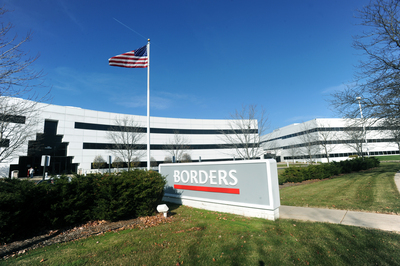
Borders employs about 600 workers at its Ann Arbor headquarters.
Photo by Lon Horwedel | AnnArbor.com
The company, which lost $74.4 million in its 2010 third quarter, is actively seeking new bank financing and trying to restructure vendor payment agreements to avoid running out of cash.
Borders spokeswoman Mary Davis said in a statement that if Borders can’t find new financing, that "could cause the company to violate the terms of its existing credit agreements in the first calendar quarter of 2011 and the company could experience a liquidity shortfall."
Borders accounted for about 8.7 percent of physical book sales in 2010, down from 11.4 percent in 2006, according to a Goldman Sachs report cited by Reuters.
Investors seem to be losing confidence in the company’s ability to survive without delving into a restructuring of some kind. Borders stock (NYSE: BGP) closed at $0.86 on Wednesday, down 26 percent since the firm acknowledged Dec. 30 that it was delaying payments to some publishers.
Pottow said a Chapter 11 bankruptcy filing would carry benefits for Borders, whose extensive real estate footprint includes more than 500 super stores and annual rent obligations of about $562 million, equal to about one-fifth of total revenue.
“It can get them out of a lot of leases if they want to lose stores faster,” Pottow said.
Jim McTevia, a restructuring expert at Bingham Farms-based McTevia & Associates, said Borders is undoubtedly consulting bankruptcy specialists to prepare for a possible filing. He said it’s possible Borders will land new financing but that it wouldn’t necessarily help the company avoid bankruptcy.
“They could get the new financing and get the refinancing and probably be able to delay an insolvency,” he said. “But on the other hand, in the final analysis, if the company is losing money, nobody is going to put any more money into the company in the form of a loan unless they have bankruptcy court priority protection of a lender.”
Still dangling as a possibility is a prospective merger with rival Barnes & Noble, which top Borders shareholder Bill Ackman of New York hedge fund Pershing Square Capital Management proposed in December. Ackman said he would be willing to help finance a Borders bid to acquire Barnes & Noble at $16 a share.
Analysts have largely expressed skepticism about a possible combination of the two book store companies because of Borders’ poor financial situation and real estate commitments.
But Pottow suggested that if Borders files for bankruptcy, Barnes & Noble might swoop in to pick up the most enticing assets, including inventory and attractive store locations.
Under bankruptcy law, Borders would get six months to propose an exclusive plan for its reorganization, a plan the court would have to approve. Secured creditors would get priority over unsecured creditors, existing stockholders’ equity would likely be wiped out, and the company’s lease footprint would be slashed significantly, experts said.
Possible outcomes of a prospective bankruptcy filing include:
--Borders could successful make cuts to its lease obligations and convince lenders to accept equity in exchange for eliminating debt, finally emerging with a profitable business model. --The firm could sell off its assets to Barnes & Noble or another player like a private equity firm with a tolerance for a restructuring effort. Under this option, Borders could use the Section 363 provision in the bankruptcy code, a provision that allows the valuable assets to be packaged together so that they can be sold to an outside firm or emerge as a new company. In that scenario, the old assets would stay in bankruptcy and be liquidated. This is what happened during General Motors’ 2009 bankruptcy filing, for example.
“Even if they decide they do want to merge with Barnes and Noble, they still may want to go through a prepackaged bankruptcy to scrub out some of these leases,” Pottow said.
--The company could be forced to convert its Chapter 11 reorganization filing into a Chapter 7 liquidation, which would involve a sale of all of its assets and the death of the company.
Existing stockholders of Borders -- including CEO Bennett LeBow and Ackman -- have a significant interest in helping the company avoid bankruptcy.
“If I’m a major shareholder, I don’t want the company to go through a bankruptcy. I want to avoid it at all costs,” McTevia said. “We saw what happened to the shareholders of General Motors. When they went into bankruptcy court they got blown away.”
One attractive aspect of a bankruptcy filing is that publishers who have stopped shipping books to Borders likely would be forced to resume doing so, Pottow said.
The publishing industry is skittish about the prospect of a major brick-and-mortar chain going out of business.
“If publishers wake up in a world without retailers that are committed to the future of books, they are going to be in serious trouble,” said Michael Norris, an analyst with Maryland-based Simba Information.
Nonetheless, Norris said he doesn’t think a merger between Barnes & Noble and Borders is a good solution.
“There is no circumstance I can think of that would make sense out of it,” he said. “Any kind of combination of these two retailers would do absolutely nothing for the consumer, and I don’t think it would do anything for the shareholders either.”
McTevia said he thinks Barnes & Noble, albeit more financially healthy today, needs to consider acquiring Borders because of the long-term challenges of the industry.
Borders employs about 19,000 workers, including about 600 at its headquarters in Ann Arbor. Barnes & Noble is headquartered in New York.
The destiny for Borders' Ann Arbor employees is decidedly uncertain.
"My experience is when companies strategically merge in bankruptcy, they don't need two headquarters," Pottow said.
Contact AnnArbor.com's Nathan Bomey at (734) 623-2587 or nathanbomey@annarbor.com. You can also follow him on Twitter or subscribe to AnnArbor.com's newsletters.
Comments
leaguebus
Sat, Jan 8, 2011 : 5:45 p.m.
I feel sorry for the employees, most work hard and know their stuff.
Gorc
Thu, Jan 6, 2011 : 8:48 p.m.
Boy...there is a lot of exaggeration and embellishment in previous threads regarding service levels.
Soothslayer
Thu, Jan 6, 2011 : 6:25 p.m.
My only visit to Borders last year I hit a barcode from my mobile phone at for a $16.95 paperback and got it as an instant download for $9.95 on my iPad. Between Amazon.com & iTunes there's little need to go anywhere else for media. Shouldn't have been napping!
UofM_Fan
Thu, Jan 6, 2011 : 3:08 p.m.
Upper management at Borders has always been out of touch. When Amazon and B&N were starting up their web sites and losing money, the president of Border stood in front of all the corporate employees and proclaimed that selling books online was doomed to failure and would never last. Just 3 months later that same president announced that Borders was going to start its own web site. That site floundered and eventually was turned over to Amazon to run. Eventually management felt that they could do it better by running the site internally. Well, you can see how that turned out. I'm sure the ebook reader fiasco followed the same path. I can almost picture some executive stating that ereaders are a passing fad and will never amount to anything. Then they came out with their own ereader. Of course, yet again late to the game and doing a half-butt job of it. Borders was all about books and music. But they focused less and less on that and more on things like PaperChase and now Build a Bear. Build a Bear? Really? THAT's the big plan to save the company? Stuffed teddy bears?
Walk54
Thu, Jan 6, 2011 : 2:47 p.m.
There was a time when the Borders brand and the Apple brand evoked similar feelings in people. Curiosity. Creativity. Exploration. Connection. One believed in the power of investing in its brand, and the other believed in investing in its bricks.
Stephen Landes
Thu, Jan 6, 2011 : 1 p.m.
Borders needs to decide what it is that a physical book store can do that an online book store cannot and then capitalize on those things. In my opinion it is nearly impossible to have a conversation with a book expert online with Amazon or some other e-retailer. However, it USED to be possible to have that conversation at Borders. Borders was known for hiring people with real knowledge about a genre of books; someone you could have a conversation with and say "I've read everything by so and so, and I would like to find another author like him". I don't think sales people like that exist much at Borders these days and that is a shame. It was one aspect of being in a real book store that no e-retailer can match.
Killroy
Thu, Jan 6, 2011 : 12:24 p.m.
Borders is history. Maybe someone will write a 'tell all' book about demise of Border's from an insider's perspective. If they do, let's hope it gets on iTunes and Amazon. Snicker...
Mark
Thu, Jan 6, 2011 : 11:38 a.m.
Amazon killed them. Free two day shipping and low prices. Almost an unlimited selection. There are people who deliberately support brick and mortar businesses by getting in their cars and driving in the snow to a place so big it's hard to find your book to wait in line and drive back home. Minimum half hour trip to buy a book. Or a few clicks and UPS brings it in two days to your front door. The book store has a good atmosphere and it's nice to browse, but everyone is so busy.
Blklight
Thu, Jan 6, 2011 : 11:20 a.m.
This has slowly been coming for the past 4 years, RIP Borders
Woman in Ypsilanti
Thu, Jan 6, 2011 : 11:20 a.m.
@Somewhat Concerned. I am not sure you should assume that just because you don't like something, it means that other people don't. I always really enjoyed going into the Borders stores and listening to the music the employees selected. That the company seemed to leave the selection up to local staff meant that more interesting things got played and musically, I found myself exposed to things I wouldn't ordinarily have been exposed to. I have my own ideas of why Borders is failing. What is interesting to me is how different those ideas are from what others are posting. I felt that the place got too corporate and mainstream but clearly others here are saying that they don't like staff with tattoos or strange music or whatever but those are all things I actually really consider to be something positive about a business.
Bob Martel
Thu, Jan 6, 2011 : 11:09 a.m.
I would doubt that a B&N/Borders merger is in the cards. They have too many competing/overlapping locations. It would make more sense for B&N to pick up selected ex-Border's stores out of bankruptcy. Why buy the whole cow when all you want is a cup of cream?
Somewhat Concerned
Thu, Jan 6, 2011 : 10:34 a.m.
Borders management has paid no attention to its (ex) customers. Most retailers do everything in their power to understand and satisfy customers. Here's an example of how Borders thinks. At most Borders stores, an employee picks whatever music she likes and it gets blared throughout the store. If she likes the most eccentric music that runs people who don't share her odd taste out of the store, it's just too bad for the customers. Most retailers think carefully about playing music that attracts customers or at least that doesn't run the majority of them off. It seems like a small thing but it's important enough that retailers and music service providers think long and hard about it. Borders management has been advised about this and other issues, such as confusing layouts and odd categorization of books that make them hard to find. They don't listen. They also spent a fortune on their "new design" stores that featured lots of electronics. Customers had no interest in buying electronics in a physical bookstore, but management loved the idea, so it squandered money on it and turned off customers. What customers did want - a good website - management wasn't interested in and so Borders was the last to have one and it's still the worse than B&N's by a long shot. Sometimes a company is so mismanaged, so arrogant and out of touch with customers (I remember witnessing a tour of Borders directors at the Ann Arbor store on Lohr Road at which directors were oohing and awing and exploring as if they hadn't ever seen a Borders), it deserves its fate. You want Borders to survive because they're based here, but it doesn't deserve to.
magnumpi
Thu, Jan 6, 2011 : 10:25 a.m.
The Borders over by Best Buy has fair customer service. It seems like the newer hires are eager and then when they've been there awhile, not so much. The problem I have with Borders is they have too much junk and not enough books. I don't know how much of their "profit" is from all the extra junk they sell, but it's frustrating to not be able to find a book and then wade thru all that garbage by the check-out. Same thing happened to Fresh Seasons (i think)---started carrying to much extra junk and let the actual produce slip a bit in quality. Better to do a few things well than a bunch of stuff not so well.
RockCreek
Thu, Jan 6, 2011 : 10:01 a.m.
I am surprised at the comment about bad service, at least in Ann Arbor. There is one unfriendly, tired, almost surly gentleman at the Liberty Street checkout - a clean cut, elderly man with no earrings, etc. On the other hand, there are several friendly, helpful people on the sales floor. I never thought about it, but as one of the people posting mentioned it, one of the men does have an earring, but he is about the friendliest of them all. Borders in many places are horrible. The one on State St. in Chicago keeps expensive books locked in security devices that prevent you from looking through the books, and the store people are unhappy if you ask them to open one. Not a big help for their sales. The restrooms are filthy. The stores in NYC tend to have workers who seem to hate being there - far different from most of the workers at B&N in New York. My only complaints about the Liberty St. store (Ann Arbor) are that it has fewer and fewer books - a very weak selection, and it often harbors homeless people who sleep, snore and smell bad - not an attractive place to be. But the Borders workers, with the exception of the unfriendly man at the registers, are helpful and friendly, with or without earrings.
amazonwarrior
Thu, Jan 6, 2011 : 9:42 a.m.
Years ago, when Borders moved their HQ to Ann Arbor, I went for interviews with three different people/departments. One person kept me waiting for close to an hour and had the worst attitude I've ever encountered. As a matter of fact, they all did. None of them discussed the job requirements, but instead, all they did was complain, complain and complain some more about how they hated having to move to Ann Arbor and how terrible the area was. We also have neighbors who work for Borders and all they do is complain about the area and how "provincial" we are. With attitudes like that, no wonder the company has been dying a slow death. They were doomed from the start.
michigan48103
Thu, Jan 6, 2011 : 9:11 a.m.
Borders, in Ann Arbor or Birmingham for years has been the only place that I would by Books, CD, DVD's and magazines. They used to always have the best selection for everything. Now, the have little of everything during the Holiday time, I would spend %500.00 to $900.00 or more and this year I spent -0- for the first time in many years. Everything that I looked for that I wanted was not there. It was sure a disapointment. In the past I have wrote to Boders and NO ONE seems to care in the Administration about the customers feelings. What I wrote was the clerks in the stores will not help any more. The men are more concern about their long hair and how many ear rings and body piercing's that they have. When I ask the workers if they could help me find something they said either buddy, I am too busy or I am going to take a break and smoke. When I first would go to borders, they had nice clean cut men and lady's that did not have their body covered with tatoos and body piercings all over their face and Clean hair not long and with a odor. If the sales are bad and that is how a store does make their money is from the sales, they should check it out why and not stay in a office and want to make alot of money and not wonder why the sales are bad. Any business needs to have good workers and nice and kind to make money. If you want to see how a Ann Arbor business makes money and has All good workers, YOU need to go the the CVS on Plymouth Road or the new one on Zeeb and Jackson Road, they all speak to you when you come in the store with a smile and some remember your name and ask how are you. They NEVER say, I am too busy or I need to go and smoke. The top Administration needs to just walk around the stores at Borders and watch the workers and tell them to take a shower and be clean and kind to the workers and I am sure they will Not never close, they also need greeters like Meijers, Wallmart and many other stores. Good Luck and I am sure they will not read this, they never do or they just do not care at borders Administration, I am 55 and I have enjoyed going to Borders for Years.
MjC
Thu, Jan 6, 2011 : 8:57 a.m.
It's a sad situation. Border's was once a trusted and beloved Ann Arbor business when it first opened its book store on State Street. But success drove it into a corporate monster, and it has not keep up with the competition or changing times. Hopefully the Borders on Liberty will at least keep its doors open, no matter what happens ih the months to come.
Somewhat Concerned
Thu, Jan 6, 2011 : 8:54 a.m.
After bankruptcy, publishers cannot be forced to ship books to Borders. Bankruptcy laws do not give a company the right to force people to sell them anything. Bankruptcy can suspend efforts to collect debts and seize property. It can restructure debt. It can allow a company to get out of executory contracts such as leases. Bankruptcy does not give any company the power to force anyone they select to sell to them (absent an enforceable contract - and there are none in the book supply industry). I think the gentleman from the law school was misunderstood.
stunhsif
Thu, Jan 6, 2011 : 8:34 a.m.
Doesn't take an expert to figure this out, it is a no brainer. A bad economy is putting the last few nails in their coffin.
stunhsif
Thu, Jan 6, 2011 : 8:33 a.m.
Doesn't take an expert to figure this out, it is a no brainer.
Killroy
Thu, Jan 6, 2011 : 8:09 a.m.
I guess Border's isn't big enough to fail?
UofM_Fan
Thu, Jan 6, 2011 : 8 a.m.
They're doomed. I hate to say but we've known this was coming. I worked there for nearly a decade and the problems they are facing started years ago. Borders has been in a death spiral for at least the last 8 years. If during that time they haven't been able to correct the ills of greed and corruption, then they are not going to be able to do so now. It's sad to know that so many thousands of people are going to lose their jobs because a few elite executives choose quick personal profit over the long-term stability of the company. Because the few made choices based on their own greed, the many will have to suffer. Nice job there. Try not to think about that when you go out to the parking lot, hop into your BMWs and Porsches and drive home to your lavish lifestyles. Meanwhile the rest of the employees will be trying to figure out how they're going to put food on the table now.