

Rick Snyder, Republicans unveil new budget altering pension tax proposal, keeping business tax cut
Gov. Rick Snyder and Republican legislative leaders said today that they are close to a budget deal that would eliminate Michigan's structural deficit, reconfigure the state's tax policy and enact big spending cuts.
The deal is similar to the budget Snyder proposed Feb. 17, but it differs in a few key ways — namely, how it would treat taxation for seniors.
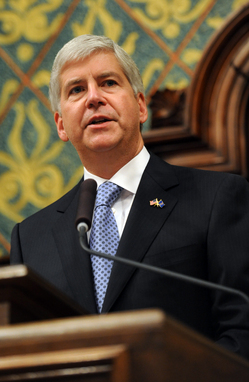
Gov. Rick Snyder and Republicans in the Legislature said this afternoon they are close to a budget deal.
Melanie Maxwell | AnnArbor.com
After extensive negotiations, the politicians said they had agreed that the plan should include increased pension taxes that would be phased in gradually, depending on the age of taxpayers.
The political officials said they would also make further reductions to the homestead property tax credit, which often benefits seniors by reducing exposure to property taxes.
The new version of the budget plan includes Snyder's original proposal to cut business taxes by $1.8 billion. It would replace the controversial Michigan Business Tax with a 6 percent flat corporate income tax that would exempt most small businesses.
Overall, the new plan would solve the state's chronic budget deficits, Snyder said.
"I feel structurally it's a very good answer," he said.
The key changes to the plan revolve around how it treats seniors. It would split taxpayers into three groups:
- People born before 1946 would continue paying taxes at the same rates they do today — which means their public pensions are tax-exempt and their private pensions are exempted up to $45,000 a person. They will not see any changes.
- People born from 1946 and through 1952 would be exempt from paying taxes on all "retirement income," including all pensions and retirement accounts, up to $20,000 for a single filer and $40,000 for a married couple. Once this group turns 67, their total income would be exempt up to $20,000 for single filers and $40,000 for married couples — which means that seniors who do not have a pension would be treated like seniors with pensions.
- Everyone born after 1952 would have their pensions and retirement account income taxed at the normal individual income tax rate. However, once they turn 67, they would get a "senior income exemption" of $20,000 for single filers and $40,000 for joint filers, regardless of where the income comes from.
The increased taxes in pensions would raise about $300 million in revenue for the state.
Snyder, who wanted to tax all pensions, said he's comfortable with the changes to his proposal.
Snyder's original proposal to tax all pensions had met sturdy opposition among some anti-tax Republicans and Democrats uncomfortable with the implications for low-income seniors.
Snyder had said that seniors with pensions should not get preferential tax treatment compared to seniors who are taxed on their regular earnings. He has also argued that the business tax reform would simplify the state's tax process and create jobs, a claim that drew skepticism from some experts.
"As I've said from Day One, by going through the legislative process, we'll make it a better product," he said today. "And I believe we're achieving that."
Senate Minority Leader Gretchen Whitmer, D- East Lansing, and House Democratic Leader Richard Hammel, D-Mount Morris Township, reportedly issued a joint statement calling the new proposal "nothing but a bait-and-switch that offers little relief in exchange for yet another tax increase on residents."
The new proposal would exempt most small businesses from paying corporate taxes, although small business owners will continue to pay 4.35 percent on their personal income tax returns.
The political officials gave no indication that they plan to scale back Snyder's proposed spending cuts, which include big funding cuts to public schools, higher education and municipalities.
In fact, because the pension tax proposal and homestead property tax credit cuts are being scaled back, the Republicans said they would seek an additional $150 million in spending cuts.
They did not offer details on where those cuts would come from except to say that the Legislature would find new places to carve out dollars.
State Sen. Majority Leader Randy Richardville, R-Monroe, said there's a "strong base of support within" the Republican caucus for the new proposal. He stopped short of saying he's lined up the necessary votes, but he suggested that Republican senators are generally on board.
"It's more a matter of understanding the details of the plan than it is questioning the basic direction," Richardville said. "I'm very pleased with where we are now.
Speaker of the House Jase Bolger, R-Marshall, said the plan is appropriate.
"We have a budget deficit in Michigan because we have a jobs deficit. Therefore, the No. 1 issue is jobs," Bolger said. "So, to help job seekers, we have to make Michigan a better place to find a job."
The new budget proposal would still slash most individual income tax credits and business tax credits.
Under the new proposal, the state's income tax rate of 4.35 percent would be extended for another year instead of falling 0.1 percent. It would drop to 4.25 percent in 2013.
Contact AnnArbor.com's Nathan Bomey at (734) 623-2587 or nathanbomey@annarbor.com. You can also follow him on Twitter or subscribe to AnnArbor.com's newsletters.
Comments
sparty2219
Sat, Apr 16, 2011 : 11:05 p.m.
Tax the medical marijuana!!!
sparty2219
Fri, Apr 15, 2011 : 3:40 a.m.
I guess I am not allowed to comment on these pages regarding Snyder. I am blocked 99% of the time. There goes MY freedom of speech! annarbor.com blows
chefbrian1
Fri, Apr 15, 2011 : 12:37 a.m.
NPR reported today that the new proposed senior pension tax will generate $700 million in less revenue, but they are treating the $1.8 billion business tax cut (lost revenue) as an untouchable. Where are they going to get the extra $700 million from? Why not increasing the proposed business flat tax to make up for the short fall? And does anyone think seniors will stay around in Michigan and not move out of the state to greener pastures when Synders goes after their pensions? Less seniors will equal even less revenue folks.
katie
Fri, Apr 15, 2011 : 12:35 a.m.
Rick said he was a nerd, but whatever happened to his computer company's jobs? Rick said he was tough, but acting tough by taking money from the poor, the elderly, the children,and the disabled is not toughness, is it? Taxing the rich would be tough. It's always hard to stand up to your powerful friends. He's not likely to do that. Therefore, he's not tough in any way. We cannot afford a whole term of this. I'll see you at the recall party. Snyder: He's not tough, he's no nerd. Recall Rich Rick!
Trepang674
Thu, Apr 14, 2011 : 4:23 p.m.
I'm trying to read some where that this new budget is taxing the poor...darn...just can't find that the are singled out.
DAN
Wed, Apr 13, 2011 : 9:58 p.m.
This does not appear to benefit the elderly much--they also have a reduced $$$ criterion to meet for state property tax credit exclusion. For people on a fixed income, the Governor's plan is very wrongfully conceived. I'd rather see a proposal for transitioning to a unicameral legislature -- Since the "one man, one vote" principle has been applicable for state legislatures, since 1964, WHY do we need 2 houses when they are both based on population ???? How much would this change save? Of course, the state legislators would probably never vote in favor of such a sacred cow.
julieswhimsies
Wed, Apr 13, 2011 : 4:50 p.m.
I believe that one measure of a country's greatness is how they care for the poor, the elderly, and the infirm. Recall Rick. I'll host the party!
Michigwen
Wed, Apr 13, 2011 : 3:45 p.m.
The Governor should be careful about taking money out of the pockets of consumers by raising taxes on older residents and cutting the earned income tax credit to pay for business tax breaks to attract new businesses to Michigan. Who is going to be buying what these businesses are selling? Does it really make sense to cause business income to decline due to reduced consumer spending power so that businesses can pay a lower fraction of their income in taxes? And why should the money taken out of consumer pockets go to business with no strings attached? We all want more jobs to open up here, but if that is the purpose of reducing business taxes, why not cut taxes for those who actually do create jobs through targeted tax credts? I was born in 1946 and don't mind paying higher taxes if we get something for it, like jobs, better schools, and good city services. But the Governor's proposal, even as revised, just throws money at business while reducing spending on education and local government. With a less well educated workforce and reduced public services, how attractive will Michigan be to businesses, let alone for the rest of us? Governor Snyder has a point that it is unfair to exempt retirement income from taxation while wages are fully subject to tax. However, why focus on just one form of unfairness in Michigan's tax system? Taxation according to ability to pay is the answer: tax the people and businesses that can afford it, which is an approach that is both fair and will stimulate the economy by leaving money in the hands of consumers who will spend it here in Michigan.
Oregon39_Michigan7
Wed, Apr 13, 2011 : 3:18 p.m.
Thanks Rick and Speaker Boenher. Your solution to the nations defitcit problem (except when Regan, Bush, or Cheney are running the show, then "deficits don't matter") is keep entitlement programs running for today's senior citizens (who vote for you) and then cut/slash/burn them for my generation (GenX, Y, and Millennials). How about an "Bush goes lookin' for them WMDs" tax to cover the cost of the invasion and occupation of Iraq? 20% increase on revenue (not gross profit) for any company that received a defense contract during the years 2003-present, 15% increase for incomes over $10 million, and 5% for everyone else. See how popular war is when we actually have to scrafice and pay for it. Oh, and cut those tax incentives for oil companies and give them to the families of the soldiers who served.
leaguebus
Wed, Apr 13, 2011 : 3:16 p.m.
How can anyone think that laying off thousands of teachers and public safety personnel has benefitted our economy? Now, if this insanity passes, how many seniors will throw in the towel and leave. How many seniors will have to sell their houses because of the massive tax increase on their already low income? All through the history of this country there has been a struggle between the rich and the poor. With the advent of the Unions and better pay for all, the middle class rose to its highest level during the 70's and the 80's, our economy was booming and we were the greatest country the world had ever seen. But, the rich were not happy and decided that they needed tax cuts and this started the greatest money grab in United States history. After 30 years of this, the gap between the rich and the poor is the largest of any developed nation in the world. The culmination of this grab for wealth was the criminal manipulation of the Financial sector, that resulted in trillions of dollars being looted from the middle class and a world wide recession. Now, the "new" Tea Bag Republicans want to grab even more by raising taxes on people that "don't pay any taxes, anyway", the poor and whats left of the middle class. These people need to be reminded that the poor and middle class elected them in the belief that they would be fair with their budget cuts. We have since found out how fair they are going to be. Governor Snyder, forget the business tax cut and lets start building this state again, otherwise Ace Ventura will be having his party and I will be there.
BioWheels
Wed, Apr 13, 2011 : 2:17 p.m.
So let me see if I have this correct. Snyder and his legislative buddies want a great pension, want to get paid for a part time job at the full time rate, they want to get insurance benefits for life after having worked in this part time job for a few years. Then they want to increase the taxes on anyone born after 1952 - people who have worked hard all of their lives, full time, and with low pay - and then they want to lower the taxes on companies and corporations. Not only is this a bait and switch, but it also smacks of nepotism. This governor needs to wake up and start brewing his own coffee just like the rest of us. He is totally out of touch with the working class people in this state. He is raising taxes, plain and simple, on those who can least afford to pay taxes. After he has "served" long enough, I for one will be one of the first to sign the recall petition. I call on the governor to resign. He has broken the most basic of all promises he made to the voters of this state. No tax increases! Recall Snyder as soon as possible.
Marshall Applewhite
Wed, Apr 13, 2011 : 3:25 p.m.
When did Snyder say "no tax increases"? I remember him saying, "We're going to do anything necessary to fix the state, and everything is on the table".
MWH
Wed, Apr 13, 2011 : 1:08 p.m.
I was born and raised in Michigan. I'll always love Michigan. My parents and grandparents worked their hands to the bone to try to give their children a good life here. Now I'm trying to do the same, but it isn't easy. We live below the poverty line. We have three vibrant, beautiful, creative children. We want to raise them here, in this state. They have so much to offer. But it seems that at this point in history if you are a "have-not", then you are just plain out of luck. My business isn't exactly flourishing, and I don't know how I can work any harder to change this. There are only so many hours in the day. Snyder, if you succeed with your tax proposals, specifically eliminating earned income credits, what we will my family and I do? Rising energy, gasoline, food costs won't help. Most of my income goes to the bank anyway, so that they can manage a few imaginary (mortgage interest) numbers in some computer somewhere. What will we do? I'll tell you what, if we end up on the streets, it will certainly be somewhere with warmer winters. We'll take our children, the state's most precious resource, and we'll move. But I'll always love Michigan.
Blue Eyes
Wed, Apr 13, 2011 : 1:08 p.m.
Rick's keeps saying he wants the young people to come/stay but he's also made it very clear without saying it out loud that he doesn't want the burdens and expenses of the older generation, he's doing everything he can to make us leave without actually saying it out loud! I might almost buy his reasoning if he'd start by making cuts at the top with his legislature and working downward until he got to the lowly retirees.
Lac Court Orilles
Wed, Apr 13, 2011 : 1:01 p.m.
Thank you Rick Snyder. Now that you lowered taxes on my business, I can afford to build my new home in Hawaii.
lefty48197
Wed, Apr 13, 2011 : 12:56 p.m.
I'll bet he and his supporters in the Republican Party will still refer to Rick and themselves as "tax cutters" LOL. Also, what a brilliant idea it was to end the item pricing law. I'm sure the people at Walmart appreciate that Rick has responded favorably to their demand!
Edward R Murrow's Ghost
Wed, Apr 13, 2011 : 12:31 p.m.
For those of you who blusteringly say that there is no alternative on the table and was none for the last 8 years: 1) Republicans controlled both houses of the state legislature for Gov. Granholm's first term and the State Senate for her second. Republicans in the state if Michigan calculated that there was political hay to be made by refusing to cooperate with the governor at every turn of the road. Elections have consequences, apparently, only when Republicans win. When the Democrats win, the election's results are to be ignored. 2) Given the complete lack of cooperation the Democratic governor received from the Republican legislature in her terms in office, why should we believe that any state budget put together by Democrats would even receive a hearing in the Republican-controlled legislature? And don't pull out "The Democrats rammed through Obamacare." Yes, they did, if that means that they included hundreds of Republican-sponsored amendments to the bill in an effort to get some sort of bi-partisan support for the bill which was not forthcoming. So let's get past that myth. 3) Governor Snyder's plan is A plan. It is THE plan that will be implemented. But he is not Moses and his plan is not writ in stone by the hand of God. There are OTHER possibilities. See: <a href="http://janus.pscinc.com/budgetsim/default.aspx" rel='nofollow'>http://janus.pscinc.com/budgetsim/default.aspx</a> Here you, too, can be the governor and craft your own budget. When you do, you will find just how extreme this budget actually is. Unlike blowhard Rush Limbaugh, who wished failure for the president and for his program, and who the lemmings followed in lockstep despite that fact that the president's failure would mean bad times for our nation, I do not wish Governor Snyder and his program ill. I am not so shortsighted as Limbaugh and his dittohead lemmings. But it better work because, if it does not, we likely will be worse off in four years than we are now. And that's saying a lot. Good Night and Good Luck
Edward R Murrow's Ghost
Wed, Apr 13, 2011 : 4:07 p.m.
One other note: My proposal above eliminates jobs--likely thousands of them. Teapartyist ideology notwithstanding, this is a horrible idea for a state that is trying to climb out of a deep recession. We need people earning money, spending money, and paying their mortgages. Closing prisons, etc.... will lead to the opposite. Indeed, it will lead to an even larger outflow of population as these cuts will have large tertiary impacts on the economy. Unfortunately, I don't know how to fix that. My budget certainly does not. But the governor's budget will cause this to happen, too. Good Night and Good Luck
Edward R Murrow's Ghost
Wed, Apr 13, 2011 : 4 p.m.
No problem. Using the above website [my comments in brackets]: --Cut funding to public universities 15%. [they can adjust their revenue streams where K-12 cannot] --Across the board reductions in state departments --Elimination of Grants and Loans for business development --Prison sentencing reforms [we have far too many people in prison for minor crimes] --Prison operation reforms --Adopt the governor's income tax reforms [e.g., taxes on pensions and ending EIC] --Extend the sales tax to services while cutting the rate to 5.5% --Sales Tax on soft drinks --Increase the beer tax [has been where it is since the 1960s] If all of these were implemented, the state would be projected to have $1.1 billion surplus in the next fiscal year. With that surplus we could then go back to the business tax, fix its arcane nature and cut business tax rates to result in a balanced budget. NOTE: Under this the SAF remains committed to K-12 only. Schools would actually see a per pupil increase. Cities and municipalities would not see drastic cuts in the revenue sharing on which they have become dependent due to changes in state law. NOTE: if 2011-12 per pupil funding were held at this year's level (which the vast majority of school districts easily could live with), a couple hundred million dollars from the school aid fund could go to colleges and universities. NOTE: Far more than the governor's budget, this IS shared sacrifice. NOTE: The website does not give what is to me an obvious option: delay the scheduled reduction in the state income tax from 4.35% to 4.25%. Eliminating that rather minor cut will bring in a couple hundred million in revenue. Again, shared sacrifice. Everyone gets it. Adopt these two additional options (neither are on the website) will result in several hundred million more in revenue. There. Yes. It raises taxes. God forbid. Good Night and Good Luck
Marshall Applewhite
Wed, Apr 13, 2011 : 3:22 p.m.
Still waiting for a proposal that balances the budget and attracts business to the state..............any day now.......
seasons
Wed, Apr 13, 2011 : 12:25 p.m.
Cutting taxes for business and the wealthy has yet to be proven to be an effective way to stimulate job growth - this is just the same old and very tired approach that is tanking this country financially. I find it incredible that there is so little mention about the slow, steady and definite upswing in Michigan's economy - happening prior to Gov. Synder's new budget plan. What about this - how about some analysis and commentary? All the cuts to the potential growth and health of this State are not in the best interest of Michigan. Long range planning means just that - you don't cut off the resources at the knees.
Grant
Wed, Apr 13, 2011 : 11:34 a.m.
looks like those of you who are 59 1/2 plus who currently draw from your 401K will no longer have a $40,000 plus exemption (single) and $80,00 plus (married) , but only $20,000 Single) and $40,000 (married) if Snyder gets his way. Quite the way to spread the tax burden on senior eh?
Trepang674
Thu, Apr 14, 2011 : 4:26 p.m.
If you are 59 years old and retired...you need to get to work. Shame on you
Roger Roth
Wed, Apr 13, 2011 : 11:23 a.m.
I'll soon be 70. When I was a little boy, my mother, the church and my schools taught me to be a good boy, to play nice, help my neighbor and work hard and everything would work out nice for me. I tried with all my heart to do just that. You don't suppose that the conspiracy to keep the poor in their place was going on way back then, do you? And MY MOTHER?????
Carole
Wed, Apr 13, 2011 : 10:45 a.m.
Agree with Cash again. There should be some serious salary/benefit/pension cuts in legislature -- still have forgotten when the times where good a few years back, they voted themselves in a 36% salary increase -- I know there were some who did not feel good about this and refused it or gave it back. RE: Educational cuts -- can some one please tell me where all of the lottery funds are going -- they were supposed to always be earmarked for education and if you watch channel four at 7:30 most evening, there is some one commenting how when you purchase tickets all of the funds go to education -- Is this true? How much? Thank you.
Domey
Wed, Apr 13, 2011 : 11:06 a.m.
As I understand it lottery monies do go to education, but they simply cut the amount of funding from the general fund by a corresponding amount. The net benefit for education is zero but it leaves more general fund money for them to award self-raises and a little something to throw into pork barrels.
shar
Wed, Apr 13, 2011 : 10:34 a.m.
He caved... too bad. He should propose a 15% sales tax. Make everybody pay their taxes.
nak60
Wed, Apr 13, 2011 : 8:29 a.m.
Taxing the pensions of the people struggling aready is only going to cost the state more because, more will be leaving the state of Michigan It,s a shame you work for a company over 30 yrs to think you be able to survive and then to have the goverment to knock you down again. I don,t see the big house and all the corporate big money people giving up nothing except giving them selves big pay raises.
Corby
Wed, Apr 13, 2011 : 4:37 a.m.
"People born from 1946 and through 1952 would be exempt from paying taxes on all 'retirement income...'" Naturally, we can expect to see this number nudged upward until the last of the boomers is taken care of. It's hard not to get generational when that generation has squandered so much. My apologies.
macjont
Wed, Apr 13, 2011 : 3:10 a.m.
BasicBob really doesn't get it. It is not a question of teachers "suddenly" deciding to become lawyers or anything else. It's a question of long-term impact. Education is (and has for the past 30 years) been attracting into the profession anything but the best and the brightest. How do we expect to correct this situation by making the teaching profession even less attractive than it is at present? And will some of the best and the brightest current teachers decide to leave for other occupations, including other professions? You bet you behind they will! And the teaching profession and the public cannot afford to lose them.
Basic Bob
Wed, Apr 13, 2011 : 3:57 a.m.
@macjont, We listened while teachers bragged about their advanced degrees and endless work. That makes them valuable, right? That makes them well-paid, right? That makes them deserving of best-in-class benefits, right? Now you say that we have not attracted the best and brightest to teaching since all our current teachers started their careers (ouch!). Explain how these do not contradict each other. Why would anyone in their right mind hire a second-rate candidate and pay them top dollar? When other second-rate professionals (as public employees describe themselves) don't have jobs, they go get a job at Home Depot or Starbucks, start their own business, or move and start over. What's the long term impact of this? It makes us stronger. That's what I think of second-rate teachers threatening to quit. Go for it. In my experience, the best ones will stay, but so will the worst ones.
Barry
Wed, Apr 13, 2011 : 2:42 a.m.
Cutting taxes are highly unlikely to bring more work to Michigan. I've lived in this state for seven years, and in no time prior in my life had seen a place with such miserable infrastructure, dysfunctional politics, and an inability to look honestly at itself. I moved from North Carolina - yes, it was an insane move - to live and work in Ann Arbor. North Carolina has higher income taxes, higher property taxes, higher car taxes, and a much more vibrant economy. Yes, North Carolina may be a "right to work" state, but at the same time it's a state with the money necessary to invest in its future paid for by both businesses and citizens. North Carolina has a university system with more than two good schools, there are freeways without potholes, and the state has money to bring in new businesses. You need money to do that, and Michigananders simply don't want to pay for the future. Snyder and his comrades will grant Michigan will lower business taxes. But who will want to move her? What business wants to come to a state where the schools are gutted so that pensioners can live tax free? Who would move to a state which doesn't even have the money to plow roads, fix bridges, run an effective highway patrol? And that does not even begin to address winter, or the burnt-out desolation that's Detroit. Your children are leaving this state, and they're not coming back. But business taxes have been cut, and somehow, despite all known economic theory and the last forty years of economic experimentation, those cuts will make all the difference. Ann Arbor may be one of the most undeniably wonderful towns in the country, but Ann Arbor alone cannot pull the state out of its decline.
aareader
Wed, Apr 13, 2011 : 2:25 a.m.
The business tax needs to be modified and made simple. The old used phrase of "it will create jobs" is without merit. If the Governor claims there will be more jobs with cuts then show us the research. The only way I would support a "business tax reduction for jobs" would be for every job created and kept in Michigan then that specific business will get a reduction. If not then no reduction. I do believe the tax system needs to be more responsible as it is now a mess. For example, I see no reason to not tax soft drinks and sports tickets. Both are items that are not necessities. That kind of a tax would reduce the need to reduce more essential services including Education. This kind of approach would go a long way to putting back a system that will help pay the way for a sustained state budget. It would also remove the apparent need to tax pensions of fixed income folks that can least afford it. It is time to remove the structural deficit John Engler gave us a decade ago. The real issue for this State is to provide a strong climate where young people will want to stay to help build a vibrant Michigan. They are leaving now. We need to be looking for ways to expand programs to attract rather that cut. Example: Seems a well thought movie tax credit would go a long way to keep and bring young people to our State. Instead of reducing programs, as has been done for the last decade, we need to put together an innovative growth plan that will turn things around. Mr. Governor, put your "nerd" brain in gear to truly come up with a winning plan that will turn the State around that will ATTRACT all kinds of people.. not drive them away.
Moscow On The Huron
Wed, Apr 13, 2011 : 1:28 a.m.
Go Rick! We're behind you! The haters try to tell us that what you're doing isn't what we voted for, but we know better.
joe.blow
Wed, Apr 13, 2011 : 1:27 a.m.
One more term, for everyone!!!! About time the legislation actually tries to stop spending money and gets business to come back to Michigan. Soon we might even have a lower unemployment rate. I'm sure some will complain that their posh pensions are getting cut, but a least people will have a job.
Edward R Murrow's Ghost
Wed, Apr 13, 2011 : 1:26 a.m.
Sure hope this works because, if it doesn't , we will be much worse off in three years than we are today. So, the starting point is: Michigan's unemployment rate is currently 46th of 51 "states" (including DC) at 10.4%. (It is interesting to note that 10 of the 15 worse states in terms of unemployment are solid red states with low taxes and with right-to-work laws. Hmmmm. Seems that, perhaps, those are the silver bullet. But, never mind facts. Let's live the myth). The median (26th) unemployment rate is that of New Mexico at 8.7% Michigan's unemployment rate, then, is 1.7% away from the median state. Source: <a href="http://www.bls.gov/web/laus/laumstrk.htm" rel='nofollow'>http://www.bls.gov/web/laus/laumstrk.htm</a> Let's check back in a year to see what this $1.8 billion dollar gift to business while taxing seniors and the poor, and while severely damaging the finances of untold municipalities and school districts has done for the state's economy in relatinship to the above numbers. Yes, I understand that this is the budget for next year. But if this is SUCH a good fix, businesses should come running here immediately. It's not like there aren't a lot of empty factories and office spaces for them to occupy. Good Night and Good Luck
Trepang674
Thu, Apr 14, 2011 : 4:33 p.m.
You tend to generalize waaay to much. "gift to business" What do you want a gift to you or people that are not working? The growth sector is small business - they are the ones getting the benifits - the more you make the more you pay...6% FLAT TAX.
Edward R Murrow's Ghost
Wed, Apr 13, 2011 : 12:07 p.m.
Yes, the current business tax system is arcane. So fix it. But "fixing it" and cutting business taxes are two different things. I fail to see the necessity to cut business taxes by $1.8 billion. And there is no evidence whatsoever that cutting taxes leads to jobs and/or to increased revenue. None. The Bush tax cuts and their disastrous effect on the deficit combined with the concurrent flat economy ought to have told us that. But cutting taxes is part of the mythology of the TeaPublicans. There's nothing that a good tax cut can't fix. So we now have the Snyder tax cut. Sure hope it works, though I fear it will not, as there is no reason to expect it will except for blind faith. Blind faith belongs in church, not in setting macroeconomic policy. Good Night and Good Luck
McGiver
Wed, Apr 13, 2011 : 11:48 a.m.
I realize we disagree fundamentally on tax policy. However, if you look at Michigan's SBT and the new MBT that I have personally had to fill out for many many years now, you would see why business people hate them. We actually have to add our personal salaries back in to the net income (SBT worse than MBT in this regard). Thus a double tax on personal income of the owners of the business. Nothing fair about that and for a small business, like mine, who creates most of the jobs in the country. Nonetheless, I appreciate your thoughtful arguments which are usually well researched..
Stephen Landes
Wed, Apr 13, 2011 : 1:30 a.m.
I hope it works, too. If it doesn't we have the right and opportunity to change direction some in two years and completely in four. For myself I can say that I working very hard on proposals to create jobs in Michigan emphasizing growing Michigan businesses. More hard work will benefit all of us.
Stephen Landes
Wed, Apr 13, 2011 : 12:45 a.m.
I just love comments from what passes for Democrat leadership in the Legislature -- "bait and switch" and "little relief". What do you expect after the awful performance of state government for so many years, much of which was under Democrat "leadership"? We are in a huge mess and someone needs to figure out how to put this whole organization back on track. Those who complain -- and I am sensing this is largely Democrats -- need to remember that they had 8 years to get the system on track, stop pretending we could fudge the books and make the hard decisions go away. Now a new governor and legislature is managing the show and they are taking on things that no one wanted to touch. Pretend time is over. As the previous governor promised we've been blown away. Now it is time to pick up the pieces and rebuild our state. If you don't like the plan that is evolving in Lansing you have to come up with your own COMPREHENSIVE plan -- not tak pot shots at pieces you don't like and ignore the rest. "Regular politicians" have done enough of that to us already.
David Briegel
Wed, Apr 13, 2011 : 12:52 p.m.
aareader, don't trouble Stephen with Facts about his beloved Republicans! And where is the investment in needed infrastructure improvement? The TeaPublicans just say NO strategy is one of the reasons we are failing in Michigan as well as in Washington! Now that they have to lead we are seeing their true philosophy. Tax the poor and retired!
aareader
Wed, Apr 13, 2011 : 3:13 a.m.
You seem to forget there was a republican majority in the legislature that STOPPED many bills that would have fixed many problems during her tenure.
tim
Wed, Apr 13, 2011 : 12:10 a.m.
Low taxes may entice businesses to come to Michigan-- only problem is the people working for them won't want to bring their families/children. Who wants their children in a under funded- downward spiraling schools.
RxDx
Tue, Apr 12, 2011 : 11:59 p.m.
No matter how you cut it, the basic proposals by Mr. Snyder are those that are shared by all the recently elected state governors. Tax the poor (get rid of earned income tax credit), tax those on fixed incomes (elderly), get rid of collective bargaining (state takeovers of nonperforming entities). The orchestration of similar initiatives in Wisconsin, Florida, Ohio, New Jersey, and Indiana seem very Stepford Wife-like or 1984-ish. No talk about keeping the business tax while the state gets its feet on the ground. No talk about shared sacrifice. This is about a power and money grab, while those making the grab have convinced themselves it will produce good results. This is very scary stuff both for the state and the country.
John Q
Wed, Apr 13, 2011 : 5:32 p.m.
"That's because small businesses pass through any profit to the owner's personal taxes." Only if they have an incompetent accountant.
1bit
Wed, Apr 13, 2011 : 12:54 a.m.
Small business owners are still paying taxes on the profit. It's in the article above. Here is the actual quote: "The new proposal would exempt most small businesses from paying corporate taxes, although small business owners will continue to pay 4.35 percent on their personal income tax returns." That's because small businesses pass through any profit to the owner's personal taxes.
Floyd
Tue, Apr 12, 2011 : 11:23 p.m.
Tax the rich!
grye
Wed, Apr 13, 2011 : 12:50 p.m.
Typical comment. I don't have it so I want to take it from you.
Dr. Rockso
Tue, Apr 12, 2011 : 11:08 p.m.
Rick your doing a terrible job GO Away!
Moscow On The Huron
Wed, Apr 13, 2011 : 1:11 a.m.
Marshall, you're on a roll. Plus 2 for this thread.
True Facts
Tue, Apr 12, 2011 : 10:45 p.m.
Rick your doing a great job Go Michigan
aataxpayer
Tue, Apr 12, 2011 : 10:39 p.m.
Last year the small company I work for donated over 30 K to food banks, community foundations and public entities because there was a business tax credit of 5K for each of the three types of donations. When federal tax saving and the state credit are both considered, it cost our company only $5,500 dollars to donate 30,000. Without the credit I'm afraid food banks will lose a lot of money.
Edward R Murrow's Ghost
Wed, Apr 13, 2011 : 12:42 p.m.
"So , in other words, your company's donation cost the rest of us taxpayers 24,500. How generous. Thank you. This is why I hate all tax credits and deductions. You want to donate, go ahead. I'll donate to my own worthy recipients." Interesting philosophy, this, coming from a conservative. Because it is the conservative mantra that (1) taxes do not belong to the government. They belong to the people; (2) that anything that that reduces tax payments is a tax cut and that there is no such thing as a bad tax cut; (3) anything that raises taxes is a tax hike and there is no such thing as a good tax hike (except for on the poor, who clearly do not pay enough); and (4) money that does not go to the government is not "lost" by the government; rather it is "kept" by the taxpayer. Your statement turns all of that on its head. If a company has it tax bill reduced by helping to feed the homeless and hungry, how does that cost YOU money? Are you rejecting the conservative mantra? Inquiring minds want to know. Good Night and Good Luck
McGiver
Wed, Apr 13, 2011 : 11:32 a.m.
So , in other words, your company's donation cost the rest of us taxpayers 24,500. How generous. Thank you. This is why I hate all tax credits and deductions. You want to donate, go ahead. I'll donate to my own worthy recipients.
joe.blow
Wed, Apr 13, 2011 : 1:29 a.m.
However with lower business tax, your company can donate even more money and hire more employees, maybe those getting food at the food bank.
Jay Thomas
Tue, Apr 12, 2011 : 10:36 p.m.
There is no reason a pension should be treated differently from someone else's retirement plan. It is just an example of privilege. People receiving pensions usually vote democrat and love taxation -- they just feel that it should be from other people.
Edward R Murrow's Ghost
Wed, Apr 13, 2011 : 12:34 p.m.
Then why is my military pension being treated differently. Contrary to the governor's assertion to the contrary, this budget picks winners and losers. As a military retiree, I'm one of the winners. Good Night and Good Luck
joe.blow
Wed, Apr 13, 2011 : 1:30 a.m.
Pension = income. They should have to pay all taxes any other person has to pay for working.
Basic Bob
Wed, Apr 13, 2011 : 1:07 a.m.
@johnnya2, Ever talk to a financial planner? I'll tell you what mine tells me. There is NO GUARANTEE about what the government will do to your taxes in the future. This is a purely legislative decision that can be changed every year, or even more often. I beg your pardon, no one promised you a rose garden. How many teachers are suddenly going to become doctors, lawyers, or business tycoons? I would guess 2 or 3.
Marshall Applewhite
Tue, Apr 12, 2011 : 11:23 p.m.
@johnnya2 I'm curious......when were pensioners promised tax free income for the remainder of life?
johnnya2
Tue, Apr 12, 2011 : 11:18 p.m.
Other than that whole bait and switch move. If I were promised one thing for my whole working life, THEN when I retire the state decides to change the rules. It is clearly what it is. I negotiate my salary AND benefits a whole. The concept of giving people a pension was to GUARANTEE what they would have in the future in EXCHANGE for taking less in the present. Snyder and the right wing nut jobs believe a promise and contract were made to be broken. I wonder how you people will feel when unemployment is around 3-4 % again and businesses are scrambling to find employees. Cops will have other job offers and suddenly the only way to get more will be to increase their pay. No right minded person will trust the right wing nut jobs, so they will DEMAND money up front. They wont care about future retirement or health care. It will be classic SHOW ME THE MONEY.
Cash
Tue, Apr 12, 2011 : 10:42 p.m.
"People receiving pensions usually vote democrat and love taxation" That's absurd. Proof please.
Cash
Tue, Apr 12, 2011 : 10:33 p.m.
And not ONE comment about cutting the legislature to part time...cutting their pay and benefits....pension for life when they leave. As always they are looking out for number one...themselves.
jondhall
Wed, Apr 13, 2011 : 5:18 p.m.
OMG we agree on something. If that Canadian was still in there I suggest your statement would be different.
Cash
Wed, Apr 13, 2011 : 9:17 a.m.
kil, The student of the prof at EMU or the guy with the high school diploma working on the UAW assembly line?
kilalqaeda
Wed, Apr 13, 2011 : 1:12 a.m.
What would that save a whole $500,000 to 1,500,000 a year just to make them an even more incompetent bunch of clowns looking out for "themselves". Michigan needs business to come back really bad and scary radical liberal people don't help that.
Cash
Tue, Apr 12, 2011 : 10:22 p.m.
Must be they figured out at what age the highest percentage of elderly are regular voters. LOL See you there, Ace!
javajolt1
Tue, Apr 12, 2011 : 10:16 p.m.
These cuts are sad. but let's examine why they are occurring: Snyder has a darn tough job ahead of him. He's not likely to make anyone completely happy with the tough decisions he's faced with. I'm glad someone if finally actually making some tough decisions. Look, anyway you slice it, government union contracts have run amok. Receiving things like 90% compensation for 5 years of service (City Admistrators - Roger Fraser and Neil Berlin...), is a joke. Teachers, cops and firefighters who are upset should go after these types of deals which are every bit as egregious as fat cat corporate types gouging shareholders. These people are gouging taxpayers! The sad thing is in order for these incredibly generous deals to be sustained, basic services like police, garbage, road upkeep, etc. suffer. Then the taxpayer is asked to ante up to "preserve services". PLUS, the latest hires are laid off because we cannot keep up with the really nice salaries and benefits of those lucky enough to have been in these sweet contracts for a while. The losers are the last to be hired. The winners are those that are about to cash out! It's a joke. Taxpayers are getting less services, people are being laid off to support the older folks who put in all of five years of service(!) its a giant pyramid/Ponzi scheme!
BenWoodruff
Wed, Apr 13, 2011 : 12:38 a.m.
Why yes, javajolt, a retired firefighter who makes $40,000 in pension IS equivalent to a "fat cat corporate type gouging shareholders"! Those darn public servants who really did all they could to rape the taxpayer, while fighting fires, arresting bad guys and teaching kids are really gouging scumbags. Just in case you didn't notice, this is sarcasm...if you got it, thank a teacher...I'm sure you will see them shopping at Tiffany!
snoopdog
Tue, Apr 12, 2011 : 10:15 p.m.
Hallelujah, fiscal sanity will finally make its way back to this state after being gone for the past 50 years. There may be hope and change ( the right kind) for us and our future generations ! Good Day
Ace Ventura
Tue, Apr 12, 2011 : 10:13 p.m.
See you all at the Recall Party
snoopdog
Wed, Apr 13, 2011 : 1:41 a.m.
Yes we will, we will be picketing you and calling for your recall ( LOL) ! Good Day
Moscow On The Huron
Wed, Apr 13, 2011 : 1:10 a.m.
Ace, Marshall. It will be a pretty dull party with all takers and no contributors. everybody will want to eat but nobody will bring any food or drinks.
Marshall Applewhite
Tue, Apr 12, 2011 : 11:03 p.m.
Is "Recall Party" code for "Upset Stubborn Union Rally"?