

Washtenaw Avenue retail center near Arborland, US-23 eyed for $3M in upgrades
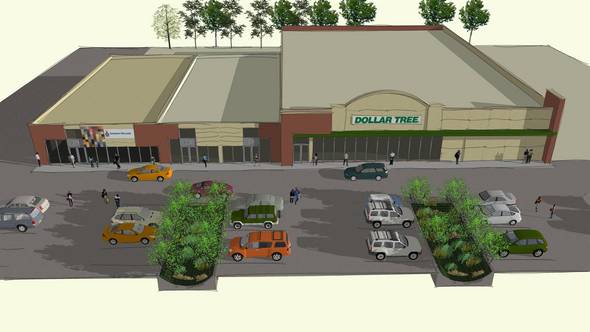
This rendering shows how the retail center could look after upgrades. Final facade details are still being worked out.
Damian Farrell Design Group| For AnnArbor.com
That plans target one of the corridor’s key redevelopment opportunities: The stores on the south side of Washtenaw from Dollar Tree west to Bank of Ann Arbor.
The first phase of the work calls for adding two storefronts to the former Frank’s Nursery outdoor sales center on the far east side of the property, while redoing the exterior of the Dollar Tree, which now occupies the existing adjacent building.
One retailer is negotiating to open in one space, and the other will be available for lease, said Damian Farrell, the architect who represents owner Duane Renken in the effort. The space totals 8,977 square feet.
Phase 2 will include adding nearly 14,000 square feet of retail space to “join” the gaps between other buildings in the center, located on the south side of Washtenaw between Pittsfield and Yost boulevards, across from Arborland Mall and about a quarter mile from the US-23 intersection.
Tenants in those stores include Casual Male Big & Tall, Mattress World and destination specialty stores. Work on Phase 2 has no timetable yet, Farrell said.
“Hopefully, at the end of the day, we’ll end up with a more cohesive looking building,” Farrell said of the structures built separately in the 1950s or 1960s, according to city records. “… That’s going to enhance the corridor.”
The property is among the last significant retail holdings on the corridor to escape upgrades since Arborland’s redevelopment a decade ago drove rental rates into the top tier of the city’s retail locations.
Since 2003, the corridor has seen Huron Village built at the corner of Huron Parkway, and smaller infill projects - both multi-tenant and single occupants, like McDonalds - on both the north and south sides of Washtenaw. The latest is the rebuilding of a Marathon gas station directly north of the center.
At the same time, traffic counts remain high - in part due to the corridor’s role as a connector between US-23 and downtown Ann Arbor - and county officials are finalizing a study called “Reimagining Washtenaw Avenue” that could end up promoting a corridor improvement authority for the road from Ann Arbor into Ypsilanti.
Properties like Renken’s retail center have been cited as examples of redevelopment opportunities to make the corridor more inviting with higher-density uses and friendly to more transportation options.
Other properties on the south side of Washtenaw to the west also have not been a part of the wave of significant upgrades in recent years, and a 7.2 acre parcel once planned for Huron Village South recently was purchased out of foreclosure, but the new owners haven’t disclosed plans for it.
Meanwhile, Renken’s center also abuts a city-owned paved right of way located between the parking lot and Washtenaw, which adds to what many describe as a “sea of asphalt” in front of the retail stores.
The improvements proposed to the center seek to trim the number of parking spaces by adding new storm water management in the form of “bioswales,” or treed islands at multiple intervals in the existing parking lot.
“It will be a very well-treed site and a very green site,” Farrell said.
The treed parking islands will be 15 feet wide and will include four to six trees on each, as well as additional shrubbery and other landscaping, Farrell said.
The bioswales also will perform a function: storm water retention without the need for underground tanks.
“(They) basically will act as basins,” said Matt Kowalski, city planner assigned to the project.
The extra room in the parking lot allows for the space for the bioswales while still retaining 255 parking space - 16 of which are barrier-free - compared to the 227 now required under city ordinance.
In addition to the parking lot reconfiguration to add the green “islands” amid the parking spaces, Renken also is seeking to remove the asphalt paving from the city’s right-of -way next to Washtenaw, replacing it with grass.
“It’s a big upgrade,” Kowalski said, nothing that the parking lot has no landscaping today, and there’s no storm water management on the site.
The property totals just under 6 acres. Today it’s made up of five separate tax parcels with a combined assessed value of $3,253,400.
Renken purchased the property from the Oscar Haab Trust in 1990, according to city records. The sale price was not recorded.
However, the property has an estimated market value of about $6.5 million, based on the assessments.
Kowalski said the site plans are likely to go in front of the city’s Planning Commission in November, then will head to City Council.
Paula Gardner is Business News Director of AnnArbor.com. Contact her at 734-623-2586 or by email. Sign up for the weekly Business Review newsletter, distributed every Thursday, here.
Comments
loran
Tue, Oct 5, 2010 : 7:15 a.m.
Sounds like the best news of the year for the washtenaw corridor. But they absolutly need to consider the bus stop situation. It is such a mess right now!
krc
Fri, Oct 1, 2010 : 11:35 a.m.
ahahaha! Had to laugh at some of the comments here. What a hoot! What can't happen fast enough for me is rebuilding the whole parking lot from Denny's up to Pittsfield. Nothing but potholes. And I hope that this ambitious project doesn't drive out the few established businesses there, like the hardware store. If this hardware store goes, that'll be the end of the only small hardware store on this side of town. I'll drive up to Carpenter Bros rather than go into one of the big box stores. However, I will say this. If I have to, I'll go to Lowe's because they treat women much better than the other.
uhhuhher
Thu, Sep 30, 2010 : 7:57 p.m.
3M for a new Dollar Tree? Sweet.
treetowncartel
Thu, Sep 30, 2010 : 7:54 p.m.
@ league bus, this area is probably closer to Carpenter Corners. East Ann Arbor is more near Packard and Platt.
Lynn Lumbard
Thu, Sep 30, 2010 : 7:01 p.m.
I remember driving all the way out to East Ann Arbor to shop there at the Thom Mcan Shoe Store and I think at a Robert Halls.
leaguebus
Thu, Sep 30, 2010 : 2:31 p.m.
Hey, the city council needs to start thinking about a Historic District for this site. We could call it East Town. After all, the shopping center is probably 50 years old with some historic buildings in its confines. Plus, a paltry $3M for renovations is not quite up to AA standards. With East Town, they could push it up to $5M or $6M with the associated rise in assessed valuation and more tax revenue!
michiganexpats.com
Thu, Sep 30, 2010 : 1:33 p.m.
I hope this happens. This area needs an uplift.
Paula Gardner
Thu, Sep 30, 2010 : 1:23 p.m.
A little extra info on the dollar store: The store is operated by Dollar Tree Inc., a Fortune 500 company that operates more than 3,600 stores. It's got a pretty solid business model and - along with Dollar General - has been on the list of the fastest growing chains in the US.
Sallyxyz
Thu, Sep 30, 2010 : 1:09 p.m.
An investment of 3 milllion $ is being made for a strip of stores featuring a DOLLAR STORE? That's how far the commercial strips along Washtenaw have fallen in past years. Dollar Stores are nothing more than cheap junk, a lot of which is damaged goods. Very little selection, often empty shelves, goods in disarray, and certainly not a store to invest in. This is the kind of store that represents an entry to Ann Arbor from 23?
Long Time No See
Thu, Sep 30, 2010 : 12:14 p.m.
@Basic Bob - I wish A2 had an ordinance for yielding to buses. In Minneapolis, the rule is that all vehicles (including bikes!) must yield to buses that are pulling out of a bus stop, and it seems to improve traffic flow (not just for the buses). It does seem like this location would be good for a bus pull-off.
treetowncartel
Thu, Sep 30, 2010 : 11:50 a.m.
@ Paula, Frank's was a great store. I think their downfall was not having enough space to compete with the big box competitors. They had great locations. I also have a little lead for you. I stopped in to the K-mart on Washtenaw in Ypsi Twp the other night and the store was open but the lights in the parking lot were not on. One of the employees told me that the landlord of the Old Farmer Jacks builing actually controls the lights and is refusing to turn them on since there is no tenant in that building.
Killroy
Thu, Sep 30, 2010 : 11:39 a.m.
Love the irony of the Dollar Store being part of the rendering. In the future, could we aim a little higher? Maybe CVS?
AlphaAlpha
Thu, Sep 30, 2010 : 11:13 a.m.
"why not move the AATA bus stop to inside that parking lot? " Does seem like a great idea. So good, it should already be being investigated. We could even call it a transit center. MS. Gardener, might you contact the key AATA / AA / Mr. Renken? It will never be any easier to accomplish this worthy goal. Thanks.
PhillyCheeseSteak
Thu, Sep 30, 2010 : 10:26 a.m.
I think that shopping area will be much improved with some updating and adding trees and landscaping. However, if the parking lot is bigger than needed, why not move the AATA bus stop to inside that parking lot? As stated in the news article, the property "abuts a city-owned paved right of way located between the parking lot and Washtenaw". It seems that would both improve the safety of bus passengers and keep vehicle traffic flowing better on a very congested road. Because the city owns that particular right-of-way, then the AATA bus stop can't be moved at the whim of the shopping center owner, such as what happened with Arborland.
demistify
Thu, Sep 30, 2010 : 10:12 a.m.
Cutting through the spin, the end result is that there will be 2 additional stores while the number of parking spaces will be decreased. That represents the Ann Arbor definition of enhancement.
ez12c
Thu, Sep 30, 2010 : 9:33 a.m.
Not in my backyard. This is Ann Arbor. Ann Arbor = no new anything.
Ian Casselberry
Thu, Sep 30, 2010 : 9:01 a.m.
Glad to read this. That patch of land has been an eyesore for too long, coming off US-23 into Ann Arbor. I especially like the plans for "treed" parking islands. That sort of thing really can make a difference in how a place looks.
Basic Bob
Thu, Sep 30, 2010 : 8:36 a.m.
Nice idea. Maybe they could build a bus pulloff in front. It gets a bit congested when the bus stops in the through traffic lane. Then we will need an ordinance to require drivers to let the bus out, as they do in Ontario. In Windsor, if you don't let a bus from the curb you will get broadsided because the bus is coming anyway.
Paul Taylor
Thu, Sep 30, 2010 : 8:15 a.m.
Good for them. Looks like Arborland booting AATA has been a good thing for this nearby property.
Paula Gardner
Thu, Sep 30, 2010 : 8:03 a.m.
Ah yes, Highland Appliance! I had totally forgotten that was there until a commenter in a previous story mentioned it. Maybe that's a sign that some day in the future I can stop calling the location "Frank's Nursery."
Angela Smith
Thu, Sep 30, 2010 : 7:51 a.m.
This is an overdue improvement in an area that needs it badly! Can't wait to see plans move forward on this. A great asset for a well travelled entry way to Ann Arbor.
treetowncartel
Thu, Sep 30, 2010 : 7:49 a.m.
Bringback Highland Appliance!!
AlphaAlpha
Thu, Sep 30, 2010 : 7:27 a.m.
Excellent. And, gee, all the benefits, without the cost of a new taxing authority.