

German artist Herbert Dreiseitl discusses new water sculpture's design, funding controversy
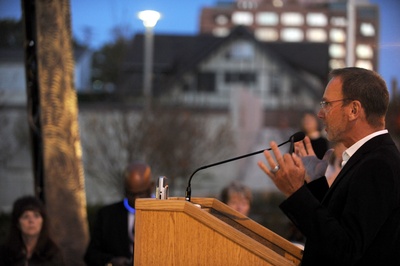
Artist Herbert Dreiseitl speaks at the dedication ceremony for his water sculpture off Huron Street on Tuesday.
Angela J. Cesere | AnnArbor.com
A crowd gathered at the municipal center’s new plaza off Huron Street Tuesday evening to meet world-renowned German artist and landscape architect Herbert Dreiseitl and check out his newly installed public water sculpture. Before last night’s dedication ceremony, the artist shared his thoughts with AnnArbor.com on his inspiration for the sculpture, and he addressed public opinion concerning the value of funding public art.
“The sculpture tells a narrative about rainwater. It is a story,” Dreiseitl explained.
A tall, tilted bronze structure sits at the end of a sculpted concrete ramp. Storm water collected from the building’s rooftop flows through the sculpture. Water pours out from behind blue LED lights, which Dreiseitl likens to ‘drops of water or stars.” It cascades down the sculpture, and then streams down a winding path on the ramp, flowing under a (soon to be installed) grated metal footpath and into an underground cistern. The storm water is filtered and recycled through the sculpture over and over. And it feeds into a rain garden planted in the new plaza.
“Rain is like a gift from the heavens that is all about the future and renewing the earth. Rain drops like pearls and penetrates the surface, glides down, collects, and then flows down the stream. The sculpture tells that whole story,” Dreiseitl said.
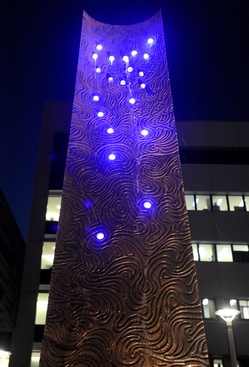
The new sculpture, seen from the side facing Huron Street.
Angela J. Cesere | AnnArbor.com
Dreiseitl proposed the artwork to the Public Art Commission and City Council in the summer of 2009. He was invited to submit a proposal after coming to town to speak at the Huron River Watershed Council’s annual State of the Huron Conference in the fall of 2008. While in Ann Arbor, he explored the local environment and spent time considering what kind of artwork would fit well in the municipal center’s plaza.
“I knew it had to be a strong piece that could handle its surroundings. It couldn’t be something fragile and still stand out with these large buildings” like the municipal center, he explained.
The artist hopes the piece “celebrates and expresses what water does in this particular region,” the environment of the Huron River Watershed and how water flows through the built environment of the city. He also thinks rain is an inspiring symbol, which “connects us with our future.” In a statement he prepared for the dedication ceremony, he wrote; “The promise of Water is all about the future. Like rain, it is comforting, providing renewal and refreshment for a dry and thirsty landscape...It is not only a symbol, water gives hope for the potential of life.”
At a cost of $750,000 to the city, the sculpture is the Percent for Art Program’s most ambitious. Under the program, 1 percent of money spent on capital improvements is allocated to funding public art. Previous coverage in AnnArbor.com has more specific details about where the money came from and how it was spent.
The city’s Percent for Art Program and the purchase of Dreiseitl’s artwork has not been without controversy.
Dreiseitl says he is not surprised that some people question the value of funding public art. “It’s not unusual. This happens in places all around the world. When money is getting short or people are out of work, the first thing people say is that art shouldn’t be funded any more,” he said.
What did surprise him was “the intensity of some of the discussions against the art: "I was thinking this region is open to art, and I hope that will prove to be the mainstream,” he said.
In his opinion, questioning the value of funding public art “is rubbish.”
“Beauty and art are not luxuries; they are necessary. If we cut art, it means we are cutting down our own image. If a city starts to think about not putting up any more art, especially in front of their most important building—their municipal center—that is actually giving up personality. If a region is not investing in beauty, character, and atmosphere, it’s not good,” he said.
“Art is extremely important because it always has the opportunity to bring people’s imagination forward. Any culture or industry that is successful looks for innovation and creativity. Creativity is nothing else but art.”
Comments
Rob T
Mon, Oct 10, 2011 : 8:40 p.m.
I attended the unveiling of the new sculpture, and the mayor in his speech stated that a) there was no legal way to use these funds for anything other than public art and that b) there was no legal way to preference a local artist in the bid for the project. He also emphasized that a great deal of the sculpture's expense went to the local companies who cast and assembled the piece on site.
Animal Lover
Thu, Oct 6, 2011 : 5:37 p.m.
I like art, in fact I'm get
walker101
Thu, Oct 6, 2011 : 4:26 a.m.
And just to think the liberals say the Tea partiers and a bunch of idiots?
pegret
Thu, Oct 6, 2011 : 1:02 p.m.
Huh? What story did you come from?
this guy
Thu, Oct 6, 2011 : 12:09 p.m.
"and a" what now? Say again?
rcastentman
Thu, Oct 6, 2011 : 1:33 a.m.
Must be about time to layoff some more firemen or police officers? I know, I know......the money to pay this "artist" came from a different pot of money than the general fund. But I'll bet someone got taxed or charged for the money, it wasn't a gift to the city. That makes it taxpayer money.....and to spend it foolishly is...... wrong. By the way, someone needs to ask the city how much it's going to cost to operate this thing every year. I'm betting the total cost of operation (electricity, water treatment, maintenance, repairs, etc.) will be $30K or higher. And those costs WILL come from the general fund. Therefore, when the city insists on keeping the fountain running while laying off public safety personnel, we can only hope enough citizens see the audacity of this thing and pull the plug on it.
A2nowDenver
Thu, Oct 6, 2011 : 12:38 a.m.
Sorry, had one more post-submission thought. I think public art's great, and I'm definitely a supporter of it. Even foreign art, as many good things come from other places. However, the art will be less impactful if the person viewing it is in the process of getting mugged. Think about it.
A2nowDenver
Thu, Oct 6, 2011 : 12:34 a.m.
Hmm... I don't think this is (or should be) about whether public art is a good thing. And, realistically, art is always a very subjective thing, so not everybody is going to like it - particularly in the beginning. Where it's from... who likes it... these are all moot points at the moment. Here's the key... I think that spending $750k on art, at the same time we're trying to scrape together cash to increase street patrols on East Liberty and catch the AA Rapist... well, that crosses the line into lunacy. This is the thing recalls are made of. Those in power should take that into account the next time they feel the urge to spend our money this irresponsibly.
Vince Caruso
Thu, Oct 6, 2011 : 12:05 a.m.
This is really about The City of Ann Arbor and our Major Greenwashing' it self again. We could have had 3 long overdue watershed studies for this amount (closer to $1M with all costs included). We are still planning in the Allen's Creek watershed with the 1968 flood data with 1,200 to 1,500 homes and businesses at risk of flooding. We had 89 homes flooded this summer alone in one rain event. I saw Mr. Dreiseitl talk early on and feel he does good work but lets keep it in perspective. And to add insult it's in the Allen's Creek watershed.
bob_miller
Wed, Oct 5, 2011 : 9:48 p.m.
Ann Arbor is a city that is known for being ahead of the curve, and has a reputation for offering more than other places in Michigan, culturally and otherwise. Investing in your home town creates a stable foundation safe bet for growth.
this guy
Thu, Oct 6, 2011 : 10:32 a.m.
"Investing in your home town"? Germany?
Elaine F. Owsley
Wed, Oct 5, 2011 : 9:44 p.m.
How ironic!! Considering his contribution is neither artistic nor beautiful.
mojo
Wed, Oct 5, 2011 : 9:31 p.m.
Timeless - no Attractive - no+ Complicated- yes Will be worn out boring by 2013 and ready for replacement with a new $750,000 art project - you betcha'.
Charlie Brown's Ghost
Wed, Oct 5, 2011 : 9:13 p.m.
"I knew it had to be a strong piece that could handle its surroundings ... celebrates and expresses what water does in this particular region ... connects us with our future ... The promise of Water is all about the future. Like rain, it is comforting, providing renewal and refreshment for a dry and thirsty landscape...It is not only a symbol, water gives hope for the potential of life. ... Art is extremely important because it always has the opportunity to bring people's imagination forward" What an incredible piece of psychobabble. And we're not against art, we're against overpriced, ugly art. This is the typical "you just don't understand me" garbage that we usually hear from artists. I have news for this fraud: a friend of mine used to say, "Just because nobody understands you doesn't mean you're an artist."
st.julian
Wed, Oct 5, 2011 : 8:29 p.m.
Art is in the eye of the beholder. Whether it,s good art will be left to future generations. The issue here is that the eyes of the initial beholders, the city commission, were blinded by their own self importance, arrogance. Their failure to champion Michigan an American artists is inexcusable. They drink from the wells of the seven deadly sins and believe the drink heavenly.
jcj
Wed, Oct 5, 2011 : 7:58 p.m.
"The sculpture tells a narrative about rainwater. It is a story," Dreiseitl explained. Unfortunately its the same old Story. The elitist get their pet project while the commoners get the shaft!
Davidian
Wed, Oct 5, 2011 : 7:42 p.m.
I don't think the sculpture is brilliant, but art is subjective. What I do know is that it's an unnecessary expense in light of some of the economic issues the city is facing. We should've looked at some of the brilliant local artisians that are making sculptures that are, in my opinion, far superior to this.
Alan Goldsmith
Wed, Oct 5, 2011 : 6:15 p.m.
According to our local daily newspaper, the Michigan Daily, the Mayor is quoted as saying this: "But according to Hieftje, the money that funded the sculpture couldn't have been used any other way. He added the money allocated for the public art program would not have been allowed to be spent in other departments." So why doesn't the Mayor request a written opinion from the Ann Arbor City Attorney, something he's dodged doing in the past, to settle this legal issue once and for all? MD Link: <a href="http://www.michigandaily.com/news/city-unveils-public-art-piece-front-municipal-center" rel='nofollow'>http://www.michigandaily.com/news/city-unveils-public-art-piece-front-municipal-center</a>
Bill
Wed, Oct 5, 2011 : 9:39 p.m.
Perhaps the money in the current fund can't be used for other purposes at least without a new mayor and council that works for the city and not for themselves! During tough economic times, the funding should be changed to 0%. This could be done by the council although they recently postponed any further reviews of such changes until after the elections. If Ann Arbor is fortunate, after the elections, new members of the city council will take control of the runaway spending mayor before further damage is done to the city.
Buster W.
Wed, Oct 5, 2011 : 5:50 p.m.
After Dreiseit shared his thoughts, he said, "I'm going to Disney World!!!"
Alan Goldsmith
Wed, Oct 5, 2011 : 5:42 p.m.
It's not PUBLIC ART. It's GOVERNMENT COMMITTEE approved, taxpayed funded art. Let's just call it that, GOVERNMENT COMMITTEE APPROVED ART from now on so as not to slander pubic art.
Tesla
Wed, Oct 5, 2011 : 7:02 p.m.
What is Pubic art, and how much does THAT cost?
Ron Granger
Wed, Oct 5, 2011 : 5:28 p.m.
There will *never* be enough money for infrastructure. There will *always* be potholes. There will *always* be problems of serious crime - rape, murder, etc. By the logic some espouse, we should sell all our park land to fund those needs. If we put the art funds back into the regular budget, you wouldn't notice the impact. We'd still have all of those things on that list. I don't think it would make the slightest dent.
this guy
Thu, Oct 6, 2011 : 10:32 a.m.
Parks are nice for everyone to enjoy, though. This sculpture looks like a bad student art project.
LA
Wed, Oct 5, 2011 : 10:01 p.m.
You are correct Mr Granger. Thank you. But please don't give them any ideas. If the parkland could be revoked, these folks would do it!
jcj
Wed, Oct 5, 2011 : 8:04 p.m.
You sound like a politician trying to defend his pork barrel project! The same old argument. It is just a drop in the bucket. Malarkey! Tell the homeless that $750,000 is not enough to do anything else. Tell that to anyone trying to pay for their medication!
djm12652
Wed, Oct 5, 2011 : 6:26 p.m.
I'm for that...or charge entry permits like the state does.
pbehjatnia
Wed, Oct 5, 2011 : 5:21 p.m.
art or far(t)se, doesnt matter. bottom line is this: we did not and do not have the money for luxuries right now nor will we in the foreseeable future. we need street repairs, bridge repairs, school repairs.... we do not NEED art. we NEED a government that thinks like a common sense two year old.
pvitaly
Wed, Oct 5, 2011 : 5:08 p.m.
I think if I was getting 100s of thousands of dollars for making public art... I would probably not be against the funding either.
Sam Smith
Wed, Oct 5, 2011 : 5:08 p.m.
I love art but not when it is too costly in so many ways as many posts have mentioned. Now the next "art" project is going to be in the court building where few can enjoy it but all is paying for it. What's wrong with this picture?
daverieb
Wed, Oct 5, 2011 : 4:58 p.m.
In my opinion it is breathtaking, amazing, and stunning... that our fair city spent $750,000 on that "art" project. Do we still have time to return the item for a full refund?
Elizabeth Sikkenga
Wed, Oct 5, 2011 : 4:47 p.m.
I believe art is important, and that public art helps build community. I don't understand why it wasn't possible to use a local, or even regional, artist for this project. Mr. Dreiseitl's work is beautiful, but Michigan has no shortage of very talented native artists. Hiring local talent would not only have served to foster greater pride in our community, but would also have kept the money in the Michigan economy.
djm12652
Wed, Oct 5, 2011 : 6:25 p.m.
Your logic is commendable, however, logical thought processes are totally unacceptable in Ann Arbor city government...
djm12652
Wed, Oct 5, 2011 : 4:45 p.m.
I'd say that the newly installed art is as artistically "nice to look at" as the new city hall...luckily I can't see the art from my apartment...having to look at city hall is bad enough...
Marilyn Wilkie
Wed, Oct 5, 2011 : 4:24 p.m.
"In his opinion, questioning the value of funding public art "is rubbish." "Beauty and art are not luxuries; they are necessary. If we cut art, it means we are cutting down our own image. If a city starts to think about not putting up any more art, especially in front of their most important building—their municipal center—that is actually giving up personality. If a region is not investing in beauty, character, and atmosphere, it's not good," he said. "Art is extremely important because it always has the opportunity to bring people's imagination forward. Any culture or industry that is successful looks for innovation and creativity. Creativity is nothing else but art." ========== And the rich get richer while ignoring where the money comes from - the people who can not afford their luxuries.
Marilyn Wilkie
Wed, Oct 5, 2011 : 8:57 p.m.
OMG! You're right! Let them eat cake!!!!!
Ron Granger
Wed, Oct 5, 2011 : 5:26 p.m.
"And the rich get richer while ignoring where the money comes from - the people who can not afford their luxuries." -- Umm, that's why we have public art. So us poor folk can enjoy and experience what only the rich folk can afford.
Animal Lover
Wed, Oct 5, 2011 : 4:21 p.m.
I don't recall art being listed in Maslow's heirachy of NEEDS. I like art, am actually taking an art class now, but ask anybody who can't breathe, is homeless or hungry, and they will tell you that it is NOT a need! But what do you expect Dreitseitl to say? And come on Ann Arbor City Concil, you REALLY couldn't find a local starving artist who could come up with this concept and design it? Doesn't sound like you have a lot of confidence in your local talent. Doesn't make me especially want to attend the A2 art fair (yes, I know artists come from all over for the A2 art fair). It would be nice to look at this every day at wor, but to say this is a NEED, insult's people's intelligence (or it should).
Roadman
Wed, Oct 5, 2011 : 4:11 p.m.
Mr. Dreiseitl, you are no Andy Warhol!
bedrog
Wed, Oct 5, 2011 : 11:03 p.m.
Do you mean that andy warhol was a great artist, or a just more convincing scamster than Dreiseitl? as to the first, one could well argue that some anonymous ad exec for Campbells soup was the neglected genius in Warhols production-line "art' At least the water feature is a one of a kind.
Buster W.
Wed, Oct 5, 2011 : 4:05 p.m.
He must be thinking to himself, "Gosh, these people are suckers!!!"
Stephen Lange Ranzini
Thu, Oct 6, 2011 : 4:52 a.m.
@Elaine, perhaps you've got a new entry in the naming contest! "The Shaft"!
Elaine F. Owsley
Wed, Oct 5, 2011 : 9:49 p.m.
Oh, right!! a shaft!! I thought that shape looked familiar.
Animal Lover
Wed, Oct 5, 2011 : 4:26 p.m.
YES! I know I would be!
Alan Goldsmith
Wed, Oct 5, 2011 : 4:05 p.m.
"Dreiseitl says he is not surprised that some people question the value of funding public art." This was never about public art. It was about YOUR art Mr. Dreiseitl. YOUR art, shallow, over priced and phony art that the local rubes in the Arts Community and on City Council fell for. It was about the lack of tranparency, the lack of even looking at other artists, and the arrogancy and hypocrisy involved from day one. Take your money, head on over to China where you have a corporate office and are in the process of creating other ' works for that repressive government and take your self serving cliches with you. That are about as original as your urinal fountain.
Animal Lover
Wed, Oct 5, 2011 : 4:25 p.m.
If this is true, the piece should be ripped out and a garden planted IMMEDIATELY!!
grye
Wed, Oct 5, 2011 : 3:58 p.m.
Yep, a lot of money down the drain. What are we going to spend our limited financial resources on next Mr. Mayor and City Council?
Buster W.
Wed, Oct 5, 2011 : 7:46 p.m.
I plan on bringing my "bridge portfolio" to the next AA City Council meeting.
grye
Wed, Oct 5, 2011 : 3:56 p.m.
Yep, a lot of money down the drain. What are we going to waste our limited financial resources on next Mr. Mayor and City Council?
Elaine F. Owsley
Wed, Oct 5, 2011 : 9:50 p.m.
Actually, what we got was a drain pipe that lights up.