

Local artists give feedback on Dreiseitl water sculpture at city hall
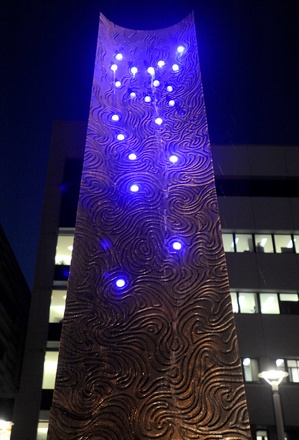
The sculpture during a dedication ceremony this month.
Angela J. Cesere | AnnArbor.com
German artist Herbert Dreiseitl designed the piece, which still has some detail work to be done. The blue LED lights and water have not been permanently turned on yet; however, a crowd got a chance to see it all turned on at a dedication ceremony earlier this month. Others have wandered to the site, on East Huron east of Fifth Avenue, and seen what it looks like turned off.
Sculptor Rick DeTroyer just installed his own public artwork, “Seats of Our Heritage,” in Saline on North Ann Arbor Street. He hopes Dreiseitl’s sculpture “will make people aware of how water is a precious commodity. We turn on faucets and take it for granted. I think the city is wise to bring about some awareness,” he said. “The idea of appreciating water really comes through because of the rain garden. The more green space in the city that captures water, lets it go back into the earth, or be utilized the better. The water sculpture with the rain garden and walkway going over it makes you stop and smell the roses, so to speak.”
Douglas Kelbaugh, a U-M architecture and urban planning professor and the former dean of the A. Alfred Taubman College of Architecture and Urban Planning, generally likes Dreiseitl’s water sculpture—with one reservation:
“It’s a thoughtful, well-executed piece with a good theme. It’s in the right location as far as its relationship with the building, the entrances to the building, and the little park. It’s in the right place with the right design,” he said. However, “it could be taller ... If you look at the size of just the plaza, then it is big enough. But when you realize it’s next to Huron, a very wide street and a big urban void, it just doesn’t feel big enough to command that size of a space.”
Local fashion designer and fabric artist Rebecca Lambers hopes “this will be an area you can walk through, sit down, and look at the sculpture. We didn’t have anything like this along Huron. I walk down to the People’s Food Co-op and different areas, but I generally wouldn’t have walked through here. But now, I’m more likely to,” Lambers said. She likes the way the sculpture lights up and had water running through it: “It’s going to be really cool at night.”
An artist who has supported the installation of Dreiseitl’s work all along is painter and mixed-media artist and chair of the Milan Arts Center Leslie Sobel. “I love Dreiseitl’s work,” she said. "... This is going to be a peaceful and playful place in the center of the city. Art shouldn’t just be in a box, in a gallery. It should be somewhere you can play with it.”
Kinetic sculptor Richard Burns, who had a monumental sized sculptural flag pole featured at ArtPrize in Grand Rapids, has mixed feelings about the Dreiseitl piece. Although he likes its size, “there were a couple of things that didn’t thrill me. I’m not sure I like the lights; they seem a little gimmicky, and the shapes in the ramp where the water comes down are a little bit too organized and rigid for me. I think it would have been more successful if there was more randomness in it or more motion,” he said. Overall, though he sees it as "generally a successful piece that I think people will warm up to."
None of the creative types who shared their initial impressions with AnnArbor.com said they feel slighted because an international artist was selected instead of a local artist. “If there were equal level artists, one from here and one from Germany, who could make art that fits the criteria, than I would say, sure, choose the local artist. However, from what I know about it, there were few options locally that fit what they wanted to do,” said architectural and furniture designer Paul Hickman.
A few artists are reserving judgement until the finishing touches are complete. Festifools director Mark Tucker, who has been a vocal supporter of public art in Ann Arbor, is giving it time to sink in. However, his first impression is that the water sculpture, plaza, and rain gardens are worth the money. “What it does is give you a benchmark—this is that $750,000 will buy you. I don’t think people always realize what art can cost,” he says. “In the long run, we’ll end up with all kinds of art. People just have to give it time,” he said.
Painter and pastel artist Janet Kohler, who teaches at the Ann Arbor Art Center, did not get a chance to see it with the water and lights on, but she took a look when it was turned off. “Like other fountains, they’ll have to turn it off when it’s winter, which makes sense. But it’s good to see a public sculpture. I thought it was beautiful,” she said. “I could envision water flowing down those wonderful crescent shapes on the platform. The walkway that they’re building will be a nice winding, sloping pathway that comes off the street. Even if people aren’t going into the municipal center, they might want to walk across the rambling brook and see the water fall. And it marks the entrance better.”
A few finishing touches to the Dreiseitl sculpture will happen in the next few weeks. Kenneth Clein of Quinn Evans Architects told AnnArbor.com that the plan is to have the lights and water on around the end of the month or shortly after. He says the walkway over the adjacent rain garden should be installed around the same time.
(This story has been revised to remove incorrect information regarding past work that Dreiseitl has done.)
Comments
Kai Petainen
Thu, Oct 20, 2011 : 12:29 a.m.
i have a question on how it was constructed... (personal curiousity) How did they cut the grooves into it?
owlnight
Wed, Oct 19, 2011 : 6:48 p.m.
When the city said yes for this thing, the drawing made it look MUCH BIGGER. For this one it should be at the mall.
mtlaurel
Wed, Oct 19, 2011 : 6:32 p.m.
the photo here is an interesting angle, however, from a car travelling on Huron , or walking across an intersection, one doesn't even really notice it. How can a critique arise when it is barely percepted ? The foot traffic around a Municipal Center occurrs mainlly during daytime hours: this piece will largely go unnoticed. The lights which are the only significant thing about it will be a peripheral vision, 2 or 3 second experience, as people do have to seriously concentrate on their driving on this part of Huron.
Jimmy McNulty
Wed, Oct 19, 2011 : 1:54 p.m.
"He hopes Dreiseitl's sculpture "will make people aware of how water is a precious commodity. We turn on faucets and take it for granted. I think the city is wise to bring about some awareness," he said." Really, a sculpture that a) cost $750,000 and b) wastes both water and electricity itself will bring about awareness of waste? Hmmmm, maybe it really WILL show the waste that goes on in AA.
rocco
Wed, Oct 19, 2011 : 3:14 a.m.
I'm somewhat surprised that local artists did not do more of a balanced critique because many of them belong to critique groups and that's what they do to help each other. The architecture professor had it right when he commented: "it just doesn't feel big enough to command that size of a space." I approached it walking west on Huron. Trees blocked the view, and when I finally saw the vertical structure it was somewhat underwhelming. Visually, anyway, it was less than I expected. Contrast the view Dreiseitl's sculpture with the one in front of in front of the UofM Art Museum on State. The UofM sculpture commands the space in front of the new and expanded museum. I realize the work is more than just the sculpture, but that is what one confronts visually. It's difficult to argue that the simple vertical structure is elegant. I've seen it now in the sunlight, rain and at night, and image that unfortunately comes to mind was that of a wafer stuck in an ice cream sundae. (Maybe the Washtenaw Dairy could do a Dreiseitl sundae, as way of popularizing it.) When you walk around it, wires are exposed on both sides, which, in my mind, violates a rule of sculpture that the work should be aesthetically pleasing on all sides. It's not. The lighted blue balls are okay, if you tend to like colored lights on Niagara Falls. I know the Japanese tourists do. But I just couldn't get away from the image of bright blue M&Ms in the cookie wafer on the Dreiseitl sundae. I know this imagery is my problem but I wasn't preset to critique the sculpture and I don't eat ice cream sundaes. Having said this, I strongly support public art and believe that investment in public art is just as valuable as investment in other public services. So for me the issue is not money, or misplaced resources, but what we received for our money. Even though this is a costly misstep for the city, the next time I expect we will do it better.
Tru2Blu76
Wed, Oct 19, 2011 : 2:54 a.m.
I agree with Prof. Kelbaugh, "it could be taller" - about two stories taller (and proportionate in all dimensions): so that it would form a visual beacon up and down Huron Street. Oddly (and perhaps for the first time ever) I think my own and Prof. Kelbaough's views fall in line with what Top Cat says. If only because it's the small size of this work which generates comments like, "This is it?" Which means of course that the commission which chose this specific work for that specific location should have started out by looking at each other and saying: LETS GO FOR IT AND MAKE IT GIGANTIC!! It's actually funny to think our art commissioners are so conservative, staid and lacking in chutzpah. If this is all the phallic symbolism Ann Arbor can crank up, then we're doomed forever to be known as "That Town with the Little Bronze Thing."
Dug Song
Wed, Oct 19, 2011 : 1:44 a.m.
Half of that would have fully funded the Ann Arbor Skatepark, which raised an additional $18,000 at a dinner last week (Farmington Hills seems to have more civic-minded folks who know how to get things done than Ann Arbor: <a href="http://www.dptv.org/ondemand/special/riley.shtml" rel='nofollow'>http://www.dptv.org/ondemand/special/riley.shtml</a> ). I think the percent for public art program is an excellent idea (as it's been done in Portland), but poorly executed here. Maybe it's just a matter of taste, but I'm pretty sure a mural program or something that this money would have funded for years would have had a much bigger impact...
say it plain
Wed, Oct 19, 2011 : 1:21 p.m.
I think this art object would work well *in* a skate park actually... It has a ramp-y quality to it...knock the thing over and it could *be* an element of a skate park. In fact, I think when a skate park gets worked out for Ann Arbor, it should eventually have a water-element fountain/sculpture that visually refers to this piece, maybe along with a plaque mentioning the generous donors who *finally* made the park possible ;-) The sound of running water goes well with the sounds of skatewheels, it seems to me, also... Will people attempt to skateboard around this new city hall 'plaza' lol, or will a cop from inside the building be permanently assigned to keeping that from happening?!
zax
Tue, Oct 18, 2011 : 10:29 p.m.
I still say it costs way too much and local artists or US artists should have been considered for using public funds. How to support the local economy, local pride in our artists would have made more sense to me. Many up and coming artists would have offered their services free just to see their imagination come to life in their community. Let individuals support foreign artists, community funds should support community talent and jobs.
Stephen Lange Ranzini
Tue, Oct 18, 2011 : 10:06 p.m.
Despite tons of virtual ink spilled about the sculpture, the fact is that "it" doesn't actually have a name, which is s shame since "we" spent $750,000 on it. I propose that the *citizens* christen the sculpture and give it a name! In that spirit, University Bank announces a new online poll to name the Dreiseitl water sculpture. Please click here: <a href="https://www.surveymonkey.com/s/W333K58" rel='nofollow'>https://www.surveymonkey.com/s/W333K58</a> to take the poll and to see the current proposed list of names! All the current suggestions from the readers of AnnArbor.com and Ann Arbor Chronicle that I am aware of have been added to the list and we are open to adding more suggestions, whether you love it or hate it as noted in the poll. We'll announce the initial results of the poll when the sculpture is finally working!
Stephen Lange Ranzini
Wed, Oct 19, 2011 : 7:08 p.m.
I am pleased to report a lot of good responses to the naming poll, including three new names for your consideration in addition to the original list of seven that I previously had noted. We've added those and the four below to the poll! Thanks, @Skyjockey43, @Kai Petainen, @JSA and @Say It Plain for your suggestions! Please click here: <a href="https://www.surveymonkey.com/s/W333K58" rel='nofollow'>https://www.surveymonkey.com/s/W333K58</a> to take the poll and to see the current proposed list of names!
say it plain
Wed, Oct 19, 2011 : 1:13 p.m.
I'd love to hear what the artist would call it! I'm sorta surprised to hear it doesn't have a name...I think artists of big pieces like that should be required to offer one as part of their proposals lol...it might have helped clarify what he wanted from it and focused his attention on how it would work in the space for which it was intended ;-) I agree with the comments of @rocco below that it has something of an ice cream sundae wafer look to it, but of course it's supposed to be a 'functioning' piece, showing what happens with the water that courses over it, right? Maybe we should wait til we 'feel' the piece operating before naming it... Otherwise the only thing that feels to me like it would be a de facto name-contender is "The Huronal" lol. Hopefully that will be as in "meet me by the Huronal", but that's a little sad for our city so I hope something else takes hold!
JSA
Wed, Oct 19, 2011 : 12:52 p.m.
Water Fountain Folly.
Kai Petainen
Wed, Oct 19, 2011 : 2:26 a.m.
call it simply... 'The 750' both as a symbolic gesture to the cost, and a gesture to a bottle of wine.
Skyjockey43
Tue, Oct 18, 2011 : 10:37 p.m.
The Rusty Urinal
whale11
Tue, Oct 18, 2011 : 9:36 p.m.
Too bad those who selected the sculpture didn't consider that Michigan has a long winter which puts everything out of action for months every year--or will there be solar-energy-heated water to operate the sculpture?
CobraII
Tue, Oct 18, 2011 : 7:42 p.m.
I'm not surprised that the local art community would like this "thing", birds of a feather hang together. They are getting in line for the next 750k payday!
David Briegel
Tue, Oct 18, 2011 : 7:31 p.m.
Well, now that we have heard from the knowledgeable people we will get to hear from the "art experts" from the peanut gallery. "It" is only part of the price tag. I saw it and I talked to the workers doing the installation. Generally you can expect some snide or snarky comments. Those guys really liked it and enjoyed working on it. I do agree with the one criticism that it could have been bigger. I expected a larger piece. But with the lights on and the water running it is a beautiful piece of which we can be proud! I hope all the nonsense can be put behind us and we can embrace the concepts and thoughts behind this and more people can demonstrate some civic pride over this fine piece of art!
Lolly
Tue, Oct 18, 2011 : 8:55 p.m.
I suspect that there are many more people who have pride in this installation than it would seem merely from reading these comments. Somehow, there is more eagerness to express a negative view than a positive one.
JSA
Tue, Oct 18, 2011 : 7:23 p.m.
Beauty is in the eye of the beholder or so it is said. Given the diversity of opinion on what is art that alone is the very reason you don't fund it with public money. Let the elitists who like and enjoy this "art", and I use that term very loosely, pay for it.
LA
Tue, Oct 18, 2011 : 7:21 p.m.
Thank you for an artists look at the sculpture.
grye
Tue, Oct 18, 2011 : 6:13 p.m.
Can't fund city services but can spend $3/4million on art. Glad I don't run my household budget that way. "No money for dinner tonight kids. Just sit back, look at the art, and chew on it for a while." Need better priorities Mr. Mayor and council.
hut hut
Tue, Oct 18, 2011 : 5:25 p.m.
Ann Arbor has to decide whether it's an "arts" town or an "artists" town. Rarely do the two mix. If a city decides to be known for "the arts" it's usually too expensive for artists to live and survive. It's understood that that young, developing artists moving into an area is a sign of urban renewal. If Ann Arbor wants to tap into this kind of growth, as an alternative to more offices and workers who live in the suburbs, it should be planting seeds, build an incubating infrastructure that will help draw the creative class to the city. Big expensive public art is not a big draw for most creative types. Lower rents, studio and exhibition space is more important to artists than big, expensive public art. If the city is serious about attracting creative people to Ann Arbor, use some of that % for art to let them know that they are welcome. If the city isn't serious about attracting the creative class, particularly young artists, keep spending on expensive public art. You can't have it both ways.
say it plain
Tue, Oct 18, 2011 : 5:45 p.m.
I meant to also add that the mayor of our fair city is a *realtor*, as is at least one of his recent DDA appointees Sandi Smith ;-) 'Nuff said, lol, about rents/'values' and 'creative' versus 'spending' classes ;-) as our city decides what it aspires to be...
say it plain
Tue, Oct 18, 2011 : 5:34 p.m.
I think AA's current powers-that-be are interested in attracting the "money-spending class" lol, not the creative classes ;-)
Ashok Gopalakrishnan
Tue, Oct 18, 2011 : 5:19 p.m.
While I have not seen the sculpture in person, I quite like the pictures I have seen of it. However, I have a hard time looking at this piece's artistic appeal in isolation, due to the fact that $750,000 of the funds spent on this project came from *user fees* - fees that citizens of Ann Arbor paid for water, sewer and stormwater services. If the city did not really need the money, I would much rather they refunded it to me, or used it for real capital improvement - repairing or rebuilding pipes, etc. Let's not forget that the city raised water rates in June: <a href="http://annarbor.com/news/ann-arbor-residents-will-pay-an-extra-1892-on-average-with-approved-utility-rate-increase/">http://annarbor.com/news/ann-arbor-residents-will-pay-an-extra-1892-on-average-with-approved-utility-rate-increase/</a> I have two very simple and possibly naive suggestions to resolve the Percent-for-Art issue: 1. Take the existing language of the Percent for Art ordinance, frame it in the form of a question, and put it on the ballot. Let A2 residents vote on whether they approve the language or not. 2. Alternatively, let's have an art millage on the ballot, say for 1/8 mills. If approved, this would raise about $563,000 a year (same as the sidewalk millage). A simple up/down vote: matter solved. While 1% of all capital improvement projects (up to $250,000 per project) may not be much, it certainly is not free money.
pegret
Tue, Oct 18, 2011 : 7:28 p.m.
Believe me, the pictures make it look a lot more impressive than it actually is, especially when they're all taken from the base looking up. Unfortunately (or maybe not) the thing is much smaller than I figured it would be, and is actually pretty easy to miss.
Loves2Cook
Tue, Oct 18, 2011 : 5:12 p.m.
How many jobs were created or how many homeless people are being helped by this? What a waste of money during such trying economic times!
clownfish
Tue, Oct 18, 2011 : 7:25 p.m.
Mike, I am not sure the art installation created hundreds of thousands of jobs. Just in A2 the ARRA created quite a few temp and permanent jobs, as well as stimulating the creation of job creating spin-offs. <a href="http://detroit.cbslocal.com/2010/09/09/26664/" rel='nofollow'>http://detroit.cbslocal.com/2010/09/09/26664/</a> Factcheck.org- "Simply put, more people would be unemployed if not for the stimulus bill. The exact number of jobs created and saved is difficult to estimate, but nonpartisan economists say there's no doubt that the number is positive."
Mike
Tue, Oct 18, 2011 : 5:57 p.m.
About the same number that were created by the "stimulus" only it didn't cost billions of dollars
Leslie
Tue, Oct 18, 2011 : 5:11 p.m.
I made an error in my comments to Jennifer Eberback - the piece at Millennium Park I was thinking of is by Jaume Plensa not Dreiseitl. Nonetheless I stand by my remarks about his work. I've seen Dreisetl's work in Berlin and loved it there. An enormous number of pieces of public art are highly controversial when they are installed and become highly beloved representations of their homes. I remember the comments when Millennium Park was being built in Chicago. It's a FAR more expensive project and the degree of outrage was proportionate. And yet it's now a significant destination that's filled with people year round. The area around the Dreiseitl piece will be a pleasant square in an area which was devoid of same.
Roadman
Tue, Oct 18, 2011 : 5:06 p.m.
As a layman, I am not impressed with this "artwork". I am even less impressed that essential municipal services are being rolled back and warmth centers to help the homeless are endangered through lack of funding.
Ricebrnr
Tue, Oct 18, 2011 : 4:52 p.m.
"Quinn Evans Architects told AnnArbor.com that the plan is to have the lights and water on around the end of the month or shortly after." just in tome for the freezes, yay!
say it plain
Tue, Oct 18, 2011 : 4:50 p.m.
I'm glad to see AA.com finally write an article evaluating this controversial piece from the perspective of *art* criticism :-) The artists interviewed make some good points... But I'm afraid my first impression of this sculpture is a sort of "that's it?!" reaction...so I'm inclined to very much agree with Professor Kelbaugh: It doesn't seem to command the space enough to have the desired impact. I've only viewed it from a distance so far though. It remains to be seen whether it will be the hoped-for 'focal point' of that little public space it's situated in, but as one moves past it in a vehicle, to me it feels rather dwarfed by the streetscape of Huron, and even by the facades of the two city hall buildings. Then it seems really waaaay too small for its space, and thusly an almost bombastic-message effect...it's really pretty small, but it's trying to be VERY big. ( I'm sure there are some who would say that this is the *perfect* vibe for that plaza lol, reflecting a lot about Ann Arbor's government ;-) ) I feel like it misses out on the 'organic' feel it might have been aiming for, at least as placed in that part of the plaza so close to the street! It might have been much better elsewhere or differently situated somehow...
Top Cat
Tue, Oct 18, 2011 : 4:43 p.m.
This past Sunday, my wife and I took a walk over to City Hall to take a close look at it. I suggest everyone do the same. She and I both looked at each other and said, "this is it?"
Hunterjim
Wed, Oct 19, 2011 : 12:16 p.m.
My wife and I went by the other day..but "this is it?" wasn't our reaction....WT#....How much was this thing.. was closer!
Brian Kuehn
Wed, Oct 19, 2011 : 11:57 a.m.
Well said. My wife and I had a similar reaction. The piece seems small in relation to the location and price tag.
Ricebrnr
Tue, Oct 18, 2011 : 4:59 p.m.
Wow ditto on both counts. Homedics analogy is spot on.
say it plain
Tue, Oct 18, 2011 : 4:57 p.m.
Funny @Top Cat, I was spending a while constructing my comments below and only saw your wife and your reaction lol after I essentially said the same thing! It really does have a "this is it?!" flavor, sigh...too bad. It comes off to me almost like one of these homedics gaiam-catalog "peace-inducing" water sculptures that one might buy for one's garden as an interesting 'water feature' lol. The colors are flat and the patterning somehow not right for the geometry of the sculpture, and it will just be even flatter against a grey winter Ann Arbor sky- and street-scape. It might work okay in some tropical garden plaza in Hawaii or something, with lots of green and color nearby lol. But here, at least in that place lol, it feels so very very "this is it" to me so far.