

Ann Arbor cell phone ban moves forward with revisions
Ann Arbor City Council Member Stephen Kunselman says he enjoys the convenience of the Google Maps feature on his iPhone when he's driving.
"I find the mapping to be very helpful," he said. "Before I get started and I'm going someplace I haven't been before, I type in the address and I find it amazing that there's a little blue dot that tells me where I am and I can scroll and find out where it is I need to go."
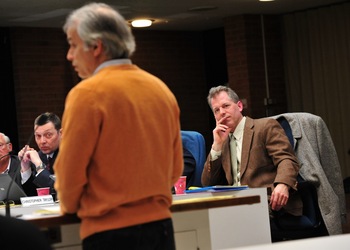
Council Member Stephen Kunselman, right, listens to expert Paul Green talk about the dangers of distracted driving Monday night.
Ryan J. Stanton | AnnArbor.com
Kunselman, D-3rd Ward, worries a proposed ordinance banning the use of cell phones while driving could send him and others back to using those "archaic" paper maps, which arguably are a bigger distraction.
That's just one of the concerns expressed over the city's proposed ban on cell phone use while driving. The issue came up again at Monday's City Council meeting.
"I'm having trouble with the ordinance," said Council Member Sandi Smith, D-1st Ward. "I would prefer to see this done on the state level. I get the safety part ... but I really would rather have it dealt with at the state level and have it be part of the Michigan Vehicle Code. I don't think it's appropriate for us as a city to tackle this."
The resolution to implement the ban is being sponsored by Council Member Stephen Rapundalo, D-2nd Ward. His resolution was expected to come back for a second reading and adoption Monday, but instead he introduced a newly revised version for first reading. The new version takes into account feedback he's received since the last meeting on the cell phone ban.
The new version was approved at first reading Monday night, but several council members said they weren't sure they'd be supporting it at second reading.Â
If approved, the ordinance would take effect 60 days after its legal publication.
Rapundalo invited two experts to the podium Monday night: Police Chief Barnett Jones and Paul Green, a professor from the University of Michigan's Transportation Research Institute who specializes in research on driver distraction.
Green told council members substantial documentation shows using cell phones and portable navigation systems while driving - especially doing data entry of any kind - increases the risk of crash.
"The most notable is texting, which seems to increase crash risk by a factor of 14, which is huge," he said.
Jones told council members he's hoping to make "operating a cell phone while driving" a primary offense in Ann Arbor, meaning city officers can pull someone over just for being on their cell phone - they don't need any other reason.
The offense would be a $125 ticket. The fine go would go up to $300 if an accident was involved.
Green acknowledged Monday night there's little difference - in terms of distraction level while driving - between hands-free technology and handheld technology. That's because the distraction is not so much that the hands are occupied, but that the mind is occupied, he said.
Council Member Marcia Higgins, D-4th Ward, said if that's the case, then hands-free technologies should be banned, too. The ordinance as currently written would exempt using cell phones if it's done hands-free.
Jones said a handheld ban is a good place to start and would get younger drivers in the habit of not texting or playing games on their cell phones while behind the wheel. He said it also allows people to take care of business while driving if they have a Bluetooth headset, which Jones acknowledged he uses.
The revised resolution states the use of a cell phone or "other portable electronic device" is prohibited while operating a motor vehicle or bicycle. The ban restricts drivers and cyclists from using such devices to do the following:
- Talk or listen to another person.
- Create, transmit, read or listen to a text, voicemail, or any other digital message, including e-mail.
- Perform other non-driving tasks besides selecting and playing music, including but not limited to: playing electronic games, viewing movies and transcribing notes.
- Type into or otherwise operate a navigation system.
- Use the Internet.
The list of "electronic devices" banned from use while driving or riding a bicycle include:
- A mobile or satellite telephone or any other electronic object commonly known as a wireless, cellular, digital telephone or smart phone.
- Any type of paging device or personal digital assistant.
- Any video game or digital photographic equipment.
- Any type of portable computer.
- Any portable navigation system, including but not limited to any equipment commonly known as a global positioning system or GPS.
The ordinance would allow use of electronic devices in the following circumstances:
- The person is using a hands-free electronic device, and the electronic device is not hand-held.
- The person uses the electronic device to communicate with or obtain directions to a police department, a fire department, an authorized emergency vehicle, a hospital, or a physicians office, during an emergency situation.
- The person uses the electronic device while performing his or her official duties as a police officer, a member of a fire department, or the operator of an authorized emergency vehicle.
- The person uses the electronic device while the motor vehicle or bicycle is stationary in a location that is not within the portion of the highway that is intended for the purpose of moving traffic and that is a legal place to park, stop, or stand a motor vehicle or bicycle.
- The person uses the electronic device while performing his or her duties as a volunteer in the Radio Amateur Civil Emergency Service.
Green said people feel the need to use cell phones while they're driving because everyone is so busy these days.
"Unfortunately that puts others at risk who aren't phone users and is unfair to them," he said. "We're seeing lots of new technology like iPhones that pretty much let you do anything while you drive - spreadsheets, play video games, check your stocks - and none of those tasks are essential to driving and therefore shouldn't be done while driving because they add crash risk."
Green addressed the common complaint that talking on a cell phone is no different than talking to a passenger in a car. He said it's actually proven to be vastly different because a passenger in a car is aware of what's going on and can help pay attention to the road, while someone on the other end of a phone conversation may not even know the other person is driving.
As far as navigation systems, Green said little distraction comes with looking at a map or listening to directions from a GPS. He said the problem occurs when someone starts trying to input addresses while driving.
"With navigation systems, it's not reading the map that really creates problems," he said. "The real problem with navigation systems is entering the destination, typing in the street address, typing an intersection, searching through long lists of potential destinations to find the one you want. Those are really the problem tasks."
Jones cited a report by the National Traffic Safety Board that estimated nearly 24,000 Americans had died by 2004 because they were operating a motor vehicle while on a cell phone. He said he's sure the numbers are even greater now.
He noted more than 80 percent of accidents that were reported in the United States in 2007 were because of distracted driving.
"In that same year, 21 percent of the fatalities between the ages of 16 and 19 were young adults that were utilizing a cell phone," Jones said.
"It has become a major, major cause of traffic accidents, injuries and deaths. I had a near-miss not too long ago and I definitely went to a Bluetooth and I'm not saying Bluetooth is better. I know it's not."
Ryan J. Stanton covers government for AnnArbor.com. Reach him at ryanstanton@annarbor.com or 734-623-2529.
Comments
Elizabeth
Tue, Mar 16, 2010 : 12:52 a.m.
The survey response options do not necessarily answer the question asked. Should the City Council ban the use of cell phones while driving in Ann Arbor? No, I do not think that the City of Ann Arbor should regulate cell phone use, but yes, I think that some cell phone use can be a dangerous.
scott
Sun, Mar 7, 2010 : 11:39 p.m.
i get the whole car thing, but the bike bill is a little ridiculous if you ask me!!!
Sandman
Thu, Mar 4, 2010 : 9:52 p.m.
This City Council is obviously out of real ideas, resorting to useless highly opinionating topics for a popularity contest. Stop wasting my money by talking about something that is already against the law, wreckless driving! Phones, radios, food, talking to passengers, arguing with your spouse, shaving, make-up, looking for your mirrors...what's the difference. Get back on track and talk about something that makes an honest difference in our lives. You are actually spending your time as elected officials talking about everyone's pet peeve, wreckless, thoughtless, air-headed drivers and we have state laws that cover wreckless driving...get off of this useless blather.
st.julian
Thu, Mar 4, 2010 : 8:30 p.m.
I blelieve the best solution would be to move to simpler communications. Therefore, I suggest all wireless devices be banned from use in th city. This owuld justify the council eliminating other aspects of contemporary technolgy that annoys a councilman. I would votefor the banning of automobile traffic in the city, perhaps bringing backhorse drawn carriages. This would reduce part of the carbon footprint as well as produce fertilizer that could be used to grow local produce as well as enhance the aroma and productiivty in council meetings.
Jack
Thu, Mar 4, 2010 : 7:19 p.m.
I think the banning of the use of portable GPS devices is nuts. Why does Ann Arbor alway have to go to extremes? This reminds me of the ill-fated animal ordinance where the committe went to such extremes they had, in the end, to abandon the ordinance. I don't have one, so I have to use Google maps. It's great fun riding down the freeway with a map and set of directions on my steering wheel that I desperately try to read while traveling 55-70 mph trying to avoid hitting other vehicles and watch for them cutting in on me. Yeah, that's really so much better than using a GPS device. What's WRONG with these people?
Moose
Thu, Mar 4, 2010 : 8:25 a.m.
Kill your cell phone.
snapshot
Thu, Mar 4, 2010 : 1:02 a.m.
I think cell phone use is the same as drunk driving. The drivers are impaired, create traffic problems and accidents and they aren't even aware of the danger they pose. I say make it a primary offense. It should be an automatic to check cell phone records at accident scenes just like alcohol sobriety tests are now common place.
Alla Flutter
Wed, Mar 3, 2010 : 3:25 p.m.
Re: "If you have taken high speed pursuit training and other vehicle handling training that police officers have then you should also be exempted under this proposal. To somehow imply that police officers use of cell phones makes them as incompetent as many drivers is just a silly argument." Does that training include high speed pursuit and vehicle handling while talking on a cell phone? It didn't the last time I checked. Just because someone is a police officer and has had driving related training in a police academy at the beginning of their law enforcement career doesn't make them a competent driver for the rest of their life (or any portion thereof). They are human and subject to distraction just like any other person on the road.
SonnyDog09
Wed, Mar 3, 2010 : 3:22 p.m.
aaman: do you have empirical data that supports your position? Or is this just your opinion?
aaman
Wed, Mar 3, 2010 : 2:01 p.m.
If you have taken high speed pursuit training and other vehicle handling training that police officers have then you should also be exempted under this proposal. To somehow imply that police officers use of cell phones makes them as incompetent as many drivers is just a silly argument.
Niel Ash
Wed, Mar 3, 2010 : 12:40 p.m.
In response to: "Recently a parent lobbied for this in your state when his 12 year old son was killed when a young individual ran a stop signal while using her phone, I would think any parent would think is justifiable, how would you feel?" This is emotional reasoning, and is a logical fallacy. You are trying to link something which can be perfectly safe (talking on a phone while driving) with an appeal to fear and emotion (Your child could die!! Ahhhhh!) Earth to everyone: cell phones or not, the road is a dangerous place. You take that risk every time you get behind the wheel. If you want to make sure you're safe from road accidents, the only way to do that is to just not drive. Please refrain from invoking fear and emotion into an argument that should be based on logic and statistics.
Milton Waddams
Wed, Mar 3, 2010 : 11:51 a.m.
So members of council and the police chief use bluetooth, yet the experts agree, including this expert Paul Green, there is little safety difference between handheld and hands-free devices? That's interesting. It's also very hypocritical of those in support of this ban, especially of Chief Jones and Rapundalo (if he in fact uses bt). More so if any supporters ever use a handheld while driving, regardless of current law.
Alla Flutter
Wed, Mar 3, 2010 : 10:23 a.m.
While traffic safety is a concern, I simply don't buy the motivation behind this effort. This is clearly an attempt to increase city revenue. There are so many arguments about what other things are equally as dangerous, that this just doesn't hold water. I also find it amusing that they make an allowance for police or other emergency responders to use their phones while driving, while performing official duties. Emergency vehicles are equipped with radios and other devices for communication. If there is a need for a phone call, use your dept. radio and have dispatch make the call for you. One more example of, "Do as I say, not as I do..." with no real justification behind it. Yes, you can say an off duty officer dealing with a situation in their personal vehicle, but that is the exception, not the rule, and should not be legislated. I also agree that this is a state issue, and the Ann Arbor City Council needs to find something more productive to do with their time.
Mick52
Wed, Mar 3, 2010 : 10:19 a.m.
Sandi Smith is absolutely correct. When a local unit of govt makes a law that is not in force in a neighboring community, a driver has no idea such a law exists. If this is allowed, the city implementing should be required to post signs at least as common as speed limit signs to make sure drivers are aware the law. This sounds like an effort to create another source of funding. I see chief Jones and the "expert" citing national statistics but again, not statistics this has been identified as a serious problem in Ann Arbor. This should not be a primary violation, but only a secondary if it can be proven to be a cause of an accident. Or only enforceable if an officer observes a driver pushing buttons on a hand held device. You can't use a GPS device? "The person is using a hands-free electronic device, and the electronic device is not hand-held." Would this mean you can't be holding it or it simply cannot be a hand held device? Also if I am driving in A2 with my earphones in my ears, can an officer presume I am in violation? "The person uses the electronic device to communicate with or obtain directions to a police department, a fire department, an authorized emergency vehicle, a hospital, or a physicians office, during an emergency situation." This sounds a lot like Big Brother is alive and well in A2
just a homeowner
Wed, Mar 3, 2010 : 10:17 a.m.
I saw Rapundalo driving a car with a bluetooth in his ear. Hypocritical? Or, do what I say, not what I do?
Lee Katterman
Wed, Mar 3, 2010 : 9:20 a.m.
Shouldn't the ban include eating while driving? Putting on makeup? And what if you are at a stoplight? Can you take a call or send a text if the car is not moving?
racerx
Tue, Mar 2, 2010 : 11:53 p.m.
Since all humans are capable of murder, lets just lock up all humans so they won't commit murders.
stonecutter1
Tue, Mar 2, 2010 : 11:08 p.m.
Detroit also bans usage. Lets model ourselves after them, as they have got it down! Big Brother is here! Your thoughts will be next!
treetowncartel
Tue, Mar 2, 2010 : 9:45 p.m.
Driving is not an unalienable right, it is a privilege. Hands at 9 and 3 o'clock people!
Fat Bill
Tue, Mar 2, 2010 : 9:43 p.m.
Just for kicks, I would like everyone to look at the police officers driving by during the day tomorrow. About every third officer passing by me seems to have a cell-phone stuck to their ear. Does Chief Jones ban the use of hand-held phones by his officers while they drive? I drive for a living, and I communicate via two-way radio, cell-phone, as well as receive brief pages for dispatch (not at the same time...) If I cause an accident because I'm fiddling with some electronic thingy I should expect and accept a secondary offense ticket, otherwise let me get back to work! How many brutal crashes are we going to see when everybody pulls over to answer the phone and then re-enters traffic?
sbbuilder
Tue, Mar 2, 2010 : 4:31 p.m.
Lots of complaining and griping here. I wonder how many of you guys will attend the next council meeting where this issue will be brought up? We can piss and moan all we want on this board, but I doubt the council members give a rip unless we actually show up. To those who say: 'This is for your good. Just shut up and drive.', I say: If I'm safely able to eat a burger, change radio stations, settle a dispute with the kids in back, pick my nose (as others must also do), while talking on my hand-held phone, then leave me alone. 26 years of being accident-free while talking on the cell phone (remember the 'bag phones'?), and now I'm lumped in with those who probably are marginal drivers in the best of circumstances. Nope. I'll just continue to use my phone, thank you very much.
averagetaxpayer
Tue, Mar 2, 2010 : 3:38 p.m.
I don't have a problem with restricting texting. Probably makes sense. The authors of the ban lose me with the rest of the garbage in the proposal. It's really unsafe to enter an address on a GPS or check an email while stopped at a light? while stuck in traffic (like last week) on 94? This proposal as written is absurd.
Atticus F.
Tue, Mar 2, 2010 : 3:32 p.m.
Maybe we should ban SUV's with that reasoning...After all it's not fair to the people driving sub-compacts because "Unfortunately that puts others at risk who aren't [SUV] users and is unfair to them"... I switched Paul Green's words around a little, but you get my point.
Subroutine
Tue, Mar 2, 2010 : 3:29 p.m.
I don't believe this law, like some other laws, will accomplish anything beyond potentially generating revenue. And while I do believe the data provided by experts, I would be interested in seeing the data that says that there are more total accidents now than there were before cell phones. My guess is that the percentage is about the same. It's against the law everywhere to drive while intoxicated and the laws just keep getting more strict, yet thousands die every year in alcohol related accidents. We all understand the reasoning behind those laws, but they don't seem to be saving many lives. My point is only that you can't fix stupid and irresponsible with laws. There will be the same amount of idiot drivers with or without these kind of laws.
Bob
Tue, Mar 2, 2010 : 3:08 p.m.
Professor Higgins would certainly wonder, "Isn't logic ever even tried?"
iamwrite
Tue, Mar 2, 2010 : 3:03 p.m.
I will support this law at the state level first and foremost. AAPD and city council should ticket all of the speeders, reckless drivers, and jaywalkers if they are really looking for money. Lastly it is natural selection...if you are unable to walk and chew gum, you probably should not text while driving.
Bryce
Tue, Mar 2, 2010 : 2:48 p.m.
I'm moving back to MI from CA to get away from just this kind of intrusive big government. C'mon Ann Arbor - this cell phone ban hasn't made any difference in California, why the heck would you think it would make any difference in A2? This is just another example of the overbearing growth of our government, and the growing level of daily intrusion on our lives by a small group of political elites intent on micromanaging our lives to their design. It's getting to the point where you are at risk of breaking any number of laws by simply going about the act of drawing breath. Wake up America! We used to be a country that prided itself on it's rugged self determination and personal freedoms, and we knew that life wasn't safe or fair, and that was okay.
A2JetGuy
Tue, Mar 2, 2010 : 2:24 p.m.
Wow, M-D, that's a great point! "The ban restricts drivers and cyclists from using such devices to... listen to another person." So... can I have my hearing aid and radio in the car as long as I promise to turn them off, or will I be required to remove the radio from my dashboard and leave it at home with my hearing aid if I intend to operate within the city limits?
jake
Tue, Mar 2, 2010 : 2:22 p.m.
WOW- This is why many folks are becoming Libertarian- get out of our lives government. We need you for some basic services, but this is another example of a bridge way too far. How about ticketing people who drive poorly or dangerously for whatever reason-I think we have enough traffic laws on the books. If you need more money cut costs or(if you would like a short career in govt.) raise taxes. What a bunch of educated morons.
walker101
Tue, Mar 2, 2010 : 1:52 p.m.
Unfortunately many of you think you can multi task while driving, if that were true why do we have so many accidents here? Cell phones are and have claimed to be instrumental in many PREVENTABLE accidents, just a fact. California has had this law in effect for a while and the statistics show that there is a decline in fender benders, I can't recall how many incidents I personally investigated that were related to cell phone use while driving, one incident for employees with less than 5 years seniority were grounds for termination, even the union agreed to this after given the stats on accidents within the company when cell phones were in use. Recently a parent lobbied for this in your state when his 12 year old son was killed when a young individual ran a stop signal while using her phone, I would think any parent would think is justifiable, how would you feel?
djm12652
Tue, Mar 2, 2010 : 1:47 p.m.
I think the city should enact a law that would make sense...like just paying attention to your driving. Or even better, mandate the driver's hand position on the steering wheel when driving, the number of times people check their side and rear view mirrors, car seats and boosters for children with silencers, and so on...I drove with a toddler in the car, sitting on the front seat, next to me...most cars didn't have seat belts back then and guess what, because I paid attention to the road and the drivers around me, neither my kid or I was injured...or even in an accident...go figure. But seriously, if the majority of drivers in this town don't even use turn signals appropriately...how about another stupid law for them to ignore. And I concur with another poster, soon the State will mandate a law and supersede the city law.
tracyann
Tue, Mar 2, 2010 : 1:44 p.m.
Personally, I couldn't care less one way or another if they ban cell phone use while driving. The way I see it, people drove just fine for years without cell phones but now, for some reason, people can't handle if they're not constantly "connected".
djm12652
Tue, Mar 2, 2010 : 1:32 p.m.
If this were to pass, how would the city inform non residents of this law? I'm pretty sure there aren't a lot of signs at the city limits that inform people of the the city law that mandates cars stop and yeild to pedestrians waiting to cross, and allow them to cross [for example] Main Street in the middle of the block where there is a marked crossing...little signs listing the "fine print" to garner more revenue? And from what I've seen of Ann Arbor drivers [I live downtown] being distracted when one is a crappy driver to begin, with is the least of our worries...
a2cents
Tue, Mar 2, 2010 : 1:28 p.m.
The bike lanes provide an ideal location for gabbing and map reading. Bicycles-only is not enforced thereon, witness: taxis, delivery drivers (including mail trucks), service trucks, etc. Now, if you can only find room amid the trash bins, lawn debris, snow banks, broken glass and garbage...
Old West Sider
Tue, Mar 2, 2010 : 1:18 p.m.
If Mr. Kunselman needs Google maps to get around the city of Ann Arbor he should not be on the City Council. Use of a cell phone while driving a vehicle should be totally banned not only in the city of Ann Arbor, but in the entire state of Michigan. If he had ever been hit by a vehicle whose driver was on the cell phone and sustained damages to his car and to himself I think he would feel differenty.
ez12c
Tue, Mar 2, 2010 : 1:04 p.m.
Just ban driving in Ann Arbor completely, add a city income tax, and tell the University to leave. Problem solved.
B
Tue, Mar 2, 2010 : 12:59 p.m.
"Council Member Marcia Higgins, D-4th Ward, said if that's the case, then hands-free technologies should be banned, too." this council member has to go...what a waste of space. I find it interesting that nowhere does this city council offer any statistics nor do they acknowledge that the studies done prove cell phone bans to be ineffective. pandering to mass hysteria at its worse...the whole lot of them needs to be tossed out on their cans...except Sandi Smith who seems to have a rational grasp on what is going on
WLD1
Tue, Mar 2, 2010 : 12:35 p.m.
I do not want to see another police officer talkin on the phone while driving. All their communications should be done on the two way. Lets ban them from using the two way while driving. I may cause an accident which will cost us taxpayers money.
WLD1
Tue, Mar 2, 2010 : 12:30 p.m.
More of the sissification of our country. More people get hurt and - or die from medical mistakes then talking on the cell phone. so lets ban doctors.
AAmom
Tue, Mar 2, 2010 : 12:22 p.m.
-and now we need to construct "pull off" areas strickly for our cellular/GPS use!! haha! These pull off or roadside texting/talking areas should be built everywhere! Wow! Jobs!
a2miguy
Tue, Mar 2, 2010 : 12:10 p.m.
A far bigger problem in this city is jaywalking. Go after jaywalkers, Ann Arbor. There's a boatload of revenue to be made ticketing them, and it's easy to prove jaywalking.
a2miguy
Tue, Mar 2, 2010 : 12:08 p.m.
The State will eventually come along and pass something more sweeping, which will render this law useless and the time/money/effort spent on it wasteful.
Kris Palmer
Tue, Mar 2, 2010 : noon
Can't the Ann Arbor city Council find better things to do with its time? This is completely ridiculous. We have City workers who are getting full benefits while those of us who are paying for their unreasonable benefits are carrying the load. I know, we have to do what's "politically correct." This is Ann Arbor. Why don't we save taxpayer money by making the City Council and City Workers pay for their own benefits like the rest of us "working stiffs?" Oh, I forgot - there aren't any "working stiffs" still living in Ann Arbor. Only do-gooders who are more concerned about cell phones and driving than attracting legitimate business to our community - what a complete waste of time -- again at the taxpayer's expense!
Jody Durkacs
Tue, Mar 2, 2010 : 11:45 a.m.
Revenue stream, not the city's business. Distracted drivers are a problem, but handheld devices are not the sole source of this.
catydid
Tue, Mar 2, 2010 : 11:41 a.m.
I'm really curious to know if they have run this by a legal team yet. As a primary offense, I just don't think this would hold up in court, especially if the person who is ticketed does not live or work in the city of Ann Arbor and would have no way of knowing that there was even a law against talking on a cell phone while driving.
Judith Schmitt
Tue, Mar 2, 2010 : 11:40 a.m.
I am concerned that the council in the interest of safety is going way overboard. I think texting, working while driving, and watching movies should be banned. Talking on the phone if using a hand free attachment to me is no different than listening to the radio.
aaman
Tue, Mar 2, 2010 : 11:36 a.m.
Read Dr. Green's bio at the following link at UMTRI and then tell us how you know better than him and all of the published research on distracted driving or all sorts. http://www.umtri.umich.edu/people.php?personID=37
Kan Daras
Tue, Mar 2, 2010 : 11:27 a.m.
Send me "'back to using those "archaic" paper maps, which arguably are a bigger distraction.'" and I'll vote you out of a job! Stay out of my business. Maybe next you can fine me for picking my nose or daydreaming while driving. For some people, nose-picking is probably as distracting as talking on the phone. Others can do it with no impact on their driving performance. For me, talking on the phone is not a distraction when I put it on speaker and set it on the center console. Focus on important issues. Glad to see others have been pondering a nose-picking ban independently. We might have some real traction here!
bunnyabbot
Tue, Mar 2, 2010 : 11:26 a.m.
additionally, I would like to know how much of the proposed fine of $125 would go into the general fund, or if a percentage would go into what bucket(s). Why would the PD write the tickets and then have Emergency services con't to be cut? I certainly don't want anymore money put into buckets for art or studies or to by more properties or for a number of other silly city council pet projects. The reason they want this before the state is that they want to get 100% of the fine as opposted to less after the state would take their cut. Yet they have no idea to communicate this to people other than when they pull them over for a ticket.
bunnyabbot
Tue, Mar 2, 2010 : 11:20 a.m.
the poll should have included a choice about if this should be a state level law or not. Instead of speed traps there will be cops waiting at city limits to pick people off.
the major
Tue, Mar 2, 2010 : 11:18 a.m.
Just stupid to ban GPS units. I just want the council to know, that if you ban gps units and you cannot see the value in people using this technology, then I will be forced to make sure I vote against you in the next election. This current bill is waaaaaay to restrictive.
jpgreen3
Tue, Mar 2, 2010 : 11:14 a.m.
The ordinance could use some more tweaking. Regardless of what the studies and statistics seem to say, not every activity proscribed by the ordinance carries the same risk, especially for a person consciously taking on being responsible for their use. I would suggest that all hand held use be a primary offense, along with anything more than momentary operation by touching the device - to be left to the officer's discretion. A responsible person can safely operate devices hands free, including voice operation and single-touch speed dial operation. I mount my phone on the dash board where I can locate a speed dial key without moving my eyes from the road. Such operation needs to be a SECONDARY offense so as not to deprive the right to communicate from responsible people.
SonnyDog09
Tue, Mar 2, 2010 : 11:08 a.m.
I like how this exempts cops and firefighters and allows them to talk on their radios and type into their on-board computers. It seems to me if this behavior is dangerous to all, then the ban should apply to all. What's good for the goose....
Niel Ash
Tue, Mar 2, 2010 : 11:04 a.m.
This is quite frankly an ageist law. It's easy for an older generation to see the younger generation's technology as a threat or a distraction. The older generation hasn't become accustomed to phones and GPS' as a way of life, so it would be easy for them to do without it. This law targets young people. It would be similar to a previous generation outlawing listening to Rock and roll music in the car because it would be a "distraction". The ban on GPS systems is the most alarming part of this proposal. GPS systems have the ability to make driving much more efficient. By banning GPS, we are shutting out a technology that has the ability to help us navigate our world in a much better way. I'd like to see someone argue that going back to paper maps (or even MapQuest printouts) would be less of a driving distraction. I see the point about the ban on texting (although it should be done at the state level.) But the argument that talking to a passenger is not as dangerous as talking on the phone because the passenger might be "aware of what's going on and can help pay attention to the road" is ridiculous. Most crashes can only be prevented within a few seconds previous to the crash; not enough time for anyone but the driver to prevent it. And if the conversation is really the distraction, wouldn't both people be distracted by the conversation? This resolution is also unclear about whether or not a passenger is allowed to use electronic devices. I see that it says a person "operating a motor vehicle" is subject to this, but they should really be more specific to explicitly make an exception for passengers. This also raises the issue of: If a GPS is just on in the car, attached to the windshield, how do you determine if it is being "operated" by the driver or the passenger? Can you even say that a lone driver is operating it if it is just on, some where else in the car?
Galluper
Tue, Mar 2, 2010 : 10:54 a.m.
Where are the City of Ann Arbor traffic accident/incident statistics supporting the need for this law? How many accidents within the city are caused by cell phone and electronic device use? Show us the data!
CountyKate
Tue, Mar 2, 2010 : 10:52 a.m.
Having been a passenger in a car driven by a friend when a guy talking on a cell phone pulled out right in front of us, I know distracted driving is a danger. The other driver admitted he had never seen us on a clear stretch of road in good weather. All this guy was doing was talking. It's not a matter of hand-held or hands-free. It's a matter of the brain being engaged envisioning something other than what's right in front of one. That said, I think this proposed ordinance is poorly written. It doesn't go far enough. If your goal is to ban distracted driving, you have to ban talking hands-free, too, because as Mr. Green said, it's not a case of what your hands are holding, but rather where is brain is focused. If Chief Jones were to be honest with himself, he'd agree with that.
Rick
Tue, Mar 2, 2010 : 10:50 a.m.
The use of navigation systems requires the destination be set prior to the veh moving. I have a Ford veh and a hand held Garmin. The voice direction I find less destracting than trying to read street signs as I approach side streets. Please review - do not over think this issue. I also agree with the comment that Sandi Smith and feel it belongs to the state.
marzan
Tue, Mar 2, 2010 : 10:43 a.m.
This should be dealt with at the state level. Unless you want to post signs at every possibly boundary to Ann Arbor.
zollar
Tue, Mar 2, 2010 : 10:27 a.m.
Traffic laws and signs are regulated by the state. This is unenforceable locally.
YpsiLivin
Tue, Mar 2, 2010 : 10:14 a.m.
The City Council should stop wasting its time on measures like this. The state legislature has already taken up the issue and the statewide measure appears sure to pass, so what's the point in having a duplicative law on the books? ActionJackson, driving while stoned is covered under the state's DUI laws. It is not treated any differently than driving while drunk. It's simple possession in Ann Arbor that's so affordable.
d_dilary
Tue, Mar 2, 2010 : 10:13 a.m.
So a police officer can "pull you over" if they think you are using a cell phone. Wow speaking about profiling; this is as bad as the seat belt law. I have been pulled over three times and every single time I wear my belt - now they are going to try this craziness. If they pull you over, I am sure they can figure out some sort of ticket. I am guessing that the first time someone gets a ticket you will start to see the court dockets fill up with cases of tickets written with no real cell phones being used. If this law passes (it will most likely due to the money), I will just lock my phone in the trunk or not carry it at all - and I am guessing that is the point of this law. Also even if I don't use a cell phone I am still driver who sucks and is not careful (this should be the law), not for using the phone but for careless driving.
rjobrien32
Tue, Mar 2, 2010 : 10:13 a.m.
Maybe we can spend a few hundred thousand to put up signs all over letting everyone know it is illegal.
C6
Tue, Mar 2, 2010 : 10:06 a.m.
Every councilperson who continues to waste time and effort on this issue and others like it, rather than tending to the real problems of this city deserves to be recalled and replaced. Why wait until November to ditch the bums?
klort
Tue, Mar 2, 2010 : 10:03 a.m.
We might as well ban cell phone usage for pedestrians while we are at it. I almost drove over one the other day. She was busy texting and stepped off the curb, completely oblivious.
Go Blue
Tue, Mar 2, 2010 : 9:59 a.m.
Maybe the city should concentrate FIRST on the speeding that is rampant within the city confines before tackling something else. If they cannot even enforce the laws they currently have, how on earth can they deal with something else to enforce. VOTE, PEOPLE! You can determine who makes decisions on your behalf and if you don't like the current decisions being made, VOTE.
a2cents
Tue, Mar 2, 2010 : 9:49 a.m.
Publicizing distracted driving has had little affect. Too many people are too self-centered to change without a nudge... and then they whine about freedom lost. Other users of the roads deserve consideration and an expectation of safety. Sad it has to come to this, but it is Ann Arbor...
GlennO
Tue, Mar 2, 2010 : 9:46 a.m.
With Professor Green stating there's little difference - in terms of distraction level while driving - between hands-free and handheld technologies. Then obviously the next step would be to ban talking to any passageners while driving. As he put it " because the distraction is not so much that the hands are occupied, but that the mind is occupied". While I believe the city does have a right to protect it citizens, this ban seems to go to far.
Michael-David
Tue, Mar 2, 2010 : 9:45 a.m.
Poorly written laws are dangerous. The language making it illegal to "...listen to another person..." is too general. I think using a radio ("other portable electronic device") could be construed as part of the ban by a reasonable person. What about a hearing aid? That's certainly banned by this law. Do we really want those who need hearing aids to turn them off when they enter Ann Arbor? Exactly how will that make it safer for everyone?
A2 Nanny
Tue, Mar 2, 2010 : 9:42 a.m.
Hello o o o I AGREE AGREE AGREE WITH THE TEXTING AND HAND HELD PHONES. Why ban Blue tooth?? People can get used to putting the device in place turn on cell phone and CLICK in your seat belt. We all got used to the seat Belt law, we can get used to using Blue tooth! Just tap the earpiece,or voice command if a call out is warranted, much easier than fiddling with the RADIO.
bruceae
Tue, Mar 2, 2010 : 9:36 a.m.
Go ahead and pass it. Then we all need to follow the council memebers and their family around town and when we see them using a cell phone make sure you call 911 and get the police involved.
MG
Tue, Mar 2, 2010 : 9:29 a.m.
Here is why I have a problem with this ordinance: - If texting is the issue (as they keep citing it is), then how about aim the ordinance at texting, not cell phone use? - GPS use? Give me a break. - Clearly another excuse to collect revenue from citizens. - Convenient that police are exempt as they clearly do not face the same issues with driving and talking on their radios as we do. - There are other distractions that are just as bad, so why be so selective on cell phone use? (e.g., changing radio, setting up DVD player, talk to passenger). This is a national/state issue, and local governments need to stay out of it. When the first national/state law goes into effect, then I'll be happy to see this ordinance struck down in court. How about giving out tickets to the bikers who don't think they ever have to stop at stop signs? This actually is against the law. How about passing an ordinance that fines people who think its okay to walk their shopping cart off the supermarket premises back to their apartment a mile away, only to leave the cart hanging out in the street when they are done?
Plubius
Tue, Mar 2, 2010 : 9:17 a.m.
http://wheels.blogs.nytimes.com/2010/01/29/study-finds-that-reduced-phone-use-does-not-cut-crashes/ Now, would these morons just look at the data instead of talking out of their asses? Rapundalo is a Ph.D. - which means that he should know how to do research. Obviously, he has completely forgotten was data-based reasoning is.
cibachrome
Tue, Mar 2, 2010 : 9:05 a.m.
Since the science of combining gps with cell phones is out there, they should require the phones to automatically shut off after the phone reaches a certain speed (say 7 mph). After a few years, the problem will be replaced by annarborists who drive 5 mph everywhere. A crasher using a phone getting a $1000 fine and 2 weeks in jail for inattentive driving would be a more appropriate solution. The phone records will show the two parties. Fine them both.
jcj
Tue, Mar 2, 2010 : 9:05 a.m.
By the way. Here is another case of a pollster framing the question to get a particular result. Why not simply ask? Do you favor this ordinance? Yes or no. Yes talking on a cell phone is more dangerous than not. But so is picking your nose since you have to take one of your hands off the wheel!
Bill
Tue, Mar 2, 2010 : 9:01 a.m.
I believe the idea of banning use of cell phones being held by hand is a good idea and is most likely why it is being looked at by the state at the time. The Ann Arbor City Council should focus on direct issues. The ordiance is far too vague in its language to be effective and will only lead to needless law suits against the city from those who are fined without just cause. The City Council needs to keep in mind that they are not professional law makers and this ordiance is a prime example. Perhaps the City Council could spend some time working on how to make Ann Arbor a better city in which to live, work and visit.
jcj
Tue, Mar 2, 2010 : 9 a.m.
I will not argue for or against this ban. However I will argue that our city council has bigger fish to fry! What a bunch of arrogant public officials we have here in this town. This is not a city by city issue! If there is to be a ban let it be at the state level. The next thing will be you can't mow your lawns in the 5th ward on Sat but you can in the 4th ward! Why is it that 90% of public officials seem to lose their common sense upon election?
Dan Romanchik
Tue, Mar 2, 2010 : 8:50 a.m.
How come there isn't a link to this new version, or did I miss it?
aaman
Tue, Mar 2, 2010 : 8:50 a.m.
It is truly stunning that many posters on this list seem to think they know more about science than people who spend their life studying these things. Just because they have never had an accident while using a cell phone (handheld or not) does not mean that it is the same for everyone. Obviously everyone in Ann Arbor is above average in driving abilities - NOT. "Green acknowledged Monday night there's little difference - in terms of distraction level while driving - between hands-free technology and handheld technology. That's because the distraction is not so much that the hands are occupied, but that the mind is occupied, he said." Did you people NOT read the article? There is a huge difference between eating, talking to children, reading a billboard, etc., and using a cell phone. I guess it just shows that even in Ann Arbor there are a lot of scientific deniers.
tdw
Tue, Mar 2, 2010 : 8:50 a.m.
Why can't they make it simple, no texting,no driving with a cell phone stuck to your ear?
actionjackson
Tue, Mar 2, 2010 : 8:49 a.m.
star> Driving while using marijauna is the same as driving while drunk! More I bet than $300. When one of our loved one's is injured or killed by a cell phone distracted driver all these comments about cash cow will end. Who is so important that a phone call or text can't wait until the driver is at a destination? Too many self important folks that think the world's turning rests on their most important phone call.
xmo
Tue, Mar 2, 2010 : 8:44 a.m.
We also need to ban babies and children in cars because they distract the driver also.
xmo
Tue, Mar 2, 2010 : 8:39 a.m.
We should also ban the use of the car radio because it distracts people and you have to take your eyes off the road to change channels. I am so glad that City Council is taking on the tough jobs instead of worrying about the budget.
a2grateful
Tue, Mar 2, 2010 : 8:37 a.m.
This is exactly the type of issue that council uses to distract itself from true issues facing the City... Look at the incredible energy they expend on worthless minutia... There are few police officers to enforce myriad existing ordinances... Why exactly are we creating more unenforceable law? Folly issues are the hallmark of a2 City Council... Folly issues are the equivalent of a2 City Council driving while texting, eating, grooming, cell phone talking, laptop computer using, etc., all at the same time. We see the car crash and carnage every council meeting... Go, team Hieftje!
Craig Lounsbury
Tue, Mar 2, 2010 : 8:33 a.m.
"I think we should ban apples while driving, nose picking,..." You can take away my nose picking when you pry my cold dead finger from....;) "It has become a major, major cause of traffic accidents, injuries and deaths. I had a near-miss not too long ago and I definitely went to a Bluetooth and I'm not saying Bluetooth is better. I know it's not." So the chief continues to practice distracted driving, just with a different distracted driving devise? And somehow we are supposed to think of him as an "expert"?
Ken Olson
Tue, Mar 2, 2010 : 8:33 a.m.
No new city law is needed. Focus on the offenders which are the drivers behaving in an unsafe manner. At the state level ban device interactions that distract -- text input. It's still very poorly worded. Many modern hands-free GPS devices "use the Internet" for operation which is prohibited in the latest wording.
sbbuilder
Tue, Mar 2, 2010 : 8:32 a.m.
"If we desire respect for the law, we must first make the law respectable." Louis D. Brandeis. I have no respect either for these council members nor this proposed law.
cook1888
Tue, Mar 2, 2010 : 8:22 a.m.
More Big Brother and more revenue for the city. I have never seen a more misdirected council wasting time and taxpayer money. What can they do but come up with schemes to fill their coffer?
sloppySam
Tue, Mar 2, 2010 : 8:14 a.m.
The last driver that blew past a sun shrouded 10 am red light on me was driving & eating an apple at the corner of State & Washington Sts. I think we should ban apples while driving, nose picking, screaming significant others, Ole Sol itself, chicken wings, fuzzy dice & about 3K minimum other distractions worse than mobile devices. This sends the message to our tourista that support our local business that a2 is a backwards provincial Podunkton. City Council is still pissed off we took their ability to play Game Boy Micro during the Monday night meetings. Wake up to the future council members. You either live it or live w/ it!
Blue Marker
Tue, Mar 2, 2010 : 8:13 a.m.
State level issue. The council needs to work on more "local" issues and leave this alone. Cash cow, and that's all.
a2baggagehandler
Tue, Mar 2, 2010 : 8:10 a.m.
Just more misdirection and subterfuge from the real issuses.
James
Tue, Mar 2, 2010 : 8 a.m.
First of all, why is Ann Arbor doing this at all? Isn't this a state issue? How many people who don't live here will drive through Ann Arbor and know the law? How much does it cost to put up signage to make sure everyone knows? Where are the boundaries of Ann Arbor? Are we really that interested in accident prevention or are we more interested in $300? Why don't the police look at catching real traffic offenders versus the criminal cell phone user? I find it passing strange that there is an underlying statement about the prevalence of teens doing text messaging. I happen to remember when "Rock-n-Roll" was evil. So were the Beatles. I believe the Ann Arbor City Council should wake up and try to improve our community with real programs that help people live here.
Craig Lounsbury
Tue, Mar 2, 2010 : 7:57 a.m.
"Green acknowledged Monday night there's little difference - in terms of distraction level while driving - between hands-free technology and handheld technology. That's because the distraction is not so much that the hands are occupied, but that the mind is occupied, he said." Chief Jones: "I definitely went to a Bluetooth and I'm not saying Bluetooth is better. I know it's not." So we have 2 experts say hands free is no safer than hands on yet... "The ordinance would allow use of electronic devices in the following circumstances: * The person is using a hands-free electronic device, and the electronic device is not hand-held. I suggest an amendment to the proposal to exempt beer from the drunk driving laws. Why not? the "logic" is the same.
loran
Tue, Mar 2, 2010 : 7:57 a.m.
The US is, as far as I know, one of the last country where you can still drive and use your cell phone. Come on, people, let's face it. It's dangerous. By talking and driving, you are endangering yourself (which really I don't care much) and the others (which I care), including my family and my baby. I find some irony in the fact that we can recall millions of Toyota's because of a few dozen incidents, but we can't find a way to ban cell phone usage, which is responsible of hundreds of fatalities every year in the country.
lou81
Tue, Mar 2, 2010 : 7:55 a.m.
I have a child who would be more dangerous without his GPS. Some people just don't know directions and if you put the adress in before you leave they are safe.
Cindy Foster
Tue, Mar 2, 2010 : 7:41 a.m.
The argument is not whether using a cell phone and driving increases the risk of an accident (as implied by the poll questions). The argument is whether yet another law is the best and only way to address the problem. Its ludicrous to argue that doing anything other than paying total attention to driving doesnt increase the odds of an accident. So maybe the reason weve targeted cell phone use is because its so prevalent. Driving with kids in our cars is pretty prevalent too. Mr. Green contends that having another person in the car may actually be a help because they are paying attention to the road as well. Thats hardly the case if the other person happens to be a crying infant, or even a sullen teenager. Lets have a law to ban anyone under 16 from riding in the car, because they dont know the rules of the road and will be distracting the driver rather than paying attention and helping them out. Thats ridiculous right? But Id be willing to bet that a well designed study would elucidate the very real risks of driving with children in the car. Have we not learned our lesson in society? Every time something is deemed dangerous we slap a law on it. I wonder how much talking on the phone and watching out for police officers while driving increases the risk of accident? Lets see if we can find a more civilized approach to this problem in this town before we put another law on the books.
star
Tue, Mar 2, 2010 : 7:40 a.m.
If you want to get our money, you should raise the price of people who are caught using marijuana, instead of $25, make it $300. Problem solved. Or you can prohibit people who smoke marijuana while driving and fine that $300-$400, isnt that a distraction while driving. Problem solved again... I really dont care if they banned the cell phone thing. I know what to exactly say. Umm yes sir, I'm in the middle of a conversation with your boss, so just give me a min.
InsideTheHall
Tue, Mar 2, 2010 : 7:21 a.m.
Just wait, the big toll bridge is coming. Anybody who dares cross into the Socialist Republic of Ann Arbor will be made to pay a heavy stipend for the honor! Hey Ann Arbor.....fix your budget and spending thingy!
racerx
Tue, Mar 2, 2010 : 7:19 a.m.
Of course, why would the police department need any other reason to pull someone over other than just talking on their cell phone. This will generate huge amounts of revenue for the city and the department, so why would any one question the all mighty chief! Yea, where are the local stats that remotely show this is an issue? How many accidents can Barnett provide that were related to cell phone use. Even he uses a Bluetooth which is a distraction. How does it matter if its hands free or not, the concertration level that is need while talking will take away from the duties of driving. At least some councilmembers see the wisdom of not allowing this to past. I hope.
Tex Treeder
Tue, Mar 2, 2010 : 7:05 a.m.
This is a state responsibility, not a city responsibility. Cities do not issue drivers licenses, therefore cities should not enact driving laws such as this. This is another attempt by well-intentioned but misguided legislators to legislate behavior because they think they know best. But ultimately, the city council is overstepping its responsibilities.
DennisP
Tue, Mar 2, 2010 : 7:02 a.m.
You can't read anything on a portable device. Apparently, a brief look at a pager or cell text (without reply) is sufficient to get ticketed. Will they cite me for glancing at a billboard on Stadium? How about store signs in Big George's windows? It's ridiculous. We are citing behaviors and actions that have a potential to produce negligent driving. That driving is already illegal. To try and ban all causes of negligence on the road is impossible unless of course you ban human drivers altogether. This is a law without a need--clearly, if they had the stats to demonstrate it with accident records in the city, they would have done so. Instead they get a U-M researcher to cite general studies of the obvious. If you don't pay attention to driving, you're not going to drive very well. To me, leave it as a secondary violation as the State is proposing.
sbbuilder
Tue, Mar 2, 2010 : 6:59 a.m.
I think we should ban the use of council members while operating anywhere in the City limits.
Don
Tue, Mar 2, 2010 : 6:51 a.m.
I use a gps for work-everyday. I never type an address into the system unless I am stopped. Using a hands free device is not difficult or distracting, I leased a saturn vue for 2 years, I was no different than talking to someone in a car. very safe. Are we going to stop people from talking in there cars also? its the same distraction. I dont want or need the city mandating how I live my life. a ban on texting is fine. do it at the state level. Don't you people have anything better in the city to do?
dconkey
Tue, Mar 2, 2010 : 6:30 a.m.
I have expressed my view on this before, ( I do not like the idea), and now there is another reason not to like it. Police Chief Jones wants to make it a primarily offense? Come on, just one more reason to dig into peoples pocket. Hope the city puts up big banners during the Art Fairs, graduation, fall move in day, etc when there is a large influx of people coming in from out of town warning them that they may be spending a bit more money than they expected. An unless I missed it, I did not see any data from the A2 police dept. as to the number of accidents in town that were directly related to phone use.