

Ann Arbor City Council votes to reduce funding for public art
Ann Arbor City Council members expressed regret Monday night as they voted to cut back on funding for public art, saying it's indicative of the financial challenges facing the city and one of many touch decisions to be made.
"It is not my favorite thing to do, but I think this is a prudent thing to do now," said Council Member Sandi Smith, D-1st Ward.
A majority of council members supported a proposal brought forward by Smith and Mayor John Hieftje at Monday's meeting to cut back on the level of contributions from 1 percent to a half-percent to the city's Percent for Art Program.
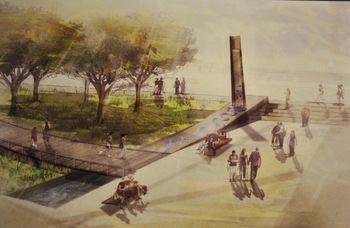
A German artist's public art proposal for a new sculpture in front of city hall could cost the city up to $850,000.
The City Council passed a public art ordinance in 2007 that dictates 1 percent of funds budgeted for city developments and some other infrastructure projects be set aside for public art projects.
By the end of this fiscal year, the public art fund will have accumulated about $1.5 million. The first use of that money being proposed includes a sculpture in front of the new police-courts building next to city hall.
Changes to the art ordinance proposed at Monday's meeting were approved for first reading and now await a public hearing and final approval. The change would reduce the contribution to a half-percent instead for the next three years.
Council Member Margie Teall, D-4th Ward, said if the city's financial situation was different, she'd fight cuts to public art funding. But she agreed it was the right choice for now.
The public art fund has been accumulating money for three years, but has not yet been tapped. The City Council will be asked soon to spend nearly $850,000 from the fund on a water-based sculpture in the lobby and courtyard at the new police-courts building currently under construction at Huron and Fifth Avenue.
Tamara Real, president of the Arts Alliance, a nonprofit organization that supports the arts in Ann Arbor, pleaded with council members at the start of Monday's meeting not to go through with the cutback. Real said city leaders can't take for granted that Ann Arbor will always remain the artsy town it is known as without a small level of investment in public art.
"Wiping out arts funding in no way fills the budget gap," she argued during the public comment period.
Margaret Parker, chairwoman of the Ann Arbor Public Art Commission, stated in an e-mail to AnnArbor.com that setting aside 1 percent of the funding on capital projects built by the city for permanent public art is a method that's been used successfully across the country for the last 30 years.
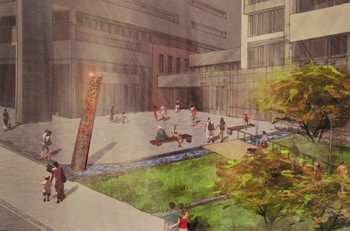
Another look at the public art proposal for the new police-courts building.
"Other cities in Michigan have made different kinds of investments in the arts to the great benefit of their entire communities," Parker said. "Jackson created a huge redevelopment project around the Armory Arts Village, an artist live-work space that attracts people to move to Jackson from around the country. Grand Rapids just spent close to $1 million on a two-and-a-half week art event, ArtPrize, that brought more than a 1,000 artists from around the world to their city and hundreds of thousands of visitors to their city."
Parker also noted Kalamazoo has an arts building that houses four floors of arts organizations, cafes, studio and practice spaces, and Ypsilanti has plans for an arts incubator where young artists can get their start.
"Ann Arbor can’t just sit still and hope to retain its reputation for innovation in the arts. It has to act to move forward," Parker said.
Council Member Sabra Briere, D-1st Ward, agreed the city has millions of dollars to cut from its budget and no guaranteed dollar amount will be saved from reducing the public art percentage.
"When we talk about reducing future allocations by one-half of 1 percent, we're talking about future capital improvements that we haven't decided how much we're spending," she said. "We're not really making a commitment to save a certain dollar amount. We're making a commitment to put aside less for art and we don't know how much less is and that's a really tough decision."
Ann Arbor officials said the belief the city is spending a bunch of money on art that it could use to help the poor or save firefighters' jobs is a myth. If the program was disbanded entirely, the money would have to be returned to the accounts from which they came. And none of the money to date has come from the general fund - contrary to previous statements that $12,500 of the public art fund came from general fund dollars.
Ryan J. Stanton covers government for AnnArbor.com. Reach him at ryanstanton@annarbor.com or 734-623-2529.
Comments
unrulyfan
Sat, Dec 12, 2009 : 3:52 p.m.
I hope they use the $$ to install more of those "art" bike racks. That was a "great" use of tax payer money. May I have a refund?
A2K
Wed, Dec 9, 2009 : 2:13 p.m.
If the money HAS to be spent (and as I am an artist/designer I feel that art and beautification of our public spaces is very important)instead of one huge $850,000 disbursement for one project, how about 10 or more "smaller" works done through the city...this is a huge amount of money, that could be used for beautifying many more places instead of just another "industro-era-knockoff" fountain.
frustrated
Wed, Dec 9, 2009 : 3:18 a.m.
1% to.5%....You're halfway there. City needs to discontinue useless/discretionary expenses before asking any employee to take a pay cut in this economy.
John Galt
Tue, Dec 8, 2009 : 10:29 p.m.
They should have cut the ENTIRE allocation. A waste of money when police, fire, schools and other BASIC services are being cut. Setting aside 0.5% is too much.
CynicA2
Tue, Dec 8, 2009 : 5:33 p.m.
A step in the right direction, but I suspect the city will be looking to rescind the entire public art financing boondoggle, as money for basic services becomes more difficult to find. Next year will be much worse, as the their won't be any Pfizer money coming in, and tax collections from other sources will probably continue to surprise on the downside. The day is rapidly approaching when the city will practically kill to get its' hands on an extra $850,000 or $1,500,000, just to make ends meet. The fact that our elected officials even went down this road in the first place just shows how out of touch with economic reality some of them are. As far as the "buckets" go - what council hath wrought, council can undo... nothing with respect to a political process is cast in stone. The sooner they undo this, the better.
brad
Tue, Dec 8, 2009 : 3:39 p.m.
An Economic Argument for Art: or how to Leverage 1% of a $1,000,000 project costs $650/year but the City will spend $10,000 immediately. If you add 10 projects, that's $6,500/year to spend $100,000 right now. I'll bet you could keep a few artists around. It's classic finance...but the magic can add up if you use this trick too often.
expono
Tue, Dec 8, 2009 : 2:51 p.m.
I work in Ann Arbor but live in a boring Detroit suburb with very few parks and even less public art. It is a dull and visually uninteresting place to live. Ann Arbor, because of it's commitment to art and parks is a very beautiful and pleasant place to visit. I hope the funds will be restored when the economy turns around.
Moose
Tue, Dec 8, 2009 : 2:22 p.m.
Did Ypsi and Kalamazoo build a public sculpture to attract creative types? NO! They didn't and yet Margaret Parker misses the point completely. She prefers to spend a million or so on yet another fountain in front of yet another government building (Now that's really thinking outside the box lol!) instead of trying something small that works like Ypsi and Kalamazoo are doing. If she wasn't so devoted to her narrow vision and paying homage to her political masters, maybe she would have advocated for proven strategies that actually attract and encourage a creative culture. "Parker also noted Kalamazoo has an arts building that houses four floors of arts organizations, cafes, studio and practice spaces, and Ypsilanti has plans for an arts incubator where young artists can get their start."
David Cahill
Tue, Dec 8, 2009 : 1:46 p.m.
Money can be moved from one fund to another during the budget year with eight City Council votes. The exception is for funds that are "restricted" by state or federal law, or by the city charter. Restrictions set by the art ordinance itself, though, don't matter because if that ordinance is repealed any restrictions contained within it disappear. Other restrictive city ordinances (if any) could be appropriately amended at the same time the art ordinance is repealed. I'm not saying moving the unrestricted part of this money around is simple. It's not. But it is possible with eight votes.
Really?
Tue, Dec 8, 2009 : 1:15 p.m.
Comments toward protecting this fund pointed to the fact that it empowered local artists. Good job Ann Arbor. Where's this artist from again? And does anyone know if this is STATE law that prohibits moving of funds, or AA city council law? They've moved money for the sacred trees, as well as the over budgeted city hall. But when it comes to saving jobs, they claim the money is all tied up... until THEY need it.
Moose
Tue, Dec 8, 2009 : 12:47 p.m.
"The money in the art fund can't be spent on the general fund where the problem is. It can't be used to pay for the fire dept. It would have to go back to the fund categories it came from." Bureaucrats made those stupid rules (as a way to play financial shell games), they can change them back. "85% of the money for the art project at city hall will be spent locally for the fabrication and installation of the piece." Since the so called budget for the Driesetl urinal is smoke and mirrors, can you guarantee that rosy prediction? The foreign car, local band and European orchestras arguments playing at the UM using tax dollars are all silly straw man arguments.
logo
Tue, Dec 8, 2009 : 12:37 p.m.
The money in the art fund can't be spent on the general fund where the problem is. It can't be used to pay for the fire dept. It would have to go back to the fund categories it came from. 85% of the money for the art project at city hall will be spent locally for the fabrication and installation of the piece. Sure its a foreign artist but since when does art recognize borders? How many people in A2 drive a foreign car or one not made in Michigan? Do we only go to see local bands? The University gets state tax dollars but they pay European orchestras to perform in the state owned Hill Auditorium. Are you against that?
Anonymous Due to Bigotry
Tue, Dec 8, 2009 : 12:35 p.m.
I don't understand why non-profit organizations can't raise enough money for public art. We have a lot of wealthy people in this town. Maybe none of them care about art? Or maybe local organizations don't know how to approach people with grant proposals? If someone insists on getting some out-of-town, out-of-country even, artist to build some sculpture somewhere, they should be putting up their own money for it. (And as much as I see art as a low priority, the least local government could do with public money is contract local artists! What the heck?) And yea, the mandatory designated funding scheme excuse sounds more like the identification of another problem that the city council should fix rather than complain about as though it were some fundamental law of thermodynamics or something.
Moose
Tue, Dec 8, 2009 : 12:30 p.m.
I like to watch movies in the theater. If I put $50 a month for movies in a bucket and don't go to the Michigan for a while, I have a couple hundred dollars in my movie bucket. I also put $100 a month into a bucket to fix my car when it breaks. If my car breaks down and I don't have enough money in my car repair bucket, I don't tell myself that I can't spend money from my movie bucket, I use the money in the movie bucket to fix my car. "It would be great if we all learn from this current economic dilemma to limit the erection of special purpose millages or funding mechanisms." (Thanks to Brian Kuehn) Let's say that suddenly a bridge falls down and there's a spare mill or two in the movie bucket... Would you go to movies?
Moose
Tue, Dec 8, 2009 : 12:12 p.m.
The politicians and the AAPAC just don't get it. Ann Arbor is a wannabe arts town. We figure that if we say "Ann Arbor = Art" enough it will be true. If it was an arts town, we'd do what Jackson did to attract artists instead putting up bike racks that say "art" or have an elite bunch of political appointees telling us what art is and then spending a cool million while bridges fall, firefighters are laid off and public employees are asked to take a 3% pay cut. Artist need bridges and public services more than they need a bunch of people telling them what and how to create. Artists will make their art wherever they are. It cannot be controlled or regulated. It must be organic and sustainable. Government cannot nor should it be in the business of deciding what constitutes a community artistic vision. The arts cannot be governed nor will artist be bound by governmental decisions makers. By their nature artists are experimenters and anti bureaucracy. Bureaucracy tend to stifle artistic expression. If the city wants to spend money on the arts let them help fund the many small local arts organizations that are arts incubators. Then maybe we'll see something new and inspiring instead of a fountain in front of a government building. Don't get me wrong I think it's good for all of us to support art and artistic diversity and that includes public funding for the arts, but it Ann arbor want to known as an artistic community, it need to let it happen organically and do the best it can to make A2 a place where artists want to be. What government can and should do is make sure that the city is a pleasant place to live and that there is opportunity for people and artists to grow and experiment. Oh, if the city made a bucket and put one percent of dollars spent on construction into it, they can just as easily drain that bucket and use that money for real stuff instead of being a wannabe art town. The whole idea of designated buckets of money for this and that ignores the real priorities and costs of government.
jcj
Tue, Dec 8, 2009 : 11:59 a.m.
Dalouie Money already appropriated cannot be moved I get it. But this will mean a smaller amount of money will be wasted on frivolous art projects in the near future.
a2idealist
Tue, Dec 8, 2009 : 11:21 a.m.
I agree with a2grateful. Those in support of the public art commission are right, it would be a mistake not to invest in the arts. However, I think a single, high-cost project with fees to non-local artists makes absolutely no sense for our community. Those funds should support local artists and local arts organizations in partnerships to produce public art. The investment is important, but there is a smarter way to do it. If private individuals and companies want to commission art project from artists elsewhere, that is their choice. But local tax dollars should remain in our local artist community.
Eric64
Tue, Dec 8, 2009 : 11:21 a.m.
Why does the city need a public Art Commission anyway. Wow a whole One percent.
townie
Tue, Dec 8, 2009 : 11:09 a.m.
I agree with Sarcastic1, it really does seem as though Council is having a lot more trouble cutting this fluff from the budget than they are with the idea of cutting firefighters or reducing salaries for City workers across-the-board. The private sector will step up and fund public art (if asked). They are not likely to step up and pay extra for basic services that they are already paying taxes and fees to receive. This cut does not go far enough. The City Hall art project needs to be canceled and all accumulated Percent for Art funds returned to their respective City accounts (some that are millage funds that should never have been touched in the first place). The Percent for Art program needs to be suspended indefinitely. We simply can't afford it.
Dalouie
Tue, Dec 8, 2009 : 11:07 a.m.
So next time you bash the city because you refuse to understand that most of the dollars they have cannot be moved around remember: Not a penny of the money that has been collected in the Arts fund can be spent on any function in the general fund. They cannot pay salaries with it, can't support the fire department or human services. I understand the bind the economy has put them in. I suppose this is symbolic and it will add a fraction to the other funds, sewers, etc., but I wish they didn't have to do it. Art matters a lot and it adds to the economy. 85% of the money called for in the city hall sculpture will be spent in the local economy and as some of council said last night, art builds a positive image for the city. That helps if you are trying to attract high tech companies.
treetowncartel
Tue, Dec 8, 2009 : 11:06 a.m.
Righton YpsiLivn, and you should also not put all your eggs in one basket. there are plenty of talented artist old and young who would probably donate their works/time in roder to gain some recognition.
YpsiLivin
Tue, Dec 8, 2009 : 10:43 a.m.
Mike D. said: They are taking costs out of projects that will be built a decade in the future during prosperous times... This is actually why so many people are in financial trouble. They insist upon banking on "future revenues." "Spend now because things will be better in the future!" There's this old saying that goes: "Don't count your chickens before they're hatched." The last recession in Michigan started in 2000. Ten years down the road, we're still in the same recession and by all accounts, there are no signs that things will be better in five years, or ten years... or even in thirty years, as one recent Pew report reckons. Hope for the best, but plan for the worst.
TripleVSix
Tue, Dec 8, 2009 : 10:37 a.m.
"Tamara Real, president of the Arts Alliance, a nonprofit organization that supports the arts in Ann Arbor, pleaded with council members at the start of Monday's meeting not to go through with the cutback. Real said city leaders can't take for granted that Ann Arbor will always remain the artsy town it is known as without a small level of investment in public art." Tamara Real can't take for granted that Ann Arbor will always remain a town at it's current level of spending.
jcj
Tue, Dec 8, 2009 : 10:35 a.m.
Let me rephrase this. I did not think my comments were anymore personal than calling people who disagree with you "small-minded, one-issue loudmouths" Any person that thinks this is not the right move has their head in the sand! I am tired of people who make their living off the public tax money crying foul when the public wants something to say about where that money is spent!
Steve Pepple
Tue, Dec 8, 2009 : 10:24 a.m.
A comment was removed because it contained a personal attack against another commenter.
Brian Kuehn
Tue, Dec 8, 2009 : 9:07 a.m.
The idea of a specific set-aside for the arts demonstrates the problem with mandatory designated funding schemes. The arts funding seemed like a small amount; it was just 1%. However, given time, it accumulated a significant amount of money. Now we have $1,500,000 that we MUST spend on art at a time when we are talking about laying off people, cutting pay, and closing parks. We have a similar situation with the Greenbelt ordinance. There is a lot of money sitting in that fund that can not be used for any purpose other than expanding the Greenbelt or acquiring new parkland (which of course we are unable to afford to maintain). Both the Arts fund and the Greenbelt/Park fund are noble ideas but their existence severely limits our flexibility in directing spending toward those issues that perhaps have a higher priority in the more near term. It would be great if we all learn from this current economic dilemma to limit the erection of special purpose millages or funding mechanisms.
Sarcastic1
Tue, Dec 8, 2009 : 9:01 a.m.
It appears to me that cutting funding for art is more difficult for council memebers than laying off firefighters and police officers. Although not surprising, it is disturbing.
treetowncartel
Tue, Dec 8, 2009 : 8:55 a.m.
Why not have the city residents from the DeLonis Center paint a mural in the new city hall instead of someone from across the pond?
a2grateful
Tue, Dec 8, 2009 : 8:37 a.m.
If we wish to nurture the arts in our community, follow this idea: Support art in Ann Arbor. Example:. Give scholarships to schools and students at university and k12 levels. Include visual arts, music, dance, etc.. Establish level of support for different entities: a) Public schools: 33% of fund establishes capitation rate of k12 support. b) U of M: 33% of fund establishes annual scholarships of up to $10,000. c) 15% of fund establishes annual research/support stipends for City resident artists. d) 15% of fund supports City nonprofit art schools/guilds. e) 2% of fund supports guest artist appearances. f) 1% of fund (or less) is for administrative costs.. What do we receive in return? a) Support of local art and artists at many levels. b) Funding of art when other sources are ending. c) The support from local artists in providing art to the city, on a temporary or permanent, basis, to be displayed in new City Hall, hospitals, schools, etc.. Supporting the arts in Ann Arbor means exactly that. Also, imagine if one of our artist beneficiaries returned in the future to establish some type of legacy fund here, in conjunction with our own funding?. Keep our precious art funds in our community, supporting arts and artists in our community!
xmo
Tue, Dec 8, 2009 : 8:31 a.m.
I think the solution is to have an voluntary ART TAX. All of you people who think that this is terrible please send your money into the city council to save ART. That should be able to fund all of the projects we need.
Mike D.
Tue, Dec 8, 2009 : 7:55 a.m.
I may be in the minority on this website, but I think this is a travesty. We're sacrificing an important part of our municipal cultural legacy over a populist outcry that won't save a meaningful amount of money anytime soon. They are taking costs out of projects that will be built a decade in the future during prosperous times, and by then everyone will then be asking why council is a bunch of cheapskates. But it will be a different bunch of people by then, so who cares now, right? This is why I couldn't be in politicstoo much dealing with small-minded, one-issue loudmouths and no appreciation from the constituency for the long haul or the big picture.
Stop & Think
Tue, Dec 8, 2009 : 7:30 a.m.
Well, how do you like those apples? City council finally had some sense and decided offering up the city's check book on so called "art" wasn't such a good idea. Baby steps.......
Awakened
Tue, Dec 8, 2009 : 6:44 a.m.
About time!