

Ann Arbor city officials beginning to plan for more cuts in next fiscal year's budget
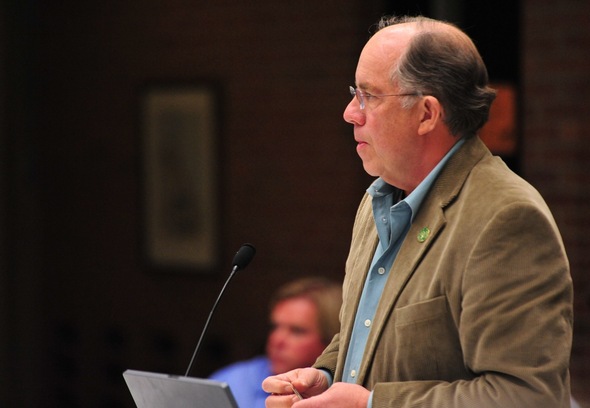
Ann Arbor City Administrator Roger Fraser told City Council members Monday night the work begins Dec. 4 on identifying possible cuts to the city's budget.
Ryan J. Stanton | AnnArbor.com
(This story has been updated with additional comments from Mayor John Hieftje.)
Ann Arbor City Administrator Roger Fraser says he's "terribly concerned" about what could happen in the next two years if the state of Michigan makes major budget cuts.
"If you take a look at the hole that the state is in, and its own spending plan for 2013 and 2014, the consequences of that, I believe, are going to be felt at the local level," he told members of the Ann Arbor City Council during a report Monday night.
City officials are expected to begin planning for future budget cuts during an all-day budget workshop at the Wheeler Service Center, 4251 Stone School Road, on Dec. 4. It's the kickoff to a six-month budget process where city officials will come up with a new two-year fiscal plan.
At last year's budget retreat, Fraser told council members the city was facing a deficit of several million dollars and would need to make painful cuts to city services. That led to months of discussions about laying off employees and eliminating various programs — but ultimately the city adopted a budget with less severe cuts than expected.
"We're anticipating that the first year of our next two-year cycle will not be nearly as financially difficult as the present year has been in getting to a budget," Fraser said. "But we're still expecting that we're going to have to take 4 to 5 or maybe even 6 percent out, as we used to do from year to year, just as a consequence of the structural deficit that we have in our finances."
Fraser said the year after that looks worse.
"If we're not getting the kind of recovery that we're talking about, we could be in the 7 to 10 percent range for the second year of this process," Fraser said. "We'll know better as we get farther down the road. It's still going to be a magician's ball that we're working from."
The city's general fund spending dropped from $85.81 million in 2008-09 to $81.45 million now budgeted for 2010-11 — a $4.36 million decrease. Trimming the general fund by 4 to 6 percent more would reduce the budget by $3.2 million to $4.9 million.
While the general fund has been shrinking due to declining property values and cuts in state revenue sharing, total city spending has grown from $260.3 million in 2008-09 to $345.5 million budgeted for 2010-11, city records show.
Tom Crawford, the city's chief financial officer, said today he doesn't yet have estimated budget figures for fiscal year 2011-12, but those will be presented to council on Dec. 4.
City staff has kicked around the idea of implementing a city income tax to help stabilize the budget, a measure a majority of council members have said they'd consider.
Mayor John Hieftje called it "a little early" to put a number on the expected revenue shortfall for next year. He said a lot depends on what happens in Lansing.
"The state has been cutting funding to the cities off and on for a long time and they will have to cut some more next year," he said. "The best thing the governor and Legislature could do for local governments would be to abolish Act 312. It tilts the playing field for labor negotiations."
Hieftje said he considers the city's general fund reserve healthy and the city's debt load moderate, which is why the city has maintained a good bond rating.
"Adjustments will be needed to balance expenditures with expected revenues in the operating budget," he said of the upcoming budget process. But he said "it looks like things will work out" with a parking agreement between the city and the Downtown Development Authority, which has fed $2 million a year to the city's general fund for the past several years.
"That, along with the efficiencies put in place in past budgets, means we won't face as steep a challenge as last year," Hieftje said.
The work schedule for the two-year fiscal plan is as follows:
- December — Council offsite workshop, Capital Improvements Plan approval by Planning Commission.
- January — Council adopts Capital Improvements Plan.
- February — Council workshop: review service area proposals.
- March — Council workshop: review service area proposals.
- April — Council working session: Administrator's draft budget recommendation, town hall meeting at CTN television studios.
- May — Council meeting: proposed fee changes, budget approval.
Ryan J. Stanton covers government and politics for AnnArbor.com. Reach him at ryanstanton@annarbor.com or 734-623-2529.
Comments
L. C. Burgundy
Sat, Nov 13, 2010 : 2:32 a.m.
You probably think they're being accommodating by saying, "Take a 25% pay cut or we're going to arbitration and laying off." ---- Yeah, pretty much. If it's more economical to the city and the work will still be done satisfactorily, then yeah, they should go ahead with such negotiations. I don't hate unions per se, but the whole idea of public sector unions that "negotiate" with government officials who are themselves just taking what they need to pay for the contract from a third party (taxpayers) who get no direct say in the actual negotiation process is pretty odious. The impending default of California (which can't be more than a year away at this point) is going to be instructive about this problem.
L. C. Burgundy
Thu, Nov 11, 2010 : 11:25 a.m.
Well, Born, if it were up to me, public sector unions would be abolished entirely, so yes, I think the city is being pretty accommodating to you.
AlphaAlpha
Wed, Nov 10, 2010 : 8:48 p.m.
So, you think 312 should maybe be abolished? What do you think will happen if 312 is abolished?
grye
Wed, Nov 10, 2010 : 10:39 a.m.
If the money is there but is not useable due to how or why it was collected, then there needs to be change to funding/expenditure regulations. I earn an income that I can spend as I see fit. I try to budget but the budget often needs tweeking. This process should be allowed within the city finance department. Too often funds are spent on unnecessary items with the thought, 'can't leave the money on the table, it won't be there next year'. Why spend wastefully when the money can be used where it is needed.
sbbuilder
Wed, Nov 10, 2010 : 10:06 a.m.
We'll probably wind up following the same scenario as the auto companies. Sell off divisions, mortgage to the hilt, do everything, in fact, except touch those precious union contracts. (Thanks, Mr Gettlefinger.) When everything else fails to keep the ship from sinking, just like the UAW finally realized that there may be no plants to send their workers, then they will be forced into negotiations that will finally bring them into line. Let's face it, there is no more 'Generous Motors'. The artificially high hourly rates, and the delux benefits are gone. Long gone. Why go the long route around to come to this place? It's going to come to this eventually, and City Council knows it. But they want to appear to do everything possible to look like the good union pleasers they are. Have the guts to address the core of the problem.
jcj
Wed, Nov 10, 2010 : 9 a.m.
One thing they can leave out of the budget next year is; Sending the street sweepers around this time of year when there is no leaf pick up! They just went down our street. And I can see NO benifit when leaves are piled in the street (we keep ours picked up!)and they just fluff them up! What a waste of tax payer monies! I guess since these guys are on the payroll anyway the city must think it will fool the residents into thinking they are getting something for their money! They might as well sit in the shop and drink coffee.
a2grateful
Wed, Nov 10, 2010 : 8:46 a.m.
To those citing legit expenditures that will be challenging the budget: You are absolutely correct. We have essential infrastructure to rebuild. The cost of the sewer plant, with a large part of the cost already reserved, is not a break the bank endeavor, especially if the folly capital items were not in the picture. Does anyone on a2.com still think that the City "needs" the $100 million hotel on the $100 million parking garage? Does anyone here still think that Ann Arbor is immune from world economic woes? If so, urge your reps to spend away. Today's WSJ has a very interesting article on municipal bond defaults and municipal bankruptcies. As the city continues to pump cash out its jugular on non essentials, it may only be just a matter of time...
digger
Wed, Nov 10, 2010 : 6:50 a.m.
Looks like a great opportunity to repeal the city CUB agreements and save money on contrating. I'm sure that'll save money. City council will take they're usual way out and raise taxes and continue paying premuims on all their purchases
AlphaAlpha
Wed, Nov 10, 2010 : 6:22 a.m.
"This is the type of city that is attractive enought to keep businesses in town, even with a small income tax on the employees." Um, no thank you Bill. Trolling? Take a look the cities with income taxes. Virtually without exception, the post-tax outcomes were disastrous.
Marshall Applewhite
Wed, Nov 10, 2010 : 5:06 a.m.
The 800 lb elephant in the room is this: Can anyone explain why we have public sector unions in the first place? I'll wait.
Awakened
Wed, Nov 10, 2010 : 3:26 a.m.
You will not hear them cutting back on furniture or perks for administrators; they go right to cutting police and fire. "Give us money or your family won't be safe" is illegal in some states.
Speechless
Tue, Nov 9, 2010 : 11:28 p.m.
"... Mayor John Hieftje... said... 'The best thing the governor and Legislature could do for local governments would be to abolish Act 312. It tilts the playing field for labor negotiations.'..." In reference to Public Act 312, approved back in 1969 and signed by then-Gov. Milliken, the state police officers association comments, "It specifically acknowledges compulsory arbitration as the quid pro quo for no strikes." In other words, police and firefighters cannot legally go out on strike. Arbitration is the compensation provided under law that allows them to maintain some leverage in contract negotiations. One question here is the mayor's intent. Does he want Lansing to dump the law so that police and fire dept. personnel may legally walk out following stalled contract negotiations? Somehow, I doubt he means that. The other, more likely, scenario is that he wishes for compulsory arbitration to be abolished while the act of going on strike still remains illegal. Yes, that would change the tilt on the 'playing field.' The angle, in fact, would be almost 90 degrees — in the favor of city and county administrations. Police and fire unions would thus bargain from a position of near powerlessness. If this latter scenario is accurate, then the Democratic mayor has chosen to align himself with the mindset of the Tea Party or the bullying of Glenn Beck. Will Hieftje speak up to further clarify what it is he and the administration are after?
lester88
Tue, Nov 9, 2010 : 10:15 p.m.
""The best thing the governor and Legislature could do for local governments would be to abolish Act 312. It tilts the playing field for labor negotiations."" For once I agree with the mayor. Except..... PA 312 tips the table fairly, not to the advantage of public safety workers as he attempts to lead one to believe. Easy to research how many governments reach labor agreements without going to arbitration. As predicted, this is the first volley of attacks on the municipal workers of A2. It's old and it's tired. A2 government spends money like drunken sailors on pet projects then cries poverty. It's difficult to convince an arbitrator of the inability to pay when you give money away(we all know this to be fact)by the millions. Public Act 312 keeps governments like A2 honest and it forces them to open the books. Shameful Mr. Mayor, just shameful. Shame on A2.com as well for continuing to report/blog this same tired story.
dotdash
Tue, Nov 9, 2010 : 10:05 p.m.
I, for one, am thankful for the hard work that local government officials do to keep the town running. The surly and ungrateful don't speak for me, and I urge anyone with their trigger finger on the flame button to slow down and reconsider their words. It's easy to be critical -- man up and contribute something positive.
Fat Bill
Tue, Nov 9, 2010 : 9:54 p.m.
Let's get a move on with the city income tax already! I am one of those who live in the 'burbs, but work in Ann Arbor. This is the type of city that is attractive enought to keep businesses in town, even with a small income tax on the employees. If you continue to let the quality of life suffer in the name of "No New Taxes", Ann Arbor will become merely average, and an income tax will be less tenable...
AlphaAlpha
Tue, Nov 9, 2010 : 9:45 p.m.
"How about we eliminate that "onerous" Act 312 for police and firefighters and allow strikes by those employees? Sounds fair to me. Eliminate arbitration, allow strikes!" Indeed. And with consequences. Much Like. Mr. Poli's 'irreplaceable' striking air traffic controllers...
BenWoodruff
Tue, Nov 9, 2010 : 9:35 p.m.
No problem, Mayor. How about we eliminate that "onerous" Act 312 for police and firefighters and allow strikes by those employees? Sounds fair to me. Eliminate arbitration, allow strikes!
Listen
Tue, Nov 9, 2010 : 9:20 p.m.
I haven't been able to open the pdf documents for the current and prior budgets, but I am guessing that a large percentage of the increase in spending isn't because the city officials "wanted" to spend more. Health care costs have been rising dramatically, and with no increases in co-pays the city budget has to absorb all increases. I assume health care and benefits are a HUGE portion of general fund expenditures, and if the cost of health care rises by 20-25% (as I understand it has for some companies I deal with), then the budget takes a tremendous hit. Hence the need to open and renegotiate contracts. Employers, including the city, cannot afford to continue to cover 100% of these costs when there seems to be no ceiling.
Stephen Landes
Tue, Nov 9, 2010 : 9:17 p.m.
@Ryan J. Stanton -- Thank you for the link to the budget documents. The $84 million general fund budget is apparently a much smaller issue than the "real" budget which is increasing at a high rate. We need to be concentrating on the real budget and not just the general fund piece. One way or another it is the $345 million chunk that we are paying for.
trs80
Tue, Nov 9, 2010 : 8:45 p.m.
Recovery.gov shows millions poured into Ann Arbor. Where did it go? Over five million to fix West Stadium, another 18 million to fix the bridge. Gald to see not only my state tax dollars but my federal tax dollars getting lost in translation.
Vivienne Armentrout
Tue, Nov 9, 2010 : 8:30 p.m.
Ha, the council receives a stipend of approximately $15,000 a year and they put in long hours when they could be earning actual money. People who think public servants (yes, elected people are public servants and are trying to do the best they can to serve the public good) should work for free are not thinking. First, at that level it is only a token amount and is insignificant in the greater picture of the incredible amounts that are involved. Second, having a modest stipend means that people of modest means can afford to take this type of assignment on. Otherwise, it is only the wealthy or the corrupt who can do this work. So let's stop suggesting that council work for free and get on with the major decisions.
Tim Darton
Tue, Nov 9, 2010 : 8:17 p.m.
Get over it. There is probably no city in the state that will not be making cuts for the next budget year. The millage in Ann Arbor has not gone up in over ten years and yet A2 government is still in better shape than any other city Of course overall spending has gone up, they are building a new sewage treatment plant to replace the one built 80 years ago. Do you want the stuff you flush to go down or bubble back up? This alone is $150 million plus a mostly new Plymouth Rd., a big portion of Stadium, Miller, etc, and a whole lot of water and sewer mains. All this stuff is outside of the general fund, money they can't spend on cops. At least make an effort to understand. They are building a new sewage plant while still having some of the lowest water and sewer rates in the state. Anybody who was paying attention to last years budget would know there are more cuts to made. It was stated many times. Everyone knew this but the still the bottom line is, the council was just voted in by 70% in the primary and the general election.
stunhsif
Tue, Nov 9, 2010 : 7:51 p.m.
You just beat me to the punch Jay Thomas. As you said they budget to increase spending over 30% in the next two years knowing that the money coming in from taxes is going the opposite direction. Individuals like myself have seen their incomes drop by almost as much as the City wants to raise spending. Insanity for certain, how do these clowns get elected, by other clowns I suppose. As SSBuilder said in an earlier post, the only way to address things is to open contracts for the unions and have layoffs of paycuts for others.
Ian
Tue, Nov 9, 2010 : 7:43 p.m.
Maybe Ann Arbor can start printing their own money just as the feds do out of thin air. Why not. If people have not noticed, starting with the Bush admin., the federal/central government has grown leaps and bounds (still growing). While the state and local governments have shrunk. Very ominous development as history shows.
Jay Thomas
Tue, Nov 9, 2010 : 6:53 p.m.
"While the general fund has been shrinking due to declining property values and cuts in state revenue sharing, total city spending has grown from $260.3 million in 2008-09 to $345.5 million budgeted for 2010-11, city records show." An over a 30% increase in spending in just two years? I can't believe this... just unfathomable. We have the worst economy since the 1930's... and they are on a spending binge like it's the late 90's. :|
A2Medic
Tue, Nov 9, 2010 : 6:44 p.m.
Layoff off more police officers this time.. With thanks and love, The Fire Department..
The Black Stallion3
Tue, Nov 9, 2010 : 6:01 p.m.
Start the cutting by reducing the city council pay by 50%. Show the citizens that you are willing to sacrifice if they have to. You are no better than us.
sbbuilder
Tue, Nov 9, 2010 : 6 p.m.
We knew this was coming a long time ago. This isn't new news. In two years we will most likely be in worse shape. Why not just plan for that? Healthcare, retirement, benefits. The big ugly trefecta. Nibble away at the composting thing, outsource here and there, but for crying out loud, whatever you do, don't change those solid gold, platinum plated, diamond studded union contracts. NooOOOOOOooooo. Bleed the rest of the City dry before doing that. Cut back on services. Sell golf courses. Leave the leaves on the streets, and tell us how that's a wonderful thing. The union contracts must be addressed, and addressed quickly, whether they like it or not.
AlphaAlpha
Tue, Nov 9, 2010 : 4:45 p.m.
""The best thing the governor and Legislature could do for local governments would be to abolish Act 312. It tilts the playing field for labor negotiations."" OK then. That's clear enough. Where is Mr. Snyder? And what is his plan to help?
LiberalNIMBY
Tue, Nov 9, 2010 : 4:24 p.m.
Welcome to DIY government! Better make sure your smoke detectors are working and that your side arm is loaded.
Vivienne Armentrout
Tue, Nov 9, 2010 : 4:20 p.m.
Mr. Steklac, those funds are paying part of the debt service but the initial funding of the Police Courts (according to a summary produced in February 2008) included $8.4 million from the Municipal Center Fund, which was simply set aside years earlier from the General Fund. In addition $1.8 million was designated in that year from the General Fund itself. The city planned at that time to issue $21 million in debt. We have been making those payments for a couple of years now, yet the payments were scheduled in part to be paid from discontinued leases for offices elsewhere that we are still occupying. The funding also presumed the $3 million for the Village Green purchase at First and Washington (this is from memory, not from the sheet to which I am referring) and that payment has not yet been made. The DDA made a substantial contribution as well. Note that there have been several new allocations voted in that were not part of the original estimate. Also, it has been acknowledged that operating expenses for the new building are higher than previous costs. The beginning of our budget problems was not the Police Courts building, but it vastly accelerated them by draining our reserves just at the time we were entering a troubled economy statewide.
sierra
Tue, Nov 9, 2010 : 4:17 p.m.
Wow this got started pretty early this year. Every year its the same old song and dance. "the city has no money. This year is going to be a state of crisis....." yada yada yada. can anyone tell me how much the city administrator makes compared to other cities? Ann Arbor is better off than 98% of the cities its size.
a2grateful
Tue, Nov 9, 2010 : 3:55 p.m.
EyeHeartA2: Sure, go ahead and use that... spell check it though, since I obviously didn't...; )
MJSteklac
Tue, Nov 9, 2010 : 3:53 p.m.
@Alan Goldsmith It is the general fund that is at most risk. I believe the traffic signals, the art projects, sump pumps, and Court-Police Building are funded from other funds such as the street fund, sewer fund, etc. The monies in those funds generally cannot be brought over to pay for shortfalls in the general fund.
Ryan J. Stanton
Tue, Nov 9, 2010 : 3:43 p.m.
@AAresident Page 97 of the FY2011 Budget Book, which can be found here: http://www.a2gov.org/government/financeadminservices/Pages/Home.aspx
AAresident
Tue, Nov 9, 2010 : 3:27 p.m.
"While the general fund has been shrinking due to declining property values and cuts in state revenue sharing, total city spending has grown from $260.3 million in 2008-09 to $345.5 million budgeted for 2010-11, city records show." Can you point us to where these figures are shown by the city? Thank you.
a2grateful
Tue, Nov 9, 2010 : 3:23 p.m.
The dark side of fiscal folly crying, "We have no money for juror furniture (maybe we should use the porch ban couches). We have no money for infrastructure repair... We have no money for leaf pickup... We have no money for ordinance enforcement... We have no money for employees... We have no money for pensions..." The light side of fiscal folly flatulence, "Look at the view from new office... Isn't the fountain beautiful?"; /
ERIC MEYERS
Tue, Nov 9, 2010 : 2:48 p.m.
Maybe we need to stop paying the city council, and stop giving roger fraser gas voucher's every year.And Mr Mayor stop all the building in the city and all the federal tax dollars you continue to waste.