

Deep cuts to police and fire avoided as Ann Arbor City Council approves 2010-11 budget
During a nearly six-hour meeting that stretched until close to 1 a.m., the Ann Arbor City Council passed a budget Monday night for the upcoming fiscal year that — although not entirely balanced — carries the city forward in relatively stable condition.
The council decided unanimously to use a $2 million transfer of parking revenue from the Downtown Development Authority, add $952,000 back to projections for state revenue sharing, and increase parking fine rates to generate an additional $625,000 in revenue.
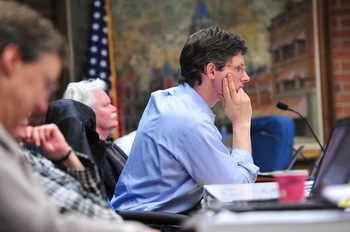
Council Member Carsten Hohnke applauded fellow city officials Monday night for passing a budget that avoids deep cuts without raising taxes.
Ryan J. Stanton | AnnArbor.com
"It is with more than hope that I think we can confirm that the revenue sharing will remain whole," Mayor John Hieftje said. "We're relying on the best knowledge that we have available to us today and taking that knowledge and moving forward with it."
The nearly $3.6 million realized from those three measures brought general fund revenue for 2010-11 back up to about $79.9 million, which was enough to save 30 jobs in public safety, avoid a $260,000 cut to human services agencies, and halt plans to reduce park mowing and trimming.
"The county made a deep cut in human services when they did their budget, the state's been cutting their budgets for some time, and we are in some ways the last safety net to keep some of these agencies at work," Hieftje said. "It's remarkable. I think it says a lot about the members of the council that have served in the last several years that — in fact, if you go back over the years — Ann Arbor has actually increased its human services funding at a time when other cities have stopped doing it altogether."
Five positions are being cut in both the police department and fire department. Previously, 20 positions in each department had been slated for elimination under the city administrator's budget.
Police Chief Barnett Jones said the police department will be able to maintain current staffing levels. The five positions being cut have been held vacant for several months.
"It would allow us to maintain a proactive response, allow us to maintain (the Community Response Unit), allow us to maintain our numbers on the street," Jones said.
Fire Chief Dominick Lanza said the elimination of five positions in the fire department is manageable. He said fire stations will stay open, and the city still will be able to get at least four firefighters on the scene of a fire as quickly as it does today.
Lanza also said the city would be able to put 18 firefighters on the scene of a working fire within eight minutes, maintaining the city's insurance rating. He said it may take adjustments in the fire department's administrative staff to accomplish that, but it can be done.
Lanza said he'd like to reorganize the department, which would leave a net loss of three firefighters. One position currently is vacant, and six or seven firefighters are eligible for retirement, so there's a good possibility no one will lose their job, he said.

Police Chief Barnett Jones, right, and Fire Chief Dominick Lanza address the City Council Monday night.
Ryan J. Stanton | AnnArbor.com
About 60 people attended the meeting, including several firefighters and many of the council's political challengers in this year's elections. Most of them filed out as the budget was approved with little contention.
Council Member Carsten Hohnke, D-5th Ward, said protecting public safety services was the best possible use of the $2 million from the DDA.
"A number of DDA members indicated it was their hope that the funds being transferred to the general fund would be used to support safety services, and there was also some concern expressed that that might not happen given the absence of an agreement at that time," he said. "So I'm also pleased that this amendment allows us to address those concerns."
The budget as presented by City Administrator Roger Fraser last month included a $1.53 million deficit for the new year starting in July. The council took no steps to close that gap.
Council members agreed it was OK that most of the amount being absorbed by the fund balance was for one-time capital expenses related to the police-courts building project.
"Where we draw the line is we don't want to spend our fund reserve on recurring expenses," Hieftje said, noting the added police-courts costs were always anticipated in addition to the $47.4 million project budget.
"It was never supposed to be built into the budget of the police and courts building," he said. "Those were some costs that weren't exactly known at that time, things like security equipment and some other high-technology type equipment, and that makes up the bulk of it."
Hieftje said city officials worked year-round on the budget this year.
"We really didn't stop working on this process from when we did it last year at this time, and that's probably what we're going to need to do in the coming fiscal year as well," he said.
Hieftje said he expects to have a clearer picture in the next few weeks showing where other Michigan cities fare with their budgets.
"As we take a look at that, we can make a comparison of where we stand. From what I can see so far ... we've come out of this in very good shape compared to other cities," he said, adding Ann Arbor's city budget usually wins an award every year. "I think there's about 5 or 10 percent of the cities in the nation that get it."
Council Member Sandi Smith, D-1st Ward, said she enjoyed the dialogue that surrounded this year's budget process.
"I think it's given us an opportunity to talk in the community about what our priorities are and I'm pretty proud of Ann Arbor and where we are today considering that we are residing in the state of Michigan," she said. "It's been a long hard road, but I would like to thank specifically the staff that spent so much time on getting us to this place."
Hohnke said he was glad the city passed a budget without increasing its millage rate while keeping safety services and human services intact.
"I think, as amended, the budget is a healthy and fiscally responsible one and serves the people of Ann Arbor well," he said. "If you look across the state, most communities are grappling with either millage rate increases, some kinds of tax increases, or significant layoffs in personnel. Sterling Heights, Taylor, Holland, Flint, Grand Rapids, Lansing — all of these communities are grappling with these significant issues."
Council Member Stephen Kunselman, D-3rd Ward, reminded his peers the city isn't out of the woods yet. He said next year will be the same story, as the city's administration already is predicting another deficit of $5 million or more in 2011-12.
The council voted Monday night in favor of an amendment halting plans to raise $25,000 in new revenue by allowing parking at Allmendinger and Frisinger parks during University of Michigan football games. Several residents had protested, saying it would damage the grassy fields.
Other amendments proposed to dig into reserve funds to avoid fee increases for contractor registration, rental housing inspection and planning were defeated by a majority of council members. Kunselman also lost a battle to decrease the city's tax administration fee revenue by $453,000. The fee is imposed on property owners in Ann Arbor to offset costs incurred by the city in collecting taxes and assessing properties.
Smith also proposed an additional amendment to avoid de-energizing certain street lights in the city, but that too was defeated.
Ryan J. Stanton covers government for AnnArbor.com. Reach him at ryanstanton@annarbor.com or 734-623-2529.
Comments
Rudy Caparros
Tue, Dec 11, 2012 : 6:33 p.m.
HazMat Experts and Firefighters petition Dow Chemical and Union Pacific for safe rail tank cars transporting gas chlorine. Secondary containment is a necessary improvement that must be implemented. See--PETITION C KIT for First Responders Comments.
Awakened
Thu, May 20, 2010 : 7:32 a.m.
Irritated's comment made me think of something.... Unions have been declining in the private sector for years but not in the public sector. Maybe that is because the same people who screw up these budgets are their bosses!!
irritated
Wed, May 19, 2010 : 4:07 p.m.
Well I hope the AAFD Union learned there lesson, you do not ever voluntarily take pay/benefit cuts no matter what the threat may be. It makes no sense for Firefighters to pay there own wages/benefits, that's the responsibility of the city.The AAFD knew when they took the cuts it would only buy them 6 months of reprieve, yet they did it anyway (Dumbfellows).Had the city actually laid the FF's off in Jan they could have been recalled with this new found money and non of there Union brothers would have lost 4% of there careers. My advice to the FF's is to be willing to work with what ever number of FF's the city is willing to fund, otherwise your going to find yourselves working for a lot less....
Speechless
Wed, May 19, 2010 : 11:26 a.m.
Karen's analogy is very overdrawn but not inherently flawed. As I gather, the city casually scooped up a very sizable pile of change from reserve to throw at the new courts building in order to cover a wrong guess on construction costs. At the same time, however, the city has also swung a sharp, gleaming ax over (to list a few examples) the senior center, Mack Pool, and other longtime recreational facilities of comparatively minor budget cost. Then, of course, there was the ax dangling over some personnel in the fire & police departments. The mayor seeks a rationale to justify this kind of prioritization, and hence we now have the devaluation of budget costs which recur every year. So... our contractors need another quick million or two to finish the new building? Very well, then, here it is. But wait that recreation center costs us $140,000 annually? Why, that's just so financially irresponsible! As to Karen's metaphor of kids becoming permanently deprived of dinner, the elimination of modest-use municipal recreational resources just isn't equivalent to facing chronic hunger and malnutrition. Nor would a reduction in fire and police personnel reach that level of comparison. Nonetheless, Karen's point about how priorities are being set at city hall still holds. It's obviously silly for the city to rate social "value" for a line item based primarily on its categorization as either a one-time or ongoing expense. And, in the case of reaching in and taking $2M from the DDA, it's clear the city will do whatever it needs to do to get the budget numbers to work. In this context, the city's renders moot its own rationale built around one-time vs. ongoing annual costs. Now, if the city were to zero-out residential garbage pickup because it's a recurring expense, then her metaphor would be much less overdrawn....
Steve the Wookiee
Wed, May 19, 2010 : 8:28 a.m.
@ Karen - according to the National Advisory Council on State and Local Budgeting Practices section 4.1.4 "Reserve funds...may be used at a government's discretion to address temporary cash flow shortages, emergencies, unanticipated economic downturns, and one-time opportunities." http://www.co.larimer.co.us/budget/budget_practices.pdf I think the city is wise (in this instance) to not use reserve dollars for on-going expenses. In your analogy, you state that it is akin to a family not dipping into savings to eat dinner when mom has lost her job. But the city hasn't lost it's revenue stream (although there is certainly a decline). A family shouldn't dip into savings to buy groceries, they should align their expenses with their revenues, just as the city should. But when an emergency comes up, I think we would all agree, it's ok to dip into savings. That's why it's there.
RecentlyMoved
Wed, May 19, 2010 : 8:12 a.m.
I just love the comments from the residents of Ann Arbor (of which I am a resident in ann Arbor). People complain about no planning for the future, but when the City plans for the future by putting money into savings for one project or another some citizen or union starts claiming that "... there so much xtra money in x fund that is not being used so let's just take that to pay for y project or z% raises or prevent w layoffs..." In all the places that I have lived this always comes up in the public sector whether it is government, education or other public employer. For example, I am sure that if the city had $5 Mil in the bank for replacement of the a bridge that did not need to be replaced for another 10 years people would say let's take that money and prevent layoffs. I believe that if the city did that, then in 10 years when we need to replace the bridge, the citizens will complain that city leadership did not plan for its replacement. It is just a no win scenario. In another thought I must applaud the leaders of the city, both council and management, that they willingly work in jobs that no matter what they do they will always be vilified by the citizenry for everything they do.
scooter dog
Wed, May 19, 2010 : 8:08 a.m.
I don't see why we even need a full time police force when we have the judges we have in this city. Why waste taxpayers money arresting crooks,murders when they give attempted murders PROBATION and a 15 day jail sentence. Really sends a good message to the police doesent it. You arrest em whe'll let em go free,case closed
racerx
Wed, May 19, 2010 : 1:20 a.m.
@karen sidney/steve bean-Steve, I would have to agree with your assessments about Karen's keen insight. However, I would have to disagree with your point about her rehetoric as it relates to this story. Her pointing out the short-sighted view that the Mayor seems to take in making crucial decisions for the city is laughable at best. Karen is just making note of how, at times, these asburd choices are made. How can you build a structure as such with its costs to taxpayers and not even have construction drawings or costs that you should have known about (x-ray machines, etc)? I think this is what angers a lot of citizens in the city. City Hall's lack of leadership in the buget process and determining needs versus wants in these financial hard times, which, didn't just creep up on the city. Michigan had been in a recession before the rest of the nation and contiues to lag behind. This isn't something that occured overnight. Nor was the need for a new courts building or bridge. But planning for the long range needs of the city and not waiting until you are pressed is the frustrating aspect that continues to fail our leaders.
Steve Bean
Tue, May 18, 2010 : 9:03 p.m.
Karen, that's a flawed and hyperbolic analogy. Your research, expertise, and analysis are valuable, and I think a lot of us greatly appreciate themmaybe more than you're aware. I wonder if your rhetoric tends to undercut that value.
Karen Sidney
Tue, May 18, 2010 : 6:24 p.m.
Mayor Hieftje says that the city always expected to spend more than $47.4 million on the police courts budget because some of the costs weren't exactly known at the time. In fact, none of the costs were exactly known at the time the city approved spending $47.4 million because there were no construction drawings. There are unanticipated costs in construction projects but it's hard to believe that the city did not anticipate they would have to pay movers or buy baggage x-ray machines, metal detectors and security cameras and monitors for this project. Claiming it is OK to use reserves to pay for one time items but not ongoing expenses is like telling your kids that the family is cutting out dinner because Mom lost her job but there is still money for the flat screen TV because that's a one time expense coming from the family savings account.
brad
Tue, May 18, 2010 : 5:14 p.m.
On 4/7, in response to the AA.com article "Ann Arbor city administrator unveils 2010-11 budget recommendations", Karen Sidney posted: "Proposed staff cuts to police and fire are $3.6 million. If the city used the latest (3/26/10) revenue sharing estimate from the House Fiscal Agency ($9.253 million) instead of $8.205 million and the city assumed the DDA parking fund would continue to pay $2 million in annual rent to the city, there would be no need for police and fire layoffs." Too bad Council doesn't copy some of her other ideas. On the tax admin fee, unless costs went up by 25% (1.0% vs.8%), the increase is needed either because overall prop tax receipts are lower or because the city needed money and used a back door millage increase.
CynicA2
Tue, May 18, 2010 : 2:58 p.m.
"20 states and countless cities around the country have these programs."... and just as many probably have lawsuits pending to undo them. If the individual funds are so flush with cash, it should either be refunded to taxpayers, or put to some useful purpose. as was originally intended. If public art, as currently set-up, had been put to a vote (as it should have been), voters would have defeated it by a wide margin. I hope everyone remembers that when they head to the polls this fall. I'd also be willing to bet that some/all of that $10 billion pork-barrel of federal money for railroad boondoggles disappears along with the congressmen and senators who voted for it, as the new congress will be looking to cut spending on expensive projects of dubious merit.
5c0++ H4d13y
Tue, May 18, 2010 : 2:35 p.m.
@RU4A2 Exactly! How's it going to work next year when there's no $2M bailout from the DDA?
Speechless
Tue, May 18, 2010 : 1:51 p.m.
Quotes from up above: "Without the unions we wouldn't have these problems." "Unions should absolutey NOT be allowed in government because it's the tax payer that gets hit at contract time." On one hand, it's annoying to witness the bad cop / good cop dance as performed for us by administrator Fraser and the city council. It is also over-the-top to build a huge city hall addition, particularly with the old Snooze bldg. sitting empty across the street. Additionally, prominent development ideas for the library lot are questionable. On the other hand, a sizable portion of the opposition to city council as expressed in numerous annarbor.com discussion threads continues to give me plenty of pause. I don't think it's worth the trouble of voting this crew out of office if the idea is to replace them with local tea baggers and rabid anti-unionists. Sorry, but I'm just not that big a fan of the 19th century. Not only should the city work cooperatively with unions, it should encourage them in both the public and private sectors, as well as advocate for increased democracy within unions. The city should also seek to become a national leader in living wage standards, which produces the long-term effect of lifting work standards throughout a community or region. You might want to consider this approach an anti-Reagan 'trickle-up' policy. In contrast, any number of commenters on this site will not be happy until we destroy city unions and pay all non-administrative personnel no more than, say, $8/hr. without benefits and job security. Despite the passage of years, I still never cease to be amazed by people who demand that others work under terms they wouldn't voluntarily accept for themselves. Although some city union leaders have endorsed the mayor's August primary opponent (as a budget-related negotiating tactic?), it's incumbent upon responsible opposition candidates to publicly condemn and distance themselves from far-right "populism." They should also put forward specific ideas for improving working conditions in local government and throughout the city. It would certainly be a concern to me if any of city council's electoral opponents try to quietly play along with the tea bagger / pseudo-libertarian mindset in order to collect a few more votes in August or November.
RU4A2
Tue, May 18, 2010 : 12:57 p.m.
Congratulations. The budget was approved without city layoffs or tax increases. Now is the time to start working on next years budget.
logo
Tue, May 18, 2010 : 12:52 p.m.
It is interesting to see how often some try to use disdain for public art to make their arguments. However, if you actually followed the issue you would know that none of the funds to be used for art could be applied to human services or fire department funding for example. The money came from restricted funds, money collected for a certain purpose, say from fees paid to install sewer mains or the parks millage. The art must relate somehow to these uses and stormwater recycling piece planned for the courts building does. Parks millage money will go for art in the parks. It would be fraudulent to use these monies for general fund expenses. This was all covered at length in this publication/web site. 20 states and countless cities around the country have these programs.
Bridget Bly
Tue, May 18, 2010 : 12:15 p.m.
I sympathize with the frustration you feel at seeing city workers slacking off. City (and state and federal) workers should bear in mind that they are working for people (the taxpayers) who can hardly afford to pay them and yet do so, not some faceless deep-pocket "government". Regarding "inequity between us working slugs that aren't in unions and those that are": that sounds like a reason for you to unionize, not to destroy all unions... (cue Woody Guthrie)
Lokalisierung
Tue, May 18, 2010 : 12:03 p.m.
"Whe I see 4 men watering the flowers on Main streetwhile only one is actually working and the other three are suppervising, I want to scream." Doesn't happen here...you're quote is pure folly.
jtwilkins
Tue, May 18, 2010 : 11:55 a.m.
I am very glad they avoided the $260,000 in cuts to human services agencies. In the last 5 years our local nonprofits have taken a severe beating. Less public services leads to more homelessness, more hungry children and families, more problems with youth on the streets and more problems with substance abuse in our communities. You would need more police and fire to deal with the problems that can be prevented by social services in our community.
DaLast word
Tue, May 18, 2010 : 11:52 a.m.
It's the inequity between us working slugs that aren't in unions and those that are. Unions should absolutey NOT be allowed in government because it's the tax payer that gets hit at contract time. At one time there was a great need for unions in this country but now greed has taken over. Whe I see 4 men watering the flowers on Main streetwhile only one is actually working and the other three are suppervising, I want to scream. Maybe you think socialism is a better way?
Bridget Bly
Tue, May 18, 2010 : 11:34 a.m.
Dear DaLast Word: What are you going to do with your pitchforks and torches? Attack the people who collect your garbage? Prevent cops and firefighters from working? Lie down in front of the snow plows? Government workers provide you with services. And unions? Unions protect workers from the abuses that are visited upon those who work for powerful organizations, organizations who would otherwise be able to hire and fire at will. After reading AA.com for a while, I sympathize MORE with unions than I did before. Those teachers, police and firefighters NEED protection, because the first thing any short-sighted taxpayer thinks about is "cut salaries". Those salaries support families who buy food at our stores, pay mortgages in our community, and pay into the social security system that will support you in your old age. They are not "them"; they are "us". I'll get down from my soapbox now. :)
gamebuster
Tue, May 18, 2010 : 11:31 a.m.
Thanks the efforts of the city council members and the Mayor. Avoid cutting $260000 on human services mean a lot to the needy people. Thanks again. Actually, take a closer look for the rising destitute community, if we check on Social Welfare States such as Denmark, Sweden....we can see a comparatively balanced society there. Anyway, I'm so glad that $260000 can be kept for our needy neighbors.
Dalouie
Tue, May 18, 2010 : 11:21 a.m.
Excellent Grateful. The money for the parking garage is all parking money, most of it wouldn't be there without the new structure. The rest comes from the rest of the parking system. The Federal Govt. has set many billions aside to pay for rail. Time for Michigan to get its share and all the jobs and economic development that will come with it. No property tax dollars involved in either endeavor. Enjoy!
DaLast word
Tue, May 18, 2010 : 11:03 a.m.
WE are on the precipice of a revelution in this country. At this point it is still relatively passive. But make NO mistake about it, if the people running this government at all levels don't start doing their jobs there is going to be further erosion of society and the people are going to be in the streets with pitch forks and torches.There is too much greed atthe government and the unions are worse.
a2grateful
Tue, May 18, 2010 : 11:03 a.m.
No shortage of ammo around here: Just round after round of wasteful spending folly... it's a fountain of folly volley : ) Excuse me while I go take a train to our new underground parking garage!
Dalouie
Tue, May 18, 2010 : 10:59 a.m.
City gov. collects the taxes for all the other govs, county, WCC, etc. and education and pass them along. They keep less than 30%. I think just about every city of size has the fee.
Steve the Wookiee
Tue, May 18, 2010 : 10:58 a.m.
@ Janelle - "First time I heard this (I'm a renter.) So tax payers are charged a fee for the costs incurred from collecting their taxes? Does something seem inherently wrong with this?" What strikes you as inherently wrong about that? There are costs associated with tax assessment and collection. If the city didn't attempt to re-coop these costs through fees, taxes would (potentially) be even higher.
Dalouie
Tue, May 18, 2010 : 10:52 a.m.
Grateful. Just about every town has it's industry, a reason for people to live there, to own homes businesses and rental property or it wouldn't be a town. Imagine Dearborn without Ford? Grand Rapids without Amway? (Need a 100 million investment for downtown revitalization? Sure no problem!) Where would they be without their main industries? But wait, those industries pay taxes! A2 used to have a big pharma company but they left and the tax money went with them. Yep, taxes are high in Ann Arbor but the city only takes 30% of the property taxes paid. Paying too much? Go where the money is but good luck going after education. Over the years the voters have demanded the city expand the park system. You should go after that too and again, good luck... Bottom line, the city government is being hit by the same storm that is ripping into all the larger cities in Michigan and doing better with less, way better. (Seems like you are running out of ammo...)
Janelle Baranowski
Tue, May 18, 2010 : 10:34 a.m.
"Kunselman also lost a battle to decrease the city's tax administration fee revenue by $453,000. The fee is imposed on property owners in Ann Arbor to offset costs incurred by the city in collecting taxes and assessing properties." First time I heard this (I'm a renter.) So tax payers are charged a fee for the costs incurred from collecting their taxes? Does something seem inherently wrong with this? What does the tax bill say, "Above are your taxes owed. The fee for providing this information is $x.xx. Thank you and have a nice day."???
Tim Darton
Tue, May 18, 2010 : 10:30 a.m.
Uawisok: As I remember it the salaried work force (including admin.) already pays way more for their benefits than the unions that can go to Act 312. Another cut for the salaried work force including the admin. folks was built into the budget.
a2roots
Tue, May 18, 2010 : 10:14 a.m.
Still have not read anything about the FF or PD paying more toward their benefit packages. How do they continue to get away without paying toward their health benefit packages? Abolish the unions and set co-pays consistently across the board for all employees.
uawisok
Tue, May 18, 2010 : 9:52 a.m.
I didn't see what concessions the 6 figure "administrative" folks gave up....did I miss this headline or am I delusional in thinking that those folks would even consider such a hardship?
a2grateful
Tue, May 18, 2010 : 9:41 a.m.
U of M doesn't pay taxes, but all of the rental property owners do... as do the homeowners and business building owners. The highly taxed property owners in Ann Arbor float the boat. They wouldn't be here without U of M. Take away the magnet, and the steel shavings fall to the floor. U of M is an economic engine. City a2.gov is along for the ride... and now it's bumpy... especially with folly-tics. Anyone consider that 2,500 acres of parkland may not be appropriate for a city of 100,000? Who planned this anyway? How much do we really need? Do we need more? How much? Do we need less? How much? There's no rationale for the parkland situation. It's a land use failure. Except, it just sort of happened... kind of like getting pregnant. As far all the other lovely sentiments, of Ann Arbor greatness, thank U of M.
Dalouie
Tue, May 18, 2010 : 9:08 a.m.
Grateful, You're right, a lot of research money comes to the UM and people give the UM money, they have a huge hospital, they have buildings and labs and a giant investment that would make any city wealthy... But what does it matter to the city government? The UM DOES NOT PAY TAXES. What other city government has to contend with 40% of the land off the tax roles, the land with all the investment sitting on it. What other city has a 2,500 acre park system to take care of? Other cities in Michigan have lost a major employer, maybe an auto plant closed, but then so has A2. They lost 3000 high paying jobs along with 5% of the total tax revenues. Gone, poof. What other city in Michigan is doing as well as A2 with a millage rate that has gone down rather than up for over 10 years? What other city in Michigan wins award after award for its high quality of life? There isn't one.
Medicine Man
Tue, May 18, 2010 : 9:04 a.m.
All this amounted to was putting a Band-Aid on a hemorrhage. If nothing is done to fix the underlying problem we will be back in this same situation (or probably worse) next year.. I still see future lay-offs looming so I hope everyone takes this opportunity to restructure and plan for the future..
DaLast word
Tue, May 18, 2010 : 8:57 a.m.
The message here is clear.... With out the unions we wouldn't have these problems!!!
nowayjose
Tue, May 18, 2010 : 8:29 a.m.
Bornandraised just wondering where you got your wrong information. The reason the PD didn't give concessions was because over the last 9 years they have been cutting their work staff from 196 to 125. The FD over the years had it in their contract that the city couldn't touch their staffing levels. So when the contract was up, and they hadn't played the game like the PD, they knew layoffs were a fact of life. And also the PD never sued the city in arbitration. The city is the one that wanted to go to arbitration when they refused to bargain in mediation.
a2grateful
Tue, May 18, 2010 : 8:14 a.m.
U of M is Washtenaw County's largest employer. It is the city's largest employer. The City thrives because of U of M, and in spite of little town politics that happen here. What other cities compare to Ann Arbor, as a barometer or relative health? Please limit your list to population of about 100,000, with stable employment. Is there really another city in the state like U of M? That's right: another city in the state like U of M. The city is U of M. It's the place of international endowments, massive federal research grant funding, private grant funding, and destination of students from around the world. It's a world class medical center. It's the county's largest employer. University business is THE business in Ann Arbor. Everything else emanates from it. The City of a2 just happens to be the lucky municipality that surrounds U of M. Until now, if you could fog a mirror with your breath, you could be a successful politician and leader in a2 City government. Now, times are getting trickier, although the politicians are not.
Tim Darton
Tue, May 18, 2010 : 7:53 a.m.
If you take a look at what is happening in other cities it is easy to see what a good outcome this is for the people of Ann Arbor. The statements by the police and fire chiefs were what I wanted to hear.
stunhsif
Tue, May 18, 2010 : 7:46 a.m.
Just keep kicking the deficit can down the dusty road and pick it up later. another 5 million dollar deficit projection for next year. Meanwhile, raise parking fines so A2 can get another appx 625 grand. What short sighted punitive thinking which the merchants have told City Council "don't do that". I am certain there are a lot of folks like myself that simply don't spend entertainment money in A2 anymore and the merchants are the ones who suffer. It also reduces taxes brought in to the city. Raising parking fines is "stepping over a dollar to pick up a dime".
Blue Eyes
Tue, May 18, 2010 : 7:38 a.m.
Although FD was the only department to "give", don't forget the non-union staff. The City "took" 3% from non-union staff - although on an individual basis many lost at least 4-5% - and this is the staff that has no say in what the City takes. At least FD had a choice in whether or not to "give"!
mrfirefighter
Tue, May 18, 2010 : 7:32 a.m.
I agree with the good cop/bad cop analogy... just ask the FF's how many times they have been told to start packing. I also believe that the next holiday will bring pink slips to BOTH police and fire personnel. Post election politics is way easier to hide. The best thing that AA voters could do is to sweep out all of the current group and start 100% new. Some of you will talk about qualifications, but I hazard to remind you that this group still doesn't seem qualified (all the mayor could do was giggle when the camera was on him). Maybe a total facelift will at least show that there are voters who really do pay attention. Maybe even get more than 20% of the electorate to participate...? Nah!
a2grateful
Tue, May 18, 2010 : 5:43 a.m.
Hmm, some more shell-game budget politics mixed with bad-cop, good-cop tactics. "Hey, Fraser: you be the bad cop and threaten a bunch of budget and job cuts to scare and worry the taxpayers. We'll be the good cops and come to save the day." "Meanwhile, we won't have to talk about all our budget surpluses. We won't have to defend our creation and use of folly funds. And, we won't be pressed on our widening future plans for more folly spending. We're ready to go shopping, too!" Now, we'll go from here to August listening to how our white-knight leaders have valiantly saved the City. And, their loyal supporters will chant how Ann Arbor was voted a top-five city six years ago. Hope they all avoid Stadium Bridge on their victory ride.