

Ann Arbor elementaries operating at 86 percent capacity
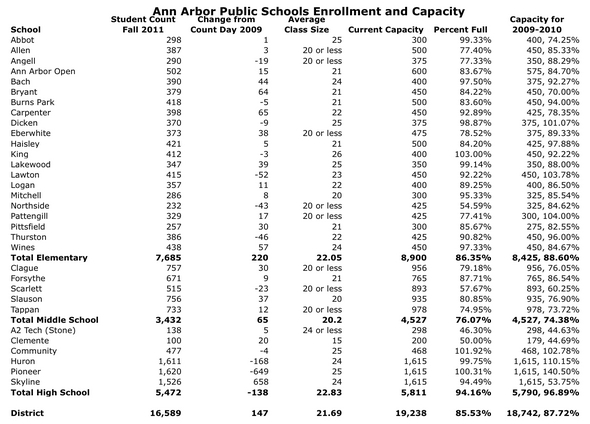
Count data and building capacities provided by Ann Arbor Public Schools.
Percentages and average class sizes computed by AnnArbor.com based on information obtained from AAPS.
During the 2009-2010 school year, three of Ann Arbor’s elementary schools were over capacity. Now, despite an increase in enrollment in grades K-5, only one elementary is over capacity.
How is that possible?
Ann Arbor Public Schools has worked to create more classroom space at its elementaries in recent years in an effort to address overcrowding as well as to help reduce the district’s operating budget.
School officials once again are conducting a review of buildings and their efficiencies as the 2012-2013 budget discussion looms. AAPS is facing at least a $14 million deficit and is looking for places to cut.
Similar studies were completed two years ago when officials were trying to determine whether closing schools would help slash nearly $20 million from Ann Arbor's general fund.

Liz Margolis
AnnArbor.com recently obtained documents from the district on enrollment and compiled a capacity chart by building. A complete analysis under way by the district will be provided to the Board of Education in the coming months, said district spokeswoman Liz Margolis.
Ann Arbor experienced a district-wide increase in enrollment during the past two years, tallying 147 new students.
The increase can be attributed to growth at the elementary level. In total, the district's 21 elementaries saw 220 new students since 2009. Over the same period, the middle schools gained 65 and the high schools lost 138 students.
Bryant, Carpenter and Wines saw the most growth, adding 64, 65 and 57 students, respectively, to their overall populations.
With the increase, Carpenter went from being 78 percent full to nearly 93 percent full. However, a significant factor in this percent discrepancy is Carpenter’s increased capacity. The school went from having a capacity of 425 students in 2009 to a capacity of 450 students in 2011.
Executive Director of Physical Properties Randy Trent said the district uses a state formula to determine capacity. For elementary schools, the formula is 25 students multiplied by the number of rooms, excluding those rooms used for special education, early childhood education, computer labs, media centers, art or music classes, staff break rooms, health or social services and other non-classroom spaces. Middle and high school capacities are configured slightly differently but also use a formula, Trent said.
He added that how each building uses non-classroom space essentially determines its capacity.
Bryant and Wines remained at the same capacity throughout the past two years, 450 students, but Bryant jumped from about 70 percent to 84 percent full, while Wines jumped from 84 percent to 97 percent full, data shows.
In total, since 2009, Ann Arbor increased capacity by 475 students across its elementaries. If all of the elementary classrooms were full today, the district could accommodate 8,900 elementary pupils, as opposed to 8,425 two years ago. Currently, the district has 7,685 elementary pupils enrolled and is running at about 86 percent capacity.
The capacity rates vary drastically from building to building, ranging from 54 percent at Northside to 103 percent at King, data shows.
King was operating at 92 percent in 2009. And although its population remained constant, decreasing its student capacity by 50 students — or increasing the number of non-classrooms — pushed the building over capacity.

Pattengill Elementary School is no longer operating at more than 100 percent capacity, according to recent documents prepared by Ann Arbor Public Schools.
AnnArbor.com file photo
AAPS would like it to be made clear that the average class sizes for kindergarten and first grade are smaller than the average sizes for upper elementary grades. Additionally, the district noted some classes at the middle and high schools, such as certain electives, may have fewer students in them than others. The district also noted the averages for core classes at the high schools are closer to 30.
“It’s a fact the community knows well,” Margolis said. “We have had to increase class sizes as a result of funding reductions. It’s not something we like to have to do — at all. But we are working very hard to fix some of these numbers.”
Northside dropped from a rate of about 85 percent in 2009 to 54 percent in 2011. Northside did increase its capacity by 100 students; however, it also experienced a drop in enrollment, which likely contributed to a declining capacity rate.
Lawton lost the greatest number of students, 52, but its decrease in enrollment helped to relieve overcrowding at the school. Its capacity stayed the same, causing its rate to fall from nearly 104 percent in 2009 to 92 percent full in 2011, data shows.
Pattengill, which also had a capacity rate above 100 percent, condensed its reserved rooms to add classrooms and increased its capacity by 125 students. Pattengill’s capacity rate subsequently dropped to 77 percent full.
From Count Day 2010 to Count Day 2011, the district lost the greatest number of pupils in kindergarten and first grade. Population increases took place in grades second, third and fifth, according to documents prepared by the district.
Scarlett was the only middle school to experience declining enrollment during the past two years. It saw a net loss of 23 students, dropping from a rate of about 60 percent to 57 percent full.
Margolis said the struggling economy has had a significant impact on the east side of town, and Scarlett’s enrollment numbers also have suffered.
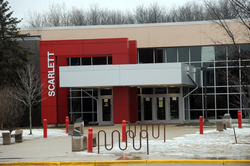
Scarlett Middle School has experienced declining enrollment in recent years, according to district documents.
There also is some speculation about the potential balanced calendar concept at Scarlett scaring away parents and children. Margolis said it is likely a few families left because of that and AAPS’ in-district transfer option does allow for it.
“There was a very vocal group of parents opposed (to the balance calendar) when it was first proposed,” she said. “But, first of all, we don’t have a balanced calendar at Scarlett and there is no definite date when that would happen. … So it’s a bit of a premature decision (to switch) based on that.”
More than half (37 students) of Ann Arbor’s growth of 65 students at the middle schools is at Slauson. Slauson is operating with a capacity rate of nearly 81 percent. However, Forsythe is the most full at about 88 percent.
2011 was a milestone year for Skyline High School. It added its fourth new freshmen class. It now has students enrolled in all four grades and is operating at about 94 percent capacity since opening in fall 2008.
The school has, according to data, helped with overcrowding in the other three primary high schools, Community, Huron and Pioneer.
Two years ago, when Skyline had just freshmen and sophomores, Community was operating at about 103 percent capacity, Huron at 110 percent and Pioneer at 140 percent. These three now sit at or just less than 100 percent.
Ann Arbor Technological High School (formerly Stone High School) and the Roberto Clemente Student Development Center still sit at or just less than 50 percent capacity, similar to two years ago.
Margolis said the capacity at each elementary building could change from year to year depending on each building’s individual needs that particular school year.
It boils down to looking at the number of reserved rooms at the elementaries and determining whether they are being best utilized or whether the school needs additional classrooms to accommodate enrollment, she said.
Jane Landefeld, director of student accounting and administrative support, said, for example, perhaps Abbot typically has two rooms for special education but there are fewer students with this need next year. Then the district would transform one of these rooms into a classroom, she said.
Margolis added the same is true for physical therapy needs, art and music rooms — the list goes on.
Other programs have been forced to consolidate into fewer rooms and some grades have been combined at various elementary schools to help the district balance its budget, she said.
Trent added the process can become complicated and there is no right answer to making the capacity work at each building.
Superintendent Patricia Green will make her budget presentation to the AAPS Board of Education this month. Until then, it is unknown what changes to classrooms, if any, will take place next year, Margolis said.
Note: Read the AAPS capacity data.
Staff reporter Danielle Arndt covers K-12 education for AnnArbor.com. Follow her on Twitter @DanielleArndt or email her at daniellearndt@annarbor.com.
Comments
glacialerratic
Sat, Feb 4, 2012 : 11:06 p.m.
This article never should have been posted. And it should have been taken down within hours after people first began to point out the fundamental flaws that make it wholly misleading. It's time to restore competent journalism before we forget what it looks like.
T
Sat, Feb 4, 2012 : 9:37 p.m.
Do the math on your school and see what you get. Lakewood was listed at 347 students. The staff directory lists 42 employees 13 of which are classroom teachers, thats almost 27 kids per class not 25. 6 other teachers appear to be special needs(speach, reading, hearing impaired and english as a second language). 7 teachers are art, music, library and gym. Then you get to the misc. catagory technical assistant school phychologist occupational therapist school social worker teacher clerk teacher consultant school nurse The only one I recognize is the school nurse, but she used to double as the secretary. Mrs. Tedder was a nice lady. Therefore: classroom teachers 30%, 47% if you include art, music gym, 50% if you include Mr. Johnson the principal. Add another 10% - 15% for lunch and custodial. Now expain what happened to the rest of the money, and don't blame it on transportation and athletics.
J. A. Pieper
Sat, Feb 4, 2012 : 6:59 p.m.
I am not surprised that the information reported/obtained related to class size is confusing or somewhat inaccurate on purpose. The idea that they include all the teachers (art, music, gym, media, support staff, etc. ) into the mix when figuring out class size is a blatant way to hide actual class size. If this is a standard pushed on the district by a state formula, then shame on them too. The interesting thing I want to comment on is that AAPS can't even get their numbers correct when planning activities for their staff. The recent professional development day, they had district grade levels scheduled into rooms where there were not enough chairs, and for some reason, they can never supply enough handouts! They expect us to work with data shared by them, but don't supply enough for us to read, write notes, take notes on during the sharing opportunities. This happens every time we get together, don't they even check on how many teachers are expected to be at specific places, or do they even care? Transparency is a concept that AAPS puts out there saying it is important to them, but they purposefully manage to hide data through manipulation.
pittsfieldfam
Sat, Feb 4, 2012 : 3:07 p.m.
The decline for Scarlett is blatantly obvious for many reasons. 1) A large number (majority) of parents voiced their opinion stating they were in no way in favor of a balanced school year. This was the result of not being a district wide change, and having multiple children at multiple schools. Since it was a majority, shouldn't the people be listened to? Obviously not in the A2 schools. The parents were disregarded and last heard, the balanced calendar is suppose to take place in the 2012/2013 school year. 2) When the redistricting was done several years ago, the "West Siders" in no way wanted the "East Siders" (Scarlett) integrated in their schools or vice verse. Initially a neighborhood in Burns Park was suppose to feed into Scarlett. It did for a few years, then miraculously, when looking at the school boundaries booklet put out by AAPS every fall, that neighborhood disappeared back into a West Side school. 3) There are no consequences at Scarlett for poor behavior. There is a lot of talk of personal responsibility that seems to go nowhere. In one instance a student was suspended 4 times in the first 4 months of school for violent behavior against other students. According to the A2 district, the student should be expelled. But the student continues to be there posing a risk to other students. 4) Once again, drugs were found at Scarlett. And again, kids were suspended, but not expelled. No consequences. 5) If you ask great students that attend Scarlett, how they feel about being there, their one word response is "ghetto". Kids that now attend Huron, formerly from Scarlett, will tell you that they feel really dumb when compared to kids coming from the other middle schools. These are Scarlett kids that had a 4.0 average and feel like their education was sub par. All of the above statements are due to the decline in enrollment at Scarlett. And next year will decline even further when I will be removing my childr
EB
Mon, Feb 6, 2012 : 11:07 p.m.
Beth, for the record, I opposed the "balanced calendar" and I was vocal in my opposition. Many of us were. To answer your two questions: (1) Scarlett does a trip to France. (2) My child will be performing Mozart at Orchestra Night next week. There is an economically disadvantaged population at Scarlett. That doesn't mean Scarlett isn't a good school. Scarlett does indeed have good things going on.
Klayton
Sun, Feb 5, 2012 : 5:07 a.m.
I have observed many teachers at scarlett and had a sibling attend the school. The teachers are WONDERFUL, very caring. They have a more difficult population than teachers at Tappan or Slauson. Thus, it is more challenging. But the education is not sub par, actually I would say Slauson is more in the sub par category (at least the "old school" teachers I have observed---YIKES, talk about worksheeting students to death!). It is purely the reputation of the school that keeps this myth. The Scarlett teachers are probably the most technologically savvy and innovative. I wish AAPS would make Scarlett another Community type school (6-12 with small classes, deep student-teacher connections, mentoring...etc).
Beth
Sun, Feb 5, 2012 : 12:52 a.m.
I wish someone from AAPS would comment on this. Can they explain why the offerings at Scarlett are so inferior?
pittsfieldfam
Sat, Feb 4, 2012 : 5:51 p.m.
So Liz Margolis stating that "the struggling economy has had a significant impact on the east side of town, and Scarlett's enrollment numbers also have suffered" is a ridiculous excuse. Did the economic downturn not affect the west side of town? only the East side? That is laughable. Did all Pfizer employees have their kids at Scarlett? No, these families were at the other 4 middle schools, yet their enrollment is at greater levels. @Beth, no there is no grade trips at Scarlett. We just recently found out that all the other schools do this (when we were searching for other options for our children). There is a French Class trip this year, but is only offered to kids taking that class.
Beth
Sat, Feb 4, 2012 : 4:57 p.m.
I have a few friends with kids who do or did attend Scarlett. Some of them have very positive things to say, while others were horrified by situations such as you mention. I hear about other schools doing 8th grade trips to DC, and apparently Tappan does a 6th grade trip to Traverse City as well, yet I haven't heard that Scarlett does any trips at all. Am I wrong? I know they have a higher percentage of students who might not be able to afford the cost of a trip, but there are ways to fundraise. I remember a year or two ago seeing a mention of Orchestra Night in the news - the other AAPS middle school orchestras were listed as playing standard classical repertory, while the Scarlett orchestra played an arrangement of a pop tune. Look at the websites for Tappan and Scarlett and see which school looks like a place you'd rather send your child, just from the information given on the site (such as teacher bios at Tappan compared to no information at Scarlett). If Scarlett does indeed have good things going on, the district needs to make an effort to promote them. The district seems to think that making Scarlett and Mitchell a combined K-8 campus, adding in lots of UM students and researchers, and moving to a "balanced calendar" will somehow magically make parents overlook the very real problems and inequities at Scarlett. Considering I don't like any of the changes, it's certainly not working for me.
Stefanie Iwashyna
Sat, Feb 4, 2012 : 2:33 p.m.
Why is the chart depicting inaccurate average class size still at the top of this article? When you present information as accurate and as representing something, e.g. the average size of classes in a school, you have a responsibility to explain how you arrived at your--in this case completely inaccurate--result. I could access Census information and divide the number of children in Ann Arbor by the number of residencies in Ann Arbor. I would get a number. It would not, however, represent the average number of children per family in Ann Arbor. Your arithmetic may be correct, but your analysis is flawed. Here is an accurate count of class size at Angell school: K am 19 pm 10 K all day 24 1 25 1 25 1/2 25 2 26 3 24 3/4 22 3/4 21 4 18 5 24 5 23 As you can see, your figure of "20 or less" does not represent our average class size. Our afternoon K has only ten kids (because virtually no one wants half-day, afternoon kindergarten for their child). And because our student population contains a number of international families, many of whom arrive in August just before school starts and are more likely to leave mid-year, we sometimes have one class that ends up small (like the one 4th grade at 18). If you discount the low and high, the average is 22.7 and the mode (most common class size) is 25. School funding in this state is a disaster and the quality of education in our public schools is suffering. The public has hard choices to make regarding cuts, and your sloppy reporting makes that task harder. Please amend or retract your inaccurate table.
kathryn
Sat, Feb 4, 2012 : 1:24 p.m.
How is King at 103% when they have an empty classroom?
Jim Osborn
Sat, Feb 4, 2012 : 11:27 a.m.
I must have missed the BIG story about the bulldozers at Pioneer High School last summer that demolished enough classrooms for over 650 students. I see that Pioneer's capacity is now listed at only 1615, exactly the same as Huron and Skyline, and it is over capacity at 1620, but last year it had 650 more students, indicating a capacity of at least 2265. Pioneer had even greater numbers a few years ago. I would not be surprised if the silly school board next year will say that Pioneer needs to expand if 100 new students show up. (spending our tax dollars, of course) AnnArbor.com also could have explained why the totals of the middle schools were not the same as the high schools. This is very odd. Are the differences made up from private school children in K-8 moving on to AA public high schools?
J. A. Pieper
Sat, Feb 4, 2012 : 6:45 p.m.
Several parent I know do not send their children to AAPS Middle Schools, and then return for the comprehensive high schools. AAPS employees do this, and hasn't there been an article about a board member who does not send their children to AAPS? Some parents, myself included, do not have the financial ability to send our children off to a private middle school, or can't arrange the transportation due to parents' work schedule.
DonBee
Sat, Feb 4, 2012 : 1:45 p.m.
Kathryn and Mr Osborn - Not only did they stop using the portables, but they also converted some classroom space to other uses. It is too bad they did not return some of it to vocational space (e.g. wood shop, metal shop). No actual building was destroyed, but the ability to hold classes in parts of the building was. This was a decision to make it harder to close any other high school and consolidate it into Pioneer (or any other school). The BOE likes having 6 high schools in 6 different buildings with the administrative positions required to support them.
kathryn
Sat, Feb 4, 2012 : 1:25 p.m.
Getting rid of the portables was a good thing. They should never have been counted as "classrooms."
Russ Miller
Sat, Feb 4, 2012 : 6:15 a.m.
Danielle, Thanks for posting the AAPS document. It's clear now that the class size numbers you calculated are nonsense - We understand class size to be the number of students being taught by a teacher, but what you've calculated are the number of students per physical classroom in the building. Here's an example: Look at the Allen elementary capacity chart and staff directory There are 20 classrooms but only 16 grade level (general K-5) teachers listed implying that there are 4 rooms not in use. 387 students / (27 rooms in building - 7 reserved rooms) = 19.35 students/potential classroom (silly number for class size). or look at the staff directory: 3 teachers each for grades K,1,2,3 and two teachers each for 4 and 5 = 16 teachers 387 students / 16 teachers = 24.2 students/class The second number is more reasonable for class size (except that some title 1 special ed students may not be counted in these classrooms?)
Russ Miller
Sat, Feb 4, 2012 : 3:57 p.m.
Don, Ms Arndt's post states that 'AnnArbor.com requested "the district's 2011-2012 enrollment numbers by building as well as each building's capacity" using the Freedom of Information Act.', and apparently AAPS responded with EXACTLY those numbers which are interesting for looking at building utilization, but not relevant to understanding how many kids each homeroom teacher is dealing with. If FOIA is going to be the primary data gathering tool then it is extremely important to formulate requests that ask for the data you want. While the reluctance of AAPS to release data is also an issue, I'm pointing out that AA.com didn't use the data they received correctly and caused a great deal of confusion in this thread by naming the fourth column in the table "average class size" when it is clearly not that value. Not having adequate data to compute average class size is not an excuse for computing something else and calling it average class size. this kind of innumeracy is not uncommon on AA.com and I think it says more about the editors than the reporters. Salary comparisons provide frequent examples, ie comparison of FTE salaries to median worker wages (which includes part timers), or reporting cost of employment (including benefits, and employer paid taxes) as salary.
DonBee
Sat, Feb 4, 2012 : 1:40 p.m.
Mr. Miller - Thank you, remember that AnnArbor.com asked for real numbers and the school district gave them the link that is posted, instead of working with them to get the right information onto this site. This is the typical response of AAPS - hide, deny and then whine when the wrong numbers are used. This is their way of discrediting anyone who wants to question how the schools are run or what the real numbers are. If AAPS had provided the right numbers up front, this whole article and the comments would be very different. Once again Ms. Margolis' disinformation campaign is at work.
Russ Miller
Sat, Feb 4, 2012 : 7:10 a.m.
A concrete example from Wines elementary showing projected class sizes in grades 2 through 5 higher than the hypothetical 24 shown in the table. (A nuance I didn't acknowledge in the previous post is that a Kindergarten teacher might have an am and pm class which would lower the average class size schoolwide.) <a href="http://winespto.org/docs/ptoMins-05-25-11.pdf" rel='nofollow'>http://winespto.org/docs/ptoMins-05-25-11.pdf</a> Class Sizes for 2011/2012 School Year – The two major changes being made to the staff at Wines next year are: (1) Kindergarten is being reduced by one full-day EDO section, and (2) Kris Tevaggia is retiring at the end of the current school year. All staff current staff here now (excluding retirements), will be here next year. David noted that 70 to 90 teaching positions would be eliminated in the District this year. There will be a slight increase in class sizes for the next school year and there will be two multi-age classes. To date, these are the expected class grade numbers and class sizes for the 2011/2012 school year at Wines: GRADE # OF CLASSES CLASS SIZES 5TH 2 27 and 26 4TH /5TH 1 26 4TH 2 27 and 26 3RD 2 28 and 28 2ND /3RD 1 26 2ND 2 26 and 25 1ST 3 24, 24 and 24 K-EDO 1 [currently unknown] K-Half-Day 2 (AM/PM) [currently unknown]
Bulldog
Sat, Feb 4, 2012 : 2:59 a.m.
I want to see a chart that shows each elementary building broken down by grade and classes with number of students in each class. Then let's talk equity! Example: Logan: k-21, k-21, 1-23, 1-23, 1-24, 2-22, 2-23, 2/3 23 etc...(these are made up numbers). How many of each grade per school and how many stdents in each section. Some 3rd grades have 27 students per class when at a different school there mighy only be 21 third graders in a class. Which class would you want to be a student or a teacher or a parent? Then let's talk secretary jobs. Why should each elementary have one full time secretary when they have 257 students and then a school with 407 students have the equivelant secretarial service? Let's talk equity!
newsboy
Sat, Feb 4, 2012 : 1:40 a.m.
Time to close Lakewood again!
a2parent365
Sat, Feb 4, 2012 : 1:33 a.m.
I find this story kind of funny since a story similar to this one ran back in Jan 2010 and these numbers are not right. Come on AnnArbor.com you can do better than this. Here is the previous story: <a href="http://www.annarbor.com/news/ann-arbor-school-buildings-878-full-district-task-force-will-look-at-possible-school-closings/">http://www.annarbor.com/news/ann-arbor-school-buildings-878-full-district-task-force-will-look-at-possible-school-closings/</a>
A2anon
Sat, Feb 4, 2012 : 12:38 a.m.
What is "capacity" based on???? Fire codes? Seriously, our school is bursting at the seams. The lunch room is ridiculous, with kids bumping elbows. I don't know how anyone can eat lunch that crammed in. Ditto the specials -- how would we get an additional 100 students rotating through our little art room? The chart makes it look like we could add 100 students! Good grief. We'd be outta there. These "capacity" numbers make no actual sense.
CLX
Fri, Feb 3, 2012 : 11:54 p.m.
Anyone with a child at Tappan should be outraged by the postings of these numbers. My child has never, ever been in a class with fewer than 20 students and has been in several with more than 30. I suspect this is true for the other middle schools as well.
Gloriagirl
Fri, Feb 3, 2012 : 11:24 p.m.
And how does this compare to other schools? How about stepping back and looking in comparison to other districts such as Plymouth-Canton? Whats going on with the class rooms that had to be vacated at Pioneer when Skyline was built? The district has not had a break down of maintenance/operating cost per sq. ft per building in the past. Also Scarlett had a lot of bond money spent on expansion in the last bond. Perhaps there needs to be boundaries adjusted to create more balance.
PhillyCheeseSteak
Mon, Feb 6, 2012 : 2:18 p.m.
During the over-crowding era at Pioneer H.S., many extra classrooms were housed in 'portables' located behind the school. Since Skyline H.S. opened these portables have been removed.
G2inA2
Fri, Feb 3, 2012 : 11:22 p.m.
In defense of Ann Arbor.com, I think this a situation where they have done the best they can in this situation. Something tells me AAPS isn't ready to announce anything yet. Further, I agree with many comments that the data is somehow skewed. I work at Haisley Elementary in the lunch room and KNOW that our full day Kindergarten is at capacity with 24. AND it takes ten tables of eight each to house the first graders. There are three classes. Do the math--that's well over 24 per class. Very similar for second grade and OVER that for fourth grade. Third graders are certainly over the 21 published in the report and the fifth graders are over the 21 as well. (All the classes have three teacher per grade level except Kindergarten which has full day session and a half-day session with the same teacher for both sessions.) A reader suggested that the "formula" includes special needs children in the equation. That MUST be true since I'm sure those special needs classrooms are counted along with their teachers. Yet another example of AAPS skewing numbers. P.S. to all--I REALLY miss the Ann Arbor News. annarbor.com has a loooooooong way to go.
Townie
Fri, Feb 3, 2012 : 11:50 p.m.
'In defense of Ann Arbor.com, I think this a situation where they have done the best they can in this situation. ' The best they can? Throw jello at a wall and call it 'reporting'. Ann Arbor News? Ha. Ann Arbor Snooze. Same ol, same ol.
Townie
Fri, Feb 3, 2012 : 10:48 p.m.
What exactly was the point of this article? That the state cut back funding significantly, resulting in significant issues? I knew that already. I guess the level of 'journalism' at AA.com is to throw a bunch of numbers up there, some comments from some people and then let us guess what is going on? Is that it? How about some conclusions (back by an analysis of the data) and some sort of executive summary? Perhaps I'm just wishing for the old days of journalism...
boo
Fri, Feb 3, 2012 : 8:30 p.m.
clemente and stone still at 50% capacity? seems like they could combine those schools.
PhillyCheeseSteak
Fri, Feb 3, 2012 : 7:26 p.m.
The headline should read, "Ann Arbor middle schools operating at 76 percent capacity". (Which is almost unbelievable in these tight fiscal times.) At the community budget meetings a few years ago, many people pointed out the middle school inefficiencies, but the AAPS administrators chose not to listen to these concerns. When money is tight, you look everywhere to save money, and it just seems common sense to close a few elementary schools and 2 middle schools. Finally, perhaps one factor in Skyline High School's slightly lower enrollment number is that getting to and from school has become a major issue for some students and families there. AAPS cut back on high school busing and also stopped providing students with student bus passes to use AATA service. When Skyline was built, and enrollment open to the entire AAPS community, we were told that students from other neighborhoods would be transported to Skyline. AAPS - what happened to that promise? If Skyline High School is attended only by neighborhood students, that will decrease the economic and racial diversity of that school.
Beth
Fri, Feb 3, 2012 : 7:08 p.m.
We live SE of town, nowhere near any elementary schools, and every neighborhood there is bussed to a different elementary school. There's just no other way to do it, though - there is no school that we could walk to, and if all the neighborhoods in our area were sent to the same elementary it would more than fill a school, with no room for any children living in the school's neighborhood. We bought our house based on what elementary school it fed to, and were less concerned about the middle and high schools. I know many other families who bought the houses they did because of their neighborhood's elementary as well. If the district is contemplating redistricting or closing a school, I hope they will look at closing a secondary school and leaving elementary boundaries alone if at all possible. Children are at an elementary school for a long time, and families really feel a bond with that school; if an elementary closes or a lot of students are switched to other elementaries, I can see some families leaving the district.
calmic
Fri, Feb 3, 2012 : 5:59 p.m.
The dramatic decline in enrollment at Northside is not a surprise to parents with kids who attend -- such as myself. Since the current principal arrived several years ago families have scrambled to enroll their kids at other schools. The Board and the Administration are aware of this fact but choose to look the other way instead of making the tough - but correct - personnel decision.
La starry
Sat, Feb 4, 2012 : 2:23 a.m.
It is sad that families are driven to leave their homeschool because of poor leadership at that school . It is even sadder that the BOE and administration continue to turn a blind eye despite parents speaking up and asking for help . Not dissimilar to the situation at Dicken elementary . Except at Dicken , as parents scramble to leave , spots are filled up with transfers from out of district ( or maybe some unsuspecting Northside families??) . I don't understand why these horrendous principals are left to wreak havoc on entire communities of staff and families despite so many people begging for their dismissal .... Over years ...... And years .....
J. A. Pieper
Sat, Feb 4, 2012 : 12:39 a.m.
I totally agree - AAPS seems to have a once hired, never fired policy for its administrators, no matter what their "quality". They just shuffle them around, or always leave them at the lower socio-economic schools, hoping they will get less complaints that way. A poor administrator can ruin a building, but as long as it is not one of AAPS "favored, elitist" school buildings, they don't care. Been there, lived with that for years!
Sallyxyz
Fri, Feb 3, 2012 : 8:18 p.m.
I agree.
Ned Racine
Fri, Feb 3, 2012 : 6:17 p.m.
Amen Sister (or Brother)!
Chris
Fri, Feb 3, 2012 : 5:31 p.m.
There is no evidence linking class size to student outcome.
Freight Train
Fri, Feb 3, 2012 : 10:55 p.m.
If the curriculum and instruction is geared for smaller numbers it certainly does. When (if) classes get smaller, if there is no pedagogical adjustment made then you are correct. The outcome will be the same.
AMOC
Fri, Feb 3, 2012 : 10:11 p.m.
sh1- Chris is correct for the range of class sizes AAPS has experienced or is contemplating. Such evidence as exists for better student achievement with lower class sizes requires class sizes of 14-18 students in early elementary, and under 20 students for later grades. Further, the effect fades out when the students reach 6-7th grade and above. There is one exception to that rule; if you assign students to classes based on achievement by top 15%, bottom 15% and the middle, even if it means fewer students in a classroom. Then both the highest achieving group and the lowest do much better than they would in a heterogeneous classroom with the same number of students.
sh1
Fri, Feb 3, 2012 : 8:05 p.m.
Wrong. <a href="http://www2.ed.gov/offices/OESE/ClassSize/myths.html" rel='nofollow'>http://www2.ed.gov/offices/OESE/ClassSize/myths.html</a>
Sallyxyz
Fri, Feb 3, 2012 : 5:03 p.m.
Another issue regarding these data is how the teachers who do not have regular classrooms are added into the equation: resource room teachers typically see a handful of students per day; art teachers, media specialists, PE, music, computers, etc, do not have their own classrooms but see students from other classes. Are these special teachers added into the total teacher count, making the class sizes appear smaller than they are? Special ed teachers have small number of students in classes. A better set of data would calculate the total number of students and only the classroom teachers at the elementary level. This would better reflect the actual enrollment in each classroom at the elem level, which in many cases is 25+. At the high school and middle school levels, a more accurate calculation would include the core class enrollments and core teacher numbers. Take out the electives and art, music, pe, computers. Then you would have accurate data showing 30+ students in core classes, far too many.
Sallyxyz
Fri, Feb 3, 2012 : 4:53 p.m.
Many classes at Huron, for example, are well over 30 students. There are some electives with small numbers, which makes the averages look lower, but the majority of classes at Huron are crowded for the size of the classroom. When backpacks are on the floor, and desks are pushed together, there is no way, literally, to walk across the room, which in my view is a safety hazard, not to mention the consequent discipline issues that arise from overcrowding. Most classrooms are built for 20 students and cramming 30+students into these spaces (some have 35 students), is bad news educationally.
Sallyxyz
Fri, Feb 3, 2012 : 4:48 p.m.
"Northside dropped from a rate of about 85 percent in 2009 to 54 percent in 2011. Northside did increase its capacity by 100 students; however, it also experienced a drop in enrollment, which likely contributed to a declining capacity rate." No explanation offered in the article for this decline, but I'll propose one: the building is very old, the heating and cooling systems are antiquated, and some of the personnel at the building are below par. There are a handful of good personnel, but not the majority. It also has huge discipline issues, in my view. Not surprising to see this drop.
Danielle Arndt
Fri, Feb 3, 2012 : 4:38 p.m.
The article has been updated to include a link to the capacity data that was used to compute the average class sizes. AnnArbor.com requested "the district's 2011-2012 enrollment numbers by building as well as each building's capacity" using the Freedom of Information Act. The link is what we received in response to our FOIA request. Average classes were configured based on the number of rooms in each building being used as classrooms. The "reserved rooms" column depicts the number of rooms being utilized for special education, early childhood education, computer labs, media centers, art or music classes, staff break rooms, health or social services and other non-classroom spaces, as is stated in the article. AnnArbor.com was told the number of classrooms at the elementary level can be computed by taking the total number of rooms in the building minus the number of reserved rooms. The district would like it to be made clear that the average class sizes for kindergarten and first grade are smaller than the averages for upper elementary grades. Additionally, the district noted some classes at the middle and high schools, such as certain electives, may have fewer students in them than others. The district also noted the averages for core classes at the high schools are closer to 30. AnnArbor.com has requested any additional depictions of average class sizes by building that the district has. When we receive this information, we will share it will readers.
Jim Osborn
Sat, Feb 4, 2012 : 11:28 a.m.
I must have missed the BIG story about the bulldozers at Pioneer High School last summer that demolished enough classrooms for over 650 students. I see that Pioneer's capacity is now listed at only 1615, exactly the same as Huron and Skyline, and it is over capacity at 1620, but last year it had 650 more students, indicating a capacity of at least 2265. Pioneer had even greater numbers a few years ago. I would not be surprised if the silly school board next year will say that Pioneer needs to expand if 100 new students show up. (spending our tax dollars, of course) AnnArbor.com also could have explained why the totals of the middle schools were not the same as the high schools. This is very odd. Are the differences made up from private school children in K-8 moving on to AA public high schools?
DonBee
Fri, Feb 3, 2012 : 9:38 p.m.
Marvin Face - Try this, try to get AAPS to give you any real information about class sizes, actual spending or other information about how the district works. Once you have, then you can see if you still think the reporter was lazy.
Marvin Face
Fri, Feb 3, 2012 : 6:07 p.m.
Here's a hint for lazy reporters who want to sit at their computers and FOIA information: Get out and actually talk to people. You might be amazed that they will provide you with useful information and explain it. As it stands now, you FOIA info, throw garbage on the interwebz, then have to spend days backpedaling. What a waste of time. Mine included for responding.
Sallyxyz
Fri, Feb 3, 2012 : 5:21 p.m.
Danielle, a key question is whether or not the "specials" teachers are added into the equation at the elem level. They do not have their own students, but would make the averages look better than they actually are, if they are added into the equation. A school with 400 kids and 15 regular classroom teachers would have an average class size of 26, while adding in the specials teachers (art, music, pe, etc) would bring that average down (add 5 special teachers and you now have 20 kids per class, which is not accurate). Can you find out if the specials teachers are added in?
mittengirl
Fri, Feb 3, 2012 : 4:31 p.m.
""Actual running of the buildings is a small share of their total cost. Remember, AAPS does not pay rent, make mortgage payments, or pay property tax. Closing buildings would save very little money, but would drastically redraw the attendance map and also remove any possibility for absorbing increased student numbers in the future. Contrary to conventional wisdom, AAPS enrollment is down only slightly over the last few years and has been steady at roughly 16,500 students for the last three years."" Comments like this always amaze me. For argument sake, if two schools were to close.... We would have 2 less water, phone, grounds, electricity and gas bills, 2 less principal salaries and healthcare coverages, 2 less entire janitorial staffs, 2 less offices to fund, 2 less bus routes and insurance payments, more concentration of 'specials' teachers in buildings and thus more accessibility to their students, more $ in our pockets by selling these closed schools, better usage of our buildings that are clearly under utilized for the last several years, I could go on and on. And to answer the 'possibility' of increased student numbers...one clearly deals in the present first and right now we have a 14 million dollar fish to fry.!
Tony Livingston
Fri, Feb 3, 2012 : 11:44 p.m.
Selling schools often allows other schools to set up. The old Newport school is Rudolph Steiner. Clinton is Hebrew Day School. It might not be a good strategy for AAPS.
johnnya2
Fri, Feb 3, 2012 : 8:48 p.m.
Based on that thought Ann Arbor should just open ONE giant school for all grades and bus them to one facility? Sorry, localization is better for education. Schools running at 86% capacity seem to be very high to me. There will not be a substantial savings because once you take away the phone lines and utilities and other things involved, there will be an increase in transportation costs, which would far outweigh it. I would prefer to see more schools with smaller footprints and grade ranges. Maybe K-3rd, 4th thru 6th, 7th thru 9th and 10-12th.
alarictoo
Fri, Feb 3, 2012 : 8:04 p.m.
Hi mittengirl, I am with you for the most part. The only area that I differ with you on is the idea of selling the closed schools. If, say, Michigan (Ann Arbor, specifically) were to experience some sort of economic boom (purely speculative, of course ;^) ), and those buildings capacity were once again required, it would not be that easy for the district to replace those facilities. There really is not that much acceptable real estate available in Ann Arbor. So, the district is still better served by those buildings being "mothballed" than by being actually sold. If those properties were sold, due to current economic conditions and the current real estate market, the properties would likely not fetch as much as people would like. And, should UMich purchase them, they will remain off of the tax rolls. I agree with dealing with the present first. But I question making short-sighted decisions that will end up costing far more in the long run.
a2schoolparent
Fri, Feb 3, 2012 : 4:22 p.m.
Re: average class size. Numbers do need to be verified. The class size on the chart for the school that one of my children goes to seems to be very accurate; for another school that my other child goes the number seems to be much lower than reality. Some statistics does use the total students/total staff in building, but this measure is sometimes called "student/teacher ratio", it's not the same as "class size".
Steve Norton, MIPFS
Fri, Feb 3, 2012 : 3:54 p.m.
Regarding class size - I don't know where the numbers presented in the article came from, but they do resemble the numbers as the State of Michigan requires districts to report them - usually an overall average of students to certified teachers, not the actual average of kids in a classroom. So the numbers as reported to the state aren't very useful. Regarding capacity: the real constraint on capacity is the number of teachers. Having an empty room doesn't allow you to enroll more students unless you can afford to hire a new teacher to take that class. So the building "capacity" discussion is only meaningful if we could have as many teachers as we want. We can't, so capacity is not the issue. Actual running of the buildings is a small share of their total cost. Remember, AAPS does not pay rent, make mortgage payments, or pay property tax. Closing buildings would save very little money, but would drastically redraw the attendance map and also remove any possibility for absorbing increased student numbers in the future. Contrary to conventional wisdom, AAPS enrollment is down only slightly over the last few years and has been steady at roughly 16,500 students for the last three years.
DonBee
Fri, Feb 3, 2012 : 9:37 p.m.
So there is little cost to having a principal and a secretary in a building? There is little cost for electricity and gas? There is little cost to having "specials" teachers drive between buildings or having a data network or providing computer support or.... There are lots of costs and some of them significant with having a facility open and running. The district has excess buildings already and is renting them at below market rates, while maintaining the buildings for the renters (e.g. the Dixboro Elementary School). In a number of cases the renters want to buy the buildings, why not sell them and get out of the landlord business?
Paula Gardner
Fri, Feb 3, 2012 : 3:38 p.m.
The story is based on the information provided by the district, including interviews that asked specific questions about building capacity and how the district computed it. The information on the chart shows building-wide averages based on utilized classrooms. We're happy to receive new information that supplements or corrects what previously was provided to us, and we'll share that with readers. The district has indicated this morning that they track grade-level averages and not building averages. We're also uploading the data that the averages were based upon. That should be posted shortly.
Danielle Arndt
Fri, Feb 3, 2012 : 4:49 p.m.
@ViSHa, the average class sizes above were computed using the same type of formula — based on the number of rooms in each building that serve as classrooms — that the district used to configure student capacity. This morning, we learned the district prefers to consider average class sizes by grade. We have requested any additional depictions of class sizes from the district and will share those with readers as soon as they are available. See my comment below for additional information.
ViSHa
Fri, Feb 3, 2012 : 3:45 p.m.
I'm a bit confused. To get the numbers above, are you saying, AAPS takes all the first grade students in the district (for example) and divides that number by the number of first grade teachers or just within each school? I guess I don't understand what they mean by "they track grade-level averages"
Diana Hunt
Fri, Feb 3, 2012 : 3:37 p.m.
Is anyone looking at the "big picture" of school populations in the context of area population statistics? The figure for Northside, for instance, prompted me to wonder whether that area is gradually shifting from young families to retirees. Realtors and various city departments probably have data on the occupancy of available dwellings, which could also be factored in to predict school population trends. I agree with other writers that the methods for determining class size should be published -- and possibly improved. Decisions should be made based on the most accurate data possible; that is, on data that mirrors reality as experienced by the kids and teachers. The range of class sizes in each school, annotated to account for extremes (such as small class sizes for special-needs students), would also provide a more accurate picture. If parents are concerned about the accuracy of the information, then I suggest that the PTOs make their own counts and present them to the school board.
Vivian1
Fri, Feb 3, 2012 : 10:38 p.m.
I live in the Northside neighborhood, and on my street, houses have been changing over from retirees to young families in the last 5 years. Unfortunately, we tried Northside for kindergarten did not feel comfortable sending our child back for first grade. We transferred to a nearby school that offered in-district choice. With some of these under capacity schools, I think a true administrative effort could be made to attract and retain the families within the schools boundaries.
DonBee
Fri, Feb 3, 2012 : 3:08 p.m.
A couple of grade schools need new principles. Families are choosing to transfer to other schools, rather than attend the one they are geographically assigned to. This will help rebalance some of the grade schools. As to crowding in the grade schools, AAPS had/has a chance to present the right numbers and this is what they provided. Right or wrong it reflects what the Superintendent, Board of Education and the Superintendent's cabinet choose to share with the public. If you want to place blame for inaccurate numbers the buck stops with Dr. Green and the BOE.
PhillyCheeseSteak
Fri, Feb 3, 2012 : 7:11 p.m.
To Mittengirl: this is a news article written by a news organization, not written by AAPS. To fact check and analyze numbers provided by an organization is a basic tenet of journalism. otherwise it's just Public Relations.
DonBee
Fri, Feb 3, 2012 : 6:09 p.m.
Ms. Margolis - If you had given them sizes of classes by class, you would not have had this issue, instead you played games by giving room counts, teachers counts, and student counts. Typical mis-information by AAPS, but then you know that. If you were more transparent with the reporters and the public, this would not happen.
mittengirl
Fri, Feb 3, 2012 : 4:03 p.m.
Shouldn't AAPS have to sign off on a 'final' copy of an article before it is printed to ensure accuracy?? This type of numerical confusion adds to the communities frustration with the entire AAPS organization, from top to bottom.
Liz Margolis
Fri, Feb 3, 2012 : 3:28 p.m.
Don Bee You are incorrect in your assumption. The correct numbers were presented to the reporter. The interpretation of the data regarding class size is incorrect.
thecompound
Fri, Feb 3, 2012 : 3:22 p.m.
Agree, but I do not understand why these principals are not being replaced if they are negatively affecting the schools and families are leaving?
Liz Margolis
Fri, Feb 3, 2012 : 3:05 p.m.
The district does not concur with the average class size posted on this chart. We are attempting to work with the reporter to correct the average class size to correctly reflect what is actually the average class size in the Ann Arbor Public Schools.
Will
Sat, Feb 4, 2012 : 1:48 p.m.
"Mathematicall approach?????????" Any unreasoned way of combining numerical data can be called mathematical! That's simply a lame dodge. Any statician begins by asking what is the purpose of the calculation, before recklessly computing and then PUBLISHING the result. For example, income is generally reported as a median because an average is is misleading. My stats teacher once said that the average human has one breast and one testicle. Another case where the average misrepresents reality.
eom
Sat, Feb 4, 2012 : 3:47 a.m.
"We worked with the district to obtain the data provided in this article." Well, since Liz Margolis is the spokesperson for AAPS, I'm thinking you didn't work with the school district to obtain your data. Clearly, the numbers used were to make the schools reflect poorly in the public eye - a very familiar sight on aa.com.
J. A. Pieper
Sat, Feb 4, 2012 : 12:26 a.m.
Okay, but then tell us this, who gave the data to AA.com? Are you actually going to deny that AAPS shared this information?
Danielle Arndt
Fri, Feb 3, 2012 : 8:47 p.m.
@alarictoo, AnnArbor.com stands behind this story. We worked with the district to obtain the data provided in this article. The average class sizes were computed using a mathematical approach. All numbers were provided by the district. Please note that an average does not mean that the majority of classes are that size. We have requested from the district any additional data depicting class sizes. When AAPS provides that information we will share it with readers.
alarictoo
Fri, Feb 3, 2012 : 7:47 p.m.
@lynel - Does seem that way doesn't it. @Danielle Arndt - Any response?
lynel
Fri, Feb 3, 2012 : 3:23 p.m.
Seems like the reporter should have worked with you to start with instead of posting such inaccurate numbers.
brimble
Fri, Feb 3, 2012 : 2:45 p.m.
Class size is a huge problem, and is directly correlated to individual achievement. It would be easy to say that we need only give the schools more money, and class sizes will be reduced, but it isn't that simple. More efficient spending would reduce class size as well. The alternatives to overcrowded public schools are many and varied, however. There are a range of private, Parochial, charter, Montessori and academy schools available in our community, and most have significantly smaller class sizes. In many cases, they involve paying tuition directly, of course, which is not an option for every family. Many offer tuition assistance and/or financial aid packages to mitigate the cost. The public school system would like to pretend that it is the only game in town, and lead us to think that it is also the 'best' game in town, but it is neither.
Tish
Fri, Feb 3, 2012 : 2:20 p.m.
I agree with others that the class sizes in this chart are based on a ratio where districts take all adults in the building with certifications and and divide the number of children by that number(this would include librarians, administration, etc.) - this is completely inaccurate picture of the actual numbers in the classroom. Anyone with children in the schools know that the numbers are much higher - most high school classes have an average of 33 students per classroom and I hear from a parent at Clague that the classes are incrediably overcrowded. On a different note: It is too bad that Scarlett is being adversely affected by the extended calendar, if this is truly why the numbers are down; it is a phenomenal school with great teachers and a very involved administration. Students are nurtured at Scarlett and character building and responsibility are an everyday part of the Scarlett experience; residents within the District that choose another option are completely missing out on a fantastic middle school education.
burl
Fri, Feb 3, 2012 : 2:17 p.m.
Perhaps one of our readers can answer this question for me as I am honestly perplexed. Why is it, when commenters who are parents, are complaining about the class size numbers being fudged and that the schools are too crowded, why is the solution for some to close several elementaries and bring race into the equation?
Ricardo Queso
Fri, Feb 3, 2012 : 2:09 p.m.
So Skyline enrolled its final freshman class. Does this mean the place shuts down in four years?
Danielle Arndt
Fri, Feb 3, 2012 : 5:15 p.m.
Thank you for pointing out how that sentence could be read. The sentence has been changed to eliminate "final."
alarictoo
Fri, Feb 3, 2012 : 2:55 p.m.
@Richard Cheese - I wondered if anyone else noticed that... lol!
blahblahblah
Fri, Feb 3, 2012 : 1:37 p.m.
"Margolis said the struggling economy has had a significant impact on the east side of town, and Scarlett's enrollment numbers also have suffered." Another contributing factor was the last elementary school redistricting process which left the southeast side a complete mess. Elementary school boundaries map: <a href="http://www.aaps.k12.mi.us/aaps.schools/elementary_school_boundaries" rel='nofollow'>http://www.aaps.k12.mi.us/aaps.schools/elementary_school_boundaries</a>
Klayton
Sun, Feb 5, 2012 : 4:59 a.m.
Agreed! There is a lot of "white flight" in the Scarlett district because Scarlett has a history of being the "poor minority" school. I think the teachers are Scarlett are outstanding (I have seen them teach many times) but it is very difficult to change a reputation of a school (I think places like Bryant are also victim to a past reputation that is not true).
gretta1
Fri, Feb 3, 2012 : 1:27 p.m.
First, some elementary schools, Thurston being one of them, were not allowed to be a school of choice last year. No one seems to know why but kids were turned away. Second, I echo the sentiments of the first commenter - the class size number are baloney. I would respectfully ask that you visit these schools and see the classrooms. My daughter's second grade class now has 28 kids in it. There are 2 second grade classes and one 1st/2nd split. Like Logan, Thurston lost two early grade teachers, or more aptly they were removed from Thurston and placed elsewhere. My son is at Clague and his classes are 30 or more in many sections. I have heard the teachers actually complain about the overcrowding. My son's English class had more kids than desk space at the start of the school year. Some kids had to use tablets. So, big deal, right? Well, it sure is if the school district has monies or plans acquire monies to spend on things other than teachers. This is really a bad situation. Please visit the actual schools and visit the actual classrooms and you will see how big the classes are. ...and this is one parent who will not be voting for the technology millage. We don't need more technology in the classrooms, we need more good teachers and smaller class sizes. That is how a good learning environment is created. In the U.S., the education system is not so rigid as in some other countries so cramming loads of kids into a room does not work so well.
Beth
Fri, Feb 3, 2012 : 7:14 p.m.
My understanding was that many schools were required by the district to reduce staff by 1 or more teachers. The number of students who can attend a school is limited by the number of classroom teachers the district is willing to authorize there , regardless of how many extra classrooms there are. We heard that AAPS would not add teachers based on increased class sizes due to school of choice students, so therefore many schools could not offer slots for in-district transfers.Frustrating!!
Joy Bash
Fri, Feb 3, 2012 : 4:15 p.m.
I agree with you about Clague. I am a custidian there and the rooms have over 30 student desks in most rooms. Some have more then 30. It makes the rooms difficult to clean because you can barely get up and down the aisles with a dust mop.
America
Fri, Feb 3, 2012 : 1:19 p.m.
Basic Bob said it best - "Closing a middle school and perhaps some elementary schools would be highly unpopular, but it would also give the district a chance to address the 800-lb gorilla - the concentration of minority students at particular schools." It is time to move beyond the classism we saw last time we tried to touch the elementary schools a few years ago. Ann Arbor should be a model of the way things should be done rather than a relic of the way things have always been.
Klayton
Sun, Feb 5, 2012 : 4:57 a.m.
Neighborhood schools is inherently racist (just look at the history of "neighborhood" schools). If we did this, there would be very few poor or minority students at schools like Angell or Burns Park (their numbers are not really great with the current busing we have). Yet, I am a parent who loves that my child can walk to school and I wish we had more neighborhood schools that were smaller with smaller class sizes. Cost wise, I understand that this is not smart, but "child" wise, I think a community school would be very beneficial, especially for students who get "lost" in the larger shuffle of busing and big classes.
Sallyxyz
Fri, Feb 3, 2012 : 5:06 p.m.
dotdash: I agree. Kids should walk to school in their neighborhoods. The AAPS boundaries that mean busing for elem schools is ridiculous. Let kids go to schools near where they live.
dotdash
Fri, Feb 3, 2012 : 1:36 p.m.
The reason people don't want to lose their elementary schools is not classism or racism. It's wonderful for kids (and parents) to be able to walk to school. Busing kids around is a waste of money, time, and kids' energy. And for what? Most parents have no issues with the quality of their kids' elementary school education, wherever in AA they are.
Jim Osborn
Fri, Feb 3, 2012 : 12:52 p.m.
What is so silly is that the school district is spending money to add classrooms, but 20 years ago it closed several elementary schools after adding 9th grade to the high schools. This also is the reason that Huron and Pioneer then become over crowded, leading to the building of Skyline. This district sure knows how to spend, spend, spend.
YpsiLivin
Sat, Feb 4, 2012 : 2:43 a.m.
Good point. I also wondered why AAPS was adding capacity, when all demographic projections for this area through at least 2030 predict declines in the county's school-age population. The school system is seeing that right now. "From Count Day 2010 to Count Day 2011, the district lost the greatest number of pupils in kindergarten and first grade." You can't lose what you don't have. Those "lost" kindergarteners and first graders simply don't exist because the school-age population in Washtenaw County is dropping. If you think that's just the impact of charter schools, guess again. In 2010, Washtenaw County public schools (combined) had 775 fewer children than they did in 2005. About half of those "lost" children disappeared from AAPS. Plans to add capacity to school buildings in the AAPS should be met with healthy skepticism unless AAPS is priming itself for some kind of district-wide consolidation or it's planning to go "all-in" with a School of Choice option.
jns131
Fri, Feb 3, 2012 : 1:24 p.m.
They really need to close more elementary schools. Ease the spending and close the gap.
CLX
Fri, Feb 3, 2012 : 12:48 p.m.
I'm with sh1. The average class is NOT 21 or 22 at these schools. I don't know a single class at my child's school that has fewer than 25 students, and several are at 30, yet my school is listed at 21 per class. Very, very deceptive.
justbob
Fri, Feb 3, 2012 : 12:37 p.m.
I would echo other posters' comments about how class sizes were determined. For instance, do the self-contained classrooms with special needs students get factored into the averages? These rooms typically have very low numbers and could really skew the averages. These numbers seem deceptively low. At my son's school, Logan, many class rooms are far over the published 22 count...especially in kindergarten and first grade (24-28 pupils per room). Crowding has been a concern this year at this school especially in light of the school maintaining its numbers while decreasing staff by 2 teachers. At Clague, my daugher's classes all have close to 30 in each section...again these numbers on the chart are not making any sense compared to the reality of what we parents are seeing.
Beth
Fri, Feb 3, 2012 : 12:26 p.m.
I have to question the average class size data - my kids attend Allen, and unless there's something I'm missing the classes all seem to have over 20 students - in some grades, lots more. How was this calculated? Do they count anything other than true classroom teachers? I'm curious - does the Young 5's program at Abbott count towards their enrollment data? Those are students from all over AA, not just the Abbott district. Also - I personally know several families who chose not to attend Scarlett. 1 went to Slauson, 1 to Forsythe, 1 to St. Francis, and 1 family is pulling their children out of Allen as spots open at South Arbor. The 1 6th grade family I know there is on the wait list for Tappan. And yes, ALL of these transfers are because of the proposed balanced calendar. It is still on the table for discussion in future years - I believe the last I heard was that the district wanted to start it in 2012/2013? - and none of these families wanted to have 1 child at Scarlett on 1 calendar, and the other child at Allen or Huron on a different calendar. No one wants to start their child at Scarlett and then transfer to another school if the calendar is approved. And frankly, a lot of parents were already on the fence about Scarlett, and the potential balanced calendar was the last straw. I've been saying this all along - make Mitchell/ Scarlett a K-8 school of choice, something like AA Open, to attract students from in and out of district. Reassign all current Scarlett students to other middle schools, and let everyone who attends there choose to do so.
Beth
Fri, Feb 3, 2012 : 7:01 p.m.
I divided Allen's 387 students by its 16 classroom teachers and got an average of over 24 students per class. As stated in other comments, the class sizes are smaller in the lower grades. I am curious about how many classrooms can be exempted when determining capacity - some rooms are needed as a home base for special ed teachers, speech teachers, physical therapists. ESL teachers, etc. - if all the classrooms were holding classes of students, these teachers would have no place to meet with children.
sh1
Fri, Feb 3, 2012 : 12:21 p.m.
The class sizes in the chart are deceptively low. They do not count the number of students in each classroom and give an average for these, which would be accurate. Instead, they divide the number of students in the building by the number of teachers, including teachers who are not classroom teachers. This unfair formula gives the public an inaccurate picture of what's going on in our classrooms.
a2flow
Fri, Feb 3, 2012 : 10:23 p.m.
@shi...you are correct. For middle school, it says approximately 20-21 students per class...my classes this year have ranged from 26 to 33 students. I am guessing that this includes any staff...so let's say you include a counselor, a social worker, a psychologist...then throw in special ed, team-taught classes, Read 180, etc. It seems like the class sizes are rather small, but what you may have is a class of over 30 combined with 3-4 kids with learning disabilities, 2-4 other students with behavior/family issues...
Will
Fri, Feb 3, 2012 : 9:04 p.m.
I agree this is deceptive...my son at Tappan is in a math class with over 32 students! Are the small remedial classes included in this average? How about another statistic: average class size of history, English, Math, and Science courses?
Beth
Fri, Feb 3, 2012 : 7:10 p.m.
@justcurious - they might be special area teachers (gym, music. etc.) or special education teachers - those teachers work with students from all grades and classes but don't have one specific class that is "theirs".
DonBee
Fri, Feb 3, 2012 : 3:02 p.m.
sh1 - Why don't you provide a more accurate list then?
justcurious
Fri, Feb 3, 2012 : 2:20 p.m.
What are teachers doing if they "are not classroom teachers"? This is an honest question.
dotdash
Fri, Feb 3, 2012 : 1:38 p.m.
Agreed. The average kid at any of these schools does not experience the class sizes that are touted in the chart. My daughter had 27 kids in her 5th grade class last year, and the other regular classrooms in the school were not much better. The chart says "20 or less" for that school -- I have to call BS on that.
thecompound
Fri, Feb 3, 2012 : 1:18 p.m.
I thought the class sizes seemed inaccurate also.
olddog
Fri, Feb 3, 2012 : 12:17 p.m.
The buildings in Ann Arbor vary in age and presumably maintenance costs. Does the district have a break down of heating and maintenance cost per capita for each building. My assumption is that it costs far less to run Scarlett and Tappan then an old building like Slauson In elementary schools what is the cost of King compared to Angell or Burns Park. Should we close older buildings and redistrict to reach maximum capacity or can we afford to run at 85%? We have three High Schools with excellent athletic facilities, what is the cost to run these. Certainly the pools have a high heating cost, are they used by large numbers of students during the day or just athletic teams? These are numbers we never see but would be useful as we look toward budget cuts.
Joy Bash
Fri, Feb 3, 2012 : 4:05 p.m.
I work for the schools as a custodian at Clague. They close the pool for several months of the year. When the pool is in use there is like one or two classes. Rec and Ed use this pool more than the students who go to school there. Seems like some of these pools could be closed permanently, and save a ton of money. What I have seen at two of the High Schools is only team use.
justbob
Fri, Feb 3, 2012 : 12:49 p.m.
@Mike, I'm guessing you may not have kids in school, or you wouldn't be inquiring about how much it costs to "fund" student groups and extracurricular activities. Most of this cost is now been shifted to participating families. Pay to play is now the expectation for these activities...although clearly some sports have costs that the district picks up. As for the arts, the cost is also shared. Teachers and basic equipment are paid for (these activities are considered co-curricular as they are graded and part of the academic calendar...not extracurricular) but parents also have to pay to purchase/rent instruments, rent uniforms, etc.
Mike
Fri, Feb 3, 2012 : 12:38 p.m.
It would also be interesting to see what it costs to have a band, different student groups and extraciricular activites fo any kind. Generally speaking the pay/benefits are out of line with the people who fund the schools (tax payers) and the schools are not well managed. Why don't they hire some real business consultants to come in and make suggestions? Most likely they have thought of this but know the answers won't be something they want to hear or implement. As long as the MEA runs the schools they will be inefficient to run and will have budget problems.
Basic Bob
Fri, Feb 3, 2012 : 12:09 p.m.
Is it coincidence that the high schools have the same capacity and nearly the same attendance? No, this was the result of analysis and redistricting. Something that is clearly overdue in the lower grades. Closing a middle school and perhaps some elementary schools would be highly unpopular, but it would also give the district a chance to address the 800-lb gorilla - the concentration of minority students at particular schools.
aamom
Fri, Feb 3, 2012 : 7:40 p.m.
I don't have child there yet, but I have heard many complain about class sizes at Tappan as well. Sometimes not enough desks for everyone in the class so they sit on the floor.
jns131
Fri, Feb 3, 2012 : 1:23 p.m.
The whole idea of three hi schools was because of Pioneers over crowding. The middle schools are still struggling with filling classrooms. Scarlett struggles because of its location. I hate to say it, but it is time to close one or two elementary schools. Since Pfizer left? Ann Arbor does not have the children it use to have.
spj
Fri, Feb 3, 2012 : 1:06 p.m.
Jim Osborn, in a racially segregated town, if you send everyone to the enearest school ou get racially segregated schools. That became illegal in 1954.
thecompound
Fri, Feb 3, 2012 : 12:59 p.m.
But they don't necessarily attend the closest if the schools aren't Title 1. Or am I wrong about this?
Jim Osborn
Fri, Feb 3, 2012 : 12:48 p.m.
Why should this matter? Do you see race in everything? Kids should attend the closest school, walking there if possible.