

5th anniversary of Pfizer gut punch: Ann Arbor leaders recall 'rallying cry'
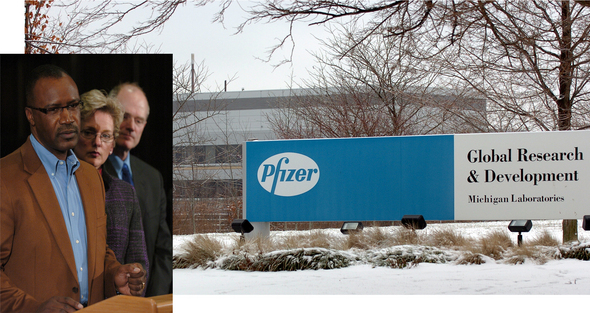
Pfizer Inc. announced Jan. 22, 2007 that it would close its Ann Arbor research campus on Plymouth Road and Huron Parkway. In the photo at left, then-Ann Arbor SPARK CEO Michael Finney, then Gov. Jennifer Granholm and Ann Arbor Mayor John Hieftje speak at a press conference addressing Pfizer's announcement.
File photos | AnnArbor.com
Global pharmaceutical firm Pfizer Inc. delivered shocking news.
“In Research and Development, the company is planning to close three research sites in the United States -- Ann Arbor, MI, Esperion (also in Ann Arbor) and Kalamazoo, MI (where the company will continue to maintain a large manufacturing and Animal Health presence),” the press release said.
The move displaced more than 2,100 workers, shocking the governor, local economic development officials, the life sciences community and the University of Michigan.
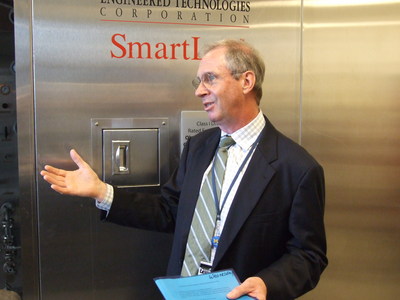
David Canter, who led the research campus for Pfizer, was recruited in 2010 to lead the site, renamed North Campus Research Complex, for the University of Michigan. Here, in 2010, he gives a tour of part of the Pfizer complex that had never been seen by the media.
Nathan Bomey | AnnArbor.com
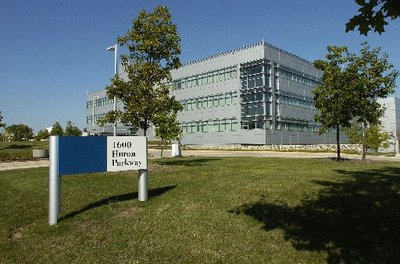
Pfizer had 30 buildings totaling 2 million square feet on 174 acres of property.
Lon Horwedel | AnnArbor.com
It didn’t shock David Canter. Canter, the leader of the research campus, had been told three weeks earlier. He fought the decision — but then-Pfizer CEO Jeffrey Kindler was committed to a 10 percent reduction of the company’s global workforce in the aftermath of a key drug development failure.
Canter — who would later earn praise for handling the news with a remarkable dose of poise and compassion — recalls the day the news became public.
5th anniversary of Pfizer's announcement
“I remember the period and the sense of stress and frustration,” he said. “I can still remember those emotions.”
But those emotions have faded.
“I’m not angry anymore,” Canter said. “I’ve absolutely moved on. I’ve moved forward.”
And the community has moved on, too. In 2009, the University of Michigan acquired the Pfizer campus for $108 million with plans to populate the site with 2,000 to 3,000 employees within 10 years.
“I like to believe that the whole experience has taught us as a community to be resilient and to be confident about our ability to weather these storms,” Canter said.
The day the bubble popped
When Pfizer delivered the news, Ann Arbor was overwhelmed with shock — in no small part because the community was still relatively insulated from Michigan’s economic troubles. After all, Washtenaw County’s unemployment rate averaged only 4.8 percent in 2007.
When leaders — including then-Gov. Jennifer Granholm, U-M President Mary Sue Coleman and then-Ann Arbor SPARK CEO Michael Finney — gathered for a press conference to discuss their response to the news, much of the discussion centered on the recognition that Ann Arbor’s not a bubble after all.
Indeed, Pfizer’s decision to close the facility was a product of a number of global issues — especially the company’s inability to generate new drugs, which drove the restructuring.
Understanding those issues, local officials were expecting cuts.
“What shocked most of us was the fact that it was a complete shutdown,” said Stephen Rapundalo, executive director of Ann Arbor-based life sciences association MichBio. “It was illogical. This was by far their most productive R&D site.”
Rapundalo said he’s spoken with Pfizer leaders who have since acknowledged that shutting down the Ann Arbor campus “was a miscalculation.”
It was a gut-wrenching blow, reflecting the largest single loss of jobs for Washtenaw County in many years.
“At first I couldn’t believe it,” Coleman said in an interview. “I just thought, ‘How can this possible be?’ It was devastating news.”
An opportunity arises
But the closure offered an opportunity, too.
“It was quite the rallying cry for the community,” said Finney, now CEO of the Michigan Economic Development Corp. “Losing 2,000 very high-quality jobs at a company like Pfizer is probably never a good thing, but there were some interesting lessons learned as part of that process.”
Without exception, local leaders said Finney and SPARK played an integral role in organizing a coordinated response to Pfizer’s announcement. SPARK coalesced dozens of community leaders to devise strategies to minimize the impact of the decision on the local philanthropic community, biotech industry, property tax base and economy.
Perhaps the most important initiative was SPARK’s focus on communicating with displaced Pfizer workers in an attempt to convince them to stay in the Ann Arbor area, launch companies or join existing local businesses.
From the beginning, it was a race against time. Pfizer moved quickly to offer jobs at other research facilities to hundreds of its Ann Arbor scientists. And other global pharmaceutical companies rushed in to pick up talent, too.
In the end, Pfizer convinced about one-third of the Ann Arbor workers to take jobs elsewhere — including its large research campus in Connecticut. Many of those transferees have since been laid off in successive rounds of Pfizer restructuring.
SPARK has estimated that another one-third of the Pfizer employees took jobs with other major pharma companies, while about one-third chose to stay in the Ann Arbor region.
Of those, former employees launched about two dozen startup companies, including consulting firms and biotech startups, according to SPARK and the Michigan Venture Capital Association.
Among those startups is the second edition of Esperion Therapeutics, led by Lipitor co-discoverer and former Pfizer employee Roger Newton.
Pfizer’s decision to close its Esperion unit at the same time it shuttered the rest of its local operation shocked local officials. Just three years earlier, Pfizer had doled out $1.3 billion to acquire the first version of Esperion.
Newton learned of Esperion’s pending demise about a month before it became public news in a conversation with John LaMattina, then head of Pfizer Global Research and Development.
In a “matter of 30 seconds” after learning about Esperion’s demise, Newton knew what he wanted.
“I said, ‘Can I get the name back, can I get the intellectual property back to start Esperion?’” Newton said. “He said, ‘Let’s look at that.’”
After about a year of negotiations and fundraising, Newton secured $22.75 million in outside venture capital, licensed IP from Pfizer and restarted his company. In addition, he worked with SPARK, the MEDC, Wayne County and other officials to coordinate a deal to buy Esperion’s 57,000-square-foot Plymouth Township facility back from Pfizer and transform it into a business incubator. The facility, now called Michigan Life Science and Innovation Center and managed by SPARK, hosts several startup companies, including the new Esperion.
“It was, for me and for a lot of people, an opportunity to ensure that life sciences in Michigan could thrive even though there’s this mass exodus of people leaving,” Newton said.
To be sure, though, Pfizer’s exodus dealt a big blow to the local employment market. In January 2007, when the announcement was delivered, Washtenaw County had 203,200 jobs. By November 2008, when the company’s departure was complete and the global financial crisis was hot, the county had 196,700 jobs.
Although the county hit its trough with 191,100 jobs in July 2009 as the manufacturing sector imploded, it has steadily crept back upward to 196,800 -- 100 more jobs than the county had on the day Pfizer left.
U-M steps in
The legacy of Pfizer’s Ann Arbor presence will not fade away any time soon. Pfizer — which assumed ownership of the Ann Arbor campus in 2000 when it acquired Warner-Lambert Parke Davis — had invested more than a quarter of a billion dollars in facility improvements just a few years earlier.
In the months after Pfizer announced its decision to leave the site — a departure that took place in stages and finished in November 2008 — SPARK and real estate agents showed off the campus to numerous prospective suitors.
Many possible buyers took a walk through the facility — including, notably, Cleveland-based developer Forest City Enterprises, which had previously redeveloped another ex-Pfizer facility.
From the beginning, few observers believed the site could be sold to another pharmaceutical company because of the industry’s rapid contraction. Some local officials held out hope that a private developer would buy the site, redevelop it and attract multiple different tenants.
But the global financial crisis intensified in 2008, making it very difficult for private companies to finance a purchase. And Pfizer had no interest in waiting out the crisis in what surely would have been a prolonged marketing process.
That’s when the University of Michigan stepped in. In December 2008, U-M revealed that it would buy the entire complex for $108 million in what was, by all accounts, an extraordinary bargain that Vice President for Research Stephen Forrest has described as a “watershed moment” in the history of the university.
“It’s a once-in-a-lifetime opportunity,” Coleman said.
The deal disappointed some city officials because Pfizer paid $14.1 million in local taxes in 2007, including about $4 million to the city of Ann Arbor. Pfizer successfully challenged the size of its tax bill on its way out of Ann Arbor, too.
The sale to the university removed the property from the tax rolls altogether, carving a hole in the city’s budget during an already challenging period.
But U-M’s promise to add 2,000 to 3,000 jobs at the site over the next 10 years pacified most criticism of the deal — or at least relegated criticism to private conversations. It’s hard to complain about 3,000 jobs during a time of economic distress.
“The fact that the university was able to take over that site and is now refilling it will certainly be a major contributor to bringing those employment numbers back up and has been phenomenal,” said Rapundalo, who was also a City Council member when the deal was struck. “They could have simply just transferred people and put people in, but they chose to be thoughtful and strategic and think how we can maximize the potential here.”
The site, which is located directly adjacent to the university’s North Campus, was renamed North Campus Research Complex, or NCRC.
The university is populating the site with administrators, health care researchers, scientists and many others. Among the focuses are cardiovascular research, translational oncology, health care policy research and drug delivery science. U-M has also formed a 16,000-square-foot business incubator at the site — which is collocated with its Technology Transfer Office and Business Engagement Center — and is leasing labs to two other tech companies.
U-M recently announced that it now has more than 1,000 workers at the ex-Pfizer site and that it would have about 1,700 there by the end of 2012.
One of those employees is Canter, who joined U-M in 2010 to lead the site. Between the end of his tenure at Pfizer — he resigned instead of taking a job elsewhere, saying he wanted to stay in Ann Arbor — and his hiring at U-M, he didn’t set foot in the facility.
But he’s glad to be back.
“I think the acquisition by the university of the NCRC site gave something positive to be constructed here, even if it wasn’t in some people’s eyes the perfect solution,” Canter said. “The reality is a university that is continuing to expand, hiring people into the area represents a terrific economic engine.”
Contact AnnArbor.com's Nathan Bomey at (734) 623-2587 or nathanbomey@annarbor.com. You can also follow him on Twitter or subscribe to AnnArbor.com's newsletters.
Comments
A2comments
Mon, Jan 23, 2012 : 1:42 a.m.
Pfizer has a track record of poor acquisitions and massive layoffs. They left A2 because mgmt was incompetent and made one of many bad decisions. I owned stock in one of Pfizer's acquisitions and sold it all when it surged on news of the takeover. We bought a "Pfizer house". The senior Pfizer exec that used to own it went to St. Louis for them and then lost his job 4 years later. Lousy company.
jj45678
Mon, Jan 23, 2012 : 1:21 a.m.
I guess you could say, never trust a drug company TOO much. Although probably should keep an eye on who they have on their payroll too as reported in this very paper: <a href="http://www.annarbor.com/tag/physicians/">http://www.annarbor.com/tag/physicians/</a>
Townie
Mon, Jan 23, 2012 : 12:22 a.m.
"The deal disappointed some city officials because Pfizer paid $14.1 million in local taxes in 2007, including about $4 million to the city of Ann Arbor. Pfizer successfully challenged the size of its tax bill on its way out of Ann Arbor, too." Of course - no surprise; just typical Pfizer behavior. September 04, 2009: Pharma Crime: Pfizer Fined $2.3 Billion for Drug Fraud (the largest health-care fraud settlement in U.S. history) We do not need to mourn the loss of a company like that. It was inevitable. Now Parke-Davis? yes, that was a loss; another victim of Pfizer. And, of course, AA.com has to laud SPARK -- of course, so typical and predictable. How about actually looking closely at SPARK and their finances? Nope, never going to happen with the AA.com...
Halter
Sun, Jan 22, 2012 : 11:17 p.m.
How different Ann Arbor was 5 years ago! -We had a real newspaper, not this joke of AnnArbor.com where news is mixed with opinion and people are allowed to post comments on tragic news stories -The Stadium Bridges hadn't dilapidated yet -We hadn't wasted all that money on a duplicate sidewalk that nobody uses either side from Stadium to Washtenaw, nor all those millions on a Greenbelt project nobody would support in 2011 -We were able to read previews and reviews of community and regional theater and concerts for the entire area, not just those who work for their own site -Rich Rod had not yet come, nor gone, and in fact nobody in Ann Arbor knew who he was, or cared -There was a normal, nothing wrong with it parking lot we could use to go to the library -People actually used the library! -Borders was our pride and joy -Halter had not yet decided to move out of Michigan within the year.
Dug Song
Sun, Jan 22, 2012 : 9:35 p.m.
In Atlanta, Internet Security Systems (ISS) IPO'd twice, got to a $4 billion market cap, and ultimately sold to IBM for $1.2 billion. Here's a picture of their larger success - spinning off dozens of Internet security companies, and kickstarting tech in the region (Chris Klaus dropped out of Georgia Tech, but the computer science building bears his name): <a href="http://monkey.org/~dugsong/tmp/atlsec.png" rel='nofollow'>http://monkey.org/~dugsong/tmp/atlsec.png</a> I would *love* to see some actual data and detail around the Pfizer / Esperion clique of companies. I'm surprised how fuzzy the numbers presented in this article are - "about a third", "dozens of companies", etc. Shouldn't be hard to track down?
deb
Sun, Jan 22, 2012 : 6:25 p.m.
Why not do a story about the rumor that U of M rebuffed Pfizer when they asked to buy the campus back? And please do not delete my comment again, and I would like to know why it was erased the first time????
Townie
Mon, Jan 23, 2012 : 12:23 a.m.
Unless they are rumors that AA.com can print...
shepard145
Sun, Jan 22, 2012 : 6:38 p.m.
They don't like humor or rumors - you will be deleted.
Beth Mayhand
Sun, Jan 22, 2012 : 6:22 p.m.
Why do we continue to refuse to give the Lord credit for all that He does? Pfizer shutting down is just another step in the fulfilling of Revelation 18. Nothing that any of us do will change what He has promised the world in any way. This is the beginning of sorrows (Matthew 24) and things are about to get much worse! It does not matter what businesses come to town or how much folks believe they can rebuild the area, it simply will not be done; here or anywhere in the world. God has an answer for everything that mankind does and His is final. He is going to destroy the entire religious, political and educated world. The important question we should all ask ourselves is what we will do during the 3 & 1/2 years of world wide famine and drought that are promised in Revelation 11; or the plagues or Revelation 16. All the science in the world won't save any of us. Jeremiah 25: 33 "And the slain of the Lord shall be at that day from one end of the earth even unto the other end of the earth: they shall not be lamented, neither gathered, nor buried; they shall be dung upon the ground."
West of Main
Sun, Jan 22, 2012 : 8:25 p.m.
Some people have taken the Pfizer closing very hard indeed.
Rod Johnson
Sun, Jan 22, 2012 : 8:06 p.m.
Wrong.
shepard145
Sun, Jan 22, 2012 : 3:15 p.m.
Pfizer left because the business model changed. They went from an in house R&D model to one that acquires other pharmaceutical companies who have already developed a new drug, partnerships and outsourcing to China, India and Singapore. Many of those who were transferred from Ann Arbor to Groton, CT were slowly let go over time until a bigger layout last winter when 1,100 were cut when Groton was changed from an R&D facility to support. The future is not great as obama democrats continue to increase both government regulation and litigation against business (payback for their trial lawyer campaign supporters), the pharmaceutical industry faces more barriers and fewer drugs are worth pursuing. In addition, there are now few companies to acquire since almost anyone who was worth acquiring has been acquired and drugs that are not profitable are disappearing from the market. Most of those scientists are now working at universities again at a fraction of their previous pay and those jobs are dependent on GOVERNMENT grants from TAXPAYERS!! GET IT!!?? ...it's the model virtually ever other major industry in the world is following!!
Edward R Murrow's Ghost
Sun, Jan 22, 2012 : 9:39 p.m.
Yup. The then-senator from Illinois was supposed to do something about Pfizer leaving A2. Conservalogic. GN&GL
deb
Sun, Jan 22, 2012 : 6:38 p.m.
You realize that trial lawyers are the only thing between corporations and normal citizens. Im sure you think the McDonald's coffee spill case was a frivolous lawsuit, and its frivolous lawsuits killing this county.
Edward R Murrow's Ghost
Sun, Jan 22, 2012 : 4:53 p.m.
"Obviously you don't know that obama's "change we can believe in" includes $27,000,000,000 in new taxes on pharmaceutical companies and another $20,000,000,000 in new taxes on medical device makers – yea, count the 0's. Maybe you'll see that written about in your People or Redbook next month…..but I doubt it." ROFL. Pfizer announced it was closing the A2 campus in January 2007. Senator Obama was . . . a senator. The president was Bush II. But Faux Noise is, indeed, scary given its propensity to make it up and its viewers' obvious ignorance of the facts. GN&GL
shepard145
Sun, Jan 22, 2012 : 4:15 p.m.
So what confuses you – that 70% of trial lawyer campaign contributions go to the democrat party in exchange for their continued support of irrational litigation of businesses? …or didn't they cover that on "The View" this week? Obviously you don't know that obama's "change we can believe in" includes $27,000,000,000 in new taxes on pharmaceutical companies and another $20,000,000,000 in new taxes on medical device makers – yea, count the 0's. Maybe you'll see that written about in your People or Redbook next month…..but I doubt it. Fox News frightens you! LOL …yea, they see a lot of that in election season – as we saw in the 2010 election cycle, the truth is not the democrat party's friend. You should try watching something other then the failing left wing democrats at PMSNBC, ABC, NBC and CNN, who spew lies and slander as a matter of daily "reporting" and on the record refusing to correct their drivel. ..but that's fine – go enjoy your fellow democrats as they try to re-elect the worst president in a hundred years. But also realize that your opinions are not your own – you have been shaped as another tool of the government controlled media. …but on the bright side, you would be totally at home living in Putin's Russia these days!! LOL
racerx
Sun, Jan 22, 2012 : 3:46 p.m.
Where does Obama democrats have anything to do with Pfizer's departure? Regulations? Really? Stop watching Faux News! Pfizer models clearly showed that increase of competition throughout the world in regards to drug development had more to do with their decision than anything else. Without any new drugs being develop by Pfizer why keep multiple research centers open? Government regulation had nothing to do with Pfizer's demised. And, if you researched the facts, the Obama administration has had less government regulations than Bush II.
dancinginmysoul
Sun, Jan 22, 2012 : 2:26 p.m.
Really? We need four "front page" articles about a business that bailed on a city and screwed a lot of people; Five years ago. Thanks for the positivity annarbor.com
xmo
Sun, Jan 22, 2012 : 1:43 p.m.
There was not any reasons given why Pfizer closed its Michigan operations but maybe it was high taxes? Something to remember when the city talks about imposing an income on workers and residents in Ann Arbor.
Stephen Lange Ranzini
Sun, Jan 22, 2012 : 1:32 p.m.
In the post above, "If 3,000, Pfizer lane" should read "If 3,000, Pfizer alone". My apologies!
Stephen Lange Ranzini
Sun, Jan 22, 2012 : 1:16 p.m.
This article says that 2,100 jobs were lost, yet in the Granholm book excerpt it says that the Pfizer CEO said that between Kalamazoo & Ann Arbor 5,000 jobs would be lost from the shut downs. The Ann Arbor operation was bigger than the Kalamazoo one that was closed. I think the difference is that people keep ignoring the contractual workers who were not employees, but whose job was directly tied to providing services to Pfizer on that site & all of those jobs were lost when the Pfizer campus was closed. I think the articles are a great idea, & helpful to educate about the process of economic development but a couple of points are missing: 1) The concept of "base economic jobs" and multipliers. This is a key principle. A base economic job is one that sells a product or service outside of the area you are trying to grow jobs in. For example, building a third gas station on a corner does not create economic development, but impoverishes two other gas station owners. Pharma R&D sold globally does create base economic jobs. Each base economic job produces on average 3x that number of jobs in the community. If 4,000 jobs were actually in the Pfizer campus, since they were all base economic jobs, they would be responsible for sustaining 12,000 jobs in total. The number of jobs lost from peak to trough was 12,100. If 3,000, Pfizer lane explains the loss of 9,000 jobs in the county. To get back to where we started, we need 6,400 jobs, or about 2,167 base economic jobs. Now we know the goal we have to set to get back to zero. 2) The current unemployment rate in Washtenaw County is 5.2% and in 2007 averaged 4.8%. However the unemployment rate doesn't take into account people working part-time who want full time work, those working lower wage jobs to make ends meet, those who took a pay cut with early retirement, those who gave up looking for work & the surge to 5% of all the adults of working age now on Social Security Disability.
trespass
Sun, Jan 22, 2012 : 12:22 p.m.
Coleman worked hard to make this happen. She wanted the facilities and land. The Pfizer executives hated her and what was the advantage of having a research facility next to a major research university when that university would not cooperate with you? Pfizer wanted tax breaks that Coleman's friend and Governor, Granholm who would not give them. They had other facilities so why keep this one open in hostile territory.
mun
Mon, Jan 23, 2012 : 6:04 p.m.
"In Research and Development, the company is planning to close three research sites in the United States -- Ann Arbor, MI, Esperion (also in Ann Arbor) and Kalamazoo, MI (where the company will continue to maintain a large manufacturing and Animal Health presence)," the press release said. Also, "In the end, Pfizer convinced about one-third of the Ann Arbor workers to take jobs elsewhere — including its large research campus in Connecticut. Many of those transferees have since been laid off in successive rounds of Pfizer restructuring." So it wasn't just in Ann Arbor that Pfizer closed down and laid off workers.
Hot Sam
Sun, Jan 22, 2012 : 4:03 p.m.
Not to mention two senators on a rampage against "Big Pharma"...
braggslaw
Sun, Jan 22, 2012 : 12:10 p.m.
Pfizer was a company that paid taxes and was plus contribur to the michigan economy. UM bought the building and they do not pay taxes to the city or state. Granted, something had to be done but we can't keep replacing private jobs with public jobs, it is an unsustainable business model.
Stuart Brown
Mon, Jan 23, 2012 : 1:01 a.m.
EyeHeartA2, Apparently, Pfizer tore down facilities in Kalamazoo in order to avoid property taxes at one time. That approach probably would not have worked for Pfizer when they left for the simple reason that that would have reduced the value of the property and Pfizer had no intention of staying so could never have recouped the property tax savings. However, braggslaw has a point in that if Pfizer had torn down all the buildings and sold the property to commercial developers, the city would have retained the reduced tax revenue from the property.
EyeHeartA2
Sun, Jan 22, 2012 : 7:10 p.m.
@Lady Audrey: I read braggslaw's comment twice and didn't see anything about tearing anything down. Could you point it out please? Thanks.
Lady Audrey
Sun, Jan 22, 2012 : 3:58 p.m.
So, you are saying the preferred handling of the abandoned site was for Pfizer to tear down all the buildings. What would that do for taxes? At least people are working at the place now.
maryfmasson
Sun, Jan 22, 2012 : 3:49 p.m.
Here is some information about tax implications and the University, from the NCRC Web site, <a href="http://www.umncrc.org" rel='nofollow'>www.umncrc.org</a>: <a href="http://ncrc.cms.si.umich.edu/about/news-and-announcements/tax-statement" rel='nofollow'>http://ncrc.cms.si.umich.edu/about/news-and-announcements/tax-statement</a>