

Ann Arbor plans to request $24 million loan for drainage projects; storm-water rates could double for some
Rain that blitzed Ann Arbor last week blasted manhole covers over stressed storm drains and caused a mudslide over Plymouth Road. Raw sewage flowed onto a street, and drivers got stuck on flooded roadways.
The storms were too much for the stressed storm drain system to handle. And Ann Arbor residents are going to be asked to help pay for improvements.
In light of an increase in the number of storms like these in recent years, Ann Arbor plans to ask the state for a $24 million low-interest loan to complete 14 projects related to storm-water management, said Jennifer Lawson, water quality manager for the city.
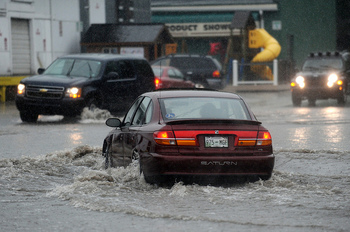
Motorists attempt to drive their cars through deep water on South Fifth Avenue near Fingerle Lumber Co. in Ann Arbor on Wednesday afternoon. The city's storm-water system is not equipped to handle rains of such heavy intensity.
Melanie Maxwell | AnnArbor.com
That means for some, storm-water rates will more than double.
The Washtenaw County Water Resources Commission, a partner on the project, will hold a public hearing on the proposed State Revolving Fund Project Plan Amendment for the Huron River watershed on June 14, Lawson said. The hearing will be held from 7 to 8:30 p.m. at the New Center, 1100 N. Main St. in Ann Arbor.
Lawson said the project will cost the city less than $24 million because the state program includes loan forgiveness of up to 50 percent for some elements of the plan. The increase in storm-water rates would not be permanent, she said.
Recent storm-water projects that have been installed are part of the same funding plan that's being amended, Lawson said. Such projects include the water storage basins under Pioneer High School parking lot and porous pavers on Sylvan Avenue.
New funding would be used to expand existing retention ponds, install more porous pavement and plant trees and rain gardens with root systems that soak up more rainwater.
The city isn’t the only entity worried about the impact of high-intensity storms on people and the environment.
Janis Bobrin, the county water resources commissioner, said the county drainage system in place isn’t built to handle the kinds of storms Washtenaw County received last week, in which a large amount of rain fell in sudden bursts.
Wednesday’s storms dumped 3.48 inches of rain on the University of Michigan’s north campus weather station in the 24 hours ending at 7 a.m. Thursday. That’s where University of Michigan weather observer Dennis Kahlbaum collects rainfall totals and reports them to the National Weather Service.
“These are very high-intensity rainfalls,” Bobrin said. “What’s different about them? If the rain falls gradually, it can get into the storm water system. When it comes down so intensely, and it can’t get into the underground systems, it ends up flooding streets and basements.
“And that’s thought to be part of climate change,” she said. “And it’s expected to continue.”
In light of an ailing county budget, that’s a problem.
“When we design storm-water infrastructure, we can’t design for the very worst case. We can’t put in pipes that will handle atypical huge high intensity. We can’t afford to do it,” Bobrin said.
Last week, the Huron River Watershed Council announced the formation of a committee to address the regional impact of climate change on communities in its 910-square mile Huron River watershed.
With the effort, it hopes to help guide drain commissions, cities and other organizations that control natural and man-made storm drain systems to make decisions that help protect waste- and drinking-water systems and prevent flooding.
In doing so, organizations will benefit people and the environment, experts say, because flood waters wash sewage, heavy metals, oil and fertilizers into rivers and streams, causing pollution, promoting excess algae growth and destroying habitat.
Juliana Keeping covers general assignment and health and the environment for AnnArbor.com. Reach her at julianakeeping@annarbor.com or 734-623-2528. Follow Juliana Keeping on Twitter
Comments
e fanta
Tue, Jun 7, 2011 : 5:48 p.m.
If Sue McCormick had not taken money from the storm water fund to plant new trees after the citizens of Ann Arbor voted down a tax to replace the elm trees, there would be money in the fund to finance needed repairs and maintenance. Now we are going to be taxed without voting for it. This is just another example of the over-reaching of the current administration.
snapshot
Fri, Jun 3, 2011 : 5:48 a.m.
More money, more money. Never is there enough money. I scrimp and save and then it's taken away because of a rainy day.
LarryJ
Mon, May 30, 2011 : 1:58 p.m.
I am amazed how many of these comments are just SOUR GRAPES. These are real problems in our infrastructure, requiring solutions. The dumbest of the comments complain about neglect of these problems in the past, then follow with "no new taxes". We can't ask past generations to do a better job, and we can't ask our public officials to solve them without spending any money (yes, our tax money) on the solutions. The best we can do is to ask our public officials to put some thought into the solutions, get our input, and to spend our tax money wisely.
Alan Goldsmith
Mon, May 30, 2011 : 10:57 a.m.
"You should also know that the much criticized fountain at City Hall is not simply an aesthetic add-on..." You got that right Leah. It's an example of mismanagement, wrong priorities and wasted tax dollars that Ms. Bobrin used her position to support.
Dog Guy
Mon, May 30, 2011 : 1:25 a.m.
Money collected by the water utilities flows by many channels wherever the Ann Arbor kleptocracy wills. The city hall gang calls diversions by many innocent names implying overhead and accounting fees. The definition of proper use is written on a rubber sheet. A loan will allow the diversion of utilities funds to increase.
Stephen Landes
Sun, May 29, 2011 : 11:17 p.m.
It seems to me that one of the recent Ann Arbor.com articles about the city budget included information about money in certain set-aside funds that couldn't be tapped for helping to balance the operating budget. One of those funds was the water fund and if memory serves that fund has a substantial balance. Is the city planning to tap that fund to do some of the needed work? Why are we borrowing money if that fund is available?
Gill
Sun, May 29, 2011 : 10:28 p.m.
What is the ratio of managers to workers at the City now anyway (versus 10 or 20 years ago).
Ming Bucibei
Sun, May 29, 2011 : 6:45 p.m.
NO!! new taxes!! We in Ann Arbor are overtaxed already!! People responsible should be charged criminally The problems are not too little taxes it is too much spending on the wrong things+ chronic neglect of infrastructure & misfeasance and malfeasance!! Ming Bucibei
Leah Gunn
Sun, May 29, 2011 : 5:44 p.m.
I would like to inject some reality into the accusation that our Water Resources Commissioner, Janis Bobrin, has done a "poor job". That is far, far from the truth. Bobrin has put much tighter stormwater requirements on development and redevelopment, but there is no way that we can simply tear put and replace all of the old infrastructure. It is simply unaffordable. In addition, Bobrin has secured over $20 million in low interest loans and grants (about 50% in each category) to make improvements to the City's stormwater system. These include the Mary Beth Doyle Park and Wetland Preserve, the Pioneer High School stormwater storage facility, the permeable pavement on Willard St., and close to a dozen other projects that improve stormwater management. The City was able to obtain this money because the projects met the definition of "green infrastructure". You should also know that the much criticized fountain at City Hall is not simply an aesthetic add-on, but is part of a stormwater management system for the municipal building. Getting the facts straight, and understanding that Janis Bobrin's commitment to the water quality management in Washtenaw County is essential. She does not deserve the remarks made about her. She is a dedicated public servant and has a deep commitment to the environment in all its aspects.
Dirk Curtis
Sun, May 29, 2011 : 5:01 p.m.
Rain gardens do a nice job with slower rainfalls, but in downpours they do not. What is needed is collection basins. Most new construction has to have water detention areas (all the pond type areas with fences around them). This is a nice first step, but when waviers are given out on new structures, what good does the law do. Porous pavement is relatively new and does not last as long in our type of climate. And porous pavement does not handle the type of downpours we received, it will certainly absorb some, but most will run off. A combination of detention, rain gardens, porous pavement,rain barrels and similar things are a great idea and should be worked into future work. But none of them deal with heavy downpours, they reduce slightly the impact, but thats all. But the government is a power hungry entity with an insatiable desire for tax money. If they ever have unspent money, they always find a way to waste it away and come back to the public telling us how they cant collect leaves, repave roads, replace underground pipes... Ann Arbor is a city run by people who just talk. We are suppose to be tree city, but many streets are empty of trees. Yes I know there was a bug, but it was poor plans on what trees to plant where ultimately at fault (changed now). We always hear we need more low income housing, but when habitat builds a house and the owners can't afford to live in the house because of property taxes (city refused to reduce), what does that say about who is running things? The city has too many departments with too many over lapping areas of concern and they need to fix that, before they will be able to fix storm water management issues or any of the many other issues.
John B.
Sun, May 29, 2011 : 5:27 p.m.
What public office are you running for at this point? Since you seem to feel that everyone currently in power is incompetent, what will you be doing to help make things better (besides complaining, that is)?
Dirk Curtis
Sun, May 29, 2011 : 4:41 p.m.
Anything the government does is never temporary. So any tax increase, added fee will be permanent. If there truely is a plan to improve the ability to direct rainfall, I would not be opposed to it. But when the public get the fear mongering mantra that our government used as an excuse to get more of our hard earned money, no I will not support it. I am really tired of the 'global warming' tag line coming out every time there is weather related issues. If science could predict the weather more than a few hours away, perhaps I would have faith in the global warming fear mongering that is done for increases in spending (be it government spending or researchers). I highly doubt the drain commission, nor the city employees bantering out the term know much about how the planet works. The sewer disconnect is a bandaid on a very poor designed system. Instead of planning a better system, the city is doing what is cheapest at the expense of the public. The city demands waivers on the disconnects, so property homeowners have no protection if the work was done improperly. Its funny how the city forces you to do it, pays for it, tells you who can do it (Several former city employees are the 'authorized' contractors) inspects it and there is no independent oversite at all. What will happen when they begin altering the stormwater system, the city will hire more cronies to do the work. They will patch here and there, and we will be told in ten years that it needs to be redone again. The city stopped collecting leaves in the fall...anyone think that maybe some of those leaves might be clogging the current sub standard system. The city gave away the compost center(and tax paid equipment) and now we have to pay outrageous fees to bring leaves, grass, trimming to the compost center. I expect many will just not rake leaves when the costs become more well known and they will end up in the sewer.
Tom Whitaker
Sun, May 29, 2011 : 4:39 p.m.
It's too bad it takes a near-disaster to motivate our local government to finally act on some components of its flood mitigation plan (adopted in 2007) and correct storm water system deficiencies that have been apparent for many years. The sump pump disconnection program was only implemented because of the City losing a lawsuit. It's too bad City officials couldn't be as excited and proactive about this matter as they've been about big capital projects like the conference center, the underground parking structure, the justice center, the fountain in front of the justice center, the Fuller Road parking structure and the Wheeler Center. Questions for annarbor.com to follow up on.... Will $240,000 of this money be siphoned off to Percent for Art? Will the City collect an administrative fee off the top, as they've done on recent bond issues? Will the City administration take additional percentages for IT, City Attorney's office, fleet services, etc., then transfer that money to pet projects like the Fuller Road Parking Structure?
Vince Caruso
Sun, May 29, 2011 : 2:44 p.m.
We like many other urban center must move to catching rain water at the source not just building bigger pipes and other very expensive hard solutions. Yes this is a big change but we can find people who can do this, it is not brain surgery. For example the US-EPA is now strongly supporting the use of Porous Pavement on roadways to infiltrate the rain fall, reduce heat island, reduce pollution, reduce flooding and recharge groundwater. It also reduces road noise 70%, lasts longer, prevents hydroplaning, reduces salt use and plowing 70%, and is now shown to cost less than conventional pavement when used on a regular basis. It can handle up to 200 inches an hour rain fall! It naturally detoxifies close to 100% of the pollution as it seeps through the pores in the pavement. Sylvan was paved in porous asphalt last year to reduce persistent flooding in that neighborhood. Philli is doing all it's roads in porous, among other things, to avoid billions in upgrades to it's failed utility system as required by the EPA. Chicago is paving 2,000 miles of alleyways in it and Calif. is now doing highways with it, just to mention a few. A new 60 home development in the northwest did all it's streets in porous and saved $250,000 and never has standing water even in major rain events that have flooded neighboring communities. It has no runoff ever! This city, and county, has to change how it manages rain water or we will be facing major losses due to flooding and infrastructure losses. This is clean fresh water after all very valuable stuff to the rest of the world.
Thick Candy Shell
Mon, May 30, 2011 : 12:23 a.m.
And of course, we are now seeing that most installations in Northern climates do not work unless you use exclusively salt or brine. Being that the Council in Ann Arbor has a mandate that the sand/salt mix on locals can not exceed a certain percentage of salt, we will still be putting sand on our locals. Sand plugs porous asphalt and then makes it EXTREMELY expensive to maintain. But at least there is less salt being used!
Sallyxyz
Sun, May 29, 2011 : 12:46 p.m.
So, today's residents are going to pay for the lack of proper infrastructure maintenance in the past? Heavy rains did not start this year. I'm sure that looking at past weather records would reveal intense rainfall in past years. If the drains had been properly maintained and upgraded as needed all through the years, instead of being ignored or "waiting until the issue was at a crisis stage," the current residents would not be hit for high costs, that in my opinion, will not decrease in the future. They will have new reasons to keep the rates higher, even after these improvements are made.
Epengar
Sun, May 29, 2011 : 10:24 p.m.
Actually if you looked at past weather records, you'd see that since the 50's, more and more of our annual rainfall has come in heavy storms rather than light showers. This pattern is one of the strongest predictions of increased warming, so it shouldn't be a surprise. I can't speak to whether planning and construction was neglected in the past, but in any case stronger measures are needed now and in the future than they have been in the past.
Richard C
Sun, May 29, 2011 : 3:28 p.m.
Would you rather problems go unfixed while the city government fruitlessly pursues former residents (or their estates) for taxes that should have been levied in the past but weren't due to a combination of near sighted project management and tax-o-phoibia?
David Cahill
Sun, May 29, 2011 : 12:35 p.m.
AnnArbor.com, which government agency is responsible for making sure that the collapsed railroad embankment is rebuilt to the correct standards? I admit that the crushed rock being poured into the hole doesn't give me a warm and cuddly feeling. I was expecting some kind of concrete replacement structure.
tdw
Sun, May 29, 2011 : 3:03 p.m.
I think it's these guys <a href="http://www.fra.dot.gov/pages/1284.shtml" rel='nofollow'>http://www.fra.dot.gov/pages/1284.shtml</a>
KJMClark
Sun, May 29, 2011 : 11:47 a.m.
It's too bad we can't set up some kind of 'three stupid comments and you're out' system. The County Drain Commissioner is not responsible for the Ann Arbor stormwater system. The stormwater system was neglected for decades and they've been improving it since McCormick was hired. Footing drain disconnects *are* helping reduce sewage backups. Pervious pavements are the state of the art way to allow rain to infiltrate pavement. In the new record spring precipitation, how many times did the Allen Creek area flood? They keep making our stormwater system more robust, but there are always a few commenters who are happy to trash things. Planting rain gardens are **PRECISELY** what **IS** going to help during a 3.5" rainfall. That's a local stormwater detention project. Stormwater detention is the best way to deal with heavy rainfall events. Do you know of a better one? The biggest problems I saw from these rains was lack of maintenance of drains - specifically, it seemed to me that the street / storm drain cleaning got off to a late start. That's probably just my perception, and is a pretty minor complaint. Look at how heavy the rainfall was and all of the places that had no flooding at all. A railroad embankment failed, the Huron was overflowing onto flood plains, but most of the city did much better than the heavy rains a decade ago.
foobar417
Sun, May 29, 2011 : 2:39 p.m.
@DennisP: The porous paving project on Sylvan Avenue is an experiment designed to enable the city to determine how well such paving treatments work. <a href="http://www.annarbor.com/vielmetti/sylvan-avenue-repavement/">http://www.annarbor.com/vielmetti/sylvan-avenue-repavement/</a> To quote that article: "It is believed to be the first street of its kind in the state of Michigan ..."
DennisP
Sun, May 29, 2011 : 12:19 p.m.
"Pervious pavements are the state of the art way to allow rain to infiltrate pavement." I've heard about pervious pavement. I've thought it to be an interesting possible solution to a lot of low load surface areas (driveways, parking lots, sidewalks), but how much is hype? What are its limitations? E.g. How would it fare with Michigan's freeze-thaw cycles that undermine just about any hard surface? Durability? Stability (will underlayment go to mush)? Cost (straight up as well as factoring savings by not having to stress sewer systems)? Anyone have some answers to these? I would consider installing that for sidewalks and stuff around the house if it's really good (and I could afford it). Is it only practical as a new install? Do you need to regrade and direct the flow underneath into french drains or some other diversion?
Kai Petainen
Sun, May 29, 2011 : 11:45 a.m.
this is a great idea, and a step in the right direction.
utownie
Sun, May 29, 2011 : 10:56 a.m.
Ann Arbor storm water rates have already increased during the McCormick / Frasier years by more than double. The City of Ann Arbor was cited a few years ago by the state Department of Environmental Quality for violations and a settlement agreement was signed. The Pioneer High School and Sylvan projects were never designed for high rainfall. Ask for design criteria. These projects are part of the same plan. To do over? To pay again? Planting trees and rain gardens are not going to make a difference during a 3.5 inch rainfall. 14 more projects that will do nothing to solve the real problem. The tax increase will be permanent.
A2comments
Sun, May 29, 2011 : 10:55 a.m.
What percent of customers will see rates double? Seems the headline is only true for a small percentage of the customers? Those at the top end will see a 22% increase.
Alan Goldsmith
Sun, May 29, 2011 : 10:13 a.m.
""These are very high-intensity rainfalls," Bobrin said. "What's different about them? If the rain falls gradually, it can get into the storm water system. When it comes down so intensely, and it can't get into the underground systems, it ends up flooding streets and basements." And it ends up with us having a public official like Ms. Bobrin, who instead of coming up with solutions BEFORE the problems happened, being a total failure in her job. And with her 'checkered past' being one of the cheerleaders for the Giant German Urinal Water Fountain at the new Courts-Police Building downtown it's plain to see she didn't have quite the right priorities. Thanks Ms. Bobrin for telling us how you failed AFTER the fact.
DDOT1962
Sun, May 29, 2011 : 1:23 p.m.
I'm with KJMClark. Mr. Goldsmith hasn't added anything of substance to these comments since he began posting. His singular purpose has been to debase public officials and somehow tie everyone into a conspiratorial knot over the approval and construction of the fountain in front of the new police-courts building. Enough is enough!
glenn thompson
Sun, May 29, 2011 : 12:27 p.m.
Ann Arbor is part of the county and the County Drain Commissioner is responsible for the drains in Ann Arbor. I believe the city has negotiated to assume responsibility in some instances.
KJMClark
Sun, May 29, 2011 : 11:28 a.m.
Hey Ann Arbor.com - I'd pay real money to thumbs-down stupid, abusive comments like this one. Hey Goldsmith, why don't you run against her, so we can laugh you off the ballot? She's the **County** Drain Commissioner. She's not responsible for Ann Arbor's stormwater system, she's just explaining how the things work.