

Ann Arbor residents get first look at final designs for $23M Stadium bridges replacement project
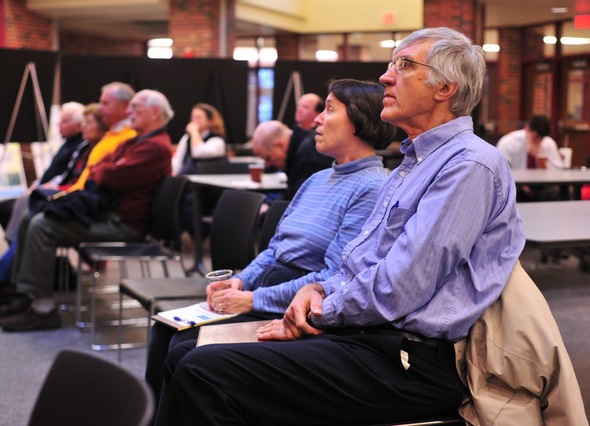
About two dozen Ann Arbor residents, including Ed and Patricia Shalis, attended a public information meeting Wednesday night at Pioneer High School to hear an update on the $23 million East Stadium Boulevard bridges replacement project.
Ryan J. Stanton | AnnArbor.com
For Ann Arbor resident Ruth Dixon, it's the walking and biking features in the upcoming East Stadium Boulevard bridges project that excite her the most.
Dixon, who lives off Scio Church Road, said she's often befuddled she lives in the middle of Ann Arbor and there aren't bike paths and sidewalks to take her where she needs to go.
"And so I'm happy as this becomes a much more well-planned urban setting," she said as she left a public information meeting on the project Wednesday night. "I'm glad the walking and biking will improve on Stadium, and as it continues westward I will be even happier."
Ann Arbor officials unveiled some of the final designs for the long-awaited reconstruction of the Stadium Boulevard bridges during an hour-and-a-half meeting at Pioneer High School.
Michael Nearing, city engineer and senior project manager, gave an update on the project to about two dozen residents who gathered inside the school cafeteria, discussing project funding, newly unveiled drawings and construction period operations, including expected detours.
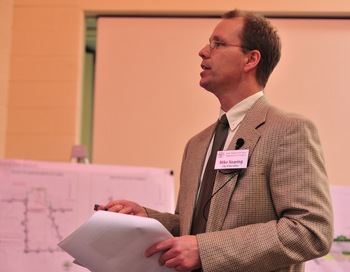
Michael Nearing, city engineer and senor project manager, gives a presentation on the Stadium bridges project Wednesday night.
Ryan J. Stanton | AnnArbor.com
Construction is expected to start later this fall.
The project starts at the entrance to the University of Michigan Golf Course on Stadium Boulevard and continues east until just short of South Industrial Highway.
Two bridge spans will be completely replaced, including the bridge over South State Street that was built in 1917 and the bridge over the Ann Arbor Railroad tracks that was built in 1928. The project also includes reconstructing a portion of South State Street under the bridge.
Nearing said the city will keep Stadium Boulevard close to its current configuration, with four lanes of vehicular traffic. There will be on-street bike lanes on each side of the road, a widened sidewalk on the north side of Stadium and a new sidewalk on the south side of Stadium.
There will be two pedestrian stairway connections to Stadium Boulevard, featuring open picket-style railings and streetlight fixtures, at the northwest and southeast corners of the span over State Street. There also will be an ADA-accessible path from State Street up to Stadium.
"We're going to have a couple of lights on each staircase to light them up at night, so that you can obviously see where you're walking," Nearing said.
Nearing talked about what the retaining walls would look like. He said it was decided they should have some texture and color, with different patterning, but they shouldn't look fake.
Based on input from residents at previous meetings, the city decided against including any type of logo on the walls. A previous conceptual drawing showed a University of Michigan logo, but residents voiced concerns since U-M wasn't willing to help pay for the $23 million project, which will help football and basketball fans get to Michigan Stadium and Crisler Arena.
"Our project is being designed for the next 75 years. We're doing this to make it last," Nearing told residents, adding most of the work will include building the retaining walls.
Ann Arbor resident Nancy Kaplan said she was disappointed to learn that one of the walls will rise as high as 25 feet at its tallest point near the railroad tracks.
"That's a lot of wall," she said. "I'm very concerned about aesthetics. It's supposed to last 75 years, and I'd like to have something that's aesthetically pleasing and neighborhoods don't kind of see a wall. So that's my concern. A 25-foot-high wall is one heck of a wall."
The meeting was attended by members of the Ann Arbor Golf and Outing Club, a private club with a nine-hole golf course located west of the bridges near Main and Stadium.
"I'm interested in what's going on with this, because eventually it's going to affect that next phase to the west," said club member Tony Rutz, who lives in the Georgetown neighborhood.
"The original plan years ago, which also included the Main Street project, was going to decimate our golf course, and I think there's been a lot of back and forth between the club and the city since then to probably mitigate some of that, but it's obviously still a concern."
As far as getting the bridges replaced, Rutz said he's quite thrilled.
"I'm glad they're finally going to do something after all these years," he said. "It seems like it's a much grander project than it might necessarily have to be, but that's the way the city seems to do things. That seems to be the city's goal is these sidewalks and bike lanes everywhere."
According to the latest schedule, the construction contract is expected to go out to bid in July, with bids due Sept. 2. The chosen contractor would be granted notice to proceed in early October. Stadium Boulevard and State Street would close to traffic starting Nov. 28.
After the contractor tears down the bridge over State Street, the street would reopen to two-way traffic with construction zones on Dec. 13, but wouldn't reopen to full traffic until July 2012.
Stadium Boulevard wouldn't fully reopen until November 2012. The entire project is being targeted for completion toward the end of May 2013.
Planning for the replacement of the bridges originally began in 2007 as part of a larger project. Given the increasing urgency of replacing the span over State Street, which literally was crumbling, city officials narrowed the scope of the project in 2009 to include only the replacement of the bridges and improvements in the immediate adjacent area.
In December 2009, the preliminary design was presented and the public was invited to provide input on options for the visual character of the project. City officials said feedback from residents was used to develop construction plans, which are now virtually complete.
Ann Arbor resident Brad Battey said he's glad to see that White Street, which runs north and south and currently cuts through Stadium just east of State Street, no longer will connect to Stadium after the project is complete. He said he lives two blocks away and that will cut down on people cutting through his neighborhood.
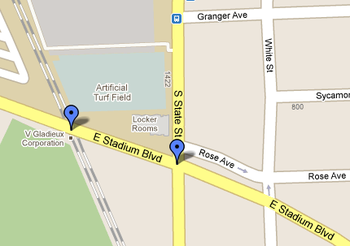
The location of the two bridge spans.
Google Maps
"Virtually all of my concerns have been addressed in the two or three previous meetings," Battey said, giving the city credit. "I can look at the drawings and see things that I mentioned or supported that are incorporated, and I guess you can't ask for much more than that."
Battey and other residents said they're still concerned with the current condition of Stadium Boulevard. They think temporary work needs to be done to repair the crumbling road between now and the time the road closes later this fall. Nearing said the city plans on cold-patching portions of Stadium Boulevard soon, but that didn't seem to please every resident.
"Driving on Stadium in the evening is very tough right now," said Ed Shalis, who lives near Pioneer High School. "There are a lot of holes, you can't see where the holes are, it's hard to avoid the holes. So anywhere around that bridge, right before and immediately after, and definitely on the bridge, it's a little bit hazardous. It should be a concern for anyone who uses that bridge on a daily basis."
Patricia Shalis said the bridge project is long overdue.
"Of course, we're also sitting here wondering about when are they going to work on the adjacent pieces of Stadium, too," she said. "Because they are in a horrible state from Seventh over and then beyond the bridge. It seems like we need a plan for the whole area."
The City Council called a special meeting last week to finalize a contract with the U.S. Department of Transportation for a $13.9 million TIGER II grant for the project. About $800,000 already has been obligated, and city officials are confident they'll secure the rest soon.
"It'll be nice when we have the final go ahead from the feds," said Mayor John Hieftje. "It's almost there, it's right there, and it's pretty darn sure we have it, and yet there's still some work to do to make sure. There's no reason for us to believe that money's in jeopardy, but I'll certainly be more comfortable when it's all allocated."
With nearly $2.9 million more from the state, the city expects to have nearly $16.8 million in outside funding for the $23 million bridge project. The city expects to pay $6.2 million.
City officials decided to hold off on moving forward with the project last year with hopes that those grant funds would come through if they waited. More outside funding for the project means more local money left over to spend on repairing local roads in Ann Arbor.
According to the city's most recent audit for the fiscal year that ended June 30, 2010, the street millage fund had an unreserved fund balance of more than $23.1 million. Total street millage fund revenues came in at $10.5 million for the year, while about $10.1 million was spent. The fund balance increased nearly $3.1 million due to increased transfers from other funds.
As city officials look for ways to spend that money, one of the projects being planned is a multimillion reconstruction of Dexter Avenue from Huron to Maple.
"We should be in good shape to really get busy on the local streets," Hieftje said. "We'll be discussing the total plan a little later, but that's my expectation that we will now be able to free that money up and go forward with all the local street work we can afford."
Click here to download a copy of Wedneday's presentation in PDF format.
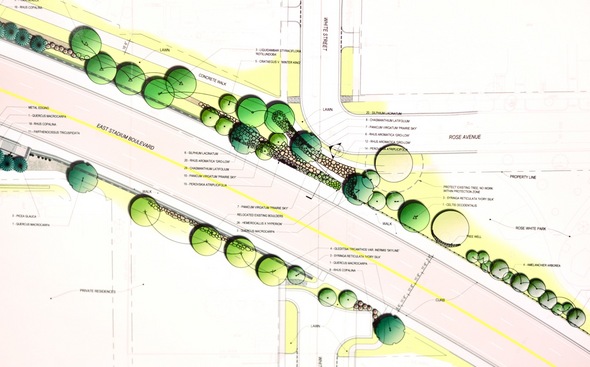
This drawing was on display at Wednesday night's meeting. It shows how White Street, which runs north and south and currently cuts through Stadium Boulevard, no longer will connect to Stadium after the project is complete.
Ryan J. Stanton | AnnArbor.com
Ryan J. Stanton covers government and politics for AnnArbor.com. Reach him at ryanstanton@annarbor.com or 734-623-2529. You also can follow him on Twitter or subscribe to AnnArbor.com's e-mail newsletters.
Comments
Halter
Thu, Mar 24, 2011 : 11:34 p.m.
"two dozen people attended" -- Wow, that is alot, considering Ann Arbor has done a lousy job of advertising these meetings nor sending out letters to the residents effected. I live one block away from this monstrosity. I never received any type of notification of this meeting taking place, nor did any of my neighbors. Typical.
Halter
Fri, Mar 25, 2011 : 9:39 p.m.
Foobar -- it is NOT up to the residents to "find" this information on a webpage -- the City is actually required to personally deliver to the mail boxes of residents within a certain radius of a major building project these type of notices of Public Hearings...the email newsletter does not work -- there are never such notifications. In this case, if ANYONE received this notification, then it would be a miracle. I know none of my neighbors did -- and I would have gladly gone to these meetings. The onus is on the City to notify, not for the neighbors to find out after the fact in the news.
A2Woman
Fri, Mar 25, 2011 : 1:48 a.m.
Wonder if the city will have a designated "crochet" display area. :)
A2Woman
Fri, Mar 25, 2011 : 1:46 a.m.
We agree about the notification process. The city could report this to the press. They also can use their email system, which sends out to all residents that are signed up for this. Since I've signed up as a resident, I've received 2 or 3 informational emails. Agreed, typical.
foobar417
Fri, Mar 25, 2011 : 12:15 a.m.
There's a page on the city website (easy to find) that discusses the project. The announcement of the meeting is on that page. Moreover, there's a link to subscribe to any announcements about the project. What more do you want?
Ryan J. Stanton
Thu, Mar 24, 2011 : 10:33 p.m.
Please note that you can now download a copy of Wedneday's presentation in PDF format (linked at the end of the story).
GB
Thu, Mar 24, 2011 : 6:23 p.m.
Do you think there is a chance the bridge will be as ugly as the new police/court building? Maybe they will add some expensive art around the bridge.... so's it will fit into the community more better!
treetowncartel
Thu, Mar 24, 2011 : 5:23 p.m.
Does any one know if they contemplated a tunnel under the tracks, instead of a bridge?
fjord
Thu, Mar 24, 2011 : 6:23 p.m.
Better yet, a loopty-loop around the tracks, Hot Wheels-style.
DBlaine
Thu, Mar 24, 2011 : 6:14 p.m.
A tunnel? Probably not. It would be much more expensive than a bridge.
RayA2
Thu, Mar 24, 2011 : 5:08 p.m.
Is anyone else irritated by the nose thumbing, finger in the eye approach the university has to Ann Arbor's residents? The bridge collapsed during the University's addition of skyboxes for football fans. The heavy construction traffic clearly accelerated their end. A very small portion of the skybox budget could have been set aside for repairs and Ann Arbor residents would have felt a whole lot more like the University's partner. The University however seems to go out of its way to demonstrate it doesn't care. They even go so far as to purchase the loyalty of our elected officials to avoid any annoying responsibility to the city. I suppose their attitude comes from the fact that, outside of the full professors, the vast majority of their employees live elsewhere.
Jim Osborn
Thu, Mar 24, 2011 : 3:25 p.m.
Since this bridge costs $23,000,000, and there are 113,900 in Ann Arbor as of 2010, this bridge costs $200 for every person in the city, including babies and UM students who pay little in taxes, especially if they live in tax free UM dorms. So the proverbial family of 4 will have to shell out $800, if there were no tax free dorm living UM residents or poor people who cannot carry their "share" of this burden. This project would never happen if we did not rely on the Feds, but since everyone else plays the same game, this greatly contributes to the out-of-control federal budget, amongst many, many other things.
Jim Osborn
Thu, Mar 24, 2011 : 3:11 p.m.
This project is what happens when we send our hard earned money off to Washington and then beg to get some of it back. (A great photo op for Dingell). Projects such as this are done across the nation. If Ann Arbor had to spend all of its own money for this bridge, would it choose spend $23 million to replace everything, including the foundations, or perhaps just the failing cross-members and replace the roadway surface, skipping new walkways and bicycle trails. Sure it would not be pretty like the Broadway bridge over the Huron River, but the price tag would not be ugly. This is a good example as to why the federal budget is out of control. Ann Arbor is spending other taxpayers money freely, and then the process is repeated in community after community with our federal tax dollars. I travel this intersection every day, and I love having no traffic light. but should people in all 50 states pay so I can avoid one? Or, should this be a local decision and if we in Ann Arbor wish to avoid a traffic light at an intersection or to have a fancy bridge, should we pay for it ourselves instead of feeding at the federal and state trough?
foobar417
Fri, Mar 25, 2011 : 12:14 a.m.
@Jim Osborn: Personally, I have no real issue with reducing federal taxes and raising local taxes and making the majority of infrastructure investment a local decision. (I do think there's an argument for smoothing the risk and an argument for looking for the best invesments across the country as opposed to locally best investments across each region, but to each his own). That said, I also believe in the rule of law and private property rights. The railroad has private property lights. The city or the state or the country has no legal right to insist on an at grade crossing and the railroad has not seen fit to allow it. In addition, our city's professional traffic engineers say it's not feasible to fit in an at grade crossing, so your comment about "avoiding a traffic light" is not a fair representation of the issue. Likewise, our city consistently votes for the a mayor and city council members who advocate for creating a city-wide bike infrastructure. Ann Arbor's voters consistently rank support for alternative transportation highly. To claim that the majority of city voters don't support things installing sidewalks and bike paths when we do other bridge and road improvements is without foundation, despite your personal beliefs that we shouldn't do it.
a2roots
Thu, Mar 24, 2011 : 2:50 p.m.
People when will you realize that the lobby that backed the non-motorized transportation plan which was passed because it flew under the radar rules any changes to roads and future development. Utilizing design concepts that support only their philosophy which has no use for automobiles, logical street marking or lane set-up.
jns131
Thu, Mar 24, 2011 : 1:49 p.m.
School buses are not allowed to turn on to White street. I also find that street totally useless. Glad they are making it a deadend street. Now, lets get on with the closure and rebuild. I still think it is stupid to close that bridge in September when no one is around during the summer. O well. More Ann Arbor bureaucracy.
Joel A. Levitt
Thu, Mar 24, 2011 : 1:40 p.m.
Bridges are expensive: Delhi bridge $1M, Dexter-Pinckney bridge $1.4M. But, $23M to rebuild a bridge across a barely used railroad track? Gold is not a useful structural material.
fjord
Thu, Mar 24, 2011 : 1:26 p.m.
If "Field of Dreams" had been filmed in Ann Arbor, the tagline would be "If you build it, they will complain."
Lifelong A2
Thu, Mar 24, 2011 : 12:43 p.m.
@Brad- Perhaps you've never attended a UM football or basketball game. The sidewalks -- yes, on both sides -- are desperately needed to accommodate the tremendous amount of foot traffic in this area. It would be a disgusting waste of money to re-build these bridges without incorporating those features. @Alan- Stop playing politics. You led a political campaign against the City in the 2009 and 2010 elections in which you and Pat Lesko lambasted the City's plan to wait for federal and state funds. You were wrong. The City Council was right. Admit your mistake, get over it, and move on.
Brad
Thu, Mar 24, 2011 : 1:35 p.m.
Nope, I've lived here for many years and appreciate that there is increased foot traffic for the miniscule portion of the time related to the games. Seems like the U should build some extra sidewalks on THEIR property in that area to handle THEIR traffic.
golfer
Thu, Mar 24, 2011 : 12:16 p.m.
i think stadium blvd is a mess... bike paths two wide is going to cause trouble. i am willing to bet the two wide will take bikers into the traffic lanes. now you got one lane for cars with bikes going into it. i think if you want bike lanes you need to keep it to one. this is a busy street and this should be looked at before you pu tthe two wide concept. the main reason is for cars not bikes. do a survey to see what will go on when it get warmer.
golfer
Sun, Mar 27, 2011 : 2:15 p.m.
what i mean is that when you have a bike lane it has to be safe. what i have seen driving down statium is that two bikers riding side by side. it tight. they go over the line into traffic. yes you have a middle lane the cars can go over to then back. a yellow line says do not go into this lane. bike lanes are ok. but should be smaller one not two bikes should ride in the lane. when you have a BUSY street like stadium. traffic should be safe. just saying riding side by side can be a danger that is waiting to happen. i hope not.
foobar417
Thu, Mar 24, 2011 : 2:05 p.m.
@Mort, I don't understand this comment. The plan is to put a sidewalk on each side of the bridges and a single bike lane in each direction, as well as 2 car lanes in each direction.
a2cents
Thu, Mar 24, 2011 : 1:26 p.m.
Perhaps the two (too ?) -wide bicycle lanes are in anticipation of their abuse use by vehicle drivers as parking areas, as cab stands, as bus stops, or as pass-on-right lanes. They'll be handy for piling snow in winter also. "Bike lanes/paths" is a misnomer, sadly.
Wolf's Bane
Thu, Mar 24, 2011 : 12:07 p.m.
I love sidewalks, bike lanes, and staircases! You folks out there rallying against the people friendly bridge need to start getting outdoors and exercising. I ride my bike everyday up and over that bridge; Monday through Friday! Many of us bicycle commuters have been waiting for years for a more bicycle friendly bridge! Thanks you to the design committee and the Mayor for making this a priority!
Macabre Sunset
Thu, Mar 24, 2011 : 2:35 p.m.
I think I do. Because the roads last a long time when fewer people travel them, and there's less need for other pieces of infrastructure. For instance, we use less police per capita because the crime rate is far lower. I pay far more in taxes than I use in services. But our country and our state continue to run at a deficit - ensuring that our grandchildren will be paying for our generation rather than for themselves (by then, the government will be spending their great-great-great-great-grandchildren's money). I'm afraid social engineering is not a viable concept. You can't remove people from their homes and stack them in crowded urban apartment buildings.
foobar417
Thu, Mar 24, 2011 : 2:20 p.m.
@Macabre You may think you are heavily taxed, although in a historical context you are not, but if you live in a township and commute by car using highways and city roads, you most certainly don't pay a proportionate share of your road consumption. Moreover, you are certainly assuming that the majority of other citizens in this country share your opinion that the role of government is to subsidize infrastructure for transportation used by private automobiles and nothing else. Many citizens do not share that opinion and believe it to be unsustainable in the long term.
Macabre Sunset
Thu, Mar 24, 2011 : 1:32 p.m.
We do. We are quite heavily taxed. Though the societal cost argument is nebulous. Imagine a world where people who ride the bus pay the associated costs. Or the people who eat at McDonald's pay the associated costs... or the people who insist on having a perfectly green lawn with no weeds... or any of a million other things.
a2cents
Thu, Mar 24, 2011 : 1:17 p.m.
@Macabre... Imagine a world where auto drivers paid their way in societal costs.
Macabre Sunset
Thu, Mar 24, 2011 : 12:23 p.m.
Most people who want exercise pay their own way. I don't ask the township to build a public gymnasium near my house. If you like biking, take your bike to a local park.
1bit
Thu, Mar 24, 2011 : 12:17 p.m.
Why not a bike bridge or elevated walkways over a roundabout? I like the sidewalks and bike lanes too (the former particularly on football saturdays).
Brad
Thu, Mar 24, 2011 : 11:52 a.m.
Sidewalks on both sides certainly seems like overkill. Sorry - that's "walking features".
average joe
Thu, Mar 24, 2011 : 11:13 a.m.
How about a view from "outside the box"- Why was the bridge built here in the first place(the railroad?), & do we really need a bridge now?- The comment from local resident Mr. Battey about the traffic cutting through the neighborhood (people trying to get from State st to Stadium, & vice versa) makes one wonder why there isn't a common intersection at state/stadium to allow direct access to both streets. I'm not sure the sparse railroad traffic justifies a bridge, & no bridge concept would eliminate "the wall". I admit, I don't travel this stretch much, & perhaps am missing some other reason for a bridge.
Mike D.
Fri, Mar 25, 2011 : 3:05 a.m.
The railroad that runs through there gets a few trains a day at most, generally in the dead of night. There's no reason for this bridge.
foobar417
Thu, Mar 24, 2011 : 2:10 p.m.
Meant to say "that doesn't doesn't currently have one." instead of "that doesn't exist."
foobar417
Thu, Mar 24, 2011 : 2:07 p.m.
@Average Joe: Railroads are private property owners with specific rights. A government cannot unilaterally put in an at grade crossing in a place that doesn't exist. Moreover, the city engineers have analyzed the option and in their opinion an at grade level intersection just doesn't fit.
Alan Benard
Thu, Mar 24, 2011 : 1:23 p.m.
Annarbor.com used to have a guy who would figure that stuff out, but they couldn't afford him so they let him go. Maybe Ed can comment in and do his job for free -- that seems to be the new business model.
Ryan J. Stanton
Thu, Mar 24, 2011 : 12:46 p.m.
I don't have that information, sorry.
1bit
Thu, Mar 24, 2011 : 12:16 p.m.
Thanks, Ryan - any ideas on what a roundabout there might cost?
Ryan J. Stanton
Thu, Mar 24, 2011 : 11:42 a.m.
<a href="http://www.annarbor.com/vielmetti/car-train-roundabouts/">http://www.annarbor.com/vielmetti/car-train-roundabouts/</a>
Alan Goldsmith
Thu, Mar 24, 2011 : 10:48 a.m.
"It'll be nice when we have the final go ahead from the feds," said Mayor John Hieftje. "It's almost there, it's right there, and it's pretty darn sure we have it, and yet there's still some work to do to make sure. There's no reason for us to believe that money's in jeopardy, but I'll certainly be more comfortable when it's all allocated."" A picture perfect snapshot quote from Mayor Hieftje. You almost get whiplash as he jumps, dodges and does a couple of back flips with his words. Almost there, it's right there, pretty darn sure, 'still some work' before it's right there?
Barb
Thu, Mar 24, 2011 : 5:12 p.m.
It's so close we can almost taste it!
Bertha Venation
Thu, Mar 24, 2011 : 3:38 p.m.
You're right, Alan! OOOO, my head and neck hurt already!
Steve Pepple
Thu, Mar 24, 2011 : 11:40 a.m.
A comment that containing a personal attack against another commenter has been removed.
Macabre Sunset
Thu, Mar 24, 2011 : 10:39 a.m.
What would the project cost without bike lanes and without staircases and walkways and varying rooflines and a giant urinal on White St? In other words, what would the taxpayers have to pay if it were just a bridge replacement? Would that make it a shorter construction period?
Macabre Sunset
Thu, Mar 24, 2011 : 9:43 p.m.
I googled a study on cycling. Lots of students have bikes, which would explain seeing quite a few on Liberty (100? have you counted), because parking is such a nightmare for student that keeping a car is impractical. But they're nowhere near Stadium.
foobar417
Thu, Mar 24, 2011 : 2:35 p.m.
@Macabre: Where are your statistics coming from? I can stand on Liberty for an hour in the morning or evening and count 100 cyclists biking to work or school.
Macabre Sunset
Thu, Mar 24, 2011 : 2:17 p.m.
Thousands? Maybe on game day you'll get thousands of pedestrians. Of the 40,000 or so working people in Ann Arbor, it's estimated 300 bike to work (the only comprehensive study on cycling indicated 0.7% of adults use bikes to commute). Not sure how many of that 300 would use the Stadium bridge on their commute, but it would have to be far less than 100. Is that worth millions?
leaguebus
Thu, Mar 24, 2011 : 1:53 p.m.
There are thousands of people that will use the sidewalks, stairs and bike lanes. Plus when gas is $10 a gallon, there will be more need than ever for bike lanes and walkways.
Macabre Sunset
Thu, Mar 24, 2011 : 12:20 p.m.
I couldn't. There is no public transportation whatsoever within miles of my home, and the potholes have potholes out here, biking is just too dangerous. But I don't think it's valid to spend millions to make it a little easier for a handful of people to ride their bikes once every month or so. Stadium might be the worst bike path in the entire area - the only way to complete a path past Main would be to make it a one-lane road, and traffic is already fairly bad. I don't think we can afford bells and whistles.
Wolf's Bane
Thu, Mar 24, 2011 : 12:09 p.m.
What would it take for you to give up your car for a week?
DDOT1962
Thu, Mar 24, 2011 : 11:41 a.m.
I would suggest attendance at the public forum for questions and discussion. Who better to get your reply from than the horse's mouth? I'd hazard to guess, though, that they are including these features because they're consistent with the master plan of upgrading the city's roads and, since this is a once-in-a-century project, it's easier and cheaper to put the "bells and whistles" in now than to retrofit them later.