

Ann Arbor teachers feel 'beat up' as debate over public education rages
Inside the classroom, Ann Arbor teachers are surrounded by the children and the work they say makes every day worthwhile.
Outside of the school building, it’s a different story.
“I came home one day and said to my fiancee, ‘I’m just going to turn off the news and not listen to it,’” said Trevor Staples, a third grade teacher at Burns Park Elementary School. “It can grow on you and change your mood.”
As the debate over public education heats up in the wake of Gov. Rick Snyder’s proposed budget cuts to K-12 education, teachers are fighting back against what they see as unfair criticism.
Staples said he believes there are misconceptions about teachers that are treated as truths. He said the idea that teachers have summers off, or are done with work when students leave for the day, is wrong.
“Everyone’s job is tough and everyone works hard and teachers aren’t the only ones who work hard,” he said. “There are a lot of misconceptions about what it’s like to be a teacher.”
State Rep. Mark Ouimet, R-Scio Township, disagrees that teachers have been vilified in the larger political debate. He said he has a great deal of respect for teachers.
“We have wonderful teachers who are very professional, who focus on the kids and the kids’ education,” he said. “So, the interaction I’ve had with teachers has always been positive regarding their performance and their commitment to quality education.”
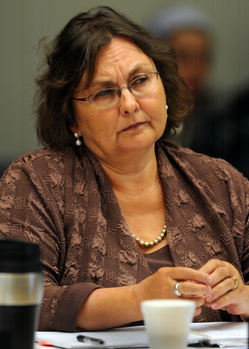
Ann Arbor school board Trustee Irene Patalan says teachers are not the cause of the state's budget woes.
Melanie Maxwell | AnnArbor.com
It’s the moments when they’re out of the classroom that Ann Arbor school board Trustee Irene Patalan said she can see the effects of the debate about public education on teachers.
“In the last couple of weeks, I’ve had teachers in front of me that are absolutely down in the dumps, saying, 'I feel devalued and beat up,'” she said. “I’ve heard the words 'beat up' a couple times.”
She said she’s spoken with teachers from all over southeastern Michigan who have felt caught up in the debate over differences in compensation between public employees and those in the private sector. Patalan said teachers are not the cause of the state and federal governments having budget issues, pointing instead to corporate bailouts.
“I feel they are the scapegoat, that you’re a teacher and you’re the problem and you’re why we are where we are at today,” she said. “I feel that they are feeling that. The vast majority of them do not take that into the classroom. When they read the newspaper and listen to the radio, they do feel punched in the gut and that they’re being blamed for all of our problems.”
Dan Ezekiel, a science teacher at Forsythe Middle School, compared the conversation around bad teachers being protected by unions right now to the debate over “welfare queens” in the 1980s. He said he doesn’t doubt there are bad teachers, but it’s a very small number compared to the teachers who are working hard and doing good things.
“It seems very out of place to say teachers, police, firemen, nurses, garbage men and custodians are the cause of the problems our country is having,” he said. “That shows a disconnect with reality.”
Ezekiel said he knows people who work in Michigan are hurting financially and he works with kids every day whose parents have lost their jobs or had their pay cut. He said teachers in Ann Arbor have made concessions to the district in collective bargaining because they understand that their pay comes from the economic health of the state.
However, being made into a stereotype in order to further a political agenda will not make the state’s budget situation any better, Ezekiel said.
“We have made concessions because our pay comes from the economic health of the state,” he said. “We want the state to be healthy. But we don’t want to be part of a stereotype that’s used to prosecute some kind of political agenda and we’re not going to say, 'Take our collective bargaining rights.'”
The median salary for AAPS teachers is about $60,000 per year, according to Ann Arbor Education Association President Brit Satchwell.
Under the current contract, salaries range from $38,670 for a beginning teacher with a bachelor’s degree to $85,843 for a teacher with a Ph.D and 14 or more years of experience.
In an interview with Lucy Ann Lance in March, Satchwell said the AAEA gave about $3 million in concessions last year, an average of about $2,500 per teacher.
Among the concessions he described was a cap on health care at $12,500. Satchwell said he pays about 24 percent of his own health care.
Satchwell said the economics of the teaching profession in public schools and the increased workload in the quest to individualize education continues have made teaching more and more difficult.
When asked about their children’s teacher, many parents would say they think that teacher is doing a great job, Satchwell said. However, he said feelings about teacher unions and teachers on a more general level can quickly become much more negative.
He said teachers don't go into the profession to get rich and many are finding it harder to motivate future generations of teachers.
“Many teachers come from generations of teachers, and I don’t know one teacher who is advising their children to go into the profession right now,” he said.
The amount of work teachers do is something Ouimet recognizes through his relationships with teachers in his own life.
Ouimet said his daughter-in-law is a teacher and said he sees her putting in hard work and long hours to prepare for her job.
“I see firsthand what she goes through, the time and energy and effort she puts into kids and the classroom,” he said. “I have a great deal of respect for how she conducts herself and I see that, quite frankly, in the school districts I represent.”
The question many teachers are considering now is how to make the public aware of what being a teacher is like.
Fred Klein, a third grade teacher at Haisley Elementary School, said it’s a difficult thing to accomplish because there is a large segment of people who think teachers are “glorified babysitters.”
“It’s being painted as a cakewalk of a job, but it’s really a very exhausting, tiring and time-consuming profession,” he said. “People don’t see that teachers keep taking coursework they pay for out of their own pocket to keep their certification valid. Many companies pay for professional development, but teachers are paying out of pocket for six credit hours every five years.”
Editor's note: A first reference to Ann Arbor school board Trustee Irene Patalan has been added.
Kyle Feldscher covers K-12 education for AnnArbor.com. He can be reached at kylefeldscher@annarbor.com or you can follow him on Twitter.
Comments
Steve Norton, MIPFS
Thu, Apr 14, 2011 : 4:47 a.m.
@Heardoc I don't have research at my fingertips, but from background knowledge I can say this: many of the countries (especially the advanced industrial countries) you are comparing the US to on education spending also have vast social insurance programs that are available to every citizen. So their education spending does not need to cover health care, pension and retirement health care costs. Funny thing - the cost of these items have been going up by far the fastest in this country. Way faster than base pay. I wonder what you would find if you did a true apples-to-apples comparison?
Oregon39_Michigan7
Wed, Apr 13, 2011 : 3:11 p.m.
Remember when teachers and public employees crashed the stock market, wiped out half of our 401Ks, took trillions in TARP money, spilled oil in the Gulf of Mexico, gave themselves billions in bonuses and paid no taxes? Yeah, me neither.
Heardoc
Tue, Apr 12, 2011 : 11:17 p.m.
Lets see here -- we have the third highest expenditure on education (k-12) in the world yet we rank in the high teens as far as ability of our children. This is the indictment of the NEA and the MEA. With all of this money being spent yet we are, at best, 14th maybe 15th in the world with regards to math and science. We should be asking why we are this low given the money we spend. Why are we allowing these people to teach our kids yet fail us when we look at results? The teachers are needed but the teachers in place today are lacking. There are some good teachers but that is not the rule -- it is the exception. More accountability for the teachers, more tying results to pay and less union penetration. This is the inly way to get things under control. NEA and the MEA are out of control.
beachbaby
Wed, Apr 13, 2011 : 3:41 a.m.
i agree with a lot of what you say, but you can't discount the lack of parent involvement and discipline in the US. my kids are always telling me about kids in their classes who don't turn in any assignments, ever. what does a school do about those kids (serious question). i can only imagine the frustration when you have no support from the home. personally, i think they spend too much time trying to coming up with "new and unique" ways to try and teach the basics that the actual basics are getting lost in the shuffle. it seems every so often there is a new way to learn handwriting, or do math (everyday math being the biggest waste of time ever--ask the middle school teachers).
A2K
Tue, Apr 12, 2011 : 8:52 p.m.
What is missing from this is that the GOP (aka, Religous Fundamentalists) would really like Public schooling to end...then, women (and women would bear the brunt of it) would essentially have to stay home and educate their kids or pay for expensive private school out-of-pocket, and hence, many women would really have to choose between kids/working and then it's GOP utopia: women out of the workforce, at home with kids...oh, and there would be TONS of kids, once the GOP outlaws birth control (next on the agenda after abortion rights...).
Basic Bob
Wed, Apr 13, 2011 : 1:41 a.m.
...and then pigs will fly.
tracyann
Tue, Apr 12, 2011 : 4:34 p.m.
Those who can teach, do. Those who cannot complain about the "perks" teachers get. Personally, I don't really know what the average salary is for a teacher, nor do I care. Yes, I know, they're public employees and it's my tax money paying for their salary, but as long as they keep teaching my children as well as they currently are, why would I complain? Because they may be getting some benefit that I'm not? If I wanted the benefits that badly I would've went to school to get a teaching degree, but I didn't, so who am I to complain that somone else did? How hostile are we getting as a society when we are complaining about or putting down the people who are teaching our future doctors, lawyers, engineers, etc. because we think they make too much or are getting Cadillac benefits? Nobody chooses a lifelong career because of the benefits they may get, at least I would hope not, but because that's what they love to do.
snapshot
Thu, Apr 14, 2011 : 4:37 a.m.
It's not the teachers folks resent, it's the unions that represent them. Businesses could not survive if 80% of revenue went to employees. Get real.Where's the money going to come from to support the union habit.
beachbaby
Wed, Apr 13, 2011 : 3:34 a.m.
i agree with you, but i also think it's unfair that the salaries of these future doctors, lawyers, engineers, etc..are used against them when comparing private vs. public compensation. as if they are only allowed to earn "so much".
Steve Norton, MIPFS
Tue, Apr 12, 2011 : 2:31 p.m.
Actually, the statistics do not show that we have had declining academic performance. Nationwide tests of achievement show that the average scores have not changed much in the last 30 years. However, when you break the numbers down into ethnic sub-groups, every group has shown improvement. What's happening is that the proportion of kids who tend to do less well has been rising, so that, even though each group's numbers have been going up, the groups that tend to score less well on average have been growing the fastest. The result, seeming stagnation on the overall averages, is a simple mathematical artifact of the changing composition of our school population. This is well-known among education researchers, but people who want to criticize American schools prefer to ignore it.
snapshot
Thu, Apr 14, 2011 : 4:33 a.m.
Come on Steve, the rest of the world is kicking our butt, get your union head out of the sand and face reality.
Edward R Murrow's Ghost
Tue, Apr 12, 2011 : 12:17 p.m.
"If all the teachers are perfect, all the administrators are perfect, all the teaching strategies are perfect, why have we had decreasing academic achievements over the past 30 years." The very way this question is phrased suggests an answer to the question. Note who is missing from this poster's equation for student success: The student and their parents. So long as student success remains, as it is today, solely or even mostly the schools' responsibility, or education "system" will continue to decline. Good Night and Good Luck
snapshot
Thu, Apr 14, 2011 : 12:13 a.m.
So Ghost blames it entirely on the "parents" that's convenient.
Edward R Murrow's Ghost
Tue, Apr 12, 2011 : 12:41 p.m.
Ugh. OUR education "system" Good Night and Good Luck
snapshot
Tue, Apr 12, 2011 : 3:14 a.m.
If all the teachers are perfect, all the administrators are perfect, all the teaching strategies are perfect, why have we had decreasing academic achievements over the past 30 years. Teachers have 3months a year off.....period. You don't work 13 hour days, that's BS. You're not all perfect either, quit pretending you are. You know the teachers that shouldn't be teaching anymore but won't admit it, or acknowledge it, because nothing can be done about it...........they have tenure and union protection. Your administrators aren't necessarily good mangers either, that's why you hire professionals to lead your unions. People with no K-12 teaching experience but lots of "labor business" experience.
snapshot
Tue, Apr 12, 2011 : 2:43 a.m.
snapshot at 3:26 PM on April 9, 2011 This comment is hidden because you have chosen to ignore snapshot. Show DetailsHide Details I'm in favor of education but when I hear teachers expounding upon how important it is to have "emergency" management with an "education" so that they "understand" it galls me when they hire Randi Weingartner (name) as the head of the teachers union who has NO "education" experience except as an adjunct professor at the law school she graduated from. She has a degree in labor management, worked for U.S. dept. of Labor for 4 years, and is now representing unions on the other side of the fence. If it's OK to have a "professional business woman" representing the "union" why is not OK to have a business man representing the taxpayers in the schools? Most teachers probably do a good job but when I see unions protecting the incompetant and drawing lines in the sand in a combative manner, as they did with their opposition to a lousy 3% contribution to healthcare plans I question the closed minded mentality of our "educators". They are not business people, don't want business people in "their business" but are OK with "business" people representing their union interests. Go figure they are not faring well in the public opinion arena where "business" is serious business. Satchwell is being deceptive because teachers don't pay 24% of their healthcare. Is satchwel a teacher or a hired union mercenary? MEA took the state to court over a 3% contribution to teacher healthcare. What is Satchwell taling about? 24% may be what HE pays and he's eluding that all teachers pay that. This is the deception that folks "hate" in unions.
snapshot
Thu, Apr 14, 2011 : 12:12 a.m.
So Steve Norton, give me some dollar figures. I guess the teachers aren't willing to stand by their fellow teachers if they don't want to contribute. Look at social Security. Good thing we all aren't in a union cause that wouldn't work either.
1bit
Wed, Apr 13, 2011 : 1:11 a.m.
The 3% contribution to retiree's health care was an additional tax on teachers. It was ridiculously unfair and rightly dismissed. Just like the "doctor tax" proposed by the previous administration that never made it out of legislature.
Steve Norton, MIPFS
Tue, Apr 12, 2011 : 2:25 p.m.
Brit Satchwell is a long-time 6th grade math teacher at Forsythe. Other local union officers are also teachers. Satchwell is on full-time release (and paid by the union) while he holds the office. As to "hired union mercenaries," well, I am at a loss for words. That's a tremendously distorted view of reality. Lastly, the 3% contribution was not for teachers' own health care, but to pay for the health care of current retirees. However, current teachers who were forced to make these contributions were told explicitly (in the legislation) that this was no guarantee that they would receive ANY health benefits at retirement. Retirement health benefits can be ended at any time, unilaterally, by the legislature. Forcing any employee to contribute to a plan like that makes a contract. Either the state has to promise that they will receive health benefits when they retire, or the state has to stop forcing employees to pay into the fund. THAT is what the court said. Ann Arbor teachers can choose from several MESSA and non-MESSA health plans. The non-MESSA plans are mostly covered by the district's contribution, but have a lower level of benefits and more restrictions (they're HMO's). The MESSA plans require a substantial contribution from the teachers, but they offer more benefits and services.
snapshot
Tue, Apr 12, 2011 : 2:49 a.m.
What the heck does "hidden because you have chosen to ignore snapshot" mean. Wh chose to ignore snapshot and how do you hide a comment?
mhirzel
Mon, Apr 11, 2011 : 8:38 p.m.
Why the United States Is Destroying Its Education System Chris Hedges <a href="http://www.truthdig.com/report/item/why_the_united_states_is_destroying_her_education_system_20110410/" rel='nofollow'>http://www.truthdig.com/report/item/why_the_united_states_is_destroying_her_education_system_20110410/</a>
Edward R Murrow's Ghost
Tue, Apr 12, 2011 : 1:07 a.m.
"Oh happy day, a liberal blog that proudly displays the fact that it is a winner of an award for a political blog. On said blog, why an article that has not one link or footnote." This coming from someone who makes claims about the nuber of students at WCC and EMU and who need remediation but who, apparently, cannot supply any data whatsoever to substantiate those claims. Find me 10 blogs where footnotes are required for someone to post. Good Night and Good Luck
DonBee
Mon, Apr 11, 2011 : 11:42 p.m.
Oh happy day, a liberal blog that proudly displays the fact that it is a winner of an award for a political blog. On said blog, why an article that has not one link or footnote.
Evemis
Mon, Apr 11, 2011 : 6:51 p.m.
I have been teaching for 10 years, both at the university level and the high school level, and never until this year have I felt my contributions were seen as so worthless as I do after reading many of these comments. I resent the claim that most teachers get their Master's Degrees from degree mills or that having a teaching degree is worth less than being an engineer, doctor or lawyer. Guess what? Many of those engineers, doctors and lawyers wouldn't be where the are today without many of the teachers they have in their pasts. I have worked incredibly hard to be the best teacher I can possibly be, taking classes most summers to maintain my certificate (I have two master's degrees, one in Education from the U of M, one in English Literature from CUA in DC) as well as a minor in Journalism from MSU. I have BA's in English Literature and Anthropology. Even when I don't get certificate credit, I have taken study abroad classes in England, Canada and Ireland (and paid out of my own pocket for all these classes) in order to gain skills that I might pass on to my students. I read formal student essays not once, but read and comment TWICE so they can learn from their mistakes and improve their writing. My husband is a high school teacher as well and before you think we're living high on the hog, let me correct that notion by pointing out that both of our salaries are WELL below the "average" AAPS salary, he has thousands of dollars in student loans to pay back to EMU and both of us could be facing layoffs for next year. Yet, despite the bad attitudes of some people, we continue to do our jobs getting up at 5 am to be to school early in case students need extra help or have questions. Grading during our lunch hours and before and after dinner. Spending countless hours doing coursework for additional college classes as well as prepping for our own students. Calling and emailing parents and replying to student questions at 10pm at night. Don't tell me I don't work
tracyann
Tue, Apr 12, 2011 : 4:44 p.m.
But...but...you get summers off! And Holidays! It's not fair! Just kidding! That's always the argument from the other side. And, just as @DonBee did, I'd like to thank you as well!
snapshot
Tue, Apr 12, 2011 : 2:51 a.m.
Blame your professional union leaders. They make you teachers look bad. Maybe because they are not teachers but "hired guns".
DonBee
Mon, Apr 11, 2011 : 8:39 p.m.
Evemis - I will not tell you, "You don't work". I will say thank you, for being a teacher.
Hillbillydeluxe
Mon, Apr 11, 2011 : 6:30 p.m.
Maybe we can change the teaching requirement so you only need a high school diploma or better yet bus in convicted felons from jackson we could pay both groups less.
redstate
Mon, Apr 11, 2011 : 4:25 p.m.
I don't necessarily question that teachers are over paid. I question why our soldiers are so UNDERPAID.
Awakened
Mon, Apr 11, 2011 : 1:37 p.m.
The husband of a friend of mine has a Masters in Engineering and a Masters in Computer Science. He has been "downsized" four times in the last six years from auto manufacturing related companies. He is now working for a company that does computer logistics. He now commutes to Toledo for work. He makes only 25% of what he made eight years ago. She has had her pay and benefits reduced over 10%. Although they have the same mortgage their house is worth less than they owe. Trust me. They feel pretty "beat up" as well. But since they no longer pay the same income tax, property tax, or sales tax I can blame them for the teachers facing cuts. Or I can blame the bank gamblers and Wall Street casino operators for devaluing the entire country and then having us bail them out because they are to big to fail.
bob
Tue, Apr 12, 2011 : 2:19 p.m.
I am sorry to hear of your friends bad luck, too many around this state and others have similar stories of suffering. Most teachers truly do understand the financial position as we share it, however, the main difference here is your friends profession is not be dragged through the mud to justify the cuts and layoffs. I think many teachers feel like this is adding insult to injury.
snapshot
Tue, Apr 12, 2011 : 2:55 a.m.
That's because the UAW protects the workers who get drunk at lunch and then make the cars. Why buy what use to be an American piece of crap compared to a Japanese model? The Japanese dealers treat the customer better, service is better, and the quality is better. Blame your union for impeding accountability, productivity, and responsibility.
Awakened
Mon, Apr 11, 2011 : 8:11 p.m.
While I agree that the loss of American manufacturing is a huge problem.... The big three were all LOSING money on each car they sold in the US. Their trouble in 2008 was not car sales. It was that they were more financial companies than manufacturers and GMAC, etc. lost their shirts in the sub-prime market.
Roy Munson
Mon, Apr 11, 2011 : 1:44 p.m.
There are Hondas and Toyotas all over the roads in MI. Those people do not have any business complaining that their houses have declined 50%, their roads are falling apart, etc!
Roy Munson
Mon, Apr 11, 2011 : 1:22 p.m.
If you want to see an "underpaid" teacher, look no further than a state such as North Carolina. But teachers aren't the only problem here and they are unfairly taking the heat for this one. The big problem is the overabundance of school districts. I wouldn't even want to know how many $250K+ a year superintendents and their support staffs are within a 25 mile radius of me. And we are also the only state that educates special education to 26 years old. One of those students alone can easily absorb the budget of one or more classrooms a year.
DonBee
Mon, Apr 11, 2011 : 8:37 p.m.
Based on the contract posted the cost to the district (salary + benefits ++) is about $325,000 a year. Money well spent I am sure. OBTW - that is the cost (Salary+Benefits ++) of 3 teachers.
DonBee
Mon, Apr 11, 2011 : 1:17 p.m.
On NPR this morning there was a story about economic growth. It talked about how countries where the government and the citizens were at odds. The more discord there was between the government and the population, the less the economic growth was. I am beginning to wonder where the US is on this scale, given the comments here.
snapshot
Tue, Apr 12, 2011 : 2:59 a.m.
We have a fragmented society these days. American citizens are not on the same page anymore. It's self serve, take it or leave it mentality.
InsideTheHall
Mon, Apr 11, 2011 : 1:02 p.m.
If the union teachers are so good then why is the US falling farther and farther behind other countries? Me thinks we have been sold a bill of goods by the NEA/MEA.
Edward R Murrow's Ghost
Mon, Apr 11, 2011 : 9:51 p.m.
Where in the posting to which I replied does it say a thing about spending? Good Night and Good Luck
Awakened
Mon, Apr 11, 2011 : 8:15 p.m.
I think you have listed anumber of factors that influence our kids performance. However, it does not refute the point that more education spending has not solved our educational ills.
Edward R Murrow's Ghost
Mon, Apr 11, 2011 : 1:46 p.m.
I'm guessing the parents and the kids have nothing to do with it in your calculus of the problem. I'm guessing that a culture that is increasingly anti-intellectual has nothing to do with it in your calculus of the problem. I'm guessing that the proliferation of video games, cell phones, texting, IM'ing, etc.... has nothing to do with your calculus. No, in your calculus, teachers are magically supposed to overcome all of the environmental influences on a child when they're not in school. Good Night and Good Luck
clownfish
Mon, Apr 11, 2011 : 12:46 p.m.
Only DOnBEe responded to the question of how much are YOU willing to sacrifice. Everybody wants teachers to sacrifice, but nobody else is willing. that is called greed, selfishness. What I see is a lot of envy based on misinformation, a lot of blame the Other Guy. No personal responsibility, no commitment to the good of the whole community. It's sad that when we need to come together as a state, all make sacrifices, we are being divided by talking heads and those with an agenda that has nothing to do with making a better future for all.
bob
Wed, Apr 13, 2011 : 1:22 p.m.
Your just plain wrong applewhite Teachers have sacrificed and in many cases for as long or longer than the average citizen. Local teachers have sacrificed over a billion dollars in the last few years in wage and benefit reductions. We have not been immune to this financial crisis and many districts have dealt with it long before 2008 when most people started to feel the pinch.
Marshall Applewhite
Mon, Apr 11, 2011 : 3:20 p.m.
Here's the problem. Teachers have been trapped in a bubble for long enough where they don't realize how much everyone else has already sacrificed.
SillyTree
Mon, Apr 11, 2011 : 2:50 p.m.
Yes, shared wealth is bad, but "shared sacrifice" is good.
George
Mon, Apr 11, 2011 : 5:01 a.m.
I agree that teachers are scapegoats in this economy. I don't agree that their compensation is appropriate. They feel they work hard and their job is tough. I'm sure it is. Try being a Children's Protective Services Worker or other social worker. My starting pay in 1997 was $19,500!!! After several years in the field, I am now making around $50,000, but that is the starting salary of many entry level positions for college graduates. And I certainly don't get all the perks of a teacher. I get 3 weeks vacation and the traditional holidays every year. Teachers work only 8 months out of the year and get the same, if not more than I earn. That's wrong! Yes its a challenge to work with kids all day; but its also a challenge to see a baby who has been beaten to death, or to see a child with third degree burns inflicted by the parents. So if they are going to sacrifice anyone, I think it should be teachers. And all the teachers who want to comment on my comment by saying I chose my profession; so did you.
bob
Wed, Apr 13, 2011 : 1:27 p.m.
I begin work at 7 and do not leave until 4:30 everyday, and yes I take work home, work every sunday and most saturdays, and work most everyday in the summer putting together lesson plans, writing grants, or with summer programs for kids. I know not ever teacher does, but the good ones do and you would be surprised how many good ones there are. Social workers are paid dirt, why? because they take care of the least of our brothers and those in power beleive that anyone who takes care of the unfortunate should live like monks. Instead of competing and complaining about each other we should be working together to lift all of these wages.
grye
Mon, Apr 11, 2011 : 6:54 p.m.
Marshall: I would suggest you spend some quality time with a few teachers and see how many hows they spend on the job. You would be amazed.
Marshall Applewhite
Mon, Apr 11, 2011 : 3:18 p.m.
@grye To work a 60 hour week, that would require working 8.5 hours per day, seven days per week. That number is nowhere close to being accurate for any teacher.
grye
Mon, Apr 11, 2011 : 1:18 p.m.
Everyone thinks teachers only work 8 months of the year. In reality, they put in on average 55 to 60 hours each week. The time spent working is more hours than a 40 hour per week job for the entire year. They also will receive no overtime pay. Check your information next time.
Roadman
Mon, Apr 11, 2011 : 3:29 a.m.
Michigan has the best compensated teachers in the U.S. They are overpaid, have excellent working conditions, and need nothing except some pay reductions. Their pay needs to be cut down to size ASAP.
DonBee
Mon, Apr 11, 2011 : 11:32 p.m.
Roadman - Like everything else in the state we have not kept up. I year ago, the teachers were ranked #1 by the teacher portal for the "Salary Comfort Index", today sadly the state is #4. From 2000 to 2010 the average citizen's rank for income in Michigan fell from 19th to 36th, this does not bode will for increasing any one's salary or benefits if they are being paid from taxes.
grye
Mon, Apr 11, 2011 : 1:20 p.m.
In addition to cutting their pay in half, why not up the education requirments to be a teacher? How about a PhD to start? Everyone will want these jobs and we will get the best, right? Clueless.
Edward R Murrow's Ghost
Mon, Apr 11, 2011 : 4:21 a.m.
Wrong. Michigan ranks 4th with an average salary of just under $58,000. Source: <a href="http://teacherportal.com/teacher-salaries-by-state" rel='nofollow'>http://teacherportal.com/teacher-salaries-by-state</a> The median personal income of someone in the US with a bachelor's degree is $56,000. For someone with a Master's degree it is $61,000. Source: <a href="http://en.wikipedia.org/wiki/Personal_income_in_the_United_States" rel='nofollow'>http://en.wikipedia.org/wiki/Personal_income_in_the_United_States</a> Given that many teachers have Masters degrees, the average teacher pay in Michigan seems just about right. But if Michigan is 4th, that tells me that teachers in other states are woefully underpaid. Do you have statistics that support your opinion? Didn't think so. Good Night and Good Luck
nicole
Mon, Apr 11, 2011 : 3:18 a.m.
"Teachers work hard". So do a lot of people. "There's no end to grading papers and lesson planning" as one poster put it. Try running your own business. My husband routinely stays up until 3 am working. And that's after he's already worked all day and through the evening. Running our family business. And we don't have any benefits like teachers do. We have major medical and pay for all the rest of our healthcare out of our own pocket. Just making the point that teachers are not unique in the fact that they work hard, nor are they the hardest workers among us!
SillyTree
Mon, Apr 11, 2011 : 2:49 p.m.
What you say is true, but nobody claimed that teachers are the hardest workers among us. The fact that you have to pay for your own health care is an abomination. Health care is costs have run amok in this country. I'm sure the governor is not giving up much. Does he have health care provided by the state? It is strange how shared wealth is apalling, but "shared" sacrifice is just fine.
katie
Mon, Apr 11, 2011 : 2:58 a.m.
The main issue is that we need more strong unions. We need a strong middle class. All those professionals complaining that they don't get paid enough need to unionize. The banksters don't need unions. They are the super-rich. The top corporations pay no taxes. They need to pay their fair share. Taxpayers need to wake up and let the politicians know, in no uncertain terms, that we are mad as h..ll and we are not going to take this trickle-up robbery and union-bashing and -busting. Once the gap between the richest and the poorest is closed, then I'll listen to how the middle-class teachers should be paid less. Wake up! This is not about the teachers, but about the rich trying to squeeze every last penny from the middle class and the poor. Unless you are rich, this attack on unions makes no sense.
bob
Wed, Apr 13, 2011 : 1:31 p.m.
well said, run for something katie, help make a difference for you and us
Matt Cooper
Mon, Apr 11, 2011 : 2:54 a.m.
jcj, did you ever once take into consideration the hours upon hours that teachers spend at home after school grading papers, preparing lesson plans, etc.? Did you? What do you think that's worth? Huh? Teachers work 9 months out of the year for 35-40k, but add in all the hours before school, after school, and supervizing events during non-school hours and then tell me what you think that's worth. You worked 8 hours a day for 30 years. Teachers work 13 hours a day for nine months of the year, and yet, people like you say they're "tremendously overpaid". Wow.
Roger Roth
Mon, Apr 11, 2011 : 2:48 a.m.
I have former students contacting me via email, students from the 1960's to the present, to thank me for their experience with me and my help in their lives. My guess is that most teachers have similar experiences. There is nothing any taxpayer or politician could do or say that could erase that vote of confidence. I would like to acknowledge all my fine colleagues, those I know and work with and those I don't know, for their hard work, dedication and for the positive difference they make in the lives of their students. You know that you are appreciated. Please don't give up! This town, state, country and the world need you--more than they know. Do I detect Teacher Envy!!??
Publius the Younger
Mon, Apr 11, 2011 : 12:17 a.m.
I wouldn't send Osama Bin Laden to the Ann Arbor Public Schools.
bob
Wed, Apr 13, 2011 : 1:52 p.m.
i'll bet the aa teachers thank you, he would be a difficult student. Although if you knew where he was, i would hope you would tell our military rather than send him to a school. He is a bad man.
SillyTree
Sun, Apr 10, 2011 : 11:18 p.m.
This article is written with a slant. "Inside the classroom, Ann Arbor teachers are surrounded by the children and the work they say makes every day worthwhile. Outside of the school building, it's a different story." It may be a different story, but it's a completely different story. The first statement appears negated by the second, but it is not. Teachers find satisfaction in doing what they know is right both inside and outside the classroom. The fact that they are upset that they are under attact is right. The fact that they pour their hearts into their jobs is right. Right action inside and outside the classroom. Where is the the different story? Have you been in a classroom? It is the toughest job that you will ever love, but you can't do it for free! The sacrifice that teachers make is one of love in its truest form and that should be compensated. You have no idea. Take your transcript down to WISD and get on the sub list for a couple of weeks. See just what it is that you are paying for. I bet you wouldn't last three days.
Jack Panitch
Sun, Apr 10, 2011 : 10:48 p.m.
@Macabre Sunset in the leadoff position: Would you please provide some evidence of this "corruption" you speak of. If you can't provide evidence of corruption please at least define your terms so that I can follow your commentary and can understand what you mean. You are talking about people who all have names and reputations. You don't use their names. Come to think of it, you don't use your name. You say you're not bashing: let's see what you've got. What I see is the heroes of our society being dragged through the mud and being surprised by the payback for their sacrifice. I think catcher John Buck said it best when interviewed recently about his time with the troops in Afghanistan: soldiers told him how he was their hero. He told them they had that wrong. He was nobody. They were the heroes. And they are the real heroes, along with policemen and firefighters and so many others. Including teachers. Every-day heroes who may not put their lives on the line but still save kids by opening their minds every day. By teaching, by inspiring by modeling in so many times in so many different ways. You want evidence of that spend some time in an elementary school classroom. You want evidence of the "corruption" in collective bargaining, read the stories about the last round here in Ann Arbor. The contract pushed by the AAEA was incredibly creative and far from selfish. There's a Harvard Education Press publication entitled "Collective Bargaining in Education, Negotiating Change in Today's Schools." The works it contains represent diverse viewpoints. I highly recommend it.
baitm
Sun, Apr 10, 2011 : 10:12 p.m.
This comment section is a perfect thing for teachers not to read. The bashing goes on most every day. I used to think I was just imagining it but one day I turned on the evening news and the first story was about teachers spanking students. Wow that takes front stage over war, economy and natural disasters! When we are not bombarded with accountability and compensation questions the media goes for cheap shots. The bashing is real and constant. Disrespect is rampant. I was spit on by a parent because I committed the felony of requiring his son to do his work. Yes, this article is correct that teachers are very unlikely to suggest others go into the profession. many of us teach for the children at the expense of our own children. During the school year weekends are rarely spent giving support to your own kids rather doing the tasks needed for the next week. Early in my career I recorded my hours of work as a teacher and with all the number crunching I calculated I get a 4week vacation. Much like other professionals do. Yes, I do get holidays but they are many times filled with planning and checking times. It seems that some people never get over certain issues with teachers, unions are not all bad as many people want others to believe. In the past Teachers were fired for getting married and men made more than women. If you asked why you were fired! It is a fact my great grandmother was one. Another fact is teaching will never get the best and brightest with our current mentality.
jcj
Mon, Apr 11, 2011 : 1 a.m.
You shouldn't be so paranoid. People that abuse parrots get lots of coverage too.
maestra27
Sun, Apr 10, 2011 : 9:55 p.m.
@kilalqaeda Your entire paragraph is filled with fallacies and misleading information. First, A2 teachers start at $38,670 with a bachelor's degree. Those who have a PhD when they start earn $48,821. The salary schedule tops off at $85,843, but in order to make that you must have a PhD and at least 14 years experience in the A2 District. I work in public education and have sat on interview committees. I assure you there are not "about 600 applicants or more for every job opening in the PUBLIC school system." (Please cite your resource.) I can also assure you that jobs are not necessarily given to a relative who knows somebody in administration. I've worked in 3 Michigan school districts and was hired each time based on my qualifications alone. There are no other educators / administrators in my family. I do agree with you that "thousands of college grads have had to leave Michigan because they can't find jobs as a teacher" but it's not because it's such a "highly desired job." The reason young and talented teachers are leaving Michigan is because school districts have been forced to cut millions of dollars and don't have positions to fill. Here's a fact . . . in my school district we have 60 fewer full-time positions than we did last school year. Further, shift supervisors at Starbucks are not required to have the same level of education and training that teachers are, so you're comparing apples and oranges. It's really a simple concept . . . jobs that require a higher level of education should pay more.
lester88
Sun, Apr 10, 2011 : 9:31 p.m.
When the price of gas goes up, we pay it. When the price of utilities go up, we pay it. When cigarettes go up. we pay it. The price of teaching and other basic services have gone up, we should pay it too.
bob
Wed, Apr 13, 2011 : 2:03 p.m.
i got news for you stunhsif, do what you say and the cost of education will not go down, instead you will shift dollars from workers to private companies. Take a look at the costs of non union and union schools, their costs are the same, some higher some lower, but most about the same. That means dollars are going into the pocket of someone else rather than the worker and the per pupil costs remain the same.
stunhsif
Mon, Apr 11, 2011 : 2:38 a.m.
Gas has gone way up as you noted. Because of that , I got rid of the SUV and bought a fuel efficient station wagon two years ago. Now it is time for the taxpayers to fire the unions and get public employees on 401k's and Blue Cross rather than Messa. Sorry Lester , the cat is out of the bag !
lester88
Sun, Apr 10, 2011 : 10:32 p.m.
I quit smoking, but I can't quit driving to work or sending my kids to school. As the costs go up, I pay it but I dont blame the gas station attendant.
Marshall Applewhite
Sun, Apr 10, 2011 : 10:01 p.m.
Or, you quit smoking cigarettes.......
Moscow On The Huron
Sun, Apr 10, 2011 : 9:01 p.m.
You're known by the company you keep. Teachers would get more respect if they'd quit hanging around with unions.
bob
Wed, Apr 13, 2011 : 2:07 p.m.
judging a group because you know one out of the group is prejudging. Whoops looks like your argument the same used against all minority ethnic groups, "my best friend is black I can't be racist" is the oldest and worst defense.
DonBee
Mon, Apr 11, 2011 : 8:35 p.m.
MOTH - It is not the union but the leadership of the state union that is a problem. The MEA leadership has been stuck in the 1960s. Overall the teachers union is not the issue. A number of state laws are issues, and many of them may get visited, more if the teachers strike than if they do not. If the teachers strike the reaction will not be a happy one for anyone.
Moscow On The Huron
Mon, Apr 11, 2011 : 2:49 a.m.
"Really prejudging a whole mass of people who you don't even know." Except that I live with one, and one who holds the same opinion, even. Whoops, looks like you just prejudged somebody you don't even know.
Cash
Sun, Apr 10, 2011 : 9:29 p.m.
Exactly Ed.
Edward R Murrow's Ghost
Sun, Apr 10, 2011 : 9:21 p.m.
@Cash: <a href="http://www.annarbor.com/news/opinion/warner-column-an-exercise-in-prejudice-not-legitimate-commentary/">http://www.annarbor.com/news/opinion/warner-column-an-exercise-in-prejudice-not-legitimate-commentary/</a> Just what Mr. Wider was addressing. Good Night and Good Luck
Cash
Sun, Apr 10, 2011 : 9:17 p.m.
Really prejudging a whole mass of people who you don't even know. That's your error and your loss.
kilalqaeda
Sun, Apr 10, 2011 : 8:34 p.m.
$85,000 a year to get summers off. I would do this in a heartbeat but the truth is there are about 600 applicants or more for every job opening in the PUBLIC school system (not charter). And that 1 job that is given is often given to a relative who knows somebody in administration. Thousands of college grads have had to leave Michigan because they can't find jobs as a teacher because it's such a highly desired job to have. Sorry teachers your job is demanding and stressful but so is being a shift supervisor at Starbucks and they sure don't make $85,000 a year with summer's off and other holidays off. This article "forgot" to mention the thousands and thousands of certified teachers in Michigan who can't find a job.
grye
Mon, Apr 11, 2011 : 1:12 p.m.
A shift supervisor doesnt' manage 30 employees all day. A teacher not only has to manage this number of students, they must also teach them. If you think the job is real cushy, then try it. The starting salary is not $85k. Try $40K with a BA and teaching certificate. The number of hours you will put in each week is more like 55 to 60. You will need to continue your education at your own expense. You will not be able to go out for lunch. Your weekends and evenings will be occupied preparing for the next day, correcting papers, grading tests, and researching new material. Summers will include time spent preparing for the next year when there are new educational requirements or you are told to teach a different class. Easy job? No way.
kilalqaeda
Mon, Apr 11, 2011 : 1:47 a.m.
LOL, I struck a nerve here. The "research" I'm applying here is first hand knowledge with family members and many friends who have applied to many Michigan schools and get back letters saying something like "Thank you for applying, you are one of 600 applicants applying for this position". I even saw one for from somebody applying to an elementary school Howell saying "Thank you, you are one of over 1500 applicants". Oh, and yes the research will show Michigan is the only state to lose population this last census and thousands of them lost were certified teachers moving to other states just to get a chance at teaching with nothing close to the pay and benefits Michigan public schools provide. Good night and whatev, LOL.
Terry Star21
Mon, Apr 11, 2011 : 12:38 a.m.
Sorry you were home schooled and missed the great experience of a public school teacher.
johnnya2
Sun, Apr 10, 2011 : 10:01 p.m.
Ok, you can have the job. Please produce your PhD. Let us also look at the years of experience you have doing this. How about your STARTING salary will be $38k. Once you are the most highly educated and senior of teachers you can make $85k. Learn to read and comprehend the article before making a stupid comment
lester88
Sun, Apr 10, 2011 : 9:40 p.m.
Lol, thats all I can say about this post. Not everyone can be a teacher. " I would do this in a heartbeat." If pay and summers off is your only motivation then i dont want you teaching my children. All the good teachers I know have a passion for it.
Edward R Murrow's Ghost
Sun, Apr 10, 2011 : 9:28 p.m.
"What research are you citing here?" Not likely, any. The $85,000 is the top step in the AAPS, and only someone with a Ph.D. qualifies for that. Nothing like a gross exaggeration turned into a generalization to proves one's point. Good Night and Good Luck
sh1
Sun, Apr 10, 2011 : 9:20 p.m.
What research are you citing here?
Cash
Sun, Apr 10, 2011 : 9:18 p.m.
Your profession is a job application counter? Interesting.
tim
Sun, Apr 10, 2011 : 7:07 p.m.
The real problem is that too many people are cheap an don't value education or Michigans children-- I call it the "hampster mentality". Children are treated like pets ( I raised my hampster now you raise yours) not like human beings - the future of the state and the country.
Alan Benard
Sun, Apr 10, 2011 : 6:34 p.m.
I believe all public employees in the state should strike for solid week, complete with demonstrations and a full-scale effort to remove Rick Snyder from office. To do less is to face the reality that Michigan will become a right-to-work state with a great number of municipalities and local government units governed by the dictatorial fiat of Republican-appointed executors.
bob
Wed, Apr 13, 2011 : 2:12 p.m.
DonBee, Keep being a voice of reason and logic. we need more clear, common sense, and rational thinking.
DonBee
Mon, Apr 11, 2011 : 8:32 p.m.
Alan - It is your push to get everyone to strike, not the unions. To a large extent I have no issue with unions. But people who push for unlawful strikes for purely political reasons I have a problem with. You want to see different things happen in Lansing, letters, petitions and proposed language is far better than strikes. The strikes in Wisconsin accomplished what in the long run? Hard feelings? A deeper divide in the state? The bill passed (whether it is legal or not is now in the courts). You don't like what is happening in the state, in some ways I don't either. But, I said at the beginning of the year, people were going to be upset with this Governor if he did what he promised. He is and we are.
grye
Mon, Apr 11, 2011 : 6:59 p.m.
Striking won't solve the budget problems. Everyone within the public employment needs to work together to help in reducing the cost of govt. There are plenty of places to save. Benefits may need to come more in line with private industry. Teacher's salaries should not be cut. They are not overpaid. Raising taxes will not solve the problems either. New jobs need to be created and govt needs to have policies in place to allow the growth.
Alan Benard
Mon, Apr 11, 2011 : 5:13 a.m.
@DonBee -- It's rich that when I say that collective bargaining is good and democratic control of local government should be defended, it's dogma. I thought that democracy -- as is practiced within labor unions, as we enjoy in choosing representatives to tax us and spend the money -- was an American value, not an abstract belief serving one side over another. What are your values, Don?
DonBee
Mon, Apr 11, 2011 : 1:42 a.m.
Alan - Dogma will not solve the lack of jobs in Michigan, by either side in this state. We need to come together, not fire up the torches.
Marshall Applewhite
Sun, Apr 10, 2011 : 9:59 p.m.
I agree that all public employees should strike. This way, we can fire them for breach of contract.
timjbd
Sun, Apr 10, 2011 : 9:42 p.m.
People will freak out when they have to take care of their own kids for a week without notice.
aataxpayer
Sun, Apr 10, 2011 : 6:31 p.m.
Ghost and some others suggest this is a manufacturers crisis. I would like to see more evidence. Is K-12 funding really being diverted to higher ed? If so that is wrong.
BlackSheep
Mon, Apr 11, 2011 : 5:26 a.m.
For those not willing to follow the link the governor is playing a shell game. Diverting money from the school aid fund that has always went to K-12 education to higher education. Then slashing even more money from the general fund to higher education. Basically all of the educational institutions in our state are bing underfunded so the governor can given massive tax cuts to his corporate CEO buddies.
Cash
Sun, Apr 10, 2011 : 6:52 p.m.
<a href="http://www.lenconnect.com/opinions/editorials/x481363643/Our-View-Transferring-K-12-money-to-colleges-is-the-wrong-move" rel='nofollow'>http://www.lenconnect.com/opinions/editorials/x481363643/Our-View-Transferring-K-12-money-to-colleges-is-the-wrong-move</a> Google it. There are hundreds of similar articles.
Terry Star21
Sun, Apr 10, 2011 : 6:21 p.m.
These teachers that are educating our children, our future are America's pride and joy - just as our doctors that treat these children. The average doctor makes five times more, has better benefits and actually more vacation time. Do you think doctors prep and plan on their off days, and take their work home for hours more - I know teachers do for sure (not bashing doctors/comparison for the clueless. Teachers are under paid, do not have enough prep time/days off, and are not compensated for their value.
DonBee
Mon, Apr 11, 2011 : 1:41 a.m.
Terry Star21 - Lets see the average doctor in private family practice makes $142,000 a year, less $20,000 in malpractice insurance, minus $15,500 in 401K (since they have to pay all their own retirement), minus health care insurance (yes, even they pay for insurance), minus life insurance. Net, net they might make $100,000 a year on a comparable footing. So the delta is about $30,000. Doctors have 6 to 8 more years of schooling, internships and residency before they can really start earning - teachers with a BA can start in the classroom and get their master's degree as they teach. Doctors typically leave school with about $300,000 in student loans and debt. Teachers (based on an average BA) about $40,000. So not only do they start really earning later, they also have to pay bigger loan payments, wiping out that $30,000 a year pretty quickly. Then doctors don't have a defined benefit program that lets them retire at 55, so they end up working later in life. Yes, they do indeed earn 5 times what a teacher does!
eom
Sun, Apr 10, 2011 : 11:08 p.m.
Dude, who do you think TAUGHT the doctors?
Marshall Applewhite
Sun, Apr 10, 2011 : 9:59 p.m.
To say that doctors have more vacation time than teachers is an absolute fabrication of the truth.
kilalqaeda
Sun, Apr 10, 2011 : 8:37 p.m.
Dude like any teacher has the cognitive ability of a doctor to do what they do.
Dog Guy
Sun, Apr 10, 2011 : 6:35 p.m.
I'm proud to say that only doctors in movies have it as good as you think or, per hour, as good as A2 teachers.
Cash
Sun, Apr 10, 2011 : 5:47 p.m.
Starve the unions? But no mention of the greed of corporate wealthy 1% holding 40% of our nations wealth....starving in ANY way. Just keep feeding the greed! In fact, Snyder suggests we take more from the poor and the working class and give it to the wealthy. And there are actually people who are falling for it...thinking that they might get some crumbs of job. Good luck. Be cause with no middle class left....they have no reason to pay you more than minimum wage. Which will soon be lowered by Republicans.
bob
Wed, Apr 13, 2011 : 3:51 p.m.
Moscow, he was not prejudging but opining on what has happened. Whoops, missed again.
Moscow On The Huron
Mon, Apr 11, 2011 : 12:09 p.m.
"And feeding the greed of the wealthy" Really prejudging a whole mass of people who you don't even know. That's your error and your loss.
Cash
Sun, Apr 10, 2011 : 6:15 p.m.
And feeding the greed of the wealthy...what does that do to educate our children exactly? Hmmm...I missed that part.
Cash
Sun, Apr 10, 2011 : 6:15 p.m.
Marshall, Don't be so reactionary. Children are our most important respirce of course......therefore Unions fight for our teachers who teach our children. Our children are our most important resource. Therefore, we should be paying teachers MORE and corporations less. Unions are a value for helping those who educate our children.
Marshall Applewhite
Sun, Apr 10, 2011 : 6:07 p.m.
So in this post, you're admitting to caring more about the existence of a union than actually educating our children. And this, my friends, is the crux of the problem with unions being involved with something as important as the education of our children.
thinker
Sun, Apr 10, 2011 : 5:45 p.m.
Sadly, my daughter went to CHS, had 3 1/2 years of Latin there, and had to start with first level Latin in college. Science lab preparation proved lacking too, as she progressed to organic chem in college. Who says the teachers are educating our kids?
Edward R Murrow's Ghost
Tue, Apr 12, 2011 : 12:23 p.m.
"The comments of the now departed President of WCC in a presentation. I assume he knew what he was talking about. But, then again he has departed, so maybe he did not." Which "departed" president? Do you mean Gunder Myran? He was the last president to leave WCC, and he left 15 years ago. Do you mean Larry Whitworth? He's still there. Larry's a good friend, so I'll be on the phone this AM to check the veracity of your memory. Do you EVER get your "facts" right? Good Night and Good Luck
Lisa
Tue, Apr 12, 2011 : 1:29 a.m.
Don said, "Over half the Washtenaw County students (all districts) who go to Washtenaw Coomunity College end up taking classes that are at a level they should have finished in high school, EMU has an even higher percentage from the County....Half of the children we send to college are not ready and most of that half never finish college. " Oh Don. No. Assuming your numbers are correct (and that is an assumption), the fact that half of Washtenaw students who attend WCC or EMU require remediation does not mean that half of the students we send to college are not ready for college. It means that half of the students we send to THOSE TWO colleges are not ready for college. That may explain why they are there rather than at U of M or MSU.
Edward R Murrow's Ghost
Mon, Apr 11, 2011 : 9:52 p.m.
I guess there are none. Unsubstantiated statement. Good Night and Good Luck
DonBee
Mon, Apr 11, 2011 : 8:28 p.m.
The comments of the now departed President of WCC in a presentation. I assume he knew what he was talking about. But, then again he has departed, so maybe he did not.
Edward R Murrow's Ghost
Mon, Apr 11, 2011 : 1:39 a.m.
"Over half the Washtenaw County students (all districts) who go to Washtenaw Coomunity College end up taking classes that are at a level they should have finished in high school, EMU has an even higher percentage from the County." Source for those statistics, please? Good Night and Good Luck
DonBee
Mon, Apr 11, 2011 : 1:34 a.m.
Cash - Over half the Washtenaw County students (all districts) who go to Washtenaw Coomunity College end up taking classes that are at a level they should have finished in high school, EMU has an even higher percentage from the County. Some kids do do, fine, but 12 percent of the children we entrust to the education system never graduate at all in Washtenaw County. Half of the children we send to college are not ready and most of that half never finish college. Yes, we are doing just fine, just fine!
johnnya2
Sun, Apr 10, 2011 : 9:57 p.m.
Let's make something clear. Your kid is responsible to learn. If you as a parent fail to make your kid spend the time it takes to learn her subject, then that is on YOU as a failed parent. Maybe your daughter is just not that bright. The fact you have her taking a dead language for 3.5 years might be a hint that you didn't think things through
Terry Star21
Sun, Apr 10, 2011 : 6:23 p.m.
You probably think none of that was her fault too.
Cash
Sun, Apr 10, 2011 : 5:51 p.m.
And yet million of other kids do just fine. Well, I would have to wonder...who taught her in college....Joe the Plumber?
Marshall Applewhite
Sun, Apr 10, 2011 : 5:31 p.m.
It really pains me that the union mentality has infiltrated our schools. Even worse, the entitlement mentality is being transferred to the children of these schools. We need to starve the beast before things are beyond control. It's time that we get the unions out of public education.
1bit
Mon, Apr 11, 2011 : 1:42 a.m.
Unions and collective bargaining are not the problem, they need to be part of the solution. There is distrust on all sides, but ultimately we all want the same things. From a business standpoint, unions and collective bargaining agreements are quite useful. Imagine the hassle of negotiating contracts on an individual basis. Unsustainable benefits are part of the problem and most teachers I know understand that and are more than willing to do their part.
Edward R Murrow's Ghost
Mon, Apr 11, 2011 : 12:31 a.m.
There is a pot of money out there. It's called the School Aid Fund. And it is flush with money. But the Governor is diverting it to other purposes for which it was not intended. But I'm certain that you'd be OK with your employer doing that with the money intended to pay your salary. Good Night and Good Luck
Marshall Applewhite
Mon, Apr 11, 2011 : midnight
@ERMG I wish it weren't the case, but it's simply astounding how many teachers are unwilling to accept reality. With these educators, there's always "a magic pot of money somewhere", and entitlement is the only plausible excuse for them to be this naive.
Terry Star21
Sun, Apr 10, 2011 : 6:23 p.m.
You can't be serious - please !
thinker
Sun, Apr 10, 2011 : 4:54 p.m.
There are too many "feeling" and not enough reasoning and thinking. Think, everyone! WE DON"T HAVE THE MONEY!
DonBee
Mon, Apr 11, 2011 : 11:19 p.m.
In the case of Education at the K-12 level, EMG is right. We, do have the money, if we don't shift it to cover Colleges and Community colleges. However on the whole, Michigan has a lot less to spend this year than last. Governor Granholm spent all the stimulus funds. The state used every accounting trick in the book, they tapped funds that had surpluses, they did not pay into the pension underfunding, and they did not have a new mandate for $700 million in additional Medicaid spending from the Federal Government. And we did not have to start paying back the $3.9 billion in unemployment funds that were borrowed from the Federal Government. So on the big picture level the state is only short a few billion from last year. in 2009 the state spent $42.7 billion, This year we will have about $36 billion to spend. Health costs to the state make up 27 percent of the budget and it is growing the fastest. Welfare and education tie at 22 percent each. Pensions for workers run another 11 percent. Police, prisons, revenue sharing and everything else comes out of the remaining 18 percent. No matter what we do, many people will be unhappy.
lester88
Sun, Apr 10, 2011 : 9:35 p.m.
I disagree, we do have the money. I am willing to pay for teachers, police, fire, water and trash colleciton. Everything else is negotiable. Parks, greenbelts, Art, solar panels and trains are "nice to haves." Sorry.
tim
Sun, Apr 10, 2011 : 7:08 p.m.
We have the money we're just cheap!
Terry Star21
Sun, Apr 10, 2011 : 6:25 p.m.
YES WE DO! And using it for our children is wise !
Edward R Murrow's Ghost
Sun, Apr 10, 2011 : 5:23 p.m.
Yes, we do have the money. The governor is creating budgetary shortfalls around the state by not distributing the school aid fund to public schools, who cannot control their revenue streams, but to community colleges and to universities who can control their revenue streams. The school fiscal crisis of 2011-12 is a crisis wholly manufactured by the governor. Good Night and Good Luck
Cash
Sun, Apr 10, 2011 : 5:03 p.m.
But it seems we have money to give to big corporations. Go figure. The top 1% get richer on your dime.
lester88
Sun, Apr 10, 2011 : 4:37 p.m.
Thanks to all the dedicated teachers out there. You have a tough job and I appreciate you. You earn every penny.
Cash
Sun, Apr 10, 2011 : 4:25 p.m.
Joseph Stiglitz on the widening wealth disparity in America: Sad Ending..... The top 1 percent have the best houses, the best educations, the best doctors, and the best lifestyles, but there is one thing that money doesn't seem to have bought: an understanding that their fate is bound up with how the other 99 percent live. Throughout all of history, this is something that the top 1 percent eventually do learn. Too late.
DonBee
Mon, Apr 11, 2011 : 1:31 a.m.
Well Mr. Gates, Mr Buffett and other Billionaires have pledged most of their wealth to charity. Mr. Gates on Aids, Malaria and other medical issues, Mr. Buffett on similar issues. Mr Gates was the world's richest man, having started one of the most successful companies in history. Much of the wealth is in the hands of first generation Wealthy (Mr Buffett is, Mr Gates is decidedly not). America is one of the few places where you can go from poor to rich in a single generation. Mr. Gates is even a college drop out.
timjbd
Sun, Apr 10, 2011 : 9:41 p.m.
Can't come soon enough.
KMHall
Sun, Apr 10, 2011 : 4:51 p.m.
As the gap widens, they may have to build higher fences around their houses. Look to the east y'all.
clownfish
Sun, Apr 10, 2011 : 4:23 p.m.
Everybody wants someone else to take the hit, I have yet to see a post from any of the teacher "bashers" saying that they would be willing to pay more in tax if it would help our state. They want the public sector employees to take even more pay cuts, benefit cuts and unpaid furlough days. Fine, if that needs to happen it should, and it IS happening. But, Michigan also needs more revenue to balance the budget. Whining does not balance a budget. What are each and every one of you willing to sacrifice in order to bring us into a balanced budget? If you want teachers to take a 15% pay cut, are you willing to pay an extra 5% in income tax? If you want state workers to take unpaid furlough days, are you willing to do pro-bono work for others? We are in it together people, we can fight or we can fix the problem. Too many want us fighting each other rather than paying attention to who is really taking your money. 400 people, 400, have as much wealth as the bottom half of this country. . 400! Think about that. I guarantee that not a single one of those 400 is a teacher. The top 1% hold 35% of the wealth, why should they not be paying 35% of the tax?
DonBee
Mon, Apr 11, 2011 : 11:08 p.m.
Bob - Unfortunately we don't have a wealth tax, property tax is as close as the tax system comes to a wealth tax. We have an income tax, and the top 20 percent of the population makes approximately 46 percent of the total income in the US. At the same time the top 25 percent of the population pays approximately 85 percent of the total income taxes at the Federal Level. The income is from the Census Bureau and the Tax from the IRS. If you want a wealth tax, then we need to tax pension values, property values, stock holdings, and all other assets. I am not sure it makes anyone happy to have to prove to the IRS that they did not miscount on the number of pieces of China they had in the Kitchen or the blue book on their car. Yes, there is an inequity - putting back the "Death" tax and taking away trusts and other multi-generation tricks for moving wealth forward will fix some of this, but about 80 percent of the millionaires are first generation folks (Forbes).
bob
Mon, Apr 11, 2011 : 8:19 p.m.
Snoopdog, If you control 65% of the wealth and pay 38% of the taxes, should we really be happy. good those of us that control 35% of the wealth get to pay only 62% of the taxes, what a great deal for us!!!! figures lie and liars figure and usually hope the rest of the world cannot do the math.
DonBee
Mon, Apr 11, 2011 : 1:28 a.m.
Clownfish - I have said and will continue to say, I am willing to pay more taxes, but I want transparency in where the money is going. In the case of AAPS, they promised to post monthly check registers, and quarterly financial statements, as well as a list of sinking fund projects. I dare you to check the AAPS website and tell me where these documents are. They promised to release the count of people in each bargaining unit and the total cost of each contract, I dare you to find them. They promised a clear and transparent accounting for special education spending. I dare you to figure out the numbers in their "easy to read" budget that is now over a year old. In short, all I want in return for more of my money, is an honest accounting and the board to keep their own promises, all of which were passed as motions in board meetings.
David Briegel
Mon, Apr 11, 2011 : 12:22 a.m.
Snoop, again I ask, What is their effective tax rate and why is it so low compared to those who work for a living?
snoopdog
Sun, Apr 10, 2011 : 8:13 p.m.
The top 1% pay 38% of all federal taxes, so your point is ? Good Day
Cash
Sun, Apr 10, 2011 : 4:15 p.m.
Joseph Stiglitz - widening wealth disparity in America: The upper 1 % of Americans are now taking in nearly a quarter of the nation's income every year. In terms of wealth rather than income, the top 1 % control 40 %. Their lot in life has improved considerably. Twenty-five years ago, the corresponding figures were 12 % and 33 %. While the top 1 percent have seen their incomes rise 18 % over the past decade, those in the middle have actually seen their incomes fall. For men with only high-school degrees, the decline has been precipitous—12% in the last quarter-century alone. All the growth in recent decades has gone to those at the top. In terms of income equality, America lags behind any country in the old, ossified Europe that President George W. Bush used to deride. Among our closest counterparts are Russia and Iran. But America suffers from an under-investment in infrastructure, in basic research, and in education at all levels. Further cutbacks in these areas lie ahead. None of this should come as a surprise—it is simply what happens when a society's wealth distribution becomes lopsided. The more divided a society becomes in terms of wealth, the more reluctant the wealthy become to spend money on common needs. The rich don't need to rely on government for parks or education or medical care or personal security—they can buy all these things for themselves. In the process, they become more distant from ordinary people. They also worry about strong government—one that could use its powers to adjust the balance, take some of their wealth, and invest it for the common good. The top 1 percent may complain about the kind of government we have in America, but in truth they like it just fine: too gridlocked to re-distribute, too divided to do anything but lower taxes.
Taycheedah
Sun, Apr 10, 2011 : 3:33 p.m.
Well Trevor it's a big bad world out here so you better get your big boy pants on. It dosen't matter if you think teachers are over or under paid. It dosen't matter if you think they are over or under worked. The reality is teachers are paid with tax dollars. Tax rolls are contracting not expanding. Tax payers have finally decided that they have been taxed ENOUGH and elected people into office that agree with them. If anyone here thinks that public employees are somehow exempt from this reality, feel free to write them a check from your check book because you are not getting another penny out of mine.
BlackSheep
Mon, Apr 11, 2011 : 5:16 a.m.
If the governor wasn't shelling out massive tax cuts to his corporate CEO buddies the tax roles wouldn't be contracting quite so fast.
clownfish
Sun, Apr 10, 2011 : 4:28 p.m.
Taxes, federal, state, local, are at a near 60 year low. Interesting that so many think that we are overtaxed, when in reality we are taxed less than our grandparents. An economist at the Tax Foundation, a non-partisan research outfit, writes: Despite these problems of data definition, the headline's claim about 2009 being a year of historically low taxes isn't far off... Total taxes divided by a broad income measure, NNP (which is somewhat close to personal income), had a rate of about 26.6 percent in 2009, which was the lowest since 1959. In reading this blog, it has become clear that propaganda beats fact any day.
Patti Smith
Sun, Apr 10, 2011 : 3:15 p.m.
I feel ya. I teach in Detroit Public Schools and have the "honor" of making less money than just about any other district (certainly less than any in Washtenaw County) and the constant threat of lay offs as well as a host of other issues that you probably all can guess. OTOH, I have the true honor of working with some amazing kids and sometimes being the only consistently loving adult in their lives. I love my job (and yup, I love the generous vacation packages and work hours...not gonna lie)
bob
Wed, Apr 13, 2011 : 5:38 p.m.
well not near the lowest paid, do not want to get into a spit ball fight here, but I have 21 years experience two masters and am almost through my ed spec. I earn just under 40K(yes a public school, unionized) this year, your salary schedule would have me earning over 40 first year and at this point I would be making over 70 which is almost twice what I make, granted I do not have to face so many of the issues that you and your fellow teachers at DPS have to face and are therefore, imho, underpaid. good luck and thank you for teaching.
xmo
Sun, Apr 10, 2011 : 3:09 p.m.
Quit crying about it, Republicans and Conservatives are treated this way by the press all of the time and we don't cry about it! Grow Up!
Terminal
Sun, Apr 10, 2011 : 9:43 p.m.
Me neither. Never never a harsh word about anything or anyone. Nope. Never.
sh1
Sun, Apr 10, 2011 : 5:21 p.m.
I never hear Republicans complain.
Edward R Murrow's Ghost
Sun, Apr 10, 2011 : 2:59 p.m.
Let me preface this by saying that I have no statistics whatsoever to back up what follows. It is my own impressions and my own memories. When I was in K-12 many moons ago, the vast majority of my teachers were women. I do not recall a single male teacher in my various elementary schools. There were a handful of men in my junior high school (mostly math and science, though there were women in those fields, as well). There were even more male teachers in my high school, though they were outnumbered by roughly 2-1 by women. And I went to school BEFORE the impact of the women's rights movement were felt, and before the impact of Title IX were felt. But those opened up doors for ambitious and competent women (as should have happened long before) in many, many fields. And this posed a problem for education (and, as an aside, for nursing, as well). Education had long depended on well-educated and ambitious women who had few opportunities outside of education and who therefore taught in a labor market where there was little competition to drive up wages. Don't like the wage? Don't teach. But that has changed, and it changed 40 years ago. Capable women who 40 years ago would have entered the teaching profession and who would have been underpaid are not doing so, They are going elsewhere. Meanwhile we continue to expect teachers to be paid far less than are the other professions (there ARE numerous studies that show this. Doubt me? Try Google). The result is that, all too often, our K-12 systems are not attracting the "best and brightest". (Continued in 1st Reply)
Edward R Murrow's Ghost
Tue, Apr 12, 2011 : 3:24 p.m.
@TSFR, Tough to argue with much you say except . . . Yes, it is difficult to fire a teacher, but it is not nearly as difficult as the bashers portray it. Bottom Line: far too many administrators are willing to do what it takes to fire the bad teachers and, when THEY fail to do THEIR jobs, they blame the unions. Sorry, but no. These administrators are far better compensated than the teachers they supervise. Time for 'em to earn their pay. Good Night and Good Luck
Left is Right
Tue, Apr 12, 2011 : 3:11 a.m.
Yes, I've seen that argument before and it seems to have merit. When the teaching profession was one of the few available to well educated women, there was a good labor supply and we could compensate them rather poorly relative to other professions. Moreover, many women were married and relatively fewer households at the time had two wage-earners so, in a sense, much of this was "extra" income. In my memory, this was the situation in the 50's and early 60's. However, we began to recognize in the early 60's that it was hard to sustain a family on a teacher's salary (seems to me ~$5,000/yr in the mid 60's). Unions needed to take hold, and did. But unchecked, a good thing can have undesirable consequences. In this case, it's the extreme difficulties school districts encounter in removing the few substandard teachers from their payrolls. I can't help but thinking that if it became easier to fire teachers much of the "teacher bashing" by the general public would go away. It's a huge public relations problem for the teaching profession--one that they somehow continue to fail to comprehend. As I see it, the size of the PR problem, modest pay, and a seniority-based system, is making it increasingly difficult to attract our most able graduates (not to say that we do not already have many excellent teachers, just that it's getting harder to attract them). As far as compensation? A K-12 teacher that can connect with and motivate students? Priceless. I had two. Good teachers should definitely be compensated better than they are IMHO. However, we need to both better recognize and better control the costs of educating the next generation. That means moving away from compensation promises that the state cannot keep and ensuring that we keep and promote our best teachers.
Edward R Murrow's Ghost
Sun, Apr 10, 2011 : 3:16 p.m.
Thanks for the thoughtful reply, BS3. Good Night and Good Luck
The Black Stallion3
Sun, Apr 10, 2011 : 3:13 p.m.
Please stop your whining and realize that it is time for teachers to share in the economic downturn of this once great country......If I were going to teach it would be the Chinese language....we are going to need it very soon.
Edward R Murrow's Ghost
Sun, Apr 10, 2011 : 3 p.m.
Moreover, 1/3 of all new teachers leave the profession after 3 years, and 1/2 leave the profession after 5 years. So it seems very hard to argue, as the teacher-bashers are wont to do, that teachers are underpaid and overworked. After all, they left because they were overpaid and their work was too easy? Hardly. But I digress. The education job market has changed. It changed long ago, but society's perception of that market remains mired in the 1950s and 1960s. For but one example, note the post way at the top of this discussion that derides teacher pay as being more than what the average blue-collar worker earns, as if that is the proper measure of what a teacher ought earn. This is not to say that there are not problems that need to be solved. Clearly there are, the state's system for teachers' pensions being at the top of the list. But note that this is a state problem, not a problem that local districts can solve. The program, its contributions, and its payouts are mandated by state law, and by that law, all K-12 employees MUST participate in that system. And it is worth noting that NO ONE in the legislature on either side of the aisle has proposed a fix for this broken system. Far easier (and far more political ground to be made) by sniping at teachers rather than fix this VERY large problem. Bottom line: our education system long relied on a surfeit of well educated, highly motivated, and underpaid female teachers. That surfeit started to disappear 40-50 years ago. It is time for our society to adjust itself to that reality. Good Night and Good Luck
AA
Sun, Apr 10, 2011 : 2:47 p.m.
Wake up. This is nothing about teachers or other public employees. It is about disparity. In pay, in benefits, in days worked compared to the private sector. For too long teachers have had inflated salaries and benefits. Same goes for municipal workers of all stripes. Public employees complain when asked to take any pay or benefit cuts. They live in an alternate reality that has them thinking they are victims because of the free ride they have been on for too long. Example: Health Care: Public employee family of 4: $114.00 per month for top tier coverage. Private sector: 2 adults, $1000.00 per person/per year deductible Blue Cross/Blue Shiled, no doctors office visits, no prescription drugs, etc. . . .$758.00 per month. WAKE UP! Enough olf this coddeling, we live in a time of SHARED SACRIFCE.
bob
Mon, Apr 11, 2011 : 8:06 p.m.
BasicBob, your argument is false. I pay income tax yet the school i work for does not pay income tax. To say the school pays income tax, because I pay income tax on the money I make working for them is laughable. Again, your facts are laughable and pulled from who knows where, in a speech in detroit, Imelt the head of GE said we may have outsourced too many jobs over the years. GE closed 28 plants and moved those jobs overseas, in the last 2 years alone. that story appeared in the freep and this paper. It is easier to echo the thought of others rather than find out if they are true yourself.
BlackSheep
Mon, Apr 11, 2011 : 5:13 a.m.
AA, not sure what kind of private sector job you are referring to "Private sector: 2 adults, $1000.00 per person/per year deductible Blue Cross/Blue Shiled, no doctors office visits, no prescription drugs, etc. . . .$758.00 per month. ". Greeter at Wal-mart? I've been in the private sector and the public sector. Private sector paid much more and had better benefits. Instead of vilifying the benefits the teachers have maybe you should be organizing your work place so you can get better benefits.
Basic Bob
Sun, Apr 10, 2011 : 3:29 p.m.
GE pays property taxes to local governments, as well as payroll taxes. Their shareholders pay capital gains taxes on dividends and appreciation of value. Their employees pay income taxes to federal, state, and local governments. To say they pay no taxes is wrong. GE has hired many highly educated workers in a difficult economy, rather than outsource to Asia. Their corporate behavior has been fairly rewarded by federal income tax incentives. Why bash a company that produces jobs and middle class wealth which supports your livelihood? It's cutting off your nose.
sh1
Sun, Apr 10, 2011 : 2:52 p.m.
We SHOULD live in a time of shared sacrifice, but don't. Why low- and middle-class people still protect the highest earners in our country, I can't understand. Why bash a teacher when GE pays no taxes?
sh1
Sun, Apr 10, 2011 : 2:34 p.m.
So...after reading all the comments here, the bottom line is that yes, teachers are regularly bashed and "beat up" on, and that, according to the people who bash them the most, it is the best job in the world they were somehow not able to get.
Steven Harper Piziks
Sun, Apr 10, 2011 : 4:44 p.m.
So true, so true!
Edward R Murrow's Ghost
Sun, Apr 10, 2011 : 3:27 p.m.
You have hit the nail square on the head. I've never understood it. Teachers are so overpaid and underworked yet their critics seem unwilling to step up to the plate to do their jobs. Indeed, they didn't choose that easy profession with the "gravy train" and the "Cadillac benefits" when they could have done so. Wonder why? Good Night and Good Luck
snoopdog
Sun, Apr 10, 2011 : 2:17 p.m.
Teachers are very important to everyone and most of them do a great job teaching our children. The bottom line though is their benefit packages are not sustainable. Their incomes( pay) are not the problem, most of us have no issue with a teacher making 80 grand with a masters degree. The teachers know that their pensions and healthcare must change. To a degree, you cannot blame them for feeling "beat up", their backs are against the wall and they know the day is coming when they will have to take meaningful cuts. Fortunate for them, they have not shared in the pain that the private sector has the past 5 years. There is no magic money tree , the state is broke, the pension funds are underfunded by billions of dollars ( appx 58 billion in Michigan). Change must happen and it will happen, real sacrifice will come to the public sector. When the taxpayers provide benefits and healthcare to their employees ( public sector workers) that they themselves do not enjoy and then get "knashing of teeth and angry outbursts" when asked for shared sacrifice, it is troubling. Good Day
Edward R Murrow's Ghost
Tue, Apr 12, 2011 : 1:14 a.m.
I need to clarify my last, because almost certainly it will be misunderstood. The discussion was not about public employee pension funds other than MSPERS, so whatever the governor proposes to do to those OTHER funds is not germane to THIS discussion. So nice piece of distracting data, but immaterial, as well. The teacher pension fund is MSPERS. MESSA is the HMO run by the MEA some (but not all) teachers can buy into. So many opinions. So much confusion. Good Night and Good Luck
Edward R Murrow's Ghost
Tue, Apr 12, 2011 : 1:02 a.m.
That's an interesting piece of information. Except the discussion was about MSPERS (not MESSA). Good Night and Good Luck
DonBee
Mon, Apr 11, 2011 : 10:55 p.m.
No EMG, I said "$400 million goes to various pension funds for the state", I did not say, nor did I imply MESSA. We have a pension fund mess in Michigan. It is not as bad as some states, but it is bad. As I said, in the original post it was in the Governor's budget. If we were to shut down the government for 15 months and put all the money into the pension fund, we could close most of the gap with the state pension funds. Reality says that will never happen. At $400 million a year we only need about 100 years to pay off the $40+ Billion the pension funds are underfunded. And the retirees are not going to be around that long to wait for their money. Pension reform has to come and because it is all in law, it needs to come from the state. I just hope we can keep the pension promises to the people who already have them.
bob
Mon, Apr 11, 2011 : 7:57 p.m.
here is a credible reply for applewhite: 1.8 billion in tax cuts to corporations. 1.7 billion in increased taxes and fees to human citizens. Share the pain? How can the state cut revenue and claim they do not have enough money? The one sided argument against taxation is bogus. "It is not very unreasonable that the rich should contribute to the public expense, not only in proportion to their revenue, but something more than in that proportion." Adam Smith the father of capitalism
Edward R Murrow's Ghost
Mon, Apr 11, 2011 : 2:04 a.m.
"In reading the budget - $400 million goes to various pension funds for the state. Not nearly enough, but it is a small step in the right direction after 8 years of not making any contributions to the underfunding." The state is not required to make contributions to MSPERS and never has been. <a href="http://www.michigan.gov/orsschools/0,1607,7-206-36450---,00.html" rel='nofollow'>http://www.michigan.gov/orsschools/0,1607,7-206-36450---,00.html</a> Might be why it hasn't happened--ever. But you say the governor's budget proposes to do so? Source, please? Good Night and Good Luck
DonBee
Mon, Apr 11, 2011 : 1:23 a.m.
EMG - In reading the budget - $400 million goes to various pension funds for the state. Not nearly enough, but it is a small step in the right direction after 8 years of not making any contributions to the underfunding.
Edward R Murrow's Ghost
Sun, Apr 10, 2011 : 5:51 p.m.
"The teachers know that their pensions and healthcare must change." Please point out to me the proposal to change the teacher pensions system. It is mandated by law for all K-12 employees, no exceptions. It is not negotiated in teacher contracts. Change must come through legislation. The teacher pension fund is between $19 billion and $25 billion underfunded (depending on which source you wish to believe). It is the proverbial elephant in the room. By comparison, health care costs for K-12 employees, which is a local issue, is not nearly as large. So please tell me which brave soul in the legislature has proposed fixing this problem. Near as I can tell, most of the "education" legislation now under consideration is about harassing the MEA (e.g., meetings cannot be held on school grounds) and little more. And that tells us what the real agenda is, doesn't it. Harassment = no meetings on school grounds is important enough to submit a bill before the state legislature. Fiscal sanity = fix the pension system. Good Night and Good Luck
Marshall Applewhite
Sun, Apr 10, 2011 : 5:22 p.m.
This is a great post, snoopdog. There is no credible rebuttal from anyone on the other side.
alan
Sun, Apr 10, 2011 : 2:41 p.m.
I'm troubled by the concept of shared sacrifice by the great majority of the population who did not create the problem. We have the have nots and the have littles bashing each other while Borders wants to compensate their fine executives with 7 figure bonuses and the legislators who are much more responsible for this mess than any teacher have outrageous benefits in proportion to time of service and are never held accountable for their screw ups. Shall we all work for minimum wage and be happy that someone is gracious enough to give us that opportunity? When an hour's work buys a gallon of milk and a loaf of bread I won't be too thrilled.
David Briegel
Sun, Apr 10, 2011 : 2:20 p.m.
The pay and benefits for the Corporate Bosses and Banksters are likewise unsustainable. I assume you will be speaking against such outrages for those that have stolen our future in your next post! Nah?
KMHall
Sun, Apr 10, 2011 : 2:12 p.m.
There are hard working teachers and there are slackers, as in any field. I predict that Americans will have to step back from these finger-pointing conversations to see the big picture. Who actually has power in this country? Whose interests encourage us to waste our Middle Class energy sniping at each so that we don't notice the large scale inequities and scandals?
John B.
Sun, Apr 10, 2011 : 8:21 p.m.
The Koch brothers! (Oh, wait, was it a rhetorical question)?
E
Sun, Apr 10, 2011 : 2:10 p.m.
Regarding the "teacher bashing" comments posted in this debate, I would like to point out that those opposed to our teachers benefit packages are not "bashing" teachers at a personal level. Most can agree that teachers are hard working members of our society. Isn't it reasonable to believe we can only have a relevant discussion of this issue if we separate the exchange and debate whether teachers pensions, healthcare, and time off are out of line relative to the private sector?
Edward R Murrow's Ghost
Sun, Apr 10, 2011 : 4:09 p.m.
A fair question. 1) Teacher pensions (indeed, for all K-12 employees) are mandated by state law. Teachers cannot negotiate them in their contract. The pension system has (depending on which source you believe) between $19 billion and $25 billion in unfunded liabilities. If what is going on in Lansing was about fixing the budget, this would have been ITEM ONE on the legislative agenda in Lansing. To the best of my knowledge, no one has even proposed dealing with this issue. 2) Though there is no statutory requirement to do so, ever since its creation, governors have spent the entire school aid fund on K-12 education. Governor Snyder is proposing to do otherwise in 2011-12. The result is that despite the fact that the SAF is expected to have more money in it in 11-12 than it has in 09-10, school funding is being drastically cut, resulting in projected deficits around the state ($15 million in A2). So this is not about school districts living within their means. They have been doing that and would continue to do that under the model of the last 20 years. The governor has proposed changing that model. Had he made clear in his campaign that this is he intended--that he was going to shortchange schools given the $ in the school aid fund--it seems clear that the election would have been much closer. School districts and teachers can hardly be blamed for crying "foul". 3) I urge you to take as look at the legislation currently proposed and awaiting action in Lansing. Forget the EFM law. Look at what has been proposed. Much of it is petty, has nothing to do with saving money, and can only be seen as an asualt on teachers. But these petty assaults (e.g., teacher unions cannot meet on school grounds--probably unconstitutional if it is enacted) are, apparently more important than fixing the pension debacle. So, yes, teachers see themselves as being under attack, and for good reason. Good Night and Good Luck
AMOC
Sun, Apr 10, 2011 : 2:09 p.m.
I am a professional with a BS, two masters' degrees and a state-issued license. Professional work weeks for doctors, lawyers, accountants, scientists and engineers now run to 50+ hours per week, but those other professionals work 48-50 weeks / year, not the 32-36 weeks / year that school is in session. Certainly only a very few teachers work only normal school hours, but relatively few teachers work 50 hour weeks most or every week school is in session. Teachers coaching sports or directing performing groups are paid extra for those work hours; in many school districts the teachers advising clubs or other extra-curricular activities are also paid extra for those hours. Almost no other professionals are paid overtime for their work outside the normally-scheduled hours. Further, teachers have almost total control over the amount, timing and location of the work they do outside their student contact hours. Most other professions do not have that kind of control and flexibility, but must perform on the schedule set by their employer or clients/patients. Public school teachers in SE Michigan make approximately the same salary and better benefits than all other professionals but the doctors and the top quartile of full-time lawyers. As a taxpayer and fellow professional, I think a more appropriate pay scale for teachers would be to match the pay scales of social workers and librarians, two public-service professions which generally require a MA for entry and for which entry to the education programs are similarly non-competitive. The difference is that the social workers and librarians are less likely to belong to a union, and have a less powerful union when they do belong to one.
Edward R Murrow's Ghost
Tue, Apr 12, 2011 : 1:16 a.m.
"Go check out GE's page... they don't advertise salaries." You mean he's makin' it up. Heavens to Betsy!! Good Night and Good Luck
Lisa
Mon, Apr 11, 2011 : 11:41 p.m.
Oh and Don.... Here's an engineering job nearby for someone w/ 3 years experience which pays $70 to 80K.
Lisa
Mon, Apr 11, 2011 : 11:30 p.m.
Don, They are bringing jobs back from India because most of the Indian firms do a terrible job and someone else is taking a layer of profit.
Lisa
Mon, Apr 11, 2011 : 11:28 p.m.
Don, Your numbers are so unreasonable. Really 40 to 70K? Starting engineers made over 40K when I graduated 15 years ago. Go check out GE's page... they don't advertise salaries. <a href="http://jobs.gecareers.com/job/Van-Buren-Township-Server-Build-Engineer-Job-MI/1109250/?utm_source=j2wmap&refurl=http%3A%2F%2Fjobs.gecareers.com#tracked" rel='nofollow'>http://jobs.gecareers.com/job/Van-Buren-Township-Server-Build-Engineer-Job-MI/1109250/?utm_source=j2wmap&refurl=http%3A%2F%2Fjobs.gecareers.com#tracked</a>
DonBee
Mon, Apr 11, 2011 : 10:49 p.m.
Lisa - Check the postings for GE in Michigan, for engineers with 5 to 10 years of experience they are offering ranges from $40,000 to $70,000. One of the people there told a group of us, they were bringing jobs back from India, because the total cost of a job (not just the salary, but all the overhead too) was cheaper in Michigan than in India. IBM is doing similar things. Check out the IBM outsourcing center near Lansing. Most of the folks I know who lost their jobs and stayed in Michigan took new engineering jobs for less than 1/2 what they were making. Don't think that if you want to live and work in Michigan in the private sector that you are going to get National Average or better salaries. If you want to leave for Texas, absolutely they pay those kinds of numbers.
Lisa
Mon, Apr 11, 2011 : 10:36 p.m.
AMOC, There is no way that the average engineer in Michigan makes $60,000 even in the recession. In fact, the average STARTING salary for engineers is about 60K. The average teacher in AAPS is very experienced and has a masters degree. Yes, we work ~200 days a year and most engineers work 240 [(15 days PTO + 5 holidays)*5]. That's only 20% more time. It seems that their salary is a great deal more than 20% of an increase over a teacher's salary.
DonBee
Mon, Apr 11, 2011 : 1:11 p.m.
EMG - Because I decided to serve my country in Uniform. Because I have the inability to stand for hours on end because of my service to the nation. I teach when I can at all levels, mostly for free, giving back where I can. We each make a choice. If, I could go into to a classroom and do a good job, I would, but knowing my inability (not disability, I refuse to let it stop me), I will keep doing what I do, because that is needed to.
ViSHa
Mon, Apr 11, 2011 : 11:59 a.m.
why wouldn't a taxpayer be allowed to be critical of a state workers pay and benefits? i don't understand the "attitude" presented by certain posters that they are always right and everyone else isn't entitled to an opinion. it's actually kind of ironic, but having lived in DC, i should be used to it, lol.
Edward R Murrow's Ghost
Mon, Apr 11, 2011 : 4:09 a.m.
"I would love . ., . . " Then become a teacher. Or, better yet, why didn't you become one when you were younger, if they have such a good deal? Odd that people who could have chosen to be teachers are so critical of the pay and benefits they receive. Odd, but typical given the cast of characters. Good Night and Good Luck
DonBee
Mon, Apr 11, 2011 : 1:21 a.m.
I would love 4 weeks of vacation and 5 to 10 paid holidays Alan. We get 15 days for sick days or vacation or days when we don't have paid work to do per year. We get Christmas day and New Years, so long as they are not on a weekend, Memorial Day, Labor Day and the 4th of July, again so long as it is not on a weekend. So in total I get 20 days. So my working year is 48 weeks or 240 days. I think you will find that Teachers don't do 20 in service days in all districts. Also many "in service days" are now 1/2 days for the students, so they count in the 180 and as part of the in service count. I have not figured out how that works, maybe some one can explain it to me. And no I did not make a mistake, I don't get Thanksgiving.
alan
Sun, Apr 10, 2011 : 3:02 p.m.
I think numbers are used without a lot of thought. The average salaried professional gets 4 week of vacation and 5-10 paid holidays per year for a work year of 230 days. A teacher work 180 school days plus approximately 20 in service days or days they work before and after the school year for about 200 days per year. Sick days and personal days apply equally to both groups. There is not a huge discrepancy in numbers of days worked (about 13%). Most teachers that I know do work a 45-50 hour week. For an 8-3 school day they usually show up by 7:30 and leave between 4 and 5. I would also point out that the average attorney earns about twice the average teacher and the average doctor earns 3-4 times although their pay is widely disparate depending on field of practice. I also have a BS, 2 master's degrees, and a state issued license but I chose my profession and I don't begrudge anyone for choosing theirs.
Dog Guy
Sun, Apr 10, 2011 : 2:08 p.m.
Unlike other bashings, this claimed teacher bashing is not based on personal aspects such as race, religion, politics, or sexuality. The claim is that we teachers are overpaid, overbenefitted, and underaccounted through union force, not that teachers are inferior persons. I certainly enjoy the envious tone of the alleged bashers. I also enjoy the tormented cries of taxpayers paying for our ruling class. In all, I do not take teacher bashing personally. It is when I must return in taxes some of the tax money I am paid that I feel beaten up.
sh1
Sun, Apr 10, 2011 : 2:04 p.m.
@JoeBlow: Where do you get the idea that fifth grade teachers don't have to plan? That statement shows how out of touch you are with the real requirements of the teaching profession.
maestra27
Sun, Apr 10, 2011 : 3:23 p.m.
This is yet another misconception of the teaching profession. Lesson planning does not diminish or get easier with time because curriculum and state requirements are constantly changing. I know teachers who've taught over 15 years who've spent the last few summers completely revamping their lessons for the upcoming school year because the State changed the benchmarks or curriculum for the subject areas they teach. Lesson planning is constant regardless of the number of years you've spent in the teaching profession!
sh1
Sun, Apr 10, 2011 : 2:51 p.m.
My bad on the misreading, but I really can't agree that a fifth year teacher has to do any less time planning. The students are different each year; you cannot just teach the same canned lessons year after year. Also, the curriculum changes often, requiring teachers to learn new material.
AMOC
Sun, Apr 10, 2011 : 2:22 p.m.
sh1- You didn't read the comment JoeBlow made very carefully. What he said was that a 5th year teacher (ie. one who is teaching for their 5th year) wouldn't have to spend a lot of time planning lessons. I think Joe assumed that this theoretical teacher had taught the same subject / grade level for those 5 years. And given that assumption, I would agree with his statement. I have developed courses and instructional units for professional continuing education, and I have delivered prepared courses to adult learners, most of whom were required by their employers to be there. Prepping to teach a set of lessons the first time is very different from the 5th or the 10th time you present material. Even if you are updating your lesson plan with every repetition of the course.
Jon Saalberg
Sun, Apr 10, 2011 : 1:54 p.m.
@macabre sunset: this from your post - "are protected from being evaluated for performance by corrupt, powerful unions." - clearly belies your claim that you have any consideration or respect for the hard work that teachers do. As one who has children in the AAPS and as one who encounters and interacts with teachers regularly, I would like substantiation of your claim that the teachers are represented by a "corrupt" union. If ensuring that teachers receive fair pay and benefits, explain how that is improper. If you have proof of wrongdoing, please send it to annarbor.com and other media outlets so the world at large can learn about these alleged misdeeds.
sh1
Sun, Apr 10, 2011 : 2:15 p.m.
Any time you ask these guys for examples, you don't hear from them again. Ad hominem attacks are their specialty. Details...not so much.
The Black Stallion3
Sun, Apr 10, 2011 : 1:35 p.m.
It is time for the teachers union to share in the spoils of this country. The tax payers can not afford to keep paying these teachers like they are royalty.
Edward R Murrow's Ghost
Sun, Apr 10, 2011 : 2:15 p.m.
"Only someone with half a brain" doesn't understand that we all pay their salaries. Do you have any kind of pension whatsoever--whether through your workplace or through your own investments? Then you are paying bankers and brokers. Do you own a car? Buy fast food? Shaving creme and razor blades? Beer? Then you are paying for the advertising that pays "professional" athletes. Good Night and Good Luck
The Black Stallion3
Sun, Apr 10, 2011 : 2:01 p.m.
Ghost........If you pay bankers, brokers and athletes then I feel sorry for you. Only someone with half a brain would throw money away like that.j
Edward R Murrow's Ghost
Sun, Apr 10, 2011 : 1:50 p.m.
Indeed, if "royalty" = $87K per year (the top pay in for a teacher in the AAPS. I believe there is one teachers on that step). We must instead pay bankers, Wall Street brokers, and "professional" athletes like they are hyper-royalty. What a screwed up set of priorities we have as a nation. Good Night and Good Luck
Topher
Sun, Apr 10, 2011 : 1:25 p.m.
I agree and disagree with much of what is posted here. There must be more accountability for teachers and administration. It's nice to say that most teachers are good and all work hard - hard work does not necessarily equal successful work. I have seen many passionate teachers who are not necessarily good at what they do. This is where genuine evaluation is critical. For those who think teachers are overly compensated - come teach a unit in a classroom. A whole unit - not a day, not a week, a unit. Many people don't realize all of the extra things that go into teaching. As a high school teacher I work 60 hour weeks. I wonder how much of the discontent with teachers is jealousy. I love my job. I love that I get to work with great students who care about learning. I love that every morning I wake up excited to go to work. I love that I feel like I make a real difference in students' and their families' lives. I love that I don't work at a place where my colleagues love what they do too. I worked in an office where drones stared at their computers and spent most of the day in a rolly chair - what a boring life! If you hate your job, come be a teacher! Change education from the inside.
silo
Sun, Apr 10, 2011 : 2:18 p.m.
"If you hate your job, come be a teacher! Change education from the inside."... Love it!!! or even: If you have a problem with public education, come be a teacher... and change education from the inside!
Topher
Sun, Apr 10, 2011 : 1:37 p.m.
Doh! Typo: I love that I work at a place where my colleagues love what they do.
David Briegel
Sun, Apr 10, 2011 : 1:28 p.m.
You touch the future!
DB Holden
Sun, Apr 10, 2011 : 1:15 p.m.
In a state where tax revenues have been cut in half during the past ten years, half a million plus manufacturing jobs lost, and a declining population it is abundantly clear we are on an unsustainable financial path. Teachers should not be demonized for their salaries and benefit packages. All of that was agreed upon by school boards we elected during a time when we were wealthy. In life and business you do not get what you deserve you get what you negotiate. What was negotiated in the past is not a guarantee for the future. Many of us in the private sector have lived it. While the process is painful it is required to create a financially sustainable future. Local school districts should not expect a "Hail Mary" from Washington and Lansing. They are both broke and while we can debate priorities and how it came to this, that is wasted energy at this point when we have little time to solve the problem. School leaders, school board members, and union leadership need to sit down and talk frankly about the future and what that means to the individual teacher. If any of the stakeholders stick their head in the sand they are not working in the best interest of our children and the educational mission.
Edward R Murrow's Ghost
Sun, Apr 10, 2011 : 1:09 p.m.
"I am very tired of hearing teachers complain that getting paid $70,000 a year (tenured with a degree mill Masters Degree. . . " Interesting point. Questions: 1) I wonder if you might define for us "degree mill Masters Degree"? 2) How does it differ from what you appear to think is a "real" MA? 3) How many teachers have their MAs from "degree mills"? Inquiring minds want to know. Enlighten us, please. And for those who doubt that there is "teacher bashing" is happening in this discussion, the post from which the above quote was taken is Exhibit 1, and there are many others. Good Night and Good Luck
Edward R Murrow's Ghost
Mon, Apr 11, 2011 : 12:54 p.m.
Fine. Provide the link and the school. I can go from there. And, BTW, teachers' salaries are a matter of public record, so I doubt A2.com would prevent you from giving the name and other data. And, if you did, what's the worst that could happen? Your post would be deleted. So, no. Until you provide the data, this is just a story--likely fictional. Good Night and Good Luck
ViSHa
Mon, Apr 11, 2011 : 11:54 a.m.
now, now you know the censors. look at the many times published school salaries and think "controversial event" if you want to know the school. and i am a parent, not a student. the degree was listed on a website. as i said, it is just my opinion that SOMETIMES these on-line degrees are just a way to boost salary. many times it's meaningful, the teacher is able to perform better/impart more knowledge---in this particular case, i have a hard time believing that this was the case. and believe me, i think most teachers earn their salary and then some, i could never do what they do. i agree with what you have stated many times---the administrators are not doing their job weeding people out. i don't know why that is, lawsuits maybe? i honestly don't know. i haven't lived in AA long enough to know how long this has gone on.
Edward R Murrow's Ghost
Mon, Apr 11, 2011 : 12:39 a.m.
What School? What teacher? Let's check out this claim. And interesting that a "student" would know where they earned their degree. So, please tell us the teacher and the school. Good Night and Good Luck
ViSHa
Sun, Apr 10, 2011 : 11:25 p.m.
the gym teacher at our school is now one of the highest paid, thanks to his phoenix degree. and he always has a student teacher, always. i think it's sad when the gym teacher is making a lot more than the classroom teachers, but that is just my opinion.
Edward R Murrow's Ghost
Sun, Apr 10, 2011 : 5:30 p.m.
"When he says 'degree mill masters"'it is likely referring to some form of online masters. To call those programs anything other than 'degree mills' is a farce." 1) Why so? The vast majority of them are "for profit" private institutions. Are you saying that capitalism and education are incongruous? Heaven forbid! 2) Accepting that as an answer (and it is yours, not his), what, exactly, is the percentage of teachers who have their MAs from diploma mills such as these? Because, lacking an answer to that question, the charge of MAs from diploma mills is both empty and scurrilous. Good Night and Good Luck
Marshall Applewhite
Sun, Apr 10, 2011 : 5:14 p.m.
When he says "degree mill masters" it is likely referring to some form of online masters. To call those programs anything other than "degree mills" is a farce.
Topher
Sun, Apr 10, 2011 : 1:43 p.m.
There are many great Education schools - Stanford, Harvard, Vanderbilt, Columbia, MSU, UM all have great programs. Under current Michigan law you just need a Master's from an approved school...this includes some online universities. Once you have this degree you are earning more. I am skeptical of online master's - I'm not sure how much more of a master you are after an online degree. Then again, the system is currently set up this way. If you are a teacher (and all teachers MUST earn credits in an approved 4 year master's program - eventually a master's) - why not earn the cheapest master's if it will earn you the same raise? Add to it that you are paying out of your own pocket with no aid from the state or (in most places) your school district.
Edward R Murrow's Ghost
Sun, Apr 10, 2011 : 1:36 p.m.
"I would say any k-12 teacher getting a MA or PhD in "eduction" would qualify under question number one. Many colleges have eduction departments or even "schools". They are largely a joke degree. Kind of like communications." Nice opinion. No facts. What is a "joke degree" from a "diploma mill". Please tell us how you define it? Good Night and Good Luck
MAS
Sun, Apr 10, 2011 : 1:32 p.m.
I would say any k-12 teacher getting a MA or PhD in "eduction" would qualify under question number one. Many colleges have eduction departments or even "schools". They are largely a joke degree. Kind of like communications.
walker101
Sun, Apr 10, 2011 : 1:08 p.m.
Sorry, you decided you wanted to be a teacher, my sister in-law thought she would leave her profession as a teacher after 15 years on the gravy train. She only lasted one summer and realized that maybe being a teacher wasn't so bad after all, couldn't wait to go back, she realized that the competition and everyone else having a college degree (dime a dozen) really didn't matter in the corporate world. It had to do with merit and dedication along with being innovative, determined and skillful along with working 50 weeks annually which in time you would gradually increase to maybe 4 weeks. 'I feel devalued and beat up,'" she said. "I've heard the words 'beat up' a couple times." Sounds like a typical lower or middle management person in the real world. Get over it.
eom
Wed, Apr 13, 2011 : 1:21 p.m.
I'm not sorry I became a teacher. I'm sorry that we seem to be living in a society that has lost perspective and understanding of educating our kids.
sh1
Sun, Apr 10, 2011 : 2:12 p.m.
Why would someone riding a gravy train want off?
David Briegel
Sun, Apr 10, 2011 : 1:06 p.m.
Instead of discussing the Banksters that stole Trillions from our future, we are bashing teachers. That is good for A2.com and the Banksters. Instead of improving conditions for all of society, we are in a downward spiralling rush to the bottom as we rob the future of some who have earned their place in our society. And there is absolutely no respect for the simple fact that behind whatever success any of us has achieved we can trace that success to a few darn good teachers in our educational background!
Reason
Sun, Apr 10, 2011 : 1:01 p.m.
I have been thrilled with the quality of the teachers in the A2 Public Schools. These people are well-trained, dedicated, committed. I get emails from my children's teachers on evenings and weekends and with the volume of homework, it is clear that they spend hours and hours outside of school time helping to educate my kids. Teachers and other public sector employees should be valued at a higher level because we are entrusting our children and our country's future to them. So much whining from everybody but priorities in this country are all wrong. And don't get me started on how underpaid child-care workers and preschool teachers and social workers are. No teacher enters this profession to get rich. I'm thrilled that we compensate them adequately and think they are worth every penny.
Marshall Applewhite
Sun, Apr 10, 2011 : 5:11 p.m.
If teachers are worth every penny, why do they need a union?
Carole
Sun, Apr 10, 2011 : 1:01 p.m.
Sue could not have said it any better -- so will not elaborate any further. As for the teachers, God Bless You All. All teachers took a cut last year as did most all of the other employees of AAPS. There are still many ways to save $$ within the district -- Let's not remember the Board recently increased the new superintendent's salary to $65,000 when the previous superintendent took a cut almost before anyone else (great person Dr. Roberts) I say those at the top of school districts, city, state, and federal folks take a real hard look at their salaries and should highly consider be the first to take a reduction in pay. Again, God Bless all of our great Teachers.
average joe
Sun, Apr 10, 2011 : 12:59 p.m.
@Peter Morville- I agree- we need a system to weed out those ineffective teachers that are only there to collect a paycheck, & to get the MEA's cooperation with this. Reading the Lincoln school board minutes recently, I noticed that the board heard that some of the HS teachers were not updating the student's "power school" report of progress that the parents can access 24/7. This program only works if the information is updated frequently, like every two weeks as recommended, & is extremely valuble for the parents/student/teacher "team" to work together. The Lincoln board was informed that they probably can't enforce teachers to update the power school reports "because it isn't in the union contract" So much for the union looking out for the welfare of the students....
DonBee
Mon, Apr 11, 2011 : 1:03 p.m.
average joe - I can tell you from my own children's teachers that PowerSchool is not updated in Ann Arbor either. Many teachers ignore it. Here is my rub, teachers and their advocates say parents need to be more involved in the children's education. Then the WISD and the schools in Washtenaw County spend MILLIONS on PowerSchool, then the schools do not train the teachers to use it (ask them). Then parents complain about the system not being updated, and the teacher replies, you don't understand how to teach your children anyway (got that from a teacher last year). Please tell me are parents a partner or not, if they are, is Power School the communications vehicle or not, if it is, then please use it. If it is not, then shut it down and stop wasting tax payer funds. If you want parents for a partner you need to help us understand what is expected of the children. Which chapter in the book, what book reports, which worksheets, etc. Without some clue the only thing I can do is to ask "do you have any homework? Please show me your papers from school". Beyond that I am powerless to help.
average joe
Sun, Apr 10, 2011 : 1:39 p.m.
ERMG- Thank you for pointing out that the parents should be "all over the Lincoln school board" . That is what I hope some one would suggest, & what I hope will result. FYI- This is in the board minutes (I believe 3/28/11), & it doesn't reflect the majority of the teachers. In my opinion, there is no classroom for those few teachers who do not want nor encourage parent involvement.
Edward R Murrow's Ghost
Sun, Apr 10, 2011 : 1:19 p.m.
"The Lincoln board was informed that they probably can't enforce teachers to update the power school reports 'because it isn't in the union contract.'" IF this happened, parents ought be all over the Lincoln School Board. No teacher contract stipulates everything a teacher has to do as a part of their professional duties, but failure to perform those professional duties (forget whether or not they were done in a satisfactory manner) is reason for disciplinary action. This is cut-and-dried, if the situation is as described. And, if so, this is not about the union. It is about administrators who will not undertake appropriate disciplinary action Good Night and Good Luck
tim
Sun, Apr 10, 2011 : 12:52 p.m.
Ann Arbor teachers get paid more because it costs more to live in A2. The same house in Chelsea would almost half what it is in Ann Arbor. If the whiners complained as much about the medical industries salaries as they do about teachers we wouldn't be in this financial mess.
Patti Smith
Sun, Apr 10, 2011 : 3:21 p.m.
I live in A2 and teach in Detroit...I certainly don't get paid for the higher cost of living!!!!
Moonmaiden
Sun, Apr 10, 2011 : 2:04 p.m.
I didn't realize Ann Arbor Schools had a residency policy.
jns131
Sun, Apr 10, 2011 : 1:53 p.m.
This is so true. Ann Arbors teachers do live outside of Ann Arbor because of Ann Arbor city taxes and higher prices. It is expensive to live in Ann Arbor. Canton has better taxes and I think schools then say Willow Run or Ypsilanti. These two are loosing students but not because of bad teachers, but because the administration can't control the students and/or the students do not want to learn. No matter, we need teachers who can control the children and get them to want to learn. This is what it was back in one room school house days. Now? It is a battle of money. Good luck teachers, but I am siding with Snyder on this one.
MAS
Sun, Apr 10, 2011 : 1:35 p.m.
That's a make weight argument at best. Drive in. Many people do in other cities.
Craig Lounsbury
Sun, Apr 10, 2011 : 1:21 p.m.
how many Ann Arbor teachers actually live in Ann Arbor? There certainly is no requirement to.
joe.blow
Sun, Apr 10, 2011 : 12:55 p.m.
I live outside of AA and commute in because of the high AA prices. Guess what, I don't get paid more for the higher AA prices and neither should they.
Goodfriendofjazz
Sun, Apr 10, 2011 : 12:44 p.m.
I am very tired of hearing teachers complain that getting paid $70,000 a year (tenured with a degree mill Masters Degree) for eight months of work (after summer break and 5 weeks of school time vacations) say that they are under-appreciated. Most of us have to work 50 weeks a year for our salary, pay dearly out of pocket for healthcare, make an effort to go to work when it snows over three inches and go through a rigorous yearly review process which typically puts most employees in the average range with no guarantee of a raise. From what I have heard, tenured teachers are reviewed for about ten minutes once every three years and 99% are deemed "excellent employees." If teachers can find a more lucrative, protected situation than that, they should do it. I think the union has more than done it's job for this group of workers. Looks to me like they no longer require union protection and help.
grye
Mon, Apr 11, 2011 : 12:49 p.m.
Before making claims regarding salary and time off, check your information. The number of hours a teacher works averages 60 per week for the year. Given the total number of hours and their management responsibilties as well as the educational requirements, their pay is adequate.
sh1
Sun, Apr 10, 2011 : 2:11 p.m.
Great examples of hyperbole! Teachers work from mid-August to late June, so they get 7-8 weeks "off" in the summer. They do also get four additional weeks off for vacation. I don't see how that equates to eight months of work. Regardless, you do know what teachers are doing during the summer, don't you: tutoring, teaching summer school, taking classes, reviewing new curriculum, etc. Hyperbole #2: where on earth did you get the idea that a teacher evaluation lasts ten minutes and takes place every three years? Your lack of information may be feeding you the ire you feel against teachers.
Edward R Murrow's Ghost
Sun, Apr 10, 2011 : 1:22 p.m.
If it's such a good deal, why aren't you a teacher? Good Night and Good Luck
David Briegel
Sun, Apr 10, 2011 : 1:11 p.m.
Why don't you apply that same "lack of" rationale to the Corporate world?
Moonmaiden
Sun, Apr 10, 2011 : 12:33 p.m.
Great. Another teacher bashing session. Does anyone's opinion ever change when all the ranting & raving is done?
AMOC
Sun, Apr 10, 2011 : 1:50 p.m.
What bashing? The entire article describes how teachers feel demoralized and abused, and why a school board member thinks they are justified in feeling that way. The vast majority of the comments are teachers or their partisans defending the generous salaries and extremely generous benefits received by SE Michigan teachers against people who claim that these teachers are overpaid compared to typical MI taxpayers. The complainers are right. Teachers are well paid, even compared to other "professions" which require a bachelor's degree for entry, such as accountants and engineers.
MAS
Sun, Apr 10, 2011 : 12:45 p.m.
Where's the bashing? Most of these comments are dealing with the reality of the situation which is a bad economy and the need to balance the budget. No one is saying teachers "suck" etc. Stop the shallow arguments and actually debate the issue please.
timjbd
Sun, Apr 10, 2011 : 12:32 p.m.
""I came home one day and said to my finance, 'I'm just going to turn off the news and not listen to it,'" said Trevor Staples..." my "finance?" _________ "It's the moments when they're out of the classroom that Patalan said she can see the effects of the debate about public education on teachers." This is your first reference to this person. Did you delete the sentence explaining who she was?
Kelly Davenport
Sun, Apr 10, 2011 : 2:05 p.m.
The reference has been added and the typo fixed, thanks.
MAS
Sun, Apr 10, 2011 : 12:41 p.m.
Agreed. The staff needs a good editor.
MAS
Sun, Apr 10, 2011 : 12:22 p.m.
85K!!! That's just crazy if you include the benefits and the summers off. Check out how much college professors make who have to start work with a PhD. At UM-Dearborn FULL professors only make 70k or so in some fields and they have to publish books and articles, go to conferences, etc. to get that salary.
grye
Mon, Apr 11, 2011 : 12:46 p.m.
That salary is after working 20 years. Well deserved. Don't you think you should be making that kind of salary after 20 years with an undergrad major, a teaching certificate, a Masters degree, and then more continuing education? The benefits are good. The summers off are really not vacations. In fact a teacher will put in many more hours each year than you. In addition they directly manage 30 kids each day, all day. How many people do you directly manage all day?
Edward R Murrow's Ghost
Sun, Apr 10, 2011 : 2:11 p.m.
"I've done the math before. The average professor salary for many fields is well below 70k." You've done the math before? Off of the web link you've posted? That would be impressive. Could you share it with us? Because it would have to take into account many different variables, among which are: 1) Many of the THOUSANDS of people on the roster on that link are research fellows or serve in some other capacity that does not involve teaching. 2) Many of the people on the roster are GSIs or lecturers--they are not tenure-track or tenured professors 3) Many of the positions on that roster are not at a full "fraction". In other words, ALL of those whose fractions are < 1 are teaching part-time 4) For those who are tenured or tenure-track, this included assistant, associate, and full professors. The single data point you pulled out for AAPS teachers is someone who by their education level and experience is the equivalent of a full professor. So, there are lots of variables to account for here, not to mention that the link has THOUSANDS of salaries that need to be figured into any calculation. So can you tell us how you did it--how you took into account all of these variables and the literally THOUSANDS of salaries listed here? Inquiring minds want to know. Inquiring minds also want to know how a 3-3 load--which means 3 classes in the fall and 3 classes in the winter--which in most cases means 9 hours per week in the classroom (three hours per course) is so much more difficult than the 30 hours per week spent in the classroom by most K-12 teachers. Cheers! Good Night and Good Luck
MAS
Sun, Apr 10, 2011 : 1:47 p.m.
Here's the website for faculty salary in Michigan. <a href="http://data.michigandaily.com/tmdsal" rel='nofollow'>http://data.michigandaily.com/tmdsal</a> I've done the math before. The average professor salary for many fields is well below 70k.
Edward R Murrow's Ghost
Sun, Apr 10, 2011 : 1:34 p.m.
MAS: There is not a single discipline where the AVERAGE is as low as the $70K as you pulled out of thin air. Love that you think that the engineering profs are grossly overpaid, because I'll be driving on the bridges, driving in the cars, and flying in the planes that their students design. And, if they are so overpaid and under-worked, I URGE you apply for one of those jobs. Ought to be easy enough to get one. Good Night and Good Luck
MAS
Sun, Apr 10, 2011 : 1:30 p.m.
Oh, forgot to mention the 3-3 teaching load is just crazy. You probably know that comparing what K-12 teachers do to university teaching is a bit disingenuous. The books etc. argument doesn't hold up either. We can get into a very long discussion of the differences between college and K-12. Making arguments that don't hold up to scrutiny doesn't further the debate. In the end, you make the case for cutting teachers salary in AA.
MAS
Sun, Apr 10, 2011 : 1:26 p.m.
Hey, Edward R. Murrow's Ghost: Do some research. That's the average salary you are citing. Look at the salary numbers for faculty within specific fields. The engineering schools professors are grossly overpaid, not the social sciences.
Edward R Murrow's Ghost
Sun, Apr 10, 2011 : 1:02 p.m.
The $85K you cite is in A2 for someone at the top of the scale and who has a Ph.D. in their field. This is no way represents what the average A2 teacher receives Source: <a href="http://www.aaps.k12.mi.us/hrs.home/files/revsalarygrid.pdf" rel='nofollow'>http://www.aaps.k12.mi.us/hrs.home/files/revsalarygrid.pdf</a> (note the bottom block on the far right-hand column) Looking at pay for full professors at UM Dearborn (they would have the equivalent of time in service and in education), their average pay is WELL above $85K, much less the $70K you pulled out of thin air. Source: <a href="http://www.umd.umich.edu/facultysenate/data/reports/report_cesf_report_2010.pdf" rel='nofollow'>http://www.umd.umich.edu/facultysenate/data/reports/report_cesf_report_2010.pdf</a> (Note the first page of Appendix B) Moreover, those UM-D profs teach, AT MOST, a 3-3 load from Sept 1 to May 1, a very light load compared to what public school teachers do from Mid August to Mid-June (HS teachers in A2 teach the equivalent of a 5-5 load). And, as for publishing books and articles: in my experience there are far too many university professors who see their teaching duties as an evil they tolerate in order to be able to pursue their research. Good teachers those, eh? In the end, you have made a case for the pay A2 teacher received when compared to their colleagues at UM-D. Good Job!! Good Night and Good Luck
DDOT1962
Sun, Apr 10, 2011 : 12:53 p.m.
Did you NOT read the text you cite? A teacher MAY make 85K/yr IF they have a PhD and have taught for at least 14 years. If my memory serves me, when they released the salary information of teachers and administration in the AA school system last year, there was 1 teacher in the entire system that reached this plateau, and she had spent decades here as a teacher. Really now, you think someone THAT dedicated is undeserving?
Peter Morville
Sun, Apr 10, 2011 : 12:02 p.m.
We have many wonderful, hard-working teachers in Ann Arbor who deserve more pay and respect. However, we also have bad teachers who deserve to be fired but are protected by the union. It's incredibly frustrating to watch your child suffer at the hands of a bad teacher (everyone in the school knows who they are), and it doesn't help to know that due to the union's protection those bad teachers are often very well-compensated and will never be forced out. When layoffs come, the excellent and enthusiastic new teachers are the ones to be let go because of the union's LIFO (last in, first out) rules. That's why I support Michelle Rhee's efforts... <a href="http://www.studentsfirst.org/pages/state-action/michigan" rel='nofollow'>http://www.studentsfirst.org/pages/state-action/michigan</a> ...moving forward in this direction will improve the quality of education for our kids AND deliver better compensation and more respect to the good teachers who really make a difference.
Edward R Murrow's Ghost
Tue, Apr 12, 2011 : 3:37 p.m.
"Right now I have a sample of 3 made headlines" Really? I don't see any. But if they were "headlines" there must be web links. And nowhere did I say it's "not the norm". Good job of putting words in my mouth. What I've said is that there is a process in every contract whereby a teacher can be fired. That process requires administrators to do their jobs, which they frequently do not do. A GREAT example is apparently is happening in the Lincoln School District, as detailed in a post below, where teachers are refusing to use an electronic grading system that provides feedback to parents, and the school district is letting the teachers get away with it. Yes, one must work to fire a teacher. I have no problem with that. An employer ought not be able to ruin a family's personal economy because they don't like their employee, or because the employee might actually be brighter than the employer, or because the employer is a petty tyrant, all of which I have seen in the private sector. And add to it this in teaching: An administrator ought not be able to fire a teacher simply because of (perish the thought) illogically irate parents or because, in a budget crunch, it saves money to get rid of experienced teachers and to higher newer and less experienced teachers. Good Night and Good Luck
DonBee
Mon, Apr 11, 2011 : 8:23 p.m.
EMG - Re-read my last paragraph. I said, I did not know if this was the norm or not. You think it is not the norm, give me some examples, right now I have a sample of 3 made headlines, and one that I listed above. I would like to see some more reasonable cases. Baring that how many tenured teachers in the state were fired for cause in any year since 2000?
Edward R Murrow's Ghost
Mon, Apr 11, 2011 : 1:13 p.m.
A single unverifiable story to support a universal truth. Yeah. That's how it works. Good Night and Good Luck
DonBee
Mon, Apr 11, 2011 : 12:56 p.m.
EMG - You are right, bad teachers can be fired. It just takes work, lots and lots of work and documentation. It helps if the teacher is convicted of a crime, child related is even better. The required documentation standard and the work required to fire a teacher is hard to believe. One principal showed me the file he created to get rid of a teacher that fell asleep durning class time. While he did not let me look in the file (privacy), he did show me that it filled 5 file folders and was over 5 inches tall. It only took 4 years from the time he started until he finally got the teacher out of his school. He claims weekly meetings with the teacher, monthly meetings with the union local president and more. He inherited the teacher from the prior principal, so he did not have a chance to not offer tenure. Whether this is an outlying case or the normal amount of work, I cannot tell you. I do know the union faugh him tooth and nail all the way. The fun part, the teacher is now in an other district, not giving a negative recommendation was part of the settlement.
Lisa
Mon, Apr 11, 2011 : 2:24 a.m.
One wouldn't listen to a medical resident who dropped out of residency over a veteran doctor in making medical decisions. Michelle Rhee dropped out of teaching after 3 years like most of Teach For America teachers.
A2Realilty
Mon, Apr 11, 2011 : 1:04 a.m.
@Peter - Your concept is completely incorrect. Any teacher can be fired. There is a process that the principal needs to follow that involves documentation and warnings; just like at any company with a knowledgeable HR department that doesn't want to get constantly sued. The problem is that the principals simply aren't following through with the process, or the "bad" teacher isn't great, but isn't so "bad" that they'd be fired.
Edward R Murrow's Ghost
Sun, Apr 10, 2011 : 1:27 p.m.
See my reply to the post below about Lincoln Schools doing nothing to teachers who will not participate in the schools parent-feedback system. Poor teachers can be fired. Lazy administrators simply will not do the work required to get rid of them. As for young teachers v. old teachers: if the old teachers are poor, administrator need to do what is required to remove them. Again, the Lincoln story (below) shows that administrators are not willing to do that work, even in the most obvious of situations. And, yes, the system does protect those more experienced teachers. If it did not, schools with budget problems would get rid of their most experienced (and most expensive) teachers, quality of teaching be damned. Good Night and Good Luck
Buster W.
Sun, Apr 10, 2011 : 1:17 p.m.
@Peter Morville This is good and all, but it will never fly. It follows commen sense...
CityFF
Sun, Apr 10, 2011 : 11:59 a.m.
Welcome to my world.
SonnyDog09
Sun, Apr 10, 2011 : 11:45 a.m.
Teacher pay and benefit packages made sense when their student's parents were getting paid what folks used to get paid to work on the line. Teachers would look at high school graduates making close to $100k in pay, overtime and benefits and ask to be paid accordingly. Those days and those jobs are gone. Teacher pay and benefit packages have to be adjusted downward to bring them into alignment with the pay and benefit packages of the taxpayers that pay the bills. That's not beating anybody up. That is simple, cold hard economic reality. Welcome to the real world.
Lisa
Mon, Apr 11, 2011 : 2:22 a.m.
Don't you think it unreasonable to pay teachers the same as a line worker or even the 'average taxpayer'? Neither group has the responsibility or education that we have. In fact, the 'average taxpayer' has a high school diploma or less.
David Briegel
Sun, Apr 10, 2011 : 1:13 p.m.
So why don't you support efforts to improve the conditions in ALL sectors of our economy? Why not a rush to the top instead of a rush to the bottom?
Steve Hendel
Sun, Apr 10, 2011 : 11:44 a.m.
Check the spelling in the third paragraph-"Finance"? A good piece, but it would have been nice to hear from someone other than teachers or their representatives. No matter the reason, it IS true that public employee terms of employment, from teacher tenure to pensions, are higher than in private employment.
clownfish
Sun, Apr 10, 2011 : 4:07 p.m.
Just because people keep saying it does not make it true. Time and again stats have been posted on this site showing public employee pay is similar or lower than private sector. Almost every public employee union n this state has taken pay cuts, furlough days and/or is paying more towards pensions/health care etc. I have asked this question about 10 times in the last couple of months, and it has been ignored everytime by those that berate public employees..."What are YOU willing to sacrifice for the betterment of Michigan?" Are YOU willing to pay an extra 5% tax? If you want someone else to take a 15% cut in pay, or pay 20% more toward health care in order to balance our budget, what are you willing to put in for "shared sacrifice?" So far not one person has stepped up. How about you?
Tony Dearing
Sun, Apr 10, 2011 : 2:17 p.m.
Thanks. The spelling has been corrected.
joe.blow
Sun, Apr 10, 2011 : 11:38 a.m.
Another point, when teachers actively try to bash the right, they're alienating over half of the population. Sorry, but slamming me doesn't make me want to respect you, but instead look for reasons to fight back. They got what they deserve. As for grading papers at a local coffee shop, wow you have to work out of school chillin at a coffee shop, I feel so bad for you while I work my 50hrs/week in a grungy office. I bet after teaching for a few years, going through papers gets quicker. When was the last time they worked Christmas ... or the summer.
eom
Wed, Apr 13, 2011 : 1:19 p.m.
aa.com isn't the only one who needs an editor, oops. It should read "that sounds dreamy".
grye
Mon, Apr 11, 2011 : 12:43 p.m.
No clue joe. No clue. If you want to pay teachers less, then you will get teachers that do less. Our education system will be last. Just the way you want it.
joe.blow
Mon, Apr 11, 2011 : 2:33 a.m.
Paul, not saying 50 is a lot (well, in this country.)
eom
Sun, Apr 10, 2011 : 10:52 p.m.
Apparently, you've forgotten that there are SEVEN days in a week. I work roughly 8-5:30 Monday - Friday (and to be fair, at least another hour before going to bed on my computer) and put in at LEAST 8 hours on the weekends. I teach eight-year olds. As it turns out, they are worth every moment I spend preparing lesson plans (after 15 years), grading tests, writing reader response letters (done weekly), preparing science lessons for 5 units, social studies lessons about the State of Michigan, reading books for my 4 book groups....and the list goes on. 8-5, that's sounds dreamy.
Paul Federman
Sun, Apr 10, 2011 : 4:08 p.m.
@Joeblow Sorry your job was so rough on you working 50 hrs/week in a grungy office. Instead of looking for better employment it's easier to bash other people who may have it a little better! Try working double shifts every day in order to meet client deadlines, all the while developing original creative ideas under pressure of failure = losing your job. That's the advertising industry!
David Briegel
Sun, Apr 10, 2011 : 1:15 p.m.
Joe, your teachers were correct!
Carole
Sun, Apr 10, 2011 : 1:11 p.m.
Mr. Joe, I know for a fact that there are many times the teachers do not leave the school until after 6 p.m. -- that is when I leave my job -- they on many occasions stay much later especially during reporting/parent meetings which some times go until 8:30 or 9 p.m. Every day, no, but often enough. Many summers are often spent taking additional courses which are required. Frankly, I just find it somewhat disgusting that all cuts from public funding involve some of the most important folks we definitely need on the job -- teachers, firefighters, police officers -- whose who make a real impact on life.
joe.blow
Sun, Apr 10, 2011 : 12:39 p.m.
Moonmaiden, you worked over 50? I don't believe you. That's 8-6 everyday. You're telling me you can't get your work done within 3hrs after school? I bet you also worked all holidays and found a way to teach in the summer. I don't believe you. P.S. most of us take work home, so please don't include that, we don't.
Moonmaiden
Sun, Apr 10, 2011 : 12:32 p.m.
I'm retired now, but 50 hours a week would have been nice when I was teaching.
joe.blow
Sun, Apr 10, 2011 : 12:19 p.m.
When I was in high-school, I learned I was conservative. When I told my teachers this, they spent a significant amount of time telling me why I was wrong (I felt like I was insane for being conservative). Millions of conservatives have had similar experience, any wonder we don't love teachers blindly?
Edward R Murrow's Ghost
Sun, Apr 10, 2011 : 11:50 a.m.
"Another point, when teachers actively try to bash the right, they're alienating over half of the population. " Darn tootin'!!!!!!!! The should just sit there and take it while TeaPubliKans slander them and their profession. Good Night and Good Luck
Dr. I. Emsayin
Sun, Apr 10, 2011 : 11:32 a.m.
It's not unusual to see high school teachers at local coffee shops on weekends grading large stacks of essays. When asking a teacher how much time she or he spends doing this, the answer is often that there is no end to it, especially between learning new material, preparing lessons, commenting on papers and inputting grades. If teachers were paid by the hour for all work done, billable hours, as attorneys put it, they would be making more money. And attorneys get paid whether they win or lose for their client. The idea of merit pay is interesting in light of other professions: dentists don't prevent cavities or gum disease, doctors get paid even when the patient dies, but teachers should only get paid if they can resolve societal ills?
Edward R Murrow's Ghost
Tue, Apr 12, 2011 : 6:22 p.m.
I have read the post to which you are replying. And you are comparing apples to oranges, as was the post to which you replied. So, in other words, neither one of you was using the data in a meaningful way. Good Night and Good Luck
snapshot
Tue, Apr 12, 2011 : 6:08 a.m.
We need to revisist the justice system and the health system also. Have you been reading the news lately. These industries are in desperate need of an overhaul as is our education system, and other government agencies. If all the teachers were at the coffee shops grading papers there wouldn't be room for anyone else.
DonBee
Mon, Apr 11, 2011 : 8:21 p.m.
EMG - I would suggest you read the post I was responding to and then re-read mine. I did not compare anything to anything, only provided numbers that were closer to reality.
Edward R Murrow's Ghost
Mon, Apr 11, 2011 : 1:11 p.m.
"The salary for a college professor in 2009 was $57,985 - $107,119 with the median at about $72,000. Both sets of numbers come from the US Government salary survey. The UofM is an Exception to the reality of the world, as is AAPS. The average salary for a teacher in Michigan may be $55,000 but that is NOT the average in AAPS." Once again DonBee, as you so often do, you compare apples to oranges and come to a conclusion. You are correct. The average pay for a teacher in A2 is higher than the state average. But you measure that against the average pay for a university professor nationwide. A better measure would be for the average pay of professors at the U of M. Below is a link to the salary of every person who works at the U of M: <a href="http://data.michigandaily.com/tmdsal" rel='nofollow'>http://data.michigandaily.com/tmdsal</a> A quick look at about a dozen people I know in different fields, some full professor and some associate, reveals that the all earn above $100,000 per year (note--they also have fractions of 1. In other words, they are full-time) Or, if you wish something a little less rigorous, pay at the U of M Dearborn: <a href="http://www.umd.umich.edu/facultysenate/data/reports/report_cesf_report_2010.pdf" rel='nofollow'>http://www.umd.umich.edu/facultysenate/data/reports/report_cesf_report_2010.pdf</a> Going to Appendix B will reveal professor pay. There appear to be no associate professors. For the full professors pay ranges from the high $80K to $120K So, now that were comparing apples to apples, make your point again, please. Good Night and Good Luck
DonBee
Mon, Apr 11, 2011 : 12:42 p.m.
Paul - The median salary for a community college FULL time instructor was $55,545 in 2009. The salary for a college professor in 2009 was $57,985 - $107,119 with the median at about $72,000. Both sets of numbers come from the US Government salary survey. The UofM is an Exception to the reality of the world, as is AAPS. The average salary for a teacher in Michigan may be $55,000 but that is NOT the average in AAPS. I will repeat, I do not regret what we pay teachers, I do however dislike the overhead costs of our fragmented school system and the long term costs of the retirement system that is in place.
joe.blow
Mon, Apr 11, 2011 : 2:31 a.m.
@Epengar. Um, after 5 years of teaching the same grade, would you really completely change your lesson plan, or just make updates. By year 5, there really isn't that many updates.
jcj
Sun, Apr 10, 2011 : 5:56 p.m.
Dr. Kermit the Frog- Doctorate of Amphibious Letters from Southampton College after speaking at their commencement ceremonies in 1996. Dr. Steven Tyler- the newest judge on American Idol has an honorary doctorate from Berklee School of Music. Dr. Yoko Ono: Honorary Doctorate of Laws from Liverpool University in 2001 and a year later an Honorary Doctorate of Fine Arts from Bard College.
Paul Federman
Sun, Apr 10, 2011 : 2:59 p.m.
In response to MAS and jns131. It's sickens me to see how many people speak of things they know nothing about. So let me enlighten you with some truth. FACT: A College professor position requires a PHD. This is equivalent to an MD for a doctor or a JD for an attorney. And to earn a PHD you need to have published a 100 page thesis on a topic relevant to your field that you have researched and must contain original ideas. College professor Salaries are $100k +. FACT: Instructors at community college only require a bachelors degree or at least 10 years work experience in your field and are generally adjunct (part time). FACT: K-12 teachers require a masters or be working toward one. Median Salary in Michigan - $55k.
Epengar
Sun, Apr 10, 2011 : 2:41 p.m.
@joe.blow "I doubt a 5th year teacher spends any time with lesson plans." There it is, the full revelation of ignorance. Whoever you are, you don't know the first thing about teaching. Elementary teachers use lesson plans all the time. If you know this little about what teachers do, with that level of ignorance, your opinion is completely useless.
silo
Sun, Apr 10, 2011 : 2:10 p.m.
Reply to MAS > I am the daughter of both an elementary and college professor, the wife of a college professor an d a mother of a child in the public school system. Just on your comparison of college teaching to elementary school teaching: 1) pay varies in both professions per experience and district / location 2) teacher in K-12 are doing / expected to do a lot more than teach a subject (or 2 or 3)...they provide social and emotional (aka surrogate parental support) too. Not so for college level teaching... I don't think you should pit the two against each other. They swim on the same pond.
jns131
Sun, Apr 10, 2011 : 1:44 p.m.
Agreed to MAS. But, you also have to realize that they do not need a masters degree or even a teaching degree to be able to teach at college level. But, they should have something to show when they do enter a classroom and be able to teach. I do believe all teachers should be paid at a base scale and those who cannot teach are done or sent back to school to learn what it takes to be a better teacher. You learn by doing. If you can't? Then find something you enjoy doing. Don't harangue the parents just because you can't do your job and your child is trying you nuts. We as parents are working with you but find it tough when teachers won't.
MAS
Sun, Apr 10, 2011 : 12:35 p.m.
I believe that NO K-12 teacher should get paid more than a college professor. The fact is that many K-12 teachers make more than college professors. The pay scale for teachers needs to change.
joe.blow
Sun, Apr 10, 2011 : 11:42 a.m.
Well doctor (really, do you need to put your title?), many attorneys only get paid if they win, also in today's world many of them have to guarantee to income, even if working. Also, they had to go to multiple years of extra school many times after a masters. Preparing lesson plans may be work, but I doubt a 5th year teacher spends any time with lesson plans. As for constant grading, they created to tests/homework, maybe they could have asked more directed questions. Also, could they get there work done if they took a shorter lunch and stayed later in the day like the rest of us? What about the summer, when was the last time you got 3 months off (on top of holidays).
mhirzel
Sun, Apr 10, 2011 : 11:31 a.m.
It's incredibly sad to see this debate turning on all the wrong issues. We are missing the MAIN point, exactly as we have been expected to miss it by the interests that are counting on the age-old tactic of splintering class interests into tiny shards, so that "resistance is futile." (Think race, immigration, religion, ethnicity, on and on....) Whether teachers are overpaid or underpaid, hard-working and dedicated, or the educational equivalent of "welfare queens," is ENTIRELY irrelevant. The REAL issue we should be debating is whether or not we have any objection to a return to the plantation or feudal systems. It is that simple and that serious. If we don't pay attention to the (seemingly successful) manipulation of public opinion by elite thugs who've overthrown our republic - again almost unnoticed - we will ALL soon find ourselves powerless to protect our legitimate interests from the abuse of the 1%. Once the public sector employees are "neutralized," dealing with the rest of us will be a piece of cake. For an eye opening shock, ask physicians - who never imagined a need to unionize - what has happened to their interests, and whether or not they feel worse is yet to come. (While you're at it, ask what they are now telling their own children about taking up the stethescope!) Joe Bageant, one of our most astute and least known political/social/philosophical observers and writers, died two weeks ago at the age of 64. Joe's focus was the lack of recognition by the middle/liberal class of the perennial existence of a permanent white underclass, the existence of which is not only a necessary contribution to middle class comfort, but why it has been so easy for corporate elites to persuade them to consistently vote in opposition to their own economic interests. Please reconsider what's at stake here, who the villains are, what the REAL issue here is. And it is NOT about whether or not a teacher has a perk or two that you resent because
Edward R Murrow's Ghost
Tue, Apr 12, 2011 : 5:53 p.m.
"Two main goals of the Great Society social reforms were the elimination of poverty and racial injustice" Yup, those were its GOALS. Find me were he said that he PROMISED to accomplish those things. The only president I know who PROMISED an end to poverty were his policies to be adopted was Herbert Hoover: Source: <a href="http://www.time.com/time/magazine/article/0,9171,881167,00.html" rel='nofollow'>http://www.time.com/time/magazine/article/0,9171,881167,00.html</a> Do you EVER have your facts right? Good Night and Good Luck
DonBee
Mon, Apr 11, 2011 : 10:38 p.m.
Er, sorry - the Great Society from LBJ Let's start with LBJ's two main thrusts for the Great Society: "Two main goals of the Great Society social reforms were the elimination of poverty and racial injustice" Tell me please that we have met these goals in the last 40+ years.
Edward R Murrow's Ghost
Mon, Apr 11, 2011 : 1:01 p.m.
"And the Democrats made promises about the New Deal and the New Society that have never materialized." And those promises were . . . what, exactly? And what was the "New Society"? Don't recall that. Good Night and Good Luck
DonBee
Mon, Apr 11, 2011 : 12:33 p.m.
David Briegel - There was no Teaparty 40 years ago. And the Democrats made promises about the New Deal and the New Society that have never materialized. We are currently working on Strike 3. Let's try to be real, both fringes are wrong. We need a society where everyone has to contribute to get money. I don't care if it is 4 hours a week as a greeter for someone who is in a wheelchair at the county building or 10 hours a week of picking up trash for someone who is unemployed. Every bit of research I have seen says people appreciate what they have if they have to work for it, and there is less depression if people feel needed and are out with other people. Everyone should have to pay at least $1 in income tax to both the Federal Government and the State Government. Earned Income and other payment programs should not be associated with our tax system. Fully 50% of the adults in the US today pay zero income tax to the US Government. And, yes the top rate needs to go up.
5c0++ H4d13y
Sun, Apr 10, 2011 : 9:54 p.m.
"The REAL issue we should be debating is whether or not we have any objection to a return to the plantation or feudal systems. It is that simple and that serious." Do you honestly believe that ridiculous rhetoric? How is a professional working for a salary at all like a person enslaved and working on a plantation or a share cropper working in reconstruction era south? How is a cut in state spending for education akin to slavery? I'd really like to know.
shrewdrealist
Sun, Apr 10, 2011 : 8:21 p.m.
Amen, Brotha! Hopefully we will see the false left/right paradigm dissolve and we can all learn to live how we are supposed to live.
mhirzel
Sun, Apr 10, 2011 : 7:23 p.m.
True, David, but after the Clinton cheerleading for NAFTA, etc and the deceit of the current administration, I'd say the Dems and Repubs really have to be seen as two sides of the same counterfeit coin.
David Briegel
Sun, Apr 10, 2011 : 1:17 p.m.
TeaPublicans have been selling many lies for the last 40 years or more. Ahhh, feel all that trickles down?
Ignatz
Sun, Apr 10, 2011 : 11:28 a.m.
Some feel that teachers are over paid. Are we forgetting that these are the people who are responsible for educating the young people who will soon run this nation? I can think of fewer important jobs. I know they couldn't pay me to try to motivate children who are heavily distracted and taught to expect instant gratification and pleasure. That's not to mention that many classrooms are nothing more than places parents dump their kids for they day.
Patti Smith
Sun, Apr 10, 2011 : 3:19 p.m.
Heh. You should come to my school with me sometime, friend...it's a trip :)
thinker
Sun, Apr 10, 2011 : 1:39 p.m.
And they do such a great job :( (Irony)
braggslaw
Sun, Apr 10, 2011 : 11:27 a.m.
Everybody in the state feels beat up. The median income has plummeted, people are moving out etc. Why do teachers believe they should be immune to the fiscal and commercial realities that have faced the state?
Edward R Murrow's Ghost
Mon, Apr 11, 2011 : 12:59 p.m.
"In understood it. It was pretty clear, really." Then try explaining it. What, exactly, is an entitlement class? If you cannot explain the words you use, if you cannot put facts behind them, they are simply empty talking points. Shocking that TeaPubliKans would have empty talking points. Good Night and Good Luck
A2Realilty
Mon, Apr 11, 2011 : 12:56 a.m.
So... many autoworkers are getting bonuses this year and the auto industry is scrambling to hire. Those are all jobs that should be immune to the fiscal and commercial realities, right? ...oh wait, I guess that we already poured money into them and the financial industry over the past couple of years. I guess that they are immune the fiscal and commercial realities - this despite the fact that they actually participated HEAVILY in getting our society to this point. Bash the teachers!!! It just makes great fiscal sense according to this post!!!
Moscow On The Huron
Sun, Apr 10, 2011 : 9:04 p.m.
"What, exactly, does that mean?" In understood it. It was pretty clear, really.
mw
Sun, Apr 10, 2011 : 8:05 p.m.
"Did you miss the section of the article where the teacher's union prez says that Ann Arbor teachers conceded (on average) $2500 last year?" What I missed was the part where the union prez agreed to accept defined contribution pensions, health care plans (and employee contributions), and retirement ages comparable to what other Michigan citizens now have.
Edward R Murrow's Ghost
Sun, Apr 10, 2011 : 7:46 p.m.
"Because teachers belong to the entitlement class. And unions have made them this way." What, exactly, does that mean? Please explain. Good Night and Good Luck
Marshall Applewhite
Sun, Apr 10, 2011 : 4:58 p.m.
Because teachers belong to the entitlement class. And unions have made them this way.
Epengar
Sun, Apr 10, 2011 : 2:36 p.m.
Why do you think teachers believe that? Have you heard any teacher say that? Did you miss the section of the article where the teacher's union prez says that Ann Arbor teachers conceded (on average) $2500 last year?
sh1
Sun, Apr 10, 2011 : 2:01 p.m.
Teachers are willing to compromise and showing that in contracts all over the state.
MAS
Sun, Apr 10, 2011 : 12:23 p.m.
Good question.
joe.blow
Sun, Apr 10, 2011 : 11:27 a.m.
The teachers union has made a noble profession look pretty bad. We all like teachers, but they have a lower end 4 year degree, have all holidays off, summer off, and good hours. Sorry, but they shouldn't get paid in the upper end of a bachelors.
grye
Mon, Apr 11, 2011 : 12:37 p.m.
Teachers put in more hours per year than the normal 40 hour per week individual and they receive no overtime pay for this work. Their degree is not on the lower end and the pay is most certainly does not start at the upper end. In addition to a regular major, they must also take the necessary classes to obtain the teaching certificate. To maintain this certificate they will need to get a Masters degree and then will have to continue to take additional courses at their own cost to maintain the certificate. Before you critize teachers salaries and perceived vacations, you need to gather a little more information.
joe.blow
Mon, Apr 11, 2011 : 2:29 a.m.
8hrs and some work at home sounds pretty good to me, sign me up, can you e-mail my boss for me? Sorry, a teaching degree isn't as high end as say -- chemical engenering, ... etc... Although, it's probably higher end than liberal arts, music, etc... Why do I get the feeling this comment is going to get removed?
Lisa
Mon, Apr 11, 2011 : 2:14 a.m.
"We all like teachers but they have a lower end 4 year degree" What a snotty, disparaging, disingenuous comment. You can't 'like' teachers when you look down your nose at them and have such a low opinion of our education and experience.
Jamie Buchanan
Sun, Apr 10, 2011 : 6:24 p.m.
Why would you say my math and chemistry degree from The University of Michigan is low end?
Epengar
Sun, Apr 10, 2011 : 2:33 p.m.
"good hours"? compared to what? Do you somehow think that teachers are done working when the kids leave the school? Every teacher I've worked with consistently puts in at least 8 hour days, and often is grading or preparing material in the evening. Get a clue.
sh1
Sun, Apr 10, 2011 : 2 p.m.
What do you mean by "lower end 4-yr degree"? Teachers are required to get a master's degree over time.
MAS
Sun, Apr 10, 2011 : 12:43 p.m.
Replying to "timjbd". What is the ignorance?
timjbd
Sun, Apr 10, 2011 : 12:29 p.m.
There is a great deal of ignorance contained within this single paragraph.
15crown00
Sun, Apr 10, 2011 : 11:20 a.m.
Teachers are worth a whole lot more to everyone than the skunks that inhabit the legislature in Lansing.they then,it follows should be compensated in terms of wages and benefits as such.the pols should be the ones that are having s&b reduced.AND REDUCED BY A HUGE AMOUNT.
Awakened
Mon, Apr 11, 2011 : 1:24 p.m.
The huge reduction in benefits for elected representatives has been proposed by a Republican Senator from Grand Rapids. His plan is to make their benefits the same as a line State employee. The schools would get more sympathy if they proposed the same for administrators and superintendents.
MAS
Sun, Apr 10, 2011 : 12:24 p.m.
The "skunks that inhabit the legislature" are the elected representatives of the people. If you or anyone else who lives in Michigan doesn't like them then vote in the next election. For the most part the governor and the legislature are doing what the people voted them to do.
David Parker
Sun, Apr 10, 2011 : 11:07 a.m.
Is the author Kyle on MEA payroll? Yep, we are in tough times & we all have to cut back. It's called reality.
Edward R Murrow's Ghost
Mon, Apr 11, 2011 : 12:57 p.m.
Watch out, gyre. The TeapubliKans are not smart enough to know that you're being sarcastic. They'll take the suggestion seriously. Good Night and Good Luck
grye
Mon, Apr 11, 2011 : 12:33 p.m.
Then why not cut back on the educational requirements for teachers. Why need a college degree to teach K-12. Everything you need you learned in high school, correct? Just think of the money savings and the great level of education everyone will receive.
A2Realilty
Mon, Apr 11, 2011 : 12:46 a.m.
Great idea! Cut back on the schools to cheapen our youth's education and decrease our property values by making our location less desirable to families.
Sue
Sun, Apr 10, 2011 : 10:49 a.m.
I am so disheartended to see this "teacher" debate become part of the polarized stalemate this state and country are currently in. The real issue which is not being addressed loudly enough, is the "elephant in the room": the few repulsively weathy at the top are refusing to pull their fair share of the load. We can pick on teachers, fire-fighters, pensioners but really, if the incredibly over-the-top wealthy corporations and individuals had their feet held to the fire and paid what they rightfully and morally should, instead of relying on loop-holes and lawyers, we would ALL be able to enjoy a comfortable life style. However, with this stalemate, we'll simply continue to chop the poorest off at the knees and get our blood pressure boiling. I am embarrassed to be an American right now. We look "small" in the eyes of the world. Please return the days of reason soon before it's too late!
DonBee
Mon, Apr 11, 2011 : 8:18 p.m.
EMG - We both know that is not the way to close the budget gap. But you and I both know that the statement that David made is not right either. I consider you, most of the time reasonable, but today?
Edward R Murrow's Ghost
Mon, Apr 11, 2011 : 1:33 p.m.
"Most families making $20,000 or less pay nothing, at either the state or federal level, and in fact most get handed money by the Federal government, a transfer of wealth." Indeed. And the way to close a $3.3 billion gap in the state budget is to tax those families making less than $20K. After all, they are the ones getting away with all of our money!!!!! Note: my computer's sarcasm button seems not to be working this morning. Good Night and Good Luck
DonBee
Mon, Apr 11, 2011 : 12:25 p.m.
David Briegel - Another set of fact free posts that repeat the same theme like a broken record. Please provide the sources of your "FACTS". Here is where you are WRONG. The state income tax is based on the Federal Income tax form, so all the standard deductions apply. Most families making $20,000 or less pay nothing, at either the state or federal level, and in fact most get handed money by the Federal government, a transfer of wealth. We can go on from there. The most regressive taxes we have are Social Security and Medicaid, both of which are the basis of our social safety net and benefit folks at the low income end of the scale more than the top. While I don't agree they should be regressive, when you look at the eventual benefit, they favor the low income over high income folks. So prove me wrong with facts and sources.
DennisP
Sun, Apr 10, 2011 : 2:13 p.m.
Because most are businesses and they no how to avoid double and triple taxation. All the property taxes that General Electric pays it deducts from its income tax. All the health care it provides its employees (which will be required under the new law) is also a deductible expense as well as salaries because it is a tax on "income" not on gross receipts. All those salaries companies pay are then taxed and the companies have to withhold that tax at the outset doing so with computers and software they have to supply at their own (deductible) expense. But, don't worry, Michigan's single business tax taxes the gross receipts as well. I don't think there's any shortage of taxes. Only a shortage of revenues and that usually points towards fiscal mismanagement by those receiving the funds--not those paying them.
David Briegel
Sun, Apr 10, 2011 : 1:59 p.m.
snoop, but what is their Effective Tax Rate? Why is it so much lower than a teacher?
snoopdog
Sun, Apr 10, 2011 : 1:46 p.m.
you could tax anyone making 300 grand a year ( is that what you would call rich Sue ?) or more triple their current tax rate and it wouldn't even make a dent in Michigans deficit. There simply are not enough "rich" people out there. Rich people Sue do pay their fair share in taxes, the top 1% of earners in the USA (truly rich people) pay 38% of all federal tax collected. Tell me how that is not more than fair Sue ? Good Day
David Briegel
Sun, Apr 10, 2011 : 1:20 p.m.
Macabre, why is the effective tax rate of those poor souls at the top so much smaller than the effective tax rate of the teachers and the vanishing middle class?
MAS
Sun, Apr 10, 2011 : 12:27 p.m.
The money has to come from somewhere. People are complaining about the cuts to the Hollywood studios and pure Michigan program. No one wants their "pet project" or slice of the Michigan budget pie touched. I think the governor should have cut a lot of things before education but even if he did there wouldn't have been enough savings to balance the budget. Remember Grandholm left us with a crap budget because of all the stimulus funds were used to balance it last year. Structurally the budget was and is a mess because of that decision.
Macabre Sunset
Sun, Apr 10, 2011 : 11:04 a.m.
What a strange statement. Such a sense of entitlement. The top 1% of all earners pay close to 40% of all income tax collected. That's more than twice the percentage they paid 30 years ago. The bottom 50% of all earners pay less than 3% of all income tax collected. That percentage is steadily declining. To say that these people don't fund our government is ludicrous. We can argue what a "fair" share is, but we can't argue that rich people don't pay more than we do for the same services. Why are we owed a comfortable life-style? What is comfortable? Why shouldn't we have to work for a living?
Grant
Sun, Apr 10, 2011 : 10:32 a.m.
I feel very angry for the fact that funding for K12 schools is being stolen. The Proposal A tax amendment provided a funds specifically for K- 12 education. I heard that it would have over a billion dollar surplus right now, if legislatures had not raided it for General Fund expenses ever since it was formed. What happened to the promise of a secure financial future for school systems? The state has actually taken back per pupil membership funds over the past 3- 4 years, while Snyder is proposing additional $700 cut for 2011-2012.
MAS
Sun, Apr 10, 2011 : 12:39 p.m.
Don't demagogue the issue. Nothing is being stolen. The money we are talking about is the people's. The people making the decisions are the elected representatives of the people. If the teacher's unions had their way they would control the funds and get a 5to 10% increase each year. That's not reality. We don't live in some world with infinite amounts of money to spend.
Macabre Sunset
Sun, Apr 10, 2011 : 10:50 a.m.
Given the current issues with funding, let's say your billion dollars did go to the schools. What would have been cut in response? The secure financial future for school systems was eaten by the giant pension monster.
Macabre Sunset
Sun, Apr 10, 2011 : 10:29 a.m.
I don't feel any sympathy, despite the concerted efforts of the mainstream media. Teachers are extraordinarily well compensated, have a vacation package that greatly exceeds any profession, and are protected from being evaluated for performance by corrupt, powerful unions. Teachers are very much valued, but they are also tremendously over-compensated. Their benefits are breaking budgets, particularly a medical package that is completely out-of-whack with what's possible in the private sector, and a pension plan that you simply can't find in the real world. Look at the percentage of tax money going to support those benefits as compared to what you saw in the past, and you'll see why the states that give the most to teachers are at the front of the line when it comes to this artificial school funding "crisis." I know people will see this post as "bashing." It isn't. It's simply recognizing that a system where a corrupt government and a corrupt union "negotiate" an unsupportable compensation system is going to eventually fail.
grye
Mon, Apr 11, 2011 : 12:31 p.m.
You have no clue. Teachers are adequately compensated for the work they do and the education required to do the work. Others in industry with Masters degrees will earn 10 times the salary of a teacher. You may think they don't even work a full year. You are so very wrong. Teachers will put in many more hours each year than the regular 40 hour per week individual and will earn no overtime for the additional hours. They will also effectively manage 30 direct "subordinates" throughout the day. Name any other management position with level of responsibility. You need to step into the shoes of a dedicated teacher before critizing their level of pay.
Macabre Sunset
Mon, Apr 11, 2011 : 6:59 a.m.
It's sad that so many people can't differentiate between the word salary and the word compensation.
BlackSheep
Mon, Apr 11, 2011 : 2:26 a.m.
Posts like this still shock me. Do you have any idea how much a bachelor degree costs? A masters? How much effort is involved? Your wild and repeated claims that teachers are overpaid shows how clueless you are. A young person just starting their career could easily have over $40,000 in debt. $38,000 a year doesn't sound like nearly enough. As a country we need to decide who we want teaching our kids. Do you want teachers earning $20,000? No competent person is going to spend the amount of time and money it takes to get a teaching degree for $20,000.
Lisa
Mon, Apr 11, 2011 : 2:11 a.m.
You decry all teachers as "tremendously overcompensated" and then go on to claim that we belong to corrupt organization(s). How is that NOT teacher bashing?
Marshall Applewhite
Sun, Apr 10, 2011 : 10:42 p.m.
"It's simply recognizing that a system where a corrupt government and a corrupt union "negotiate" an unsupportable compensation system is going to eventually fail." This is precisely what this debate boils down to. Anyone trying to say otherwise is simply trying to obfuscate(Which happens quite frequently with many pro-union people in all walks of life. When you don't possess any real power, desperate measures have to suffice).
oldgaffer
Sun, Apr 10, 2011 : 10:38 p.m.
My wife is a teacher and works from 7:30 am until 10 pm 5 days a week, and then spends most of the weekend getting ready for the next week. She is the sort of teacher that changes lives and will be remember by her students for their entire lives. She spends her own money buying food and supplies for her students. She has no fringe benefits except for free parking. She has no health insurance as she is a long term substitute. Her master's degree cost us $35,000, more than her annual salary. There are many like her. Rick Synder, mark my words, will go down in Michigan history as one of our worst governors, worse even than the despised John Engler.
johnnya2
Sun, Apr 10, 2011 : 5:12 p.m.
How ridiculous. What do you think an AVERAGE person with a PhD gets paid? A starting teacher makes $35k per year with a bachelors degree. That is not huge money. If it was such an easy job why doesn't every person in the world who works at McDonnld's or as a dishwasher become one? Your mentality is the Wal Martization of this country. Pay EVERYBODY less and get crappier service, and crappier products. Here is what a teacher makes: <a href="http://www.youtube.com/watch?v=tpog1_NFd2Q" rel='nofollow'>http://www.youtube.com/watch?v=tpog1_NFd2Q</a>
jcj
Sun, Apr 10, 2011 : 4:31 p.m.
Alan I was not treated poorly. I could have taken off more time. But I did not get paid for time off. I got paid for the hours I was on the job. And if that were the case with all workers production would be much better. BTW I just checked and in ADDITION to the summer off for the 2010-2011 school year there are about 30 days WITHOUT school.
alan
Sun, Apr 10, 2011 : 3:19 p.m.
@ jcj The fact that you worked for 30 years with one week of vacation does not mean that everyone should be treated so poorly.
Patti Smith
Sun, Apr 10, 2011 : 3:17 p.m.
Your posts, and the posts of many, smack of envy. I can't blame you...when I look at it from an hourly basis, I'm fairly well paid (way less than any teacher 'round here though). Can't beat the schedule and time off. I was totally jealous of teachers back in my legal aid days and made similar comments...I would really seriously love for you to spend a day with me though and then tell me what you think.
jcj
Sun, Apr 10, 2011 : 3:01 p.m.
Marcus Please Please Please! Stop using the "teachers only get paid for 9 moths of the year" card. It ONLY takes away from any argument that teachers are underpaid. Let ME lay some reality on You! When I was working it took me 12 months to make $45,000 in a very good year. I f I had had the opportunity to work 9 months and make that same $45,000 I would have JUMPED at the chance! Imagine I could have gone on vacations instead of working 30 years with ONE full week vacation! So when a teacher says I only get paid for 9 months. It makes ma wonder where they got their"education"!
InterestedReader
Sun, Apr 10, 2011 : 2:53 p.m.
Why do you assume that "bad teachers" are the fault of the union? There is more to this than that.
Oregon39_Michigan7
Sun, Apr 10, 2011 : 2:48 p.m.
"[Teachers H]ave a vacation package that greatly exceeds any profession ..." I assume you are referring to teachers receiving summers off? If that is the case, allow me to drop some hard education on you. TEACHERS ONLY GET PAID FOR 9 MONTHS OF THE YEAR. Those summers off? Unpaid. Now, most (but not all) school districts allow for teachers to choose between receiving their salaries over the entire year (reduced, of course) or just during the school year.
silo
Sun, Apr 10, 2011 : 2:03 p.m.
Then why aren't you a teacher?
sh1
Sun, Apr 10, 2011 : 1:59 p.m.
What do you think is fair compensation for a teacher?
jns131
Sun, Apr 10, 2011 : 1:36 p.m.
It all depends on where the teacher teaches. If it is Detroit? Maybe $30,000? But in Ann Arbor and the surrounding Washtenaw county area teachers will make this or more. There are bad teachers inside the system as we speak and they are protected by union MEA. Sorry to say, but the bad apple does not fall far from the tree. Teachers do have it good in Ann Arbor and any where else there is money to be had that can pay for good teachers. For the ones who work the slum? Not much there. As for corrupt union negotiation? I agree. Look at what happened to transportation, the food service workers and custodians. The custodians are heading to privatization if nothing else to save another teachers pay salary.
Topher
Sun, Apr 10, 2011 : 1:14 p.m.
I'm a little confused too - do you mean the private sector in regard to education (private education) or the private sector in general? Most of the private sector workers outside of education don't have a bachelor's or master's degree.
alan
Sun, Apr 10, 2011 : 12:25 p.m.
I would like to see some numbers to support your contention that teachers are "tremendously over-compensated". A new teacher in Michigan with a master's degree earns about 35k and the average salary is about 55k. Not so good compared to most other professions which require a similar educational level. Their medical benefits are comparable to that provided by a good employer to a salaried professional. I do think that a defined benefit pension plan has to be rethought.