

Ann Arbor's new police-courts building taking shape, under budget
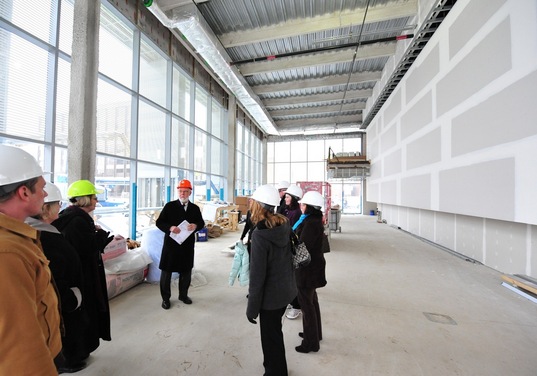
Bill Wheeler, the city engineer overseeing the police-courts building project, stands in the new building's lobby with court employees during a recent tour.
Ryan J. Stanton | AnnArbor.com
After nearly a year of construction, the city of Ann Arbor's new police-courts building at the corner of Fifth Avenue and Huron Street is starting to take shape.
The $47.4 million, five-story addition next to city hall is about halfway complete - and it's on schedule and under budget, say city officials.
Motorists passing by may notice a series of metal panels forming around the exterior of the upper stories, while a brick facade is making its way around the lower levels. The 1963-era city hall next door is starting to pale in comparison.
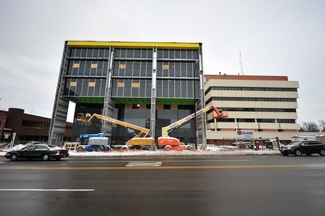
The 103,000-square-foot police-courts building takes shape next to the current 1963-era Ann Arbor city hall.
Ryan J. Stanton | AnnArbor.com
"The building is starting to look like it's really going to look," said Bill Wheeler, the city engineer overseeing the project. "We expect it to be done at the end of November. We'll start occupying in December. That's probably a one or two-month process."
The top two stories of the new building will be home to the city's 15th District Court, which is being forced to move when its lease ends at the Washtenaw County Courthouse. The second and third floors will be occupied by the Ann Arbor Police Department, which is vacating its cramped quarters inside city hall. And the city's information technology staff is taking over the first floor of the new building.
After the building is finished, renovations inside city hall - which are included as part of the project - will last through May 2011, Wheeler said.
City Administrator Roger Fraser acknowledges the city is working hard to stay within budget.
"We've done a lot of what's known as value engineering," he said. "And as we got into the project, there have been a number of things that have been sort of slipped away as we discovered we couldn't do it within the budget."
The project, paid for with a combination of cash and bond proceeds, has been in the works for years. It has sparked controversy - including a failed petition drive to force a citywide vote on borrowing for the project.
Some residents continue to question the city's decision to undertake a $47.4 million capital project at a time when city services and staffing levels are being reduced because of decreasing operating revenue.
City officials respond the building was needed - and they're making adjustments when possible to keep costs down.
Even before construction began, the city made more than $1.7 million in cuts. Examples include using standard hinged doors on the new entrance instead of stainless steel revolving doors, reducing the west and south facade sunshades, eliminating an entrance canopy and reducing the amount of terrazzo flooring.
Wheeler said mechanical and electrical system changes saved another $400,000. The city also decided not to spend money on building foundations for a meeting room expansion, which still could eventually happen in the future.
A recent tour of the building reveals crews have been hard at work transforming the steel skeleton into a habitable work space. Drywall is freshly hung, door frames are being installed, courtrooms are taking shape, and floor tiles that still need polishing have welcomed their first sets of footprints.
"As far as efficiency and effectiveness, this is a quantum leap for us, so it's important to us that it be done - and done right - and it looks like that's exactly what's happening," said Keith Zeisloft, administrator of Ann Arbor's 15th District Court.
Zeisloft said the new spacious environment offers features a modern-day courthouse should have.
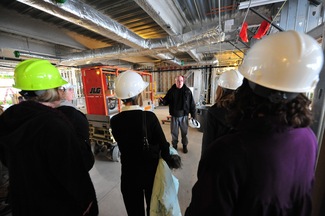
Keith Zeisloft, administrator of Ann Arbor's 15th District Court, shows his employees their new work environment.
Ryan J. Stanton | AnnArbor.com
"In the county courthouse, often you see prisoners being moved through public areas, and that's certainly not a good thing from a security point of view," he said. "What's also important to us is that, for the first time, our judges and magistrate will have assigned courtrooms. There's no more wandering from courtroom to courtroom day-to-day."
Fraser acknowledges the city still hasn't budgeted for furniture, fixtures and equipment, which are typically part of the budget plan for any building project.
"We assumed going into this - given the frugal nature of our operations - that we would just ramp up as we went along, and we'd have to live with a lot of used stuff when we moved into the new building," he said, adding the city still is negotiating with the departments - particularly the court - about how that will work. "Some of it is being addressed in their budget, some of it's being addressed over the course of time in operating budgets, some of it will just not be met."
Tom Crawford, the city's chief financial officer, said the city will see increased operating costs because of the new building. That will be a hit to the general fund, which already is struggling with a $5.2 million deficit heading into next year. Crawford said utilities alone for the new building are estimated to cost about $130,000 next year, a figure that jumps to $275,000 the first full year of operation.
"The premise of this thing was we needed to build this within the resources we had," Crawford said. "Now we've got less resources coming to the city than we had then, but we didn't know that."
Still, he said, the project makes sense.
"You have to remember this is a long-term decision, and if we were continuing to pay leases over time, 30 years from now you're still paying leases," Crawford said. "This will be done. And so, as a long-term investment, this is a lower cost to the citizens."
Annual debt payments are set at $1.86 million for 30 years, about $735,496 of which is being covered by discontinued leases. The Downtown Development Authority agreed to take on $520,000 of the remaining cost, while $374,180 is coming from revenue from antennae sites and $225,000 from court tickets.
Fraser acknowledged the project budget is dependent on $3 million from the sale of city property at First and Washington - a deal that has stalled because the developer, Village Green, has had trouble coming up with financing. Fraser said the city continues to operate under the assumption that the sale eventually will happen.
Fraser said it's always a risk taking on a capital project this large, and some degree of criticism always follows.
"Having done this in more than one place, I can tell you that the community discomfort with the idea of spending a bunch of money on a building - particularly for bureaucrats - is not one that's easily sold," Fraser said. "But getting this done will set up the citizens and councils of the future in a much better place than they were."
City officials note the police department is located in a part of city hall originally designed for storage space and is badly deteriorating. Oftentimes after it rains, the ceiling leaks, and employees have reported air quality issues and black mold.
"We needed to do it," Fraser said of the new building. "And it's one of those investments that - it doesn't matter when you ultimately decide to do it - there's going to be good and bad. But ultimately, 10 years or 15 years from now, the community is going to look back at this and say, 'Thank God we got this done.'"
Ryan J. Stanton covers government for AnnArbor.com. Reach him at ryanstanton@annarbor.com or 734-623-2529.
Comments
dlb
Sun, Feb 21, 2010 : 9:52 p.m.
The Municipal building addition is one of the ugliest pieces of public architecture I have ever seen! What were they thinking? I do believe that enough money needs to be spent on public buildings to get a good design, especially in our city which values art and design. But, what happened here? Who designed this thing?
RUKiddingMe
Mon, Feb 15, 2010 : 11:11 p.m.
Regarding the "laying" vs "hanging" of the drywall; perhaps they DID actually lay the drywall instead of carpet; with how many times I've seen streets torn up, repaved, then torn up AGAIN and repaved AGAIN within a month, I can't be sure there's not drywall on the floors in there.
RUKiddingMe
Mon, Feb 15, 2010 : 11:07 p.m.
I very much agree with 1bit; I would love to get some info on past city projects that justify themselves with future revenue (or future reduction in cost), and what actually happens. At the Fuller Road Transit Station meeting on 2/10, someone asked a relatively direct question about where money would be coming from to pay for the project, and the response was a pretty vague reference to how Amtrak might be paying for some parking spaces (75 they would need as soon as rail service is there, and then 150 IN 20 YEARS). No mention of city cost or U of M contributions. It's this type of nebulous assumption that "it's worth it" that makes me really tired of these enormous expenditures with nil justification. Anyone know how I can find out exactly how much money A2 spent on that feasibility study for putting a trolley car system downtown? I have a feeling someone should have done a feasibility study on that feasibility study.
logo
Mon, Feb 15, 2010 : 4:47 p.m.
The total hit to the city's year to year budget is $275,000. This was an affordable solution to a tough problem. The county would not renew the city's lease at the court house. The city has to house the courts in a secure building and the police really needed new space. Why shouldn't a city have buildings people can be proud of. I like the modern look of the new building. It is so tiring to hear so many who are against any change of any sort.
glenn thompson
Mon, Feb 15, 2010 : 1:08 p.m.
The city's current financial problems were very predicable. Almost two years ago Council member Mike Anglin stated "We will be in bad shape as a city...Two years from now...people will say why is that building there and look at what we are facing."
pseudo
Mon, Feb 15, 2010 : 9:36 a.m.
I am always skeptical of performance to budget claims for projects that are under way - not a good time. I drove by the building for the first time (I don't bother going downtown very much anymore - its too expensive to breath the air) and wow, that exterior is ugly. I don't get it. Not interested in getting it just think its really ugly and a sharp, painful contrast to the care and beauty required of all the other developers in town. wow.
Fred&Barney
Mon, Feb 15, 2010 : 8:05 a.m.
Typical - They are under budget so far after eliminating two million dollars because they are over budget. I have no doubt they will bring this project in under or at budget. Then, they will pay out the nose for upgrades and renovations after the project is complete. Someone should have reminded Roger that building new city halls usually results in him searching for a new job a few months later.
Ryan Munson
Sun, Feb 14, 2010 : 10:35 p.m.
|0| at the post above.
djm12652
Sun, Feb 14, 2010 : 5:17 p.m.
"Drywall laid"???? Are you kidding me? Are these descriptions from a city employee or the reporter? Tile, flooring, carpet etc is laid...drywall is hung.
Frank
Sun, Feb 14, 2010 : 4:35 p.m.
I agree with some of the comments listed here concerning the aesthetics of the new building. The metal siding on the building belongs on a Walmart or a WWII quonset hut, not on our city hall.
Really?
Sun, Feb 14, 2010 : 3:56 p.m.
Did I miss part of a story here? How did this building become the fault of the unions? Guess we should just let Fraser spend money on whatever he wants and then tell the unions they have to pay for it. Unions living the "secret life of luxury". Get your head out of the clouds. The city plays this game with us to try to push their own agenda and turn the residents against what we do. WE cost the city too much money? Really? How about factoring in pet projects and 'administrative benefits'? But sure, the entire problem of this city rests on the shoulders of unions. Fraser's kool-aid must taste great! Maybe that should flow from the fountain in city hall.
Dalouie
Sun, Feb 14, 2010 : 3:28 p.m.
Vivianne, the decision to go ahead with this building was made before the market crash. If you knew the economy was going to go off the cliff in the fall of 2008 I guess you made a big bundle short selling the market. Are you retiring to Hawaii for the winter? Sure, Michigan had been down for awhile but even on Wall St. only a few saw the foreclosure crisis tipping the markets into free fall. But anyway, if you followed it, the city looked at the city center building (underground parking?) and others, none of them worked for the courts and police. The county is moving the juvenile courts into the court house they own, the county administrator said the city had to move. If you are serious about other options... the county would have let the city build a new courthouse on their land but the city would have still been paying rent, forever. A good deal for the county but a bad one for the city. This is a much better option with a very small effect on the city operating budget. Grateful, from everything I have been able to learn about this building, the administrative offices and the mayor and council are staying where they have been in Larcom for all these years.
Vivienne Armentrout
Sun, Feb 14, 2010 : 2:55 p.m.
"Fraser said in an interview on Friday that the level of financial troubles the city is experiencing today was not foreseen when this project was approved." But we knew about most of it. City budgets even then were forecasting a deficit in coming years. Michigan had been in a severe recession as early as February 2007 (http://www.stateline.org/live/details/story?contentId=197521). The closing of Pfizer was announced in January 2007 (http://blog.mlive.com/annarbornews/2008/01/one_year_later_pfizer_labs_emp.html). When I was campaigning for council in early 2008, people were complaining at campaign events that the assessed valuation of their homes had gone down but their taxes hadn't. I won't try to repeat the whole tangled tale of the county courthouse, but there were definitely alternatives to building a huge new building. The City Center building across Huron was offered to the city for sale and it could easily have been retrofitted for courtrooms (check out those tall ceilings on the first floor) and to accommodate the police. The Board of Commissioners was never asked to extend the lease further at the county courthouse and a long-standing offer for the city to pay for its own addition to the county courthouse was never seriously considered. As you state, this decision was controversial. I recently revisited it in the context of governance on my blog (http://localannarbor.wordpress.com/2010/02/09/process-procedure-and-governance-in-ann-arbor/).
voiceofreason
Sun, Feb 14, 2010 : 2:26 p.m.
Ryan, Thanks for that info. I was gonna say, the addition does not fit with the existing building. On a side note, its good to see that other Ann Arbor residents are beginning to demand more accountability from unions. They have been living the "secret life of luxury" for far too long.
Ryan J. Stanton
Sun, Feb 14, 2010 : 2:11 p.m.
According to Fraser, the 1963-era city hall (a.k.a. the Larcom building) is not meeting the city's needs and is highly inefficient (for instance, its outside walls are not insulated). Some time ago, Fraser actually had city staff remove a sign that was put up in the mid-1990s that had said the building was energy efficient. Still, when I asked him about the fact that the new building and the old building don't really match, Fraser said there are no plans for the foreseeable future to do anything more to the current city hall other than the already planned renovations of the basement, first floor and sixth floor, which will start later this year after the new building is completed. "The concept that almost everybody had when we started talking about doing something about Larcom was to knock it down and start over the general belief being it's an inefficient, ineffective building for what we need to do today," Fraser said. "But the architects convinced us that this building actually has good bones and that the best thing that we could do financially would be to put a new skin on the outside. That new skin would have contemporary glass, contemporary insulation, it would square the building off and would be done in a way to compliment the new building. I forget what the ballpark estimate was, but it was never seriously a part of this plan." So, for lack of money, city hall will maintain its 1960s look for a while.
a2grateful
Sun, Feb 14, 2010 : 1:05 p.m.
I don't know... that new building looks pretty sweet in this economy... I hear the new administrative offices will be quite lavish... The king and his court... strike that... The mayor, administrators, and council should all be quite comfy... Now about that eyesore Phase I building... once the new digs are ready, you'll hear about the plans for demolition and replacement of "old City Hall"... What, you haven't heard about that yet? Well, that's how they roll at City Hall and DDA now... Make the deal, seal the plan, let the public know after the fact... The deals are done... without you... Enjoy, A2!
bruno_uno
Sun, Feb 14, 2010 : 12:38 p.m.
bornraised- why must you keep trying to divert from such a simple way to solve the issue in this city? do you have an agenda here other than trying to help the city residents be able to take their tax base and fund the services needed to make this a viable city? i dont understand where you get 50% pay cut? are we that much over budget that we would have to have each person cut their paycheck in half to meet the budget? if so, thats a scary number but if thats the hole we dug into, then so be it. please understand i have no agenda, just take a reduction in pay and benefits for all employees, union or non-union, and then we would keep all our services and most importantly, no one has to go home to their families and say they lost their job. the model is broken, we need to fix it. this is the only direct solution. what dont you understand?
logo
Sun, Feb 14, 2010 : 12:10 p.m.
Ryan's post above makes a good point. The decision to go ahead with this building was made before the economy collapsed but then, they had to move out of the county court house anyway so I don't know how much difference that would have made. Looks like they can afford it. $275,000 out of a $310,000,000 million total budget is nothing. Even $275,000 out of an $80 million general fund is peanuts.
BornNRaised
Sun, Feb 14, 2010 : 11:52 a.m.
@Bruno... you make it very difficult to engage in intelligent conversation. If the city gets rid of all city services, they are still pulling money from the general fund to pay for these pet projects. If every union took a 50% pay cut, would you then be silent to how the city spends its tax base, or would you expect some accountability? For anyone else... I'm not an accountant, so maybe someone of a sound mind can help me understand this. If I create a budget and stay under that budget but don't have the money for it, did I really accomplish anything great? I can create a budget for a $1M house, and stay under budget. But if I never had the money to fund it, what service have I truly provided to anyone? City hall is working on staying under budget, but taking from other funds to pay for it, and banking on deals that fell through to pay portions of it. Translate that to: The money source isn't there, but we're moving forward. Somehow Bruno wants that translated into union contracts are the fall of this city. Like I asked... someone of a sound mind please explain to me if it makes sense to have a budget for money that you don't have???
bruno_uno
Sun, Feb 14, 2010 : 11:39 a.m.
bornraised- the statement that i hate unions is way too strong of a word. im not swayed by your diversion tactic...i dont need your stats, suspicions, conspiracies, and other comments that are a waste of the city of Ann Arbor's time, money, effort, and energy. This building was an eyesore in a city and not functionable in a city that prides itself as a better place to live among a placeless society. unions had a great run but this crisis we are in need us to fight the fact that the money from the public tax base is not there. the most direct solution, the best solution, is to take the union contracts, open them up, and then make the necessary percentage cuts to union and non union contracts to balance the budget. this would have no impact on job loss, and no services lost for the people that the civil servants work for. sorry if i sounded anti union, most of my family and good friends are unionized, this is so far from the issue. please stay on track with the fight to save our city. thanks!
Ryan J. Stanton
Sun, Feb 14, 2010 : 11:35 a.m.
Fraser said in an interview on Friday that the level of financial troubles the city is experiencing today was not foreseen when this project was approved. "At that time, we had no idea that we were going to see the Great Recession," he said. "Whether that would have changed anything, I don't know. The fact is that we always understood that we had to do this with the money that we had and we weren't going to be able to get money out of the community."
Ryan J. Stanton
Sun, Feb 14, 2010 : 11:31 a.m.
The city is planning to go for LEED Gold certification on this building, which costs more money upfront. But according to Wheeler, it will be a savings in the long run in terms of reduced energy costs. According to Fraser, the city also still is planning in conjunction with roof repairs to make a "green roof" that will top the existing patio area of the second floor of city hall. He says that is still in the project budget.
logo
Sun, Feb 14, 2010 : 11:31 a.m.
The county said the city's lease at the court house would not be renewed after 2010. The county is moving the juvenile courts into the county courthouse. The city courts had to move. The city looked at several existing buildings but none could be remodeled to meet the security requirements. The police have been in the basement for years. They needed new quarters. Bottom line: This building was needed and it has a small impact on the city operating budget.
BornNRaised
Sun, Feb 14, 2010 : 11:16 a.m.
@Bruno, assume for a second that the city has a private plow service, trash pickup, police, fire, water, etc. Those services would still be paid for out of the General Fund. So please get off your anti-union soap box just for a few minutes to realize that this city is taking money that they say they don't have from the general fund to dump into this building. Not only that, but then trying to tell us they had no way of knowing this would happen while in other articles telling us they've been reducing the work force to plan the these economic times. Your obvious hatred towards the unions is blinding you from what this city is doing with the money it doesn't have. The point of my original comments was to highlight the double talking the city leaders have been doing this entire time. Recognize that.
GoblueBeatOSU
Sun, Feb 14, 2010 : 11:13 a.m.
Tom Crawford, the city's chief financial officer, said the city will see increased operating costs because of the new building. That will be a hit to the general fund, which already is struggling with a $5.2 million deficit heading into next year. Look for the ticket quotas to go up. Not only will they have to write more tickets to pay for the building but also for the operating costs. Recently the city said the bus depot had to be replaced, which is only 20 years old. I hope the expected life of this building is greater than 20 years....
daytona084
Sun, Feb 14, 2010 : 10:57 a.m.
"...Drywall is freshly laid..." Drywall is not "laid", drywall is "hung"
Awakened
Sun, Feb 14, 2010 : 10:50 a.m.
@Annarbor28. According to the plans the prisoners come in through a secure garage area to a separate secure elevator that services the police detention and interview areas (on the 2nd and 3rd floors) and Court detention above that. Prisoners will be kept in a secure area the entire time until needed in court. For those of us who go back far enough to remember when the 15th District Court was on the 6th floor of the Larcom building they had a similar system but the elevator was shared with City staff and led to unsecure areas. Right now officers routinely walk prisoners from AAPD to the Court building.
Justavoice
Sun, Feb 14, 2010 : 10:31 a.m.
@BlueNever!: It's unfortuante you look at this as a Univeristy problem. I point out to you if the Unveristy didn't exist in it's current form Ann Arbor would be a spot on that map. You can continue to blame the University but the problem is with your city and city council budgets. I point out to you as a University employee, attendant of University events and weekly, if not daily vistor to the city to buy services that the Univesity supports a LOT of local business which in turns supports city services by paying for taxes and allowing business to expand. Game days alone brings in a ton of money through restraurant sales and off campus parking. Lets not forget also not forget the ton of off campus students that the University brings in that support your taxes directly. Daily the university buys a ton of local services including employees purchasing lunch, bring vistors in to campus hotels, parking, etc. I vist downtown frequently and I pay for parking and I buy a ton of services. However the prevalient attitudes of blaming the University let alone University staff for the mess your city administration has made leaves me just to shurg and say, why bother with going downtown anymore. I'll still go to work, I'll still attend events, but if you don't want me there, then I certainly have plenty of other businesses and restaurants to go to outside the city. You don't want my business and the resulting taxes it pays. That's fine. I'll stay outside the city, and I'm sure I'm not the only one who feels that way. The bottom line with this story is your city is in a mess. Your council is out of touch with the relaties of the economy in Michigan today. My guess is they will need to comission a study to look at this problem at last once to spend more money than just doing it in the first place (Another Argo dam study please?)
bruno_uno
Sun, Feb 14, 2010 : 10:25 a.m.
good job, sorry the old building was in dire shape and this project needed to be done. dont connect this job with the union complaints that they should be saving jobs over a new building. that is short sighted and an objective argument based on keeping union jobs and nothing to do with their duty as serving as civil servants. unions have been abusing the public sector tax base forever and it needs to stop.
annarbor28
Sun, Feb 14, 2010 : 10:18 a.m.
Wouldn't it make more sense for courts to be on the first floors, to avoid taking prisoners up to higher levels? How will they go, by elevator (dangerous) or by stairs (which are also enclosed and which I bet most people won't want to do, ie walk up 3-4 flights of stairs, esp with prisoners.) Is this building "green"? Is it utilizing solar energy? annarbor.com: do you have the answers for these questions, and also for the ones in my prior comments?
BornNRaised
Sun, Feb 14, 2010 : 10:06 a.m.
"Having done this in more than one place, I can tell you that the community discomfort with the idea of spending a bunch of money on a building - particularly for bureaucrats - is not one that's easily sold," Interesting if you google Fraser's name you'll see the short amounts of time he spent in other cities. Maybe it's because of his same business model. So he's going to spend this money, against the wishes of the city, and cut our police and fire? Interesting methods Mr. Fraser. City governments are tasked with providing safety services to it's citizens. Maybe that's news to you, and maybe you think you can just spend money on what you want. An additional $275K from the general fund for this building? That's interesting. How many more firefighters and police officers does that take off the streets? But hey, they cut back on the terrazzo flooring. So we should probably re-elect everyone because of their keen financial planning. CRAWFORD: "The premise of this thing was we needed to build this within the resources we had," Crawford said. "Now we've got less resources coming to the city than we had then, but we didn't know that." IS THAT RIGHT?!?!?! We didn't know that? You're the same person that's been telling us for years that you've been planning for the hard economic times. But now that you build your Taj-Mahal, "WE DIDN'T KNOW THAT".??? WOW! Is just me, or is everyone in this city just laying down and taking what the city 'leaders' shove down our throats? I can't believe the quotes from both Fraser and Crawford. I'm also disgusted with the city council for laying down while Fraser runs over them. I've never seen ANY other organization where the employee can dictate what the boss does and talk down to the boss such that he does and STILL stays employed. Wonder how many more police and firemen will be taken off the street when the $3M deal for the apartments goes away. And let's not forget the conference center the city wants at 415 Washington. But wait... didn't they opt NOT to expand the fondation in the city building for the conference center? We were told that this building was such a great thing the city needed to bring everything under one roof. So instead of making some adjustments for the conference center/rooms... well sure, let's just build a brand new building. I'm sorry, I mean ANOTHER brand new building on the backs of the tax payers. Wake up Ann Arbor.
belboz
Sun, Feb 14, 2010 : 9:57 a.m.
Another one of those addittions that looks totally like nothing it is being added on to. Is this the same city that denies permits because they don't fit in with a master plan? Look at that picture above - is that the architecture you think of when you think Ann Arbor??? This project is exteremely dissappointing. Words can't express the excessive, wasteful nature of the project - but the number above sure do regarding the current lease vs. new building loan cost. Someone should be fired for cause. When taxpayer money is wasted to the extent it is for this building - when the cost of running the city goes up significantly, but there is not value added to the taxpayer - then someone has failed miserably. The building is not providing any new services - just the same people doing the same job in a new seat. Actually, Ann Arbor will have less services on a yearly basis because of the increased cost. Because of this, Fraser should be let go for cause. Maybe citzens would be more likely to vote yes for School Mileages or City Tax increases if leaders showed a very frugal, efficient, and effective plan when it came to spending Tax Dollars. But, that has not happend. Based on the reputation the leaders of Ann Arbor have built, I see no new taxes being approved by the citizens. Poor leadership, despite the tough economic times.
annarbor28
Sun, Feb 14, 2010 : 9:44 a.m.
Perhaps the art money can be diverted from the sculpture to the "furniture, fixtures and equipment" which somehow were not budgeted for by the City Council. Maybe if you put cute stickers on them or get brightly colored furniture they could be considered art. Does anyone know the energy and maintenance costs of the water sculpture in terms of the budget? Also the costs of protecting an unpopular sculpture that I assume will be vandalized or spray-painted? (I am not considering it, but think U-M rock which is constantly painted.) Also, will it attract skateboarders?
bunnyabbot
Sun, Feb 14, 2010 : 9:27 a.m.
Fraser said "the city continues to operate under the assumption" exactly what the city always does, operates under the assumption, counting the chickens before they hatch. additionally, if the public art sculpture thing is based on the buildings dollar amount and they come in under budget one would hope that the art could cost less. But I don't see the German artist reducing his sticker price on the ugly piece of junk.
BlueNever!
Sun, Feb 14, 2010 : 8:59 a.m.
Last I remembered, the Univ. of Michigan was part of the Ann Arbor community. They rarely contribute yet always withdraw services from the City. I should think the UM could donate all the furniture and fixtures to the new City building and lend free art/design from the Arch school. Another possibility would be to levy a $10 face value City (entertainment) tax on UM sports game tickets. The football program could cover most of the costs in one season.
Ryan J. Stanton
Sun, Feb 14, 2010 : 8:31 a.m.
@marzan I believe Alan is referring to the $750,000 sculpture to be erected in front of the new building. This is not part of the project budget but is an expense from the city's public art fund.
marzan
Sun, Feb 14, 2010 : 8:07 a.m.
I've heard people mention this $1,000,000 for the urinals before. Is there a citation or any truth to this claim?
HappySenior
Sun, Feb 14, 2010 : 8:04 a.m.
Yes, people will look back and say this building is a monument to the total disconnect of the city administration/city council with reality.