

Are the entrances to Ann Arbor ugly? Some think so

Planning Commissioner Kirk Westphal pauses as he writes his thoughts on a whiteboard during a brainstorming session at Tuesday's Planning Commission retreat. Click here to download a digital screenshot of the white board's notes.
Ryan J. Stanton | AnnArbor.com
Evan Pratt spoke candidly Tuesday night as he confessed his thoughts on the appearance of the so-called gateways to the city of Ann Arbor.
"All the entrances to town are ugly," said Pratt, a member of the Ann Arbor Planning Commission.
Pratt's comments came during a discussion about future planning initiatives at the Planning Commission's annual retreat. He and other commissioners supported the idea of getting started on new corridor studies in the coming year, providing a guide for future land use and design along the city's major transportation arteries.
That includes the entrances to the city.
"I think there's an opportunity there," Pratt said during a break in the meeting. "The state House of Representatives passed probably three or four years ago legislation that would allow increment finance districts to come along — just corridor section areas — and that seemed like an opportunity to create a funding source to really upgrade those corridors. I mean, the Main Street corridor could be upgraded significantly. Maybe it could be like a three-lane boulevard."
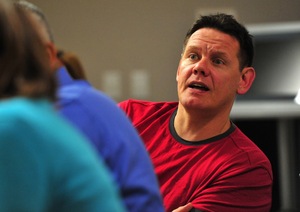
Planning Commissioner Evan Pratt voiced support Tuesday night for the idea of a corridor study.
Ryan J. Stanton | AnnArbor.com
There was talk Tuesday night that a corridor study of one or more of the city's major arteries could be included as part of an upcoming update to the city's master plan.
Wendy Rampson, the city's planning manager, noted in a report that the city already has been exploring strategies for improving the Washtenaw Avenue corridor along with Washtenaw County and a joint task force of planning and elected officials from the city of Ypsilanti, Ypsilanti Township and Pittsfield Township.
The group is now considering whether to apply for a grant for technical assistance to help put together a corridor redevelopment plan. The goal would be to have a draft of the plan completed later this year.Â
The plan would have specific recommendations regarding transportation (motorized, transit and non-motorized) and design along the corridor, as well as less-specific recommendations for land use.
"I think people see corridors as a way to bring a lot of different ideas together, whether it's sustainability or economic development," Rampson said. "At this point, the Washtenaw Avenue corridor is the one that has some energy behind it in a multi-jurisdictional effort."
Planning commissioners also have voiced interest in the State Street corridor because of opportunities for new development and redevelopment they see there. And given the University of Michigan's acquisition of the former Pfizer campus, the Plymouth Road corridor also may be the center of future study efforts.
"That may change the whole look and feel of the corridor, and so that may be something they want to tackle, too," Rampson said.
Ann Arbor completed its last corridor study for West Stadium Boulevard in the mid-1990s as part of the city's West Area Plan. Rampson said many of the recommendations in that report — such as uniform lighting and sidewalk improvements — have been implemented.
"But I heard the Planning Commission talk even about land use changes, looking at bringing buildings closer to the front and making corridors more pedestrian oriented," Rampson said of the kind of corridor studies being talked about now.
Rampson said such studies could address the concern that the current gateways to Ann Arbor aren't that attractive.
"I think one of the pieces of a corridor study is how people enter the corridor and usually they're entering from another community or from the freeway," she said. "So there are many opportunities, and a lot of communities put energy into that to welcome people into their city."
Pratt said he hopes to see taller buildings greet visitors to Ann Arbor in the future - but he's talking years into the future.
"To see one-story buildings around freeway interchanges just doesn't make any sense, unless you're into sprawl," he said.
Pratt said he's glad some of his fellow planning commissioners are talking about the issue, and he's glad the city likely has funding in its budget to at least study it. He acknowledged the future redevelopment of the city's major corridors will require private investment.
"The taxpayers of the community are not going to be the ones who can afford to redevelop and improve the stuff that we've got around all four quadrants of the city," he said. "It's all going to be on private development coming in, and they're not going to come in with the current kind of zoning that we have. It doesn't make much sense. It just makes sense to keep renting out the same little strip malls."
Bonnie Bona, chairwoman of the Planning Commission, said the discussion going forward will be: Does the city focus on all of the corridors or does it start to pick and choose?
"In my mind, the corridors are defined by where major mass transit already exists," she said. "I think where land use comes in is the stops along that corridor, and often transit-oriented development is mentioned as how you actually develop immediately adjacent to that bus stop — in order to create the ridership and not have to get out into the residential neighborhoods around it.
"In my opinion, if we create more pedestrian-friendly, experientially vibrant nodes along these corridors, the development that produces that is going to be more appealing than the typical strip center that gets pushed to the back of the site with a big parking lot out front," she said.
Bona also mentioned bringing buildings closer to the street and increasing height as ways of improving corridors. But she said focusing on the entryways to the city is not the solution.
"I think it's all along the corridor, and it happens to start at the edge of the city," she said. "So I think that's where the entrance starts to look better, but we're not building monumental arches at each of our entryways."
Ryan J. Stanton covers government for AnnArbor.com. Reach him at ryanstanton@annarbor.com or 734-623-2529.
Comments
bruno_uno
Sat, Apr 3, 2010 : 9:39 p.m.
what a waste of consulting....lets implement some of these plans before spending wasteful money on another study. maybe the planning commission should spend these meetings reviewing the plans we have and learn from what has been done before adding more studies to the taxpayers bill.
Richard C
Sat, Apr 3, 2010 : 9:12 a.m.
Given the ring-roads (I94, US23, M14) around Ann Arbor, ALL of the major entrances to the city are highway exchanges and suffer from strip malls. There isn't much you can do to beautify that. If the goal is to demonstrate that Ann Arbor is a prosperous city, worthy of investing in, then fix the major roads and clean up any litter. If mowing is too expensive, then do more with wildflowers and native grasses, such as what has been done with Huron Parkway. I count the major entrances to Ann Arbor as: (1) Jackson Rd @ I94 (strip malls) (2) Washtenaw @ US23 (strip malls) (3) State Street @ I94 (strip malls) (4) AA/Saline Rd @ I94 (strip malls) The Main street entrance @ M14 is limited, (since it's a 1/2 exchange), but gives good access to the center of town. It also has the best view of the town, just before the AA Railroad bridge. Yes, it's "post industrial", but replacing the old junk yards and the presence of the Art Train make up for a lot. I think it's pretty charming, if of limited utility. Still, the "limited utility" is towards the east - Detroit Metro and the suburbs. There isn't really anything to the west for 200+ miles until you reach the Chicago conurbation. (Connections to the north don't count for much - that's still mostly Michigan, and who has money in Michigan anymore?) Miller Road and Maple road share an exchange with M14 - but Jackson Road is more appealing to travelers from the West, unless their destination is on Miller Rd. Geddes Road @ M14 is good for North Campus and UofM and St Joes hospitals. Packard Road, Carpenter Road, Liberty, Scio, Nixon, don't connect to the ring roads - call them side-door entrances to the city, good for neighbors and good friends.
thurber
Fri, Apr 2, 2010 : 11:12 p.m.
I like where you're going with this. Perhaps with Hash Bash kinda, well, you know, old...we can put the word out that our potholes are, you know, wink, wink, Pot Holes. Holes that are filled with Pot! That should bring in some new people to admire our town's entrances creating a steady inflow of visitors who appreciate art. Once they get into town we can sell them salty snacks.
Anonymous Due to Bigotry
Fri, Apr 2, 2010 : 5:14 p.m.
Perhaps we could get the panhandlers to wear street mime makeup and reclassify them as "cash-soliciting performance artists"? That should help improve the artistic value of the city. The potholes and crude patch jobs are obviously part of an avant garde artistic statement on the stark contrast between the dark voids of our lives and the bland yet ultimately impermanent smoothness of the universe.
AAmom
Fri, Apr 2, 2010 : 11:24 a.m.
again, STADIUM BRIDGE, please!
glynda
Fri, Apr 2, 2010 : 9:03 a.m.
My favorite part of the entrances to Ann Arbor is the panhandlers that wait at the end of the off-ramps. Welcome to our city!
thurber
Fri, Apr 2, 2010 : 7:39 a.m.
The hideous obtrusive overpriced wayfinding signs in the city center have a fourth line left blank for the 'secret conference center.'
James
Fri, Apr 2, 2010 : 1:13 a.m.
I have spent most of my life in Michigan entering Ann Arbor from the North: South-bound on 23 to Main or Barton exit. It really is a beautiful entrance to the city. You just have to step back a bit to appreciate it. The landscape and hills, over the river. The city rising up out of the Huron River Valley. Very nice. Thankfully, we don't have the giant hill-hugging condo development in Bird Hills to look at, or the 10 story hotel on the West side of N. Main, or many of the other atrocities that A2's urban planners have tried to bring us. Keep your overpriced corridors and streetlights and HIDEOUS, OBTRUSIVE, out-of -scale "wayfinding" signs away from the Northside, if you please. I like it the way it is. The best thing about Ann Arbor to me is the way it becomes rural and natural so quickly on the North and West sides after leaving the city. It is part of our unique character; we have to keep fighting to keep it that way. Don't we have enough to do maintaining our city without spending all this time/money/energy on "improvements"?
thurber
Thu, Apr 1, 2010 : 10:17 p.m.
It's refreshing and reassuring to see so many good common sense observations written by and about Ann Arbor. For the most part comments are truthful, civil, real, funny, thoughtful and original. Be proud. It's our Ann Arbor, too. Ann Arbor is not the sole domain of the unresponsive needlessly complicated self serving arrogant political machine that would prefer to meet in secret. We live here too. We have rights. We work, we pay our taxes, we breathe the air, we drink the water. We're the voters. We need to be heard.
BobbyJohn
Thu, Apr 1, 2010 : 9:01 p.m.
Planning commissioner Pratt is talking about narrowing North Main Street from it's current 4 and 5 lanes down to 3 lanes. It's tough enough now with 2 lanes in each direction, think about what it would be like with 1/2 as many lanes in each direction. Total gridlock during rush hour. The planning commission seems to want a larger population and narrower streets. I walk to many locations in Ann Arbor, but one has to still drive.
DagnyJ
Thu, Apr 1, 2010 : 4:11 p.m.
@Liberalnimby: the city has been rolling in dough for years. We had money to run golf courses, money to buy fountains, money to pay consultants, money to give cars to city officials. We have money for single stream recycling, and we have surplus money in the water accounts. Oh no, the problem isn't that we haven't had enough money. The problem is that the clowns who are running this city spend the money on nonsense (see above list). And they go on and on about bike lanes and the world's most expensive park grass mowing project. Please fix the roads. Please fix the Stadium Bridge. Please stop wasting our money. Please, no more consultants, no more public art, no more expensive trash collection projects.
LiberalNIMBY
Thu, Apr 1, 2010 : 2:30 p.m.
@Greg Koepp: Best comment yet. Yes, please do run for council. Just keep your eyes on the prize: the city needs to make money in order to spend it. Right now our roads, our facilities, our non-profits and the entire city are reaping the results of years of not letting anyone increase the tax base.
Greg Koepp
Thu, Apr 1, 2010 : 9:52 a.m.
I'm proud of the responses to this article. As a 3rd generation Ann Arborite I have been truly distressed over the general conditions of our town. It boggles my mind how our city government sets it's priorities. It's way past time for all of us to demand more. It's time to take care of what we have...the grass looks shabby, edge the weeds hanging over the curbs, tell the lawn crews to get off the mower and remove a branch or limb on the groung rather than mowing around it all summer, fix these horrible roads and STOP pounding asphalt patch as a half ass attempt. Paint some fences, repair others. Clean up the schools and school yards, the city parks are indeed plentiful, but plenty disgraceful. Come On...we deserve better, we certainly pay enough for it...we all need to make the demands. Aw to heck with it...I guess I'll have to run for City Council.
PersonX
Thu, Apr 1, 2010 : 8:49 a.m.
I wholeheartedly agree that the entrances to Ann Arbor are ugly; State St. is depressing most part of the year, and Washtenaw is tacky as they come. However, I also agree that perhaps there are more pressing matters to spend money on currently. Most of all, I would object to more studies, consultants, and expensive planning that would undoubtedly be shelved and never implemented. The whole issue of expensive consultants should be reconsidered; most of them are completely superfluous and a drain on public coffers.
Do not taunt Happy Fun Ball
Thu, Apr 1, 2010 : 7:13 a.m.
But what about the rain gardens?. We could build the world's largest rain garden - perhaps use some sort of eminent domain and tear down Briarwood mall (it's old and icky')- think of giant rain garden with daisies and unicorns and rainbows and lollipops and sandals for everyone..Now that would be an entrance to Ann Arbor we could all be proud of.
thurber
Wed, Mar 31, 2010 : 7:54 p.m.
Funniest string in recent memory. Glad the weather changed. Happy warm evening everybody. Life is good.
townie54
Wed, Mar 31, 2010 : 5:45 p.m.
yea lets spend money thats hard to come by.Lets put flowers or a flashing neon around the city limits signs.Only in my home town of Ann Arbor would anyone worry about this.Who cares?Your not driving into nirvana or Shangri La for petes sake.You want something like those stupid metal things you drive under on I 94 by Belleville.Yea those make a lot of sense.I still dont know why they are there.The things you people worry about crack me up.On the west side Knights and Zingermans are full every night.I dont think it geters anyone there.Try driving by Arborland.I dont think the traffic lightens up on that side of town.Oh yea I heard 4 people yesterday mention they turnrd around and went the other way because of the entrance to the city.Not!Get real people
Anonymous Due to Bigotry
Wed, Mar 31, 2010 : 5:24 p.m.
Perhaps if the roads and bridges could be reclassified as "art" then they'd get fixed? I'm also betting that if the police department was renamed to the "public art security department", and the fire department was renamed to the "art anti-combustion department" then they could get more funding too.
Shitari123
Wed, Mar 31, 2010 : 4:32 p.m.
@dading... I 100% agree. This is rediculous. Other than possibly some traffic congestion relief, what do these corridors need? Wait, lets do a "Study" and waste some more dollars. There are much more pressing problems that need attention.
Brian Bundesen
Wed, Mar 31, 2010 : 4:06 p.m.
I agree with many of the opinions here. The roads are a disgrace. Improved landscaping with trash cleanup would also go a long, long way.
voiceofreason
Wed, Mar 31, 2010 : 4:02 p.m.
Ann Arbor is a great town where Government often has mixed up priorities. Still though, it was very amusing to read 77 comments of fake outrage. You people need to leave the house more often.....
Cici
Wed, Mar 31, 2010 : 3:47 p.m.
This is pot-hole city. Everyone knows that so fix the roads and bridges. So what about the entrances?!! Are those into Detroit, or Lansing, or Adrian "pretty"?? Good grief!!! Who cares as long as you can get into the city without needing a wheel alignment or new shock absorbers. Spend our money where it is NEEDED. What are you thinking when the city cries "broke"?? This isn't a city needing arches and gateways.
KarenH
Wed, Mar 31, 2010 : 3:42 p.m.
@Lokalisierung - I definitely did not say that Ann Arbor was prettier than California. I merely said that I moved to Ann Arbor from California. Ann Arbor certainly IS prettier than many, many places in California. There are also several places in California that are far prettier than Ann Arbor. It's all relative in the end. This is a nice town. I think I'll stay for a while.
Freemind42
Wed, Mar 31, 2010 : 3:13 p.m.
Although it is off topic, i've seen a bunch of comments about it: students trashing the neighborhoods with garbage, beer bottles, cigarette butts, etc. It also really bothers me that so many once-beautiful historic homes are ruined because of lazy students trashing them. This is a problem that exists in every college town and is not indicitive of UM students. I agree that the city should step up its enforcement of ordinances about litter and trash left after parties.
Lokalisierung
Wed, Mar 31, 2010 : 2:19 p.m.
"After our long trek from where I had been living in California, as we approached Ann Arbor," Ann Arbor is as pretty as California? Egads!
KarenH
Wed, Mar 31, 2010 : 2:13 p.m.
When I moved here a few years ago, I had already bought a house here, yet had never visited Ann Arbor. My partner had already lived here for several years, and had done most of the leg-work in finding our new home, so I trusted her. I also did enough research to know that Ann Arbor was the kind of town where I would feel at home. After our long trek from where I had been living in California, as we approached Ann Arbor, I started to become worried that I had made a HUGE mistake buying a house sight-unseen. My fears continued to escalate as we drove into town. Then as we got closer to our new home, I started noticing old threadbare couches on porches and dozens of red plastic cups scattered on and off folding tables on lawns and nearly turned the car around. A few heart-pounding blocks later we reached our neighborhood and all was well with the world. Yes, Ann Arbor looks quite ugly when driving into it.
Rhe Buttle
Wed, Mar 31, 2010 : 1:54 p.m.
Oh, but Beth, 'twas not always this way. Once were a time when male students, resplendent with slide rule attached at the belt, wore button down shirts, trousers, not jeans, and usually penny loafers. Female students wore those frilly blouses, pleated skirts, knee socks, and penny loafers (one should have sold penny loafers in town back then). And the homes and businesses alike kept their appearances tidy. But you see, Americans like to do the easy, LAZY, thing. We'd rather look like downtown Beirut than old town Ann Arbor. Its easier. You want to flip it around, you are going to have to do it. Don't count on much support though, it won't be easy...
Beth
Wed, Mar 31, 2010 : 1:39 p.m.
Honestly, will people really choose to move to AA or not because the entrances are pretty?? I have no problem with Washtenaw, all the way to Ypsi - I shop at those stores, eat at those restaurants, and think it looks like a regular place where people live and do business. I drive around the area of the Carpenter/ Michigan intersection every day - it's all ugly, but it didn't stop me from buying a house out that way. Student neighborhoods will always look a little trashy - if people can't handle that, perhaps they shouldn't live in a college town.
Lokalisierung
Wed, Mar 31, 2010 : 1:24 p.m.
"Has AA suddenly become Yuppyville..." Suddenly? As in you thik this is recent?
Blue Eyes
Wed, Mar 31, 2010 : 1:21 p.m.
Wow, in the middle of spend, spend, spend we get the NIMBYs too! Tramps, vagrants, panhandlers....and tents - OMG! You don't suppose they live in tents because they can't afford anything else?! Has AA suddenly become Yuppyville where those less fortunate should be hidden out of sight? Trash? If you don't like it, I'll bet no one would fight you if you decided YOU wanted to pick it up. Remember the City has less money so can't do everything it used to do - liking picking up trash. Infra-structure, bridges, potholes, fire and police? I'll vote to spend money on all of those any day over beautiful entrances. So someone on the Planning Commission thinks there's money in the budget for their "wonderful" ideas? Well let's find that money and put it to work helping with the important things in life, not tall buildings etc.
Lokalisierung
Wed, Mar 31, 2010 : 12:54 p.m.
Atticus I do understand what you're saying and I don't have any super strong feeling either way, but to compare Michigan Ave in Ypsi with Ann Arbor is a little bit of a stretch don't you think?
Atticus F.
Wed, Mar 31, 2010 : 12:49 p.m.
You know another area that isn't big on zoning laws?...Ypsilanti. Without zoning laws, places tend to look like ypsilanti on michigan Ave. Muffler shops, scrap yards, pawn shops, ect. Not saying zoning laws are right or wrong. Just that I choose to live in A2 because it doesn't look like the michigan Ave coridor.
thurber
Wed, Mar 31, 2010 : 12:30 p.m.
Don't dare fill those cracks in the asphalt, they're Historically Significant Alligator detailing.
LiberalNIMBY
Wed, Mar 31, 2010 : 12:17 p.m.
"The taxpayers of the community are not going to be the ones who can afford to redevelop and improve the stuff that we've got..." Um, I don't think these folks are talking about using your money. My understanding is that private developers have to kick in money to make the targeted area look better, which attracts more business, which funds more improvements, etc. The alternative, like some of the folks posting on here (who are running for council) suggest, seems to be that we could stop everything from being built and be happy with the old strip malls and massive, empty parking lots. I could see the merit in that--maybe they'll have a "retro" appeal in another 20 years or so and we can designate them historic districts!
brad
Wed, Mar 31, 2010 : 12:10 p.m.
if you read the story, the city isn't talking about landscaping, but future development. Future development = more tax revenue for things like roads. But development needs to be planned to be efficient and sustainable.
ArgoC
Wed, Mar 31, 2010 : 11:40 a.m.
Having just looked at the post's attachment, a legible image of the whiteboard (see the photo caption)... it's clear that this corridor-appearance topic was a tiny part of the retreat and there were plenty of important items being talked about. My apologies for reacting as if the gateway stuff was their main focus. It would be great to have articles on the discussion around the other topics, and I'm a little disappointed that the article led me astray, but I guess I have to take responsibility for that too. Anyway thanks Ryan Stanton for getting that visual into the article.
tdw
Wed, Mar 31, 2010 : 11:21 a.m.
They need to spend a $100,000 on a consultant
Matt Kaz
Wed, Mar 31, 2010 : 11:14 a.m.
Entrances to the city "ugly"? Maybe if you are doing what you have to do and you're staring down at the pothole-filled roadways, trying to avoid them... The view coming into town on southbound 14 and coming in from the east on Geddes are two of the most memorable first experiences I have of Ann Arbor. The location and lay of the land makes it beautiful... not wayfinding signs, boulevards, flower pots, taller buildings, etc...
djm12652
Wed, Mar 31, 2010 : 10:55 a.m.
what roads, specifically are the city "entrances" that the city can improve upon? That bering said, I too have a white board, however, I've found out that just by scheduling the payment of my bills on it doesn't magically put the money in my bank account to pay them...where would the funds come from?
ArgoC
Wed, Mar 31, 2010 : 10:54 a.m.
Why exactly are they wasting time talking about this and furthermore why are they even thinking of spending money on a study, or writing a proposal for a grant for a study? Whose idea was this? Who is supporting it? Planning Commission people please step back and take a look at what the real issues are. Thank you AnnArbor.com for bringing this to light; maybe future committees and commissions will think more in terms of how their priorities appear to their constituents.
Michael Martino
Wed, Mar 31, 2010 : 10:47 a.m.
I think some, not all but some entrances are bad.
saltedpistachio
Wed, Mar 31, 2010 : 10:18 a.m.
All the major entrances to A2 are pedestrian and bike-unfriendly. For instance: There's no sidewalk on Ann Arbor-Saline Rd. where it crosses over I-94, and no safe way to cross the entrances to the highway ramps without running (or biking) like a fool. Especially not in winter. If they're going to reassess city entrances, access for pedestrians and bicyclists needs to be part of the plan.
treetowncartel
Wed, Mar 31, 2010 : 10:13 a.m.
Hey, do like Kwame and organize a beautification day for the city. Maybe the so called leaders on the borads, councils and commission could lead the intiative. Clean up trash, put some bulbs in the ground, plant some shrubbery. Just remmber to consider the line of sight for vehicles navigating the road ways.
David Paris
Wed, Mar 31, 2010 : 10:13 a.m.
It's nice to talk about spending money to spruce things up, but it all starts with Zoning, and ReZoning. On Washtenaw for example; The vacant lot on the south side of Washtenaw and across from Whole Foods is zoned for Another strip plaza mirroring the one on the north side... we don't need that. Rezone that whole strip from H. Prkwy to Platt for a Condo/Apartment complex, close to the road, with 10-20% retail included, and make it look as nice as Ashley Mews, but a little more affordable. There's a vacant gas station in front of Borders, tear it down, and rezone it. And that Victors hotel at Washtenaw & 23...
wln15
Wed, Mar 31, 2010 : 10:06 a.m.
Putting the bus stops back into Arborland where they belong would improve the image of Ann Arbor at 23 and Washtenaw. Traffic is only more congested since the bus stops were placed on Washtenaw.
BobbyJohn
Wed, Mar 31, 2010 : 10:01 a.m.
Planning commissioner Pratt is talking about narrowing North Main Street from it's current 4 and 5 lanes down to 3 lanes. It's tough enough now with 2 lanes in each direction, think about what it would be like with 1/2 as many lanes in each direction. Toatal gridlock during rush hour. The planning commission seems to want a larger population and narrower streets. I walk to many locations in Ann Arbor, but one has to still drive.
David Briegel
Wed, Mar 31, 2010 : 9:56 a.m.
visit downtown on Sat or Sun morning and enjoy the remnants of the previous nights "business". Urine, vomit, cigarette butts, trash and litter galore. Welcome to downtown. The stench sure is "inviting"!
Peter A Webb
Wed, Mar 31, 2010 : 9:27 a.m.
My gut reaction is that this is a manufactured problem. I'm hard pressed to think of cities that do have attractive entrances. I agree with the commenters who have criticized the trashed yards downtown. Ann Arbor is a college town, and there is no need to discourage students from hosting social events, but they should be fined if they don't clean up after themselves. Enforcement could begin today at very modest cost.
Vivienne Armentrout
Wed, Mar 31, 2010 : 9:14 a.m.
If you read this carefully, it is less about greeting visitors to the city and more about pushing development opportunities. As I indicated in my blog post The Fog of Plans II, the general intent is to promote "Transit-oriented Development" (TOD), which is denser and bigger, along the major thoroughfares. It is part of the overall push by the mayor and the development-oriented planning commission (several, including the chair, are employed by development-related businesses) to fulfill the land-use goals of the Ann Arbor Transportation Plan Update.
garrisondyer
Wed, Mar 31, 2010 : 9:10 a.m.
The Plymouth Rd. entrance off of US-23 used to look really great! Until they started developing right up next to the natural spaces with those ugly buildings (northwest corner of Plymouth & Green, for example). The southeast corner of Plymouth and US-23 also comes to mind...
Rhe Buttle
Wed, Mar 31, 2010 : 9:09 a.m.
I think perhaps arches around the entrances to the city that are bathed in pink lights, offering a never-never land of wonder would be appropriate for Ann Arbor. Perhaps little people could gather at the entrances welcoming people by singing "We represent the lollipop guild..." For as we all know, tra-lala-lala, everything is wonderful in Ann Arbor, life is beautiful, earth shoes and birkenstocks are handed out at city hall, non-ozone air fresheners are imbedded in buildings emanating a collegial scent. Or so my sister, the rastafarian dope smoker, thinks. Hey, know why she didn't leave Ann Arbor? (I won't say when she grew up, she hasn't yet) Because the pot posession fee is only $5.
Rusnak
Wed, Mar 31, 2010 : 9:08 a.m.
Macabre Sunset; Your comment makes no sense. How does more restrictions on business encourage job growth or, investment? Just my thought, what a waste of money.
Tailgate Jim
Wed, Mar 31, 2010 : 9:08 a.m.
I concure with the group on the appearance of our entryways. Another thing that really bugs me is the amount of litter on the entrance and exit ramps to our city. We could hire the group that begs for money at all the exit ramps to pick up the trash. It would be a win win for the city. Groups, such as the Moose Club, that pick up the trash along the freeways should be commended.
cathy ogawa
Wed, Mar 31, 2010 : 9:06 a.m.
I lived off Washtenaw near Stadium. The entrance from 23 and Ypsi would be much improved by large trees along the road. The parking lots along the road are rarely full and could easily sacrifice several feet. A pleasant park-like entrance might make the horribly jammed up traffic more bearable!
bunnyabbot
Wed, Mar 31, 2010 : 9:01 a.m.
wow, this seems like such a logical idea, have a retreat, create an exploratory committee, start a fund ("bucket") hire a consultant or two (not in any particular order) just like all the other logical ideas they come up with. Maybe they can borrow some money from the fairy's that live all over, just leave them little notes in front of their little doors. (do fairy's pay taxes?) I want shrubbery at the entrances to the city, nice ones that are not to expensive.
d_dilary
Wed, Mar 31, 2010 : 8:55 a.m.
Ann Arbor City seems to be broke and although we all are drowning; city council is spending money like it is going out of style. You need to settle down, take a few steps back and reflect on the situation get your priorities in order, and not do something superficial. Some of the roads in Ann Arbor are like a test track. Yes an entrance to a city is somewhat important, however if you lose a tire when visiting (or working) when driving around any city, that memory will stick out more like a sore thumb. It is embarrassing when having out of town guests visiting, when we give a city tour (or a night out on the town) and they see a missing bridge that is a major artery of the city and roads that are in disrepair. Maybe just maybe we should worry more about the infrastructure of the city before the entrances
C6
Wed, Mar 31, 2010 : 8:51 a.m.
Hey Alan Benard! I don't need to go to Ypsilanti to see that stuff - I live an easy walk away from Packard Street in Ann Arbor. There I can see acres of cracked asphalt parking lot surrounding abandoned Georgetown Mall. Just up the way there's more cracked asphalt at the dead zone that was formerly a video store and sandwich shop. That's just before I get to where there's a auto detail shop next to a house, next to a transmission shop next to a burrito shop, next to another house. Oh wait a minute - that last house is a dentist's office now. Anyway, why waste the gas or bus token on a trip to Ypsi if I want to study a run-down economically depressed area? It's all right here.
don
Wed, Mar 31, 2010 : 8:42 a.m.
The two lots at the entrance to Ann Arbor (Ann Arbor Saline Rd.) are for sale right now. Why doesn't Ann Arbor buy them and make something happen there. This could solve one entrance problem. They could build low income housing there and solve two problems. With which looks like two acres of raw land, they could solve many of there concerns. Maybe even move the houses from the Fifth St. proposed project (German Town?). Many ideas could happen there.
a2roots
Wed, Mar 31, 2010 : 8:42 a.m.
The gateways to the city have been a topic of discussion dating back at least 25 years. What in the world makes anyone think that ideas and plans of the past are irrelevant? Old studies or new studies are worthless unless acted upon. Blowing the dust off the prior studies should be the first step. Problem of course is that the city has never followed through on the gateway initiative so how can we believe that they will this time?
Alan Benard
Wed, Mar 31, 2010 : 8:28 a.m.
If you wish to live in a town without apparent zoning, opportunity awaits a mere eight miles to your east in Ypsilanti. SEE! The high-tension-line tower sprouting out of someone's front yard!SEE! Oceans of cracked-asphalt parking lots fronting vacant big-box store after big-box store!SEE! A house next to a fast-food place next to a house next to a car wash next to a mini-mall next to a house!SEE! 600-unit apartment complexes a mere 50 feet from five-lane state roads!I wish you well.
anonamoose
Wed, Mar 31, 2010 : 8:24 a.m.
Good comment rrt911! And: Fix the bridge!
rrt911
Wed, Mar 31, 2010 : 8:13 a.m.
I really hate to say it--I love Ann Arbor even though I moved away 2 yrs ago to NY, but I too believe that some people have lived here so long that they just don't see it. I would get comments like, oh it's so beautiful, how could you leave? It ain't that beautiful. Sure many of the neighborhoods are great, but going through the dowtown area, the houses look terrible, yes, I know it's a campus, but clean it up. I feel that they need to enforce the campus housing rules better-it shouldn't come from the tax base. But hey, fix the freaking potholes and such, if building are crumbling, enforce the rules to remove the debris. Quit looking for ways to spend more money.
cactus charlie
Wed, Mar 31, 2010 : 8 a.m.
Do visitors, businesses, and our taxpayers really worry about the status of our current corriders? This appears to be the 'brainchild' of people who must justify their current jobs. Our pressing needs are infrastructure necessities like road repair. If, in this process, we can improve the appearance of our entry corriders at minimal additional expense then it would be worth it but not for cosmetic purposes only. Any changes should be centered on function.
cfsunlet
Wed, Mar 31, 2010 : 8 a.m.
The Stadium Bridge is a great opportunity to create a tasteful entryway to Ann Arbor.
DagnyJ
Wed, Mar 31, 2010 : 7:56 a.m.
Hire a consultant!
cfsunlet
Wed, Mar 31, 2010 : 7:56 a.m.
And then what about the missing bridge over State St? Seems like a prime opportunity for a tasteful entryway to downtown.
cfsunlet
Wed, Mar 31, 2010 : 7:54 a.m.
Okay--so coming up State St. north of 94 there are long stretches of medians that could be greatly improved with trees, bushes, flowers or even just grass. Then, as you move from the wide version of State to the two lane version where it feels like you are entering downtown, you pass under an invisible bridge. No wait, it is a missing bridge. Hmmm...Seems like a prime opportunity for a tasteful entryway to Ann Arbor.
aamom
Wed, Mar 31, 2010 : 7:53 a.m.
I am glad to hear that people recognize that our entrances are ugly. I am also a transplant and sometimes it seems everyone has lived here so long that they don't really "see" it anymore. Simple things like landscaping the big concrete median on State Street (similar to Eisenhower) and then maintaining it. We all know a house with nice landscaping sells faster and for more than the same exact house without it. We just need a little bit of curb appeal.
C6
Wed, Mar 31, 2010 : 7:48 a.m.
Yes of course it's an ugly ride into downtown Ann Arbor, but once you're there, ain't city hall purrtee?
brad
Wed, Mar 31, 2010 : 7:47 a.m.
So planning the city's future is a bad idea because there are potholes, a bridge needs repair, we shouldn't have zoning, there are bums, and we have a budget deficit. First, having a strategic plan that addresses the way people enter and leave a city is a no-brainer. How do you mitigate risk or take advantage of opportunities? Second, the city can do more than one thing at a time; it can plan and still fill potholes.
SonnyDog09
Wed, Mar 31, 2010 : 7:38 a.m.
One thing that I found missing in the article is a simple listing of just what "entrances" the planning commission is talking about. I read the article and found references to these: * Main Street (I guess this would be both the north and south entrances) * State Street * Plymouth Road * Washtenaw Avenue * West Stadium (???) Is there a list somewhere that I missed? Also, how is West Stadium an entrance? Is it possible to enter the city from something other than a freeway? For example, is Packard Road an entrance as it passes underneath US23? The article seemed to switch between references to "entrances" and "corridors".
MichaelinA2
Wed, Mar 31, 2010 : 7:37 a.m.
May I ask how many times this "issue" has been mined (er... studied) over the years by our "planning consultant" community? Did others not study this to death in the 60's 70's and '80's? JJR's brilliant, but partially implemented (thank you... UM & VA... no thank you MDOT) "Fuller Road" report comes to mind. What happened to Peter Pollack's more recent study(s)? Did they not specifically target "entry corridors" and how to improve things? A ton of citizen & public official time and energy were spent on these efforts. They produced some good ideas, yet not much has changed to the better... Why? Is the answer going to be uglier bridges and a louder version of the cutesy "You are Here" and "Art" street signs/hardware cluttering and ruining downtown? How will this "new" (again) proposal produce better results than the ones that have gone before? A concerned citizen (and voting taxpayer) wants to know...
xmo
Wed, Mar 31, 2010 : 7:36 a.m.
Only in Ann Arbor would they worry about this! Mean while, unemployement is sky high, revenue is down, and Michigan football and basketball stink. I like the priorities they set!
jimbob24
Wed, Mar 31, 2010 : 7:30 a.m.
where's the $$ going to come from? more taxes?
Freemind42
Wed, Mar 31, 2010 : 7:27 a.m.
How about the Stadium bridge? seriously, the planning commision is talking about beatufying city entrances while the city is broke and bridges are left in disrepair for years on end in the hope that the federal or state government will take care of it. Our city council is ridiculous. This isn't a liberal/conservative or republican/democratic problem here. This is poor city management plain and simple.
krc
Wed, Mar 31, 2010 : 7:24 a.m.
The North Main entrance is the worst, in my opinion. But then, there are no vagrants begging for handouts because there are no traffic lights there. What visitors get is a fine view of abandoned buildings and crumbling vacant lots on one side and some really strangely built houses and alot of underbrush on the other. I'm not worried though. If it's been in the works for decades, it will stay this way. Welcome to Ann Arbor!
Top Cat
Wed, Mar 31, 2010 : 7:20 a.m.
One exception is taking Huron River Drive in from Dexter. These "public servants" either are being paid too much money or have too much time on their hands. If they think the entrances are ugly, I will volunteer to buy each of them a push broom and some plactic garbage bags.
Gill
Wed, Mar 31, 2010 : 7:07 a.m.
Houston, TX does not sound very interesting... http://www.planetizen.com/node/109 I think Austin, TX is the cool place to be in TX
81wolverine
Wed, Mar 31, 2010 : 7:04 a.m.
I agree with this initiative. Many of the main thoroughfares coming into Ann Arbor are less than impressive. Part of it's due to dated buildings that are due for renewal and development decisions made decades ago. Part of it is due to zoning that needs to be changed. State St. for instance could be improved quite a bit over the hodge-podge of small stand-alone buildings from Eisenhower to the campus. But, that still looks better than the hyper-developed traffic nightmare of Washtenaw Ave. west of 23. But, a lot could be accomplished by doing simple things. Like Hunterjim says - pave the horrible sections of road right where people come into town, like the AA-Saline Rd/I-94 intersection. I think it says poor things about our community to people visiting, when they enter the city over crumbled roads. Or simply mow the grass (weeds) more often in the median on Eisenhower. These are basic maintenance tasks that our tax dollars SHOULD be paying for now.
Will
Wed, Mar 31, 2010 : 7:03 a.m.
The comments from Awakened and Hunterjim, about the potholes and the people holding signs at the end of the exit ramps of our highways, made me laugh! Their comments are so true! Fixing potholes and ending the exit ramp handout signs would help AA's image. Also, AA is a college town and lots of downtown lawns are covered with "party trash" on weekends. What are we expecting here? NYC looks terrible when you enter it, but that doesn't deter people from going.
Agradable
Wed, Mar 31, 2010 : 6:58 a.m.
We already have City ambassadors. Im greeted by panhandlers arriving from the expressways, streets of downtown, and shopping centerswelcome.
dunne
Wed, Mar 31, 2010 : 6:51 a.m.
I agree wholeheartedly with the first 9 comments! Stop wasting our money Ann Arbor!!! Fix the roads, and put a dang sidewalk in at the busstop on Washtenaw and Manchester!!!!
SallyDay
Wed, Mar 31, 2010 : 6:44 a.m.
Drive down the parking prices and Ann Arbor gets a lot more beautiful from any entrance. At $1.20 an hour, it just looks menacing.
Awakened
Wed, Mar 31, 2010 : 6:43 a.m.
My favorite sight when entering Ann Arbor is some reprobate at the end of the ramp holding a sign for handouts.
Do not taunt Happy Fun Ball
Wed, Mar 31, 2010 : 6:42 a.m.
I don't trust any developer ever.;) They are all bad people that just want to build up new businesses and homes - who needs that? "I" KNOW WHAT WE NEED - What we need is.. A 10 year study on why our other 10 year studies have not answered the questions we ask about how zoning has chased away more and more businesses and people. Shouldn't zoning help us? Houston TX has no zoning and look how bad that city is - with it's stupid "One of the fastest-growing metropolitan areas in the United States." slogan. We don't need growth! We need the opposite - stop opportunity - stop growth - stop jobs - stop all the improvements and ideas - We need to downsize - fewer stores, fewer homes, fewer businesses, less jobs -- that is what AA needs. And lots of Zoning is how that is done.. Also, we could tie our hands even tighter with another 30 year Land Use plan for each and every parcel (or even every square yard) of land because the last 30 year plan (my comrade) was sooooo successful - at stopping development and jobs from coming into the community.
Bryan123
Wed, Mar 31, 2010 : 6:24 a.m.
One thing that would make the entrance to Ann Arbor look nicer would be to clean up the thin layer of trash that's next to the Ann Arbor-Saline entrace to 94 East. I think you would be hard pressed to walk on that area of grass without stepping on a piece of trash with each step.
Hunterjim
Wed, Mar 31, 2010 : 6:12 a.m.
I'm too busy dodging pot holes to notice much else...fix our roads! then comes the "Nice" stuff.
thurber
Wed, Mar 31, 2010 : 6:04 a.m.
How long have our highly compensated officials and their wannabe ilk been talking about affordable housing to the overtaxed and underrepresented taxpayer? And we've got a tent city. The potholed streets are dirty, bridges are falling down, higher taxes are threatened and voters are left out of the meetings where secret conference centers are planned atop $50 million dollar holes in the ground. It's the secret out of touch agendas that are ugly. Put the mayor appointed commissions and their pet projects into the single stream recycler. Reduce, recycle and replace them at the polls in the August primaries.
Linda Peck
Wed, Mar 31, 2010 : 5:38 a.m.
We have a perfectly wonderful town that people love to visit. What is the problem here? People with too much of our money to spend? Let's find ways to really make a difference in this world. If you people in our city government have too much of our money, then give it back to us!
A24Evr
Wed, Mar 31, 2010 : 5:36 a.m.
What's with the 'Tent City' at the West bound Saline Road Exit off of 94? It's back in the trees and you can hardly see it but why is it allowed to remain? A2 doens't need entrances like this, tents, tarps and tramps! Seems like some of the other exits off 94 have been thinned out, like State St., why not do the same at Saline Road?
dading dont delete me bro
Wed, Mar 31, 2010 : 5:13 a.m.
gee...let's spend a deficit budget to make something look nice. only in ann arbor...
Macabre Sunset
Wed, Mar 31, 2010 : 5:12 a.m.
This is an excellent idea, because what we need desperately in Ann Arbor is even more restrictions on business and construction. This will definitely encourage prospective entrepreneurs and stimulate job growth.