

Bike lanes, road diets and crosswalks: Ann Arbor looks for ways to improve walking and biking
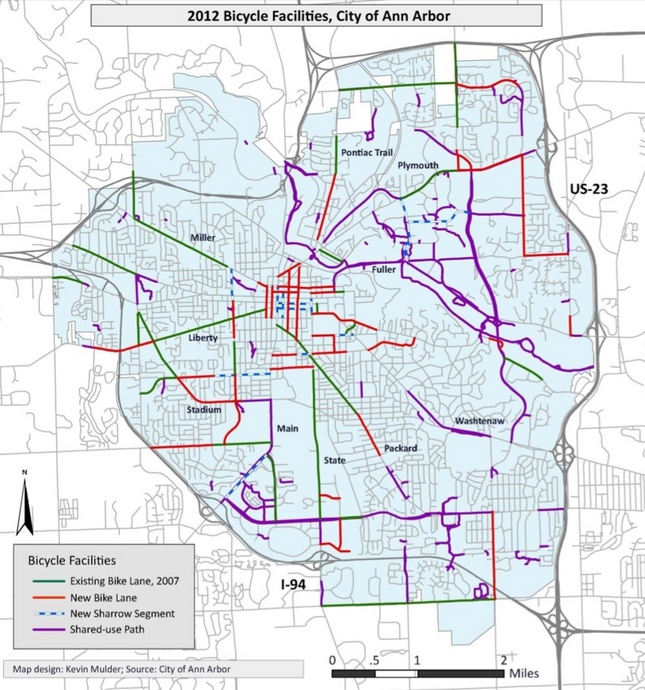
Ann Arbor officials are using this map to demonstrate the progress that has been made since 2007 on adding bike lanes and shared-use arrows and paths in the city.
Courtesy of City of Ann Arbor
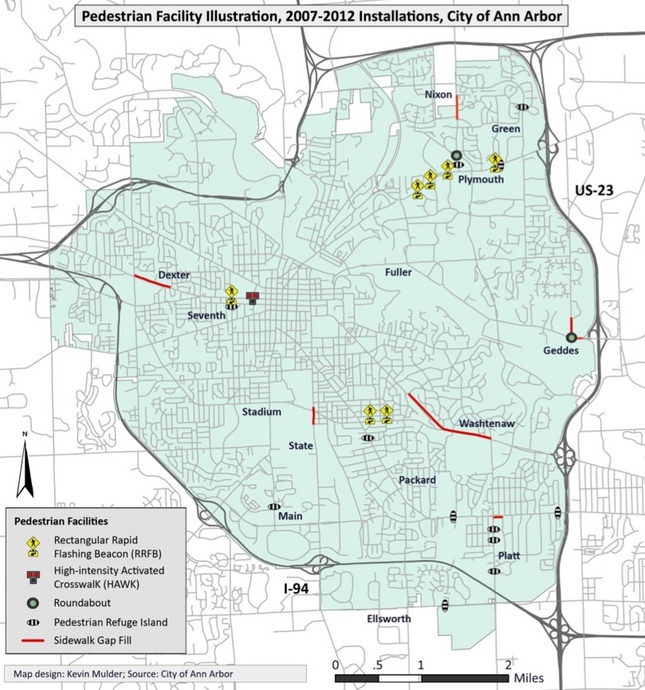
The city also built 12 pedestrian refuge islands, filled nearly three miles of gaps in the city's sidewalk system, and added shared-use arrows to 5.8 miles of roads.
Those figures were relayed in a progress report that Eli Cooper, the city's transportation program manager, delivered to the Ann Arbor City Council Monday night.
Cooper's report comes as the city is in the process of updating its 2007 Non-Motorized Transportation Plan, which is focused on creating a safe environment for bicycling and walking in Ann Arbor.
Five years after its implementation, city officials are reviewing and updating the plan and looking for new ways to improve the walking and biking experience.
Courtesy of City of Ann Arbor
Cooper said there have been substantial changes in the way non-motorized systems are addressed, and a number of new concepts have emerged in more recent years.
Many bike-friendly cities have focused on developing "bike boulevards," which are streets intended primarily for bikers and walkers, and "cycle tracks," which are buffered bike lanes.
"These are the kinds of things we have really just begun to look at to see which ones are implementable," Cooper said.
Cooper also said the city is working with the Clean Energy Coalition and University of Michigan to potentially bring a bike sharing system to Ann Arbor next year. He referenced the B-cycle program that has become popular in many cities throughout the country.
Cooper acknowledged the city's non-motorized plan has been overly ambitious from the start, and there's simply not enough funding to meet every goal.
"When we looked at the 120 recommended crosswalks and the 50 miles of bike lanes, it was in the order of $10 million worth of improvements on just those elements," he said. "And so I think it's important to note that with all this progress, the plan is ambitious and expects us to do more."
Cooper said additional funding would be needed to fill more sidewalk gaps or install wayfinding signs to help bicyclists get around town. In five years, he said, the city has filled only 2.9 miles of the 25 miles of sidewalk gaps identified in the original non-motorized plan.
"It would be interesting to know what the city's interest is in ramping up investment in this area in order to make more progress," Cooper told council members Monday night.
Five of the council's 11 members were in attendance. Absent were Carsten Hohnke, Christopher Taylor, Margie Teall, Sandi Smith, Jane Lumm and Tony Derezinski.
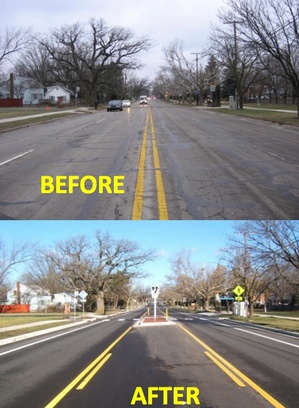
So-called "road diets" are another part of the non-motorized plan. Such diets can involve lane reductions and additions of bike lanes and crosswalks with pedestrian islands. Here the city gives an example of a road diet on Platt Road. Jackson Avenue could be next.
Courtesy of City of Ann Arbor
"There wouldn't be general fund money going in that direction," he said. "That money is going to be needed to pay for basic things like police and fire."
Hieftje said the city has been able to use state gas tax money for alternative transportation projects, and that will continue to happen.
"But we're certainly always looking for other opportunities," he said.
Council Member Stephen Kunselman, D-3rd Ward, said it's hard to say where the city might be able to find more funding. But if he's faced with a choice between putting city dollars toward either non-motorized transportation or public safety, he said, the latter wins.
Cooper said the non-motorized plan isn't just about walking and biking — it's also about addressing larger issues like traffic congestion and pollution.
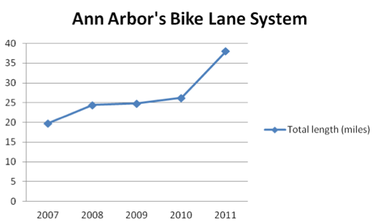
When the non-motorized plan was adopted in 2007, Cooper said, the city had "18 miles of scattered, non-connected bicycle lanes that were ideas that were the beginning of a system." He said the downtown had virtually no bicycle facilities, but that's changing.
"Over the six or seven years that I've been in town, there's a noticeable increase in the number of bicycles that I see every time I'm out on our streets," Cooper added. "So we're really seeing significant increases in the reliance on these means of transportation."
Cooper reminded council members of the city's pedestrian safety ordinance, which was first approved in 2010 and later amended. It's aimed at getting motorists to stop for pedestrians at crosswalks.
"That fits within the framework and was actually recommended within our plan," Cooper said, suggesting the ordinance has helped level the playing field for pedestrians and motorists.
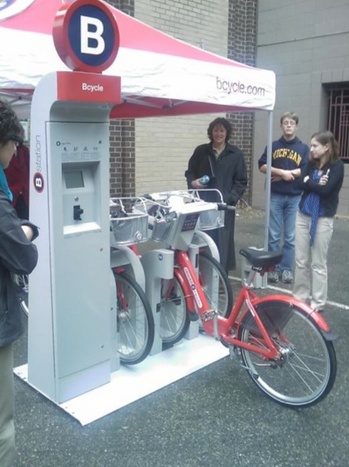
Here's what a bike sharing system could look like in Ann Arbor. As explained on the B-cycle website: "B-cycles are there when you want one and gone when you don't. Just swipe your card, grab a bike, and get to where you’re going."
Courtesy of City of Ann Arbor
Council Member Marcia Higgins, D-4th Ward, said she appreciates the progress the city has made.
"On pedestrian islands, in particular where we've used the flashing beacons, I like those a lot because it alerts me as a driver that I need to be preparing to stop," she said. "You can see it for a distance."
Cooper said targeted enforcement efforts by the Ann Arbor Police Department have helped make the community aware of the city's rules.
"I can tell you that there has been a dramatic change in the behavior at crosswalks resulting from targeted enforcement exercises," he said.
He said the city could get more creative, too. He pointed to one city where police have used a bunny costume to grab motorists' attention and get them to stop at crosswalks.
"These are the creative ideas we can incorporate into the plan if that's the direction we as a community want to go in," he said.
Council Member Mike Anglin, D-5th Ward, said he thinks the city needs to focus on more educational outreach and not punitive enforcement.
"I think there's more goodwill developing between cyclists and motorists," he said. "There's 'thank you for letting me go' — that hand signal seems to be more prevalent."
So-called "road diets" are another part of the non-motorized plan. Such diets can involve lane reductions and additions of bike lanes and crosswalks with pedestrian islands.
"Our plan calls for many of them," Cooper said. "As a matter of fact, at last count we have implemented 10 road diets in different parts of the city over the past five years."
One of the next roads the city is hoping to place on a diet is Jackson Avenue, where the city wants to have a portion reduced from four to three lanes to add bike lanes and possibly new crossings.
The city plans to continue work on updating the non-motorized plan throughout the fall, including more public input and review, with adoption in early 2013.
Courtesy of City of Ann Arbor
Ryan J. Stanton covers government and politics for AnnArbor.com. Reach him at ryanstanton@annarbor.com or 734-623-2529. You also can follow him on Twitter or subscribe to AnnArbor.com's email newsletters.
Comments
15crown00
Sat, Oct 13, 2012 : 5:40 p.m.
maybe it should be first things first.i'm thinking of more cops,more fireman and fix roads.
Steve
Wed, Oct 10, 2012 : 10:45 p.m.
@YpsiLivin I'm guessing you don't commute on your bike very often. The few times I took up a lane and prevented someone from making a right on the red I was greeted with a lovely rendition of 'leaning on the horn'. The driver apparently expecting me to pick up my bike and move to the sidewalk. The truth is that cyclists (and to some degree motorcyclists) are not treated the same way on the road. Too often drivers don't see us and when they do, they'll happily put our lives at risk to save 2 seconds on their commute.
Steve
Wed, Oct 10, 2012 : 10:03 p.m.
I have a question for my fellow Ann Arborites: why speed past a cyclist even when they're going downhill at 28 in a 25 zone? Why do you get so (often audibly) upset when a cyclist switches (legally) to the sidewalk and crosses an intersection?
Radlib2
Wed, Oct 10, 2012 : 3:26 p.m.
I' m against the proposed Jackson Road "diet." even though I'm an avid cyclist, one who has a general disdain for the notion of internal combustion and lives close to Jackson, those changes are unnecessary, as their are far better ways to get to town, like Washington/liberty/Miller, that are perfect for bikes. On Jackson, the traffic is dense, denser than most roads in the county. I do not want bike infrastructure projects to be stifled because of an unpopular change, which it's sure to be. Use that money one where ese!
Brian Kuehn
Wed, Oct 10, 2012 : 11:13 p.m.
Agreed. Don't put roads on a "diet" if it will adversely affect auto traffic AND there are reasonable alternate routes. When I bike to downtown I do not mind taking a somewhat longer route to avoid heavily used roads.
Sandra Samons
Wed, Oct 10, 2012 : 3:04 p.m.
I like the pedestrian islands but when is the city going to get around to painting the curbs around them white? When driving at night it's easy to see the sign indicating that an island is there, but not so easy to see the borders of it, especially in dimly lighted areas.
Frustrated in A2
Wed, Oct 10, 2012 : 4:08 a.m.
"Road Diet". All I can say is dumb. Put an option on the poll that says leave the streets as is. Or take away some of the "road diets". As long as the vehicles, bikers and pedestrians obey the current laws and look out for one another we'll all be ok. Why does Ann Arbor always try to copy an idea from another city, be original on some stuff. And what works in a city of 800,000 doesn't always come with success in a city of 114,000.
Ron Granger
Wed, Oct 10, 2012 : 1:27 p.m.
"Why does Ann Arbor always try to copy an idea from another city, be original on some stuff. " Where possible, you do what works and is proven. Otherwise you'd have people complaining that "nobody else does this! why is ann arbor the only one!"
Landshaper
Wed, Oct 10, 2012 : 12:08 a.m.
Gas tax is paid by cars for roads for CARS! Non-motorized path users need to quit useing our road funds. Snowmobiles pay for trails, boats pay for lakes RV's pay for campgrounds, passengers pay for airports. Bike's need a tax to pay for "special" places to ride.
Ron Granger
Wed, Oct 10, 2012 : 1:27 p.m.
CARS don't pay for roads, people do.
Radlib2
Wed, Oct 10, 2012 : 5:12 a.m.
In 2006, the gas tax brought $928 million th sate, however, expenditures for road and bridge upkeep was mor thn $3 billion. As a comparison, only $158 million was spent on public transportation. Don't forget the $42 million the city spent on roads and parking last year. It seems to me that roads are subsidized by everyone, or at least those that pay taxes.
Tru2Blu76
Tue, Oct 9, 2012 : 10:28 p.m.
Please, everyone, look at the freeway interchanges on the first map. If you do, you'll quickly notice there is not a single bike-safe passage across ANY one of them. If anyone doesn't think this is a deadly gap for cyclists: they should simply try crossing any of those freeway interchanges. This is a lingering example of roads designed ONLY for motor vehicles. The key here is to see that, in most cases, there is NO way in or out of town at these points for cyclists to use. And they're all major in/out arteries. Is it part of "The Plan" to address this situation?
15crown00
Sat, Oct 13, 2012 : 5:42 p.m.
you don't belong on or near freeways so whats your point?
Brian Kuehn
Wed, Oct 10, 2012 : 11:16 p.m.
I believe there is a pedestrian/bike bridge at Geddes, also. Some of the maps I have accessed seem to be out of date.
FredMax
Tue, Oct 9, 2012 : 11:37 p.m.
The map seems inaccurate. Scio Church parallels a dedicated bike bridge. Liberty also has a bike path over I94.
Myles
Tue, Oct 9, 2012 : 8:18 p.m.
So that's why Platt road is so congested and irritating?
Ron Granger
Tue, Oct 9, 2012 : 9:23 p.m.
It is a residential street. Not a highway. Not a racetrack.
demistify
Tue, Oct 9, 2012 : 7:33 p.m.
The "road diet" fable reminds me of an old German folk tale: A peasant decided that he would be better off if he did not have to spend on feed for his horse. He had the brilliant idea that if he gradually decreased the amount of food he gave the horse, he could ultimately accustom it to do without. The experiment went very well for 2-3 weeks. But then, unaccountably, the horse died.
Tru2Blu76
Tue, Oct 9, 2012 : 8:52 p.m.
That's exactly the point and a good one: car travel will die out completely within our lifetimes (a fact, not a fable), so why not put cars on the diet that'll "fit" their usefulness in the not-too-distant future? :-)
NUXI
Tue, Oct 9, 2012 : 7:13 p.m.
Stone School Road is in drastic need of sidewalks and sidewalk repair. 1. On the west side of the street about half of the distance from Eisenhower to I-96 lacks a sidewalk despite two bus stops being located in that stretch of road. (about 350 meters) 2. From the far side of the bridge to Ellsworth lacks a sidewalk and also contains bus stops. (about 650 meters) 3. The east side of the street from Packard to Eisenhower lacks a sidewalk. (about 300 meters) 4. The west side of the street from Packard to Eisenhower has the most laughable sidewalk in existance. (200 meters) Stone School road is only 2,000m long from Packard to Ellsworth. So out of the 4,000 meters of sidewalks that should exist we are completely missing 1,300 meters of it and another 200m can barely be called a sidewalk. Thats nearly half of the distance.
jim
Tue, Oct 9, 2012 : 6:33 p.m.
These articles always make me think of the old cartoon about "Cars of Tomorrow." One of the cars had an extra wide bumper in case pedestrians tried to get out of your way, and a glass floor so you could see if the pedestrian you just ran over was a friend of yours.
Tru2Blu76
Tue, Oct 9, 2012 : 8:50 p.m.
Good point: the assumptions of those who think cars will even be here "tomorrow" are neatly highlighted and debunked. :-)
John of Saline
Tue, Oct 9, 2012 : 7:58 p.m.
I'd buy that car. (Kidding....)
Macabre Sunset
Tue, Oct 9, 2012 : 5:02 p.m.
Nice that the city continues to spend millions to support the hobby of a just a few. Meanwhile, if Michigan actually ever pulls out of this recession with real growth, like it has with every past recession, this habit of removing roads for bike lanes will cause new problems. It's too bad we can't vote on bike lanes and road reductions.
15crown00
Sat, Oct 13, 2012 : 5:46 p.m.
cops,firemen,roads first.then sidewalks.then if there is money left the bicyclists get their paths for their hobby.
Joe
Tue, Oct 9, 2012 : 11:17 p.m.
As a cyclist, I'm tired of supporting your driving hobby.
Tru2Blu76
Tue, Oct 9, 2012 : 8:55 p.m.
Cycling isn't just a hobby, it's essential and a great cost-avoidance method - for rich and poor alike. And besides, today's "hobby" is demonstrably going to become tomorrow's ESSENTIAL MODE of transport. Short-sightedness isn't going to increase your reputation for self-education or wisdom one bit. ;-)
Ricebrnr
Tue, Oct 9, 2012 : 7:18 p.m.
yah I gotta go with Phil on this one. So poor people that can't afford a car, or can't depend on "mass transit" should just deal with it? Wow, I've gotten the completely wrong impression of you all this time.
Phillip Farber
Tue, Oct 9, 2012 : 5:55 p.m.
Right. My "hobby" is getting to and from my job, 5 days a week.
Richard Carter
Tue, Oct 9, 2012 : 4:43 p.m.
Every time a bicycle discussion comes up, there's a lot of discussion of what's legal and illegal. annarbor.com could do a great service by getting some legal experts (police, lawyers, etc.) to look through and make some of the legalities/illegalities clear. I always thought it was perfectly legal to go past a bunch of stopped cars on the right and then go straight (when I'm a driver, it's potentially annoying, but no more so than a pedestrian waiting to walk straight across). However, maybe it is illegal -- I'd love to know. Certainly it'd be legal where there's a separate right-side bike lane, but when there're no lane markings or it's a standard two-lane street... I'd LOVE to know for sure. A lot of the hostility between drivers, cyclists, and pedestrians seems to be "I think it's illegal / I think it's legal" disagreements. And, sure enough, probably all of us have encountered some rare pathological case where we suddenly have no idea who has the right of way (wish I could think of one offhand but I know I, who actually read up on this stuff, get flummoxed every year or two).
NUXI
Tue, Oct 9, 2012 : 11:46 p.m.
> always thought it was perfectly legal to go past a bunch of stopped cars on the right and then go straight You know how drivers are supposed to pass by going all the way into the other lane because legally your bike occupies the full width of the lane? Now put 2 and 2 together ;) Squeezing past a row of stopped cars on the right is illegal (and dangerous)
YpsiLivin
Tue, Oct 9, 2012 : 10:15 p.m.
Richard, Not only is it illegal to ride up on the right side of a line of cars in the right lane (and annoying, as you yourself point out), it's dangerous to both the bicyclist and the drivers. It's a very good way for a cyclist to get himself hurt and to cause an otherwise completely avoidable accident. Section 257.660a A person operating a bicycle upon a highway or street at less than the existing speed of traffic shall ride as close as practicable to the right-hand curb or edge of the roadway except as follows: ... (d) When operating a bicycle in a lane in which the traffic is turning right but the individual intends to go straight through the intersection.
Tru2Blu76
Tue, Oct 9, 2012 : 3:46 p.m.
"These are the creative ideas we can incorporate into the plan if that's the direction we as a community want to go in," –– Eli Cooper That's IF this is the direction the community wants to go in. Well, what about what's really happening - economic forces are actually determining the direction of choice between walking, cycling and motor vehicle driving. Right now, a new car costs 20 to 30 times what a bike costs and things like gas prices inflate and continue the cost of owning a car. Also inflating MV cost is the cost of road building and road maintenance. We are looking at a $20 million dollar bridge just to keep traffic flowing near Michigan Stadium. Meanwhile, due to political trends bringing economic consequences, the average wage and average income levels have either plateaued or declined a bit. Petroleum is a limited, non-renewing resource. Eventually, "rarity" will take over and there'll be no gas-burning vehicles. 1995: Adjusted for inflation, gas prices were averaging $1.35 / gallon. Today that price is at $3.57 (and the actual dollar amount is almost $5.00 / gallon). That's how fast things have been changing: and it all points to a car-less culture and country. A newly licensed driver may see the end of our "car culture" before they reach their 30th birthday. And what should we think will be the most likely replacement for cars? From other areas of the world where cars are already out of reach for the majority - bicycles have proven the transportation method of choice. Bikes - and mass transit. That's where we're headed. Because of this, we have only a piddling $10 million dollar expenditure to consider when it comes to making our streets more "bicycle friendly." Well, things are going to get almost entirely "bicycle friendly" in about 20 years. Ann Arbor isn't Portland, but it's heading in this inevitable direction. Everything else is moot.
MJ
Tue, Oct 9, 2012 : 3:45 p.m.
How about cracking down on the bicyclists riding without lights between dusk and dawn. I am tired of almost being run over by them as they go speeding by me as I walk to the Mitchell field parking lot. Not to mention how are drivers suppose to see them approaching poorly lite driveways and crosswalks? While drlivers need to share the road with bikes, bicylists need to share the sidewalks and crosswalks with pedistrians. Also, when a car in front of them puts a right turn signal on, they need to yield to the vechile turning instead of riding by the car as it is trying to turn.
Tru2Blu76
Tue, Oct 9, 2012 : 10:03 p.m.
Well, how about cracking down on pedestrians who walk about as if sleep walking? And how about cracking down on drivers who think they can cross sidewalks at 15 mph without looking for sidewalk traffic? Where did you get your attitude and your notion that only cyclists are responsible? Oh, I get it now: you were just taking the opportunity to rant. Thanks, I thought you were serious at first. :-)
gladys
Tue, Oct 9, 2012 : 3:30 p.m.
I live off Stone School Rd. and can tell you that the traffic has greatly increased since the "diet road improvement" on Platt Rd. Taking away car lanes on heavily traveled roads is a stupid idea!
Jim Walker
Thu, Oct 11, 2012 : 9:36 p.m.
MDOT had the MSU engineering department do a study for them on prior road diets projects in Michigan. That MSU study said the guideline to consider a road diets project should be reduced from 20,000 ADT to 10,000 and that Michigan should strongly recommend that change to the Federal Highway Department. James C. Walker, National Motorists Association, Ann Arbor, MI
Thaddeus
Wed, Oct 10, 2012 : 12:10 a.m.
Myles - Such a 4-to-3 lane (or in Washtenaw Ave's case a 5-to-3 with bike lanes) conversion wont be done on Washtenaw Ave as traffic volumes are way too high for it. 20K vehicles a day is typically the limit for such conversions. Last I knew traffic volumes on Washtenaw were 40K-70K/ day - stats that are a decade or more old and may very well be low for Washtenaw Ave now.... Analyzing traffic volumes are key in deciding which roadways are good candidates for "road-diets". Washtenaw Ave does not meet the criteria.
Myles
Tue, Oct 9, 2012 : 8:21 p.m.
I completely agree. It is very stupid. They might as well reduce washtenaw ave to 2 lanes with one center lane.
Jim Walker
Tue, Oct 9, 2012 : 4:07 p.m.
Diversion to avoid reduced capacity on road diets streets is normal. But officialdom can survey the results on only the road diets streets and proclaim victory, with no data on what happened on the other streets where traffic diverted. James C. Walker, National Motorists Association, Ann Arbor, MI
DeeAA
Tue, Oct 9, 2012 : 3:06 p.m.
I just recently was in Boulder, CO, for a week. There are many people there who ride bikes even though there are many hills. Most streets have a very bike and car-friendly lance arrangement. There are two lanes for cars, one in each direction. There is one lane on one side for cars to park, clearly marked. AND there are two bike lanes, clearly marked, one in each direction on each side. The bike lanes look to be wider than ours, probably half the width of a regular car lane. Unless it's a very wide street, there is not a separate turn lane for cars in the middle. On campus, there are very wide sidewalks with three lanes: one for pedestrians and two others, clearly marked for bicycles, one in each direction on each side. Ann Arbor should study what Boulder has done, especially as to the width and placement of lanes. It functions very well. In comparison, our bike lanes seem pretty narrow and not consistently placed.
DeeAA
Tue, Oct 9, 2012 : 3:08 p.m.
Sorry for the type. That's "lane" not "lance."
golfer
Tue, Oct 9, 2012 : 2:57 p.m.
i think they should fix what they started. you have crosswalks without blinking lights. take stadium blvd. still people stop on the left and cars go right on by on the right. you fix them first before you start something else. sorry but that is common sense. like starting a job and leaving before it is done. SAFETY COMES FIRST. bike sharing is so far done the list of things. finish the blinking lights at crosswalks first all of them!
Ron Granger
Tue, Oct 9, 2012 : 9:27 p.m.
Fortunately, we aren't stuck doing things one thing at a time. If that were the case, nothing would ever get done because there would always be something more important.
MRunner73
Tue, Oct 9, 2012 : 2:14 p.m.
No more bike lanes at the expense of lane reductions. Traffic volumes are too high these days. I thought there was a spike in traffic volumes in the fall on football Saturday but it seems the volume of traffic is just as high any other day. Keep Jackson Ave at 4 lanes.
Gardener1
Tue, Oct 9, 2012 : 2:14 p.m.
They need to have Jaywalking laws and enforce them.
GoNavy
Tue, Oct 9, 2012 : 2:35 p.m.
Yep, I support enforcing that. I also support enforcing laws against motorists who stop past the indicated stop lines (so they can "see better"), including motorists who pull into cross walks while attempting to make a right on red. I also would like to see enforcement actions against motorists who do not come to a complete and full stop when traffic signs and signals so indicate. So, a net-net positive for all when laws are enforced.
Jack Campbell
Tue, Oct 9, 2012 : 2:01 p.m.
We don't have enough policeman to be talking about spending money on junk like this. Roads are for cars first and bikes second. The motorized transit in A2 sucks, roads are in horrible condition and the stoplights where optimized by either a 3 year old or a goat. Lets focus on what most of us do on roads, drive cars.
Ron Granger
Tue, Oct 9, 2012 : 9:31 p.m.
People pay for the roads. Cars don't pay for the roads. How many police"man" would we need before we could spend money on "junk like this? We just built a parking structure for cars at a cost of $70,000 per space. And you think we aren't spending enough on cars? Feeling entitled doesn't make you entitled. Just because you climbed into a car does not make you more important than anyone else.
GoNavy
Tue, Oct 9, 2012 : 1:56 p.m.
As we expand bicycle lanes, we need to seriously consider an ordinance to take bicycles off of sidewalks, as it is in the city of Chicago.
Steve
Wed, Oct 10, 2012 : 10:24 p.m.
I'd support this. In the meantime I'm going to continue switching between the road and sidewalk to maximize safety.
Joe
Tue, Oct 9, 2012 : 11:13 p.m.
Bikes do not belong on sidewalks, but many people, myself included, feel that an outright restriction is not the best solution, since it scares some people away from biking entirely. Anything that discourages cycling has a negative impact on public safety.
Andy Price
Tue, Oct 9, 2012 : 7:52 p.m.
I ride a bike, and I totally agree with this. Bikes off the sidewalks!
Vince Caruso
Tue, Oct 9, 2012 : 1:52 p.m.
An east west route through the downtown is a major gap in this effort. We would have many more bikers from the west side going into town and the UM if we had this. We ride it all the time but It is currently way to dangerous and uninviting and that needs to change. Getting Doored or hit by a car is way to common. A form of a bike boulevard, used very effectively in other communities, on Washington or Liberty is needed. The staff are coming around now we need the political will, which always seems the last to come. KJMClark also makes some good points. Ultra low cost high return compared to the $70k! parking spots we keep building.
Richard Carter
Tue, Oct 9, 2012 : 5 p.m.
I've not done it myself, but I know several people who ride through Gallup Park and The Arb to go east-west on the east side of town.
GoNavy
Tue, Oct 9, 2012 : 1:59 p.m.
I would speculate that one reason there isn't an obvious "East-West" route through the city is that the city is constrained on the eastern end by the Arboretum and the Huron River. Hill is one obvious east-west route that can be taken as it is far enough south to not be affected by the geography described above. Huron street is less acceptable, though still a major throughway.
EyeHeartA2
Tue, Oct 9, 2012 : 1:50 p.m.
Regarding the poll; We have four choices, all supporting this. The complete fail choice essentially means "do more". Really, is this like Cuba? You get to vote for whatever you want, as long is it is for the party? How about - Enough is enough, we are good?
EyeHeartA2
Tue, Oct 9, 2012 : 5:28 p.m.
I'm just asking the writer of the poll to give us real choices in the poll. I don't expect him to actually implement policy, so your comment makes no sense at all. Of course you knew that when you wrote it.
Richard Carter
Tue, Oct 9, 2012 : 4:59 p.m.
Run for election, or find someone who shares your views who will.
Brad
Tue, Oct 9, 2012 : 1:45 p.m.
Marcia Higgins in, Margie Teall out. Do other wards also have "tag team" representation like we have in the 4th?
G. Orwell
Tue, Oct 9, 2012 : 1:37 p.m.
I, like many people in AA, do not mind the addition of bike lanes and walkways (other than the death crosswalks) as long as they do not sacrifice driving automobiles. Particularly since vast majority of the people want and have to drive automobiles. Unfortunately, with the agenda in place, driving will become more and more difficult. The agenda is to MAKE people take public transportation, bike and/or walk. Even if it is not the will of the people.
Myles
Tue, Oct 9, 2012 : 8:24 p.m.
If that's the idea then I'm moving lol
Rugeirn Drienborough
Tue, Oct 9, 2012 : 1:29 p.m.
Wow. 57 feet of new bike path per day.
jcj
Tue, Oct 9, 2012 : 1:27 p.m.
Problem - No controversial articles for a few days Solution - Throw together something mentioning bikes and crosswalks
xmo
Tue, Oct 9, 2012 : 1:05 p.m.
"the city of Ann Arbor has added 19.7 miles of bike lanes to its streets......filled nearly three miles of gaps in the city's sidewalk system" I don't have a bike, don't want a bike because it gives off "GREEN HOUSE GASES" when I pedal. Why is the city catering to the bike crowd and not the walkers?
Tru2Blu76
Tue, Oct 9, 2012 : 9:47 p.m.
Maybe the city "caters to" cyclists because of your example: walkers produce as much or more "green house gas) as cyclists but EITHER mode produces a minuscule amount compared to car and truck engines. Besides: a bike rider is about 3X more efficient in getting around compared to pedestrians (which is why Mankind sought other means of transport from the beginning). :-)
Rugeirn Drienborough
Tue, Oct 9, 2012 : 1:30 p.m.
Maybe there's a few too many beans involved?
Plubius
Tue, Oct 9, 2012 : 1 p.m.
"Road diets" are proof that the engineers in the bottom decile of their class become traffic engineers. One of the stupidest ideas ever - restricting the flow of commerce for most to help assuage the fears of a few.
crayzee
Tue, Oct 9, 2012 : 4:50 p.m.
To Ponycar's comment - I've driven on all of the "dieted" roads around here and never had a problem with traffic flow (certainly no worse than it was before the diet). I think the traffic flow problems we have in Ann Arbor are almost wholly related to poor timing of traffic lights, not street capacities. In my daily commute across town, it's not uncommon to spend up to 1/3 of my travel time waiting at lights. And many times I'm the only car trapped there. Which is why when I am out biking, I will ignore a traffic light if it is one of the "Ann Arbor Specials" - red for no reason.
Ponycar
Tue, Oct 9, 2012 : 2:59 p.m.
I'm not surprised that road diets reduce accidents since they slow traffic to a crawl. I would love to see the logic behind how narrowing Jackson Rd. to one lane each way will improve traffic flow. That just sounds silly or biased in favor of "dieting". That area currently backs up past Worden during rush hour with TWO lanes each way. How does reducing the number of lanes allow for more traffic flow? Maybe because people are trying to find alternate routes through neighborhood streets.
Brad
Tue, Oct 9, 2012 : 1:43 p.m.
Road diets save lives? So would decreasing the speed limit to 2MPH. But it's all about striking a reasonable balance, and many feel that road diets address a largely nonexistent problem.
Paul A.
Tue, Oct 9, 2012 : 1:39 p.m.
You might want to check the report from 7 "road diet" sites in Minnesota in 2007 which said in part "...statistical analysis of total crashes, consistent decreases in the total crashes were observed after the road diet conversions at all seven sites for which crash data were available. The range of Empirical Bayes crash reductions between the seven sites varied from 37.3 to 54.3 percent, with an overall total crash reduction of 44.2 percent (408 crashes reduced). Crashes were also analyzed by injury status (injury vs. non-injury) and type (rear end, right angle, and left turn) using a Grouped Comparison procedure, which showed a net reduction in crashes after the conversions for non-injury and right angle crashes, with crash reductions of 45.7 and 37.0 percent, respectively". (www.cmfclearinghouse.org/study_detail.cfm?stid=68) Counter intuitive, but I think if you checked on the results of the Platt Rd "road diet" for example, you would find the same. An added benefit, beyond the reduction in accidents, is an actual improvement in automotive "through time" as reported by most car users of roads that have installed them.
Ron Granger
Tue, Oct 9, 2012 : 1:32 p.m.
Ah yes - the flow of commerce. Certainly, that is more important than human life. Road diets save lives. http://www.annarbor.com/news/ann-arbor-officials-pushing-for-conversion-of-jackson-avenue-from-4-to-3-lanes/ East of Maple Road, Jackson has four narrow traffic lanes that measure about 10 feet wide each, said Homayoon Pirooz, head of the city's project management unit. Pirooz said four-lanes roads were common many years ago, but over the years traffic engineers have found out that it's not the safest arrangement. He used the example of Platt Road, which the city converted from four to three lanes from Packard to Ellsworth. Prior to the changes, he said, there were 20 to 30 accidents per year, but now in the last two years it's down to six or seven. He recalled there were a lot of concerns about the conversion at the time, but it has worked out.
lugemachine
Tue, Oct 9, 2012 : 12:58 p.m.
One road-diet byproduct that's pretty scary is Division north of William. They added a bike lane, but retained three (narrower) traffic lanes. The left lane forces you to drive perilously close to parked cars. Cars emerging from the new structure have virtually no line-of-sight to the right. To top it off, the street took a serious hit from all the construction trucks coming and going during the underground structure project. Why was Fifth resurfaced, but Division left with massive ruts and dips?
Tru2Blu76
Tue, Oct 9, 2012 : 9:41 p.m.
The underlying cause might be: all roads combined represent the effort to provide infrastructure for a country that currently depends 98% on car travel. That cost goes up as population increases demand and already finite resources (like asphalt) diminish (more rapidly). The bottom line is a demand / supply equation: when the materials supporting car travel diminish (as they inevitably will), the infrastructure becomes progressively degraded. Government officials then "recognize reality" and act accordingly. You'll see more and more of these mystifying compromises: until bicycle travel becomes the travel tool of choice for as little as 20% of the public. Then the ultimate solution becomes: building roads, bridges, overpasses and roundabouts - exclusively for bicycles. It's already happening in several European countries. People are fooled by the current (massive) support of fossil fuel burning transportation. It'll take less time than most people realize for bicycles to become the wiser choice for everyday transportation needs. People seem to think the automobile is a permanent thing: it took LESS than 20 years for cars to replace horses - starting from ZERO CARS and millions of horses. Massive petroleum deposits were discovered in the Arctic Ocean: but few people stop to realize: the poles are literally the Ends of the Earth. That's where we're at in terms of "accessible oil" and that "access" gets more expensive with each passing year. So, in the interim: I'd expect to see more scary compromises like the one you describe. But, the bright spot is that the faster people adopt bicycles for travel, the faster we'll get bicycle-only infrastructure (because costs are 95% LESS overall).
a2cents
Tue, Oct 9, 2012 : 3:05 p.m.
Meanwhile, the bikelane on Fifth across from the library near William is less than the mandated 5' width (before cars park far from the curb). Again ca-parking is supreme.
GoNavy
Tue, Oct 9, 2012 : 2:02 p.m.
Well stated on the danger of emerging from the new structure. I'm a parker there and regularly pull on to Division; I have to first search for pedestrians when crossing the gate, then try and peer over the parked cars to see if there are any cars speeding down the left lane (Division is 25 mph but you certainly wouldn't know it by observing actual speeds). I feel that one of the most obvious solutions would be to remove many of those street spots that are just to the right of the Library Lane/Division street exit, in order to increase visibility.
Brad
Tue, Oct 9, 2012 : 1:08 p.m.
It isn't scary, it's pure insanity. But the DDA just had to have those meters on the left side of Division (lest they miss out on a dollar), so if a cyclist or two has to get "doored" for the greater good then so be it.
EyeHeartA2
Tue, Oct 9, 2012 : 12:48 p.m.
"Council Member Stephen Kunselman, D-3rd Ward, said it's hard to say where the city might be able to find more funding. But if he's faced with a choice between putting city dollars toward either non-motorized transportation or public safety, he said, the latter wins." Wait, what? A voice of reason from somebody other than Jane Lumm? I almost spit out my coffee.
Brad
Tue, Oct 9, 2012 : 1:06 p.m.
Nice line but it's a false choice because if he's faced with a choice between public safety and lame public art, the latter will win.
DDOT1962
Tue, Oct 9, 2012 : 12:48 p.m.
Here's a question I'd like answered: Ann Arbor just did a major resurfacing of Packard between Carpenter and Platt. Why didn't they include painted bike lanes as part of this project? Packard is a major artery that gets significant commuter usage. It would have been great if they'd included space for those of us wanting to bike into work...:O(
Joe
Tue, Oct 9, 2012 : 11:09 p.m.
Packard is incredibly wide, with plenty of space on either side, since most development is set way back from the road. Nonetheless, it's an alright road to bike down. It slows down drivers, which is unfortunate for them, but I guess that's just the way it will be until bike lanes are added.
foobar417
Tue, Oct 9, 2012 : 7:58 p.m.
Although I too would have preferred bike lanes, presumably the traffic count is 20k+, not 20k or less, as noted during the Jackson discussion.
Brad
Tue, Oct 9, 2012 : 7:47 p.m.
@a2migrl - Hey - don't give them any ideas on that road diet!
a2migrl
Tue, Oct 9, 2012 : 7:34 p.m.
I am surpirsed that they didn't use the '"road diet" for this section of road. It makes sense according to the logic of doing this to other roads in the city. The did this on Packard between Jewett and Stadium. Why not the entire length?
MRunner73
Tue, Oct 9, 2012 : 2:53 p.m.
Let's put bike lanes on I-94 and US -23.
Ryan J. Stanton
Tue, Oct 9, 2012 : 1:12 p.m.
City officials said there's not enough width to add bike lanes there.
Ghost of Tom Joad
Tue, Oct 9, 2012 : 12:44 p.m.
you should really use air quotes while using the phrase "bike lanes" when you refer to what the city has implemented. Drawing a stick figure of a bicyclist in the middle of the street does not constitute making a bike lane. The efforts from this city have done nothing but make driving/biking/walking more dangerous in this city.
aabikes
Tue, Oct 9, 2012 : 12:35 p.m.
What an improvement over the last five years. Definitely see more bikes out and about, and feel much more safe and friendly interacting with drivers. Bravo!
J
Tue, Oct 9, 2012 : 12:15 p.m.
Slightly off-topic: I so wish I could have snapped a photo of a Honda Odyssey with a "Share The Road" bumper sticker driving right down the bike lane on 7th.
Peter Eckstein
Tue, Oct 9, 2012 : 12:14 p.m.
I wish there were as much energy devoted to a Motorized Transportation plan--for the vast majority of us who still drive cars--as there is to non-motorized transportation. "Road diets" may be great for bicyclists, but it is getting harder and harder to drive in Ann Arbor, and that needs serious attention. If we are going to "Reimagine Washtenaw," especially, let's get some experts in who can find ways to improve the flow of motorized traffic. Rather than have cops in bunny costumes at pedestrian crosswalks, how about repainting the many ones that are harder and harder for motorists to see.
Joe
Tue, Oct 9, 2012 : 11:05 p.m.
The percentage of transportation money that goes to personal motorized traffic is higher than the percentage of Americans who primarily use personal motorized transportation. Yet you think that there's not enough "energy" going towards making driving a car as easy as possible, at the expense of everyone's safety and health. Non-motorized transportation benefits everyone, including those who use motorized transportation.
a2cents
Tue, Oct 9, 2012 : 2:58 p.m.
cataract surgery does wonders
Brad
Tue, Oct 9, 2012 : 1:03 p.m.
The city "leadership" is mainly interested in what's currently defined (by outsiders) as "hip", which is living downtown and using non-motorized transportation. Never mind that both involve and interest a small minority of the city residents, they'll still spend disproportionate efforts and resources on them. Why? Because they can.
murphthesurf
Tue, Oct 9, 2012 : 12:13 p.m.
just wondering if the city actually looks at how much use these bike lanes get? if not why not? how much extra (if any) does it cost to build these 'special' lanes? im not a bike rider but if i were i sure as hell woudn't ride it on jackson ave,or any other heavely traveled road for fear of getting creamed by a car or a mirror on a semi-truck!
a2migrl
Tue, Oct 9, 2012 : 7:29 p.m.
They just added bike lanes on Ellsworth between Carpenter and Platt. I noticed the other day they actually have the 'counter' wires across the bike lanes. So they do seem to do that on some roads.
aabikes
Tue, Oct 9, 2012 : 12:33 p.m.
too bad, you're missing out.
Stephen Landes
Tue, Oct 9, 2012 : 12:07 p.m.
We can start by training walkers and bikers! I have noticed many walkers and joggers using the bicycle lanes along Green Rd even though there is a perfectly good sidewalk on at least one side of the road and, doe most of its length, both sides of the road. I have also seen bike riders riding as groups just cruise through stop signs as if they have sone right to reenact the Tour de France in downtown A2. Of course it is standard practice for bike riders to ignore stop signs and pedestrians at intersections and crosswalks. So, alternative transportation folks, get the earphones out of your ears, stop staring at your hand-held devices as you walk through an intersection, wear some sort of reflective clothing in low light conditions (don't assume your dark hoodie and blue jeans are visible just because you can see cars), and obey the nice new lane markers, cross walks, signals, and other devices the City has provided for you.
a2migrl
Tue, Oct 9, 2012 : 7:27 p.m.
I was driving in my neighborhood over the weekend. A father and young daughter (maybe 7 yrs old) were riding bikes in the road. I stopped at the four-way stop when they were still 25 ft from the intersection. I had started to go thru (turning left with my blinker) and the father daughter team blew the stop sign and almost got hit. Now with parents teaching their children that they do not have to obey traffic laws what does that say about the future rider/driver in the city?
ArthGuinness
Tue, Oct 9, 2012 : 2:33 p.m.
Mr. Landes, Yesterday I was coming up to an 4-way stop intersection on my bike. I stopped. The car coming from my left did not. Therefore, all car drivers are bad and all bike riders are good, right? The plural of anecdote is not data.
Ghost of Tom Joad
Tue, Oct 9, 2012 : 12:47 p.m.
@brian, the problem is that most of the people driving cars have simply lost their patience, or have absolutely no idea what they are supposed to do. now this doesn't excuse those who blow through stop signs, or try to scoot in behind the person in front of them out of turn. But I see very few bikers and walkers who actually obey the rules.
Ghost of Tom Joad
Tue, Oct 9, 2012 : 12:46 p.m.
starts slow clap...
Brian Kuehn
Tue, Oct 9, 2012 : 12:42 p.m.
I drive an auto, walk extensively and ride a bicycle. Certainly there are walkers and bikers who ignore common sense or create problems when they ignore the rules of the road. I see many automobile drivers who are equally guilty. The problem does not lie solely with one group or the other and attempting to lay the blame on pedestrians/bikers does nothing to advance the goal of safe coexistance of autos, bikes and walkers.
AAW
Tue, Oct 9, 2012 : 11:52 a.m.
I am little confused about the new pedestrians crosswalks and crosswalks with traffic lights. Are we to stop for the pedestrians no matter which crosswalks are being used? Someone crossed the road this morning at 7am against the light I just barely saw this person, god for bid if the person coming up over the hill did not see them. Just crazy!!
Brad
Tue, Oct 9, 2012 : 7:45 p.m.
You also said "supposed to stop". I'm pretty sure you are *always* supposed to stop for a pedestrian (the alternative being to run them over). Right of way is another thing entirely.
foobar417
Tue, Oct 9, 2012 : 4:01 p.m.
That's why I distinguished between a pedestrian in the crosswalk and a pedestrian waiting at an unsigalized crosswalk.
Jim Walker
Tue, Oct 9, 2012 : 3:59 p.m.
Pedestrians who cross AGAINST the light do not have the legal right of way. Drivers should do everything they can to avoid hitting those lawbreaking pedestrians, but in those cases the pedestrians are at fault. James C. Walker, National Motorists Association, Ann Arbor, MI
Skyjockey43
Tue, Oct 9, 2012 : 2:28 p.m.
Foobar, the crosswalk ordinance only applies to crosswalks without lighted signage. Yes technically pedestrians always have the right of way, but cars can't just stop on a dime when a distracted jaywalking pedestrian walks in front of a car that has a green light (an all too common scenario in this town). Your post and the attitude of this city council is encouraging pedestrians to ignore their responsibility for their own personal safety.
foobar417
Tue, Oct 9, 2012 : 12:28 p.m.
You are driving a car with the potential to kill someone. Drive defensively, yield to pedestrians Yes, you are supposed to stop for pedestrians in any crosswalk or waiting to cross at an unsignalized crosswalk.
dotdash
Tue, Oct 9, 2012 : 11:50 a.m.
Ditto what A2grateful said: sometimes the bike lanes just end abruptly. Geddes Rd would be a great bike route to Gallup, but the lane just ends and it happens to be where it is most dangerous to join the auto traffic on Geddes. It keeps kids and the faint at heart off that route.
mw
Tue, Oct 9, 2012 : 3:18 p.m.
I go down to Gallup that way on my bike quite often, but I almost never take Geddes. Instead, I cut through Ann Arbor Hills (Avon to Devonshire and then through the little park path to the crosswalk across Geddes and into the park). Almost anywhere you want to go in Ann Arbor, there are safer, slow-speed, low-traffic streets to use.
a2grateful
Tue, Oct 9, 2012 : 11:43 a.m.
Unlike the Platt Rd photo above, most of Ann Arbor bike lanes are arbitrary road paintings that are dangerous for cyclists. For example many Ann Arbor bike lanes end before intersections. The lanes abruptly veer into curbs. Follow the bike lane and crash the curb. Additionally, the abrupt lane end leaves bicyclists most vulnerable in intersection traffic paths where most protection is needed. Or, consider the bike lane on Pauline, between Seventh and Stadium: it's a bike graphic painted on the center of the street. Ann Arbor calls this a bike lane? What a joke. Measure the number of miles of safe bike lanes in the city, and you will have a figure 90% less than the total bike lane miles that city statistics indicate. Poor maintenance is a defining issue for our roads, and thus and bike lanes. We already have substantial unspent dedicated road millage money, which is the hallmark of poor management. Why would we add a new folly bucket for "non motorized transportation?" Automobiles drive in bike lanes. Auto driver error or possible malice? Nope. Lane marking paint is worn off most off Ann Arbor roads, for cars and bikes, alike. Between poor lane markings and pot-hole dodges, who knows where to drive anymore? However, the greatest problem facing cyclists in Ann Arbor has nothing to do with bike lanes: Mother Nature. The fall, winter, and spring months dissuade most cyclists from riding due to wind-chilled temperatures generated by cycling, slick riding conditions, and low ambient light. I will never support a non-motorized traffic millage here, because there is no integrated, intelligent plan or safety consideration for bicyclists. The horrible integration of bike lanes vehicle traffic leaves everyone frustrated, and cyclists most vulnerable.
Kea
Tue, Oct 9, 2012 : 9:47 p.m.
"most of Ann Arbor bike lanes are arbitrary road paintings that are dangerous for cyclists." For example, that on E University seems to be designed to keep cyclists out of the way of drivers by forcing them to bike dangerously close to parked cars.
golfer
Tue, Oct 9, 2012 : 3:01 p.m.
yup and bikes go into the traffic lanes also. two riders side by side. one will go outside the stripes. so it goes both ways. the smaller the traffic lane and bikes making it smaller is not good. wait until you get snow on the ground.
a2grateful
Tue, Oct 9, 2012 : 2:46 p.m.
You are absolutely correct. In practice, smart cyclists pay little attention to the city's weak ideas of bike lane construction and maintenance, especially when lanes are pothole riddled, and blocked by garbage and recycling containers, sticks, rocks, garbage, and leaves. Yes, many city residents still rake their leaves into the street. As cyclists, we don't crash the curb. But, the bike-lane designers and bike-lane mileage promoters hit the curb with great regularity. Please call their responsible adults to accompany them to the smarter, more truthful place.
Unusual Suspect
Tue, Oct 9, 2012 : 12:13 p.m.
"Follow the bike lane and crash the curb." If you do that, you should not be riding a bike. Or even out in public unaccompanied by a responsible adult.
B2Pilot
Tue, Oct 9, 2012 : 11:31 a.m.
He pointed to one city where "police have used a bunny costume to grab motorists' attention and get them to stop" Only in A2 You can't make this stuff up LOL
B2Pilot
Wed, Oct 10, 2012 : 12:32 a.m.
Eli Cooper our transportation director made the suggestion to City council. He liked the other city that did it. What lucky police officer does he volunteer for that duty?
ArthGuinness
Tue, Oct 9, 2012 : 2:28 p.m.
Only in A2? That happened in *another* city!
brimble
Tue, Oct 9, 2012 : 11:20 a.m.
New cycle lanes are great. As to long-term maintenance of these lanes, that's another challenge. Potholed cycle lanes aren't safe, and poor street surface that inclines cars to drive in bike lanes to avoid potholes is no better. I do wonder whether the City's view is that bicycles are required to follow traffic laws. The common practice certainly seems not to be that they do -- cyclists regularly blaze through stop signs and red lights, among things. The best comprehensive approach is one that makes the roadways safe for all users. Ann Arbor is better than it was, but has a long way to go.
Radlib2
Wed, Oct 10, 2012 : 3:10 p.m.
I don't know if I'm better or not, I do know, however, that in time, laws will be adjusted to account fort he significant differences between cars and bikes. As it is, technically most bike riders break the law. Considering such a great frequency do, one should wonder why we do. Is it that we're all recalcitrant, anarchist, sacofflaws, bent on chaos? Is It that we think we're better somehow becaus our mode of transportation is environmentally benign, doesn't damage the roads, and is terror-free? Not for the most part. In fact, most cyclists have cars. We drive places. We se just how many speed, switch lanes without signaling, come to rolling stops, throw cigarette buts out their windows, text, which if grievously irresponsible, eat while talking on a cellphone, an a host of other infractions. In our view, each of those acts constitute a greater threat to public safety (besides the cig. butts). Everyone focuses on bikers though. We're the bad guys. We're the ones that should be punished, in the view of many, because we have an unfair advantage-- we cheat to get ahead in the "game." It's true, we do cheat a little, bu when we cheat we exposed, so we're sure to do it when, and only when it's safe. When we're wrong, it is us, and only us that get hurt. Of course there are outlying cases where a biker caused, a car to crash and someone got hurt, but those are very rare. Far more bikers have been killed by a negligent driver. People beep at us for no reason, just because hey don't like we're there. It's too bad we can't get along better. As a sidebar, if I were to take the lane when I'm at intersections, and generally act more like a car, I'd actually be more cumbersome and in the way. It I worth noting, moreover, that I'd be taking on more risk of injury.
John of Saline
Tue, Oct 9, 2012 : 6:07 p.m.
Paraphrasing Radlib2: "I'm better than you."
Radlib2
Tue, Oct 9, 2012 : 5:49 p.m.
Forcing bikes to behave as cars is unreasonable. We are nothing like cars. It's hard to accelerate, so coming to full stops is impractical. We pose no risk to cars. Zero. None. We're the ones at risk. Without cars, there wouldn't be stops, or at east not as many. When it's safe to go, we go, irrespective of what the antiquated law says. It is not immoral to run stops, in fact, it behooves us to ignore unjust laws. W live in a auto-centric country. Cars have every advantage. Cars pollute. Wars are fought to secure your precious gasoline. Call the cops if you want, I'll still weave in and out of traffic and roll through stops because I know I'm doing nothing wrong. The cops know it too, which is why they don't care. We pose no risk to public safety.
aanative
Tue, Oct 9, 2012 : 5:27 p.m.
Radlib's behavior and attitude, like that of too many bicyclists, is exactly why I've grown disgusted by bicyclists in Ann Arbor. 'Rules are for others' is a selfish way to conduct one's self. If you're wearing bright or reflective clothing, using hand signals, and obeying traffic LAWS, I'll give you ample room and consideration. If you're wearing dark colors, weaving in and out of traffic, and running signs and signals, I call the cops.
Jim Walker
Tue, Oct 9, 2012 : 3:56 p.m.
Cyclists are required to follow traffic laws in almost every venue in the country. The attitude of Radlib2 is simply wrong. James C. Walker, National Motorists Association, Ann Arbor, MI
Radlib2
Tue, Oct 9, 2012 : 3:42 p.m.
We don't follow laws designed for motor traffic, because guess what? We are not cars! We will ignore stops on side streets because they are there to slow down cars/ prevent them from using them as thoroughfares. We have unincumbered sight lines and and can hear when cars approach. Cars cannot. We approach intersections much slower, and can therefore determine if it's safe. Other states and countries have recognized this and allow for cyclists to treat stops/ red lights as yields. We can stop on a dime. Cars can't. If a car hits someone they die.
motorcycleminer
Tue, Oct 9, 2012 : 11:19 a.m.
Step right up and watch the bubble grow folks ...step right up... High time for the 99% er's ( in this case those who drive cars ) to step up and put the 1 % er's ( those who ride their bicycles, ox carts , or what have you ) in their place ..the wallets of many feeding the fancys of the few.. abject balderdash ....you gotta love OZ....
local
Tue, Oct 9, 2012 : 11:16 a.m.
I am all about bike and pedestrians safety, but it is still a majority of people who come into Ann Arbor for work and entertainment that drive cars. Enforcing laws for all is huge, please keep that in mind as well. But as someone who drives to work in Ann Arbor my biggest concern continues to be extended wait/ travel time in cars. With highly traveled roads having "diets" as they are being called, does nothing to improve wait/ travel time. That, as a car driver, will be the biggest concern for me.
foobar417
Tue, Oct 9, 2012 : 1:29 p.m.
As someone who lives in Ann Arbor, my biggest concern is idiot, self-entitled car drivers racing to work. For example, as happened this morning (and yes, I'm still angry and shaking), there was the driver who passed a slowing down street sweeper in a no-passing zone on Liberty well in excess of the speed limit with no visibility and barely managed to stop in time to avoid hitting a crossing guard and my kids in a crosswalk. (The street sweeper was coming to a stop as legally required.) I'm not saying the previous commenter drives like this. I'm saying there are plenty of drivers that do. And designing streets to impede their ability to act like a lethal weapon is more important than shaving 30 seconds off their commute.
KJMClark
Tue, Oct 9, 2012 : 11:07 a.m.
Geez, five of the best things they could do wouldn't cost a dime. 1) Drop the city ordinance on driving in bike lanes. The UTC the city has adopted already covers that. 2) Get the police to enforce the UTC ordinance against driving in bike lanes. Those are misdemeanor tickets - well worth enforcing. It's not that hard to tell when someone's driving in a bike lane. It happens constantly on Plymouth Road, and I've seen people driving in bike lanes all over town. 3) Tell staff to stop putting sharrows in the door zone. All future sharrows have to be completely outside the door zone, and if that leaves less than 10' of lane, the sharrow should be right in the middle of the usable part of the lane. 4) Update the off-street parking ordinance to require less bike parking, but require 1/3 of the bike parking to be covered bike parking. We need more covered bike parking, not just more hoops out in the rain. 5) Set up assessment districts to put in the sidewalks. The property owners are *supposed* to pay for new sidewalks. Just tell them a few years in advance to pay for the sidewalk or the city will have it built and tack it onto their taxes.
KJMClark
Tue, Oct 9, 2012 : 8:16 p.m.
DennisP - no, the sidewalk millage is primarily to maintain existing sidewalks. I'm well aware of the millage, but it doesn't cover new sidewalks, just repairs. Also, the City *had* a registration requirement - my bike that I use to get to work still has an Ann Arbor registration sticker. They dropped that a few years ago because it wasn't worth the City Clerk's time. I'd be happy to pay based on vehicle weight class, just like my car and truck. The truck is like $75 a year and weighs about 3000 lb. The bike weighs around 30lb, so where should I send my 75¢ per year? Do you really think it would be worth the time to collect that?
NUXI
Tue, Oct 9, 2012 : 7:21 p.m.
Quoting for truth: 2) Get the police to enforce the UTC ordinance against driving in bike lanes. Those are misdemeanor tickets - well worth enforcing. It's not that hard to tell when someone's driving in a bike lane. It happens constantly on Plymouth Road, and I've seen people driving in bike lanes all over town. I drive a fairly narrow vehicle (jeep wrangler) and its amazing just how often someone in a car will try to squeeze past me using the bike lanes. Also gonna gree with another poster. Enforce the crosswalk law. We don't even need extra enforcement really. The city could just try leading by example and having their own employees follow the law when out driving around!
Richard Carter
Tue, Oct 9, 2012 : 4:47 p.m.
@DennisP, I like your general concept... but 10% of the price of the bike is outrageous! If we did that with cars, a car with $20,000 value would pay a $2,000 registration fee! Keep in mind a person on a bike contributes a LOT less to excess pollution, wear and tear on the roads, and takes up a good deal less space.
DennisP
Tue, Oct 9, 2012 : 4:11 p.m.
In 2011, voters in Ann Arbor voted to approve a citywide millage of 0.125 mil for sidewalk repair. This was to replace the assessment system. See: http://www.annarbor.com/news/ann-arbor-street-millage-and-sidewalk-millage-election-results/. This was part of a 2 mil package that included renovations to add bike lanes, etc. Now, you ask that property owners be assessed a fee on top of the tax. I'm assuming you were unaware of the passage of the citywide millage. Given that all property owners are contributing to roads, walks and bike lanes, I would recommend the city now consider licensing and registration of bicycles at a rate that reflects the new emphasis and costs of these programs, protection from theft, covered bike parking, etc. Perhaps, like autos, a registration fee can be charged that is proportional to the cost of the bicycle--something like $10 per $100 purchase price. Those fancy $1000 bikes can bring in a$100 per year alone. Also, I agree, that the UTC should be enforced. All bicyclists that ignore the road signs and lights should be given a ticket and fined. If the UTC doesn't cover ticketing cyclists, then Ann Arbor should adopt a local ordinance applicable to all cyclists over the age of 16--i.e. old enough to learn the rules of the road well enough to be given a auto license.
KJMClark
Tue, Oct 9, 2012 : 11:32 a.m.
For that matter, they could enforce the crosswalk laws at outlying crosswalks. About 1/3 of the motorists either completely ignore the crosswalk up by Arrowwood, or actually speed faster to avoid having to stop for a pedestrian.
deputydwag
Tue, Oct 9, 2012 : 10:34 a.m.
All good things to implement. Please remember that the increase of bikes in the roadways goes the education of the bicyclists that they are subject to the same laws as cars; stop at stop signs, traffic lights, yield to pedestrians, signal when turning, etc. Also, the education of vehicle drivers needs to be included, especially, using the turn signals installed on our vehicles. Also, remember that with the education goes enforcement. That is enforcement for all. I keep waiting for the lawsuit suing the city for discrimination because the police only enforce the traffic laws against operators of cars and trucks, and that the city does not comply with the michigan motor vehicle code that they adopted. We could do all these things and not have to worry about making another list.
Steve
Wed, Oct 10, 2012 : 10:46 p.m.
@YpsiLivin I'm guessing you don't commute on your bike very often. The few times I took up a lane and prevented someone from making a right on the red I was greeted with a lovely rendition of 'leaning on the horn'. The driver apparently expecting me to pick up my bike and move to the sidewalk. The truth is that cyclists (and to some degree motorcyclists) are not treated the same way on the road. Too often drivers don't see us and when they do, they'll happily put our lives at risk to save 2 seconds on their commute.
YpsiLivin
Tue, Oct 9, 2012 : 5:26 p.m.
Sandy, The language of the law is clear. It says, "A person operating a bicycle upon a highway or street ..." The language in this section does not refer to dedicated right-turn lanes. As it says, it refers to "highways and streets." A bicyclist should NEVER ride to the right of a vehicle in the right-hand lane. With regard to points, I said the cyclist *should be* assessed nine points - primarily to illustrate exactly how dangerous that one particular maneuver really is. In general, when I drive my car, I know what I can and should expect from other drivers. In contrast, I NEVER know what to expect from cyclists. Therein lies the problem.
Sandy Castle
Tue, Oct 9, 2012 : 3:27 p.m.
YpsiLivin, Bicyclists are never assessed points on their drivers licenses as bicycle violations are not reported to the Secretary of State. Points are only assessed on motorized vehicles. I believe your citation of state law refers to dedicated right turn lanes where a cyclist is intending to go straight, NOT a lane where cars MAY turn right or go straight.
YpsiLivin
Tue, Oct 9, 2012 : 3 p.m.
Arth, According to state law, bicyclists are to remain on the far right side of the road with several exceptions, listed here: EXCEPTIONS TO FAR RIGHT Section 257.660a A person operating a bicycle upon a highway or street at less than the existing speed of traffic shall ride as close as practicable to the right-hand curb or edge of the roadway except as follows: (a) When overtaking and passing another bicycle or any other vehicle proceeding in the same direction. (b) When preparing to turn left. (c) When conditions make the right-hand edge of the roadway unsafe or reasonably unusable by bicycles, including, but not limited to, surface hazards, an uneven roadway surface, drain openings, debris, parked or moving vehicles or bicycles, pedestrians, animals, or other obstacles, or if the lane is too narrow to permit a vehicle to safely overtake and pass a bicycle. (d) When operating a bicycle in a lane in which the traffic is turning right but the individual intends to go straight through the intersection. (e) When operating a bicycle upon a 1-way highway or street that has 2 or more marked traffic lanes, in which case the individual may ride as near the left-hand curb or edge of that roadway as practicable. As indicated in Section 257:660 (d), when a person on a bicycle intends to go straight through the intersection while in a lane where motorized traffic is turning right, the bicyclist needs to "take the lane" and act like any other vehicle. In other words, it is NEVER correct for a bicyclist to ride along the right side of a line of cars that are stopped in traffic, but waiting to turn right. The bicyclist who intends to go through the intersection must wait in line behind the cars and proceed through the intersection when traffic is clear, just like the driver of a car would do.
ArthGuinness
Tue, Oct 9, 2012 : 2:26 p.m.
Regarding passing on the right to get to the intersection at a red light: I have previously been told this is the correct course of action for a bicyclist. Of course I agree that they shouldn't go *through* the red light, and need to exercise caution with cars turning right.
YpsiLivin
Tue, Oct 9, 2012 : 1:08 p.m.
It bothers me to no end to see a bicyclist with the intention of traveling straight through an intersection ride up the right side of a long line of cars waiting at a red light to make a right turn. This is in no way an unusual circumstance; I see it all the time. Without fail, the bicyclist will proceed through the intersection against a red light when cross-traffic has cleared, even as the driver at the head of the line (who is unaware that a bicyclist has illegally entered his lane) tries to make a right turn. The bicyclist should be cited three points for ignoring a traffic control device, two points for passing on the right and as many as four points for causing an accident, if one occurs, for a total of NINE points plus all of the attendant fees. What's most incredible is that bicyclists display such callous disregard for THEIR OWN SAFETY in the first place! Bicyclists are very good about arguing for their rights on the road, but they don't seem to know much about their responsibilities while riding in traffic. Bicyclists traveling on the roadway are indeed responsible for following ALL traffic laws exactly as they would if they were driving a car, and all citations go against your Michigan Driver License. With the scenario described above, the bicyclist should also be assessed annual Driver Responsibility fees of $200 and appropriately increased insurance costs. Until the police start enforcing traffic laws for all vehicles, including bicycles, the roads will be less safe for everyone who uses them.
AAW
Tue, Oct 9, 2012 : 11:44 a.m.
There are several bicyclists that have forgotten that they must follow traffic laws or just think they don't have to.