

Carsten Hohnke defending seat against Lou Glorie in Ann Arbor City Council's 5th Ward race
A political newcomer two summers ago, Carsten Hohnke's path to the Ann Arbor City Council began with a 53-vote victory over Vivienne Armentrout in a hard-fought primary battle.
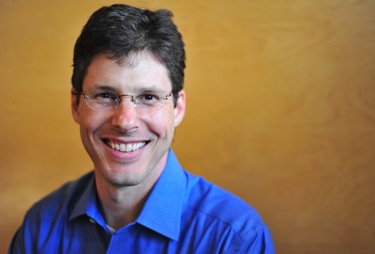
Carsten Hohnke is seeking reelection to his 5th Ward seat on the Ann Arbor City Council on Aug. 3.
Ryan J. Stanton | AnnArbor.com
Of course, he still had to win in the November general election. But after spending a whopping $20,000 on his campaign, Hohnke came out ahead of Republican John Floyd by 10,404 votes to 2,667.
Two years later, Hohnke is back to seek reelection to another two-year term in the 5th Ward. He faces off against fellow Democrat Lou Glorie, a local real estate agent and tough critic of the city, in the Aug. 3 primary.
The winner will go on to face Floyd in November, along with Newcombe Clark, who is running as an independent.
Glorie, a self-described underdog and citizen activist, has aligned herself with an unofficial slate of candidates hoping to overthrow the current council majority. Her political allies include mayoral candidate Patricia Lesko, 1st Ward candidate Sumi Kailasapathy and 4th Ward candidate Jack Eaton.
Campaigning together for the past several months, they say their goal is to restore fiscal responsibility and reprioritize city spending on basic services. They also have stated a desire to put an end to what they consider a city building spree.
"I would say that our government has gotten out of the business of caring for the citizens," Glorie says. "This has been a long time coming. It's actually gone from the top to the bottom and I call this rot. This is rot. Right now in Ann Arbor, since the focus is on growth, this is taking away from our ability in this economic climate to take care of the citizens. We've spent money on things that we didn't need to spend money on."
Hohnke argues the city has been making prudent choices in tough economic times. Despite some cutbacks to services, he says, Ann Arbor is faring relatively well — especially by comparison to other cities across hard-hit Michigan.
"We're operating in the context of the greatest economic upheaval in 70 years," Hohnke says. "It's a difficult environment, and that's why I've spent so much time on trying to make sure that we can craft a budget that's fiscally responsible and still provides all the services that we need."
Glorie has closely aligned herself with Lesko, who has been criticized for her combative style and inaccuracies in her campaign messages.
"Pat Lesko is the person we need to come in and clean out the stables," Glorie says. "I don't really understand some of the personal attacks that have been made against this woman. We shouldn't be going there, because it's the issues that count. And on the issues, I'm with Pat."

Lou Glorie is challenging Hohnke for his 5th Ward seat on the Ann Arbor City Council on Aug. 3.
Ryan J. Stanton | AnnArbor.com
Glorie questions the direction the city is headed with projects like an underground parking garage being built downtown, and the $47.4 million police-courts building being constructed next to city hall. Meanwhile, she says, the city's roads and bridges are crumbling, firefighters are being laid off, and water and sewer rates are on the rise.
Hohnke argues he wasn't on council when the police-courts building was approved, and he fought to decrease the size of the underground parking structure.
"I thought it was a little bit too big, and I thought that it stretched the DDA's resources too far," he says. "I was happy to win support for that and we ended up making the underground parking structure $6 million less expensive."
City officials say the new garage — like others previously built in the city — should pay for itself with revenue from users, not tax dollars. But Glorie still argues the city shouldn't take on any more financial risk at this time.
"When we're in an economic downturn, it's a very good time to consolidate," she says. "We're not going to grow right now. Anything we do growth-wise is going to be forced and ugly, so it's time to consolidate. We are decreasing services, at the same time spending money on things we really don't have to get into right now. Single-stream recycling is another good example of that."
From Paris to Ann Arbor
Glorie, 60, a native of Inkster, has lived in Ann Arbor off and on since 1978. She and her husband Francis bought their first house in town in 1987.
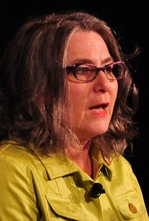
Lou Glorie
She originally came to Washtenaw County in 1968 to attend Eastern Michigan University. She later took "time-outs" in Boston, Detroit and Pinckney, as well as England and France, which she calls "a little seven-year vacation."
"Our three kids were very young, my husband is French, and we wanted to be in France so that our kids would know their French family and learn to speak French," she says. "So that's why we took off, and mission accomplished."
Before her children were born, Glorie worked as a printer and graphic artist. She says she first started working in publishing while in Boston.
"When I came back to Michigan, because my father was ill, by just a funny turn of events I was employed by somebody to run a printing shop in Howell," she says. "And it ended up that I loved running a printing press — just loved it."
Glorie says she has fond memories of living about 12 miles outside Paris in a small village of about 3,000 people. The town had two bakeries and three pharmacies, she recalls.
"Just because they weren't messed up by zoning, these villages were very, very livable," she says. "There's never been in France this idea that you have to segregate housing from commercial, from light manufacturing and all that stuff."
After returning from France in 1997, Glorie started her career in real estate. Today, she works for Keller Williams Realty.
She says she and her husband considered several cities when deciding to move back to the United States, and Ann Arbor stood out above the rest.
"We looked at other places like Palo Alto and San Francisco," she says. "And I said, 'I think we should just go back to Ann Arbor because it's such a cool place and it's manageable — it's human scale.' And I think that's what I would like to see preserved in this town."
Born and raised in the 5th Ward
Hohnke, 40, was born and raised in Ann Arbor. The days of his youth were spent playing in a neighborhood near Virginia Park, he recalls.
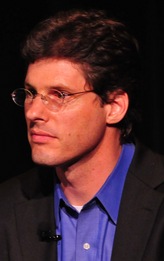
Carsten Hohnke
"I spent my whole early life here and loved it," he says. "I have such great memories of going to listen to concerts at the band shell at West Park, and having extended family potlucks and volleyball nights behind Zion Lutheran Church, and going on bike rides through the Arb and Gallup Park. That's probably a big part of where my passion for the city came from — growing up here."
Hohnke says his first summer and after-school jobs were at the Washtenaw Dairy, at the Kline’s department store on Main Street, and at the city’s parks and recreation department, where he was responsible for mowing city parks.
In those days, the city's parks and maintenance operations were based out of the old 415 W. Washington building, the same site where city leaders today are discussing plans for a Greenway park along with space for artists.
"It is kind of funny now to come full circle," Hohnke says. "I'm walking through the empty version of 415 W. Washington now as part of the Greenway task force and trying to see what we can do to make that a really vibrant community space."
After graduating from Pioneer High School, Hohnke attended the University of Michigan and earned degrees in computer science and biopsychology. He did his doctoral work in neuroscience at the Massachusetts Institute of Technology, followed by his post-doctoral work at the Howard Hughes Medical Institute at Duke University.
After four years of strategy consulting in New York City, Hohnke came back to Ann Arbor and started his own consulting firm, West Pole Inc. And he met his wife Heather, who owns and runs Vie Fitness and Spa downtown.
"I came back because of the quality of life here in Ann Arbor. This was where I wanted to raise a family," Hohnke says. "We now have an 18-month-old son, and he's growing up going to the same parks and living in the same school districts that I did."
Hohnke says he found his dream job, too.
"I do work for the Michigan Economic Development Corp. as a manager of the direct investments that the state makes in early stage life sciences companies in the Ann Arbor area," he says. "So I've got my kind of life science-neuroscience hat on, I've got my business consulting hat on, and I've got my public policy hat on."
On the issues
Glorie and Hohnke see eye-to-eye on several issues. They both oppose a city income tax, and neither thinks it's a good idea to expand the city airport runway.
They both remain relatively uncommitted to a long-term decision on Argo Dam, but both say they think the dam should stay in place for now.
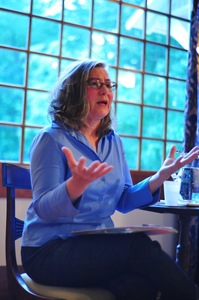
Glorie speaks at a debate with Hohnke last week.
Ryan J. Stanton | AnnArbor.com
Both candidates also sympathize with residents in the Germantown neighborhood, where they support establishing a historic district to prevent out-of-character developments from being built. And both say they believe in a city government that is focused around its citizens and committed to bringing diverse voices to the table.
One issue where Glorie and Hohnke start to differ, though, is whether the city should build a new transit station on Fuller Road. Hohnke has supported working with U-M on plans to build a parking structure and transit center with facilities for buses, trains and bicycles.
"It'll be a huge win for the community," he says. "We need to be forward looking about transit, and this is exactly the right place and the right time to be looking at this."
But Glorie points out the site city leaders have selected is technically city park land. Building on that property, she argues, violates the spirit of the city's charter, which requires any sale of city park land to be approved by voters.
"In good faith, the citizens of Ann Arbor voted for a charter amendment to protect park land, thinking that this would protect park land from transfer of usage rights," Glorie says. "If they want to give this land to the university or transfer the use of it, it should be on the ballot. Ask the citizens if we want to sell this for $5 million."
Hohnke says there is no sale or lease, so he's not sure what voters would be asked. He argues the property has been a surface parking lot for two decades, and with thousands of visitors entering the community at that location, near the U-M Hospital, he sees it as a perfect place to create a new gateway to Ann Arbor.
"At the same time, we help to refocus the university away from building parking garages in our neighborhoods, which is what they had planned to do until this proposal was brought forward," Hohnke says, adding that Ann Arbor has to "have the courage to make progress."
But Glorie says she still thinks "the whole project is rather foolish anyway."
Single-stream recycling
Another issue where Hohnke and Glorie stand on opposite ends of the debate is the recent switch to single-stream recycling. Glorie and her political allies think it was a bad investment, one they've tallied to cost taxpayers more than $6 million.
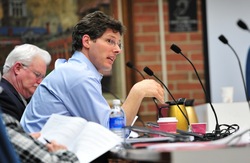
Hohnke is shown at a meeting earlier this year.
Ryan J. Stanton | AnnArbor.com
City officials originally called it a $4.6 million investment, but they now say it will cost closer to $5 million when factoring in all expenses for new carts and upgrades to the city's recycling plant. That's not counting $1.16 million the city is spending for four new trucks because city officials say they were scheduled for replacement anyway.
Despite the upfront costs, city officials say single-stream recycling should pay for itself in about seven years. Hohnke talks proudly about that investment.
"I worked very hard on two recycling initiatives, which we rolled out in the last couple of years — commercial recycling and single-stream recycling," he says. "It's good for the environment, it's good for our quality of life, it's user-friendly and it's going to reduce our solid waste expenses going forward."
Glorie remains skeptical. She says the program isn't guaranteed to increase recycling — it'll just increase the amount of recyclable materials collected.
"What is going to actually be recycled depends largely on, No. 1, the condition of the materials when they reach the place where they will be turned into something else and, No. 2, whether there is a market for those materials," she says. "So, the fact that we are now throwing everything into one container and we're expanding the numbers of those acceptable plastics doesn't mean that these are going to be recycled."
The police-courts building
"I hate to flog a dead horse, but that addition on Larcom (city hall) should not be there," Glorie says of the new police-courts building at Fifth and Huron.
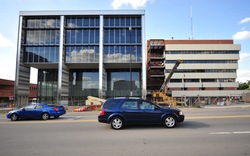
The police-courts building in progress earlier this month.
Ryan J. Stanton | AnnArbor.com
"The fact that we have to provide a space for our courts does not mean we had to go with that building," she says. "It certainly was not the right time. As to what we might better have done, I think the near-term solution would have been to renovate something in the City Center Building."
Hohnke, who notes the decision was made prior to his arrival on council, fully supports the project. It was set into motion after the city's courts were asked to vacate space leased from the county.
"We're required by state law to provide a suitable location for the court," Hohnke says. "At the same time, we had a police station that was totally inappropriate for anybody to work in, so there really had to be some new location for both."
Hohnke says a number of alternatives were considered, including Tally Hall, the City Center Building and the Library Lot. He says all of those locations were rigorously evaluated and deemed inappropriate.
Fixing the Stadium bridges
Glorie argues the Stadium bridges require urgent attention. She points out the city's street repair millage has an undesignated fund balance of $19 million.
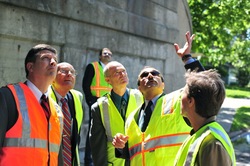
City officials show federal officials the deteriorating condition of the Stadium bridge span above State Street recently.
Ryan J. Stanton | AnnArbor.com
"If we cannot find federal money, if we cannot get state money, we have to spend that money on the Stadium bridge," she says. "The other alternative would be to bond for that, which might be the thing to do and ask the voters."
Hohnke says the repair of the Stadium bridges has been a priority for him and all members of the City Council. He says there's no question that the bridges must be reconstructed, and that's why the council has instructed city staff to commence work on the $23 million project no later than next spring.
But first the city is taking one last shot at applying for grants.
"We have correctly, I believe, chosen to continue our efforts to secure the usual state and federal support for this type of a project over the next six months," Hohnke says. "We have the potential to save the taxpayers of Ann Arbor millions of dollars by pursuing this course. If the usual funding sources don't materialize, we will use our local street millage funds and begin reconstruction in early 2011."
Glorie considers it an example of misplaced priorities. She says it's unfortunate the city didn't instead issue bonds to fix the Stadium bridges.
"We have a piece of critical infrastructure failing," she says. "If I had a choice, I would have bonded for that rather than an underground parking structure."
The Greenway and the Greenbelt
Hohnke says he has made advancing the protection of the environment a priority during his time on council, including through his work on the Environmental Commission, the Greenbelt Advisory Commission and the Washtenaw Area Transportation Study Policy Committee.
He says he supports not only the creation of a Greenway along Allen Creek, but also the continued efforts of the city's Greenbelt Program, which is using city tax dollars to purchase the development rights of farmland just outside the city limits.
Glorie says she agrees that saving land outside the city is valuable. But she thinks it's time to start using some of the Greenbelt millage dollars to purchase park properties inside the city and develop a Greenway following the Allen Creek. It's an idea that's been talked about for a long time, but has been slow to move forward.
"The Greenway is important not only for recreation, not only for urban green space, but very important for flood mitigation and the health of the Allen Creek," Glorie says. "So I think we have to accelerate as much as possible our city government's support for the Allen Creek Greenway."
Hohnke agrees the Greenway is an exciting vision for the city. He says it would run along the western edge of downtown and contribute to the area's vibrancy.
"Over the last couple of years, I've been working to try and make sure we keep taking steps in that direction and do what makes sense," he says. "I sponsored a resolution to add the First and William surface lot to the Greenway and identify it as being a target for park use, so it will be kind of an anchor right in the lowest part of the floodway."
Hohnke says the City Council recently took another step by passing a resolution he co-sponsored to add a Greenway section at 415 W. Washington.
"That's going to be important and I continue working with the community and folks in the city on the further steps that we can take," he says. "Obviously, you'd always like things to go faster, but we've actually taken some tangible steps."
The business of government
Glorie says Ann Arbor has been on "the superhighway to growth" for a long time. She says that's over, and it's time for citizens to take back control of their government.
"My style is not leadership," she admits. "I know people that hate it when they hear me say that. But the fact is that every idea I've ever had has been improved with collaboration with other people, and so I would be asking a lot of my fellow citizens in the 5th Ward ... to collaborate with me, to be part of the process."
In Their Words
Here's what Hohnke and Glorie had to say on four issues.
- Airport Runway Expansion
-
Hohnke: "The safety data that I've seen has not convinced me that there's any need for a runway extension. In the end, safety is the pilot's responsibility. If the runway is too short to land on, it's too short to land on."
Glorie: "The reason I'm against it is, No. 1, it would allow larger jets to land there, and I'm not interested in Ann Arbor being a hub for corporate jetdom."
-
City Income Tax
Hohnke: "The state provides very severe restraints on how we can construct that tax, so we have very little degrees of freedom to make adjustments for different segments of the community that have different economic profiles. If we had as much flexibility in crafting that tax as the federal government does crafting its income tax, then it might be something worth looking at, but we don't."
Glorie: "I'm not in favor of it. But that again is the sort of thing where I'm committed to having the citizens decide. If there were a lot of citizen agitation for this, I think it should go on the ballot, but I wouldn't vote for it."
-
Argo Dam
Hohnke: "We need to make the necessary investments and fix the toe drains and take any short-term question about the dam being in or not off the table. Then we should start talking about a 10-year vision for the whole stretch of the river through the city and engage all of the parties without this threat of dramatic change hanging over everybody."
Glorie: "I am dam in for the moment. I would say that I could be persuaded sometime in the future that the dam should come out, but I think other dams downriver especially would be the first ones I would remove."
-
Library Lot
Hohnke: "I'm not at all supportive of the city getting into the hotel or conference center business. I don't think we have the expertise for that, and I don't think the city needs to do that. I don't think we need to put our bond rating and our debt financing at risk for a particular business sector, so I'm not interest in solutions that ask us to do that."
Glorie: "As for the idea of a conference center on that spot, my first concern is that every place I've gone in the world where there's a conference center or some such thing, it has created a dead zone. I believe that a well-designed town square in that place could work beautifully, synergistically with the programs at the library, and just bring a lot of life and vitality there."
Hohnke believes all of his experiences and his financial management background combine to make him an effective leader on the City Council.
"I'm really excited to be a part of council," he says. "I have a passion for Ann Arbor. And I've always been energized by community service and public policy. It's something that fills my bucket and I enjoy doing."
He says he also would call on citizens to help the city get through the next two years.
"I think that working together," he says, "we can all find a way to continue to make this a vibrant sustainable community, a community that has strong, unique neighborhoods that are anchored by a lively and accessible downtown, a community that's surrounded by open space and that's connected with a vibrant transportation system."
But Glorie says she feels the city leaves citizens out of the decision-making process.
"In terms of development, the citizens of this town need to have a better handle on what's happening," she says. "We do have a right to direct the future of our city. In fact, we not only have a right, it's a responsibility to direct this change. So I would actually like us to go back the drawing board. Right now the city is trying to consolidate the various area plans. I think that should be halted."
Though often attacked for being part of the council majority, Hohnke has strayed from the popular majority at times, particularly on issues of development.
Hohnke has been a vocal opponent of both the Moravian and Heritage Row developments in Germantown. A majority of council members supported both projects, but opposition from Hohnke and a few others on council has held up both projects from getting the eight votes they need for approval.
Glorie cites the council's failure to approve the Germantown historic district as a reason change is needed. But Hohnke also strayed from the majority on that issue and was one of only four council members who favored the district.
"I have a pretty clear principle, and I feel like I've been consistent in communicating that and in acting on it," Hohnke says. "Our city can't prosper without some growth. And so with respect to development, to the extent that development happens, it's got to be well thought out, it's got to be smart and consistent with the best urban planning principles, and has to happen in a place where there's a community consensus for where that added density should be. And to me, that's within the DDA boundaries."
Hohnke says he has no real regrets after his first two years in office. As for some of his accomplishments, he cites moving forward with the city's first-ever management plan for the Huron River and working to make sure the city continues to create a stronger non-motorized infrastructure and a safer culture for bicyclists and pedestrians. He points to the installation of new pedestrian islands in various places around town, including on Seventh and Washington, which he says have helped make dangerous intersections safer.
Hohnke also says he's continually looking for ways to reduce operating expenses in city government. One of the most visible examples of that this past year was when Hohnke established and served on the Mack Pool Task Force, which found ways to cut costs and increase revenues to keep the city-run indoor pool open.
"We also have to make sure that we continue to have a healthy and growing economy and support our local merchants," Hohnke says. "So I've worked, for instance, with other council members to make sure we found a way to allow downtown merchants to use sandwich boards. We found a way to not have to charge for loading zones and allow our merchants' vendors easier access to our downtown. And we also collectively supported the Business Improvement Zone that a number of the Main Street area merchants worked hard on."
Glorie says it's not the business of government to ensure economic growth. Instead of investing time and money into business attraction efforts, she says, the city should focus on improving quality of life through measures as simple as fixing streets.
"The business of government is to provide the services to the citizens who pay for it," she says. "We're here now. We need water, sewers, we need police protection, fire protection. Let's make sure that all of these things are secure."
Ryan J. Stanton covers government and politics for AnnArbor.com. Reach him at ryanstanton@annarbor.com or 734-623-2529.
Comments
Speechless
Tue, Jul 20, 2010 : 11:13 p.m.
Hmm.... Does that mean Lou Glorie would differentiate her candidacy from Hohnke's by passionately opposing a measure that calls for increased pedestrian safety and the enforcement of legal rights in crossing city streets? That's always possible, I suppose, but I would kinda doubt it.
Atticus F.
Tue, Jul 20, 2010 : 12:47 p.m.
I will be encouraging all voters I know that live in the fifth ward to vote for Glorie, due to the short sightedness of Hohnke in sponsoring the new pedestrian crosswalk ordinance.
Gloriagirl
Tue, Jul 20, 2010 : 11:07 a.m.
Candidate Glorie, as a real estate agent gets to see first hand how the depressed economy has ravaged our local community. She sees every day home foreclosures, families struggling to stay in their homes and pay Ann Arbor's exorbitant taxes while city hall looks at operational issues, as pointed out not a good time to expand. Private companies don't go through building programs and physical plant expansions when their revenue projections are in constant decline. Candidate Hohnke on the other hand by the very nature of his business is insulated from the severe economic downturns that hit city taxpayers. Glorie will clearly help drain the swamp and give city government back to the people. The best form of governing is balance from many diverse positions.
Ben Mitchell
Tue, Jul 20, 2010 : 9:56 a.m.
For me, Mr. Hohnke is the clear choice. The two candidates seem to align pretty closely on a number of issues. When they diverge, Ms. Glorie distinguishes herself as being totally lacking in vision and constructive reasoning for the city. An attitude that Ann Arbor is not going to develop seems self-defeating, and is certainly not an attitude I would like in a council member. I can't say I understand her opposition to the single-stream recycling program. Ms. Glorie reasons that just because more stuff is collected doesn't mean more will be recycled. I'd have to disagree. More recyclable material collected = more stuff recycled. Her position opposing the funding strategy to fix the Stadium bridges is similarly twisted. While she bases much of her campaign on imprudent city spending, she's opposed to the city seeking federal funds to repair the bridges. The Fuller road station is, for me, an important first step in what will hopefully become a transit hub for Ann Arbor and the region. The underground parking structure next to library is, again, a first step in realizing a vibrant project for that property. There are some real dead spots in our downtown that owe much to the presence of hulking parking structures. I applaud the city for making the investment in the underground parking structure that will support better street-level development. Planning for future development in this way, rather than stating that Ann Arbor is not going to develop, is the type of leadership that our city council should demonstrate.
Barb
Tue, Jul 20, 2010 : 9:28 a.m.
Using Lesko as an excuse not to vote for a lot of these new candidates doesn't hold much water. Listen to what they say not what she says.
Mick52
Tue, Jul 20, 2010 : 9:27 a.m.
Need a write in candidate here.
Dr. I. Emsayin
Tue, Jul 20, 2010 : 9:15 a.m.
Lou Glorie is a leader in that she takes the lead in gathering people and information so that the work can get done. I have seen her environmental work on various committees and she is very successful in working toward consensus. She cares deeply about the community and will work for the ward in such a way that ward members will feel heard and supported.
Anon E Muss
Tue, Jul 20, 2010 : 8:45 a.m.
@Dr. I. Emsayin Glorie: "My style is not leadership"
Dr. I. Emsayin
Tue, Jul 20, 2010 : 8:38 a.m.
Whether or not Glorie aligns herself with Lesko, she is not Lesko and she is great at collaboration. She will talk to every citizen in her ward and work as a leader to get things done.
community101
Tue, Jul 20, 2010 : 8:20 a.m.
Glorie says things like, "were not going to grow right now" and the Transit Station on Fuller, "is rather foolish".....I think she has said enough. I love Ann Arbor and I think were are moving in the right direction-forward.
Lifelong A2
Tue, Jul 20, 2010 : 8:06 a.m.
Glorie claims that the City should have bonded for the Stadium bridges instead of the underground parking garage. Her proposal demonstrates that she is ignorant about City finances and issues. The parking garage bonds will be paid for using parking revenues collected and controlled by the DDA and generated by the garage itself. Perhaps Glorie it not familiar with the concept that issuing a bond requires a revenue source to pay for the principal and interest on the bond. Glorie also implies that the City is not currently spending park millage dollars to buy park land inside the City. Wrong again, Lou. The City has already spent millions from the Greenbelt millage to buy local neighborhood parkland inside the City, consistent with the 2/3 - 1/3 formula that was part of the Greenbelt discussion in 2003. Which of the local neighborhood parks bought with Greenbelt dollars does Glorie think should have instead been sold to developers? These are just two examples of why Lou Glorie -- and her running mate Pat Lesko -- is not qualified for office.
oldgaffer
Tue, Jul 20, 2010 : 7:42 a.m.
What an awful choice for the city! Despite his U of M degree and MIT PhD, Carsten Hohnke sold out to the slumlords who feared the competition of the Moravian and Heritage Row projects and was central to the defeat of both projects. His actions-- unlesss reversed by the courts-- will deprive the city of jobs, tax revenue and two excellent developments which were properly oriented and scaled for their respective neighborhoods. Anyone who couldn't see the true character of the organized mob filling council chambers to rail against those two projects should not serve on city council. But what about realtor Lou Glorie? Her alliance with Pat Lesko is a huge problem for me. I recommend writing in Newcombe Clark's name.