

Drought turning Ann Arbor's trees from green to brown
Editor's note: This story was updated for clarity at 8:30 a.m.
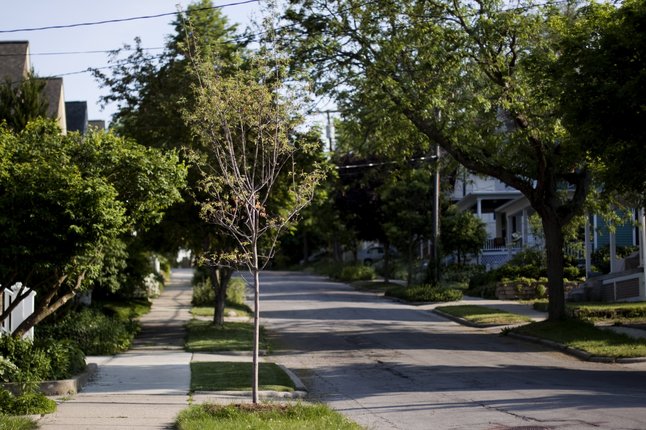
This summer's drought has put stress on Ann Arbor area trees, including street trees such as the one pictured here in May that was recently planted along Mulholland Street.
Jeffrey Smith | AnnArbor.com
Both street trees and yard trees are showing signs of drought stress including defoliation and wilting, said Kerry Gray, urban forestry and natural resources coordinator for the city of Ann Arbor.
“It’s hard for us at this point to really know the impact of the drought,” Gray said. “They can be resilient and come back.”
The city will be conducting an inventory of its trees in mid-September to determine if any of them need to be replaced. The contractor that plants the trees has given the city a one-year guarantee — meaning trees planted in 2011 that have died can be replaced this year at no cost.
The survey will first check the trees planted in 2011 and then assess the status of about 525 street trees planted this calendar year, Gray said. A total of about 1,000 trees are slated for planting in the 2012 fiscal year as a part of a storm water diversion plan.
As a part of the agreement, the contractor waters the trees for the first year of planting.
Gray said the city has yet to change the type of the trees planted along streets because of changes in the climate due to global warming.
Bob Bricault, horticulture and natural resources educator for the Washtenaw County branch of the Michigan State University extension office, said signs of drought in deciduous trees like sugar maples, red maples and sycamores include browning on the edges of the leaves or between the veins as well as drooping and folding leaves.
Evergreens show less signs of drought stress, Bricault said, because of their ability to retain water. The new growth on evergreens that are drought-stressed may not be as turgid, he said.
“Pines and spruces are a little more drought-hardy than most plants because of their leaves and they can’t lose moisture as easily - but that goes out the door when temps are above 90,” Bricault said.
Most trees draw the moisture they need from the top foot of soil, Bricault said.
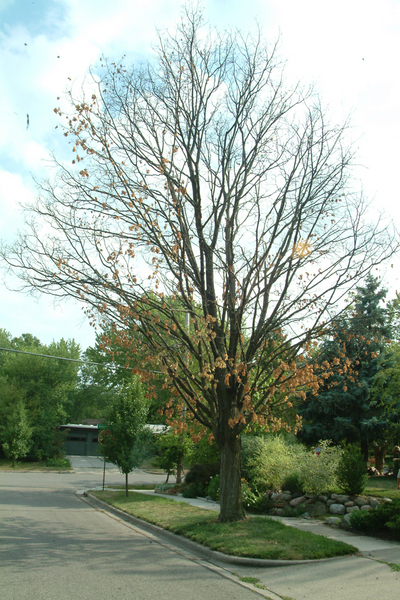
Ann Arbor resident Pamela Gesund took a photo of this maple tree in May near the corner of Avondale Avenue and Mershon Drive. Gesund said she's concerned that many of the city's maple trees are stressed and look like they're dying.
Courtesy of Pamela Gesund
A newly-planted tree takes several years to establish a root system, Bricault said, and should be monitored for the first three years by watering. Two to three inches of mulch spread evenly around the base of the tree also help retain soil moisture and protect the roots during large temperature fluctuations.
Bricault said he’s the most concerned about how thin-leaved plants like Japanese maples and fruit trees fared this summer.
“Maples in general would need to be watered in the drought situation,” Bricault said.
Stressed trees also are more susceptible to diseases and fungi - including verticillium wilt.
Maple trees planted along streets, often in disturbed soils, are especially susceptible to the fungus verticillium wilt, Bricault said.
Pamela Gesund, an Ann Arbor resident for the past six years, said she's noticed many trees on both the east and west sides of the city could be exhibiting signs of the fungus.
For the past three summers, Gesund said she's noticed many maple trees in the area struggling.
The fungus affects the tree’s ability to absorb water through its roots - so even if the tree is being regularly watered, it will still continue to wilt. Signs a tree is being affected by the fungus are variable, hard to pinpoint and include scorching and wilting of leaves on the tops of individual branches, dead branches on one side of the tree and smaller leaves.
“Plants can grow for years without showing any signs of a problem,” Bricault said. “You just never know. It’s a susceptibility thing. … Every place between the sidewalk and the curb is pretty unfavorable for anything that grows over 15 feet.”
Amy Biolchini covers Washtenaw County, health and environmental issues for AnnArbor.com. Reach her at (734) 623-2552, amybiolchini@annarbor.com or on Twitter.
Comments
15crown00
Sat, Aug 18, 2012 : 7:58 p.m.
trees and grass aren't the only things effected by the drought
regularjoe
Fri, Aug 17, 2012 : 11:23 p.m.
I have two properties that got new trees this may, one on Third and one on Madison. I had no idea the trees were coming. I asked the workers what should I do to ensure their survival. They said the trees should thrive in normal conditions, were guaranteed for a year, and they would be back to water at least once in a few weeks. ( I did observe them coming through to water once). They said if it hasn't rained in a few weeks to go ahead and give them a good soaking. So I did. And the trees are beautiful and doing quite well. My cost was probably 2 hours total watering from a spigot for the 2 trees over the summer. What's that, maybe 5 bucks? Maybe less? My property is better for it and my neighborhood is better for it. I don't always agree with City policies and actions. However this time I felt proud to point to my tax dollars at work. The City took a positive step and I reciprocated with a tiny bit of civic duty. That's my feel-good City story for the summer :)
jcj
Sat, Aug 18, 2012 : 2:19 a.m.
That's the way it should work Joe. It is well worth the effort for those willing to water.
martini man
Fri, Aug 17, 2012 : 10:32 p.m.
I know !!!! Maybe the city can impose an emergency tree watering TAX to go along with the ART tax . The miriads of homeless people could go around Ann Arbor watering the needy trees, while getting subsidies for rent , food , etc. But then again ..the liberals would probably consider that as an infringement on the dignity of the homeless. Better to just raise taxes a little higher as to not offend anyone.Hug dem trees , hug dem trees !!!
SEC Fan
Fri, Aug 17, 2012 : 9:29 p.m.
guess the mayor and city council were right...I don't see the Dreiseitl water sculpture drooping for lack of water.
LXIX
Fri, Aug 17, 2012 : 9:09 p.m.
I see your green door and I want it painted brown. No colours any more in this glo-bal lit-tle town.
rougehuron
Fri, Aug 17, 2012 : 6:56 p.m.
I was thinking the same wolfman...why have a 1% art tax when we could instead have a 1% beautification tax that could go towards actually maintaining simple things like the planter boxes at W Ave and Stadium split that would make just as much of a visual difference as a randomly placed sculpture.
wolfman jack
Fri, Aug 17, 2012 : 6:11 p.m.
I would suggest trees = art. Don't we have a fund for that ? I can buy a lot of oaks for the price of a fountain. I'd personally rather have the oaks. Might be onto something here.
Alan Goldsmith
Fri, Aug 17, 2012 : 5:48 p.m.
WHO in City Government is responsible for the dozens of tree planted along Maple Road in Veterans Park? All with their nice green 'gator' bags, all of which are never filled with water and for the most part, all are dying and look horrible? Not only has this planting process been a fiasco, it's an insult and disrespectful of American veterans, which the park is supposed to be honoring. Not surprised to hear the 'it's not my fault' Greek chorus from City officials and the usual silence from our oh so 'green' Mayor. City Council needs to look at this issue and see who screwed up.
Linda Peck
Fri, Aug 17, 2012 : 4:32 p.m.
My own maples on my property look great. All it takes is a little water once in a while in a drought. The care of the city's newly planted and older trees on their property has been dreadful in my opinion. Those green bags hang there, dry as a bone, clutching onto dead little trees. What a waste of taxpayer money! Whoever is in charge needs to be replaced. If a person calls the forestry department, they are told there is a problem with under staffing. This is hardly surprising when even the police are under staffed in this "affluent" city.
leaguebus
Fri, Aug 17, 2012 : 4:26 p.m.
I live in the Maple/Miller area and many of the Maples planted during the 50's are dying. My neighbors Maple died, was cut down and another planted in its place, which died too. I thought that it was lack of watering the new tree, but my neighbor swore he filled up the water bag every time it was empty. It must be one of the fungus diseases that is killing the trees. It is obvious to me that when a Maple is cut down, as a matter of policy, something that resists the fungus should be planted in its place.
jcj
Fri, Aug 17, 2012 : 11:18 p.m.
Carolyn My point was unless you have well water there is no chance the Gelman water contamination plume has anything to do with it.
jcj
Fri, Aug 17, 2012 : 8:53 p.m.
Carolyn Do you have well water?
Carolyn
Fri, Aug 17, 2012 : 4:35 p.m.
You are absolutely correct. The fungus can remain in the ground also and affect future plantings. I live in Maple- Miller and we are also subject to the effects of the Gelman water contamination plume from 30 years ago (when they had injection wells out there). The mature London Plane trees in the area are also suffering. It will be really, really sad if we lose all those mature trees.
tdw
Fri, Aug 17, 2012 : 3:17 p.m.
Wow....I kinda feel sorry for a lot of you folks.I have two huge maples in my yard and have never watered them ever.Infact , they are the best looking trees in my neighborhood.I'm gonna cut down a oak here very shortly.
mixmaster
Fri, Aug 17, 2012 : 5:55 p.m.
Why? Too many leaves to rake?
ypsituckian
Fri, Aug 17, 2012 : 2:57 p.m.
So it's too late? I have a maple type tree out front that is probably about 20 years old. Can anyone recommend something that will help minimize further stress?
John of Saline
Fri, Aug 17, 2012 : 3:42 p.m.
Water.
Carolyn
Fri, Aug 17, 2012 : 2:19 p.m.
I wrote letters to City Council and the City Forester months ago pleading them to tell residents to water their trees...doing it now - when leaves are already brown / wilted / falling is probably too late. I preditct Ann Arbor will lose hundreds of trees this year due to the drought and added stress that has exacerbated various diseases. The result is that there will be less shade and even greater heat stress and air conditioning costs next year and beyond. The City should give homeowners the option of planting a city-provided tree in their front lawns, as opposed to putting then in the extension, which is too narrow and holds insufficient moisture.
djacks24
Fri, Aug 17, 2012 : 7:55 p.m.
As soon as the city pays for everyone's water, then you can start "pleading" with the city on what the residents should do with it.
MRunner73
Fri, Aug 17, 2012 : 3:42 p.m.
Once again, for your peace of mind please ask a tree expert at one of the local nuseries. Even if you turn out to be correct, the drought is so widespread, city trees will die off by the thousands across all of Indiana, most of Kentucky, Illinois, a good part of Ohio, then head west to Iowa and MIssouri where the drought impacts are actually far worse than here. For the lateste drought monitor please see http://droughtmonitor.unl.edu www.drought.gov
Mick52
Fri, Aug 17, 2012 : 2:13 p.m.
Firefighter and police officer numbers are cut but the city has money to plant trees? Depending on size, tree are not cheap. The city charges you for water, then plants trees expecting you to run up your bill watering the trees. Finally does this meant the city will now again be picking up leaves? http://www.annarbor.com/news/opinion/fall-leaf-pickup-prices-leap-after-ann-arbor-discontinues-curbside-service/#.UC5Q6iK4Qsc
jcj
Fri, Aug 17, 2012 : 8:51 p.m.
If you can't afford the little amount this water would cost then you might want to leave Ann Arbor for the hills of Kentucky or the UP!
dexterreader
Fri, Aug 17, 2012 : 2:06 p.m.
I also wonder what the significance is of the photo taken in May?? I have several new, but fairly large, deciduous trees that we purchased ourselves and planted within the past 3-4 years. This year I watered meticulously beginning in mid May. In June, I invested in 2 of the green "TreeGator" watering bags. Best decision I ever made!! I've stuck with a rigid watering cycle and my trees look much better now than they did at this time last year. Too much money spent to lose them!!
treetowncartel
Fri, Aug 17, 2012 : 4:01 p.m.
@kyle, I have a hibiscus that i planted this spring that is showing some signs of the drought, however, this article is about Ann Arbor trees the tree is not in Ann's Arbour
Kyle Mattson
Fri, Aug 17, 2012 : 2:20 p.m.
Hi Dexterreader- If anyone has a photo of a tree in their yard showing signs of stress from the season feel free to send it to us here: http://www.annarbor.com/up/ Glad to hear that your trees are doing well!
MRunner73
Fri, Aug 17, 2012 : 1:44 p.m.
I am rarely a critic about AA.com news stories but this one is a little disturbing. For one, the photos were taken in May. The drought was not yet established. I looked back the U.S. Drought Monitor to prove that. There was short term precip deificit and we know that there was not much snow the previous winter to melt off. Drought and heat stress was not evidient in May. Summer heat came toward the end of the month and then through June and July as early August. That put much more stress on the tress then the previous 6 or so months. The article goes on to indicate fungus has been a player in this. The drought has not been as extreme enough, per U.S. Drought Monitor for our Climate Division as we were in a D2 stage drought. The extreme drought or D4 and D5 has been in the Lower Ohio Valley of Southern IN, Western KY. A trusted cohort in Des Moines said the heat there, almost twice as many days above 90 and well over a dozen days of 100 has put the tress there under great stress and quite a number were dying or signs of dying over there. The article goes in different directions with weather and disease which are not always related. So in the past week, lawns are turing grenn thanks so some rain and much cooler temperatures. Trees can respond as well but won't show obvious signs. Young trees certainly had more heat stress than the older. Note that this is now the time of the year where leaves start to shrival up and fall off. This is due to longer nights, less intense sunlight for photsynthesis which make chlorophyll and is the greening effect of the leaves. Leaves start falling in this manner every year. I have lived in KY and saw the same there about this time of year.
jcj
Fri, Aug 17, 2012 : 8:49 p.m.
MRunner73 Is your data for Ann Arbor or Detroit, Brighton,Milan? Almost every storm this year has split and we have not gotten as much rainfall as the other area's mentioned.
djacks24
Fri, Aug 17, 2012 : 8:16 p.m.
Thanks MRunner73, great information. Much better perspective than the fear mongers at AA.com and the sheep that believe them.
MRunner73
Fri, Aug 17, 2012 : 5:02 p.m.
Carolyn: As two experts, we just have differing views. I am a professional meteorologist with an extensive ag background who also worked in Kentucky in the past. I hope you can recall the impact the summer of 1988 drought had on our local area. Thanx.
Carolyn
Fri, Aug 17, 2012 : 4:32 p.m.
I happen to be a tree expert - I am a lanscape architect with a minor in plant pathology. - carolyn
MRunner73
Fri, Aug 17, 2012 : 3:35 p.m.
Carolyn; sorry you missed my point. Notice in the first photo that the brown tree is youngest and all others in the background are healthy. Notice in the Gesund photo, one tree is brown while all others in the brackgroud are healthy. Also note, the lawns were green because both of those photos were taken in May. Please use caution on stating the word severly regarding trees and the impact of the drought. I would state that "some" trees are impacted, mainly the young and the ones suseptible to disease. I hope I know this city as well as you do and I do not see trees dying off by the thousands. The cooler temps are coming at a good time. You can ask any tree expert at one of the local nurseries and hopefully, their remarks would be conistent with mine.
Carolyn
Fri, Aug 17, 2012 : 2:34 p.m.
So what is your point? The trees were SEVERELY affected this year because msot people do not bother to water trees in the extension. Just watch as your property value goes down when you have nothing but blaring, HOT sunshine on your street next year and thereafter...
gretta1
Fri, Aug 17, 2012 : 2:14 p.m.
Nicely stated.
xmo
Fri, Aug 17, 2012 : 1:19 p.m.
Is this for real? or a Joke? Science has not proven anything yet and we have an urban forestry and natural resources coordinator who is suppose to be a man of science talking about a theory as if it were fact! "Gray said the city has yet to change the type of the trees planted along streets because of changes in the climate due to global warming."
LXIX
Fri, Aug 17, 2012 : 9:39 p.m.
That's true. The only fact in science is that nobody knows nor will ever know the facts about anything (until that last moment of change). The most likely projection and expert consensus is as good as it gets. The scientific consensus is that the climate is undergoing change and Earth is getting warmer.
aggatt
Fri, Aug 17, 2012 : 8:33 p.m.
You mention "talking about a theory as if it were fact," but in science a theory pretty much is fact. Gravity is a theory, for example, but I would guess you accept that as fact.
mixmaster
Fri, Aug 17, 2012 : 5:52 p.m.
Check out who makes up "Powerline" It reads like a who's who of right wing politics and related right wing "think" tanks. Yeah these guys are serious climate experts and scientists. Oh, wait, they're attorneys. What else would they say, xmo? http://www.powerlineblog.com/about-us
leaguebus
Fri, Aug 17, 2012 : 4:25 p.m.
I saw an interview with the scientist that Tom mentions and he was funded by the Koch brothers. I say again, funded by the Koch brothers. They and the big energy companies have been the funders of all the global warming junk science naysayers since day one. It is amazing how lies and half truths get so much traction these days.
xmo
Fri, Aug 17, 2012 : 4:21 p.m.
I hope I don't ruin your day! We, the undersigned, respectfully request that NASA and the Goddard Institute for Space Studies (GISS) refrain from including unproven remarks in public releases and websites. We believe the claims by NASA and GISS, that man-made carbon dioxide is having a catastrophic impact on global climate change are not substantiated, especially when considering thousands of years of empirical data. With hundreds of well-known climate scientists and tens of thousands of other scientists publicly declaring their disbelief in the catastrophic forecasts, coming particularly from the GISS leadership, it is clear that the science is NOT settled. http://www.powerlineblog.com/archives/2012/04/nasa-scientists-rebel-against-global-warming-hysteria.php
Tom Whitaker
Fri, Aug 17, 2012 : 2:49 p.m.
I suggest you read this op ed, written by a scientist who was a skeptic. After conducting three years of research, he is now convinced that global warming is both happening, and is being caused by human emissions. Oh yeah...and the Koch brothers funded his research. Oops! http://www.nytimes.com/2012/07/30/opinion/the-conversion-of-a-climate-change-skeptic.html?_r=1&pagewanted=all
mixmaster
Fri, Aug 17, 2012 : 2:03 p.m.
And what would you call it? There's reams of evidence. Documented rise in temps, loss of polar ice, massive drought often where you'd least expect it, increase of greenhouse gases, particularly in the ones generated from industrial processes, increases in population, increase in the use of fossil fuels. And all this from hundreds of reliable scientific sources. Graphs of that evidence directly correlate with the increases in global temperatures. But I guess, the Tooth Fairy says it's not true. Good enough for some people.
grimmk
Fri, Aug 17, 2012 : 1:11 p.m.
Yes, it is sad that trees and grass and dying. But so what? What is really the issue is the lack of healthy crops we'll have this year. How much will this cost our city if the trees are dead but not in the 1 year warranty? If the tree is in front of your house are you supposed to care for it like you are supposed to shovel sidewalks in winter?
jcj
Fri, Aug 17, 2012 : 8:43 p.m.
You mow the grass on the extension don't you?
Madeleine Borthwick
Fri, Aug 17, 2012 : 3:55 p.m.
I agree that it's sad about the crops and my heart goes out to the farmers. BUT. will letting the trees die help that situation? why not do at least what we can?
Carolyn
Fri, Aug 17, 2012 : 2:32 p.m.
For crying out loud, that is your property - yes you are supposed to take care of the trees and the sidewalk. You got the tree for free!!!
mixmaster
Fri, Aug 17, 2012 : 12:54 p.m.
Not only did I water the street tree in front of my home with run off rain water from the rain barrel, I fertilized it with fish emulsion. Took about 1/2 hour and maybe a few cents for the fertilizer. It seem silly to let a tree die in front of my house especially since it was one of the last street trees planted by Paul Barely, former City Forester, using money from the Dean Fund. A "Swamp Oak" Quercus Bicolor, is nice and healthy.
Mick52
Fri, Aug 17, 2012 : 2 p.m.
Perfect! The answer to this issue. If the city wants to plant trees in front of a residence and expects the homeowner to care for it, then they must supply rain barrels. I have four, about 55 gallons each and a great source of extra water.
Cash
Fri, Aug 17, 2012 : 1:57 p.m.
Swamp oaks are beautiful trees. You will be rewarded as well as generations to come.
jcj
Fri, Aug 17, 2012 : 1:03 p.m.
If only others would be so diligent!
Guinea Pig in a Tophat
Fri, Aug 17, 2012 : 12:41 p.m.
There are a couple of trees in West Park that have been hit pretty hard. No leaves at all and only a few branches are left.
Donna
Fri, Aug 17, 2012 : 12:40 p.m.
It's climate change, people. We will have to get use to drought and extreme weather. Let's be glad we don't live near the rising oceans.
djacks24
Fri, Aug 17, 2012 : 6:31 p.m.
Here we go...(roll eyes)
mohomed
Fri, Aug 17, 2012 : 2:50 p.m.
Climate change might or might not be true; however the oceans are not rising. All our coastal cities have the same beaches in the same spots as they did 100 years ago. Miami, New York, Los Angeles, ect... All same beaches and no buildings even getting close to being overtaken by water. Every now and them you will see some "research" suggesting the oceans have risen a half centimeter or so but then other data dismissing that. Fluctuation is normal. Remember the Great Lakes back in the 1980's, they were overflowing and the beaches were much smaller then they are now.
ferdcom
Fri, Aug 17, 2012 : 12:57 p.m.
I'd love to live across the street from the people with the beachfront property.
Jim Osborn
Fri, Aug 17, 2012 : 12:57 p.m.
Remember the dust bowls of the 1930s in the plians states? Perhaps not since that was 80s years ago. Droughts are not new.
Brad
Fri, Aug 17, 2012 : 12:36 p.m.
"Every place between the sidewalk and the curb is pretty unfavorable for anything that grows over 15 feet" So why does the city continue to plant thousands of trees there? Are they planting pygmy trees or something?
RUKiddingMe
Fri, Aug 17, 2012 : 12:12 p.m.
I'm guessing that paragraph with the first mention of the fungus is supposed to be moved. I also don't know how one monitors a tree by watering it.
mohomed
Fri, Aug 17, 2012 : 12:11 p.m.
Where are all the tree hugging hippies when you need them an Ann Arbor. They are all talk and no action.
genetracy
Sat, Aug 18, 2012 : 7:13 p.m.
They are out there alright, blaming the republicans for global warming.
Jim Osborn
Fri, Aug 17, 2012 : 11:38 a.m.
These trees are not dying due to a drought, they are dying due to not being watered by the people whose house the dying or dead tree is in front of. For those trees planted along parkways, it is the city's responsibility. I grew up in Southern California where it never rained from March until late November and I never saw any trees die. I water with a hose the ones in front of my house in Ann Arbor. Last week I spoke with several city employees about these dying trees and they said that they lacked resources. The city has One water truck, which is enough during normal times. I then met with Mayor John Hieftje, explained the situation and suggested that the city contract out watering to private watering firms (local construction or landscaping). This would be so much less expensive than replacing dead trees over the years. Already we have several. I rather have trees than art, after all, is this not "treetown"?
Carolyn
Fri, Aug 17, 2012 : 2:31 p.m.
Exactly!! More people need to srite their Council reps to have them allocate money for street trees if we want to keep our "Tree City" status!!!
Elaine F. Owsley
Fri, Aug 17, 2012 : 11:52 a.m.
That $750,000 spent for "art" could have saved a lot of trees. Tree town, yes. Art town, no.
jcj
Fri, Aug 17, 2012 : 11:31 a.m.
Pamela Gesund, an Ann Arbor resident for the past six years, said she's noticed many trees on both the east and west sides of the city could be exhibiting signs of the fungus. And where does it mention what this fungus is?
John of Saline
Fri, Aug 17, 2012 : 2:24 p.m.
It's among us.
jcj
Fri, Aug 17, 2012 : 11:33 a.m.
I missed where it later tells what the fungus is.
jcj
Fri, Aug 17, 2012 : 11:30 a.m.
Anyone with a tree planted on their extension that has not taken the time to water it should not bother taking the time to complain!
snark12
Sat, Aug 18, 2012 : 2:07 p.m.
I find it funny that someone will blithely say another person should spend $5 per month to water a tree planted by the city without their input, but yet pages and pages of anger are aimed at the One Percent for Art program which costs the average resident less than $1 per month.
jcj
Fri, Aug 17, 2012 : 7:23 p.m.
Mick you say Au contraire. I say baloney! It might cost $5 a month to keep a small tree watered. Your argument does not hold water! Why not let the weeds grow too? Oh yea more and more lazy people are doing that already!
Mick52
Fri, Aug 17, 2012 : 1:56 p.m.
Au contraire. When you have to pay for your water and the city comes by and plants trees on its own, you should have the option to maintain or not. I believe it takes quite a bit of water to properly water a tree. It is the city's property and I think it wrong for the city to plant trees, expect people to pay more in utility fees to water them and decide year by year whether or not the city will pick up leaves.
jcj
Fri, Aug 17, 2012 : 12:43 p.m.
Arieswoman I am sure there are cases where it might be hard. But as a general rule its laziness or not caring.
Jim Osborn
Fri, Aug 17, 2012 : 12:28 p.m.
Really? Home Depot was selling 100' hoses for only $20. Is the poor tree not worth $20 or $40 to you?Any tree farther than 200' from a faucet is the city's responsibility, and they have done a very poor job at that. Not the individual workers, but the council has not allocated extra money to pay for this. I think it went to fix that artwork in front of city hall.
Arieswoman
Fri, Aug 17, 2012 : 11:40 a.m.
@jcj I live to far away from the extension to be able to water the trees. :-(
foobar417
Fri, Aug 17, 2012 : 11:28 a.m.
These two paragraphs look like they need to be moved much later in the article. They talk about "the fungus" which is not introduced until the last four paragraphs. "Pamela Gesund, an Ann Arbor resident for the past six years, said she's noticed many trees on both the east and west sides of the city could be exhibiting signs of the fungus. For the past three summers, Gesund said she's noticed many maple trees in the area struggling."
Joanne
Fri, Aug 17, 2012 : 11:22 a.m.
what is effecting my pine trees? they are losing their needles and looking frail..actually looking quite dead? They are very large trees and are probably 20 years old.
GP
Sat, Aug 18, 2012 : 7:09 a.m.
There is a nasty pine blight that kills them slowly. I lost two 50 year old giant spruce trees. I replaced them with pretty ornamental plumes. The plus side is after laying down some lime, I can finally grow grass where the pine needles used to fall; but I miss my majestic pines.
Epengar
Fri, Aug 17, 2012 : 4:51 p.m.
One of the jobs of the State and County Extension system is to answer just these kinds of questions. http://www.ewashtenaw.org/government/departments/extension/frontpage This time of year they have a Garden Hotline you can call. Also, there's a statewide "Ask an Expert" system: http://www.extension.org/ask
Cash
Fri, Aug 17, 2012 : 1:54 p.m.
Pine wilt is pretty serious in Michigan. There are a couple of other pine diseases as well. I'm sorry that you are losing yours. They are beautiful trees.
Chris
Fri, Aug 17, 2012 : 11:34 a.m.
Did you get some of the DuPont Imprellis herbicide? It was supposed to be very safe but killed Norway pines and others, including many in this area. http://green.blogs.nytimes.com/2012/06/22/dupont-facing-30000-claims-for-tree-deaths/
zags
Fri, Aug 17, 2012 : 11:15 a.m.
We've been watering the new city trees (redbuds) in front of our house and they're doing quite well. Can't say that for others on our street. They planted them right before the drought hit. Hopefully most of them will make it.
motorcycleminer
Fri, Aug 17, 2012 : 11:05 a.m.
At least Arieswoman got water bags ..city ( not a contractor ) planted 2 on my apron and that was it ..no bag.. no water..no nothing ..trees both terribly mismatched as well ...both dead..mercifully....
Madeleine Borthwick
Fri, Aug 17, 2012 : 3:46 p.m.
what, exactly, was stopping you from watering those poor trees?! if you'd spent as much time watering those supposedly "mismatched" trees, they'd be thriving!!
RUKiddingMe
Fri, Aug 17, 2012 : 3:28 p.m.
Mick is correct. Like when the credit card company screws your bill up; you have to do the legwork yourself if you're going to resolve it, but you can certainly still be disappointed with the company's handling of it and the fact of the error. If the city spends money planting trees, it's a disappointment that there's no followthrough and they die. If I watered them, I'd still be complaining (to which I'm sure a clever retort would include that I always complain, blah blah)
Mick52
Fri, Aug 17, 2012 : 1:52 p.m.
I would agree with the three replies here is Motorcycleminer was asked if he would assist with the maintenance of the trees before they put them in, but if the city puts them in without asking and expects the homeowner to run up the water bill by watering them, I disagree. The apron is the city's property, they do not need permission, but if they plant something they should not expect a resident to care for it. And Motor here is very justified in complaining that the city screwed up his front yard. They live and he has to rake more leaves too.
arborani
Fri, Aug 17, 2012 : 1:50 p.m.
At least 10 springs ago the City put a scrawny - kinda ugly - 6 foot replacement tree on my front apron. I not only watered it all that first summer, but gave it some fertilizer and a little mulch. It's now a 30 or 40 foot flowering pear, still growing and filling out every year. Jim Osborn has it right.
EBL
Fri, Aug 17, 2012 : 1:20 p.m.
Classic. Sits back. Watches tree die. Does nothing. Then complains.
PattyinYpsi
Fri, Aug 17, 2012 : 12:18 p.m.
So with you, Jim Osborn. I can't imagine just sitting back and watching trees die.
Jim Osborn
Fri, Aug 17, 2012 : 11:43 a.m.
What kept you from watering the poor tree with a hose, or even a bucket? It is so easy to do, If you do not have the 2 minutes every few days, hire a kid. Do you expect the government to do everything for you? Wow?
areyoukiddingme
Fri, Aug 17, 2012 : 10:45 a.m.
"Drought turning Ann Arbor's trees from green to brown" DUH! That's what usually happens when there's a lack of water.
Arieswoman
Fri, Aug 17, 2012 : 10:16 a.m.
I find it interesting that the city wastes money planting a bunch of trees here on Platt Rd. They put the green bags around the base and never come back and fill them up again with water! No wonder they are dying! These trees were planted between the sidewalk and the curb.
jns131
Fri, Aug 17, 2012 : 1:09 p.m.
How can they collect rain water if there is no rain? Just a thought.
Jim Osborn
Fri, Aug 17, 2012 : 11:46 a.m.
It is a total waste of money, I told the mayor in a face-to-face meeting last week in his office. He was nice and recptive, but I still see unwatered and dying trees.
sellers
Fri, Aug 17, 2012 : 11:18 a.m.
The green bags can also help collect rain water and offer slow seep into the soil versus runoff. While it's not a panacea for your observation, the bags do still add value.