

DTE's opt-out plan for smart meters will come at a price
In response to a growing controversy surrounding DTE Energy’s decision to install advanced energy meters in its customers’ residences, the utility has developed an opt-out program.
Opting out will come at a cost to those that request it — with an initial opt-out fee coupled with a monthly surcharge.
DTE filed the details of its program July 31 with the Michigan Public Service Commission, which must approve it before it can be enacted, said Judy Palnau, spokeswoman for the commission.
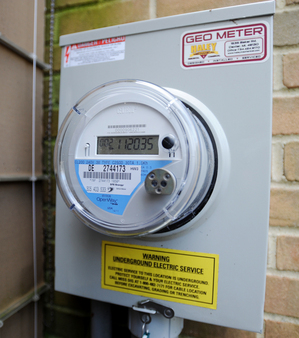
DTE Energy has filed a plan for an opt-out program for residents who don't want a smart meter. The state has to approve the plan, which includes a $15 monthly fee.
File photo | AnnArbor.com
The so-called “smart” meters — which wirelessly distribute information about electricity consumption — allow the Detroit-based utility to remotely monitor power outages and allow customers to track their usage.
Should an individual decide they do not want a smart meter on their residence, they would be charged an $87 initial fee and then a $15 per month surcharge.
The fee and surcharge are intended to cover the cost of switching the smart meter out with a new digital meter, and for the labor hours required to manually read the standard digital meters for billing purposes.
“Anyone who chooses to opt out should have to bear the costs,” Singer said.
For those that express to the utility that they don’t want a smart meter at their residence, a brand new digital meter that looks extremely similar to the advanced model will be installed, Singer said. The digital meter does not emit a radio frequency.
Installing an old analog meter would not make sense as they’re outdated and not manufactured anymore, Singer said.
DTE plans to expand smart meters to all of its customers. The utility began installing the meters this year, beginning with Washtenaw County.
So far, DTE has installed about 48 percent of the 235,000 Washtenaw County customers destined for the smart meters, Singer said. Overall, DTE has installed about 825,000 smart meters to date.
It plans to have a total of 1.2 million meters installed by the end of 2013. DTE estimates it will cost $447 million for 2.6 million meters to serve its electric customers, and is projecting a savings of $65 million per year with the new technology.
About 1,000 customers have contacted DTE with questions about how to opt out of the smart meter program, Singer said in an interview with AnnArbor.com Friday.
At a public meeting in May when Ypsilanti Township officials placed a moratorium on the installation of smart meters until a statewide health study concluded, DTE representative Bob Sitkauskas also reported the same number of complaints.
An investigation by the MPSC that concluded this summer into the radio frequency emitted by the smart meters determined that the health risks are “insignificant.”
A contingent of local residents is continuing to advocate against the smart meters, including Ann Arborite and local psychic Nanci Gerler.
Gerler said she’s developed a heart condition since the smart meters were installed in her southwest Ann Arbor neighborhood. Although her home does not yet have a smart meter, Gerler said she’s not going to let DTE take her analog meter away.
Calling DTE’s opt-out policy, including the additional fees, a “bully mentality,” Gerler said she feels DTE is trying to discredit the people who speak out against the company by calling them an “emotional minority.”
“I can’t think of anything more emotional than your health and well-being,” Gerler said. “DTE has failed to offer — nor has MPSC held their feet to the fire — to prove any cost-efficacy to this whatsoever. My quality of life in and around my neighborhood has declined dramatically since the install.”
Residents in communities that do not yet have smart meters installed cannot opt out of the program until the advanced meters are announced in the market, Singer said.
The DTE opt-out plan for its smart meter program is scheduled for a pre-hearing Sept. 10, Palnau said. It must go before an administrative law judge for a decision before going to the MPSC for a vote.
There is no timeline available at this point for when the opt-out program will become available.
All of the events in the process are public meetings, Palnau said. Public comment can be submitted directly to the MPSC online.
Jackson-based Consumers Energy is also in the process of implementing advanced meters to its customer base, but has yet to file plans for an opt-out program to the MPSC.
Amy Biolchini covers Washtenaw County, health and environmental issues for AnnArbor.com. Reach her at (734) 623-2552, amybiolchini@annarbor.com or on Twitter.
Comments
dan
Tue, Jan 1, 2013 : 5:44 p.m.
So if I opt out, they will charge $87 to cover the cost of a digital meter... BUT, I opted out of having a new digital meter. I think their accounting department misplaced a negative sign. When can I expect a check from DTE for saving them $87 for not installing big brothers new set of eyes in my house?
Mary Ann Barbary
Mon, Aug 27, 2012 : 4:20 p.m.
Could we have a follow-up article with the name of the administrative law judge, if we want to make our opinions known?
moveover2012
Sun, Aug 26, 2012 : 5:44 p.m.
OUR SENATOR Debbie Stabenow Iussed $ 84 MILLION to DTE for the Smart meter. so much for Dte payingALl the cost.
mel
Fri, Aug 24, 2012 : 2:23 p.m.
Since this meter has been installed I have had several heart palpitations, headaches and muscle twitches. I have never in my life had any heart problems. My Mother has multiple Sclerosis and the meter is right outside her bedroom window. My neighbors little girl is having health issues as well as many other friends and family I have spoken with. Some of them never hearing of the smart meter and unaware of why they have suddenly been inflicted with these health issues. Hopefully we will be able to opt out soon or a lot of people are in big trouble with their health. Even though paying $15 per month to have a digital meter without the radio frequencies installed is a rip off (we didn't pay an extra $15 before the new meters for the guy to come out to read it and we haven't gotten any $15 discounts on the bills since) it's still worth it to keep your families health from going down the drain and to keep our children safe. Also, with these monitors they can tell what electrical appliance/lights you use, at what time of day, how often, etc. Essentially, with these patterns they could determine which members are at home at specific times of day. Pretty scary if that info got into the wrong hands. I am praying that something be done and that we soon have the option to opt out. If you have anything "smarta**" to comment, please don't. This is serious and I am afraid for the health of my loved ones and myself. Maybe we should move to a state where these meters are optional...
Judy
Tue, Aug 21, 2012 : 2:03 p.m.
I do not have a smart meter yet, but what if you do not have a computer to get the information from DTE? My husband and I do not have the net or cable TV at home because when he lost his good paying job back in 2009 that was one expense we had to cut. Good think I guess I can go to the library and use there computer, but I agree DTE should sned the smart meter to my home if I ask for it. I am sure many seniors also do not have a computer in there home and would like to see what information the smart meter is saying.
jdmb03
Tue, Aug 21, 2012 : 11:39 a.m.
Ever since we had our 'smart meter' installed I've had a tingling feeling down in my plums, they have turned a purplish hue.
Dr. Darren Schmidt
Tue, Aug 21, 2012 : 2:41 a.m.
http://maisonsaine.ca/smart-meters-correcting-the-gross-misinformation/ 40 scientists correct the gross misinformation on smart meters.
Dr. Darren Schmidt
Tue, Aug 21, 2012 : 2:37 a.m.
http://www7.dleg.state.mi.us/orr/Files/AdminCode/107_92_AdminCode.pdf The rules from Lansing allow us to read our own meters. Why should we pay $15 per month to opt out? So DTE can profit.
Dr. Darren Schmidt
Tue, Aug 21, 2012 : 2:32 a.m.
Two smart meters in Ann Arbor have caught on fire and damaged the homes.
Murf
Mon, Aug 20, 2012 : 3:30 p.m.
Several years ago, I believe YCUA did something similar by attaching a box to the water meter so that the their employee can at least read it remotely from the road. Isn't this the same thing? If so, where was all the uproar with YCUA and their boxes?
Dr. I. Emsayin
Sun, Aug 19, 2012 : 1:46 p.m.
If your meter has not yet been installed call 1-855-864-2271 Advanced Meters Infrastructure. This is what DTE tells customers, and be sure NOT to say "opt out" as that is a different program. Just say Do Not Install.
Ron Granger
Sun, Aug 19, 2012 : 12:31 p.m.
While it is true that the profits of a regulated utility like DTE are capped, that does not mean portions of their business do not over-charge. Also, who owns the company that makes the meters? They get rich off these.
Basic Bob
Mon, Aug 20, 2012 : 4:14 a.m.
Itron, Inc. Liberty Lake, WA President and CEO: LeRoy Nosbaum NASDAQ: ITRI
Ron Granger
Sun, Aug 19, 2012 : 12:25 p.m.
These have already been hacked and, last I read, the industry had no solution.
Lisa
Sun, Aug 19, 2012 : 11:21 a.m.
All of you that did allow the smart meter on your homes will also suffer a big rate increase as well did you know that? The birds you are laughing about I did call and they were Robins. It is usually crows blue jays and ? but not Robins and I meant to publish PSC notes on smart meters so look it up and read !
Tom Todd
Mon, Aug 20, 2012 : 12:03 a.m.
Lots of studies have proven that your bill goes up after the smart meter is installed.
brian
Sun, Aug 19, 2012 : 4:23 a.m.
Well, of course it will come at a price. DTE isn't in the business to lose money. They will get us with what ever meter we have. I say let's go back to the good old days and make a fire to keep warm and cook outside. Just a thought.
Thoughtful
Sun, Aug 19, 2012 : 2:50 a.m.
Apparently the 1000 who are against smart meters have no problem with strangers coming to their home on a regular basis, and no concern for their children or families about said strangers. Recently, on the west side of A2, we had SEVERAL incidences of break-ins as well as a group of adults who would attempt to enter homes on a number of pretexts- "you called for a gutter estimate, here to check our meter, etc" With my new Smart meter installed, there is no reason for anyone to approach my property uninvited, with my posted no soliciting sign. And we have already finished the FEW months where DTE was double checking meters for validity. Just a few months, not several, not years. Both meter installers were pleasant and happy to answer questions, I just missed the gas installer, but saw her nearby- she was more than happy to come back to complete the job. There is another option- go live out in the pesticide free country and get yourself some candles, build an outhouse. You have the choice. Just sayin.
Frustrated in A2
Sun, Aug 19, 2012 : 1:28 a.m.
This was a regular article until I got to the psychic and then it turned to humor. Wouldn't a psychic have seen this coming and moved or voiced their opinion on it earlier?
leaguebus
Sun, Aug 19, 2012 : 12:04 a.m.
Health Canada has studied these meters and says they are no problem. http://www.hc-sc.gc.ca/hl-vs/iyh-vsv/prod/meters-compteurs-eng.php
Jack
Sat, Aug 18, 2012 : 10:13 p.m.
Well done, Amy.
Mac
Sat, Aug 18, 2012 : 10:02 p.m.
Not to mention the absurd idea that it costs then an extra $15 a month to read the physical meter (which they're doing anyway for the next few years) and $87 to replace a meter they haven't even installed yet? With real-time monitoring of your electricity use, it's child play for someone to remotely tell if you're home (less power being used) and decide to go over to your house and snatch some stuff. Who determines who is on the MPSC? Looks like the governor put 'em in there (subject to the Senate), so we can bet the next few will be industry-friendly.
Dog Guy
Sat, Aug 18, 2012 : 11:53 p.m.
The $15 charge includes having my meter read by an intelligent woman who brings a bottle of Shaw shiraz and debates philosophy and the arts with me. (She is completely wrong on gravity and cannot understand that gravity describes increasing disorganization since the big bang.)
jcj
Sat, Aug 18, 2012 : 10:51 p.m.
Mac Will you come over to my house and get my mail drop it in your mail box for $15?
Angry Moderate
Sat, Aug 18, 2012 : 10:10 p.m.
You can't imagine that it costs $15 to pay an employee at least minimum wage to drive a car, which runs on gas, to the house, record the information, and then drive back?
Tom Todd
Sat, Aug 18, 2012 : 9:58 p.m.
we are becoming a third world country with no jobs. I can buy things without going to the store(internet) I can buy grocery's and check them out myself,newspapers are disappearing & the jobs that go with them,you get my drift, now meter readers are out, this is less people supporting the economy paying taxes and buying houses etc. something has to give?
Tom Todd
Mon, Aug 20, 2012 : 12:07 a.m.
guess we can all live and eat at angry moderates and sonnydogs houses since they are not affected by the economy.
SonnyDog09
Sun, Aug 19, 2012 : 12:13 p.m.
Right. And who will stand up for the poor Buggy Whip Makers that are losing their jobs on account of those infernal horseless carriages?
Angry Moderate
Sat, Aug 18, 2012 : 11:03 p.m.
I'm not a meter reader.
Tom Todd
Sat, Aug 18, 2012 : 10:17 p.m.
We are all going to be on welfare or food lines, down the road if we keep this up, unless Your independently Wealthy.
Angry Moderate
Sat, Aug 18, 2012 : 10:08 p.m.
My electric bill is not a welfare program.
Mac
Sat, Aug 18, 2012 : 9:55 p.m.
Yes a single case doesn't prove anything, but if we hear enough of them it may spur some more thorough investigation. I have a patient who has been well controlled for her seizures for a long time. Suddenly after the smart meters are installed on her building, she starts having seizures again. Nothing else changed. Could it be something else? Maybe. But perhaps the intense, irregular and noisy EMF from these is enough to to cause problems in the sensitive. As we pile more and more on to our exposure, at what point will each of us start having problems? I haven't read it, but there's a book by Devra Davis, _ Disconnect: The Truth about Cell Phone Radiation, What the Industry Is Doing to Hide It_ that should go into more details about the effects of this radiation on us all. Does anyone really believe the cell phone industry would commission honest studies about the risks of these high power devices if the study could potentially stop their business in its tracks?
1stho
Sun, Aug 19, 2012 : 12:25 a.m.
You might want to actually read this book before citing it...
jcj
Sat, Aug 18, 2012 : 9:52 p.m.
It would be interesting to know how many of the Nay Sayers are smokers!
Tru2Blu76
Sat, Aug 18, 2012 : 9:45 p.m.
My electric bill rose by 50% in about two years w/o these new meters. I wouldn't worry about the new meters, someone has to find a way to keep DTE from raising rates every time someone sneezes. What we really need is (far) more efficient solar cells. If cyano-bacteria figured out how to use solar power, we ought to be able to do it. :-)
daytona084
Sun, Aug 19, 2012 : 1:32 p.m.
If your electric bill rose by 50% in two years, it's because you used 50% more electricity than two years ago.
leaguebus
Sat, Aug 18, 2012 : 11:50 p.m.
My total bill has gone down by 14% in two years.
Cash
Sat, Aug 18, 2012 : 10:57 p.m.
Agreed. My friends in California get paid by their electric provider....because they generate more solar power than they use at their home and sell it back to their electric provider.
jcj
Sat, Aug 18, 2012 : 9:40 p.m.
Amy Why is it any more significant that a "psychic" is against it than say, a teacher,iron worker, a bagger at Kroger's? What on earth would cause you to put any more credence in her opinion than any one else? Foolishness!
leaguebus
Sat, Aug 18, 2012 : 11:48 p.m.
It would be significant if a whole group of physicists or electrical engineers from the U had opted out.
jcj
Sat, Aug 18, 2012 : 9:36 p.m.
"A contingent of local residents is continuing to advocate against the smart meters, including Ann Arborite and local psychic Nanci Gerler." Wow if I had only known a "psychic" was against them I would never have agreed to have one installed! I can only conclude that those opposed have had a cell phone attached to their ear for to long and it fried their brain.
G. Orwell
Sat, Aug 18, 2012 : 9:07 p.m.
Why can't we read our own meters and send in the data for free? That is the way it was done years ago. We can take pictures of the meters with our cell phones to verify the numbers.
A2comments
Sun, Aug 19, 2012 : 11:52 a.m.
Because then a human has to read the card that DTE pays to mail in.
julieswhimsies
Sat, Aug 18, 2012 : 8:50 p.m.
Wait. If you don't have this service as yet, you have to pay DTE to NOT give you this service?! Huh? Rip-ff artists.
Angry Moderate
Sun, Aug 19, 2012 : 2:27 p.m.
No, you have to pay them to continue giving you the service of reading your meter in-person.
Cash
Sat, Aug 18, 2012 : 10:53 p.m.
Nobody does it better!
mbill
Sat, Aug 18, 2012 : 7:49 p.m.
Nancy should be able to afford the opt out as she charges $150/hour. Or line her walls with lead to sheild her from the cell phones, tv's, radios, photons and electricity.
oyxclean
Sun, Aug 19, 2012 : 10:42 p.m.
$150/hour!? Man, I'm in the wrong business!
MichaelinA2
Sat, Aug 18, 2012 : 6:31 p.m.
For 'Opt-Outers" living in City of Ann Arbor neighborhoods ~ Were you given an opt out choice when the City installed remote readers on your water meter several years ago? If yes, what was the outcome? If no, what's your situation, now? Just curious...
leaguebus
Sat, Aug 18, 2012 : 11:46 p.m.
No opt out for the city, but I have been wearing my tin foil Beanie since then, so I was ready for DTE when they installed my new meter.
dading dont delete me bro
Sat, Aug 18, 2012 : 5:49 p.m.
"Anyone who chooses to opt out should have to bear the costs," Singer said. so are these new smart meter going to increase my bill? sounds like a win-win for dte..
jerry heim
Sat, Aug 18, 2012 : 5 p.m.
There is much to suggest these meters could be devastating to the health of a sizable portion of the population. There are a host of members of the scientific community who are concerned. Why did the A2 News just interview a psychic? Not to diminish Ms. Geller's credentials in any way, but I feel this was an intentional choice on behalf of the reporter to bias the story & make it seem as if only a fringe contingency is concerned about this very serious health issue.
Brad
Sun, Aug 19, 2012 : 7:24 p.m.
Why did they ask a psychic? I guess the holistic chiropractor they also interviewed last time must be busy.
julieswhimsies
Sat, Aug 18, 2012 : 8:51 p.m.
Agreed!
jason c dyer
Sat, Aug 18, 2012 : 4:23 p.m.
i don't have DTE for electricity but i do have them for gas so i am assuming i will have a smart gas meter soon enough, my electric company is probably the biggest crook utility company in the state of Michigan, GREAT LAKES ENERGY , our service charge per month is $19 a month and we have digital meters but not sure if they are smart, but they can read the meter from the station and turn it on and off as well, if the power goes out we still have to call, so no meter readers no tech to come out for anything and i pay no less than $100 a month for electricity and i live with just my wife in a med size mobil home last months bill was $128 , and we are both diabled and on a fixed income so that kind of money is a lot to us, so if you DTE customers are paying more than $19 a month just for the service i feel for you if not quit complaining because i would love to have a choice with electric like we do with gas, because GREAT LAKES ENERGY is probably the most expensive utility company in the state of Michigan
ferdcom
Sat, Aug 18, 2012 : 4:57 p.m.
Great Lakes Energy is a non-profit member owned energy co-operative. Any revenue in excess of costs is supposed be distributed to members ("customers") annually. You get to vote for the directors who manage the co-operative.
Deb Burch
Sat, Aug 18, 2012 : 4:18 p.m.
The company that DTE has contracted to install the meters are not easy to work with. If they need to come inside your home they only offer that by appointment during normal business hours, so you would have to take time off to meet them....and after doing that they cancel. They do offer sat. appointments, but the same applies, they canceled X 3 on me. What at pain!
Basic Bob
Sat, Aug 18, 2012 : 8:55 p.m.
That's why the meters are generally installed on the outside of the house.
xmo
Sat, Aug 18, 2012 : 3:57 p.m.
Sounds like the "GREEN MOVEMENT", taking away your some of your liberty's and forcing products on you that you don't want! "Calling DTE's opt-out policy, including the additional fees, a "bully mentality," "
Middle America
Sun, Aug 19, 2012 : 8:15 a.m.
Why do you capitalize "green movement"? Also, what do you really think is going to happen? Furthermore, if you want to talk about your liberties, don't call them "liberty's" because that makes no sense.
cybercitizen
Sat, Aug 18, 2012 : 3:56 p.m.
monthly fee=carbon taxes. Thank you oh mighty powerful globalist pigs... now we should all be good little slaves and drink plenty of that fluoridated water and take their big pharma drugs that are killing us all! Don't forget to eat all your GMO chemical laced foods loaded with nice chemicals to dumb you down so you are easier to drag off to the reeducation camps! Wake up to what is happening in this world people!
leaguebus
Sat, Aug 18, 2012 : 11:41 p.m.
60 years and counting with fluoride and there has been a huge drop in the number of cavities in kids, plus our life expectancy has gone up 15 years in that time.
Angry Moderate
Sat, Aug 18, 2012 : 8:26 p.m.
Why do the globalist pigs only want a carbon tax on the people who don't get the smart meter? (And why would an electric company want a carbon tax, anyway?)
demistify
Sat, Aug 18, 2012 : 3:47 p.m.
I would be more impressed if the reporter sought advice about radio-frequencies from a physicist instead of a psychic.
Cash
Sat, Aug 18, 2012 : 3:31 p.m.
But will squirrels still chew the powers lines and "cause" power outages, DTE? Having dependable power is more important to me than how you meter it. DTE is one step less popular than Congress for me. Love that they are giving CREDIT to the Oakland County citizens who were without power a whopping TWO days, while over 4th of July week neighbors in Washtenaw County were out for FIVE days during the 100+ temps and DTE refuses to give them anything at all.
Cash
Sun, Aug 19, 2012 : 2:24 p.m.
Not my outage but my elderly (late 80s) neighbors. I'll help them with the forms and do my best to get them some credit. Thanks.
DonBee
Sat, Aug 18, 2012 : 11:13 p.m.
Cash - Go on the MPSC website and download the form, send it to DTE and get your $25 credit. It is the law in Michigan.
Mike
Sat, Aug 18, 2012 : 2:56 p.m.
Smart meter and DTE in one sentence? Not compatible. After years they still can't figure out why our power goes out continuously. When they respond, they manage to park their bucket truck on my lawn rather than my driveway. We had alot of fun this spring didn't we DTE? Right up to the axles. The MPSC needs to stop mollycoddling these dolts.
moveover2012
Sun, Aug 26, 2012 : 5:33 p.m.
The MPSC need to get a leader that speak English and understands the American way of living!
bunnyabbot
Sat, Aug 18, 2012 : 2:34 p.m.
unfournately I do not own the home I live in, so I could not make the decision. I will say that the DTE woman who rang my door bell at 745 was RUDE. I said I didn't want it and would have to ask the owner to let me know if he wanted it, she said it was her third visit and if I didn't have the meter installed I would be charged a huge amount. Turns out it was her FIRST attempt and she completely LIED. The owner of the house never knew about smart meters and is upset about Big Brother monitoring.
Hot Sam
Sun, Aug 19, 2012 : 11:13 a.m.
I had one stop at my house...I said "I really don't want it" she sad "OK" and walked away...NO mention of any cost etc.
DJBudSonic
Sat, Aug 18, 2012 : 2:33 p.m.
Don't expect any help or advocacy from the MPSC, they are in place to rubber stamp anything the utilities ask for. When I asked a field service tech from DTE about the benefit of smart meters to DTE, she said the number one use is that it provides DTE the ability to turn off your power remotely, without having to send someone out to make a disconnect. This gives you an idea of where the priorities are for DTE.
Sparky87
Sat, Aug 18, 2012 : 2:33 p.m.
Is this a ploy by the government to use these smart meters to adjust our power consumption? Will they be able to use these meters to adjust our thermostats higher on warm summer days to lower our power usage?
moveover2012
Sun, Aug 26, 2012 : 5:50 p.m.
Goverment ploy/Check out BLUFFDALE UTAH the new housing for WHOM?
julieswhimsies
Sat, Aug 18, 2012 : 8:57 p.m.
Hey Sparky, DTE is a Corporation!....NOT the government. Wow.
daytona084
Sat, Aug 18, 2012 : 3:46 p.m.
No, the smart meter cannot raise your thermostat. BTW, it's DTE, not "the government".
daytona084
Sat, Aug 18, 2012 : 2:22 p.m.
Are we to assume that everyone who is concerned about the health effects of the smart meter never talks on a cordless or cell phone, never uses a computer with a wireless connection, does not live within range of a cell phone tower or broadcast TV antenna, never goes to the library, McDonalds, or Panera Bread (where they have WiFi), lives outside the range of police and fire dispatch, .... and I could go on and on....
leaguebus
Sat, Aug 18, 2012 : 11:36 p.m.
Don't forget about walking under power lines, if one stands there long enough, you can feel your arm hairs charging up.
G. Orwell
Sat, Aug 18, 2012 : 2:14 p.m.
We have to get rid of this monopoly that is squeezing consumers and the Public Service Commission that is in the pockets of DTE.
leaguebus
Sat, Aug 18, 2012 : 11:34 p.m.
For $30 or $40 grand, you could fill your roof with solar cells and become a mini DTE.
Townie
Sat, Aug 18, 2012 : 2:04 p.m.
OK, I have the new 'smart' meter -- so when can I get all this wonderful data promised about my energy consumption? Even the meter display is a mystery. Still waiting for word from DTE. I suspect there will be a sneaky little charge or fee showing up on my bill once that's implemented. But the cost of having meter readers no longer going house to house will not lower my bill I'll bet . $15 is what DTE says is the cost per month in this article so shouldn't our bills drop by $10- $15 a month following the installation of the smart meters? I'm sure DTE will say 'the savings is already in your bill'. Try and find it. Sure. Of course, reducing consumption with DTE is a bit of a joke - everything we do to reduce consumption (and we've been knocking the number down for years) is matched by some new obscure charge / fee/surcharge, etc. by DTE so what we pay continues to go up. Almost every month it's the same story -- our usage is down from the previous year but what we pay is higher. But that's what DTE is about: pleasing the sacred 'shareholders'. We're just chump customers (with no one else to select) so we don't matter but the stock price does. Just take a look: http://www.google.com/finance?client=ob&q=NYSE:DTE The CEO? He's paid $4.38 million a year (2011, probably higher this year) to push the stock upward, not please 'consumers'. Since he also owns $7.2 million in stock that's what you'd expect. http://www.forbes.com/lists/2011/12/ceo-compensation-11_Gerard-M-Anderson_PUPA.html
Angry Moderate
Sat, Aug 18, 2012 : 8:20 p.m.
What did you want them to do? Hire a psychic to tell them that you want to know how to check your energy usage, and then send an employee to your house to give you the information, so that you don't have to turn on your computer and check their website?
Townie
Sat, Aug 18, 2012 : 5:36 p.m.
OK, thanks. But why couldn't DTE tell us? It's the 'push-pull' issue - 'go to our website' is pull and up to you. But that's DTE's approach - you come to us, we ain't goin' to you.
daytona084
Sat, Aug 18, 2012 : 2:15 p.m.
The information about reading the meter and getting information about your consumption is on DTE's website.
johnnya2
Sat, Aug 18, 2012 : 2:01 p.m.
I drank 10 beers last night and a piece of pizza. I guess pizza causes headaches in the psychic world.
suburbia
Sat, Aug 18, 2012 : 1:56 p.m.
I think this is a great idea and will provide better service and more efficiency for the company and its customers. My water meter has been smart for quite awhile now and for many years, it is nice not having to be home to let the meter person in anymore. While there may be some concerns about the radio frequency, the technology sounds as safe as any other out there. With wireless routers, cell phone towers sending signals everywhere, GPS and entertainment satellites, rf remote controls for your tv, bluetooth, atomic clock signals, electric wires, etc, etc...we are bombarded by signals in the air all the time. This doesn't sound any different that what we're already dealing with. Not that that means it is healthy, but the other technologies have so far proven out.
CindyY
Sat, Aug 18, 2012 : 1:52 p.m.
@hail2thevict0r -- You are so correct in your analysis. Over the last decade, all citizens have been so bathed in radio & microwave frequencies from cell phone towers, GPS satellites, radio broadcasts, WiFi transmitters, etc that the Smart Meter transmissions are dwarfed in comparison.
leaguebus
Sat, Aug 18, 2012 : 11:29 p.m.
It's been longer than a decade, the 2GH microwave dishes have been around since the mid 70's. We have had lower frequency TV and radio since the 20's. Some of the TV and radio are very high power. People in Southfield which has several large antennas have not been dying in droves, yet.
JW
Sat, Aug 18, 2012 : 1:35 p.m.
Gerler should take a statistics class. Correlation does not prove cause.
Some Guy in 734
Sat, Aug 18, 2012 : 7:52 p.m.
Yes, but the plural of "anecdote" is "data".
MRunner73
Sat, Aug 18, 2012 : 1:25 p.m.
It is amazing how much controversy these smart meters have garnered. A little perspective; DTE is not THE ONLY or first utility in the country to install these. For all I know, they may be one of the last which would be ironic. Technology will march forward. Think of the robots at the auto assembly lines who are replacing people, if one wants to debate loss of jobs. These robots are not utilized by only GM but by ALL auto makers. So that discussion has a dead end. If health issues were really a risk, this smart meter techology wouold have never gotton off the ground, nationwide. In the end, my remarks or showing support data otherwise will not convince those who are opposed. Thus, each is entitled to their own opinion. Like it or not, smart meters are coming. I for one am affirmative on the plan.
Chamillion
Mon, Sep 10, 2012 : 2:40 a.m.
Well just like the robots that replaced workers at the auto plants , I just have one thing to say how many jobs did it take from the people and how many new cars has them robots bought as of today.......LOL
moveover2012
Sun, Aug 26, 2012 : 5:31 p.m.
Okay BUT what and where and How are the old meters KILL or what parts being reused? Are they All going into our LANDFILLS?
jcj
Sat, Aug 18, 2012 : 9:51 p.m.
Billy Bob I suspect you were soo concerned about the automobile that you have never owned one!
Billy Bob Schwartz
Sat, Aug 18, 2012 : 9:06 p.m.
"If health issues were really a risk, this smart meter techology wouold have never gotton off the ground, nationwide." Are you kidding, MR? Let's make a list of any new technology that had health risks but still got off the ground. Um, let' see now, the automobile, coal burning furnaces, hydrocarbon-emission-producing fossil fuels in automobiles, thalidomide for expectant moms, the tanning booth, DDT, lead in paint and in gasoline, etc. etc. etc. There is absolutely no connection between the dangers of new technology and it's ability to get off the ground, nationwide or otherwise.
hail2thevict0r
Sat, Aug 18, 2012 : 1:09 p.m.
In today's world where we're being constantly bombarded by cell phone, WiFi, Radio and all sorts of different transmissions - I don't see how it's possible that someone out there could be afraid of these for health reasons. It sends a signal like once every 15 minutes. Your neighbor's wireless is doing more "harm" to you than that. But I guess DTE is allowing people to wear their tin foil - at least they'll have to pay for it. I have no problem with DTE doing this.
moveover2012
Sun, Aug 26, 2012 : 5:30 p.m.
Check this out with Dr. Mercola on the computer and see HOW GOOD we are and what effect all this technologie has on us. Haarp .com also and the lost continent of Atlantis< our time is running OUT!
Jim Whittenberg
Sat, Aug 18, 2012 : 12:55 p.m.
If you need something (clothes, computer, car, etc...) you can go to a store or the internet and choose the one that you would like but for electricity in most areas you have only one choice. No matter what kind of meter they install on your house will really matter unless they have someone else to compete with to fix the price gouging.
Lola
Sat, Aug 18, 2012 : 5:25 p.m.
Great point, Jim! And while we're at it, how about a little competiton with cable providers?? If you ask me, this is the stuff city council should be dealing with!
Basic Bob
Sat, Aug 18, 2012 : 2:06 p.m.
So the CEO of the power company is rich compared to, say, the CEOs of Microsoft, Wal-mart, Apple, CBS, Fox, United Health, Starbucks, Disney, or Facebook? Maybe we should talk to some of these folks about price gouging.
johnnya2
Sat, Aug 18, 2012 : 1:59 p.m.
Not true. Many people are "off the grid". You can produce your own power with a generator, wind, solar, or hydro. You can not do it as cheaply and efficiently, but you have that option. You CHOOSE this option because it saves you money and headache
DonBee
Sat, Aug 18, 2012 : 12:51 p.m.
One item to remember - without a smart meter - the ONLY way the utility knows your lights are out is if you pick up the phone and call them. With a smart meter they CAN get an outage message from your meter as the power goes out. I kind of like the idea that if I am at work and the lights go out - that the utility does not have to wait for me to come home to call to find out the power is out.
moveover2012
Sun, Aug 26, 2012 : 5:40 p.m.
To LOLA: The city collectsFRANCHISE FEE from the cable company! So NO help to you/me.!
arborani
Sun, Aug 19, 2012 : 6:21 p.m.
We keep an inexpensive corded phone at hand for just that contingency.
WalkingJoe
Sun, Aug 19, 2012 : 2:44 a.m.
Or use your cell phone.
ferdcom
Sat, Aug 18, 2012 : 4:37 p.m.
@demistify Plug in a old fashion corded phone. They don't need electricity.
demistify
Sat, Aug 18, 2012 : 4:04 p.m.
For many of us, picking up the phone does no good. The phone does not work without power.
J. A. Pieper
Sat, Aug 18, 2012 : 3 p.m.
Both times I have had a power outage since my new meter has been installed, I did not call, and neither did my neighbors. The issue was solved in a timely manner. I live on the East side thought!
woolspinner
Sat, Aug 18, 2012 : 2:26 p.m.
You might need something besides a "Smart Meter" to tell DTE about a power outage. We have a "Smart" meter and had to call about two recent power outages in my neighborhood just west of A2.
Brad
Sat, Aug 18, 2012 : 12:37 p.m.
So how does this all turn out, Nanci? You are a psychic, right?
1stho
Sat, Aug 18, 2012 : 11:51 p.m.
ROFL!
David Cahill
Sat, Aug 18, 2012 : 12:24 p.m.
One thousand complainers out of millions? Sending them all aluminum foil hats would be cheaper.
arborani
Sun, Aug 19, 2012 : 6:22 p.m.
Ouch.
Brad
Sat, Aug 18, 2012 : 12:36 p.m.
Nah, the aluminum warps their auras, resonates with their crystals, and short circuits their chakras.
Colby
Sat, Aug 18, 2012 : 12:22 p.m.
Clearly the Ypsilanti Township moratorium had no effect, as my smart meter was installed, with no advance notice by DTE, several weeks ago.
motorcycleminer
Sat, Aug 18, 2012 : 11:42 a.m.
Electricity, other than lightning does not come from god ...it is a commodity that you can buy...if you don't want it as deliverd by the manufacturer, don't buy it...you may opt out to the dark ages..or perhaps in the case of psychic gerler she can conjur up her own....duh....
bobslowson
Mon, Aug 20, 2012 : 3:10 p.m.
Lightning doesn't come from god either...jus sayin...
A2comments
Sat, Aug 18, 2012 : 11:37 a.m.
Did she offer medical proof that she developed a heart condition since meters were installed in her neighborhood (but not at her house)? We missed the installer of the smart meter, but the installer of the gas meter attachment (which transmits to the electric meter) rang the bell, stepped off the porch (to not concern us that a stranger was at the door), identified himself, and explained why he was there. Very courteous, even explained how it worked (transmits from the gas meter to the electric meter) while he worked.
Billy
Sat, Aug 18, 2012 : 11:52 a.m.
I'm not surprised by that at all. I bet because of all the negative publicity they've taken extra steps with their installers to make SURE they are very courteous to customers and are very knowledgeable about everything they are doing. With a company like DTE....your installers are ALSO your frontline PR guys cause those are really the only people you ever see or interact with from the company.
Billy
Sat, Aug 18, 2012 : 11:29 a.m.
"and local psychic Nanci Gerler." That doesn't actually make your opinion stronger....just sayin'
Basic Bob
Sat, Aug 18, 2012 : 11:40 a.m.
Even after the smart meters are installed, I will still wear the tinfoil hat around Nanci. Just to be safe.
db
Sat, Aug 18, 2012 : 11:36 a.m.
Awesome.
trespass
Sat, Aug 18, 2012 : 11:06 a.m.
At a time when cyber attacks are rising rapidly, is it wise to put our utilities under direct computer control. Look at the damage done by the stuxnet virus. I asked the DTE official that question at the Ypsilanti Township meeting but he just assured the public that DTE had good computer security. If cyber attackers can get into Google, the China Commission and even some Dept. of Defense computers, why should we feel reassured that they cannot get into DTEs computer. If the only real reason to make this change is to save the cost of a few meter readers it doesn't make sense. I don't think DTE is being honest about all of the other reasons they are doing this. They forsee electricity shortages and they want to be able to easily brown out or black out selected homes or areas easily. They want to be able to charge different rates depending on their formula on optimum usage. It is going to be a little like Google saving every search term you have ever used. It is one more way that coporations will increasingly manage our lives.
Middle America
Sun, Aug 19, 2012 : 8:18 a.m.
"At a time when cyber attacks are rising rapidly" means what exactly? What are "cyber attacks" and how could they affect your electric service?
Itchy
Sat, Aug 18, 2012 : 5:27 p.m.
Obama was the source of the stuxnet virus. You trust him, don't you?
Mick52
Sat, Aug 18, 2012 : 5:04 p.m.
"If the only real reason to make this change is to save the cost of a few meter readers it doesn't make sense." The article says it will save $65 million a year. Makes sense to me.
demistify
Sat, Aug 18, 2012 : 3:56 p.m.
Unless you are connected with the Iranian atomic bomb project, the Stuxnet virus will not affect you.
hail2thevict0r
Sat, Aug 18, 2012 : 1:06 p.m.
What do you think they're going to get? Your name, address and power usage? What do you expect them to do with this information? You should be more worried about someone stealing your mail than the information transmitted by one of these meters.
Basic Bob
Sat, Aug 18, 2012 : 12:52 p.m.
"Look at the damage done by the stuxnet virus" Quite funny, since it only affected systems at a specific (alleged) uranium enrichment facility in Iran. At great cost to the (alleged) US and (alleged) Israeli government, and with specific proprietary knowledge of the control system (possibly reverse engineered).
GoNavy
Sat, Aug 18, 2012 : 12:32 p.m.
Are you certain that these meters are designed to be operated remotely, rather than simply having the ability to share their information with a remote office? It's one thing to submit statistical/usage data over the Internet; it's a completely different situation if we were to enable remote meter control (which I feel is not the case here).
Bob W
Sat, Aug 18, 2012 : 10:50 a.m.
Well, if $15/mo. is the labor cost to read the old style meter for billing, when will I see the reduction in my bill for having the smart meter installed? ;o)
Bob W
Sat, Aug 18, 2012 : 1:47 p.m.
DonBee, good point.
DonBee
Sat, Aug 18, 2012 : 12:47 p.m.
When you read every meter on the street in the most efficient manner with a human - it does not cost $15 a month. When you read one or two meters in an area and have to send someone out to do it - it does.
GoNavy
Sat, Aug 18, 2012 : 12:30 p.m.
Technically, you will. Public utilities which are granted a local monopoly operate under strict regulation which dictates the profit margins of said utilities. If that profit margin rises due to cost savings, technically those cost savings should be passed further down the line to consumers.
Jennifer Fillion
Sat, Aug 18, 2012 : 10:50 a.m.
This is pretty interesting since the meter reader who comes to our house after they have installed the "new meter"" told us that they will still be using people to check the meters to verify they are correct for several years before they can operate everything on the new "smart" system. So why should people who opt out not be able to a) to pay anything until the new system is totally operational or b) read their own meter and report the results like we had to up North?
jns131
Sat, Aug 18, 2012 : 6:53 p.m.
I miss reading my own meter. Filling out those little cards, with those little lines to the what the meter says..........those were the days my friend. Not now. Dead birds and what ever else is happening to the environment. O well. Just put the box up and stay outta my house.
A2comments
Sat, Aug 18, 2012 : 11:38 a.m.
Several months, not years.
Lisa
Sat, Aug 18, 2012 : 10:23 a.m.
I believe an independent not affiliate of DTE should have the device monitoring for safety reasons . Where they have been installed I have found small forest animals birds dead . What is this so called smart meter doing to the enviorment.http://www.earthcalm.com/5582/emf-dangers-2/smart-meter-radiation-risks/ please read I have heard of my neighbors with pace makers having issues. The people are rude also they come through your gated home and act like they own it. Cause damage to gates and don't care that is another issue . This will take 1000's of jobs away and what would Edison say??????This is America DTE you don;t own our homes pay our taxes .You have no right to come on our property and do what ever you want let our pets out break our gates get real . Have an Independent company do all testing for a year and let the people decide not a company that pimps your pocket every month/ This is ambush at its finest. We want the truth is that too much to ask? NO
daytona084
Sat, Aug 18, 2012 : 2:03 p.m.
That's funny, I found a dead bird in my yard and I don't have a smart meter yet. However, I did see someone walking nearby once with a cell phone. That's probably what killed the bird.
GP
Sat, Aug 18, 2012 : 1:44 p.m.
Lisa, if you are finding birds dead it is more likely from the West Nile Virus. I am completely serious. Epidemiologists explain bird deaths are a significant indicator of the virus and when tested, it is usually found the virus is the cause of the birds' death.
Jim Doyle
Sat, Aug 18, 2012 : 1:40 p.m.
Just for balance, take a look at this website: http://www.skepticnorth.com/2009/12/why-i-bet-you-didnt-even-know-about-brain-fog/comment-page-1/ . It seems to me that Earthcalm is just another opportunistic vehicle to alarm people and scam them into buying their products. Unfortunately, it looks like they have "easy picking" for some people.
Steve Hendel
Sat, Aug 18, 2012 : 12:34 p.m.
Lisa, calm down...
A2comments
Sat, Aug 18, 2012 : 11:39 a.m.
Have you called the authorities to show the proof of the small forest animal deaths?
Basic Bob
Sat, Aug 18, 2012 : 10:59 a.m.
@Lisa, these units are tested by independent laboratories and meet 10 national and international standards. They are far safer than wireless internet or cell phones. If you can afford a forested preserve inside a gated community, you can afford a few extra bucks to have a worker manually read your meter.
walker101
Sat, Aug 18, 2012 : 10:33 a.m.
Unfortunately the utilities do have a right and the initial homeowner who asked to have service for any utility gave them eminent domain for installing their meters from the street to the house. You can elect to have them removed (utilities) but you'll have to go back to candles and wood burning stoves. Your Public Utility Commission gave them permission to install, this has been ongoing probably for about the last 8-10 years and former governor.