

Superintendent: Consulting group's role in closing Ann Arbor achievement gap will be 'significantly less'
As the Ann Arbor school district prepares to implement Superintendent Patricia Green's plan for closing the achievement gap, it will significantly reduce its reliance on a consultant paid $441,000 over the last six years to address the problem, Green said.
Green said the district has been contracting with Pacific Educational Group for about seven years, spending a minimum of $30,000 per year. And from what she can tell, the firm wasn’t using any “measurable components” to gauge the district’s progress toward eliminating the gap, she said.
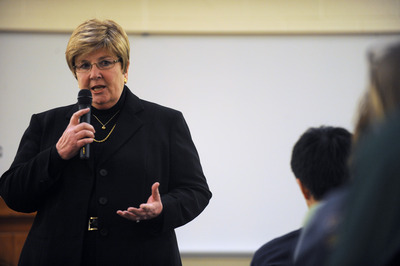
Ann Arbor Superintendent Patricia Green
Improving minority students' test scores has been a priority of the Ann Arbor Public Schools for nearly 31 years. But the problem has remained persistently stubborn. The performance of Ann Arbor black and Hispanic students still lags well behind that of their white classmates on standardized tests. Just last week, that gap placed many of the district's schools on a state list targeted for improvement.
From March 2005 until June 2011, the district spent $441,130.06 on various services from the Pacific Educational Group, as previously reported by AnnArbor.com. That’s an average of $73,521.68 per year.
Most of the charges were for consulting services and travel expenses for Glenn Singleton, chief executive officer of PEG, and other individuals within his organization.
The group started out training administrators on how to develop an “equity framework,” for looking at race from different perspectives. PEG’s training eventually translated into the development of equity teams throughout the district.
Part of Green’s plan, which is now in the action/implementation phase, includes creating equity teams at the remaining buildings throughout the district. However, rather than using the Pacific Educational Group for this training, Green intends to use Tappan Middle School Principal Jazz Parks and Logan Elementary School Principal Terra Webster.
Both of these principals have built successful equity teams at their schools, Green said in March when she rolled out her plan to address the achievement gap. They will lead professional development throughout the district in an effort to eliminate inconsistencies in grading and assessment practices, she said. They will emphasize culturally responsive teaching techniques, instruction strategies and the use of supportive interventions, Green said.
Moving forward, the district will contract with the Pacific Educational Group to provide “Beyond Diversity” training only. Even then, the consulting firm will be called upon for this service to bring only “limited” new employees entering the district “up to speed,” Green said.
Beyond Diversity is Singleton’s nationally recognized method for improving race relations at educational institutions. Based on this platform, Singleton co-authored the book “Courageous Conversations About Race: A Field Guide for Achieving Equity in Schools.”
Green’s previous experience in diversity education and her understanding of the role the discipline gap plays closing a district's achievement gap was one of the reasons the Board of Education hired her. "It's hand in glove," she said previously of the correlating gaps.
The discipline gap refers to the disproportionate number of black, Hispanic, special needs and economically disadvantaged students being removed or suspended from the classroom. In Ann Arbor, 42.4 percent of all students suspended in 2010-11 were black, when black students made up 14.3 percent of the entire student population that year.
Green has a track record of reducing the number of suspensions in the districts she served prior to Ann Arbor. In 2011, she received the Spirit Unity Award from the North Hills Anti-Racism Coalition for leading efforts to promote multicultural awareness and sensitivity at North Allegheny School District in Pennsylvania.
On Thursday, the Michigan Department of Education released its annual report card for schools, complete with new designations that highlight performance discrepancies at individual buildings. Ann Arbor had 27 of its 33 schools targeted for improvement by the state due to its achievement gap. District leaders said the report cards further emphasized the need for the gap elimination plans that are being implemented.
On the Michigan Educational Assessment Program exam in 2010-11, 80 percent of Caucasian fifth-graders scored proficient in math, while just 32 percent of African American students and 42 percent of Hispanics scored the same. In reading, 93 percent of Caucasians, 50 percent of African Americans and 55 percent of Hispanics scored proficient.
Aside from constructing equity teams at all of Ann Arbor Public Schools' buildings, the other components and focus areas of Green's achievement gap elimination plan are:
- Developing clearly defined and articulated content and grading standards
- Developing an accountability system
- Quality professional development
- Parent and community engagement
- Student engagement
- Improving early childhood programs
- Understanding the barriers to learning and resources
- Providing student intervention and support services
Danielle Arndt covers K-12 education for AnnArbor.com. Follow her on Twitter @DanielleArndt or email her at daniellearndt@annarbor.com.
Comments
Dog Guy
Mon, Aug 6, 2012 : 3:27 p.m.
"Out of the 40 people who were given one-year rent subsidies when they were evicted in June from the homeless camp on state land in Scio Township, more than half have yet to find a new residence." And they are threatening to start a new Camp. These threats are quite as much a taxpayer shakedown as AAPS' achievement and discipline gaps. The threats never stop despite ever-increasing payoffs. Why do we tolerate such protection racketeers?
ViSHa
Mon, Aug 6, 2012 : 2:14 p.m.
I am hoping "significantly less" is code for we are letting his contract run out. This superintendent has a youtube video about the Comer School Development Program of which I have yet to find any smoking guns on line (compared to all the complaints and lawsuits concerning Glenn Singleton and PEG). I agree somewhat with the sentiment of "the world needs ditch diggers" (movie quote) but let's not write off children until they have at least been given a chance to elevate themselves. If they choose not to take advantage of the chances, then so be it, but they cannot help what they are born into.
no flamers!
Mon, Aug 6, 2012 : 1:38 p.m.
We should not be trying to "close the gap" between the educational achievements of students of different races. We should be trying to elevate the educational achievements of all students regardless of race.
Macabre Sunset
Mon, Aug 6, 2012 : 6:10 p.m.
Sorry, no flamers, common sense has no place in a debate involving the AAPS.
Unusual Suspect
Mon, Aug 6, 2012 : 1:44 p.m.
Agree. The size of the gap should not be the goal. Educating every student as much as possible should be the goal.
Elijah Shalis
Mon, Aug 6, 2012 : 11:52 a.m.
The desire to learn starts at home with the parents, schools can not fulfill that function unless they are boarding schools. Also some kids are just dumb IQ wise. The World needs ditch diggers.
Stuart Brown
Mon, Aug 6, 2012 : 5:56 a.m.
The suspension rate for blacks (three times that of whites) says it all and is probably the tip of the iceberg. Metrics like this tend to favor the notion that more than just social-economic explanations are involved.
Stuart Brown
Tue, Aug 7, 2012 : 3:01 a.m.
justcary, You appear to have misjudged my position; I am arguing that three times the suspension rate can't be accounted for by only economic status. More than likely, race itself is a factor in the high suspension rate. Makes me wonder what else they are doing besides suspending people of color at much higher rates (like not teaching anything?) I bet the true purpose of the achievement gap program was to justify keeping things the way they are (we have a program to study the issue, what more do you want!)
justcary
Mon, Aug 6, 2012 : 3:54 p.m.
Just because one uses the word 'metrics' doesn't mean one understands how the data can be disaggregated (take that!) and account for socioeconomic status. I've been to the meetings. No statistical expert is needed to satisfy the "this is not race it's income" deniers. All you do is pluck all the single-mother $25K-$35K family data from the AAPS database, and then look at race. Race should not show up there as a predictor of success with this filter, by your assumption, but it DOES. And it does to a degree in Ann Arbor that it does not in comparable districts. So YES something's wrong and we can't just explain it away.
Macabre Sunset
Mon, Aug 6, 2012 : 3:57 a.m.
It doesn't seem like Patricia Green understands education. This is a parenting gap, not an achievement gap. Time and time again, we see African-American children with supportive parents faring quite well in Ann Arbor. Treating this as a racial issue only ensures that more African-American children will give up because they perceive the system as inequitable when really they're simply not being supported by their parents. The "discipline gap" is a particularly insidious invention. Now, teachers can only discipline African-American students for the most egregious violations. By the time they get there, it's too late - they're problem student. Now, because of Green, you really do have racism in the schools - and the victims are, you guessed it, the kids who might have been turned around if Green were a real educator who understood and cared about individuals rather than numbers. I think Green should resign, along with the school board members who recommended hiring her.
Basic Bob
Mon, Aug 6, 2012 : 10:47 a.m.
She is clearly out of her league. Not so many minorities in suburban Pittsburgh. It was a non-problem just like Saline or Dexter. Maybe if they eliminate busing the minorities will drop out since their parents can't all buy them BMWs or Toyotas.
livingthelife
Mon, Aug 6, 2012 : 2:17 a.m.
So...what other consultants are on the payroll. It seems that this should be investigated seeing as money has been poorly allocated in the past toward consultant services.
mun
Mon, Aug 6, 2012 : 1:40 a.m.
Two words: Parental involvement.
Piledriver
Mon, Aug 6, 2012 : 12:24 a.m.
Why are we so worried about this "achievement gap"....the world needs ditch diggers too!
justcary
Mon, Aug 6, 2012 : 3:44 p.m.
"Gunga...gunga gulunga..." Seriously, it is appropriate for AAPS to ask the questions: Is this kid a ditch digger because WE shortchanged him in the classroom by failing to engage him? Is there something we can do better? Do others do it better? The answer to the last question is YES, which means we must persist.
Dog Guy
Mon, Aug 6, 2012 : 3:32 p.m.
(Spaulding) "You'll get nothing and like it!"
Unusual Suspect
Mon, Aug 6, 2012 : 1:42 p.m.
"Spalding get your foot off the boat!"
DJBudSonic
Mon, Aug 6, 2012 : 11:54 a.m.
"...felt I owed it to them."
local
Sun, Aug 5, 2012 : 11:19 p.m.
Couple of quick comments from someone who lives it everyday in an elementary classroom: Teachers can't discipline certain kids, and kids who deserve suspensions don't get them. (threatening to kill teachers/EI students, using foul language, etc...) It hurts the principal evaluation and the districts discipline gap. The flag idea will be a debacle because schools will alter discipline to make sure flag flies high on that pole. Wouldn't want parents to be upset that the school flag isn't at its highest. Teachers hands are clearly tied, that is why I am not using my name. Have had and seen some of the worst behavior over the past few years, nothing we can do about it. Just as a reference from my classroom experience, all kids are those who come from families who simply aren't around. I have to hunt them down for conferences and I struggle to contact them when needed. Our district has made it almost impossible to educate those kids in the classroom who want to be there, and who are vested in the lessons of the day. Teachers are spending more time and energy on the few, and a lot less on those who want to learn and are excited to be at school (the majority). Dr. Green has done nothing to gain support from the teachers who are simply doing the work. It seems easy to make statements behind your glass office when it isn't you doing the hard work in the classroom. Clearly a disconnect between those at Balas and those doing the work (teachers). This is clearly a parent gap issue, my 12 years of teaching is the data I am using to make that statement. Until that issue is addressed, this conversation will continue. AnnArbor.com would benefit from having those conversations with those doing the work, not just those sitting around Balas being theoretical about the issues.
J. A. Pieper
Wed, Aug 8, 2012 : 2:37 a.m.
Local, you have said it all. I have taught many years more than you have, and see the increase in students who are just not involved in the learning process. You are so on target about the flag issue, every school will be perfect now, so the problem will be "solved." Please continue to share your experiences!
ViSHa
Mon, Aug 6, 2012 : 12:37 p.m.
I think daily homework clubs are a great idea but then you run into the problem of late buses, currently I don't believe there are late buses at elementary schools. I like the mentoring idea too, maybe our high priced legal expert could look into how something like that could work, when he is not too busy being farmed out to "increase AAPS revenue" that is ~sarcasm~
anotherannarborite
Mon, Aug 6, 2012 : 2:43 a.m.
I agree that the problem is real and the reasons for the problem is home based. Not necessarily because they don't care but because their value system is different or they don't know how to be acedemically supportive outside of shouting out spelling words. But what are we going to do, let kids fail in school who don't get what they need from home and don't miraculously have motivation to seek it out themselves? Of course not. One idea is extended day (parents who don't want to parent will definitely take advantage of that). Another idea is early and extensive parent education so parents know what they can do to help. Another idea is a true mentoring program for low acheivering students - not the once a week go out for ice ceam big sister type programs, but true academic and life mentoring. Another idea is free tutoring for students on free/reduced lunch (we all know that a majority of students from families with means have purchased tutoring at one point or another.) Title I money should be used on the students that bring that money into the school anyway. Another idea is expand and really utilize homework club like programs - and extend it to before school homework club too. Again, extended day will get those students who need it into a more supportive, intellectually stimulating environment for more of their day. And give students a supportive environment to do homework. I could go on and on. There are many ideas. Which ones really work? Some work for some kids, others for other kids. I'm sure there's data on it.
KeepingItReal
Mon, Aug 6, 2012 : 1:17 a.m.
local: When you have "so called community leaders" who Dr. Green is promoting as part of her "community engagement" initiative, irresponsibly linking the achievement gap to the aa.com not promoting African American students in their citizens of the year award..it only highlights why there is an achievement gap. I attended the "Achievement Gap" forum at the Michigan Theater on and it was very disappointing to see so called community leaders and educators not addressing this problem in a district such as Ann Arbor. Perhaps we nee to address the "leadership gap" in both the district and community leaders who profess to be concerned about this problem. It is irresponsible when a leader of an organization associates the achievement gp with the aa.com not having any African American students in its final pool of Young Student of the Year award." What a week act.of leadership the irresponsible notion that aa.com have had an African American Students who was supported or promoted for the citizen of the year award. While race continue to be a factor in the prevalence of African American life in this country, you will not be able to deal with the "achievement gap,"or "discipline gap," until internal issues of self respect and high expectations are addressed. It is futile to think otherwise.
Dog Guy
Mon, Aug 6, 2012 : 12:13 a.m.
Amen, Sister! Teach that truth, Brother!
A2Realilty
Sun, Aug 5, 2012 : 10:58 p.m.
This gap will not be fixed. It will always exist. Some families value education. Some families do not. Wasting time on the achievement gap is a worthless endeavor. Teach the students that want to learn.
Dog Guy
Mon, Aug 6, 2012 : 12:34 a.m.
A gap will always exist, but may be crossed by many. Aristotle, the greatest observational researcher (Heavier things do too fall faster.), wrote that "All men by nature desire to know." So I teach only the humans.
JRW
Sun, Aug 5, 2012 : 9:20 p.m.
"As the Ann Arbor school district prepares to implement Superintendent Patricia Green's plan for closing the achievement gap, it will significantly reduce its reliance on a consultant paid $441,000 over the last six years to address the problem, Green said." What exactly did AAPS get for $441,000 in consultant fees? 'And from what she can tell, the firm wasn't using any "measureable components" to gauge the district's progress toward eliminating the gap, she said.' What were they using instead of measurable components? (BTW, measurable is spelled incorrectly in this quote.)
vivian
Sun, Aug 5, 2012 : 10:46 p.m.
Chances are excellent that they got the usual blather from the high-priced consultants. Common sense and a willingness to face facts are free, and we'd do a lot better with those.
Me717
Sun, Aug 5, 2012 : 9:08 p.m.
Here is an inexpensive way to help close the achievement gap: Have and enforce an attendance policy. Stand outside any school and count how many students walk into school late. Look at the attendance data and compare it to achievement data. At the the high school level it should be easy see a pattern in the data with the late/absent students failing 1st hour. AAPS could make a difference in the achievement gap immediately by enforcing an attendance policy at all the schools.
Me717
Sun, Aug 5, 2012 : 10:33 p.m.
10+ days absent is too many for teachers or students.
A Voice of Reason
Sun, Aug 5, 2012 : 9:27 p.m.
http://www.brendanwalsh.us/2012/04/absenses-enough-to-make-you-sick/ 33% of the AAPS teachers miss 10+ days of school. We should start with making sure that the teachers are there to teach.
A Voice of Reason
Sun, Aug 5, 2012 : 9:23 p.m.
Are you talking about teachers not being in the class rooms vs. the 13 day off school they get and numerous meetings that they attend during the day? Check out the substitute budget.
JRW
Sun, Aug 5, 2012 : 9:21 p.m.
How about enforcing the residency policy and stopping the scams of students living with "uncles" in apartments in the boundaries, that no one verifies.
Momma G
Sun, Aug 5, 2012 : 5:28 p.m.
How about breaking all ties. Singleton didn't impress me at all and the number one problem with the gap is and will always be "non-parent" involvement. It has been proven if the parents are invovled in their child's education whether it be encouragement, reading to them at an early age, assisting in the classroom, staying on top of their school work, etc. students do better in school. There are too many parents who do nothing and probably shouldn't have children to begin with.
Jay Thomas
Sun, Aug 5, 2012 : 4:23 p.m.
The gap in the ann arbor schools is no different than the gap in state and national test scores of course. But the powers that be have to be seen to be doing something so they throw money at consultants. Some people value education and others don't, thinking that school attendance alone demonstrates their commitment. It's time we stop putting all the responsibility on the schools when so many seem to do just fine attending the same classes. Equal opportunity doesn't mean equal outcomes.
justcary
Mon, Aug 6, 2012 : 3:40 p.m.
I sometimes wish the moderators would hold commenters to reasonable standards of publishing, like Where Do You Get Your Data? The whole reason this keeps coming back as a big deal in Ann Arbor is because ANN ARBOR's gap IS different than the norm. It's egregious, professionally embarrassing to the faculty and administration, and frustrating to parents like me who attend PTSO meetings and look at the data firsthand. That's Where I Get My Data.
A Voice of Reason
Sun, Aug 5, 2012 : 4:18 p.m.
I am sorry, these solution are vague and abstract. Let's hear the hard facts about what you are planning to do and how are you going to assess if children are learning. How many children did not understand math last year? A 1 on the MEAP is meeting National Standards (NAPE)--so our advanced is not really correct--other than in the State of Michigan's mind. And, hello parents, you are being fooled too. So, for example, at Tappan Middle School, only 12% of 7th graders are meeting national standards in math (scored a 1 on the MEAP). I think the Connected Math program and the outdated teaching styles are the problem. Children need daily feedback and assessment to make sure they understand math. There should be after school help groups nightly to go over assignments and homework help. Once a week tutoring does not cut it, especially by the unclear teacher who is teaching the class.
A Voice of Reason
Sun, Aug 5, 2012 : 9:22 p.m.
Never mind, the article has that figure paid to consultants. Good point!
A Voice of Reason
Sun, Aug 5, 2012 : 9:20 p.m.
What? Well, there was $80,000 spend wasted on a special election. I am not sure where the $440K you are talking about. There is plenty of money in the system. Maybe teachers should pay a little of their health care benefits. I guess that is the $440,000 you are talking about.
barb
Sun, Aug 5, 2012 : 4:40 p.m.
$441,000 could have bought a lot of after school help...
barb
Sun, Aug 5, 2012 : 3:32 p.m.
Glad to hear they are reducing ties (although I would prefer cutting ties) with the race-baiter Singleton. Has anyone asked any of the kids who fall into the gap if they had any ideas on how to help them do better? (Realistic ideas, not silly "yeah, pay me", etc..). I would also like to know what culturally responsive teaching techniques are and how teachers are expected to use these in the classroom? When something has to have a PC name like this, I become suspicious.
MsWebster
Sun, Aug 5, 2012 : 4:01 p.m.
If you are up for a lot of ed-jargon, here's a link to "culturally responsive teaching". http://www.alliance.brown.edu/tdl/tl-strategies/crt-principles.shtml As a teacher in A2, I look forward to some really good Professional Development, as promised by Super.Green. We spend most of our p.d. sifting through data or learning about the new evaluation process instead of focusing on students and curriculum.
Karen
Sun, Aug 5, 2012 : 2:18 p.m.
"Consultant's role...will be significantly less". How about zero - equal to the progress made using their expensive help. Thank g*d I don't have a child in the AA school system any more - no doubt in my mind using the new "equitable" disciplinary quotas that my child would be "disciplined" despite obeying the rules and not disrupting class to equalize the numbers.
Wake Up A2
Sun, Aug 5, 2012 : 2:18 p.m.
I wonder what the gap is with students who start in kindergarten and go through 12th grade compared to the vast numbers of kids that only do high school or middle school. I bet there is much less of a gap with k-12 when they stay compared to those who show up with other districts issues.
Dog Guy
Sun, Aug 5, 2012 : 2:15 p.m.
Do a significant number of mothers in the AAPS district value their children more for current payments and benefits than for future potential? Does the government pay for failure and turpitude? Mothers tend to have a broader view than fathers and fathers tend to have a longer view than mothers; both are needed, but are both present? School discipline and academic performance mirror family integrity (except for a few mean and lazy kids who hang out together).
Tony Livingston
Sun, Aug 5, 2012 : 2:14 p.m.
It would be really helpful to disadvantage students if the administration would look beyond test scores for areas where there is significant exclusion. Chief among those areas is high school sports. Since winning is such a priority, coaches spend little time developing athletes who come from the local programs. Instead, they cherry pick the kids with years of private club and travel team experience. Everyone is quick to point out the benefits of participatiing in sports, but coaches are king, beyond question, and focused totally on winning. High school sports have become an extension of private organizations. There are a few exceptions, but this is more and more the trend. Pulling kids into after school activities like sports instead of keeping them out is an excellent way to integrate different groups and cultures and give kids a reason to come to school. I think everyone agrees with this, but no one wants to challenge the win at all cost mentality to make any changes.
Tony Livingston
Tue, Aug 7, 2012 : 7:58 p.m.
I agree anotherannarborite. High school sports serve certain students (the one who make the team and actually get to play) very well but do little for anyone else. I would like to see the number of competitive sports teams cut way back, be pay to play, and put the money into after school intramurals that everyone can play in.
anotherannarborite
Mon, Aug 6, 2012 : 2:26 a.m.
We absolutely need FREE intermaural or club sports at middle and high school. Let kids (parents) pay for the cut teams. My daughter loves sport and had to alter what sports she did because she is not that good of an athlete. She had to choose sports that didn't cut, but they weren't her first choice..
vivian
Sun, Aug 5, 2012 : 10:43 p.m.
Yes, getting rid of high school athletics would be a good start. Let the kids play intramural sports for exercise and fun, if they want, but keep the competition between schools--and all the attendant nonsense--out of it. Fire the coaches (unless, improbably, they're qualified to teach academic subjects competently) and divert the savings to programs that will actually improve our students' education. What's to lose? Please spare me the talk about athletics and character development: I've seen a lot of former high-school athletes in my undergraduate classes, and the one who had character didn't get it from playing sports.
Tony Livingston
Sun, Aug 5, 2012 : 9:37 p.m.
I agree about intramural sports, aamom. It would be a great use of at least some of the enormous amounts of money that goes into high school sports. I brought this up with the AD at Pioneer and she wasn't interested in considering it at all. Jay Thomas, not sure what you are talking about at all.
Jay Thomas
Sun, Aug 5, 2012 : 8:31 p.m.
Wow... More "balling on the boulevard" is the answer and not doing your homework.
aamom
Sun, Aug 5, 2012 : 2:42 p.m.
I get your point, but even if they didn't pick the travel team kids, given the size of the teams compared to the school population, most kids will be left out. More helpful to kids would be vibrant IM sports like there is in college. Most kids don't get to play on the college team either, but there is still lots of opportunity for competitive sport. My kids aren't old enough for this, but I've not heard of anything like that existing in Aaps after early middle school when it becomes "uncool to play rec and Ed anymore.
InterestedReader
Sun, Aug 5, 2012 : 2:12 p.m.
"supportive interventions" This is what should be explored. What can be offered to students outside of the classroom to support instruction and enable them to be better prepared and capable.
J. A. Pieper
Sun, Aug 5, 2012 : 10:13 p.m.
Supportive interventions = PARENTAL INVOLVEMENT!
Dog Guy
Sun, Aug 5, 2012 : 2:32 p.m.
Khan Academy is free.
jns131
Sun, Aug 5, 2012 : 1:54 p.m.
Need to start this off in Preschool. 5 days a week either half or all day. You see this in K? So why not start it in Preschool. If they are getting strict with K? Then lets do what GB does, start them off at age 2. What achievement gap.
xmo
Sun, Aug 5, 2012 : 1:42 p.m.
Isn't this typical of our educational system? " the firm wasn't using any "measureable components" to gauge the district's progress toward eliminating the gap" Like teachers and administrators, No "Measureable Components"
aaparent
Sun, Aug 5, 2012 : 1:27 p.m.
@Danielle - Were there any teachers included in the administration's plan proposed in March? Is there a a committee that includes experienced teachers to review and comment on the administration's plan and flag what is realistic to implement and has a high chance of succeeding -- and what does not. In my opinion, the administration and board have a responsibility, to ask teachers who are on the front lines with students to pin point any obvious problems in execution of the new plan. Any plan can sound "brilliant " when proposed, but the execution of the plan falls on teachers to carry out. The board hails the new superintendent for having fabulous goals, but teachers are the ones on the front lines with all of the kids in the district, the ones who are achieving and the ones who are not. The district's achievement gap dates back a lot longer than 30 years. I remember that there was a committee to study achievement gap was appointed in the 1960s and more committees after that. I am always surprised to read these articles about the future direction of the district's education goals with no comments from teachers. A2.com seems to exclude or not seek out teacher or guidance counselor comments from the main articles and only speaks to BALAS administrators or board members. The administrators and board members are not in the classrooms. Some board members are excellent at voicing concerns of parents who contact them, but the board then goes back to the administration for answers. Teachers do not seem to be a part of this new wave of planning, yet are the ones who have the greatest accountability to carry out any new plan.
cette
Mon, Aug 6, 2012 : 4 p.m.
If a kid is aggresssive in class, that's a huge red flag. It doesn't mean PBIS doesn't work, it means that there needs to be a much better grasp on what is going on in that classroom, that the teacher and the student need much more support from administration than they are getting. Tolerating that is not good PBIS, it does the whole concept and practice a disservice. Doing PBIS wrong can be worse than not doing it at all.
thecompound
Mon, Aug 6, 2012 : 1:58 a.m.
Wow, I hope by the thumbs down people don't think I was being sarcastic. The fact that teachers cannot discipline disruptive kids just so data can be manipulated truly scares me. I really feel for the those on the front lines.
thecompound
Mon, Aug 6, 2012 : 12:29 a.m.
Wow, J.A. Pieper. Your comment and the one from the other teacher literally turn my stomach knowing that I send my children into this type of environment for their education. I cannot begin to imagine the stress you teachers must be under when all you want to do is teach and help children. Good luck :) Also, is this PBIS something that the board is aware of and they approve of it's use? I can only imagine what paper-pusher came up with it's conception.
J. A. Pieper
Sun, Aug 5, 2012 : 10:41 p.m.
thecompound, as a teacher, I was a little surprised about the whole "flag" idea also. Are the children really going to notice? Are the parents going to use it as a way to evaluate schools (this school does not have a flag showing very often, we won't be sending our children there). Is anyone going to understand the reasons why a school does not have the flag flying? Are schools going to cover up discipline problems, just to fly the flag? Has anyone at Balas even though of these issue? What the public does not understand is that our hands are tied when it comes to disciplining some children in our classrooms. We are all supposed to be using the Positive Behavior Intervention & Support program, referred to as PBIS. Our categories are: Above & Beyond, Ready to Learn, Think About It, Consequence, and (it was originally called) Office Discipline Referral, but we can't send kids to the office, so I am not sure what we are calling this level now, but hopefully you get the idea. So, each week one child is selected to have his/her name turned in, and their name can be randomly selected as the PBIS winner of the week. A small token prize might be given. But the one thing we are told is that we have to give this "recognition" to every class member throughout the year, so they really don't have to "earn" anything. Another thing that the public doesn't know it that kids can kick teachers, throw things at them, bite them, and there is no real consequence. But if the same behavior is demonstrated to the principal, they they can be suspended. Do I have a whole lot of trust that this system will work? NO, what we are teaching the younger generation is that they have nothing to worry about, there are no consequences for their behavior. Anyone who has children in the AAPS, oh, in the struggling schools, knows what is going on day to day in our schools.
J. A. Pieper
Sun, Aug 5, 2012 : 10:18 p.m.
aaparent, very appropriate comments. The administration of the AAPS does not seek out the opinion of most teachers, only those who rubber stamp what the administrators want to do. Actually, they don't seem to care a lick what their front line teachers think.
thecompound
Sun, Aug 5, 2012 : 3:12 p.m.
Completely agree with your post. I am very curious what the front line teachers think of the "flag" plan for motivating student behavior. Personally, I can't imagine that kids who may be worried about where their next meal is coming from or going home to a dysfunctional family situation are going to really care about a flag, but I would love to be proven wrong. Another thought, and I could be wrong, but based on the "black-only field trip" from two years ago, I am guessing that teachers/guidance counselors are not allowed to speak to A2.com and doing so would not bode well for their job security. (at least anything beyond canned statements fed to them by the administration). jmo
Wake Up A2
Sun, Aug 5, 2012 : 2:19 p.m.
That not her style. Teachers don't matter.....
squidlover
Sun, Aug 5, 2012 : 1:17 p.m.
Well, I am certainly glad to hear that PEG will play a smaller, and supposedly a less expensive role. Yes, both the discipline gap and the achievement gap are socio economic issues, and they are both too big for Dr. Green and the school board to solve on their own. The discipline gap may exist, but I believe it is important not to show favoritism to any race just because a group is trying to narrow this gap. If a student commits an offense, that student needs to be disciplined accordingly. Regarding the achievement gap, I have always been a big supporter and promoter of volunteer work in the schools. Of course the most effective way to have students succeed is to have active participation of the parent(s) in the home. However, since that isn't going to happen as much as it should, I encourage parents of students to ask the schools how you can help, such as forming study support groups for students who have fallen behind, having students practice their reading skills to you in school, or other activities. Even volunteering just a few hours per month can make a big difference to many students.
J. A. Pieper
Sun, Aug 5, 2012 : 4:41 p.m.
squidlover, you have something right in your post, related to the discipline gap. There will be success in this are because we are not allowed to discipline students of color. Period. So they are sitting in the classrooms disrupting the education of everyone else, hey - this will solve the achievement gap!
Annie Zirkel
Sun, Aug 5, 2012 : 1:17 p.m.
While supporting teachers and holding them accountable is important, getting parents on board is, in my personal and professional opinion, the #1 untapped source for helping any student. You want kids to succeed? Create real coalitions with their parents. The teachers that take this seriously, not as an added task that they don't have time for but as part of how they acheive your ultimate goal of teaching your students. Are the ones that succeed.
easy123
Sun, Aug 5, 2012 : 12:41 p.m.
Why is there such a strong bias in this article and the AAPS? Why are the asians not factored into the equation? Is it because the "consultants" will not have have anything to consult? In fact, have they done assessments of blacks and children of African? You will find out very quickly that the family values on education matter most in the outcome of the child. You do not need a consultant for that. The parent is more worried about their child being desiplined.
justcary
Mon, Aug 6, 2012 : 3:37 p.m.
As an involved parent, I can tell you that Parent Involvement is no elephant in the room, it's always being talked about. At some point, however, the people responsible for addressing the statistical gap have to say "okay, at the same time we have to fight the fight for more parent involvement, we have a group of kids to bring along." Teachers by and large cannot fix parenting, so they put a lot of energy into What We Can Do On Our End. The two biggest dodges are "it's not about black it's about income" and "it's not about the classroom it's about the living room." If these were true, Ann Arbor would have the SAME gap statistics as comparable school districts, and we don't. They're demonstrably weaker, even though we have an incredible talent pool in the AAPS faculty. One weakness of that pool is a paucity of black teachers.
KeepingItReal
Sun, Aug 5, 2012 : 1:06 p.m.
easy123: Its a known fact that children of African and Carribean countries perform quite well in school because there is strong family and community support which values education. As a matter of fact, if you observe from this past school year, there was quite a few African American students who was recognized for outstanding academic achievement at Green Hills school but none from Ann Arbor Public school. Do you think its because the Green HIlls students parents took an active role in their children's education because they are paying for it and they actually supported it. Parent involvement is the elephant in the room that no one wants to talk about. Its time to change the conversation on the achievement gap and I'm not talking about another superintendent plan. We have plans up the kazoo but nothing to show for it
thehawk
Sun, Aug 5, 2012 : 12:34 p.m.
Just what, exactly, are "culturally responsive teaching techniques"?
RUKiddingMe
Sun, Aug 5, 2012 : 6:50 p.m.
Synergy.
thecompound
Sun, Aug 5, 2012 : 3:03 p.m.
Was wondering the same thing myself. Hoping one of the school personnel who post here can enlighten us?
Mike
Sun, Aug 5, 2012 : 12:25 p.m.
Fix the family problem and close the gap. No charge...............
antikvetch
Sun, Aug 5, 2012 : 12:19 p.m.
As I have said before, simple expel all the smart kids, and we can achieve a nice uniform shade of dumb in the classroom. Gap eliminated -
RUKiddingMe
Sun, Aug 5, 2012 : 11:29 a.m.
Are people getting fired over stuff like paying for consultants and their travel for 6 years with no real measurable outcome? Given the following quoites from the article, are people getting fired and/or priorities/methods getting re-evaluated when there has been no improvement for THIRTY-ONE YEARS??!!!!! "Improving minority students' test scores has been a priority of the Ann Arbor Public Schools for nearly 31 years." "The performance of Ann Arbor black and Hispanic students still lags well behind that of their white classmates on standardized tests. Just last week, that gap placed many of the district's schools on a state list targeted for improvement"
J. A. Pieper
Sun, Aug 5, 2012 : 4:35 p.m.
Find a district anywhere in this country that has eliminated their gap, it is probably through manipulation of data.
SonnyDog09
Sun, Aug 5, 2012 : 11:27 a.m.
Here is my plan for reducing the "achievement gap:" count Asian american students as minority students. Problem solved. No consultants necessary. Nothing to see here. Move along.
boo
Sun, Aug 5, 2012 : 2:11 p.m.
I like your idea. But then we would have a gap between Asians their white counterparts. And whites in A2 would not be happy. Maybe then we would see some REAL change in A2 schools.
KeepingItReal
Sun, Aug 5, 2012 : 11:11 a.m.
Here we go again. A new Superintendent and a new "achievement gap" with a new twist thrown in called the "discipline gap." Sounds impressive and very "educational jargonry." I see that Dr. Green list "parent involvement" and "community engagement" as key elements of her "new plan." It will be very interesting to see exactly what she means by parent involvement and community engagement. Keep in mind Dr. Green, as an educator, I'm sure that you are familiar with student achievement data which emphatically list parent involvement as one the most critical variables in student achievement. I hope your plans in this area is more than just talk and that your community engagement strategy involves more than just inviting community people to a meeting or two.
justcary
Mon, Aug 6, 2012 : 4:05 p.m.
I suppose if you've never had to open the hood of your car, words like "manifold" and "compression" are "jargonry" to you as well. To make an omelet you gotta crack some avian ova.
J. A. Pieper
Sun, Aug 5, 2012 : 4:34 p.m.
Nothing like hiding behind her glass walls, and rarely being seen, but then when you only work four days a week for $260,000, what can you expect?
Basic Bob
Sun, Aug 5, 2012 : 1:54 p.m.
Community engagement: How about stepping foot in the schools you run?
Gloriagirl
Sun, Aug 5, 2012 : 10:46 a.m.
Thank you Ms. Green for getting rid of the last traces of George Fornero administration that hired many crony consultants rather than using the talented resources available in this community. Any consultant should have measurables and metrics reviewed on a regular basis. As for the achievement gap, I believe it is a disservice to all students to categorize by race. Isn't this really a socio economic issue? AAPS has an enormous amount of involved parents who are able to get time off from work to support their kids in school. But there are many who do not get employment packages that cover time off for school meetings or have to leave work without the pay to attend school functions that may not be practical to many lower income families. The good news is AAPS has alternative schools for students that learn different or may not have the support at home and to cut or close these schools in the future would open the gap wider. It is encouraging news to see, finally a Superintendent that uses common sense.
ViSHa
Mon, Aug 6, 2012 : 3:46 p.m.
Are you referring to the faculty discussions concerning white privilege and bullying faculty until they fess up to their hidden racist agendas? The PEG approach has done nothing but make Glenn Singleton rich, he is very fortunate that for every school district that ends his contract there is always another one desperate enough who fall for his scam and empty promises.
justcary
Mon, Aug 6, 2012 : 3:28 p.m.
As an involved parent, I have news for you. It IS about race. It's easy, and by no means a statistical trick, to take the student-by-student data and create income categories instead of racial categories, then look at those income categories by race. In nearly every income group, it's been shown that black and latino students are not achieving at the level of their same-income peers. There's something about the way we are delivering instruction that is less effective with certain kids. It is a true failing of the AAPS, it's egregious among comparable schools, and I believe teachers are sincere about addressing it. The PEG approach was to try and bring Culturally Relevant Instruction into the classroom, along with some techniques for faculty discussion. We'll see what's next.
Basic Bob
Sun, Aug 5, 2012 : 1:41 p.m.
I agree that it is not simply a race issue. But the fact remains that in Ann Arbor there is a strong correlation between race and poverty. Any of the Title I schools also have higher black and Latino populations. As far as alternative schools, CHS is not being promoted to poor families. The transportation issues are insurmountable for many. The other alternatives - Tech and Clemente - are a long way down in the way of alternatives. We can't afford to have children slip this far down before we offer them any help. It must be done in the regular high schools. The Superintendent has not exercised any common sense in the whole year she has been on board. But finally she is cutting ties with PEG, a program highly unpopular with the people who run this town for the good of every one else in the community. Nothing will change, the poor black schools will remain exactly as they are, and other neighborhoods will remain as racially ignorant as ever.
olddog
Sun, Aug 5, 2012 : 10:36 a.m.
Bravo!! now let's return to Ron Ferguson who does have measurable goals and has achieved success across the country. His Tripod project was working but it made some teachers feel uneasy!
J. A. Pieper
Sun, Aug 5, 2012 : 4:30 p.m.
Olddog, I like the Tripod project, and it did not make me feel uneasy. Like to know where you got that information.
Dirtgrain
Sun, Aug 5, 2012 : 11:05 a.m.
Do you have evidence ("measurable") that the Tripod Project was working?