

Federal court ruling striking down Michigan's ban on panhandling doesn't change much in Ann Arbor
A federal court ruling striking down Michigan's longtime ban on panhandling in public places won't change much in Ann Arbor since the city already is 16 years ahead of the state on the issue.
Senior Assistant City Attorney Kristen Larcom said the city established its own ordinance regulating panhandling in 1996 in response to federal court decisions in other parts of the country that indicated begging for money was a free speech right protected by the First Amendment.
Ann Arbor's tolerance toward panhandling has stood in contrast to a 1931 state law that considers any "vagrant" or "person found begging in a public place" guilty of disorderly conduct, a misdemeanor punishable by up to 90 days in jail or a fine of up to $500.
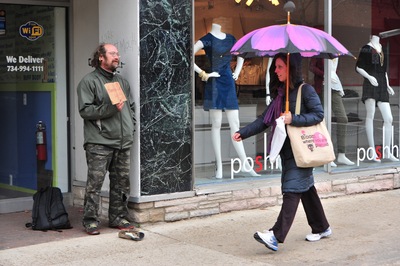
A panhandler asks for money on Liberty Street in downtown Ann Arbor last year.
Ryan J. Stanton | AnnArbor.com
The opinion came out of a civil suit brought by two Grand Rapids men arrested last year for begging in public.
The American Civil Liberties Union represented the two men and argued the city of Grand Rapids enforced the state's panhandling ban 399 times between Jan. 1, 2008, and May 24, 2011.
But now that will change.
"Anyone who's enforcing state law can no longer do that," Larcom said. "Grand Rapids was enforcing state law, so it was not that they had an ordinance that was struck down."
Ann Arbor's ordinance, which city officials are confident isn't affected by the ruling, allows panhandling to take place with the exception of prohibitions on aggressive begging in certain areas of the city.
That includes a ban on panhandling on public buses, inside or near parking structures, from a person in a vehicle, from customers in outdoor seating areas, within 12 feet of a bank or ATM, or within 12 feet of Nickels Arcade, the Galleria and the Pratt Building on Main Street.
The City Council tweaked the ordinance last year to also prohibit panhandling in front of the downtown library and within 12 feet of any public alley.
But elsewhere in Ann Arbor, including many parts of downtown, panhandling is fair game, as anybody who spends much time walking the city sidewalks knows.
"An ordinance that is like Ann Arbor's should withstand a constitutional challenge," Larcom said. "But they can't enforce state law anymore. That's clear. That's statewide under this federal decision."
Ann Arbor is unique for diverging from state law in 1996, as most communities even now simply go by the state's panhandling ban.
"That was the city ordinance up until 1996 like everybody else," Larcom said. "The city changed it in 1996 to read basically as it does now. The reason was because of other federal court decisions that prompted us to feel that this would be more enforceable.
"In this particular type of thing, cities can have ordinances that are different," she explained. "And we used to have exactly what was in state law. The city felt (having its own ordinance) was better."
The Michigan State Police up until now has enforced the state ban, including on highway ramps where Trooper Duane Zook has focused his attention on connecting with those in need and finding ways to help them with whatever problems led them to panhandling.
Sgt. Mark Thompson of the state police post in Brighton said he thinks the ruling won't do anything to lessen or increase panhandling on highway ramps. Despite not being able to enforce the state ban any longer, he said, state police still have some legal tools at their disposal.
"You can't impede traffic. If somebody is at an intersection and they come up and start impeding traffic, that's a civil infraction," he said. "And that's how we would enforce it. It doesn't have to be panhandlers. It could be anybody. We would enforce the traffic law."
But with the state ban struck down, Thompson acknowledged, there's not much state police can do now to stop a panhandler from accepting money from a motorist while traffic is stopped.
Ryan J. Stanton covers government and politics for AnnArbor.com. Reach him at ryanstanton@annarbor.com or 734-623-2529. You also can follow him on Twitter or subscribe to AnnArbor.com's email newsletters.
Comments
Cathy
Sun, Sep 2, 2012 : 1:37 a.m.
Giving money to beggars is like hiring someone to annoy you.
John Hritz
Wed, Aug 29, 2012 : 7:51 p.m.
When I read about the Ann Arbor panhandling ordinance, I can't help but think of times of year when I am waylaid by well-meaning students handing out poppies or tags or other paraphernalia. The rule should be applied consistently that obstructing someone's path or otherwise interfering with them in order to solicit money on the street should be prohibited whether the charity is you or another organization.
Cathy
Sun, Sep 2, 2012 : 1:54 a.m.
Alright, I'll say it: I'm not a fan of the Galen drive. There has to be a less annoying way to raise money.
John Hritz
Fri, Aug 31, 2012 : 2:55 a.m.
I'm opposed to strong arm tactics. Make your pitch, but stay out of my way.
Billy Bob Schwartz
Fri, Aug 31, 2012 : 12:34 a.m.
So you are opposed to the Galen drive?
Tru2Blu76
Wed, Aug 29, 2012 : 2:16 p.m.
The real question not addressed by such things as the free speech doctrine is whether pan handlers represent a threat. I've seen no statistics nor have a seen any articles in the press which focus on the distinction between threat and nuisance re pan handlers. Maybe the concept of freedom needs a bit of tweaking: many people consider those who set off fireworks to be a nuisance and consider beggars / pan handlers in the same way. Certain freedoms are unpopular - when they are practiced by someone else. Turns out, a person can do what they please (have more freedom) if they do it in isolation. There's a distinction in the motives of those who buy rural homes, suburban homes and city homes which appears to be based on the degree of self isolation sought. The wealthy self-isolate big time: and they preach "individuality" as if it were a religion they want to impose on everyone. So maybe their motive isn't as noble and patriotic as it is made to appear. Pan handlers and beggars: are distributed throughout the world. Since the world population includes our population and both are growing - we can expect the beggars to be with us for the foreseeable future. We are already developing a caste system to deal with this problem. This is a extra-constituional means of protecting the isolation of the majority against the minority. No need to bother with the fine points of freedom: society is always active in finding ways to make the desired adjustments.
Brad
Wed, Aug 29, 2012 : 12:45 p.m.
So if it really is a "free speech" issue (which of course it isn't) then how does the city exclude certain spaces like the arcade? Is it the opposite of Bush's old "free speech zones"?
SonnyDog09
Wed, Aug 29, 2012 : 11:06 a.m.
It's really simple. If you feed the pigeons, you get more pigeons. Likewise, if you give money to bums, you get more bums.
Barzoom
Wed, Aug 29, 2012 : 10:11 a.m.
As long as the city allows aggressive panhandling we will avoid downtown Ann Arbor and the businesses there.
Rod Johnson
Mon, Sep 3, 2012 : 8:40 p.m.
See ya.
Michael K.
Wed, Aug 29, 2012 : 8:31 a.m.
Ah, such empathy! As a photographer, I spend a lot of time out in the streets. You get to know who to give to, and who not too. That is true here, and in Chicago, Philadelphia, Austin, Detroit. It is just an extension of street smarts. Too bad they irritate you so. I suppose I could decide to be just as irritated at angry, whiny olds. We live in one of the richest countries in the world, at a time when the average middle class person has a higher quality of life than Pharohs or Kings in the past. Yet you have to demonize someone trying to get by, just to survive day to day? Most are decent, polite, even intelligent and funny if you engage with them. You are no better than them in the streets and on public sidewalks. Both just citizens.
Cathy
Sun, Sep 2, 2012 : 1:52 a.m.
You are one naive fellow.
MI Farmer
Wed, Aug 29, 2012 : 3 a.m.
Ah hears a thought, maybe if everyone stops handing them money they will stop panhandling and move on? Problem solved!
treetowncartel
Wed, Aug 29, 2012 : 2:49 a.m.
People, when approched by somone who most likely is going to ask you for money, ask them for money first. The look on their face is almost worth giving them a dollar, not!!
Dog Guy
Wed, Aug 29, 2012 : 1 a.m.
Even if we gave pans to all of Ann Arbor's beggars, how many would handle them?
Goober
Tue, Aug 28, 2012 : 11:43 p.m.
AA has no ban on pan handling. They know they have a choice - the rights of the pan handlers and the rights of the patrons to AA business establishments. We have experienced more than 15 years of this issue and it is clear to us- AA leadership supports the rights of pan handlers over the rights of AA patrons. On this basis, we have and will continue to take our business elsewhere.
Cathy
Sun, Sep 2, 2012 : 1:51 a.m.
The right to not be hassled by addicts, vagrants, and sundry ne'er-do-wells.
clownfish
Wed, Aug 29, 2012 : 11:53 a.m.
What rights are "patrons" lacking?
mixmaster
Tue, Aug 28, 2012 : 11:53 p.m.
Have a great time. Elsewhere.
smokeblwr
Tue, Aug 28, 2012 : 11:30 p.m.
I remember the good old days of panhandling in Ann Arbor 20 years ago. Lots more of it back then.
JRW
Tue, Aug 28, 2012 : 9:47 p.m.
"You can't impede traffic. If somebody is at an intersection and they come up and start impeding traffic, that's a civil infraction," he said. "And that's how we would enforce it. It doesn't have to be panhandlers. It could be anybody. We would enforce the traffic law." This is ridiculous. Even if someone calls the cops because a panhandler is in the roadway, as soon as the cop car comes along, the panhandler stands on the sidewalk or on the side of the road, so it's impossible to prosecute. ALL panhandling needs to be banned in all circumstances. These guys are pros.
Robert Granville
Tue, Aug 28, 2012 : 10:11 p.m.
If they can't enforce it, why on earth would you suggest a full ban? I bet you support the war on drugs too and think we should double down on funding.
JRW
Tue, Aug 28, 2012 : 9:44 p.m.
"That includes a ban on panhandling on public buses, inside or near parking structures, from a person in a vehicle, from customers in outdoor seating areas, within 12 feet of a bank or ATM, or within 12 feet of Nickels Arcade, the Galleria and the Pratt Building on Main Street." So, according to this, panhandling from a person in a vehicle is illegal. So why is it ok for panhandlers to stand on street corners (at the exit of Arborland, for example), with a sign asking for money? Isn't that panhandling from people in vehicles? There isn't anyone else there except people in vehicles! I have called the police to complain about these jerks at intersections, and they tell me that as long as they aren't standing in the street or road, it's ok. Doesn't make sense.
golfer
Tue, Aug 28, 2012 : 9:31 p.m.
just remember what they get they do not pay taxes on. to me this is income.
Billy Bob Schwartz
Fri, Aug 31, 2012 : 12:27 a.m.
OT....They are all bums, just some of them have bucks and can go out on the town. A bum is someone who avoids work and sponges off others. Unless, of course, you consider hassling innocent bystanders on Ann Arbor streets to be work. LOL.
OLDTIMER3
Wed, Aug 29, 2012 : 12:53 p.m.
I remember reading an article in a magazine don't remember which one about panhandlers and some of them made a very good living doing it. After panhandling all day they would go home and get into their dress clothes and go out on the town. One or two of them stated they made over $100,000 a year and delared it on their income tax forms. So they are not all bums. If they put tracking devices on some of them everyone would be suprised.
MD from ChiTown
Wed, Aug 29, 2012 : 12:44 p.m.
SWCornwell - There is a threshold below which one does not have to file. It varies depending on filing status and type of income.
swcornell
Wed, Aug 29, 2012 : 4:49 a.m.
I believe that technically, if you have any income at all, even if it's not enough to pay taxes, you still have to file your tax forms.
golfer
Tue, Aug 28, 2012 : 11:57 p.m.
robert sorry but i know you pay tax's on what you make. look at a paycheck. even if you do not have it taken out now. on April 15th you have to file. either long or short form. it is called income. so yes we have to pay tax on what we earn.
Robert Granville
Tue, Aug 28, 2012 : 10:08 p.m.
They would have to make quite a bit for their tax rate to be above 0%. I'm aware that some do. I doubt that this number is significant.
xmo
Tue, Aug 28, 2012 : 8:25 p.m.
I really feel bad for those pan handlers! The weather here is bad and they have to be in it. Be kind and lets all help them get enough money for bus fare to Arizona or Florida! Live is so much better there for them!
Rod Johnson
Mon, Sep 3, 2012 : 8:41 p.m.
Someone has adjusted the settings on the xmobot.
mixmaster
Tue, Aug 28, 2012 : 11:52 p.m.
What? No Obama, or lib A2 reference?
Goober
Tue, Aug 28, 2012 : 11:44 p.m.
Go west young man, go west! I believe the next stop is Jackson.
Dhurandar Bhatavdekar
Tue, Aug 28, 2012 : 9:06 p.m.
I suspect that our generous contributions to pan handlers will be immediately spent on booze, cigarettes, or drugs, and not on a savings account for a bus ticket ... On the plus side, more business for local stores. All we need is trash cans and some facilities on each ramp so the pan handlers have a receptacle to place trash instead of leaving it behind each day ...
Vivienne Armentrout
Tue, Aug 28, 2012 : 7:35 p.m.
As a followup to this, I suggest a review of the work of council's panhandling task force. Sabra Briere and others put in much time last year studying the issue and tweaking the ordinance. We can be proud. Here is a link to a recent article: http://www.annarbor.com/business-review/awareness-campaign-kicks-off-to-discourage-people-from-giving-money-to-panhandlers/#.UD0dXqCnKFp