

Big and biting: Gallinipper mosquitoes are here
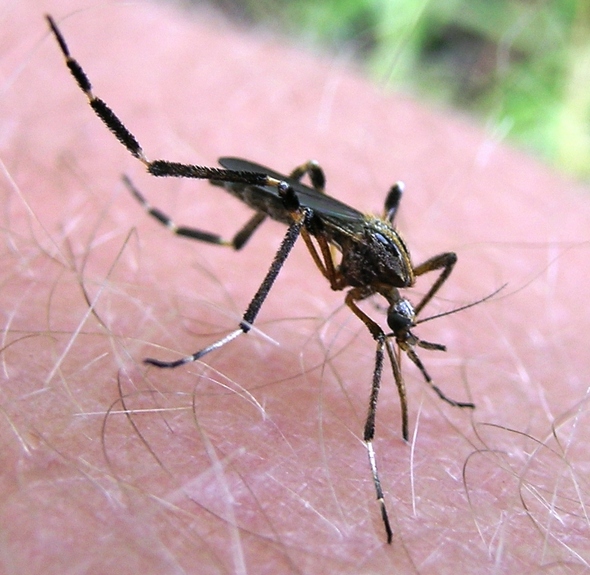
Washtenaw County residents have noticed large gallinipper mosquitoes buzzing around as part of a recent boom in the mosquito population. This gallinipper is a somewhat all-encompassing term for big, flying biting insect. These mosquitoes are officially known as Psorophora ciliata.
Photo courtesy of Flickr user smccann
Ann Arbor resident Ken Clark and his family noticed the strikingly large mosquitoes at their 10-acre plot of farmland in Chelsea on Sunday morning, Clark said.
No one in Clark's family thought the strange-looking creatures were actually mosquitoes.
Maybe, they pondered, these eerie giants buzzing around and perching on farm equipment were just gentle crane flies.
Then one of them bit.
“They’re biting through cotton canvas shorts,” Clark said. “We’ve never seen a mosquito go through something like that.”
The bites are “like a stab," Clark said. "Not as bad as a yellow jacket but you know when one of ’ems got you. It’s much worse than a regular mosquito bite.”
The bite doesn't hurt afterward - it just itches, he said.
The term gallinipper describes a variety of big flying bugs, but in this case, it’s the easier-to-say version of the mosquito called Psorophora ciliata, said Mike Kaufman, a Michigan State University entomologist.
The insect has a half-inch long body and even longer legs - hairy ones with white bands. Clark said the mosquito would easily cover a quarter. It’s aggressive when pursuing its blood meal, and it loves to bite during the day, Kaufman said.
The gallinipper could be mistaken for the invasive and more exotic sounding Asian tiger mosquito, which has made its way to parts of Indiana and Illinois.
So far, Michigan entomologists haven’t confirmed the presence of the Asian tiger mosquito, Kaufman said.
“It’s not impossible for it to be here,” he added. “There might be isolated populations. None of us have a specimen and no one’s shown me one.”
The gallinipper, on the other hand, is native to Michigan.
It doesn’t make an appearance every year, Kaufman said. The recent cycle of heavy rains and dry spells rendered conditions ripe for a burst of the big biters.
The gallinipper’s larvae feed on the larvae of its smaller mosquito cousins. If there are lots of smaller mosquitoes buzzing about, you might see the large versions flying around, too.
Clark said he’s lived in Michigan all his life and never noticed gallinippers before. Large swaths of fields around his land in Chelsea have flooded more heavily and regularly than in the past in recent months, he said.
Gallinipper eggs can sit for years, waiting for the right conditions to hatch. Once they’re out, adults live for two weeks to a month, Kaufman said.
Clark said he’s seen the mosquitoes in Ann Arbor since first spotting them on Sunday.
A gallinipper even flew its way into the house after Clark’s wife Jodi came in from taking out the compost.
Kaufman said gallinippers carry West Nile virus, though smaller mosquitoes are much more prone to pass it along to people and animals.
Last year there was one case of West Nile virus in Washtenaw County, and there have been no reported cases yet this year, Washtenaw County Public Health officials said earlier this week.
Once the virus is in the bloodstream, it can attack the central nervous system, weaken the immune system and muscles and - in under 1 percent of cases - lead to encephalitis or meningitis.
Juliana Keeping covers general assignment and health and the environment for AnnArbor.com. Reach her at julianakeeping@annarbor.com or 734-623-2528. Follow Juliana Keeping on Twitter
Comments
RunsWithScissors
Fri, Aug 12, 2011 : 3:11 p.m.
Send in the dragonflies! I was walking (rapidly!) through County Farm Park and noticed dozens of dragonflies hovering over a grassy area. They were gobbling up mosquitoes. These were enormous dragonflies - they looked like a miniature fleet of Chinook helicopters. And don't forget the bats. I've seen plenty of bats wingin' around at dusk. No doubt grabbing up mosquitoes left behind by the dragonflies. Yep, it sucks to have a good walk ruined by biting bugs but take the time to check out Mother Nature's response to the mosquito.
DJ DeMarco
Fri, Aug 12, 2011 : 2:58 p.m.
One of these huge things assaulted me while I was trying to give a lecture Wednesday at a summer camp -- wouldn't take a brush off and kept charging me repeatedly; ignoring many seated and unmoving targets. Can't recall encountering anything like it after a lifetime in rural Michigan. Whew! -- Only relief was to smash it dead, dead, dead... Only piece of mind was that it seemed to be alone... ...or was it?
Sierra
Fri, Aug 12, 2011 : 1:11 p.m.
My (almost) 2-year-old daughter is a swift and silent live-bug-capture expert. She ran up to me the other day with this...this THING...dangling by a leg, between her thumb and finger. I thought it was one of those mosquitoes from Jumanji, and I shrieked and swatted it out of her hand before it could kill us both. I don't freak out about bugs, but this buddy was GNARLY.
Ariel
Fri, Aug 12, 2011 : 12:51 p.m.
Omgosh that thing tried to fly into my car and it freaked me out because it's so huge and creepy looking.
Wolf's Bane
Fri, Aug 12, 2011 : 12:39 p.m.
We have them in the Water Hill neighborhood. The only blessing is that these suckers are more easily spotted and therefore killed. They do leave puncture wounds that itch like crazy and our young children have welts that last for days. Get "Off" Deep Woods.
jmac
Fri, Aug 12, 2011 : 12:26 p.m.
One of these landed on my arm yesterday and I actually screamed in horror at the sheer size of the thing! Like rreidannarbor said above, I kept swatting at it but it kept coming back - I actually ran away to get rid of it! Evan though I'm not a big fan of DEETS I'm going to spray myself with bug spray before I go out to walk the dog or work in the backyard, no sense getting chewed up by these things or their (many) smaller cousins out there.
Fatkitty
Fri, Aug 12, 2011 : 12:19 p.m.
I began noticing these B-52 size skeeters last week while out in my yard (Chelsea village). Their size makes them a good target - slow and easy to swat. hehehehehe
Jack Gladney
Fri, Aug 12, 2011 : 9:26 a.m.
Once again. Another failure of the Snyder Administration and the Tea Party.
Fatkitty
Fri, Aug 12, 2011 : 2:31 p.m.
oh fur cryin' out loud - give it a rest.
Wolf's Bane
Fri, Aug 12, 2011 : 12:42 p.m.
how do you know that the Synder Administration didn't have them imported so that we would stay indoors and use more AC and thereby tax the power grid, giving his biggest corporate sponsors more cash flow? Huh?
Tom Morson
Fri, Aug 12, 2011 : 11:03 a.m.
I was out mowing my lawn yesterday morning about 10AM in Burns Park Area in Ann Arbor and was bit twice by two of these remarkable aggressive mosquitos--glad to know that they are in fact, a mosquito. FRIGHTENED to read that they carry West Nile. Wonder what are the best ways besides dressing in multiple layers to ward them off from our property. Any ideas? Thanks
Macabre Sunset
Fri, Aug 12, 2011 : 4:19 a.m.
I hit one of them with my car last night. Left a dent. Its mate followed me for five miles before giving up. Tell ya' what. We can trade the giant German urinal outside of city hall for a few rounds of DDT for the area.
Kristine
Fri, Aug 12, 2011 : 6:29 a.m.
Not many things can make me laugh at 2:30 in the a.m. Your comments did just that. Thanks! :)
julieswhimsies
Fri, Aug 12, 2011 : 3:25 a.m.
Darn! That thing is as big as a B-52! We use bug spray out at the barn on the horses (and us) that will drop a horsefly dead in its tracks. I'm thinking the only thing that's going to work with these things is weapons grade Plutonium! Yeah. We'd all die very early deaths, but at least we wouldn't be eaten alive. I have some bites on the back of my neck that are as big as tumors! My sweet, gentle mare turned into BEELZEBUB (Satan) this afternoon after one of these guys nailed her on the ear!
NewStart
Fri, Aug 12, 2011 : 3:16 a.m.
I killed a couple today.
southAA
Fri, Aug 12, 2011 : 1:43 a.m.
Could you please italicize genus and species? I've collected a few around UM central campus, in broad daylight. Great legs!
Are you serious?
Fri, Aug 12, 2011 : 12:44 a.m.
I suspect there is a horror movie in the works - "The Mosquitoes" or "Attack of the Mutant Mosquitoes." After all Alfred Hitchcock made The Birds. They probably won't film it here though since the tax incentives are gone.
greenstriper
Fri, Aug 12, 2011 : 11:26 a.m.
They've already made a giant mosquito horror movie, and it was shot in Michigan: "Mosquito", released in 1995. It even starred Ron Asheton. It shows up from time to time on the channel-formerly-known-as-SciFi. Much of the locale looks very familiar, Zingerman's catering credit at the end provides another local connection.
KJMClark
Thu, Aug 11, 2011 : 11:31 p.m.
... And a hat tip to Mark O'Brien from Tuesday's article for the ID. I used to live next to a flood plane for a tributary of the Rouge, and while we had lots of mosquitoes, I've never seen one of these before. I think when people say their state's mosquitoes are so big they should be the state bird, they're talking about these things. I couldn't decide if it was a small wasp or a crane fly. Then I saw that proboscis and those two rear legs sticking out and thought it must be some kind of Amazonian mosquito, new to the US! Impressive. Or maybe monstrous is a better word.
Fatkitty
Fri, Aug 12, 2011 : 12:22 p.m.
Flood plane. Is that similar to a sea plane? :-)
Mark
Fri, Aug 12, 2011 : 12:18 a.m.
Thanks. As an a professional entomologist, I have to know these things!
Marilyn Wilkie
Thu, Aug 11, 2011 : 11:24 p.m.
My husband brought one into the house on his shirt last night after work. It was huge. The tiny ones are still swarming in clouds here. I must have killed 20 today in the house. They are bumping against the windows all day. It's a shame we can't be outside to enjoy the nice weather.
Bones
Thu, Aug 11, 2011 : 10:18 p.m.
Why are the cities and townships not spraying pesticide to curb them like they used to do? I remember that the city would drive down the streets and spray for mosquitos every spring and mid summer. I am going to get one of the propane killers for my yard. I can not mow or walk out in my yard with my dog with out getting mauled by all sizes of these nasty creatures.
einy
Fri, Aug 12, 2011 : 1:06 p.m.
Really?! It just wouldn't be a good idea. Either you pollute water with insecticide (this is where the eggs/larvae/pupae live) or spray the adult egg layer and kill off beneficial insects too.
Mark
Fri, Aug 12, 2011 : 12:17 a.m.
Thank goodness they DON'T do that. Read Silent Spring.
drewk
Thu, Aug 11, 2011 : 11:05 p.m.
It's called lack of money. Or hadn't you noticed the lack of money coming into the coffers.
golfer
Thu, Aug 11, 2011 : 10:14 p.m.
i think i just killed one. it was big. i sprayed it and it was gone to bug land. really it was the biggest one i have seen . three weeks to a month. good luck i will use lots of deet on the golfcourse.
81wolverine
Thu, Aug 11, 2011 : 10:05 p.m.
Yep, I've been seeing them in the yard - and killing some who came after me. They ARE more aggressive, that's for sure. Unlike other mosquitoes that you can wave away, these just keep coming. I'm looking forward to going up north tomorrow to get away from these swarms for 3 days. I'm sure there are some mosquitoes up north, but since they didn't get the 100 year rainfall we did, it won't be nearly as bad. (But I'm bringing the repellant just in case!)
little bird
Thu, Aug 11, 2011 : 9:19 p.m.
These nasty things are the new plague! I woke up yesterday morning and thought I'd had a nose bleed because my pillow was covered in blood. Upon closer inspection I noticed it was one of these GIANT smashed creatures on my pillow. Yep, other peoples' blood. Not awesome.
dading dont delete me bro
Thu, Aug 11, 2011 : 9:17 p.m.
"No one in Clark's family thought the strange-looking creatures were actually mosquitoes." seriously? i saw one today, it was hovering in and out of the car as i tried dodging it. read on... Kevin McNulty at 3:50 PM on August 11, 2011: "... Now I know to swat them." hunh? as opposed to inviting them in for dinner?!?
KJMClark
Thu, Aug 11, 2011 : 11:22 p.m.
Well, it didn't take us long to figure it out! Man, I've just never seen a mosquito that big. We thought they were crane flies at first - they're almost that big. But then they started landing on us and we figured out *really* quickly that they were monster mosquitoes.
Mark
Thu, Aug 11, 2011 : 8:49 p.m.
Dang! One just landed on me. I shooed it off and it became aggressive! I was like "that can't be a mosquito!"
silodog
Thu, Aug 11, 2011 : 8:46 p.m.
Thanks for posting - now my husband won't think I'm (totally) crazy. One landed on my leg yesterday when I was out with the kids... I thought it was a bee at first, it was so large - HUUUUGE! Very aggressive - It was going after me through my Chinos as I was sitting next to a lit OFF insect repellent coil - smoke billowing in our direction. Needless to say, I took the kids inside ASAP...
Matt Whale
Thu, Aug 11, 2011 : 8:43 p.m.
They are huge. One bit me through my shirt and I shook it off. It hurt. The skeeters are out earlier now. I bought some deepwoods Cutter yesterday.
David Bardallis
Thu, Aug 11, 2011 : 8:25 p.m.
Do OFF! and other repellents work on these things, too? I have a fairly wooded yard but have mercifully yet to see one.
Larry Works
Fri, Aug 12, 2011 : 3:12 p.m.
Cutter w/ 15% DEET does NOT! Deep Woods OFF at 30% DEET keeps the regular ones at a distance but so far hasn't phased the big ones. If I see otherwise I'll post again. FYI - DEET is a solvent so be careful putting it on synthetic materials (plastics/paints/etc.). especially at higher concentrations. <a href="http://en.wikipedia.org/wi" rel='nofollow'>http://en.wikipedia.org/wi</a>?ki/DEET
KJMClark
Thu, Aug 11, 2011 : 11:54 p.m.
David, we were using 20-30% DEET sprays, and they were iffy. I don't think the gallinippers where intimidated. We just got back from Isle Royale, where we used 100% DEET sprays, so we'll have to try that stuff and see if it works better.
tom swift jr.
Thu, Aug 11, 2011 : 8:07 p.m.
These should be kept on a leash, a short one!
BTPud
Thu, Aug 11, 2011 : 10:50 p.m.
Wouldn't a short leash make it easier for them to bite ya?
Jimmy McNulty
Thu, Aug 11, 2011 : 8:22 p.m.
If your gallinipper comes near me, I will end your mosquito.
Larry Works
Thu, Aug 11, 2011 : 8:06 p.m.
I've posted a size comparison of our regular summer mosquito and this recent (to me anyway) addition on my Flikr page. It is neither a Crane fly or a Mosquito Hawk. Both nearly silent and their legs are not nearly as striped. Only sweatshirt over long-sleeve cotton shirt keeps them from biting through my clothes. See for yourself. <a href="http://bit.ly/ofCUiV" rel='nofollow'>http://bit.ly/ofCUiV</a>
West of Main
Fri, Aug 12, 2011 : 12:02 a.m.
Holy man, that is disgusting!
Atticus F.
Thu, Aug 11, 2011 : 8:04 p.m.
My friend was telling me about seeing a giant mosqito yesterday, to which I replyed that it was simply a mosqito eating bug that resmbled a mosqito. I guess I was wrong.
Kevin McNulty
Thu, Aug 11, 2011 : 7:50 p.m.
Thanks for the article Juliana. I am sure I have seen these around the house. Now I know to swat them. They as so much bigger than a standard mosquito I thought it must be something else. And those people in Florida complain about alligators.
rreidannarbor
Thu, Aug 11, 2011 : 7:19 p.m.
I'm pretty sure one of these landed on me as I was walking into my health club yesterday. It kept coming back after repeated swats at it, landing on my shirt and pants. It was in direct sunlight but that didn't seem to matter (unlike the smaller ones that swarm on you in shady areas or at dusk). Yes, it was an intimidating looking mosquito. Could be the deemed new State bird if we see more of them.
Barb
Fri, Aug 12, 2011 : 2:27 p.m.
" It kept coming back after repeated swats at it..." Maybe we should all start carrying tennis rackets for protection!
OLDTIMER3
Thu, Aug 11, 2011 : 7:19 p.m.
Right next to the picture it says first case of WEST NILE VIRUS in Washtenaw county this year.
BTPud
Thu, Aug 11, 2011 : 10:49 p.m.
And if you click on the link, it's an article from 2010.
Thomas
Thu, Aug 11, 2011 : 7:06 p.m.
I think I killed one of these in my house last night. I couldn't get over how the size of this mosquito.