

Governor's budget cut proposals aimed at poor anger Washtenaw County commissioners
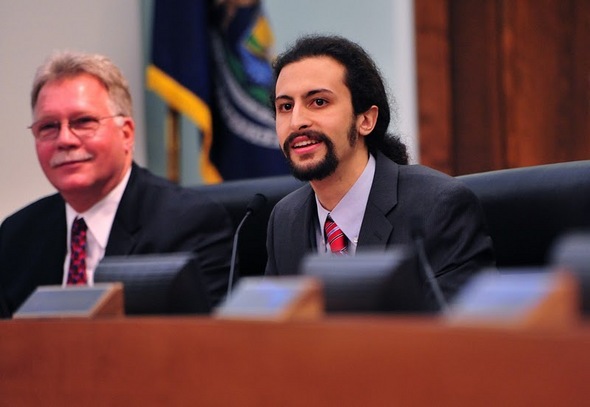
Washtenaw County Commissioner Yousef Rabhi, D-Ann Arbor, said he has concerns about the potential impact of state budget cuts outlined in Gov. Rick Snyder's executive proposal, particularly those affecting low-income Michigan residents.
Ryan J. Stanton | AnnArbor.com
No matter how you slice it, Washtenaw County will feel some pain if Gov. Rick Snyder's executive budget proposals are approved by the state Legislature.
That was the message lobbyist Kirk Profit delivered to the Washtenaw County Board of Commissioners Wednesday night during an update on state budget talks in Lansing.
Snyder's plan to cut business taxes, while increasing taxes for senior citizens and making cuts to programs that help low-income people, has angered some commissioners.
"It seems like there's a tendency to think, 'let's not kick the can down the road,'" said Commissioner Yousef Rabhi, D-Ann Arbor. "But I feel like what's being done here is we're picking up the can and we're throwing it at the homeless, and we're throwing it at the poor, and we're throwing it at the elderly, and we're throwing it at our local communities."

Lansing lobbyist Kirk Profit
Ryan J. Stanton | AnnArbor.com
Profit was joined by fellow lobbyists Kenneth Cole and Adrian Hemond, two of his colleagues at Government Consultant Services Inc. Cole touched on changes in community health funding, while Hemond addressed cuts to the state's human services budget.
"As you may have heard, the governor has proposed a 48-month lifetime limit on state cash assistance benefits, applied retroactively," Hemond said, noting that translates to about 12,500 individuals who would be immediately cut off from welfare come October.
"Obviously, some of those folks are going to be looking to units of local government for some services as they're cut off from those cash assistance benefits," he said.
According to figures from the state budget office, the move is expected to save the state about $77.4 million next year — $65 million of which would be in the general fund.
"Another major change the governor has proposed is a reduction in the hourly reimbursement rate paid to relatives and aides that provide day care to low-income children," Hemond said. "Currently, the rate's at $1.60 an hour and that would be lowered to $1.35 an hour, for a potential general fund savings of about $13.9 million."
Cole noted that Snyder's budget also recommends a $67 million cut in graduate medical education spending — $17 million or 25 percent of which would be borne by the University of Michigan Hospital. Considering that money goes toward training of residents, it could have an impact on health care in Washtenaw County, though he couldn't say to what degree.
Profit noted Snyder plans to finance about half the $1.8 billion in business tax cuts he's proposed by taxing the pensions of seniors. His plan to eliminate the Michigan Earned Income Tax Credit for low-income wage earners would free up another $350 million, Profit said.
Commissioner Leah Gunn, D-Ann Arbor, said she doesn't mind that her pension might be taxed, and neither does her husband.
"I think this is something that we have to look at very seriously. It's only fair," she said. "Senior citizens are not all poor. They might want to think maybe about putting in a circuit breaker for people of low income. But frankly, we geezers are the ones that have a lot of money."
Commissioner Wesley Prater, D-York Township, disagreed. He cited figures that suggest 35,000 people in Washtenaw County don't have health care.
"I think it's unfortunate that the governor would try to give tax breaks and put it on the backs of some of the poorest people in Washtenaw County," Prater said. "I just simply oppose it. Personally, I can handle it, but there's a lot of people out there that can't handle it."
From a macro perspective, Cole said, Snyder actually proposes spending $2.7 billion in state general fund money on the Michigan Department of Community Health next year — about a 12 percent increase. The department's spending would consume nearly 40 percent of the state's $7 billion general fund budget under Snyder's recommendation.
"Undoubtedly, the primary reason for this spike in community health spending is growth in Medicaid caseloads," Cole said, noting the state is grappling with nearly 1.9 million cases right now, a number expected to grow by 3.2 percent next year. "That's a conspicuous sign that the Great Recession continues to wreak havoc in our state."
Of particular interest to Washtenaw County might be the fact that it had the seventh highest rate of Medicaid caseload growth from 2002 to 2010, Cole said. In June 2002, the county had 19,706 cases, which nearly doubled to 39,142 by June 2010.
A micro look at the governor's budget shows Snyder would cut non-Medicaid community mental health spending by 3 percent or $8.5 million — from $282 million to $273.5 million, Cole said.
For the Washtenaw Community Health Organization, that reduction would translate to a loss of about $200,000 from the $7 million it currently receives, he said.
"Similarly, the governor's spending plan does not recommend pre-paid inpatient mental health plans — more commonly referred to as the Medicaid side of community mental health service programs — for an increase in funding," Cole said. "Granted, it doesn't prescribe a cut, either, but the fact that there isn't a bump in spending on this program could have the same effect as a cut because, again, Medicaid caseloads are increasing."
Additionally, Snyder's budget proposes a 5 percent or $1.7 million cut in spending on local public health departments. In all, about $40 million is spent in that area right now.
"It's unclear at present if that reduction would be made across the board, so I can't tell you with specificity how much it would cost Washtenaw County," Cole said.
Hemond noted Snyder's executive budget proposes closure of a juvenile justice facility in Grayling. If that happens, he said, it would leave the state with only two publicly run juvenile justice facilities, one of which is the Maxey Boys Training School in Whitmore Lake.
"There's also a proposed elimination of the before- and after-school grants program in the human services budget for a savings of $3 million, and the proposed elimination of 300 local office staff through attrition," Hemond said.
While it wasn't included in Snyder's budget, Hemond said the county might expect future administrative actions aimed at lowering the reimbursement rates to counties for juvenile justice placements. Currently, the state splits that cost 50-50 with counties.
"A final thing to keep an eye on, which could have a potential financial impact on Washtenaw County, are increases in private foster care day rates," Hemond said, noting there have been multiple attempts over the years to do so. "And this is another area where Washtenaw County bears 50 percent of this cost for juveniles that are placed in foster homes."
Hemond said the good news is the governor's budget has recommended keeping funding flat for the County Jail Reimbursement Program and community corrections programs.
Profit said the county can expect to see lawmakers in Lansing continue to push for cuts to public employee compensation. He said legislation already has been introduced to repeal Public Act 312, a state law that provides for binding arbitration for police and fire unions.
"Make no mistake, collective bargaining is on the minds of almost every member of the majority at least," he said, adding some legislators might move later this year to remove collective bargaining in the public sector altogether.
"Obviously they are going to attend to state employee compensation, but they're going to watch carefully what local governments are doing as they move forward with their agenda with respect to local government finance," Profit said. "So you want to be very attentive to that issue because it certainly is on the minds of state policymakers."
Ryan J. Stanton covers government and politics for AnnArbor.com. Reach him at ryanstanton@annarbor.com or 734-623-2529.
Comments
Dalex64
Fri, Mar 4, 2011 : 10:59 p.m.
I think bike paths make the area more desirable to live in, thereby attracting more people to live here, thus increasing the tax base and the economy to bring in more money. Do they eventually pay for themselves this way? I don't know. They also offer a safer path for riding, rather than the roads and sidewalks, allowing it to be easier to get around, and to work if you can't afford a car or for some other reason want to reduce or eliminate driving a car at all.
DonBee
Sat, Mar 5, 2011 : 5:32 p.m.
7 months out of the year bike paths are useful and fun. 5 months out of the year, I seriously doubt they would attract people to the area. If you have to prioritize funds, do bike paths make sense? If so what do you cut elsewhere to pay for them? Bridges? Police Services?
Marlean
Fri, Mar 4, 2011 : 4:07 p.m.
Well Washtenaw County....keep building those bike paths. I'm sure that will help feed and protect the elderly.
superhappyfunbrett
Fri, Mar 4, 2011 : 2 p.m.
A lot of these comments make me feel like I should quit my job and start living the good life. Apparently, the cost of living HASN'T been growing exponentially disproportionate to wages these past few decades. Here I thought I needed to get an education and perhaps still need to work a second job to survive as a middle (second?) class citizen. To think - all I REALLY have to do is work at Meijer, and the money will roll right in! Seriously? Apparently, people who are poor get that way by being lazy. Has nothing to do with injustices of the past or any on going. And if you become poor by some cruel twist of fate, well don't expect me to care. But I swear if you start committing crimes out of desperation to take care of your family... I am going to be really upset and complain a lot about you! (Don't make me...) I don't see how trying to cure the diseases of this society will help ease all these symptoms I keep whining about! Just do me a favor... stop using my tax money to help people survive. Matter of fact, stop giving it to schools, too. And movie people are nothing but trouble. And I never did care for the elderly. Why should I? That is until I am in that situation. Honestly... why should I care about anyone's situation if I am not in or near it? Meanwhile in reality... It impresses me how out of touch some of us are. Especially the "go work at Walmart!"-type proclamations, or the "no more living off MY taxes!" statements. It's amazing that so many people truly feel so victimized by people in need. That some of us actually whole heartedly believe most every person on the lower end of things is enjoying a free ride and apparently living it up while we suffer at our horrible 9 to 5 job. (WOW.) As I mentioned in my response to the first commenter on this story, I believe things should change. But it begins with remembering our humanity. Point should be creating a better society, not ONLY crunching numbers. (Former takes care of later, if done right.)
Kevin McGuinness
Fri, Mar 4, 2011 : 2:29 a.m.
Surely we want everyone to work and be involved n the community. But why tax people who are making subsistence living. Why not give a pass on income tax to people for the first $30K of thier income as an incentive to work. I do think their are some people because of physical or mental infirmities who can not work, are we not going to help them? Where is our sense of community. Why does 'nt the governor propose a graduated income tax and let himself and his buddies give a little more back to the community, after all it is because of the community that he is well off and doing well. This whol;e concept of taking it out on the less fortunate does seem wrong.
Dalex64
Fri, Mar 4, 2011 : 11:11 p.m.
I guess in short, I am trying to point out that there is a difference between a reduction in income tax, a tax credit, and government assistance programs, and how at least two out of those three are not a disincentive to work. I am definately not trying to double-talk like a politition and probably should not have used a spin phrase like I did.
Dalex64
Fri, Mar 4, 2011 : 10:20 p.m.
It's like this. A giveaway is welfare. Food stamps. The child tax credit. The tax break from mortgage interest and property taxes. Other programs like that, where you get money, unrelated to how much you earn, except for the income levels required to qualify for some of these programs. Keeping the money you earn is the money they take from your income. Income tax. The same logic applies to business taxes on business income, but not business tax breaks, rebates, refunds, tax abatements, etc. In a round-about way, getting money, rather than not having money taken away, is the same effect. It doesn't happen for the same reasons, though, and I think there is an important philosophical difference between the two. So, I guess, looking at my words, the EITC would be in the giveaway side. However, in response to Macabre Sunset, the income tax break from federal tax on $30,000 in income is not a giveaway, it is a cut in how much is taken away. In anycase, not paying income tax on $30,000 isn't giving them money. If they don't work, they don't have income to be taxed. They don't get money if they don't earn money. So, I don't think that a federal tax exemption on the first X dollars of your income is a disincentive to working.
jcj
Fri, Mar 4, 2011 : 4:57 p.m.
@ Dalex64 "The tax break doesn't give them money, it allows them to keep the money they earn" Does the same logic apply to businesses that get tax breaks? I suspect you would come up with some double talk to "explain" what you really mean on that one!
Dalex64
Fri, Mar 4, 2011 : 12:02 p.m.
Why do you assume that people making $30,000 a year lack incentive to work? The tax break doesn't give them money, it allows them to keep the money they earn. Surely this is a republican, libertarian, and tea party movement ideal.
Macabre Sunset
Fri, Mar 4, 2011 : 5:49 a.m.
People making $30k do not pay federal income tax. This is already generous. If you don't have incentive to work, you should not beg for money from the state.
DonBee
Fri, Mar 4, 2011 : 1:53 a.m.
This will sound mean, and it is not intended that way. How can someone be poor and have cable tv? How can someone be poor and everyone in the family have cell phones? How can someone be poor and drive a nice car? When I was growing up, we were poor, we had to borrow the phone next door, we ate potatoes most days, my brother wore my old clothes, somehow my mom found some for me. But, my parents were proud to pay taxes and vote. We never took a government handout, my parents were too proud. I grew up mostly in better circumstances, both parents found jobs and moved up the ladder. But every year my dad hunted, my mom canned and we made due mostly with food that we worked for. I have trouble understanding sometime what people mean by poor. I helped build 3 hospitals in Africa and a dozen clinics. I lived in the dirt floor huts with the folks in the community, that to me is poor. We shared our food everyday because people did not have much, and they returned the favor and shared with us. Again I don't mean this to sound mean, it is just I wonder how we now decide what poor means? If this offended anyone, I apologize.
Angela Barbash
Fri, Mar 4, 2011 : 4:02 a.m.
Preach on DonBee... that's what I mean by suck it up and do what you have to do.
macjont
Fri, Mar 4, 2011 : 3:51 a.m.
To an extent, I know what you are trying to say. I spent two years in the late 60s working in the rural Philippines and saw living conditions there that make it difficult to understand poverty in today's world. But that is the difference. People in the rural Philippines and people growing up under circumstances you seem to be describing as those of your youth were not competing in or attempting to cope with the world of today. So the answer is, yes, poverty is relative ... but today's poverty is no less real for those who trying to live in today's world and who are not trying to live in the past or in another world. You are not mean, just, paradoxically, a little narrow in your thinking.
MWH
Fri, Mar 4, 2011 : 1:23 a.m.
By the way, has anyone else noticed how the hobo villages are growing around the I94 Jackson / Wagner Rd areas? Its only a matter of time...
MWH
Fri, Mar 4, 2011 : 1:13 a.m.
Oh come on Seniors, get a part time job at McDs to pay for your meds. Oh come on Single Moms, get a third minimum wage job to pay for shoes for your kids. Simple solution isn't it?
macjont
Fri, Mar 4, 2011 : 3:53 a.m.
Yeah, but even those jobs are hard to get and, for those who are too old to stand on their feet hours a day, harder to do.
fortin911
Fri, Mar 4, 2011 : 1:07 a.m.
May I suggest that the State and county governments cut back on the feed budgets for all convicted inmates at our county jails and state prisons. It is about time these folks see what lean times mean to them and what they cost the system for not behaving.
SillyTree
Thu, Mar 3, 2011 : 11:59 p.m.
The belief that the poor are responsible for their predicament is a rationaliization of the wealthy that they are responsible for their wealth. Social Darwinism has been disproved, but its acceptence is still widespread. I gave up the majority of my material wealth because I could not rationally justify my rights to it. There are hard working people of all social classes and there are lazy people at all levels as well. I would rather work hard and be poor than any of the options of being rich. The pay for hard work should be equal for anyone that is doing that work. Counting money is not hard work.
Dalex64
Thu, Mar 3, 2011 : 11:37 p.m.
There was a comment above that basically stated that the poor are poor because they are lazy. Removing the EITC can increase their tax burden by somewhere around $1000. A middle class person is looking at maybe a $100 increase, and the rich are actually looking at a decrease! How is that fair? Give businesses a tax cut, sure. But maybe a smaller one to preserve the income of the working poor. That money will surely be spent. That's good for the economy, right?
DonBee
Sat, Mar 5, 2011 : 5:28 p.m.
EITC at the Federal level can increase the tax burden by $1000 but at 4.35% you need to earn about $23,000 above your exemptions and other deductions before you see this kind of tax burden added. Given the current deductions on the IRS-1040EZ, that means a single person needs to have an income of about $33,000 a year to pay the state of Michigan $1,000 in taxes. The current poverty line in the US is $10,200 for a single person, so this person is making 3x the poverty line. Does not sound like poor to me.
Floyd
Thu, Mar 3, 2011 : 11:22 p.m.
Tax the rich. Save the middle class. It is just and righteous to tax the most wealthy among us.
grye
Fri, Mar 4, 2011 : 5:55 a.m.
Just? Just wrong. If you were to double your income, would you give half of it away and stay in the same economic status? The wealthy already pay a higher tax rate than you and me. Tax them more for being successful? That would be the just thing to do? Then why be successful, just be mediocre. A whole country of mediocres. I don't think this country has been successful by being mediocre.
Ace Ventura
Thu, Mar 3, 2011 : 11 p.m.
Leah, please re-read your last post look up the michigan tax law you sound a little mixed up. Also don't you think you should focus your efforts on getting your fellow commissioners to pay back the money they owe the county before asking retired people on fixed incomes to pay more taxes to fund you pet projects?
Leah Gunn
Thu, Mar 3, 2011 : 9:54 p.m.
What was left out of the article was that I said pensions should be taxed on a sliding scale. Right now, only the first $45,000 of a private pension is taxed, thus it's a giveaway to the rich. Everyone should pay their fair share, and tax cuts for the rich seem not to have crated any new jobs. I doubt that a business tax cut will either.
Bob Martel
Fri, Mar 4, 2011 : 12:17 a.m.
Leah, I believe you have it backwards. Right now, the FIRST $41k (+/-) is NOT taxed. Twice this much for joint filers.
Jay Thomas
Thu, Mar 3, 2011 : 9:37 p.m.
Pension beneficiaries never deserved preferential treatment that the rest of the public is not entitled to with their retirements. Michigan is one of only a HANDFUL of states that was doing this. I doubt someone making 50-70k untaxed really believes in the social justice mantra of the democrats they vote for.
John B.
Thu, Mar 3, 2011 : 9:49 p.m.
If you mean 13 states is a handful, well, OK. Don't buy into the Fox propaganda!
dexterreader
Thu, Mar 3, 2011 : 9:32 p.m.
It is a very "typical" republican proposal ... take from the poor guy who can least afford it and give it to big business and/or the rich guy. When will people learn this is the republican way of doing business? Yep, same politics as the Engler administration, just a different decade. It's how we got in this mess to begin with.
Basic Bob
Thu, Mar 3, 2011 : 9:10 p.m.
Back to the point of the story, which commissioners are angry over budget cuts? Ms. Gunn doesn't seem upset. Only Rabhi and Prater. How about the other eight commissioners?
James Leonard
Thu, Mar 3, 2011 : 8:10 p.m.
Dear Ms, Barbash, Before you become too consumed with longing for the days of rural and old age poverty before Roosevelt,, I suggest you read David Kennedy's "Freedom from Fear: The American People in Depression and War, 1929-1945" published as part of the Oxford History of the United States. As they stand, your nostalgic comments seem amazingly uninformed. James Leonard
John B.
Thu, Mar 3, 2011 : 9:52 p.m.
I think Wesley Snipes and others belong to a group that follows that strategy. You might want to call Wesley at the Pen. to discuss it. Doesn't go over too well with the IRS....
Angela Barbash
Thu, Mar 3, 2011 : 8:22 p.m.
Thank you James for the reading recommendations -- and please do not misunderstand my suggestion. I was simply saying that perhaps we should look to ourselves, our communities and our families for support instead of sending our money to the government and asking them to reroute it back to us, as they have proven themselves to not be an efficient steward of our resources. I was not advocating a return to depression era economics.
bugjuice
Thu, Mar 3, 2011 : 8:05 p.m.
This is called Social Darwinism. Rich folks tell the poor folks that they can be rich too if they would only work harder and pull themselves up by their bootstraps like the Rich folks did. The problem is that the Rich folks aren't serious, don't want the competition and need to have poor folks to use for their own benefit. It seems a lot of people buy into this bald faced lie. You'll never be rich even though we're told that in the USA anyone can be rich. The world is a lot more complicated that it was 50 or 100 years ago. There are a lot more people to deal with and fewer resources to do it. The gulf between the "haves" and the "have nots" is bigger than ever. The top 2% of the population control 85% of the wealth. Yet, regular folks are told it's their fault and they have to sacrifice. Who's telling gullible regular folks that? Why the Rich folks, that's who! You're right something has to give. How about having a few less kids?
grye
Fri, Mar 4, 2011 : 5:47 a.m.
Pardon the typos. Late at night
grye
Fri, Mar 4, 2011 : 5:46 a.m.
Angela: The more I read that these writers don't think the poor can help themselves and we must take care of the poor at all costs makes me think they don't want the poor to better themselves, or there may not be a need for all their social welfare programs. Then what will they have to complain about? Good for your family for finding a way to make things better without having expect money to be throw at your feet with no expectation of any betterment in performance.
Angela Barbash
Thu, Mar 3, 2011 : 10:57 p.m.
@Bugjuice, since you directly referenced me in your post I feel obliged to respond. I don't swallow any fox new bs, or any CNBC bs for that matter -- I don't even have television because it's all a smoke screen anyways, meant to keep the masses fighting amongst themselves in blue/red color combinations so that they don't pay attention to the real mess the cartel is creating with a pen stroke. Trust me, I'm not naive on these matters... And yes, it is up to us to fix the wrongs. No one else is going to do it -- surely 'they' will not do it. Just about everyone on this board has loudly declared that those uber rich people in power are not doing a darn thing for us little guys. So then who else are you suggesting we turn to? How about we turn to ourselves. And yeah the deck is stacked against us, get over it and do something about it instead of just demanding that someone else move mountains because it's not our job, it's their job. Lastly, here's my anecdote of success: My grandmother is the eldest of 19 children, every single of them by the way worked in the fields as a migrant picker. My father worked in the fields until he dropped out of school to find a better job. Him and all his brothers and sisters were determined to not let their children work in the fields -- we're the first generation to get college degrees, and because 3 generations of our family worked hard, not a single one of us has stepped foot in a field. Don't tell me that people can't pull themselves and their families together. Give yourself and your fellow man a little more credit.
grye
Thu, Mar 3, 2011 : 9:58 p.m.
Taxes are a difficult issue. The most fair way is a flat tax. No exception exemptions (except for children and charitable contributions). No exemption for home mortgages. The tax codes are absurd. some scaling may be necessary from a base level of income and possibly a slight increase on extremely higher incomes, but not an exorbitant amount. There is too much polarization in today's world. Each side has good things and bad things. Conservative fiscal policy is necessary. Don't waste. But there is also the need to help our fellow man as long as he also helps himself. We can't keep giving to some people if they are not willing to try harder. There; that's my 2 cents on the issue.
grye
Thu, Mar 3, 2011 : 9:58 p.m.
I would like to see a single payer health care system. We essentially have that now with Medicare and Medicaid. We need to care for the sick and injured where as many would rather see them die. Is this socialism? Probably. But so is the federal highway system. Do need to help the less fortunate? Yes, but not forever. The less fortunate need to use the opportunity to move up, not sideways.
grye
Thu, Mar 3, 2011 : 9:57 p.m.
I disagree with his cuts in education, but could there be cost savings through consolidation? I agree with taxing the pensions of public employee retirees. My 401K will be taxed. Why should my tax dollars be given to a retiree? I would like to see a portion of college education funded by the State with the requirement that the money needs to be paid back if the graduate does not stay in the State for at least 5 years. If we don't properly educate our young, we will not have much of a future. And if they all leave the State, they leave with the knowledge base that is needed for Michigan to succeed.
grye
Thu, Mar 3, 2011 : 9:55 p.m.
Syder is the exception to the rule. I truly believe he is trying to fix the economy by providing the opportunity for businesses to flourish. Businesses need to grow to allow for more hiring of employees.
bugjuice
Thu, Mar 3, 2011 : 8:43 p.m.
Is Snyder the rule or the exception? Not everyone gets the breaks to go with the hard work. And you miss the point. The deck is stacked against people Like Ms Barbash, yet she swallows the false choices and eats up the nice sounding lies that we all must sacrifice. Some folks have been sacrificing for their entire lives with little to show for it. This message is perpetuated by Fox News, Corporate CEO's and the Koch brothers to their benefit. They don't care one whit for her. It's not up to her or other hardworking people to fix the wrongs, it's up to the people who profited from the mess.
grye
Thu, Mar 3, 2011 : 8:13 p.m.
Really? Snyder didn't grow up in a rich family. He worked hard, went to school, pushed himself to excel, and did well for himself. And now he is one of the elite who really don't want anyone to succeed? I think more people need to be like him and try harder. Having less kids is not the answer (although it would cut back on the expenses).
grye
Thu, Mar 3, 2011 : 7:50 p.m.
Tax the wealthy. Tax the businesses. Seems to be the most popular answers. Makes me think it is better to sit at home, do nothing, and let rich people and business provide for all my needs instead of trying to make things better for myself.
grye
Thu, Mar 3, 2011 : 9:34 p.m.
Yes they do. But is throwing money at the problem going to fix it? Is taking more money from wealthy individuals and businesses going to fixt it? That's all I ever see from anyone here. Take from the rich, give to poor. Just a bunch of Robin Hoods. There needs to be programs in place to help the working poor learn a better vocation to find a better job, not just give them extra money to keep the status quo. The elderly need to be warm and fed. But many of them can give back to society as part of the process. Free lunches should be far and few between. I have compassion for those in need and want to help themselves. I don't have a lot of compassion for those who are lazy.
Cash
Thu, Mar 3, 2011 : 8:44 p.m.
Do the words "working poor" and "elderly" mean anything to you?
leaguebus
Thu, Mar 3, 2011 : 7:24 p.m.
<a href="http://www.nytimes.com/2011/02/28/opinion/28krugman.html?_r=1&ref=paulkrugman" rel='nofollow'>http://www.nytimes.com/2011/02/28/opinion/28krugman.html?_r=1&ref=paulkrugman</a> The URL is from an OpEd piece by Paul Krugman about Texas and the results of their budget cutting. I would not say a word about Snyder's budget if it did not have the business tax cuts in it. But because he proposes the typical Republican dogmatic response to budget cutting, less taxes for business and more taxes on the people that can least afford it, I have a problem with him. By having to cut more from education we just keep digging the hole deeper. Class sizes get bigger, college tuition gets higher, and on and on. We are quickly becoming the Alabama or Mississippi of the north. What does this mean, the only good schools are private and the only people that can afford to send their kids to them are the wealthy. I guess this makes sense for the new governor, where does his daughter go to school?
Angela Barbash
Thu, Mar 3, 2011 : 6:34 p.m.
@Cash, Atticus, Clownfish and RayA2 -- you can say I'm an idealist and that the pre-FDR days sucked and that it's unrealistic to expect anyone but government to take care of the needy, but bottom line -- WE ARE BROKE -- there's no two ways around that. Our governments are out of money. Where do you think this road is leading us? Into renewed prosperity and 'better times'? Something -- has -- to -- change. Show me your better plan and I'll listen. Until then, I say we pull ourselves together and do what we can. We'll all be lucky if we still have water service in 10 years let alone social programs. Wake up people.
joe golder
Thu, Mar 3, 2011 : 7:37 p.m.
US Gov cannot keep buying our debt. The poor will get a huge kick out of watching the wealthy push around wheel barrows full of useless paper. @ Cash I hope you aren't sitting around waiting for things to get better. If I were you I would get to know your neighbors better.
Angela Barbash
Thu, Mar 3, 2011 : 7:17 p.m.
Mr. Clownfish! You have ideas!! You shouldn't have wasted all your board capital earlier in the day and perhaps should have posted these items instead! ;) 12. Stop borrowing our currency from a private banking cartel, which keeps our nation in perpetual debt and defies our own constitution's mandate that our Treasury manage our monetary system, as directed by Congress. 13. Educate the public about how their federal income taxes go towards only paying the INTEREST on the national debt, despite the often repeated claims that we're paying for the wars, the tax breaks, the social programs, etc. We're not paying for those things -- the Federal Reserve and China are paying for those things -- we're just paying the interest on the loans. 15. Stop generally living outside our means as a country. And sorry Cash... I study this stuff professionally every day. This is worse than most people know, only because it hasn't hit the streets yet (but it will). Yes, most people will survive this but our lives in America will look much different in the years to come than they do now. I'm all in favor of ending these ill-gotten wars, but unfortunately that will not solve our budget problems in their entirety.
clownfish
Thu, Mar 3, 2011 : 7:02 p.m.
1: return tax brackets to the Clinton era levels. 2: Lower Means Testing income levels for SS and Medicare. 3: Raise the SS minimum age to 67. 4: increase regulation on imported good to reflect our own labor and environmental standards 5: Reduce defense spending by 15% over the next 10 years 6: increase funding for education and worker retraining to enable laid off workers to come into the 21st century economy. 7: Tax stock trades like most of the rest of the world does. 8: tighten regulation of banks and investment firms. 9: raise the tax bracket on those making over 1 million/year to what it was under Reagan. 10: reduce health care costs by allowing the federal and state govts to negotiate. 11: Reduce administrative costs for health care by removing companies that produce no medical results. Next?
Atticus F.
Thu, Mar 3, 2011 : 6:53 p.m.
Angela, one of the reasons we are broke is due tax breaks for the wealthy/corporate welfare... Along with a a ten year war in Iraq, and an 8 year war in Afganistan. We need to be taking care of our citizens before we go giving tax breaks to the wealthy and invading soverign nations.
Cash
Thu, Mar 3, 2011 : 6:52 p.m.
We have had hard times before and we will again. You don't throw the baby out with the bathwater as they say. We will be fine. We've sure been through worse times than this! We will be fine. We have to cut spending yes. End the war in Afghanistan and we can balance the budget.
FattyJ
Thu, Mar 3, 2011 : 5:39 p.m.
Great! This is why i voted, instead of smoking a joint on election day morning.
macjont
Fri, Mar 4, 2011 : 3:56 a.m.
Are you sure you didn't do both?
Dr. Rockso
Thu, Mar 3, 2011 : 5:27 p.m.
Angela, Do you have any idea how crappy the quality of life was for most people before FDR?
jcj
Thu, Mar 3, 2011 : 7:30 p.m.
Atticus I agree completely with that statement. It just struck me that this sentence: You seem to forget that we had elderly people living homeless and dying in the streets, waiting for peoples charity before the days of social security. Let's not forget the great depression also. Pretty much describes what is going on now.
Atticus F.
Thu, Mar 3, 2011 : 6:50 p.m.
jcj, the point I was trying to make was that things were better after the introdution of the New Deal, and of Social Security. And that we cant count on charity alone to meet the needs of the poor.
jcj
Thu, Mar 3, 2011 : 6:35 p.m.
So exactly what has changed Atticus?
Atticus F.
Thu, Mar 3, 2011 : 6:28 p.m.
Angela, seem to have 'selective nostalgia'. You seem to forget that we had elderly people living homeless and dying in the streets, waiting for peoples charity before the days of social security. Let's not forget the great depression also.
clownfish
Thu, Mar 3, 2011 : 6:20 p.m.
Angela, what exactly is keeping Dick DeVos or Mr and Ms Stryker from reaching down and helping their less fortunate neighbors now? I know they give a lot to certain institutions, but obviously it is still not enough. John and Abigail Adams lived a fairly frugal life, helping out widows in Quincy. Thom Jefferson lived an extravagant life backed by debt and slavery. Most often it is Thom that gets quoted and referred to as a Founder worthy of our reflection. It depends on how one looks at it, no?
Angela Barbash
Thu, Mar 3, 2011 : 5:48 p.m.
Yes I do, but we have a collective economic advantage today over our great grandparents 100 years ago. We also have technology and communication revolutions on our side today versus then. I'm not saying revert back to those times in all ways, I'm simply suggesting that we as people could take care of our neighbors more efficiently and effectively on our own than an elected body of distant representatives in Ann Arbor or Lansing (yes, the commissioners are distant to a lot of people). Really, these are the tenants of country republicans circa 1770. People taking care of people. It's just too bad that most people today don't know where the word "republican" came from...
Angela Barbash
Thu, Mar 3, 2011 : 5:15 p.m.
So I've read all the comments and replies up to this point, and there's one concept that I haven't seen floated yet... Back before FDR people took care of people personally -- not through the government. If you think about it, we changed the nature and scope of our government (local, state and federal) a 100 years ago to include social welfare programs. We decided to send money to government for them to turn around and dole back out to the neediest of our citizens. Before that we handed our assistance directly to the neediest and did not use the government as pass through. Per usual the government being notoriously slow, hostile to innovation and generally wasteful has created a funding system that is inefficient and open to fraud. If we reversed this and brought assistance back down to a truly local level through the churches and neighborhood programs, if families started to pull back together after 30 years of fractured relationships, then we could start to take care of our neediest citizens on our own. Instead of sending our money to Ann Arbor or to Lansing, perhaps we could get more assistance to the people who need it through direct relationships with those people. Furthermore, it would reduce the opportunity for fraud. In a smaller system with fewer people involved, each person knows the other and can work with them individually to help solve the root issues of why they need assistance. Fraud would be easily recognized. In the end I think smaller, closer communities and families are the answer. Not wasting our time being angry about why the government is doing this or is not doing that. That wasn't their role to begin with, and shouldn't be their role now.
joe golder
Thu, Mar 3, 2011 : 7:17 p.m.
I agree with you Angela. There was a time family, church and community took care of folks in need. Politicians have become a bunch of useless tools that need to be recycled. We should turn them and their banksta friends up side down and shake the last bit of our change they haven't wasted out of their pockets. There has been a huge decline in family values. social morality and responsible use of our natural resources. I believe the Gov is very much to blame for this. It has become an industry taking care of the needs of the dysfunctional . It used to matter how family and community would hold you accountable. Now go fill out some papers and stand in a line.
cinnabar7071
Thu, Mar 3, 2011 : 6:56 p.m.
Love the idea Angela! You and I can help our neighbors, family and friends. And clownfish and cash can donate to the gov't, problem solved. Except I don't thing Cash and clownfish will follow though.
Cash
Thu, Mar 3, 2011 : 6:29 p.m.
Angela, Bread lines, sweat shops, lifespan 55 yrs, avg education 6th grade, the good old days stunk. Go to an elder care home and talk to someone who lived through it. People were starving. My grandparents had a huge picture of FDR in their home. He saved the family farm. He gave them hope. He kept this country from sinking into a depression that would have been the end to the country they loved. Advocating churches as the decision makers for care of the poor? How many churches still discriminate based on color? How many churches still discriminate based on sex or sexual orientation? That okay with you? Well, it's NOT with me. How many churches are consolidating and closing? If you go back and reread posts here, you will quickly see that not every citizens really care if people are poor or hungry. Their solution is to go to work. How do you think THEY would distribute food?
clownfish
Thu, Mar 3, 2011 : 6:13 p.m.
What you are after is a return to "the good 'ol Days" ! Days when we had tenements filled with the impoverished. Days when children worked in horrible conditions in order to help feed the whole family. The Days when private charity served a small minority of those actually in need. FDR's New Deal did not arise in a vacuum.
Angela Barbash
Thu, Mar 3, 2011 : 6:07 p.m.
Darn, I had a nice reply written up and then my internet connection was disrupted... Basically, something has to change. We're broke, our local municipality, our county, our state, our country. We're operating on borrowed time and borrowed money, and so something systemic has to change. I know for a fact that the closer communities and families are, then better off everyone in that social circle is. I don't expect that if we actually got to retain more of our income that overnight people would do the right thing with it, but over time and with enough people working hard to bring everyone together it could happen. Furthermore, with a closer community comes the lessening of an awkwardness about asking for help. I come from a large Mexican family -- no one feels awkward about asking for help. Everyone just asks when they need it, the system works fine, and public assistance is kept at a minimum within the family because that carries more of a stigma then just asking your uncle or your cousin for some help. And I don't mind redistributing my wealth as I see fit on my own, but the government has clearly not been the best steward of the people's money. We have to do something different here.
RayA2
Thu, Mar 3, 2011 : 5:50 p.m.
Do you actually think that Churches could fill the place of government in the redistribution of wealth? Would such help come with the cost of conversion? Do you think that the majority of people would actually take saved tax money and give it to their church? Do you think it is easier for the poor to ask their neighbors for help when they are down and out?
YpsiLivin
Thu, Mar 3, 2011 : 5:13 p.m.
"Governor's budget cut proposals aimed at poor anger Washtenaw County commissioners" So, aren't these the same clowns who have been "slow" to repay their disallowed expenses and insist on having their per diems ON TOP OF the salaries they already get? I thought so...
ViSHa
Thu, Mar 3, 2011 : 6:47 p.m.
i'm sure glad it "angers" them, lol. it's win/win for them.
Ace Ventura
Thu, Mar 3, 2011 : 5:09 p.m.
@spelling You betchya!
John Spelling
Thu, Mar 3, 2011 : 5:01 p.m.
Mr. Clownfish says he doesn't really need a job but, if he did, he'd have to commute about an hour and a half. To fish and others that can't find work locally, move! It makes no sense that folks (that are physically able) choose to stay and take handouts rather than move and work. Obviously there are circumstances that prevent some from moving. This is not directed at those few. Ace - Make sure you give postal service your new address so they know where to forward your mail.
Mick52
Thu, Mar 3, 2011 : 8:04 p.m.
Yeah its so easy to sell your house now. Just sell your house and move. Great advice John.
clownfish
Thu, Mar 3, 2011 : 6:07 p.m.
My house is worth about what I owe, probably less on the open market. Is it fiscally responsible for me to sell my house, move and still owe money to Chase Bank? Is it morally responsible for me to take a 'strategic default" in order to make it economically feasible to move? FYI, I have worked out of state 3 times in the last year. I have spent up to 6 months at a stretch away from my family in the last few years in order to find work. If I had kids it would create an interesting Family Values environment.
Bob Martel
Thu, Mar 3, 2011 : 4:41 p.m.
Interesting to see how far off topic (i.e., the County Commissioners reaction) we've been allowed to stray with our comments!
Cash
Thu, Mar 3, 2011 : 4:33 p.m.
13 states do not levy income tax on retirement. Seven states have NO income tax. Two states tax only interest and dividend income. Four states do exempt elderly from income tax. That's 13 states, not four.
Atticus F.
Thu, Mar 3, 2011 : 4:24 p.m.
Very sad to see some of these comments. Especially the old "get a job" mentality... As if hoards of lazy people are looking to avoid work and live a life of luxury. Here's something to think about...There are not enough good paying jobs in this state. And most people are looking for a hand UP, not a hand out. Also, have any of these "get a job" people considered the working poor? or do they just assume that all poor people are lazy, and are simply looking for a free ride.
Atticus F.
Thu, Mar 3, 2011 : 6:11 p.m.
jcj, I'm glad we can agree on some issues. However, as far as illegals go, I see the employers of illegals the source of the problem. The people who disregaurd american workers in favor of hiring illegal aliens, are the true and more dangerous form of law breaker.
jcj
Thu, Mar 3, 2011 : 5:35 p.m.
You bring up a good point about the working poor! They truly are the forgotten ones here. Unless they are poor working illegals.
cinnabar7071
Thu, Mar 3, 2011 : 4:20 p.m.
Ace I was being sarcastic, sorry you didn't catch that.
Ace Ventura
Thu, Mar 3, 2011 : 3:41 p.m.
@cinnabar7071 Nope not a Christian you lose that bet. As to how my finances you do not have a clue.
cinnabar7071
Thu, Mar 3, 2011 : 3:30 p.m.
"So what I will do is leave the State of Michigan and take my pension, ira, and social security with me. I will no longer be spending my money on food, clothing, autos, or at local restaurants, bars, auto dealerships, drug stores, lawn care, snow removal, and many other local businesses. I will also no longer be making donations to local charities and universities. " You sure have allot of money, you know the poor could use alittle help. Not fair you living so large, all the while children are going hungry. Just not fair Ace and I bet your a Christian too!
Townie
Thu, Mar 3, 2011 : 3:27 p.m.
Fair share? Look at the Detroit News analysis of the tax shift. As a retiree I'll be paying 300% more while the $250k folks will paying 6% more. Once again we're asked to sacrifice a lot more than the rich folks (like Slick Rick). I'm willing to pay more but why should I pay 300% more while the richer folks are treated so much better. Oh, I know they are superior, smarter, work harder, etc. Yeah. And remember they were the ones who got the large tax breaks over the years that created a large portion of this deficit.
John B.
Thu, Mar 3, 2011 : 9:43 p.m.
Uh, tax breaks do not create deficits? That's rich....
Mick52
Thu, Mar 3, 2011 : 8:01 p.m.
You are not going to get much sympathy with percentages and not figures. Your 300% increase might be affordable to you but enough to make the $250k folks leave the state. I do not know how you can blame the wealthy for this problem when their taxes make up the bulk of tax revenues. Tax breaks do not create deficits. Paying out more than you take in does. Assessing taxes to the rich makes them move and it is far easier for them to do so.
jcj
Thu, Mar 3, 2011 : 3:09 p.m.
@clownfish If the figures (and my math) are correct it looks like about 19% is fraudulent. I have no problem with those in need getting assistance but the government is so lax in actually accounting for where our tax dollars are spent. I don't care if it's waste in the Pentagon or the Ann Arbor school board. Just a few figures I found Last year, the DHS reported that at any given point during the 2009-10 school year, 10,000 to 18,000 college and university students were receiving food assistance (at a maximum of $200 per month each). <a href="http://www.thenorthwindonline.com/?p=3860275" rel='nofollow'>http://www.thenorthwindonline.com/?p=3860275</a> I think this might give you what you were asking. It looks like the total payment for Michigan bridge card users is $262 million by 1,946,040 people.
Mick52
Thu, Mar 3, 2011 : 7:52 p.m.
It may be very hard to get the real figures. I have heard that some people with bridge cards will use them to buy food and sell it to others. Inappropriate buy very difficult to uncover.
clownfish
Thu, Mar 3, 2011 : 6:02 p.m.
Thank you. I too am in favor of reducing food assistance to students that do not need it, and reducing fraud wherever it occurs. I am not in favor of broad stroke cutting BECAUSE fraud exists. Almost 2 million people on govt dole in MI! Definitely speaks to a broken system. I think it is easy to say "get a job" but the reality is that if 2 million people are on food assistance the jobs must not be there.
Tom Wieder
Thu, Mar 3, 2011 : 2:57 p.m.
@Ace Ventura - You're right, not ALL states tax pensions, just 46 of them. The other 3, besides MI, that don't are Alabama, Alaska and Wyoming. (See <a href="http://www.kiplinger.com/tools/retiree_map/index.html?map=14&si=1)" rel='nofollow'>http://www.kiplinger.com/tools/retiree_map/index.html?map=14&si=1)</a> So, if you want to move there to avoid a tax which, after exemptions and decutions, will amount to a few percent of your pension, enjoy! We'll miss you, sort of.
DonBee
Sat, Mar 5, 2011 : 5:16 p.m.
The Elder tax in Michigan is uneven and unfair. If you were lucky enough to be in an old fashion pension plan, you pay no taxes. If you had a 403, 401K, or other non-traditional pension you pay tax. The folks with pensions in general make more in retirement than the folks without. This according to the US Bureau of the Census and the CPS data. "So the folks with the mostest, pay the leastest" among the elders. I guess that is way we see folks with pensions complaining here and not the others, the pensioned folks can afford computers and internet. Fair would be either all the folks over 65 be exempt (at least to a level of income) or they all pay the same rate. Only seems fair to me.
Mick52
Thu, Mar 3, 2011 : 7:50 p.m.
Really now! You guys are making me dizzy, which is it? The Kiplinger link is interesting Tom, thanks. What irks me about Michigan is tax free pensions but taxed 403 plans. I think only people with low retiree income from weak retirement plans should get a tax break, not those with generous ones. People at the lower end of the pay scales are getting screwed by the well paid and may never be able to afford retiring.
Ace Ventura
Thu, Mar 3, 2011 : 5:19 p.m.
Try Austin, TX a great city now state income tax period food and gas cheaper. Sure the sales tax is a bit higher but now state income tax means. Are you a lawyer by any chance? I ask this because noticed that you presented a distortion of information in your post. Also you said "We'll miss you" do you have a mouse in your pocket? No pension tax No ira distribution tax No social security tax.
Cash
Thu, Mar 3, 2011 : 4:32 p.m.
That number keeps being thrown around...it is INCORRECT. 13 states do not tax retirement. Seven states have NO income tax. Two states tax only interest and dividend income. Four states do exempt elderly from income tax. That's 13 states, not four.
Ace Ventura
Thu, Mar 3, 2011 : 2:35 p.m.
@Matthew I forgot to mention that not all other states tax IRA distributions either.
Ace Ventura
Thu, Mar 3, 2011 : 2:33 p.m.
@Matthew Not all other states tax pensions. I would have never thought about leaving Michigan until the Rick came up with this winner. So I have been doing my research and guess what. I have found some interesting alternatives which will work to my financial advantage. Also my decision not to support this huge tax shift from business makes sense to me and that's what counts.
Mick52
Thu, Mar 3, 2011 : 7:41 p.m.
My three kids all live in San Francisco. K-ching. Yup, the costs are unbelievable, a four bedroom apt is more than double my mortgage. But what happens there is that the pay for a minor level job starts at $20/hour. That is what has to be paid to find someone who can get to work there. And CA is in the deepest of deficits and things are going to get more expensive.
Angela Barbash
Thu, Mar 3, 2011 : 4:53 p.m.
FYI -- I've known several people who have left Michigan over the past 3 years for 'greener pastures' that included job opportunities, educational opportunities and better tax structures. Almost every single person has come back to Michigan because the cost of living was so much higher that it diminished the financial gain of moving, the most recent friend left in September for Austin (a state with no income tax) and came back last week because it was unaffordable. On top of that, the social capital you'll leave behind is priceless -- the people you know, the connections you have. Without the support of friends and colleagues, making it on your own in a new state is difficult. Just food for thought...
jcj
Thu, Mar 3, 2011 : 2:31 p.m.
I know 55 million is not much to public officials and their shills on this site. But it adds up. Just a couple on numbers for you. 43 years old but I doubt the number has gone down! Welfare Fraud (Primarily Involving Bridge Cards) Costs State $55 Million Annually <a href="http://blogpublic.lib.msu.edu/index.php/2008/02/13/welfare-fraud-iprimarily-involving-bridg?blog=5" rel='nofollow'>http://blogpublic.lib.msu.edu/index.php/2008/02/13/welfare-fraud-iprimarily-involving-bridg?blog=5</a> According to a report last year from the U.S. Department of Agriculture, Michigan in 2008 ranked fifth among states in dollars defrauded in the federal food stamp program
clownfish
Thu, Mar 3, 2011 : 5:59 p.m.
ALAN, well done!!
alan
Thu, Mar 3, 2011 : 3:23 p.m.
Thank you for the link but I'm puzzled by the name calling. As I suggested in another reply, the system is badly broken and needs to be fixed. Why would we hand out debit cards full of cash instead of food stamps to those in need or increase benefits for those already on welfare who can't use birth control? I think it encourages fraud. I think that a civilized society should have a civil discussion about their responsibility to help those less fortunate but carry out programs in a fiscally responsible manner while at the same time addressing issues as they arise. Unfortunately, we have a political system that doesn't look beyond 4 years and turns every discussion into a strict 2 sided issue. I despise welfare fraud too, I think the system needs to be rethought, but I also believe that how we treat those who are truly in need through no fault of their own is telling in itself. I see little sense in cutting off those in need while at the same time cutting educational funding which might help them to take care of themselves and then giving tax breaks to businesses on the premise that they will hire the people who aren't educated to do the jobs. How about the size of government and the thousands of "supervisors" who earn over $100,000. What do they do? How about the way the state spends my money without accountability? I live near a 10 mile stretch of state highway which is maintained by the county. They grade the shoulders twice weekly and plow several times per day in the winter while completely ignoring every other street because the state reimburses them for maintenance at several times the actual cost. It seems politically expedient to pick a scapegoat and turn every discussion into an us vs. them situation when maybe we should fix the problems.
clownfish
Thu, Mar 3, 2011 : 2:46 p.m.
Sorry, one more question, then I must go... what is the total cost of Food Stamps in MI, ie what % is the fraud? Not being sarcastic or argumentative, just seeking answers.
clownfish
Thu, Mar 3, 2011 : 2:42 p.m.
What would you suggest as a method for weeding out the fraudulent from the truly needy? How many new govt employees would it take to institute such a program? I would assume it would cost far less than 55 million to hire them so that would be a net gain for the state. Instead of cutting the program to punish the fraudulent, would it not make more sense to go after the fraud?
jcj
Thu, Mar 3, 2011 : 2:32 p.m.
actually 3 year old data. Do not know how the 4 got in there.
clownfish
Thu, Mar 3, 2011 : 2:17 p.m.
I just found a job I am qualified for, an hour and a half from home. Wage = a whopping $450 week for skilled manufacturing labor (13 years experience, certified in field) Gas = 3.50/gal. 25 miles/gal = $20/day. Wear and tear on car, $10 day. Net income after taxes = +_ $200 week. 11 hours a day away from family. Do the math fiscal responsible posters.
f4phantomII
Mon, Mar 7, 2011 : 8:58 p.m.
Take the job until something better comes along.
clownfish
Thu, Mar 3, 2011 : 2:36 p.m.
Alan, you are correct. But, if I do not take the job, I am "lazy". FYI, I own my own business and do not need the job right now, but that is the only one I found this week for which I would be qualified that was over $10/hr. It is a real world example of the job market.
alan
Thu, Mar 3, 2011 : 2:29 p.m.
I think you underestimate your transportation. At 150 miles per day and an average total cost per mile of about 50 cents for everything (amortized cost of car, gas, insurance, maintenance, repairs, etc.) you're looking at about working for free after taxes.
Matthew
Thu, Mar 3, 2011 : 2:09 p.m.
@Ace Ventura. Other states already tax pensions. Your plan to leave Michigan because it taxes pensions for another state that taxes pensions makes no sense. Everybody needs to pay his or her fair share.
bugjuice
Thu, Mar 3, 2011 : 5:18 p.m.
15% capital gains on stock traders vs 30+% for working stiffs.
Cash
Thu, Mar 3, 2011 : 4:31 p.m.
That number keeps being thrown around...it is INCORRECT. 13 states do not tax retirement. Seven states have NO income tax. Two states tax only interest and dividend income. Four states do exempt elderly from income tax. That's 13 states, not four.
cinnabar7071
Thu, Mar 3, 2011 : 4:24 p.m.
Bug we who make money in the stock market do pay our fair share, that I am certain of. The CEO's I agree should be paying more, much more.
bugjuice
Thu, Mar 3, 2011 : 4:09 p.m.
Corporations, CEO's and people who make money in the stock market without working up a sweat need to pay their fair share too!
Mumbambu, Esq.
Thu, Mar 3, 2011 : 2:21 p.m.
Let's not allow facts to get in the way of perception.
trs80
Thu, Mar 3, 2011 : 1:52 p.m.
Sounds to me like Detroit will burn and OCP will finally be able to build Delta City.
lumberg48108
Thu, Mar 3, 2011 : 1:48 p.m.
Our governor was elected in a landslide and promised it was no longer business as usual! He made no secrets he would be making cuts ... did people think there would be no pain involved? Everyone is critical of the cuts - DUH - but few offer different options to slow spending! Should he simply keep spending money the state does not have because its easier? Or should he, and we, recognize there will be pain and try to deal with it?
Mick52
Thu, Mar 3, 2011 : 7:33 p.m.
Angela, you are so right. You could see from the 1970s that the big three were driving down a hole they could not drive out of because their cars broke down. They completely ignored the trends of fuel efficient cars and better quality manufacturing. And even now, the commercials I see on TV for GM, Chysler, Ford: all big gas guzzlers too expensive for most people.
Angela Barbash
Thu, Mar 3, 2011 : 4:44 p.m.
Actually, the demise of the auto industry and especially the collapse of the financial and housing markets was well predicted and foreseen. The problem was that no one paid attention, and called us all 'chicken littles'. We tried to tell people...
Bob Martel
Thu, Mar 3, 2011 : 4:37 p.m.
alan, I agree with a lot of what you've said, but the Michigan electorate during the past thirty or so years, deserves some of the credit for our fine mess based on who they elected to office. There is plenty of blame to go around. Plus, who could have predicted the demise of the auto industry and the financial bubble that has just occurred?
alan
Thu, Mar 3, 2011 : 2:07 p.m.
I would make the point that the failure by the state government to manage the money of the citizens of Michigan is primarily the doing of those in charge of making bad decisions for the last 30 years, not the fault of the citizens and businesses who contribute the money. To go on, for the most part, with business as usual, and expect those who already financially support the government to make the sacrifices without changing the way business is done is wrong.
antikvetch
Thu, Mar 3, 2011 : 1:44 p.m.
The economic phrase you are thinking of is "deadweight loss".
clownfish
Thu, Mar 3, 2011 : 1:43 p.m.
People need to make a decision, are you in favor of NAFTA, fewer unions, Most Favored Nation status for Communist nations, child labor in Third World Countries or for American jobs so people don't end up on the Dole? I know this may be news to a lot of folks out there, but not everybody can be a Doctor, nurse, innovator, radiologist, programmer, engineer or biologist. If there are no jobs for those that are never going to be in high tech fields then they will still need to eat and feed their kids. People cannot do this on $8/hr! (can you live on $300 week?) Do you want two parent households or do you want Dad in Kentucky for a job and Mom here working 40 hours too? There seems to be a disconnect in some of the conservative dogma, social cons vs fiscal cons. This is the economy sought after for decades by the Far Right, off shored jobs, fewer unions, lower wages, less regulation of Wall Street, lower taxes for the top incomes. So, this is what we have, why the Whining? You got what you ordered I don't want my money going to lazy folks either, but not everybody collecting Medicaid is lazy. Some are disabled, some are not too bright, some are elderly. Yes, go after those that cheat, prosecute them (this includes businesses that cheat medicare/aide), but why the gross generalization about everybody? Have you been to Flint, Battle Creek or the UP? Not too many jobs there, if you have not noticed. Even the topless bars are closed in Battle Creek.
clownfish
Thu, Mar 3, 2011 : 5:57 p.m.
I gave examples of right wing govt/economic ideology. Was I wrong about those? The "right" wanted fewer union members, we have that, about 7% of the workforce is union. the "right" wanted lower taxes for the top brackets, we have the lowest income tax n 60 years. The "right" wanted less regulation of Wall Street, we have de-regulation which brought us such things as credit default swaps, less capital/risk investment. We have "free Trade" agreements with multiple low wage nations. These things were supposed to bring us more employment and rising boats for all. We have 9.4% unemployment and the largest equity gap in my lifetime. No generalization.
jcj
Thu, Mar 3, 2011 : 2:35 p.m.
So my reply is all those on the far left want is give any lazy person what they want as long as we can get the suckers that have worked all their life to finance it. See how those "generalizations work?
clownfish
Thu, Mar 3, 2011 : 2:22 p.m.
Sorry, did I misunderstand the theology of the Far Right? Lower taxes on top income earners. Less regulation of Wall Street. NAFTA, CAFTA. Fewer union workers. Is this not what Dick Armey, Newt and Reagan wanted? Did I misunderstand?
jcj
Thu, Mar 3, 2011 : 2:12 p.m.
1st paragraph "This is the economy sought after for decades by the Far Right," 2nd paragraph "but why the gross generalization about everybody?" These two sentences by the same person tells a huge story. I guess its OK if you are making the generalization.
Ace Ventura
Thu, Mar 3, 2011 : 1:35 p.m.
"Commissioner Leah Gunn, D-Ann Arbor, said she doesn't mind that her pension might be taxed, and neither does her husband." Well Leah I do mind having my pension taxed. So what I will do is leave the State of Michigan and take my pension, ira, and social security with me. I will no longer be spending my money on food, clothing, autos, or at local restaurants, bars, auto dealerships, drug stores, lawn care, snow removal, and many other local businesses. I will also no longer be making donations to local charities and universities. Yes I will be voting with my wallet on this issue. Would you like to know something else I will have plenty of company joining me.
Mick52
Thu, Mar 3, 2011 : 7:28 p.m.
Florida, Ace! No state income tax. For now anyway. I should add that most states that do not have an income tax make it up some other way. Except for Alaska which is oil rich. User fees like driver licenses, registration fees, gas tax, toll roads, property taxes, etc., etc., can all be manipulated to make up for the lack of a state income tax. If tourism rebounds, Florida may get back on its feet again. You can get a cheap house there now too. You can also get free alligators, big bugs, wild hogs, snakes, including pythons, monitor lizards, hurricanes, floods to give you something to complain about.
ssAA
Thu, Mar 3, 2011 : 5:22 p.m.
Well, bye.
Bob Martel
Thu, Mar 3, 2011 : 4:32 p.m.
@ alan, no you are correct, but a lot of them have very fat 403(b) plans (aka TIAA CREF) that makes it possible for some of them to have state-tax free pension income well into the six figures. The pension part of my comment was meant to apply to other state retirees and of course, the politicians.
alan
Thu, Mar 3, 2011 : 2:55 p.m.
@Bob Martel U of M does not give pensions to faculty or staff.
Bob Martel
Thu, Mar 3, 2011 : 2:36 p.m.
This threat to move to escape a pension income tax is mostly bluster. A number of states have no income taxes at all so a retiree could move there and live state-tax free as well. But, if you look at the math, moving just to save a maximum of about $3,400 a year in state taxes (for private pensioners with $80,000 in pension income between the two spouses) does not make a lot of sense. On the other hand, if you have a very high State pension/403(b) distribution which are 100% state-tax free, the figures can be substantial. But realistically, if you are a high level retired U of M professor are you going to want to live in Texas or North Dakota to save a few bucks? I don't think so.
alan
Thu, Mar 3, 2011 : 2:18 p.m.
I believe that 46 or 47 of the 50 states tax pension income so you will have to be very selective in where you go if that is the issue for you.
clownfish
Thu, Mar 3, 2011 : 1:48 p.m.
Which state will you be moving to?
Top Cat
Thu, Mar 3, 2011 : 1:35 p.m.
It is not hard to find fault with or nitpick Governor Snyder's plan to balance the budget and begin growing our economy. But he actually has a plan. For those casting stones, where is your plan?
SillyTree
Thu, Mar 3, 2011 : 10:31 p.m.
My plan is to get out of here. That should help. One less to feed. Good luck to the rest of you. Before you jump, I mean one less to feed off of Michigan's economy and not from give outs.
leaguebus
Thu, Mar 3, 2011 : 10:11 p.m.
Mick, if Michigan is so toxic to business by having unions, why haven't all the auto companies moved all their plants to the cheap labor states? Surely you jest about the wars! Saddam posed no threat to us as we ultimately found out. Watch the documentary Restrepo and see if this doesn't look exactly like Vietnam. By the way, we have just left the Pech valley. Read the URL below and tell me we are winning that war. <a href="http://www.foreignpolicy.com/articles/2011/03/03/what_the_us_is_leaving_behind_in_pech" rel='nofollow'>http://www.foreignpolicy.com/articles/2011/03/03/what_the_us_is_leaving_behind_in_pech</a> It costs $1M a year to keep one soldier in Afghanistan and Iraq, and what do we have to show for it? Thousands of US soldiers dead and wounded and no end in sight. Plus, these wars have driven our national debt into the stratosphere, thanks to the mindless Republican tax cuts. Top Cat, here is a plan. Do exactly what Snyder is doing but forget the business tax cut so that we don't have to balance the budget on the backs of our fixed income residents and don't have to cut more funds from education, which in the long run will foster Michigans competitiveness for jobs in future years.
Mick52
Thu, Mar 3, 2011 : 7:19 p.m.
Top Cat, I see you have two stone thrower responses and neither offered a plan. You post is exactly what I have been thinking, a lot of complaining, but no alternative ideas or solutions, other than raise taxes and keep doing what we have been doing as if by some magical event, it will all reverse. I do not get all the whining about tax breaks to the rich. It has long been agreed that Michigan's business tax was a burden and kept businesses from expanding here. Ditto the unions. Remember in 2006, Michigan lost a 2000 VW plant to Tennessee, where the workers prefer a non union job than a union card an no job. So the people who own them are the rich but if they decide Michigan is now a place to do business and hire people, I am all for it. Maybe what the Gov is planning will not work. Our state may still not attract business, it depends on what other states are doing. Bugjuice, Iraq and Afghanistan are costly failures? Frankly I am glad there is only one country in the mideast lead by a despotic idiot developing nuclear weapons instead of two, which is where we would be sans the war in Iraq. In re to Afghanistan, I suggest you Google Time Aisha. Send that woman an email telling her you don't think she should be living in the U.S.
bugjuice
Thu, Mar 3, 2011 : 4:14 p.m.
George Bush had a plan for Iraq and Afghanistan. His plan was a costly failure. Eisenhower said "Plans are nothing. Planning is everything". What this means is that you know all the possible effects and alternatives of your plan before executing it. Snyder has plans, but did little planning because that requires collaboration and thinking things through.
clownfish
Thu, Mar 3, 2011 : 1:53 p.m.
Sounds like the criticism we heard about the GOP circa 2009-2010. Obama had a plan, but what we heard was "NO!" NOw we have the New Plan, tax breaks for Charlie Sheen and Paris Hilton so we can cut food aid to the poor. Remember when the Socialist Obama wanted to cut the entitlement spending in Medicare? What was the GOP response then? "NO!" Remember back to 2003, then the GOP increased Medicare spending by about $400,000,000,000?
clownfish
Thu, Mar 3, 2011 : 1:25 p.m.
Does anybody have actual statistics on how many people are cheating the System? Is there a reference on the number of people actually gaming welfare, or is it all presumption and anecdotal?
Rich
Thu, Mar 3, 2011 : 10:38 p.m.
I think it is possible to find real statistics out there. I can tell you what I've seen personally. I grew up on the southeast side of Ann Arbor and know many people on that side of town and in Ypsi that don't care to look for a job because they collect welfare checks or unemployment. I know people that will only take a job that pays cash so they can still collect those checks. I know people that are just plain lazy and complain about no jobs. But, when asked where and when have you looked for a job, they have a blank face, a long stare, and no answer. The free sh!t is over. I show up to work, I do my job, and I get payed. I even pay my taxes. It's really not that hard.
Mick52
Thu, Mar 3, 2011 : 7:07 p.m.
You know it may not be "cheating." It could be that people are comfortable with it and have no reason to find a job, or that it is easy to get in and stay in rather than look for a job. Here is a video that shows some examples. It is not in Michigan, but I am sure this occurs everywhere: <a href="http://www.youtube.com/watch?v=--EeXv2yp3s" rel='nofollow'>http://www.youtube.com/watch?v=--EeXv2yp3s</a> Please do not decide not to watch it because it was broadcast on Fox News. It was done by John Stossel who is quite liberal/libertarian. The show is in six parts, all available on Youtube and the interviews with people are very interesting. It is quite informative on this issue in re to welfare programs and unemployment benefits. I am not saying all people on public aid are cheating or not needy of help, its just that there is a opportunity for people to be on these programs who may not have to be. It is not a matter of right or wrong, but whether it is done or not, and how much do we want to spend on it. In re to statistics here in Michigan, I do not know if they are being compiled but some areas do. A few weeks ago, the county administrator of Los Angeles reported the children of illegal immigrants costs the county $600 million per year in welfare costs.
bugjuice
Thu, Mar 3, 2011 : 4:03 p.m.
It's all made up like Reagan's supposed "welfare queens".
David Briegel
Thu, Mar 3, 2011 : 1:23 p.m.
Clownfish is correct. Slick Rick is taking care of his fat cat buddies on the backs of those least able to fend for themselves. Lower wages, just never at the top! A nation of haves and have nots. Why doesn't America demand higher standards in the rest of the world if you are going to be allowed the privilege of importing your cheap stuff? cinnabar, where did you find the numbers for "people taking advantage"? I'll bet the sun ain't shinin' there!
Mick52
Thu, Mar 3, 2011 : 6:52 p.m.
Dave, when you post something such as, "Slick Rick is taking care of his fat cat buddies," you certainly would not mind if anyone posted that the former governor was taking care of her fat cat buddies? I would post such and use the example of her not suspending the Detroit School board when the DPS schools deficit hit $300 million before she appointed a financial manager and did nothing when the school board sued him. Her other fat cat friend, Kwame Kilpatrick stood accused for months before she ever muttered a word. It works both ways except the former gov got us into this mess and the current one is trying to get us out. Will it work? Maybe not, but what we have been doing got us here.
clownfish
Thu, Mar 3, 2011 : 6:46 p.m.
CInn, what do you mean they are "legal"? If they have a means of support, a boyfriend, then they do not need govt support. Did you ask your friend why he allows the sponging off of him and you the taxpayer? If you see abuse in the system it is your responsibility to prevent it, not wait for somebody else to do it, right?
Barb
Thu, Mar 3, 2011 : 6:43 p.m.
Of course he doesn't - he posts one anecdotal example and then extrapolates the rest. Thus, "everyone is taking advantage.". Classic stuff, quite frankly. And a little tired. Anyone got a new song to sing? I'm with Clownfish. Where's the compassion?
cinnabar7071
Thu, Mar 3, 2011 : 6:40 p.m.
No Clown they are legal, they sponging off mama's boyfriend and have no jobs.
clownfish
Thu, Mar 3, 2011 : 6:34 p.m.
CINN, did you report your friends kids to the appropriate agency? Did your friend report this fraud that is taking place under his roof? If not, why not?
cinnabar7071
Thu, Mar 3, 2011 : 3:10 p.m.
Forgot, the 3 sons are in their 20's.
cinnabar7071
Thu, Mar 3, 2011 : 3:06 p.m.
"cinnabar, where did you find the numbers for "people taking advantage"?" David I didn't post any numbers, it's what I see. For example I was on camping with a an old friend last year, he lives in a $500,000 home with his disabled girlfriend and her 3 sons, hes making $200k per year. His girlfriend is getting SS, and has a bridge card, her 3 sons all have bridge cards. How do I know, well one of the sons and I went to the store to buy food and he says if I buy the beer he would buy the food, when we got to the counter and it was his turn to pay out comes the bridge card. So in the end I paid for the beer and the food. I've had enough and I'm not alone.
Do not taunt Happy Fun Ball
Thu, Mar 3, 2011 : 1:13 p.m.
Aren't we All Poor when compared to say- - Micheal Moore? Should not we all get free internet and free cable and free "reduced rent' apartments, and free food, and free gas cards and free health care, and free education and free everything else. Do I really have to work for anything? Really?
SillyTree
Thu, Mar 3, 2011 : 10:28 p.m.
Why did you choose Michael Moore? How rich is the gov?
clownfish
Thu, Mar 3, 2011 : 6:41 p.m.
I suggest you read <a href="http://www.amazon.com/Free-Lunch-Wealthiest-Themselves-Government/dp/1591841917" rel='nofollow'>http://www.amazon.com/Free-Lunch-Wealthiest-Themselves-Government/dp/1591841917</a>
bugjuice
Thu, Mar 3, 2011 : 4:02 p.m.
When you have no facts, make things up and resort to ridicule.
macjont
Thu, Mar 3, 2011 : 1:12 p.m.
To those on the right: Too many of you spending way too much time away from his or her desk sipping the cool-aid at the Fox News / George Will / Robert Samuelson water cooler. Try educating yourself. Check out MSNBC, Paul Krugman, Joseph Stiglitz or Robert Reich for a change.
f4phantomII
Mon, Mar 7, 2011 : 8:49 p.m.
The utter failure of the most recent stimulus package is just another nail in the coffin of Keynesian Economics. Krugman and Reich? I'll pass. I prefer Hayek and Friedman.
Macabre Sunset
Fri, Mar 4, 2011 : 5:47 a.m.
How 'bout watching neither brand of kool-aid and making up your own minds? MSNBC is the same biased shtick as FOX, only for the other extreme.
clownfish
Thu, Mar 3, 2011 : 6:51 p.m.
Try The Dianne Rehm Show and Talk of the Nation Robert Reich should be sainted, and listened to.
Mick52
Thu, Mar 3, 2011 : 6:45 p.m.
I tried too, but it was too painful.
cinnabar7071
Thu, Mar 3, 2011 : 2:50 p.m.
Tried watching MSNBC all they talk about is Glen Beck, Sara Palin, and Fox News.
Bogie
Thu, Mar 3, 2011 : 1:07 p.m.
Right on Cinnabar! Thank God, we finally have a Governor, that wants to balance a budget. I, too, would love to help everybody in need, but in the state of Michigan; we have generational welfare recipients. It is not working, and we need to change. I'm not really concerned about the "exodus of the social service dependant citizens." With them, goes the obligation of an underfunded; federally mandated medicaid (medicare) programs. I had to leave the state for work in 09, but came back in 10. You do what you have to do. I know many, that have been on every assistance program, that they can find. They have done everything but work, in the last two years. I look forward to their rebuttals of my posting. I'm sure they will be awake by 10.
bugjuice
Thu, Mar 3, 2011 : 4:21 p.m.
Some people are walking and talking contradictions. Those "social service dependent citizens" will go somewhere. Do you think that Michigan isn't part of our Union? Sending your so called problems somewhere else is like burying your head in the sand. Do you compare it to dumping your trash in someone else's yard? But thank heaven its not your problem anymore?
Bones
Thu, Mar 3, 2011 : 1:05 p.m.
Taxing the retired and elderly is not good. The only reason he is working for a dollar is that if his cuts go through. All of his monbey is safe. Why not take back the last three raises those people voted in for themselves. Remember when the state was going to go broke? he december before that and then in june right before the sept deadline, they all voted themselves raises. I think that government should not make so much money. It is a public servant position right? Well, I say make the positions pay what the middle class lives on. Then we all wouldnt have to see a million or more dollar ads that are nothing but mudslinging. And then maybe we could have teachers, schools and better roads?
joe golder
Fri, Mar 4, 2011 : 2:55 a.m.
There should be a system put in place that puts everyone competing for an elected position on an even playing field. No special interest should have an advantage. The lower and middle classes shouldn't have to pay or compete for equal representation. Shame on big biz for influencing the out come of politics that should look after mankind.
Wolf's Bane
Thu, Mar 3, 2011 : 12:50 p.m.
Gov. Rick Snyder's executive budget proposals are nothing new. These proposals aimed at the poor and elderly who are dependent on social services is taken straight from former Gov. Engler's playbook and will simply result in a mass exodus of the social service dependent citizens. Same story, different decade. Well, I sure hope the Republicans are happy with repeating history, instead changing things for the better?
Gorc
Fri, Mar 4, 2011 : 1:16 a.m.
Why is it the governments responsibility to help those who can't help themselves?
Wolf's Bane
Thu, Mar 3, 2011 : 3:05 p.m.
Matthew, if you want to be simplistic about it, yes the ones that can leave will, but most will simply continue to languish quietly and fall through the cracks. The issue really is about Governments responsibility to help those that cannot help themselves. It never fails, put a Republican in office and the first segment of the population to get the boot is the poor. It is just highly offensive.
Matthew
Thu, Mar 3, 2011 : 2:11 p.m.
Are you saying that those who are living off of other people's tax dollars will leave the state? I fail to see a downside. . .
cinnabar7071
Thu, Mar 3, 2011 : 12:08 p.m.
It would be nice if we could help everybody that NEEDS help but too many are taking advantage of the system. This statement says it all. "Obviously, some of those folks are going to be looking to units of local government for some services as they're cut off from those cash assistance benefits," he said. How about looking for a job instead of other sources of free money.
joe golder
Fri, Mar 4, 2011 : 2:42 a.m.
If you are looking for a job in America good luck. If you have a degree from a US college I feel sorry for you. It must suck that you just spent a small fortune on a degree that maybe give you a job at Mc Donalds. If you want to blame someone look no farther than the US Gov for selling you out.
jns131
Thu, Mar 3, 2011 : 9:33 p.m.
I could not have said it better if I wrote it myself. Stop the free loading and get a job. McDonalds is hiring and so is Meijers. O thats right, you don't want to work weekends. Tough. Thanks for a great submit.
superhappyfunbrett
Thu, Mar 3, 2011 : 7:12 p.m.
Here's to hoping you and yours are never in a situation where you are in desperate need of assistance from others. You may look at your "too many are taking advantage of the system" comment differently. Personally, I think conservatively. But above all else, I'd rather think REASONABLY. I'd feel safe guessing that you are rather far removed from the world of government assistance. Good for you! But to assume a high number of people who are receiving such help simply "don't want a job" or "live to take advantage of your taxes" is misinformed and out of touch, in my opinion. Most people who say things like this tend to be ones living with only their wants in mind. But it's a much different world when you're living trying to have your needs met. Just saying... Keep an open mind and realize not everyone has lived a life like yours, or has had the opportunities you may have been given. Most people I've donated my time to help want nothing more than to be independent. Hard times don't make you subhuman. For the most part, we all want to know we can take care of ourselves. Just because there are a few people being parasitic, doesn't mean everyone is doing it. The system should be altered to help people become more independent, yes. But simply slashing and cutting and demoralizing it isn't going to help on any level. Respect for people in need is needed, paired with a better vision of how to help. By doing this, in the long run, we could have less people on assistance, AND save all of us money. As a personal opinion, I wish we could all stop thinking in terms of "SIDES" and begin to look at our issues purely from a logical stand point. I think we all want the same things, but sometimes we don't listen to one another. There are good points from many sources. But when everyone is screaming, no one can be heard.
RayA2
Thu, Mar 3, 2011 : 5:55 p.m.
Do you actually think for one second that most people living on cash assistance benefits aren't looking for a job? If so, what planet are you on?
grye
Thu, Mar 3, 2011 : 5:32 p.m.
Jobs come and jobs go. Fact of life. You can wait around until another job comes along, do something to help yourself get one of the jobs here, or go where the jobs are. No one is limiting you except yourself.
bugjuice
Thu, Mar 3, 2011 : 4:23 p.m.
Where are the jobs that Snyder said he would produce? Where is the job that pays enough and has health care benefits to keep a family of four off the welfare rolls?
alan
Thu, Mar 3, 2011 : 2:16 p.m.
Nobody has any statistics that I've ever seen regarding how many people are taking advantage of the system. Maybe the system is the problem and it needs to be changed so that those who don't need help can't take advantage. Where are the jobs? My business went under two years ago when customers stopped coming but i can't find a job because there aren't any. My applications are into the thousands now. I can't get a job doing what I'm trained to do because I'm too old which makes me a risk. I can't get a job at Meijer or Home Depot because I'm overqualified. I can't start another business because I've been spending my money to live. It would be nice if everyone could just get a job but there are over 4 unemployed job seekers for every job, higher in Michigan. Every unemployed person that I know would go to work tomorrow if they could.
clownfish
Thu, Mar 3, 2011 : 1:11 p.m.
What I am wondering is why we "are a Christian Nation" when it comes to gay people and abortion but not when it comes to taking care of the least among us? Anybody know why that is?
clownfish
Thu, Mar 3, 2011 : 1:09 p.m.
The jobs left. When wages stagnate and jobs go to Mexico, guess what? Welfare rolls go up until a new equilibrium is established. This new balance will be a lot of people with lower incomes (unions make too much, remember?) meaning more people end up on social programs. As business demand lower wages be paid, and fewer people are needed due to productivity gains....Pay now or pay later. There are roughly 600,000 people on unemployment, there are not 600,00 jobs available.