

How Rick Snyder secured Michigan's Republican nomination for governor
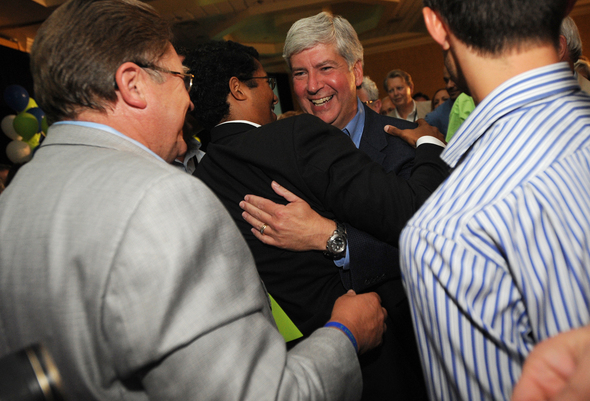
Ann Arbor venture capitalist Rick Snyder hugs a supporter after winning the Republican gubernatorial primary nomination Tuesday night.
Melanie Maxwell I AnnArbor.com
Political obscurity turned out to be Rick Snyder’s greatest asset.
Snyder, taking a page from his day-to-day work as an Ann Arbor venture capitalist, has treated his campaign for Michigan’s Republican gubernatorial nomination like it's a startup company.
Snyder, former president of Gateway Inc. and co-founder of economic development group Ann Arbor SPARK, vaulted into the national political spotlight Tuesday night, outpacing four opponents to win the nomination.
Here’s how he did it:
1. He was the quintessential outsider.
Snyder started the campaign with virtually no name recognition in Michigan’s political circles. When he launched his exploratory committee in March 2009, one of the state’s top political experts, Inside Michigan Politics editor Bill Ballenger, said he'd never heard of Snyder.
But early on, Snyder identified political inexperience as his startup campaign’s biggest asset. He consistently labeled his opponents as “career politicians” for a full year before the primary - and that resonated with voters who were tired of political insiders.
"It really just felt like people were ready for a difference, not the same old thing," said supporter Bruce Heissenbuettel of Pittsfield Township.
An EPIC-MRA poll released in the final days of the campaign by the Detroit Free Press and WXYZ-TV showed voters liked the fact that Snyder was a business executive and not a politician. In addition, he was a tech executive - much like former eBay CEO Meg Whitman and former Hewlett-Packard CEO Carly Fiorina, California’s Republican nominees for governor and U.S. Senate, respectively. Voters seemed to embrace that background.
Snyder's campaign took extreme steps to ensure he wasn't seen as part of the political machine. After participating in a few debates, for example, he decided he would no longer take part in the debate cycle - which raised eyebrows among political experts. (Snyder has said he would debate his Democratic opponent, Lansing Mayor Virg Bernero.)
But the goal was obvious: Snyder wanted to make sure voters knew he didn't play by the traditional political rules.
"I got tired of the debates," Snyder said Monday night at his last political rally before the primary. "We did well in them, I did a bunch of debates, stood up well, made my points, but it was so much soundbites and bickering. We need to talk about substance."
2. He spent millions.
Snyder plunged more than $5.8 million of his own cash into the campaign during the primary, giving him a significant edge in TV advertising.
Michigan’s unemployment crisis made it unlikely that voters would fork over large donations to candidates of any kind. Snyder, in a sense, identified a market opportunity for a self-financed candidate. His wealth - albeit nowhere near the pocketbook of 2006 billionaire Republican nominee Dick DeVos - helped him get the name recognition he needed to become a serious contender.
He raised another $1.4 million from more than 3,000 people - including a wide range of business executives from his Washtenaw County network - and rejected money from political action committees. Still, without his own money, winning the nomination would have been nearly impossible.
3. He stuck to a distinctive branding plan.
Snyder, recognizing he had to differentiate himself from the pack of candidates, aired ad after ad branding himself as “one tough nerd.”
It was a classic strategy straight out of Business Marketing 101: Find a way to make your product stand out. Snyder’s first “nerd” ad - aired during the Super Bowl in most Michigan markets - instantly branded him as the nontraditional candidate. And in 2010, nontraditional is appealing to voters.
“It’s an ad that we believe will cut through the clutter of standard political advertising,” Snyder campaign chief strategist John Weaver told reporters the day after the Super Bowl. “It’s self-deprecating about our candidate in an honest and fair way, and it also deals with the problems facing Michigan and confronts those head on.”
The “nerd” label was endearing to some, perplexing to others - but it helped Snyder stand out. It was perhaps the most entrepreneurial move of the campaign.
"Now we know that geeks shall inherit the earth and a nerd will inherit the governor’s chair," Rich Sheridan, CEO of Ann Arbor-based software firm Menlo Innovations, said Tuesday night at Snyder's victory party.
4. He benefited from the complexion of the Republican ticket and appealed to moderates.
Snyder actively reached out to moderates and even Democrats, in large part because he didn’t have to win a majority of the traditional conservative voters who typically dominate the primary election.
U.S. Rep. Pete Hoekstra and Michigan Attorney General Mike Cox effectively split the traditional conservative vote, allowing Snyder to spring to victory by appealing to voters in the ideological center.
Hoekstra couldn’t get any traction on the campaign fundraising front, and Cox couldn’t escape allegations that he bungled the investigation into an alleged wild party involving former Detroit Mayor Kwame Kilpatrick in 2002.
5. He maintained a focus on revitalizing Michigan's economy.
In the midst of a devastating economic collapse, voters are focused almost exclusively on the economy, and Snyder recognized that from the beginning. He declared Michigan's "economic disaster" on the day he launched his campaign and repeatedly called himself a "job creator."
He emphasized his experience in boosting Ann Arbor's entrepreneurial economy and said he wants to replicate the SPARK model throughout the state.
For voters whose lives have been impacted by the downturn in the economy, Snyder's message clicked.
"It is time for Michiganders to work and win together," Snyder said Tuesday night after winning the nomination. "And by doing that, we will create more and better jobs, we will create a place for our young people and we will bring that attitude, that spirit of entrepreneurship and innovation, and we will be a great state again."
Contact AnnArbor.com's Nathan Bomey at (734) 623-2587 or nathanbomey@annarbor.com. You can also follow him on Twitter or subscribe to AnnArbor.com's newsletters.
Comments
A2K
Wed, Aug 4, 2010 : 7:09 p.m.
"Independent Thinker" You are incorrect, Regan did far more to limit firearm ownership than Clinton ever did (i.e., Brady laws). Just more Faux-News/Talking points with no basis in fact.
Nick
Wed, Aug 4, 2010 : 3:41 p.m.
Rick Snyder is Jesse Ventura of gop
spaceman
Wed, Aug 4, 2010 : 12:57 p.m.
This was fascinating to watch as Snyder, a political outsider, let the three 'conservatives' chew each other up while he ran a positive, ideas based and professional campaign. I hope this is a sign of things to come not just in Michigan but around the country. The contrast with the spear-thrower Virg Bernero could not be starker. Bernero is by all appearances not just an idiot, but a belligerent and obnoxious idiot.
Sandy Castle
Wed, Aug 4, 2010 : 12:53 p.m.
You all are assuming that Rick Snyder will need the backing of congress to get anything done. Do you think all of the solutions to Michigan's economic woes will need new laws, or changes in existing ones, and government money? I am an Independent who usually votes Democrat because our political system seems to attract either far left wingers or far right wingers and I'll take liberal over religious right-wingers wanting to tell me how to live my life any day. I voted for Rick Snyder because I believe he won't tamper with social issues and I believe he has the knowledge and the ability to get Michigan's job market moving again. I think he's an honest guy who means what he says. Naive, I know. But I'm guessing there are a whole lot more of "us" out there than most of "you" here are giving credit for. I WILL be voting for Rick Snyder in November. I don't waste my vote by trying to throw off the other side.
InsideTheHall
Wed, Aug 4, 2010 : 12:10 p.m.
How Snyder did it: 1. Bet the ranch on Super Bowl ads and the nerd image to drum up a name recognition. It worked. 2.The Mike Cox implosion came late benefitting Snyder not Hookestra. This surprised many political scientists including me. The implosion hit in SE michigan with voters more aware of Kwame and the Detroit disaster. 3. Cox overspent in the Grand Rapids market thinking Hookestra was the main competition.This combined with the implosion doomed Cox. 4. Hookestra never gained traction in SE Michigan and focused on his West Michigan base to carry the day. This may well have worked until Cox imploded. No question Snyder ran a great tactital race but Cox and Hookestra made big strategy errors leaving the door wide open for Snyder.
demistify
Wed, Aug 4, 2010 : 11:57 a.m.
The last businessman to be elected President without prior business experience was Herbert Hoover. He demonstrated what sound business practices accomplish in an economic downturn.
Juliana Keeping
Wed, Aug 4, 2010 : 11:49 a.m.
Are you an A2 Dem who voted for Snyder yesterday? I'd like to interview you: E-mail or call julianakeeping@annarbor.com 734-623-2528.
DonBee
Wed, Aug 4, 2010 : 10:40 a.m.
Meg Whitman in California, Rick Snyder in Michigan. Two strong business people who built businesses from the ground up. If they win (and there is no promise), It will be interesting to see if they can deal with the challenges of these two states. I hope, truly hope they can, if they win.
democracyrox
Wed, Aug 4, 2010 : 10:39 a.m.
Mick52, I agree. It's easier to run as an outsider than govern as one. Herding the cats that make up the Michigan Legislature will be next to impossible, but people from business backgrounds always think they can try. I wish him luck. And peg, I agree with your analysis as far as the primary goes. I think those traditional GOP will coalesce quickly enough in the fall, however. They sure ain't gonna pull the lever for Bernero.
Mick52
Wed, Aug 4, 2010 : 9:46 a.m.
I had the same concerns as noted by johnnya2, a lack of political experience may quickly lead Mr. Snyder to some frustration upon assuming the governor's seat. Our president lacks experience and it shows. During the stimulus discussions Mayor Bernero made some strong statements but he quickly showed himself to be a labor supporting run of the mill democrat. Same as Jennifer Granholm. Michigan needs a huge overhaul to recover and tax and spend democrats are not the answer. No guarantees republicans are the answer, but we have to give them a try. What we have been doing has lead to where we are, we need re-direction. I think for a short while at least we are going to require some tax increases, its inevitable, but the key is what taxes and how they are applied to our problems.
Jeremy
Wed, Aug 4, 2010 : 9:16 a.m.
Rick Synder's backwards views on social issues will drive businesses away from Michigan. That, my friends, is a fact.
peg dash fab
Wed, Aug 4, 2010 : 9:09 a.m.
I think Snyder won by splitting the traditional GOP vote.
Independent_Thinker
Wed, Aug 4, 2010 : 9:04 a.m.
It's interesting Clownfish that you think you can infer any conclusions that I've reached about you. Why don't you quote one of the specific conclusions about you that I've stated.
Independent_Thinker
Wed, Aug 4, 2010 : 9:02 a.m.
Does the Olympic Training Camp have anything at all to do with defensive shooting? Did you do jam clear drills, fast draws, and tactical reloads for the Olympics? Ever done IDPA? And, you know what they say about people who brag, right? Furthermore, Clinton did come to your door for guns with the Assault Weapons Ban. In fact, he didn't even need to come to your door, he just prevented you from getting them to begin with.
Independent_Thinker
Wed, Aug 4, 2010 : 8:56 a.m.
Laws??? What I listed are platforms that the liberal party would like nothing more than to make laws. Are you going to deny that fact? FYI - MI law does dictate that we must get a background check and register handguns as well as go through a course and pay to get a CPL. That qualifies as infringement in my book. "While you are at it, perhaps you could show me the private charity groups that have ended child hunger, provide 100% of mental health care needs for our veterans and disabled citizens." - Perhaps you can show me the government entity that has managed to do any of this effectively with my tax dollars to date???? I'm not going to get into the specific issues (abortion, etc) as it's not what this article is about, although I do have some pretty commons ense opinions on those issues. My point was both sides have agendas in which they want to limit us as citizens. And to throw out the idea that somehow liberal politicians are upright, forthcoming, and out for our best interests is patently ridiculous.
clownfish
Wed, Aug 4, 2010 : 8:48 a.m.
BTW- INDYTHINKER, I bet I am a better shot than you! Have you been to the Olympic Training Camp for Shooting? I have. Placed in the top 100 in the country at one time. I am down to about 1/2 dozen firearsam at this point, NEVER have I had a govt official come to my door and try to take them. Not even Obama! But, don't let that indy thinking make you leap to conclusions!
clownfish
Wed, Aug 4, 2010 : 8:44 a.m.
INDEPENDENT- could you please show me the LAWS that REQUIRE you to buy a green car, a MI law law that denies you the right to own a gun. I will show you the LAWS that prevent Mary Cheney from marrying her partner, the LAWS that limit reproductive freedoms of women. While you are at it, perhaps you could show me the private charity groups that have ended child hunger, provide 100% of mental health care needs for our veterans and disabled citizens. I agree, it happens on both "sides" of the political spectrum... My point was that so many people throw around the term "freedom" while having zero interest in it. They too want to control what you and I do, but they hide it behind slogans, soundbites and hyperbole. Take our friend RUNBUM. He does not get a social conservative candidate and he blames it on Cuba!! But, we digress. I think Snyders victory shows how fed up people are with the social cons in this state. Devos lost because he was too far right in these stances.
Independent_Thinker
Wed, Aug 4, 2010 : 8:33 a.m.
@clownfish -"freedom voters" (those that want to control your freedom to procreate, or marry who you wish) I actually have no opinion on the specific issues you brought up. I'd just likr to say that this is an uniformed viewpoint as the liberals want to control some things and the conservatives others. Yeah, conservatives are big on telling you what you can do in your own home as far as marriage and abortion. But, liberals, are bent on telling you what kind of car you can buy (green), what kind of things you can say (speech), whether or not you choose to own guns or can even have one (2nd amendment clamp down), gun locks?? (how about you stay out of what I can do in my own home with that one??? huh???), take more tax dollars to give away for social programs (how about you let me decide exactly who and what I want to give money to period??? huh???). Get real buddy, all government officials want to control you period. One a whole, liberals are far worse in my opinion. At least this guy is not a career politician, maybe, just maybe, he'll be different (probably not).
clownfish
Wed, Aug 4, 2010 : 8:30 a.m.
All Hail Governor Bernero.? Big Egos? I give you two dozen eggs....how many chicks will you have? (and will you be allowed to keep them in your city/village?)
clownfish
Wed, Aug 4, 2010 : 8:27 a.m.
MIKE, I think a lot will depend on the so-called "debates" between Bernero and Snyder. Bernero is not an energizing candidate at all. Snyder does make a compelling case, with some well thought our ideas. I agree that govt and business are not the same, do not work alike, should not work alike so it will be interesting to see how Snyder adapts. However, the sheople are tired of "career pols" (but not career doctors, engineers, mechanics, child care providers etc) and we must no underestimate the power of the bloviators and celebrity entertainers that will be pushing for more business execs to be placed in office. Perhaps they forget that t is CEO"S that run/ran AIG, Goldman Sachs, ENRON, Bear Stearns, Lehman Bros. I don't think any dem has a chance at the gov spot this time around, too much damage done by the blame placed on Granholm (some deserved, some not). As I said above, it is also a simple matter of the wheel turning. Sheople get tired of "A", vote for "B", get tired of "B" vote "A" back in, get tired of "A". Remember, for all practical purposes we have exactly one more party than Cuba or China!
Doctor5X
Wed, Aug 4, 2010 : 8:27 a.m.
Synder's victory was the result of conservative fratricide (read: big egos) and crossover Dems who will not be there in November. The Dem maching will take Snyder apart and the GOP base will be unmotivated. All Hail Governor Bernero.
northside
Wed, Aug 4, 2010 : 8:25 a.m.
1. He spent millions 2. He spent millions 3. He spent millions 4. He spent millions 5. He spent millions Amazing that someone so wealthy can be seen as the "quintessential outsider."
clownfish
Wed, Aug 4, 2010 : 8:17 a.m.
How did MI become the "Peoples Republic"? In my lifetime: George W. Romney January 1, 1963 January 22, 1969 Republican William Milliken January 22, 1969 January 1, 1983 Republican James Blanchard January 1, 1983 January 1, 1991 Democrat John Engler January 1, 1991 January 1, 2003 Republican Jennifer Granholm January 1, 2003 Incumbent Democrat 33 years vs 20. My memory could be faulty here, but I don't remember dems controlling MI's congress since the 80's, about 30 years. It was not until 2006 or so that the dems took the House, with Repubs still in control of the Senate. Hmmm, RUNBUM, looks like it was the republican party that turned this place into a "socialist" paradise.
mike from saline
Wed, Aug 4, 2010 : 8:17 a.m.
once again the Michigan GOP will demonstrate [like Chris Angel] their incredible ability to snatch defeat from the jaws of victory. Buisness man, outsider, not a career politician! Someone who'll run the State like a buisness? Isn't that the same thing they said about Dick DeVos? What is the difference? Being Governor is not like running a buisness!! It's politics. So far, the only political skills Snyder has demonstated is the ability to win the GOP primary with slightly more than a third of the vote. The democrat voters who crossed over [and are now congradulating the republicans for their wise decission] will vote for Bernero in the fall. Bernero [who has political skills] will get full support from his party's base,and split the independent vote with Snyder. Snyder will give Libertarians an excuse to vote Libertarian, and the Republican, conservative base an excuse to stay home and rake leaves, on election day......See if I'm not right!
clownfish
Wed, Aug 4, 2010 : 7:57 a.m.
It will be interesting to see how Snyder does as Gov (A republican is going to win this time around, just the way the wheel turns). Remember, we had a "CEO President" in George W, and where did that really get us? Snyder held a lot of appeal to those that are tired of social conservatives telling people what to do in their bedrooms and living rooms. He intentionally steered clear of those fear issues that bring out droves of "freedom voters" (those that want to control your freedom to procreate, or marry who you wish)He ran a clean campaign, unlike the more xtian conservatives that allowed false witness, innuendo and exaggeration to be broadcast over the airwaves. I am curious how his pro-science approach is going to play on the west side of the state. Also curious how he will work with congress, being Gov is FAR, FAR different than running a board or a corporation. I recall the old Doonesberry cartoon from Ross Perots run: "Fireman!, here to fix your dishwasher...Physician!, here to fix your lawnmower... Software salesman!...here to fix government". As much as our Randian friends would like, government is not business, it does not run like business and it never will. Will the Randians accept a tax hike from a republican businessman, if that is what he says needs to be done? Looks to me like the best man won the repub primary, I wish him luck, and a congress willing to work with him, something our last Gov never had. (RUNBUM- please show some proof of your alleged "Cuban election". Where there multiple candidates on the ballot? Did a "socialist dictator" win? Will Snyder be converting Camp Grayling back into an Obama concentration camp? or, is this just more Breitbart type garbage spewed on an anonymous web forum, easier to make junk up about "Cuban elections" than face reality? Reality in this case being the MI electorate is fed up with social conservatives and the AIG's/Enrons they support?)
katie
Wed, Aug 4, 2010 : 7:48 a.m.
I really do hope that he's independent of all these special interests that are so attack oriented. It would be refreshing to have a governor's race that is about the issues and what the people of Michigan need. I think his clean campaign is responsible for his win, in part. People are fed up with hypocrites who attack their opponents about moral issues, acting holier-than-thou, then turn out to be worse themselves. These hypocrites then get away with murder on the important issues that matter, like the economy, because they are diverting attention away from that.
John Alan
Wed, Aug 4, 2010 : 7:25 a.m.
Another proof that Money can buy you anything.... Spend the money in ad and get the votes. Anyway,at this point, anything is better than the current situation in Michigan.....
johnnya2
Wed, Aug 4, 2010 : 7:10 a.m.
I wonder how this "businessman" would feel about a company he is funding hiring a person with absolutely NO EXPERIENCE or knowledge in what the company produces. Imagine say Gateway hiring somebody who doesn't own a computer. That is exactly what you are getting in this situation. The "outsider" label means he is just going to be a figure head. If you want to trace the problems Michigan has had in reinventing its economy and government, it can be directly traced to term limits. Most of the people in Lansing have such short stays, and then since they CAN'T run for their current office, they end up trying to do things based on their next campaign.
Dan H
Wed, Aug 4, 2010 : 7:05 a.m.
Synder won because people with real brains finally saw a genuine candidate who knew what he was talking about and had the personal history to back it up. It's as simple as that. Go, Rick, Go.
JS
Wed, Aug 4, 2010 : 6:54 a.m.
Mr Snyder led a compelling campaign and it was the endorsement of Bill Ford that sold me. This state needs to be run like a business with integrity and ingenuity. By the people and for the people! The number of voters turning out in November will tell the true story.
Booradley
Wed, Aug 4, 2010 : 6:49 a.m.
Good for Snyder. We've all tried the career politician thing -- been there, done that -- and it doesn't seem to work anymore. I see Snyder not owing any politician any favors; and with his success as a businessman maybe he can get us back on track.
81wolverine
Wed, Aug 4, 2010 : 6:47 a.m.
I'm really happy Snyder won. I think he benefited quite a bit from the Republican ticket being divided among somewhat viable candidates. As the article said, he just fit in the middle. He's a really hard worker who is probably the best person for the State right NOW to get our economy back on track. BTW AnnArbor.com - fix that awful typo in the headline "Synder.
stan
Wed, Aug 4, 2010 : 6:04 a.m.
runbum03, I think you're overstating the Democrat crossovers. The Democrats had their own primary, and I doubt that they voted Republican in large numbers. I'm a conservative Republican and I'm estatic that Rick Snyder is the Republican nominee. He was by far the best choice in the primary. Hopefully, he can beat Bernero in the fall. We don't need another pro-union governor.
runbum03
Wed, Aug 4, 2010 : 5:18 a.m.
#6 He had support of "crossover" Democrats. This was a Cuban style rigged election. Vote with your feet, young people, anywhere but the People's Democratic Republic of Michigan.
Cash
Wed, Aug 4, 2010 : 5:09 a.m.
I think Cox couldn't fight the whole Manoogian disaster, and maybe rightfully so. I wouldn't vote for Cox for dogcatcher (why don't we vote for dogcatchers?) but I do think Yatooma's timely release of the deposition put the last nail the Cox Coffin. I actually thought Hoekstra ran a dignified campaign and took some pretty hard shots from some unnamed groups supporting some other candidate. As usual we will never know who that candidate is. So again, no one can really say who ran a clean campaign because all of the dirt is thrown from secret no-name cowardly groups....who really are beginning to take control of our elections. Doesn't that worry anyone? And here's what's really interesting to me...all of the talk about Tea Party power and right wing grabbing votes etc and yet the winner from each party is, in my opinion the "least right wing". Interesting.
A2K
Wed, Aug 4, 2010 : 4:38 a.m.
Not a surprise to me! Mr. Snyder has led a masterful campaign: not gotten hung-up on the tired-old GOP social issues, he's not played to the electorates emotions - but to intellect (how refreshing!), is pro-environment, pro-science/innovation, a hard-worker, refused special-interest money so isn't a tool of an established regime or group, and wasn't on the attack 24/7 like a bratty teenager. Bravo!