

Letter from Ann Arbor police officers union raises concerns about proposed layoffs
Staffing levels in the Ann Arbor Police Department have reached a critical point, the Ann Arbor Police Officers Association said today in a letter sent to the City Council.
The union claims in a six-page letter that further reductions will result in longer response times and reduced police enforcement efforts. Since 2001, the union claims, the number of patrol officers in Ann Arbor has been reduced from 86 to 58, meaning about a third of the department's patrol presence has been taken off the streets.
"Over the course of the past 10 years, the AAPD has been forced to move from proactive policing to reactive policing," reads the letter signed by AAPOA President John Elkins and Vice President Jamie Adkins (download the letter here).
The City Council meets at 7 p.m. today to consider a two-year budget that includes eliminating 25 positions in the police department over the next two years, with the first round of cuts coming July 1.

Since 2001, the number of patrol officers in Ann Arbor has been reduced from 86 to 58, meaning about a third of the department's patrol presence has been taken off the streets, according to the police officers union.
Ryan J. Stanton | AnnArbor.com
Mayor John Hieftje said he wasn't surprised by the union's letter but said he disagreed with the assertion that the city has gone too far with cuts to police services.
"I think our police department is still very capable of doing proactive work and they demonstrate that all the time, and that's reflected in the crime statistics," he said. "Fortunately in Ann Arbor, we've seen crime go down steadily over the last 10 years, and that trend is continuing."
A total of 7,911 crimes were reported in Ann Arbor last year, a figure that's down nearly 19 percent from 2002 levels. Crime ticked up 2.6 percent last year, but city officials attribute that to a crackdown on underage drinking and open intoxicants.
FBI Uniform Crime Reports show Ann Arbor remains the second safest of Michigan's six largest cities, trailing only Sterling Heights. Lansing has 4.4 times more violent crime per capita, Grand Rapids has 3.5 times, Detroit has 7.7 times and Warren has 2.5 times.
"While it has been stated that there has been a reduction in crime statistics, at least some of that reduction is due to the fact that there are fewer officers available for proactive enforcement," the union's letter from today reads. "A reduction in reported crime does not necessarily mean a reduction in actual crime occurrences."
The union argues the police department has experienced a 39 percent reduction in full-time employees since 2001, while other city departments have been hit with lesser cuts. The letter mentions by name several police employees who face losing their jobs and talks about their dedication to the department and the need to preserve those jobs.
"In a national comparison of cities with major universities and similar populations, Ann Arbor ranks second to last for the number of city police officers," reads the letter, which includes a chart comparing Ann Arbor to other college towns. "All of the universities included in this comparison maintain their own police agencies, the same as the University of Michigan."
Over the next two years, city officials propose eliminating 48 full-time positions in city government, reducing the number of employees from 736 to 688.
On the chopping block starting July 1 are 13 positions in the police department and seven firefighter positions. The police department has 124 sworn officers, including Police Chief Barnett Jones, who as of last month also serves as the city's fire chief.
The 13 positions in the police department that would be eliminated effective July 1 include two vacant dispatch positions, one vacant telecommunicator position, one vacant police professional assistant position and one vacant officer position. Five officers, two dispatchers and one police service specialist would be laid off.
"I hate to see anyone at the city laid off," Hieftje said. "But the city has been very good to the police department over the years in that there's never been a layoff of a police officer, and we've been prioritizing safety services for a very long time."
Hieftje said the police union has the ability to stop four of the five officer layoffs by agreeing to bring its health care benefits in line with the packages offered to the city's nonunion employees, but the union has been unwilling to make that concession.
The union argues the police department's costs have been inflated since 2004 when it began incurring charges from the city's fleet and information technology departments.
The union claims the police department is now being billed $18,000 a year in fleet service charges for each police vehicle. In addition, the union claims the police budget is billed more than $5,500 per year in IT charges for each computer assigned to the department.
Tom Crawford, the city's chief financial officer and interim city administrator, said those are internal service charges that apply to every city department and they allow IT and fleet to recoup actual costs incurred for services. As for the IT charges, Crawford said those not only cover computer costs, but also access to the city's network and all of its software.
As for the vehicle charges, he said, that covers setting aside money every year for eventual replacement of the vehicle, work orders for repairs and maintenance, and several thousand dollars a year for fuel alone. He said there are some vehicles where the annual fleet charge ends up being more than $18,000, but the average appears to be about $11,000.
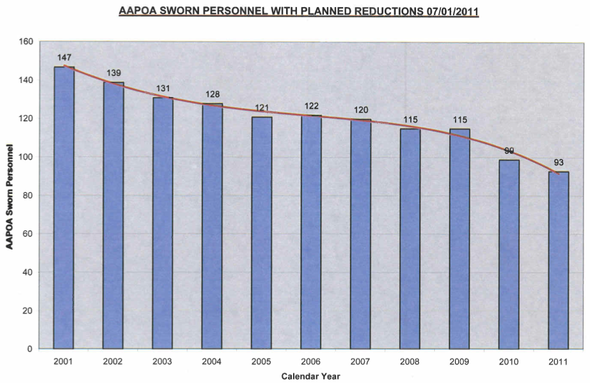
This chart provided by the Ann Arbor Police Officers Association shows the drop in officers represented by the union over the last several years as the city has cut positions from the budget.
Comments
2020
Tue, May 17, 2011 : 5:32 p.m.
Why doesn't the City just contract with the Sheriff's Department, who can provide the services cheaper, from what I have read? It would eliminate probably half of the city's police departments command structure, then that money could be used to hire more street level police officers. It would also return funds to the city, from the state, since Govenor Snyder is rewarding communities who consolidate. They already consolidated their dispatchers and SWAT teams, why not go all of the way?
Joslyn at the U
Tue, May 17, 2011 : 5:26 p.m.
You know if I was the police department and the Fire department and they wanted to lay all of me and my people off. ......... Id say go ON STRIKE> see how hitfje and council like that.
Boo Radley
Wed, May 18, 2011 : 12:02 p.m.
The reason police and fire departments have mandatory binding arbitration is because they cannot go on strike. Public Act 312, which gives them binding arbitration, also makes it illegal for them to strike.
EyeHeartA2
Tue, May 17, 2011 : 2:37 p.m.
@SW40; I really don't have a problem with traffic enforcemnt per se. What I have a problem with is lazy traffic enforcement and wasting resources writing tickets for a speed limit that is not even legal. Or camping out by a stop sign that they know people will roll through, since all the cross streets are blocked off (true story). Go after the high value problem. Get the guys that run the red lights at Washtenaw and Platt. It is just down the road from the illegal speed trap anyway. Go after the guy that tears through the subs at 35 mph. I think there is a difference. I'm surprised you don't.
EyeHeartA2
Wed, May 18, 2011 : 2:37 a.m.
Still don't see your point. My driving record is clean, I don't get stopped there. Seems easy to understand that they should go where they can do some good. Sorry you don't agree and would rather have them sitting on the side of the road, writing unenforceable tickets and losing the court case that follows. Not a good use of resources in my book. Evidently in your book it is. Odd book indeed.
SW40
Tue, May 17, 2011 : 5:06 p.m.
Perhaps there are drivers at Washtenaw and Platt that don't want the police making traffic stops in their area. Maybe the drug dealers don't want the cops arresting them or confiscating their narcotics. I imagine people who beat their spouses don't want tot go to jail for domestic violence. People who break the law don't get to chose when the laws are enforced, Seems pretty easy to understand I'm surprised You don't.
aataxpayer
Tue, May 17, 2011 : 2:09 p.m.
The win-win part of the solution is to find a way to save money in health care costs. Users of health care do a better job of considering costs when they pay some of the bill. I hope the police officers union agrees to changes that are long overdue.
Mike
Tue, May 17, 2011 : 12:35 p.m.
Will they cut traffic enforcement or their basic purpose of crime prevention? Hmmm........
John A2
Tue, May 17, 2011 : 6:19 a.m.
I also would say for A2 to lease out or sell some of the prime reality it owns, like veterans park for instance. The parks are real valued property. Vets park could be sold at 1.6 to 2 million dollars an acre, and theres at least 25 units or so. Put some more apartments and businesses in. Anything but mess with the police and fire departments.
EDM450
Tue, May 17, 2011 : 5:20 a.m.
"I hate to see anyone at the city laid off," Hieftje said. "But the city has been very good to the police department over the years in that there's never been a layoff of a police officer, and we've been prioritizing safety services for a very long time." The City never laid off a Police Officer? Well Mayor you are not much for history are you? They in fact did lay off Officers back in the early 70's so that was a nice thought. You have been prioritizing safety services for a very long time? How long is that? Because while you did not lay off any sworn Officers from the Department you did lay off 8 non-sworn Officers from it in 2007. You know the ones in the light blue uniforms that do all those police reports at the front desk and over the phone for far less pay than the rest of the Police employees? Now those jobs have to be filled in by sworn Officers, taking them off the road and putting them behind the desk when they are more useful out on the road. You say that these Officers can save there jobs by giving in to Health care benefits? Do you really think that in light of the passing of Officers Murray, and Zogaib, not forgetting CSA Limon who also passed away of a similar nature, and the possibilities it was caused by Radon and or Asbestos inside City Hall, that they would consider doing that? If anyone of you out there were facing this sort of uncertainty, would you honestly be so ready to give up some of your health care???
John A2
Tue, May 17, 2011 : 5:12 a.m.
Well I actually like the idea. Let UofM hire the Cops we let go. Their students are policed by us too, and the university can handle the extra weight. The university don't pay taxes, and we have to police their students too. The university police should be taking care of themselves, as they are state endorsed. We need the force as they are. Especially when we have a great homeless system, and people come here from all over to be homeless here. That leads to crime and drug usage, and behavioral problems. With this in mind, our university depends on enrollment for survival. I as a parent would not allow nor pay for my child to go to an unsafe place for a long school year. Especially being far away from them. The police force is a huge decision factor for where I will pay for my child to go. We have terrorists and financially desperate people around the US. I don't want to nor like loosing police. We are growing and just getting larger in population. Lets not drop the ball here folks. Get rid of the 6 digit employees first. Our fire and police should be larger not smaller. Who ever thought of getting rid of cops and firemen in a Big Ten College Town, should have their heads examined, or cast out of office. These acts will cause deaths, harm, and more crime. It happened in Ypsilanti and elsewhere, so please don't let it happen here also.
John A2
Tue, May 17, 2011 : 5:43 a.m.
Another idea, is to charge the university for our services. All the hours spent on UofM students crime and misbehavior.
lester88
Tue, May 17, 2011 : 3:33 a.m.
Personally, I dont think they (the Mayor) are laying off police and fire to get back at them for backing mayoral candidate Lesko. Its purely a means to save their (his) idealogical pet projects. Art, parks, trains, human services, solar panels, LED lights, hybrid trucks, E-85 gas, etc, etc, etc. Raise the living wage while at the same time eliminating the wages of others. The city is laying off and hiring at the same time. How can this be? Does laying off police and firefighters hurt the police and firefighters? No, well maybe a handful but the others are going to make more money from overtime. What a poor and pathetic personnel relations strategy. Bash the employees for years then ask them for help. What a joke. And what about the Radon and Asbestos that we read about only a couple of weeks ago? Some posters still have the nerve to wonder aloud (on this blog) why the police union is firm on health care demands. That question has been asked and answered. I have never seen firefighters demeaned like this by any other city but this one. Not Detroit, not Pontiac, not Benton Harbor, not Flint, not (fill in the blank). Yes, other citys have cut public safety but the difference is they dont blame the workers like this city does. If you can only afford ten firefighters then so be it, but dont blame the firefighters. The legislative body in this city needs some fiscal conservatism.
Michigoose
Tue, May 17, 2011 : 2:56 a.m.
The police in Ann Arbor are friendly, helpful and fairly reasonable. They have even jump-started my car when I was alone in a parking garage in the middle of the winter. They take care of people who are drunk or mentally ill. They help to keep our town safe and it is a shame that so many of them have been laid off at a time when crime is on the rise. As the economy suffers, more desperate people resort to robbery and other crimes. Last week we had a bomb threat downtown. The University has been reporting crimes by armed and/or violent assailants throughout Ann Arbor. (In response to another comment) It's not fashionable to think about traffic cops saving lives, but if you look at the statistics you'll find that drunk driving and other forms of reckless driving are among our top killers. You may remember how in 2005, a drunk driver killed a woman and her two children elsewhere in Michigan was convicted of murder <a href="http://www.clickondetroit.com/news/4458690/detail.html" rel='nofollow'>http://www.clickondetroit.com/news/4458690/detail.html</a> I knew these murder victims personally, I have known several others who died in traffic accidents, and I bet that everyone reading this article knows someone who died in a traffic accident- including people who don't know anyone that was killed by a gun. Driving drunk, driving sleepy, speeding, etc. are negligence with a deadly machine and these actions routinely kill people. We need more police to pull people over and not less. Our speed limits are generous and those who break safety laws should be held accountable before they kill others or themselves. I have been to countries that do not have strong police unions, where police officers make so little money that they spend all day shaking innocent people down for bribes, where it is often safer and more sensible not to call the police about crimes. Thanks to our unionized police force, we are much safer than people in those countries. If we keep cutting public safety funding, we'll end up in a very different place.
eagleman
Tue, May 17, 2011 : 3:47 a.m.
Unions are not the unalloyed good that you make them out to be. As a member of an Union myself, I can say that they are a mixed blessing.Corruption, incompetence, and laziness are rampant.Unions, lkje everything, are susceptible to being perverted. Police unions are the Thin Blue Line that protects crooked or brutal cops. I would not heap too much praise on them.
snapshot
Tue, May 17, 2011 : 3:35 a.m.
So the union makes the people in the union good? We live in the United States, so everybody should be good. Other countries have corruption problems, unions don't? Where's Jimmy Hoffa?
steve339
Tue, May 17, 2011 : 1:26 a.m.
"The union claims the police department is now being billed $18,000 a year in fleet service charges for each police vehicle." "He said there are some vehicles where the annual fleet charge ends up being more than $18,000, but the average appears to be about $11,000."-Tom Crawford. Did I read this correctly?? The Police Department is charged $18,000.00 PER VEHICLE......PER YEAR??!! FOR MAINTENANCE??!! I'm guessing those "police package" Fords don't cost much more than $25,000.00. How about they stop paying the city fleet services place and start getting their cars fixed at a local repair place, help the local economy. I understand the police cars get driven hard, but $18,000 in maintenance?? I would hate to see what the other city departments have to pay for their vehicles for MAINTENANCE. Even at $11,000 it sounds crazy.
snapshot
Tue, May 17, 2011 : 3:54 a.m.
The money all comes from the taxpayers so government workers try to get as much of it as they can. It should be a crime but they have immunity and a license to gouge the citizenry. They are unionized.
Ricebrnr
Tue, May 17, 2011 : 1:51 a.m.
Smoke and mirrors, folks. I reiterate: " the police and fire layoffs smack heavily of the mayor giving both unions a big screw you for endorsing Lesko in the last elections?"
Heardoc
Tue, May 17, 2011 : 1:02 a.m.
Maybe they could look at augmenting with the Sheriff dept (through contracting). They may find this to be more efficient and less expensive. It is worth a look.
xsnrg454
Tue, May 17, 2011 : 12:43 a.m.
Saved from layoffs in the same way the firefighters who took voluntary pay cuts and were layed off anyway?
SW40
Tue, May 17, 2011 : 12:27 a.m.
eyeheartA2, While I think most of us can agree that nobody likes getting a traffic ticket lets face it traffic enforcement is important regardless if you think so or not. Secondly, If you knew anything about law enforcement you would realize that a vast amount of crimes are solved by random traffic stops. Warrant Arrests, Drunk Driving, Narcotics Arrests, weapons violations etc.... Its not always about traffic tickets, cops assigned to traffic details make a large amount of arrests and provide visibility to an area in order to create a deterrent for criminals.
1bit
Tue, May 17, 2011 : 12:09 a.m.
Would some of the police officer jobs be saved if the benefit structure for current police officers was reworked (e.g. paying higher copays/deductibles on medical insurance)?
Ricebrnr
Mon, May 16, 2011 : 11:39 p.m.
Nobody else has said it, but does anyone else think the police and fire layoffs smack heavily of the mayor giving both unions a big screw you for endorsing Lesko in the last elections?
Ricebrnr
Tue, May 17, 2011 : 6:46 p.m.
Oh snap zinger on AAPD, I guess...but since I'm in no way associated with either safety services... You know what they say about assumptions
snapshot
Tue, May 17, 2011 : 3:50 a.m.
You must be on duty with all that time on your hands.
Ricebrnr
Tue, May 17, 2011 : 3:39 a.m.
9 yes votes (so far) beat your 2 no's
snapshot
Tue, May 17, 2011 : 3:28 a.m.
No again.
stunhsif
Mon, May 16, 2011 : 11:52 p.m.
Ah, no !
snapshot
Mon, May 16, 2011 : 10:55 p.m.
Scare tactics. Time our young college students are "educated" on personal safety strategies. You could put another 30 officers on the streets and they still can't be all places at all times, except maybe the donut shop.
snapshot
Tue, May 17, 2011 : 3:44 a.m.
Now I'm really scared.
nowayjose
Mon, May 16, 2011 : 11:05 p.m.
Until it's you that needs one. But you sounds like you have it all figured out
EyeHeartA2
Mon, May 16, 2011 : 10:52 p.m.
Saw a cop "enforcing" the illegal, unenforceable speed limit on Huron River Dr. If less cops on the street means that guy is gone, it is fine by me. That guy is my baramometer for staffing levels. I might believe they need more cops when he is gone. By the way, nobody ever gets robbed or stabbed on Huron River Drive north of Washtenaw. Just a hint for AA's finest.
EyeHeartA2
Tue, May 17, 2011 : 2:31 p.m.
@ricebrnr: Didn't get caught since I wasn't speeding. If the cop is there and I am speeding I get caught. Shouldn't be that hard to comprehend. I also didn't get caught for bank robbing and smoking left handed cigarettes, since I didn't do that either. Regardless, if you feel that is the best place for a cop to be, don't beat the drum on protecting yourself so much any more. I would rather have them deterring real crime, rather than trying to enforce a speed limit that has already proved unenforceable in several court challenges, but maybe that's just me. BTW, no tickets on my record.
Matt Cooper
Tue, May 17, 2011 : 3:47 a.m.
Funny how the only people that complain about the cops ticketing people for speeding....are those doing the speeding. Don't wanna get ticketed? Stop speeding. The cop was doing exactly what he was hired to do: Enforce the law, which also includes stopping speeders (unfortunately for you).
Ricebrnr
Tue, May 17, 2011 : 12:43 a.m.
"Didn't get caught"...speeding? Then he's doubly doing his job, no?
EyeHeartA2
Mon, May 16, 2011 : 11:19 p.m.
@nowayjose Saw him last week. Didn't get caught. Thank god he was there though, making sure nobody goes 42 on the road with no cross streets. Also important that they make sure nobody rolls through a stop sign when both cross streets are blocked due to construction. Yes, it POs me when I see a scarce resource being sqaundered.....or maybe it isn't as scarce as the police union would have us believe?
stunhsif
Mon, May 16, 2011 : 11:11 p.m.
"By the way, nobody ever gets robbed or stabbed on Huron River Drive north of Washtenaw. Just a hint for AA's finest." They generate income passing out speeding tickets. Arresting perps costs the city money. It is a no brainer , they need to bring in money, not spend it. Sad but true !
nowayjose
Mon, May 16, 2011 : 11:04 p.m.
Wow, speed much?
Ricebrnr
Mon, May 16, 2011 : 10:38 p.m.
"And they never will folks. If they don't give a hoot about their newest, youngest and most vulnerable co-workers, do you really think they give a hoot about you ? Actions speak way louder than words ! " Please cite where you get this information? Directly from AAPD during one of the Citizens Police Academy classes, there is only one officer under 30 and it's been some time since there have been any new hires. Where are these youngest and most vulnerable officers you are talking about? You don't think those would be included in all the previous reductions...nah
Ricebrnr
Tue, May 17, 2011 : 1:45 a.m.
AAPD 2000 - 216 officers 2007 - 150 officers 2010 - 124 officers <a href="http://www.ewashtenaw.org/government/sheriff/media-1/files-for-public/public-safety-challenges" rel='nofollow'>http://www.ewashtenaw.org/government/sheriff/media-1/files-for-public/public-safety-challenges</a> I didn't specify how the reductions happened, 216 to 124 is undoubtedly reductions though.
Eep
Mon, May 16, 2011 : 10:50 p.m.
There haven't been any previous reductions. The AAPD hasn't laid off any officers - at least not within the last 30 years. The reduction in force has all been accomplished through retirements / resignations, etc. Not that this really disproves your point, since there are still no "youngest and most vulnerable officers," except in very relative terms. "Rookies" on the department have probably been there close to 10 years. Personally, I think the fact that the union hasn't been willing to concede on health benefits has more to do with the City failing to bargain in good faith than any sentiment by the union to throw their least-senior members under the bus.
snoopdog
Mon, May 16, 2011 : 10:05 p.m.
"Hieftje said the police union has the ability to stop four of the five officer layoffs by agreeing to bring its health care benefits in line with the packages offered to the city's nonunion employees, but the union has been unwilling to make that concession." And they never will folks. If they don't give a hoot about their newest, youngest and most vulnerable co-workers, do you really think they give a hoot about you ? Actions speak way louder than words ! Good Day
Matt Cooper
Tue, May 17, 2011 : 3:45 a.m.
Or maybe it's simply that they fought long and hard to get those benefits and don't feel a need to give them up when other options are available. Nah. That might make too much sense.
Awakened
Mon, May 16, 2011 : 9:40 p.m.
If you get rid of the police department then there will be no one to report crime to and the crime rate will be zero. Heiftje has a plan for eliminating crime. And he's comfotable with that!
Joslyn at the U
Mon, May 16, 2011 : 9:37 p.m.
yep stabbings on monroe and state street..........ummm stabbings on brookwood..........umm was it last year that poor kid got stabbed and almost died at S university and E. university? yea another stabbing...........and before that a stabbing in front of Pizza House. Wowsers sure Mayor Hietfje lets just lay off a couple more cops no big deal (sarcasm) You have got to be joking.......oh wait your not. How did this guy get re elected?
Jake C
Tue, May 17, 2011 : 5:07 p.m.
Yep, if only we put another 300 cops on every street corner in the city, we could prevent every crime from happening, ever.
InsideTheHall
Mon, May 16, 2011 : 9:55 p.m.
At what time did these incidents occur? Overweight the night shift. This ain't rocket science.
djm12652
Mon, May 16, 2011 : 8:55 p.m.
gee, wonder if we still had had the beat cops, would there have been an armed robbery, oh wait no 2 in what 2 months, last fall on Main Street? Have both of these robberies been solved and prosecuted? hmmm...I say skip the ugly new city center art and get me more cops on patrol!
Huron74
Mon, May 16, 2011 : 10:53 p.m.
The only way you can answer a hypothetical question like this is to catch the robbers and ask 'em. Good luck with that.
Cash
Mon, May 16, 2011 : 8:55 p.m.
grye, It appears from all we read about the city administration....every employee group there needs to stick together, yes. At least together their voices are heard. Do you think the administrators aren't sticking together thick as thieves? Union = agree in referring to a oneness, either created by putting together, or by being undivided. I think both sides have formed a union. It's just that one calls it a "union" and one calls it an "administrative committee".
Joslyn at the U
Mon, May 16, 2011 : 9:33 p.m.
absolutely correct cash
Joslyn at the U
Mon, May 16, 2011 : 9:32 p.m.
absolutely correct
grye
Mon, May 16, 2011 : 8:42 p.m.
65% decrease in personnel has not equated to an increase in crime. As with other govt agencies and many private companies, when the money is flowing in, just keep on spending it. Now that the well has begun to dry up, cuts need to be made. If there were an increase in crime, then there would be reason to increase staffing. On a side note, people complain about a teacher's union. Don't hear much about people complaining about a Police Officer's Union. Does there need to be a Police Officer's union?
Matt Cooper
Tue, May 17, 2011 : 3:43 a.m.
Do you really not understand the difference between reported and unreported crime? Just because the incidence of reported crimes has gone down does not in any reflect a concurrent downward trend in actual crimes committed. It just means less are being reportd, and in this case that is perfectly understandable since you have fewer and fewer police to take reports, investigate and make arrests. If you think that the raw number of total crimes is actually falling with less police on the job, I've got some swamp land in Arizona to sell you. Don't be so naive.
Joslyn at the U
Mon, May 16, 2011 : 9:31 p.m.
apparently there does need to be a police officers union. Nothing should come before public safety.