

Deep cuts to police and fire included in Ann Arbor city administrator's final budget proposal
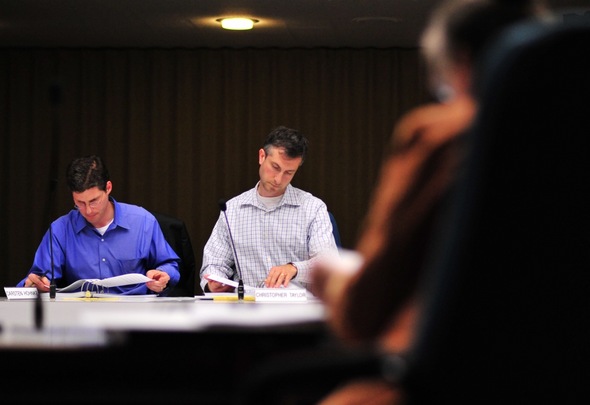
Ann Arbor City Council Members Carsten Hohnke, left, and Christopher Taylor pore over the city administrator's recommended budget during a special work session Monday night. The budget includes deep cuts to police and fire.
Ryan J. Stanton | AnnArbor.com
(This story has been revised to reflect that the budget now includes cutting one less firefighter than previously stated in 2012-13 and instead cutting one additional police officer. The cost for bathroom renovations in city hall also was changed to reflect the fact that the actual total is $345,000 when both budget years are added together.)
Deep cuts to police and fire services are on the way if the Ann Arbor City Council agrees with budget recommendations laid out by City Administrator Roger Fraser.
Fraser unveiled his two-year administrative budget proposal Monday night during a special work session of the City Council. It includes some of the deepest cuts to employee counts the city has seen in recent history, many of them in public safety services.
Over the next two years, Fraser proposes eliminating 48 full-time positions, reducing the number of city employees from 736 this year to 706 next year to 688 the year after.
On the chopping block for next fiscal year, which starts July 1, are 13 positions in the police department and seven firefighter positions. Various other positions in areas such as forestry, facilities, solid waste, accounting and administration would be gone as well.
"This year, more than any we've had recently, we're talking about dramatic reductions in the number of FTEs," Fraser acknowledged.
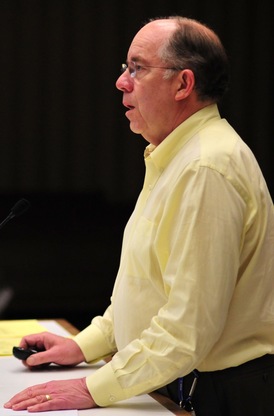
City Administrator Roger Fraser presents his budget to the City Council Monday night.
Ryan J. Stanton | AnnArbor.com
Of the additional 18 positions Fraser proposes for elimination in fiscal year 2012-13, 12 are in the police department and five are firefighters.
The cuts would drop the city's firefighter ranks, which the firefighters union and recently resigned Fire Chief Dominick Lanza argue already are too low, from 89 to 77. Fraser noted two of the seven firefighter positions to be cut effective July 1 are vacant already.
The 13 positions in the police department that would be eliminated effective July 1 include two vacant dispatch positions, one vacant telecommunicator position, one vacant police professional assistant position and one vacant officer position. Five officers, two dispatchers and one police service specialist would be laid off.
The police department has 124 sworn officers, including Police Chief Barnett Jones, who as of last month also serves as the city's fire chief. Jones expressed hope Monday night that cuts to both police and fire can be minimized.
"We're in the hands of the politicos and it's a process, and I'm hoping at the end of this process we can resolve it without laying off firefighters and police," he said. "If confronting this is a reality, we will come up with a plan to make sure that response time is not affected and also that the number of officers on the street is not decreased."
Fraser last year proposed eliminating 40 positions in police and fire, but the City Council used some last-minute budget balancing measures to stave off most of the cuts. In the end, just five positions in each department were eliminated.
Mayor John Hieftje said the administrator's budget proposal is about what he expected, and the city's budget woes are similar to those playing out in cities all across Michigan. He said the council still will take a close look at what Fraser has proposed over the next month.
"I think there's a whole bunch of stuff here that myself and other council members would rather we didn't have to go that far," he said. "But it's another tough budget year in Michigan and, as you look at our income adjusted for inflation, I think that really tells the tale about what's happened, so we're just going to do our very best to preserve the vital services."
Hieftje referred to a set of pie charts Fraser presented, showing the city's general fund spending has dropped since 2000, when adjusted for inflation. He said the city spent $69.8 million in 2000, and those same operations — though accounted for differently today — now cost about $78.4 million, or $64.4 million if adjusted for inflation.
When city officials began looking at the 2011-12 budget several months ago, they predicted general fund expenditures of $80.7 million and revenues of $78.3 million, which left a $2.4 million gap to close. Fraser's budget doesn't entirely close the shortfall, instead showing expenditures of $78.9 million and revenues of $77.9 million. That means the city would dip $1 million into its fund balance next year, lowering cash reserves to $9 million.
The 2012-13 budget, as proposed by Fraser, also would draw another $700,000 from reserves, with expenditures of $78.5 million and revenues of $77.8 million.
Fraser, Ann Arbor's city administrator since 2002, is leaving at the end of this month to start a new job as deputy state treasurer in Lansing. He acknowledged during Monday's meeting he won't be around for the council's adoption of his budget next month.
"Obviously this year is somewhat unique in that I'll be presenting this budget that I'm responsible for and I'm bailing out at the end of the month of April," he said.
A town hall meeting on the budget is scheduled for 7 p.m. Wednesday at CTN studios. A formal public hearing is set for May 2, followed by council adoption of the budget on May 16.
The staffing cuts outlined Monday night would trim nearly $1.1 million from the police department's budget next year, and about $756,000 from the fire department's budget.
This year's city budget strategy targeted an initial 2.5 percent cut to all departments, with a potential 1.5 percent additional cut in departments staffed largely by union employees who have not agreed to switch to the city's new health care plan, which includes police and fire.
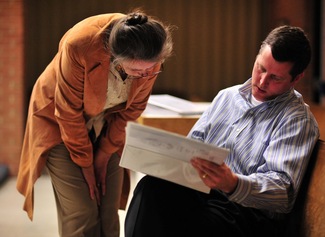
Council Member Sabra Briere, D-1st Ward, speaks with CFO Tom Crawford about the city budget after Monday's meeting.
Ryan J. Stanton | AnnArbor.com
Several city officials, including Jones and Hieftje, said they hope members of the police and fire unions will step up and agree to concessions to help avoid some of the cuts.
"I'm looking toward 2013," Jones said. "We're in negotiations and I'm hoping that if we get to 2013, there may be some savings of the FTEs by the contract negotiations being resolved, or retirements."
Council Member Stephen Rapundalo, D-2nd Ward, asked how much of the cuts to public safety could be mitigated if the police officers and firefighters agreed to concessions, particularly on their health care benefits. Fraser said he didn't have that information available.
Council Member Stephen Kunselman, D-3rd Ward, asked if Fraser was concerned about a potential increase in overtime with so many positions being cut. Fraser said the presumption is overtime, which records show totaled $2.7 million last year, will be virtually eliminated. The city already started addressing that this year.
"We have two things we believe will assist us in the coming year," Fraser added. "One is the completion of the study taking a look at the operations of fire, and a fresh look at how we deploy our firefighters within our existing contract. And we believe each of those things has the potential to enable us to make these reductions without an increase in overtime."
Hieftje pointed out crime is down 18 percent in Ann Arbor since 2003 and the trend is continuing in that direction. Fraser said that's hard to explain but it's true.
"Our already relatively low level of crime has continued to decrease, particularly in the areas of major concern," Fraser said. "Our folks are doing a great job still of making the arrests that are needed, particularly in the areas of larcenies and burglaries."
Hieftje pointed out safety services has gone from being 41 percent of the city's general fund budget in 2000 to 51 percent today. Since it's half the budget, he said, it's hard to avoid making cuts to police and fire when confronted with multimillion-dollar deficits.
The totality of the cuts outlined Monday is actually greater than the actual deficit because of a number of one-time capital costs that are accounted for in Fraser's budget.
For instance, Fraser is budgeting $76,000 so the fire department can replace a generator and acquire a thermal imager. He also is budgeting $345,000 for bathroom renovations in city hall.
Some unknown variables also are accounted for in Fraser's budget. He's assuming the city will see a decrease of $400,000-plus in payments from the Downtown Development Authority next year, that the city will lose 33 percent of its statutory revenue sharing payments from the state, and that property tax collections will be down 1.3 percent next year.
Fraser's budget reduces the level of support to nonprofit human services agencies by about $116,000 next year, with another $49,000 being cut the following year.
Combined, that equals a nearly 13 percent reduction in the money the city gives each year to community groups like Food Gatherers, Avalon Housing, Big Brothers Big Sisters of Washtenaw County and the Women's Center of Southeastern Michigan.
Fraser proposes saving another $158,000 by using temporary labor to maintain service levels in park operations. Another of the biggest proposed savings to the general fund is not actually a cut but a shift of $474,000 in forestry expenses to the stormwater fund.
Fraser noted the budget does not include a property tax increase. The city will continue to levy about 16.5 mills of taxes. About 10.3 mills of that goes to the general fund, of which a little more than 2 mills is passed through to the Ann Arbor Transportation Authority.
Fraser highlighted the fact that 41 percent of the property in Ann Arbor is tax-exempt. That includes land belonging to the city and its parks system (16.1 percent), the University of Michigan (11.9 percent), K-12 schools (5.7 percent) and churches (1.8 percent). Various other state, federal and county government properties make up a smaller percentage.
Despite the cuts the city must make, Fraser said the city remains relatively healthy financially. He said the city's per-capita debt is $2,199, which he said is not high compared with other communities. He showed the per-capita debt figures for six other communities:
- Sterling Heights — $284
- Troy — $469
- Kalamazoo — $1,261
- Lansing — $2,356
- Grand Rapids — $2,713
- Detroit — $3,482
Fraser also noted the city's pension system is 90 percent funded, though the trust that funds retiree health care benefits is only about 30 percent funded.
Ryan J. Stanton covers government and politics for AnnArbor.com. Reach him at ryanstanton@annarbor.com or 734-623-2529. You also can follow him on Twitter or subscribe to AnnArbor.com's e-mail newsletters.
Comments
BornNRaised
Thu, Apr 14, 2011 : 3:30 p.m.
I'm sure that Fraser and Hieftje haven't made public that in the last 2 years, Ann Arbor has seen the highest death rate via fires it ever has. Read the article about the town hall meeting. Where Fraser says, "Admittedly, this is an experiment." Wonder how the families feel about his experiment.
katie
Thu, Apr 14, 2011 : 2:17 a.m.
They closed the fire station in our neighborhood. This is ridiculous. There is all kinds of money in the budget for managers, to hire consultants for various projects that will benefit developers, for all kinds of fluff. This appears to be an attack on the unions. Do not lay off fire fighters. It's not a direct ratio between the number of fire fighters and the number of fires. There is the issue of prevention, preventing fires from spreading, for instance, timely responses from a fire station in one's own neighborhood. Ok, if the crime rate goes down, lay off a few more police officers, but only after you've laid off a bunch of managers, stopped hiring consultants for the "main street corridor" and the like. Why would any sane person want to lay off fire fighters? They would not. The motivation is to gut the unions. I want well paid fire fighters and police. They do tough jobs. They are worth it. Of course, I'm sure Mr. Snyder is just fine with all of this. Headed for a recall, I hope. . .
Cici
Wed, Apr 13, 2011 : 5:22 p.m.
Perhaps with cuts to the fire and police departments we won't get so many ridulous tickets, and fire trucks won't need to keep busy chasing ambulances and showing up at every injury or heart attack. Is it 911 policy that both an ambulance and fire truck must both go to every call??? (Just what percentage of fire truck calls are actually for a fire?? Does anyone have those stats?)
BornNRaised
Wed, Apr 13, 2011 : 8:53 p.m.
HVA (the private ambulance company) dispatches for Fire. So as for your smart mouthed comment regarding us 'chasing ambulances', we are requested by them for assistance. To go along with your comment of chasing ambulances, I'm sure you're well aware of the statistic that we (the FD) are on scene 80% faster than the ambulances. Perhaps you should call it 'ambulances chasing fire trucks' if you want to be more realistic. And by the way, maybe one day it will be the fire truck racing to your home to help you when you're in need. Wonder how cynical you'll be then? Probably greet us at the door with, "What are you doing here?"
BornNRaised
Wed, Apr 13, 2011 : 4:52 p.m.
Remember when teachers, Fire Fighters, Police Officers, Planned Parenthood and PBS crashed the stock market, wiped out half of our 401Ks, took trillions in TARP money, spilled oil in the Gulf of Mexico, gave themselves billions in bonuses, and paid no taxes? Yeah, me neither
BornNRaised
Wed, Apr 13, 2011 : 1:27 p.m.
Ok, time again for the factual history lesson... Last year when the Mayor asked ALL departments to cut 3% from their budget, the Fire Dept. was the only one to come to the table with the 3% from salaries and another 1% towards pension contributions. It was a 'show us your hand, we'll show you ours' good faith gesture to stop the cutting of FFs and closing of stations. As soon as the deal was done, they laid off 5 FFs. Tally to far, 4%. Then with the reduction of 5 people, 2 retirements, and the chief leaving that equates to another 5.75% from the budget. New tally, 9.75% with 8 less people gone. Rest of the departments? 0% and no layoffs. Now the city is demanding 4% from Fire and other unions, PLUS calling for 10 more layoffs. I know Fraser is an expert an Enron accounting... but 'cutting' vacant positions doesn't save any money. You're not paying salaries or benefits. It's a shell game. FD is actually losing bodies that ride on the trucks and provide a function. Let's also recall the reluctance of city council to provide the same 3% pay cut. Instead, they offered to write a ONE TIME check for 3%. Ok, that's one check. The FD gave up the 4% forever. Now let's take into account in the last 10 years, the city has cut the city staff by 25% and increased revenues by roughly $10 Million. You really think it's the employees creating the debit in the city? Look around at the construction going on by city council. So for all of you saying, "They need to give more back." WE as a fire dept did to get our foot in the door with a show of good faith bargaining. City's response from Robyn Wilkerson (HR Head).... "That was your own fault for doing that." When asked why our 4% wasn't even being acknolwdged. But Rapundalo is the one with a 'look of distaste frozen in his eyes'?
Lets Get Real
Wed, Apr 13, 2011 : 2:46 a.m.
So how about cutting all those "ESSENTIAL" services that are in such demand: since the number of housing starts are down and building construction projects are in the tank - how about all of those important building inspector, sidewalk police & permit administrator types? How about rallying the Boy Scouts/Girl Scouts/valuable community volunteers to help with park care - gardening by master gardners, trash pick-up by "adopt a park" groups, volunteer docents to conduct nature tours, senior citizens who love golf to be starters/marshals, retired outdoor enthusiasts to rent canoes - need I continue. Can we be creative about how to rally our citizens? or can we only think of how to save overpaid, union jobs held by people who have made the casethat their job is more important than another's. Why do AA voters continue to support unreasonable expenditures for overpaid, under challenged workers who receive unprescidented benefits and pensions. Let's Get Real here - the gravy train must end
Stuart Brown
Wed, Apr 13, 2011 : 2:27 a.m.
Time to re-purpose Greenbelt monies! The consultants the city pays to advise the city on which properties to target get enormous sums of money for their time. No money for new furniture for the 15th District Court! No $5 Million to re-skin Larcom so it matches the new expansion! Put a toll booth on stadium bridge that only operates on game days to raise money for the bridge rehab! No city paid parking for UofM employees (aka, the proposed transit center on city parkland.) No cuts to the Fire Department!
Fat Bill
Wed, Apr 13, 2011 : 1:25 a.m.
Lets persuade the U to go private, think of the assessed value of the land and improvements that would no longer be exempt...
Justice4all
Tue, Apr 12, 2011 : 10:52 p.m.
What makes this so absurd is that I just drove past the "Palace" aka 301 S. Huron. Lets cut police while at the same time giving them this monstrosity of a station to use.
Justice4all
Tue, Apr 12, 2011 : 10:46 p.m.
To me, it's all about what is important, where your priorities are. I for one believe that the central role of local government is to provide basic services such as police and fire. I know it is difficult but cut the other "not as essential" parts of local government. Of course, unions have to do what is right and take cuts like we all have.
RUKiddingMe
Tue, Apr 12, 2011 : 10:34 p.m.
Ryan, or anyone at AnnArbor.com; Can you find out and report on: 1) How much money the city has ALREADY spent on Fuller Station (even though it SUPPOSEDLY wasn't a done deal, I know they've done studies, work, etc. on the project as if it IS a done deal), and how much they intend to spend on it over the next 5 and then 10 years. Readers, Fuller Station is one of the least needed things I've ever seen; that whole idea is like an insult, like an experiment to see how much they can do before we revolt. To know that they intend to continue putting money into that in the face of all these budget woes is infuriating. 2) Help me understand the deal with the new city hall; I thought the whole justification for it was that the old one was in shambles and unusable AND money would be saved by NOT PAYING RENT for it, like we were renting it from the county or something, right? So what's this with us renovating it and continuing to use it? Am I confusing buildings here? DId I misunderstand what the city was saying they were building the new building for? Thanks for any help on this.
Cash
Tue, Apr 12, 2011 : 10:31 p.m.
Let's say my home budget is looking "iffy" and my bills are: $ 20 alarm system $100 heat $100 electricity $50 water/sewer $50 phone $100 food $100 cable tv $50 movies $100 restaurant Etc..... So would you cut part of your electric bill? Part of your heat? Your food? NO! We'd cut cable, movies, eating out etc before we'd take part of our food away or our heat away. And we'd keep our alarm because our safety is vital to survival. Now at home we know what to cut...we cut what we do NOT need! Our budget should be 100% REQUIRED items...necessities. Why is it so darned hard for city hall to get that?
Ricebrnr
Thu, Apr 28, 2011 : 7:48 p.m.
@ Craig 1st and with immediate effect: Heat - lower the thermostat in winter, open windows in summer Electricity - turn off lights, don't watch TV etc Water/Sewer - use less and both bills go down. Food - there are many choices you can make to lower your food bills if you must. Less meat, no pop or coffee, more peanut butter, pastas and legumes... 2nd and more delayed: Consider reducing coverage on insurance where applicable. For example: Instead of comprehensive maybe liability only with a higher deductible on the car. As a matter of fact sell one car while you're at it. I wouldn't be selling all my guns and ammo or my fire extinguishers that's for sure..
Cash
Wed, Apr 13, 2011 : 9:13 a.m.
Craig, You would look at need and value. If I am getting a good value for my dollars, no I would not cut my insurance ...because if I needed it tomorrow...if I had a devastating fire or a break in....I would be very sorry that I didn't have the best insurance. I would be glad then that I cut the cable bill and the movies (fountains and all) and put my money into the best value.
Craig Lounsbury
Wed, Apr 13, 2011 : 2:26 a.m.
what if you made cuts already but things were still tight and it looked like this... $100 heat $100 electricity $50 water/sewer $100 food $300 house insurance $300 life insurance $900 health insurance would you shop for cheaper insurance?
63Townie
Tue, Apr 12, 2011 : 10:23 p.m.
"...Several city officials, including Jones and Hieftje, said they hope members of the police and fire unions will step up and agree to concessions to help avoid some of the cuts." The firefighters already did and look what it got them.
CityFF
Tue, Apr 12, 2011 : 8:02 p.m.
I just renovated my bathroom for $2000. They must have 75 bathrooms in city hall. Didn't we just spend a bunch of money renovating the old city hall before the new ridiculously ugly addition was added?
javajolt1
Tue, Apr 12, 2011 : 7:38 p.m.
These cuts are sad. but let's examine why they are occurring: Look, anyway you slice it, receiving things like 90% compensation for 5 years of service (Roger Fraser and Neil Berlin), is a joke. Teachers, cops and firefighters who are upset should go after these types of deals which are every bit as egregious as fact cat corporate types. The sad thing is in order for these incredibly generous deals to be sustained, basic services like police, garbage, road upkeep, etc. suffer. Then the taxpayer is asked to ante up to "preserve services". PLUS, the latest hires are laid off because we cannot keep up with the really nice salaries and benefits of those lucky enough to have been in these sweet contracts for a while. The losers are the last to be hired. The winners are those that are about to cash out! It's a joke. Taxpayers are getting less services, people are being laid off to support the older folks who put in all of five years of service(!) its a giant pyramid/Ponzi scheme!
Macabre Sunset
Tue, Apr 12, 2011 : 10:33 p.m.
Yes, Ponzi Scheme is a good way to describe it. Same with Social Security and the other major entitlements. It was easy when they were founded and a far greater percentage of adults were working. Today, not so easy. Ten years from now? We're defaulting on the deficit like a banana republic with a potassium problem.
andys
Tue, Apr 12, 2011 : 7:58 p.m.
Exactly, prior city councils / administrators set up an unsustainable system that now requires draconian cuts or significantly higher taxes. What are you going to do? Its the prior people that were in power that took us all to the cleaners and probably feel good about their prior "public service".
seasons
Tue, Apr 12, 2011 : 7:07 p.m.
Instead of just focusing on numbers in this article, it would be more informative if we could learn about the impacts of the cuts in the various areas. If we currently have X number of police and we lose X # of positions of various kinds - what is impacted? Decreased ability to respond to calls? Increased time to get to site of reported difficulty? Ditto for the fire department. The fire department has obviously felt great discomfort over the past years with the perceived attitudes of how relevant its operations and staff are to the community. Investigative reporting is such a great gift for all of us - keeping informed. Are the recommendations being made for cuts in all areas based upon good data or a wish list of what "should" be cut? Thanks.
Dominick Lanza
Tue, Apr 12, 2011 : 6:52 p.m.
Again the fire department cuts are in real people not vacant positions or non combat personnel the counts are lopsided and why are any changes being proposed when the city has commisioned a study. One would think a smart council would wait for the results of the study they just approved unless of course they already know the recommendations. The numbers suggested where in place when I left if I am not being replaced that should mean two less firefighters need to be cut?
Cash
Tue, Apr 12, 2011 : 10:02 p.m.
Chief Lanza, Please know that there are taxpayers who really admire you for your honesty. It's so rare in public service. Thank you very much.
CityFF
Tue, Apr 12, 2011 : 7:59 p.m.
Chief, They get to budget 150,000 for your position with no intention of filling it and then at the end of the year they can claim it as a big savings. Shell games....
John
Tue, Apr 12, 2011 : 5:32 p.m.
Cut salaries, cut office staff, work harder, cut benefits, stop defined benefit pensions. Stop taking away services from taxpayers and start confronting the real problems.
Stephen Landes
Tue, Apr 12, 2011 : 5:25 p.m.
I cannot just vote in your poll as the choices are, in my opinion, too limited. One advocates no action by Council, one creates a more adversarial relationship between Council and staff, and the third presents a false dichotomy. What we need in Ann Arbor is a set of principles that we can use to direct the development of the budget. I would begin with looking at the whole budget rather than what is called in the article the administrative budget or what might be considered the discretionary budget. All spending is ultimately discretionary even if we have to re-write some laws and regulations. Decide what we value; what are our priorities. This cannot be just as simple as saying "We want to live in a safe neighborhood". We have to define what that is: Fire Department response time must maintain all residential property at the lowest risk level for insurance purposes -- something specific that the City Administrator can measure and act on. If police response time to a call anywhere in the City must be within 5 minutes then say so. If our objective is to have one acre of park land for every thousand residents and be within a 5 minute walk of where each resident lives, then be that specific. Then elect City Council representatives to act as a board of directors to make sure that the City Administrator understands how to balance all those specific requirements and, most importantly, what to do if he cannot achieve that balance. I think we started on a process to develop specific priorities when we engaged in the "Ann Arbor 2000" exercise years ago (so long ago I don't remember when it was). At least it was a process for engaging the entire community. The results are probably sitting on a shelf somewhere, gathering dust. It is my observation that we tend to bounce from one thing to another, from one crisis to another, without a long range plan specific enough to allow us to achieve any civic objective.
Awakened
Wed, Apr 13, 2011 : 11:46 a.m.
But under your plan what does does council do when it finds something cool that it reallllly wants to spend your money on?
seasons
Tue, Apr 12, 2011 : 7:09 p.m.
Very good comment.
AACity12
Tue, Apr 12, 2011 : 5:17 p.m.
Watch this before you vote. <a href="http://youtu.be/v0rnkyByPyE" rel='nofollow'>http://youtu.be/v0rnkyByPyE</a>
Boo Radley
Tue, Apr 12, 2011 : 3:56 p.m.
An 18% reduction in crime .... which crimes? Is shoplifting down 75% while assaults and home invasions are up a like amount. Just pulling figures out of the air to ask what good that 18% average statistic is. Crime reduction statistics are also of no more value than any other type of statistics. All can be manipulated to "prove" whatever you wish to prove. There are many different smoke and mirrors tactics that can be used when reporting crime statistics, but it probably behooves the city's management to come up with statistics like this so they can show the citizens they really don't need police and fire after all.
Roy Munson
Tue, Apr 12, 2011 : 3:31 p.m.
I'm not keeping the stats, but I certainly don't see an 18% reduction in crime here since 2003. It certainly seems to be going in the other direction.
Pete Warburton
Tue, Apr 12, 2011 : 3:28 p.m.
It is time for the University of Michigan to step up and give Ann Arbor more money for public safety. I know they give us plenty of jobs and contribute in ways not reported. However, we all know when the money is gained as a indirect benefit it can end up helping a developer and not the people of Ann Arbor . Have we sat down with them and talked about the negative impact on safety for student citizens and townies caused by under staffing ? It is time ! The University will not get mad and move ...They own a tremendous amount of property that is property tax free.
grye
Tue, Apr 12, 2011 : 6:27 p.m.
They have their own police department. High time they provide all their own city services.
A2Girl63
Tue, Apr 12, 2011 : 4:38 p.m.
Watch what happens when a UofM building burns. Defensive fire fighting - WATCH IT BURN....
LiberalNIMBY
Tue, Apr 12, 2011 : 3:24 p.m.
--Sadly, in government circles, only scarcity drives innovation. Fire fighter deployment techniques are woefully antiquated, inefficient, and often dangerous (13 speeding trucks going to a minor fire?). It's too bad this is being forced upon them, but it has to be done. --We should NOT be dipping into reserves, because the budget situation is just going to get worse. Don't spend my savings! --Where are the benchmarks for how many lawyers a city needs? --What about the 30% funding of future retiree health benefits? Please explain! For people who want to look more than 2 years down the road, is this last line of the story the biggest story?
AACity12
Tue, Apr 12, 2011 : 8:56 p.m.
But hey, you got your jab in with no facts to back it up.
AACity12
Tue, Apr 12, 2011 : 5:15 p.m.
Ann Arbor doesn't have 13 fire trucks it has 5. All 5 don't go to a minor fire either. There are highly trained, professional dispatchers the decide what the adequate response is. But even then the dispatchers aren't at the incident and they should always error on the side of caution and send more then less.
CincoDeMayo
Tue, Apr 12, 2011 : 3:12 p.m.
Make that three quick questions : )
CincoDeMayo
Tue, Apr 12, 2011 : 3:11 p.m.
Two quick questions: Why are we spending $156,000 on bathrooms in a new city hall? ANd, why does Fraser not know the result of various options like the one asked by Council Member Stephen Rapundalo, D-2nd Ward, who asked how much of the cuts to public safety could be mitigated if the police officers and firefighters agreed to concessions, particularly on their health care benefits? And why is it not stated that the issue discussed below has been "addressed" by shutting down fire stations? Council Member Stephen Kunselman, D-3rd Ward, asked if Fraser was concerned about a potential increase in overtime with so many positions being cut. Fraser said the presumption is overtime, which records show totaled $2.7 million last year, will be virtually eliminated. The city already started addressing that this year.
grye
Tue, Apr 12, 2011 : 6:29 p.m.
That was 3 questions.
leaguebus
Tue, Apr 12, 2011 : 2:56 p.m.
The Unions are not the problem. They have given concessions only to have positions cut anyhow. Public Safety is a dangerous profession and not for older bodies. How many people 60 years old can still climb a 50 foot ladder in full fire equipment or subdue a 250 pound 25 year old? Not everyone in Public Safety can get a desk job when they get older and less able to do the job. That is why their pension exists and why it needs to continue. If anyone is to blame, it is the mindless tax cutters in Lansing who want to cut $2B from Business taxes and balance that on the backs of the poor, pensioners and Public Safety personnel.
rossianroulette
Tue, Apr 12, 2011 : 5:11 p.m.
Still no reason why their health packages and pension contribution percentages are way better than everybody else's. And why so many fire and police chefs retire with pensions based on their last year total comp which is heavily boosted by overtime, after just a year or two in that position. This ripping-off of taxpayer funds has to stop NOW.
brownfields
Tue, Apr 12, 2011 : 2:45 p.m.
With all the dislike for unions and what our public safety employees earn, I ask what is a fair wage and benefit package? Then ask yourself, would I do the job for that? Public saftey costs, and cannot be run like a business. Comparing it to the private sector is apples and oranges. Where was all the wealth for public employees when private business was posting record earnings? Sure sounds like a lot of people suddenly want to become a firefighter or police officer.
Craig Lounsbury
Tue, Apr 12, 2011 : 5:13 p.m.
stopthink, I'm game for a spirited discussion. But to do that we need to base our comments in facts and not scare tactics. Nobody anywhere is suggesting we slash taxes to the point where we have no police or fire. That is a stupid/insulting statement.
StopThink
Tue, Apr 12, 2011 : 4:51 p.m.
@Lounsbury - you ask how much "should we tax the citizens for police and fire?" I say enough to keep the departments running, and the city safe. Unless you live in a city that prefers to spend it's revenue on say, art and uneccesary buildings for the administration to sit it's rear ends in. The alternative is to have no police or fire, it's not mandatory. Now there's a scary thought. Guess you can sit and thing about that when you're being robbed, having a heart attack, or your house is burning to the ground - but the mayor and city council has dismantled all the city services.
Craig Lounsbury
Tue, Apr 12, 2011 : 2:56 p.m.
"what is a fair wage and benefit package?" to answer a question with a question how much should we tax the citizens for police and fire? "Then ask yourself, would I do the job for that? " a dangerous question. These days the answer for many folks would be...heck I'd do it for 1/2 that. "Where was all the wealth for public employees when private business was posting record earnings?" Many Companies are still posting record earnings while shipping jobs overseas, slashing pay and benefits and laying off employees. So i fail to see any point on this one
rossianroulette
Tue, Apr 12, 2011 : 2:07 p.m.
Until these police and fire unions get the message that they need to accept the same level of benefit, healthcare, pension plan, retirement age, and overtime terms that the rest of us taxpayers live by, we need to keep reducing their numbers just as this draft budget does. Fraser is not the bad guy. These unions are. If these unions accept this basic point above, there will be enough savings to pay for these positions that now need to be cut. Its very, very, simple. The police and firemen in danger of losing their jobs need to fight their own union bosses and senior officers bent on preserving their outrageous packages.
Awakened
Wed, Apr 13, 2011 : 12:04 p.m.
The average life expectancy for police officers and fire-fighters is 68. The country as a whole, 78. Can I assume you want Social Security benefits delayed to 75 years to save cost? Unions will make concessions whether they like it or not. I cannot find myself upset that they have made, and will make, the best deals they can. Some of the deals were outrageous. But where was the outrage when they were made? We kept electing the same people who did the same thing. I think I'll look in the mirror for blame, learn my lesson, and change my voting behavior in the future.
StopThink
Tue, Apr 12, 2011 : 4:57 p.m.
Also, I love the lack of compassion for the fact that these are human beings losing their livelihood. No, just deem it as"reduce their numbers" so as not to have a human aspect to it. Don't consider they are fathers, mothers, husbands and wives. People with homes which will be lost and lives which will be destroyed. Nope, just "numbers to be reduced". Very, very nice. Simply appalling.
StopThink
Tue, Apr 12, 2011 : 4:54 p.m.
All jobs everywhere should have the exact same pay, same benefits and same exact retirement age. No disparity for education, experience, or qualifications should be taken into considerations. It's simply UNFAIR! And life cannot ever, ever be allowed to be unfair! How ridiculous!
Boo Radley
Tue, Apr 12, 2011 : 4:05 p.m.
Do you really think that police officers and firefighters should be on the job until they are 65-67 years old? If that happens, any savings you see in their retirement benefits will be more than offset by worker's comp claims for injuries and deaths. I also never see any acknowledgement in comments about this subject that many police department employees do not receive Social Security benefits. Their qualifying government pension takes the place of any Social Security retirement. How good does their pension plan and retirement look when you take that into account? And how much money is saved and put towards the pension when the city does not have to pay SS tax? I 'think' that Ann Arbor is one of the cities that doesn't pay into Social Security for it's officers. Maybe someone can correct me if I am wrong about that.
leaguebus
Tue, Apr 12, 2011 : 1:46 p.m.
We have cut half of the Police force in the last 10 years and cut a bunch of Fire personnel, so do we know what adequate staffing levels are for a city of this size? Isn't there some way to find out except by having a whole downtown block burn? I would assume that anyone running a city in these times would need to know what are adequate staffing levels without using the trial and error approach. Obviously the trial and error approach is alive and well in Ann Arbor. We cut staffing until we have a large fire, or a huge increase in crime, then we start adding again. We cannot use the trial and error approach year in and year out. At some point we need to know that we cannot cut anymore from Public Safety, someone must be able to tell us, why can't we identify this entity and find out?
xmo
Tue, Apr 12, 2011 : 1:14 p.m.
I think we need more cuts to man-power. The Big 3 have reduced their Union and non-union staff by at least 25% since 2000 yet the city has only cuts about 5%. Are we living in the same world? Do we really need all of the departments we have in the city Government?
kilalqaeda
Tue, Apr 12, 2011 : 1:14 p.m.
My EMU Criminal Justice professor told us in class that police and military are the same at terrorists, I don't believe him but he has a PhD so is it so bad that police are taking a hit when many of them are viewed by radical professors as the same as what terrorists do?
Fat Bill
Wed, Apr 13, 2011 : 1:22 a.m.
I had this guy a few years ago... first initial is G. He plays the part of the radical left winger pretty well, usually to illustrate a point to a class full of right leaning criminal justice students...
Cash
Tue, Apr 12, 2011 : 5:25 p.m.
Sorry but from your previous post: "Try working in the shop for the UAW for a living, I earn my money. I only have a high school diploma too and make more than most teachers but I work harder".... can't have it both ways.
Garrett
Tue, Apr 12, 2011 : 3:50 p.m.
I suspect you may have missed the point of what he was trying to say.
Sarcastic1
Tue, Apr 12, 2011 : 3:47 p.m.
Is he the same professor that was on Gilligan's Island?
Sarcastic1
Tue, Apr 12, 2011 : 3:46 p.m.
Wow. What is the professor's name?
andys
Tue, Apr 12, 2011 : 3:18 p.m.
Are you sitting there and lapping up that nonsense? Is this what tenure is all about? Protecting idiots so they can spout this junk.
5c0++ H4d13y
Tue, Apr 12, 2011 : 2:11 p.m.
I would have asked for a refund on that class.
grye
Tue, Apr 12, 2011 : 12:59 p.m.
Teachers must manage 30 kids in their classrooms. How about having managers be accountable for 30 working employees. If all you are doing is managing, a manager can handle personnel in multiple departments. If this ratio is expected in the school system, it can be adopted within the public employee sector. Great way to save money.
Garrett
Tue, Apr 12, 2011 : 12:52 p.m.
Wow. Just Raise Taxes! I don't see why people have to lose their jobs and families have to be relocated/uprooted and destroyed because those that make over $200,000 refuse to pay a few percentage points more of their 'income.'
Marshall Applewhite
Tue, Apr 12, 2011 : 4:16 p.m.
Yeah, you're right. Nobody else is against raising taxes besides those $200,000 fat cats. We're all thrilled about the idea of raising taxes in a recession.
Garrett
Tue, Apr 12, 2011 : 1:54 p.m.
I'll do that when volunteer to be the one that rips these families out of their home and throws them into the street.
kilalqaeda
Tue, Apr 12, 2011 : 1:15 p.m.
Why don't you give out of your own money to the general fund of the city?
Craig Lounsbury
Tue, Apr 12, 2011 : 1:15 p.m.
we don't have an income tax to fund the city. Its funded by property taxes. Are you proposing an income tax?
aes
Tue, Apr 12, 2011 : 12:50 p.m.
I am very concerned about this situation. If I had a vote right now, I would vote NO CONFIDENCE in our City Council. We need our police. We need our firemen. They are our insurance for PUBLIC SAFETY, the reason I think that most of us need our city government--to provide basic services, keeping the homes and streets SAFE. Perception is reality in these matters. If we perceive that our City of Ann Arbor is unsafe, it WILL BE unsafe.
15crown00
Tue, Apr 12, 2011 : 12:43 p.m.
criminals and arsonists are licking their chops. so Fraser is a buddy of big business Snyder huh?guess it figures. bet Joe The Plumber could go into City Hall study the situation for two weeks and set a plan where 20-30% of the employees are cut saving the city thousands and thousands of dollars. and to top it off Fraser is leaving.typical boss!!!
DeeDee
Tue, Apr 12, 2011 : 12:30 p.m.
So Fraser says crime is dropping but he doesn't know why (seems like knowing should be part of his job) and then later this article says in the time is has dropped spending on public safety has gone from 41% to 51% of budget. Maybe that is why! So, let's cut what is succesful - that makes a lot of sense. It look like they are going to cut about 10% of police force. Where is the 10% cut in administrative positions one wonders? There certainly seem to be a lot more highly paid managers and directors of This'n'that than are needed. I bet no one would even notice if 10% of them went away.
Craig Lounsbury
Tue, Apr 12, 2011 : 12:42 p.m.
I don't think you can make the connection between the public safety cost percentage going up and crime going down. After all as the percentage went up the raw numbers of public safety "boots on the ground" personnel went down.
Craig Lounsbury
Tue, Apr 12, 2011 : 12:26 p.m.
I don't pretend to have any answers, easy or otherwise. But I will say if cuts need to be made its hard to ignore 51% of the total budget. I will add that I have lived within the city limits of Ann Arbor since 1982, in my current modest home since 1994. My property taxes in that house have only gone down once since 1994 and that was in 2003. They aren't scheduled to go down this year either. I will also add that our contribution to our employee provided health insurance is $206 a week, $10,712 a year for a family plan.
2WheelsGood
Tue, Apr 12, 2011 : 12:18 p.m.
The PRIMARY role of any government is to keep its citizens safe. How can we be making cuts to the most important part of the system while somehow finding the money to pay for the new school superintendent at a cool $245,000 a year. When my house is burning down, or there's a thug with a gun in my face, I guess the new superintendent will be there to save the day. Also, the schools serve those with children (at a cost to everyone), while the police and fire department serve EVERYONE. How can priorities be so skewed?
SonnyDog09
Tue, Apr 12, 2011 : 12:17 p.m.
"Fraser also noted the city's pension system is 90 percent funded, though the trust that funds retiree health care benefits is only about 30 percent funded." The budget situation will get worse when the unfunded liability of retiree healthcare has to be paid.
Gorc
Tue, Apr 12, 2011 : 12:52 p.m.
SunnyDog09 - you are spot on. There was a previous annarbor.com article, about a month ago, that reported the current salaries and benefits paid for fire and police was in the fifty million dollar range. The city of Ann Arbor pays over sixty million in pensions and health benefit costs to retirees. The city has to fulfill it's obligations to the retirees and honor those benefits. For the future financial strength of the Ann Arbor, both the city and unions must change the current pension system to a defined contrabution plan and have the union employees pay the same amount towards their health care cost as the private sector. It's the legacy cost that are strapping the local and state governments, not just the current cost. I realize my post does not address the current fiscal problems that the city faces today. But I am concerned about the city's long term fiscal viability too.
Tim Darton
Tue, Apr 12, 2011 : 11:48 a.m.
The cuts to the PD & FD are not nearly as deep in A2 as in other cities and crime and fires are both going down here. Lansing is cutting 150 in PD & FD, same size city. They are also asking for a big tax increase. I am surprised the cuts are not deeper in A2 they have not raised taxes. This looks like a good budget for taxpayers, council should hold the line.
Cash
Tue, Apr 12, 2011 : 5:28 p.m.
Yeah, cutting the only services that are vital to the city....good idea. (sarcastic font on) But they are always right aren't they?
2WheelsGood
Tue, Apr 12, 2011 : 12:21 p.m.
Regardless of what other cities do, the primary responsibility of the government is to keep the citizens safe. Without that, nothing else matters. And when crime goes up, the good people start moving out (think Detroit in the '60s). If the cuts are necessary, they should come from somewhere else.
snoopdog
Tue, Apr 12, 2011 : 11:45 a.m.
"Several city officials, including Jones and Hieftje, said they hope members of the police and fire unions will step up and agree to concessions to help avoid some of the cuts." History has shown that public union folks have never taken "meaningful cuts" to save their youngest and most vulnerable brothers and sisters. Government in Lansing is going to have to change laws regarding public pensions, they are not sustainable as they stand. It is time to roll over anyone with 10 years or less to a 401K and to raise the minimum retirement age to 62 to get your full pension. Good Day
StopThink
Tue, Apr 12, 2011 : 12:47 p.m.
@DonBee - but how would you propose that would work? The city would fire (or "lay off") the poor schmuck currently working dispatch, city park or handling city paperwork in order to give police or firefighters those jobs as they reach 55 or whatever age? Or maybe just create an extra job they don't need so these guys can keep working just to suit you because it irritates you that it's not the deal you got in life? I don't get why people are always so quick to be upset that someone else might have a different or better lot in life than they do. That's life. Not always fair, but whatever. We all make our choices. Plan well, maybe you can retire at 55 as well. I know I won't be able to, but far be it for me to begrudge anyone - ANYONE - who is able!
snoopdog
Tue, Apr 12, 2011 : 12:41 p.m.
@BenWoodruff, I didn't say concessions/cuts, I said "meaningful cuts". Physical demands for a cop or firefighter ? If you were a tree trimmer, a bricklayer or construction worker I might buy your story. How many tree trimmers get to retire at 55 or younger, unless of course they work for a city and are in a union ? Good Day Good Day
DonBee
Tue, Apr 12, 2011 : 12:38 p.m.
Mr. Woodruff - Would you consider it a good thing or a bad thing that a police person over the age of 55 was no longer carrying a gun and was working dispatch or working in the city parks or handling city paperwork, or maybe working court security? There are plenty of jobs that older police and fire personnel can do.
BenWoodruff
Tue, Apr 12, 2011 : 12:21 p.m.
snoopdog, you are incorrect as recent history shows. The Firefighters Union took concessions to save jobs and then the city cut positions anyway,,,also, all jobs are not the same...there's a big difference between a secretary or manager and a firefighter or cop, as far as the physical demands of the job...62 is NOT the same
BobbyJohn
Tue, Apr 12, 2011 : 11:26 a.m.
What has to be addressed are the OUTSIZED benefits given to city workers that the city bargained poorly for. City workers pay seems fair, but the too generous benefits need to be reduced to realistic levels. City needs to do some hard negotiating
Cash
Tue, Apr 12, 2011 : 11:36 a.m.
What about those that WEREN'T bargained for?
Awakened
Tue, Apr 12, 2011 : 11:23 a.m.
On the other hand, I think concessions must be made by the Unions. A pay freeze, modification to the pension system and pension health system, and cost sharing for health care. Reference this latter it should be done on a percentage basis, not upon $X/month. It really is not fair to ask a $40,000 employee to pay as much per month as her $120,000 department head. This would help get the unions to agree because it would be a shared sacrifice, something they have not seen muchunder Fraser's administration.
Cash
Tue, Apr 12, 2011 : 11:37 a.m.
Do we wonder why there's so much resistance? Look at the administrative salaries WITHOUT bonuses, without perks, without expense accounts, without car allowances, without benefits. Lead by example.
aataxpayer
Tue, Apr 12, 2011 : 11:19 a.m.
"Another of the biggest proposed savings to the general fund is not actually a cut but a shift of $474,000 in forestry expenses to the stormwater fund" This is classic Roger. He constantly moves expenses to the water department so we pay for them in the water bill rather than the tax bill. We pay for police services through the water bill in case anyone tries to steal our water treatment plant and now we pay for trees through the stormwater fund? What's next, mowing the lawns with stormwater funds because grass uses water? This is plain stupid.
DonBee
Tue, Apr 12, 2011 : 12:35 p.m.
Cash - He can't move the money, so he justifies moving the work. In this case, the work maintains the "watershed" so it should be paid for by the water fund according to the city.
oneofsix
Tue, Apr 12, 2011 : 11:49 a.m.
With all those separate city budget buckets of money, one only needs to turn them over and voila!, the shell game begins.
Cash
Tue, Apr 12, 2011 : 11:34 a.m.
Yes, isn't it interesting how people were posting on here a few months back about how you CANNOT move money from one fund to another and blah, blah....but I know it is being done. And now Roger the Dodger admits it is true. The shell game aka the City budget.
Awakened
Tue, Apr 12, 2011 : 11:12 a.m.
I thnk Cash has made a good point. The City has reduced, through layoff and attrition, almost half of the staff. For example, the police department is down almost 50% and these cuts would take it below 50%. But we still have the same number of bosses? What do they do all day? If the PD is down 50% then we certainly don't retain the need for a Chief AND 2 Deputy Chiefs (all making six figure base salaries.) And why do we never hear of cuts to Sergeants and Lieutentants? Certainly as the rank and file shrinks less middle managers will be needed. Perhaps AnnArbor.com could ask Chief Jones how many cushy office positions get cut. But, of course, if this is all just a bluff to force concessions there will be no plan to cut those positions. Will there?
Carole
Tue, Apr 12, 2011 : 10:46 a.m.
Corrections -- didn't reread comment typo -- Folks --- not folds. Again will continually commend the great staff of AAFD and AAPD for the work that they do -- bless you all.
Awakened
Tue, Apr 12, 2011 : 11:03 a.m.
"Folds" was funnier, though.
Carole
Tue, Apr 12, 2011 : 10:44 a.m.
Have to agree with Cash. The cuts to the AAFD and AAPD always seem to come first in the minds of the politicians. The city is at risk already with the cuts made. In reviewing the salaries of city employees, many are very well paid and there seemed to be some layers that could possibly be cut. Take the street cleaners off the road before any more fine folds dressed in Blue.
a2grateful
Tue, Apr 12, 2011 : 10:42 a.m.
Folly fountain, folly cuts . . . Trim the fat, not the muscle . . .
Cash
Tue, Apr 12, 2011 : 10:18 a.m.
Political balderdash. Cut the multiple city attorneys. You don't need them if you stop fighting FOIAs. That frees up over $600,000 in salaries alone. After reading the admin salaries last week, there appear to be way too many chiefs and not enough indians. <a href="http://www.annarbor.com/news/top-25-highest-paid-nonunion-employees-in-ann-arbor-city-government/">http://www.annarbor.com/news/top-25-highest-paid-nonunion-employees-in-ann-arbor-city-government/</a> Stop toying with the public fear and start getting serious about cost savings. We aren't fools.
snoopdog
Tue, Apr 12, 2011 : 2:02 p.m.
As DonBee said, I cannot believe I for once agree with Cash but there are not enough folks in admin to get the needed cost savings. They need to cut admin staff, cut their pay by at least 5% on top of reducing the union benefits and head count. They can keep cutting a little bit year after year but what they need are meaningful cuts in pension reform, healthcare reform and lower overhead in admin. Good Day
Garrett
Tue, Apr 12, 2011 : 12:53 p.m.
Don't reduce their salaries. Just tax the hell out of them.
DonBee
Tue, Apr 12, 2011 : 12:33 p.m.
I almost had a heart attack! I agree with Cash.
oneofsix
Tue, Apr 12, 2011 : 11:23 a.m.
Cash, I couldn't agree more... The administration salaries are the straw that is breaking our collective backs. Until this City starts taking a serious look at a reduction in the top heavy fat, we will continue to see safety services kicked to the curb. The usual political spin is still being spun by Hieftje. Try telling the family who has had their home invaded, possessions taken or the student who was assaulted if they feel the reduction in crime. Try telling the family of the young gentleman who perished in the fire last year downtown, if they feel we should reduce firefighters. Everyone is feeling this economy crisis, but it is hard to see if the City staff has realized it when we see so much spending waste going on. Stop spending like drunken sailors. Put the money where it does the most good for ALL the people. My vote is keep the police and firefighter, but cut the top heavy administration.
racerx
Tue, Apr 12, 2011 : 10:16 a.m.
Hey Roger, was your budget preview for the citizens of Ann Arbor, or Snyder? How much can the city continue to cut Safety Services departments before our safety level is compromised? And as always, Hieftje responds by his typical political reply that offers neither leadership or solutions. Suggestion to council. Accept Roger's budget. Sit on it until he leaves and start again.