

Library Green group: Ann Arbor has unique opportunity to create a downtown central park
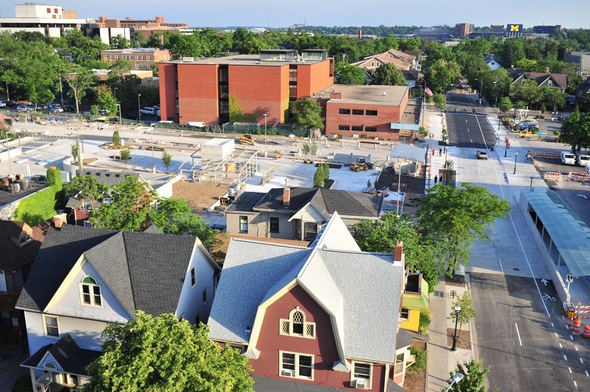
For the foreseeable future, a surface parking lot will stand atop the 700-space garage that extends four stories below ground off Fifth Avenue in downtown Ann Arbor. City officials hope to see the site redeveloped eventually, while a group of citizens want to see it become a large green space.
Ryan J. Stanton | AnnArbor.com
But at least for the foreseeable future, a surface parking lot — a vast sea of concrete — will stand atop the 700-space garage that extends four stories below ground.
The residents rallying behind the vision for a "Library Green" call that wasted space, and they're speaking out in full force.
"We're really trying to help the city not miss an opportunity," said Will Hathaway, a spokesman for the Library Green group. "They've built this remarkable underground parking structure there. It just seems like such a waste to put surface parking back on top of it."
Hathaway said the city has a unique opportunity to create something amazing and attractive right in the middle of downtown.
"There were proposals for a park on the Library Lot, but these were dismissed because it was claimed that they wouldn't create economic benefits for the city," he recalled. "But other cities have created spaces that have generated economic development."
The idea for a downtown central park — a large green space in the heart of the city — was first put forward by residents Alice Ralph and Alan Haber in 2009.
Their idea ultimately was rejected by city officials, who argued the so-called Library Lot is a prime piece of real estate that's fit for a large vertical development of some kind.
The city-owned site is located on the east side of Fifth Avenue, between Liberty and William, immediately north of the downtown library.
For a while, city officials seriously considered a private developer's proposal for a hotel and conference center, but that ultimately was rejected by the City Council.

Will Hathaway
They mostly took issue with his comparison of Ann Arbor to larger cities that have downtown parks, and disagreed that Ann Arbor's downtown lacks green space.
Hathaway pointed to Campus Martius Park in Detroit, Post Office Square in Boston, the High Line in New York City, Millennium Park in Chicago and Discovery Green in Houston as examples of public plazas that work in an urban setting.
"Campus Martius is a thriving part of the center of Detroit with many outdoor performances. In the winter, there's skating," he said. "Post Office Square was built on top of underground parking in the center of Boston. The High Line is built on top of an abandoned rail line in New York City. All these parks generate economic benefits through placemaking."
Mayor John Hieftje and Council Member Sandi Smith, D-1st Ward, both serve on the DDA's governing board and called the Library Green group's presentation disingenuous.
"They're showing something in Detroit, Houston and New York City," Smith said. "And with each one of these, what you could kind of see at the edge of the pictures are very large buildings, and those all provide activators for these spaces. They provide eyes on the park and people who want to go and use that. We don't have that in downtown Ann Arbor."
Smith said what the Library Green group portrays is "just not possible on that block" due to a lack of density. She said Ann Arbor doesn't even have 5,000 people living downtown.
"We don't have the density of people," she said. "And we don't, in that particular block, have an opportunity for density to occur without new building, primarily because 90 percent of the surrounding properties are historic districts, so they will not be redeveloped."
There's a core group of about 20 people who are active in the Library Green discussions, and the group's overall membership totals about 80, Hathaway said.
Examples of attractive outdoor features that could be ideas for the Library Green, Hathaway said, include outdoor ice skating, interactive sculptures, and a place for live music.
"Sculpture Plaza in the Kerrytown area is an open space that relates to nearby businesses," he said. "The Library Green would do the same thing."
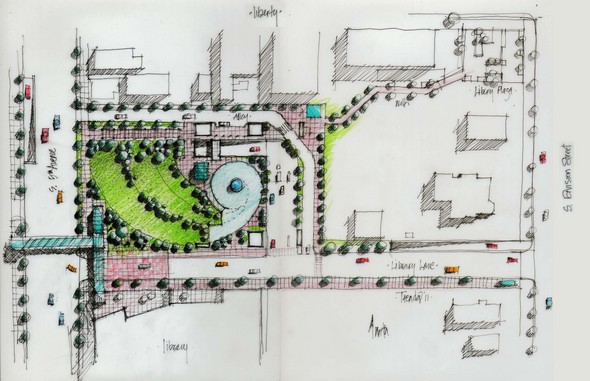
A look at what a large green space could look like on the Library Lot, immediately north of the downtown library on Fifth Avenue.
Illustration by Stephan Trendov
Members of the Library Green group are inviting the entire community to come join them at the site of the new underground garage on July 14 — two days after city officials celebrate its grand opening — for a gathering to talk about the vision for a large central park.
Hathaway said it will be sort of a block party or community picnic, lasting from noon to 5 p.m., with live music and other family-oriented entertainment.
"We're inviting the entire community to come and join us for an afternoon of celebration for the end of the construction, celebration of the businesses nearby that have endured all the turmoil during the past couple of years, and an opportunity to envision what a park or a plaza on this site might look like," he said. "The choice is a park or a parking lot."
In search of a town square
A 92-page report by consultants from Calthorpe Associates in 2006 recommended strategies the city could take in regard to downtown development. It encouraged the city to pursue and design a town square or central civic area that incorporates an outdoor meeting place, an art center, underground parking, an indoor facility and mixed-use buildings.
The report suggested the city consider using the Library Lot to achieve that vision with a combination of civic uses, including an outdoor amphitheater as well as mixed-use retail and office with upper-floor residential to add pedestrian activity and safety.
Hathaway said Ann Arbor used to have a town square in the form of a lawn at the old county courthouse before it was torn down, but that was decades ago.
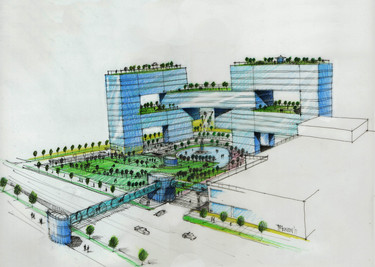
A conceptual illustration inviting people to imagine what the Library Lot might look like with both a large park and a 13-story building, including office, residential and retail uses.
Illustration by Stephan Trendov
"If our ancestors were to come back here, they'd need to see some recognizable signs of the nature that was there that belongs to them," Trendov said, expressing hope for more green space downtown. "We've eradicated that. With that, we eradicate part of our history."
Hathaway said Liberty Plaza — a sunken, mostly concrete, pocket park at the corner of Liberty and Division — is the only true park in the downtown. Creating a pedestrian link between Liberty Plaza and the envisioned Library Green, he said, could be Ann Arbor's new "Downtown Diag."
Hieftje argues there's no shortage of green space in downtown Ann Arbor, and one example of that is the Diag on the University of Michigan's Central Campus.
"I'm downtown almost every day and I'm really puzzled why you wouldn't consider the Diag, which has families there playing frisbee, as a park that's available to everyone," he said. "It's populated by the people of Ann Arbor. It's populated by families having picnics on blankets."
He said Ingalls Mall looks similar during the Summer Festival.
"We'll see families spread out on blankets on University of Michigan parkland all the way to the fountain, and young people talking and throwing frisbees, having a great time, with bands playing right there," he said.
Hieftje also pointed to the green space next to U-M's newest residence hall on Washington Street just east of State Street.
"Go over there and have lunch," he said. "Sit down on a bench and read a book sometime and try to think that it's not a park. It's a very nice green space in downtown Ann Arbor."
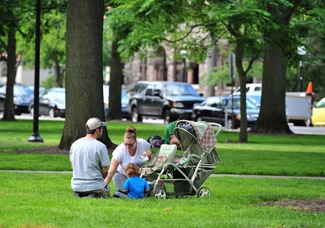
A family enjoys a lunch on the University of Michigan Diag on a recent afternoon. Mayor John Hieftje argues the Diag is a downtown park.
Ryan J. Stanton | AnnArbor.com
"And I hope to see a park there," he said. "I think the conversation right now is about the size of the park there and how it would be paid for."
Hathaway said he thinks the mayor and others are stretching the definition of downtown parks to include things most people wouldn't think of as being parks.
"The Diag is a wonderful resource, but it's the university's. It's not the city's," he said. "And it's not located downtown really. Most people think of the campus as separate territory."
Hathaway said it's also nice that events like the Summer Festival, which started Friday, can turn Ingalls Mall on U-M's campus into a community park. But he said it's not the same has having a town square in the center of the city.
Ann Arbor DDA officials have invited members of the Library Green group to participate in the city's Connecting William Street initiative, which is focused on coming up with redevelopment ideas for the Library Lot and four other city-owned properties in the area.
Ann Arbor officials also are in the early stages of planning a redesign of Liberty Plaza. Hieftje and Council Member Sabra Briere recently toured the site with city park officials.
"We hope to make improvements to Liberty Plaza to improve that park," Hieftje said. "And Liberty Plaza has come a long ways, and people should give it a fair shake. It's really looking pretty good right now. It's well-maintained thanks to First Martin."
Hieftje noted the city also is working on plans to transform two blighted properties near downtown — 415 W. Washington and 721 N. Main — into green spaces.
"We're applying for Natural Resources Trust Fund grants at 721 N. Main," he said. "And I've continued to work with the Greenway Conservancy, along with Council Member Margie Teall, on the 415 land, and so we've got a real effort there.
"Those are city-owned properties we have to do something with," he added. "They're in the floodway and really parks are the best use for them."
Hieftje also made note of the polluted MichCon site that abuts the Huron River just north of downtown. DTE Energy is working to clean up part of the site so it can become a park.
"That's a property the city has wanted for many years," Hieftje said. "So there's kind of a lineup of new park proposals and we have to figure out how that's going to all work in, and how it can be afforded without stressing the parks budget."
Ryan J. Stanton covers government and politics for AnnArbor.com. Reach him at ryanstanton@annarbor.com or 734-623-2529. You also can follow him on Twitter or subscribe to AnnArbor.com's email newsletters.
Comments
uabchris
Tue, Jun 19, 2012 : 9:17 p.m.
By the poll, I would say the PEOPLE...all 481, have spoken!
A2comments
Tue, Jun 19, 2012 : 7:20 p.m.
Calling Liberty Plaza a "park" is pretty funny. It's a CONCRETE HOMELESS GATHERING SPOT THAT SOMETIMES HAS WACKY PROTESTORS. Not a park...
Will Hathaway
Tue, Jun 19, 2012 : 7:09 p.m.
I appreciate AnnArbor.com's coverage of the discussion that occurred at the June 6 meeting of the DDA. I have communicated with Mayor Hieftje since then I feel like we had a constructive conversation. It may be helpful for folks to see the slide show I presented to the DDA so that they can see the comparisons to parks in other cities and make their own judgements about whether there is something that Ann Arbor can adapt to our situation. I would like to point out that the the slide show includes examples from big cities and from local parks in places like Manchester and Dexter and even Ann Arbor itself. Here is a link: http://www.youtube.com/watch?v=jYYDeR39kRY&feature=plcp
a2jean
Tue, Jun 19, 2012 : 5:56 p.m.
"They're showing something in Detroit, Houston and New York City," Smith said. "And with each one of these, what you could kind of see at the edge of the pictures are very large buildings, and those all provide activators for these spaces. They provide eyes on the park and people who want to go and use that. We don't have that in downtown Ann Arbor." They don't have "very large buildings" in Plymouth, either, but they make excellent use of their downtown park (http://www.downtownplymouth.org/index.aspx?nid=71). Their Ice Festival draws thousands of money-spending visitors, even in the dead of winter! (http://www.plymouthicefestival.org/). Arguments that townspeople could use U-M grounds and a brownfield may be true in fact, but ludicrous in practice -- there is little-to-no parking available. How many LEVELS of parking are under the Library Lot?
Alan Goldsmith
Tue, Jun 19, 2012 : 10:06 a.m.
Leah, unless there's a coupe and elected government if overthrown in the City of Ann Arbor, this space ISN'T going to be a Conference Center, regardless of how many backdoor deals and attempts to keep the public out of the process.
Alan Goldsmith
Tue, Jun 19, 2012 : 6:25 p.m.
Darn spell check. Lol.
Bonsai
Tue, Jun 19, 2012 : 3:01 p.m.
but if there's a sedan, all bets are off
Alan Goldsmith
Tue, Jun 19, 2012 : 10:04 a.m.
When Leah Gunn and her puppet master The Mayor are against something, it's usually a great idea.
grimmk
Tue, Jun 19, 2012 : 1:53 a.m.
What we really need is a garden. An honest to god garden where food is grown and then that food helps people in need. Where kids can go and learn where food comes from. We need to get back to our roots.
greg, too
Tue, Jun 19, 2012 : 1:47 a.m.
I am all for a park downtown, but calling a park in Detroit a model is not a good idea. And the other parks they mention are in the 2nd and 3rd (depending on the numbers you us) largest cities in the US. These are not logical comparisons. Even Boston has multiple times the population Ann Arbor has. Is there a city, and I am asking because I do not know, that is of relatively the same size as Ann Arbor that has done something like this? And if so, what are their results? Comparing Ann Arbor to Chicago, Boston, or Houston doesn't make a lot of sense. And, there was a good deal of private financing that went into Millenium Park in Chicago...
uabchris
Tue, Jun 19, 2012 : 4:15 p.m.
How about right down the road in Plymouth? They have a nicely used town square...and LESS population than A2...
Robert Katz
Tue, Jun 19, 2012 : 1:35 a.m.
Between the parks and the ridiculous buy up of green space surrounding the city, it once again shows the out of touch with reality displayed by so many. Ann Arbor probably has more than 10 times the parks needed. Go to most any park on a nice afternoon and discover they are absolutely empty. There are a handful of parks that get adequate use. If you want to go the park, right now you have a multitude of choices in all parts of the city. We don't need one downtown.
lococit
Tue, Jun 19, 2012 : 12:27 a.m.
I find it odd for elected officials "seeking citizen input" to say it is disingenuous for the Library Green Group to point out other city parks as examples of how urban parks can create economic benefits for those cities. Of all ideas presented by Ann Arbor citizens for the top of the Library Lot, the one thing that several of our elected officials seem so ready to put down is citizen support for a central park or town plaza. Most recent surveys I have seen have totally excluded a park as an option for feedback and yet this little survey (admittedly unscientific) being conducted via this article clearly shows there are many people interested in a park option. If 20,000 Ann Arbor citizens told certain council members and the mayor they want a Library Green would that provide enough citizen input? Or, would there be no activators looking down from tall nearby buildings to justify serious discussion regarding the benefits of central park. I know there are plenty of people that would prefer a park to any other option on the Library Lot. I know these same people do not look down from tall buildings on the Lot. I fear however, that the Mayor and certain Council members will not give these people a fair chance to be heard.
MyOpinion
Mon, Jun 18, 2012 : 11:33 p.m.
A couple more points: The residential population is not the only consideration. Many urban parks are successful because of the daytime population. Trust me. It is the daytime population that makes Campus Martius work, although Detroit is finally getting some young urban professionals in that vicinity. Leah Gunn is correct that these types of parks aren't built for $25,000 and there are janitorial and maintenance costs associated with them. Likewise, there are costs associated with the floors of parking below and the unfilled spots that cost $25,000 - $40,000 per slot to build ought to be factored into the costs of the underground structure. Nonetheless, I think a temporary urban park could be build for $100,000 if the city consulted with the business owners who do things pretty efficiently and have a good read on the mood/spending potential of the downtown population - think Mark of Downtown Home and Garden/Mark's Carts/ soon to be beer garden; or the Sava/Babo owner; etc. The DDA doesn't think twice about spending $75,000 for a shoddy consulting report. Instead, invest it in a park. I'd love to see a bocce ball court; half-court basketball; low-cost skating rink (e.g., no cooling system); 100 community gardening spots; a fairy door somewhere, etc.
Arboriginal
Tue, Jun 19, 2012 : 12:46 a.m.
Amen.
Mick52
Mon, Jun 18, 2012 : 10:53 p.m.
Quite a reaction from the Mayor. He is so strongly against this I think he has something up his sleeve already. A surface parking lot on top of a huge underground lot, is that necessary? And yes there definitely is a lack of green space downtown, if you look at the area west of State St. Seems the mayor considers the UM Ann Arbor's green space. It would be nice to go to a park downtown that is not overrun by college students. I think what the mayor and DDA fear is a place where the homeless aggressive panhandlers will hang out, maybe set up a campground.
jcj
Mon, Jun 18, 2012 : 10 p.m.
Call it Camp Take Notice Central!
Ron Granger
Mon, Jun 18, 2012 : 9:43 p.m.
Make it a community pool.
MyOpinion
Mon, Jun 18, 2012 : 9:29 p.m.
. . . . . "Smith said what the Library Green group portrays is "just not possible on that block" due to a lack of density. She said Ann Arbor doesn't even have 5,000 people living downtown. Well, is this based on facts or just what she thinks? Here are the population in households for the census tracts in the surrounding area: 4001 1753 4002 216 4003 4729 4004 2941 4005 5940 4006 4248 4007 2424 4008 2417 I'm leaving out all the folks living in dorms, jail cells, nursing homes, etc. although frankly I think students ought to be counted as they are likely to be attracted to this venue. Need to know where these census tracts are located? Type is something like 900 Main Street, Ann Arbor, 48104 in the link below and you'll get a map of all the in-close census tracts http://www.ffiec.gov/Geocode/default.aspx Methinks the density is greater than Smith thinks and we have parking for 12,000 more assuming folks come down with their cars filled with more than one person.
uabchris
Mon, Jun 18, 2012 : 9:19 p.m.
No one wants to live downtown because it is entirely comprised of Hardscape, duh! That's why everyone wants the outer communities like the OWS...wake up City Council and serve your constituents not your own pet projects. Vote YES on Central Park!
uabchris
Tue, Jun 19, 2012 : 4:07 p.m.
@ Greenradish- thanks for supporting my point...again 95% of what you described in the "immediate" downtown is HARDSCAPE...no grass in sight...
Greenradish
Tue, Jun 19, 2012 : 2:12 p.m.
Factually, you are completely wrong. There is ample green space. Except for zealots who disregard the real behavior of normal people, the Diag and the rest of the campus - quads, gardens, plazas, etc... are world-class open spaces. Liberty Plaza has mature trees (even though the site plan is woefully stupid and not people-friendly). West Park. Wheeler Park. Sculpture Park. There's an entire county-wide riverfront park within 5 minutes walking distance. The Main Street Promenade has wonderfully large planters and a full tree canopy. It's not some kind of soviet concrete apartment complex. Fewer people live downtown because (a) there are not enough units; and (b) they are not affordable for many people. And the more parks you make, and the more developments you demonize, the more scarce and expensive the existing housing becomes.
Leah Gunn
Mon, Jun 18, 2012 : 9:18 p.m.
I also attended the meeting where Bob Gregory described the development of Campus Martius. The two huge differences are that Campus Martius is surrounded by high rise office buildings which have thousands of workers, and it was developed entirely with private money. The cost of development was $30 million and the annual upkeep is about $4 million - all financed privately. Two names mentioned by Mr. Gregory were Peter Karmanos and Edsel Ford, as well as the corporation Quicken Loans. That will give an idea of how much it takes to sustain such a park.
Alice Ralph
Mon, Jun 18, 2012 : 8:49 p.m.
Bob Gregory came to Ann Arbor this Spring to tell his success story about Detroit's Campus Martius. In his talk, he said that every community should have a central park and Ann Arbor certainly deserved one. This was from someone who has spent over a decade making that success possible. If such a grand plan were to be scaled to Ann Arbor, we could have our downtown central park in about two months. We already have the underground parking which will bring the drivers and their eyes through the park as they use the parking beneath. Library users will also have direct view as they come and go. All these and more would have the opportunity to meet, pause and refresh. Contrary to the characterization of the block as having little opportunity for development, about half of the frontage could be redeveloped. A park in the middle is incentive for owners to work with each other and the city to create a block with secondary addresses that face the interior, as well as more traditional street frontage where mid-century building may be approaching the extent of their utility. Such buildings are not likely to be given historic protection. Land swaps might bring coherence to future development with access to underground short-term and long-term parking. For the time being, a park-like surface treatment would provide a focal point for thinking about bigger and more enduring ideas than a parking lot. Why not try?
Greenradish
Tue, Jun 19, 2012 : 2:21 p.m.
You know, that's a pretty crazy chain of assumptions there. Parochialism and nostalgia already make it hard to redevelop property in this town. And where are these companies going to get financing for reconstruction? You gonna get a kickstarter fund going to rebuild? What're you going to do about the blank walls of the post office? And what about people who don't want to redevelop? You think swapping land is like trading baseball cards? You've got a mighty cavalier attitude about other people's property - not just what people can't do with it (which is one thing) but what they ought to do with it (which is entirely another). There is a pretty serious practical problem with your proposal, even assuming everyone buys into it. Reverse the frontage from one side of a lot to the other, and then you have to put utilities, garbage, and loading somewhere else. I don't think putting dumpsters and grease traps on Liberty Street is a rational tradeoff for a mid-block park that _just might_ have a view of something pleasant if you get everything on your wish list for the next ten to twenty years of redevelopment.
Marvin Face
Mon, Jun 18, 2012 : 11:27 p.m.
Agreed about the redevelopment of some of the property's surrounding this site. There are several "restaurants" that are absolutely run down near the corner of 5th and Liberty and Herb David could use a major redevelopment as well. If we could knock down those and the Christian Science Reading Room and open views to this site from that corner we MIGHT have something.
jrm.jr
Mon, Jun 18, 2012 : 8:23 p.m.
why not plant grass, fence it in and use it as a dog park.
timjbd
Mon, Jun 18, 2012 : 7:19 p.m.
The situation for homeless people in Ann Arbor is about to get much worse. Rather than listing all the places (like this) where they SHOULDN'T be, how about some idea where they COULD be? I have been up to Empire Campground many times. They have bathrooms, showers and lots of campsites. Certainly a place like this can be found somewhere around Ann Arbor that's on a bus line so people can get to/look for jobs? For those who don't trust (or dislike or fear) those unfortunate enough to have lost everything, this is a much better way to address the problem than casting them to the wind, dissing them and making them outlaws everywhere they try to pitch a tent. It also keeps them in a place where those who want to provide food/health/social services to them can do that without having to hunt them down. If they have a place to go and they will take care of it with even the most minimal help from the city in the form of trash pickup, police patrols, etc. Camp Take Notice has proven that crime and clean-up can be kept in check for the most part by the residents themselves. This would also be provide a way for those who want to contribute financially to do so in ways other than handing cash directly to panhandlers. Maybe through A2 Shelter Org? http://annarborshelter.org/Programs/services-only
Ross
Mon, Jun 18, 2012 : 6:05 p.m.
So judging by many of the ridiculous comments thus far, if we build a park here, only the homeless will get to enjoy it. So we can't build a park anywhere near downtown now? Seriously? So people in New York City can't use central park for their enjoyment because some homeless people might stroll through and try to talk to them? Get a grip, the homeless problem in Ann Arbor is really no big deal at all.
nickcarraweigh
Mon, Jun 18, 2012 : 5:53 p.m.
Plenty of profit in landscaping and baby trees and such, but it's chicken feed compared to the graft opportunities offered by every other option, and at so many levels, too.
DJBudSonic
Mon, Jun 18, 2012 : 5:16 p.m.
From what I have observed there is going to be a new library construction bond on the November ballot. It will probably be passed by about 5 percent of the eligible voters, like the school tech bond. If that is the case, might I suggest the new library and various other civic functional spaces be built on the parking structure, and the existing library space, when torn down, be turned into a park? As for the observations of homeless and other trouble in the parks, I can speak from experience. I work and travel all over this city, including downtown and on campus, and it IS a problem. Liberty Square IS full of vagrants; remember when they put in the divided metal benches in an attempt to quell the sleeping? That didn't work. But somehow the University manages to keep their property clear and reasonably safe. Someone should find out how they do that. Lastly, the suspicion that individual profit is the driving force behind many city council and DDA decisions may not be unfounded. I urge "our" council members to explain just what the reasoning is behind so many tax dollars spent on major capital projects, like this parking structure, that seem to be of limited benefit to the city as a whole, and are often in direct opposition to other stated goals, such as the promotion of alternate transportation. The mayor and many council and committee members seem so hostile to any community input, I can't decide if this is arrogance, ignorance, or something more devious.
Greenradish
Tue, Jun 19, 2012 : 2:38 p.m.
How the university does that is by high foot traffic and complete visibility in open space. At the very least, the city should redesign the park -- not merely the furniture. Here is an example of designing parks so that vagrants do not discourage regular folks from using the parks their taxes pay for: http://www.asla.org/lamag/lam03/june/feature1.html
Barzoom
Mon, Jun 18, 2012 : 5 p.m.
Maybe they could build a combination train station and transit center. The parking garage is already there. All they'd have to do is re-route the railroad. That would free up all of that valuable space where the existing train station is located.
Greenradish
Tue, Jun 19, 2012 : 2:39 p.m.
Railroads are not lego blocks.
timjbd
Mon, Jun 18, 2012 : 6:54 p.m.
At first I thought you were serious.. Hilarious!
nickcarraweigh
Mon, Jun 18, 2012 : 5:56 p.m.
Some sort of accommodation could surely be found with Wayne County's Bob Ficano, a man who thinks like Ann Arbor's elite in so many ways, and they could push a Detroit Metro Airport runway right up Fifth Ave. Then the hotel would actually make sense.
Alan Goldsmith
Mon, Jun 18, 2012 : 4:48 p.m.
"Mayor John Hieftje and Council Member Sandi Smith, D-1st Ward, both serve on the DDA's governing board and called the Library Green group's presentation disingenuous." Ann Arbor's 'green' (as in bought and paid for with greenbacks by developers?) Mayor speaks again. Which of his political supporters are going to profit in developing the surface of the new underground parking structure? Time will tell.
Greenradish
Tue, Jun 19, 2012 : 2:40 p.m.
Y'know, being profitable and being green are not mutually exclusive. Cool your jets.
HBA
Mon, Jun 18, 2012 : 4:38 p.m.
I once again reiterate the idea for an outdoor ice skating rink such as at Rockefeller Center in NYC. Flanked by cafes and boutiques, what a draw it would be. We certainly don't need additional hi-rises downtown, and I believe it's already been researched that a conference center would be a costly and inadvisable undertaking. The ice skating rink easily could be incorporated into the vision of those interested in a Library Green.
Dog Guy
Mon, Jun 18, 2012 : 11:15 p.m.
The cost to refrigerate an ice rink would be very great . . . even in winter.
mixmaster
Mon, Jun 18, 2012 : 4:37 p.m.
The anti everything crowd's a one sound bite. "it will attract the homeless". And they base this on one park and the observations of a few people who hardly every go downtown and hate everything to do with Ann Arbor.
rusty shackelford
Mon, Jun 18, 2012 : 5:29 p.m.
Can you tell me what would be different about this park compared to Liberty Plaza? Because except for special events, that park is very little-used, and those who do use it are mostly homeless or itinerants. Why would this be different? Why put a second park downtown when the one that's there gets so little use? And most other city parks are heavily used?
rusty shackelford
Mon, Jun 18, 2012 : 5:25 p.m.
I'm not sure on what you're basing that characterization, but it certainly doesn't apply to me, though I am concerned about that park attracting a large number of homeless/vagrants. That's far from "one soundbite," though, it's mostly the capper of many reasons this is a bad idea.
braggslaw
Mon, Jun 18, 2012 : 4:20 p.m.
I have no wish to create a park for the homeless on a valuable piece of property. I am not a big fan of being accosted by agressive panhandlers, public urination, and tent cities.
Arboriginal
Mon, Jun 18, 2012 : 4:55 p.m.
Hmmmm......not a fan of public urination? What is the matter with you?
demistify
Mon, Jun 18, 2012 : 4:01 p.m.
The fundamental inconvenient issue that this whole discussion completely ignores is money. Construction of the parking structure has cost us a bundle. There have been many loud complaints (including from a number of those commenting here) that it used up scarce tax resources in a period of austerity when police and fire budgets were cut. Now people who voiced those complaints demand that the city assume further expenditures and long-term obligations for a park. Some of the same beautification advocates are the shrillest objectors to the public art budget. The justification presented for spending on the parking structure was that private development on top of it would bring tax dollars. We cannot afford to throw away that prospect now, even though the implementation to-date has been faulty. There is plenty of room for parks in the Allen Creek flood plain, where building is precluded.
JRW
Mon, Jun 18, 2012 : 3:58 p.m.
A park in that location would be a haven for the homeless, next to the library, and across from the bus station, both of which serve as homeless hangouts. Not a good idea to attract more homeless to a city park.
zanzerbar
Tue, Jun 19, 2012 : 2:32 p.m.
@ Ross...how would/do you know that?
Ross
Mon, Jun 18, 2012 : 6:02 p.m.
I think it would be a haven for everyone. Homeless people don't like intermingling with big crowds of people.
Robert Minger
Mon, Jun 18, 2012 : 3:20 p.m.
What Better Way to make the City more beautiful and encourage public transportation/cycling as an alternative to more people to drive their cars down town. More parking = More cars. *I always drive downtown because the bus is too far from my house, but I still think a park rather than parking (or something to make more money) shows how much of a progressive town Ann Arbor can be.
Brad
Mon, Jun 18, 2012 : 11:14 p.m.
And who will it "show" that to? And why do we need to "show" anyone anything about out town? This is becoming a recurrent theme here - the need to "prove" to someone, somewhere just how darned cool/progressive/whatever we are. Get some self-confidence, people !
Macabre Sunset
Mon, Jun 18, 2012 : 3:14 p.m.
Funny, I would never have thought anyone on Council understood the density argument because of all the nattering about trains these days. The problem with a park there is that it's off the path, except if you're headed to the library. Unless it's in conjunction with an urban center (like the 13-story one proposed), it will just become a bit of space for homeless to sleep. Which will make the underground lot less desirable and more dangerous. But we can't support a 13-story urban center right now. This is the problem you get when the city starts playing Sim City and sticks an expensive underground lot where a surface lot was working perfectly well.
Macabre Sunset
Mon, Jun 18, 2012 : 5:19 p.m.
You need to draw people to something, or it's just a waystation. The library isn't enough. Comparing this "bustling" to the foot traffic you have in an urban area that would benefit from this type of park is just silly - more of the same silliness you see from the "all we need is an expensive train to nowhere" crowd.
Arboriginal
Mon, Jun 18, 2012 : 4:57 p.m.
Have you been downtown in the last year? Ever? That section of town is bustling like never before!
mixmaster
Mon, Jun 18, 2012 : 3:44 p.m.
Surface lots are an incredible waste of valuable downtown property. We place more value on people's cars than we do people themselves.
mixmaster
Mon, Jun 18, 2012 : 3:42 p.m.
What "path" are you referring to? There are loads of downtown workers and more residents in the near future. There are plenty of people who would welcome a place for respite in downtown.... and the stale argument that only "homeless" people would hang out there is a popular misconception. widely spread by the anti everything crowd.
fjord
Mon, Jun 18, 2012 : 3:13 p.m.
I would love to have a park in downtown Ann Arbor. I just don't believe that the library lot is the place to have it. Not every available space is a candidate for a park. I'm as skeptical of most new development projects as anyone else, but I think it makes more sense to put some kind of building above the new parking structure than a small, oddly shaped park that isn't optimal for any purpose.
richh
Mon, Jun 18, 2012 : 3:11 p.m.
It doesnt need to be a park, the convention center & hotel was a great idea , brings in added business too downtown, perfect for the way to many restraunts downtown. we have an awesome park just west of town called west park with a band shell, an once ice skating rink in winter. some day maybe the outer edge of that park will be condos , semi highrise apt buildings, an more senior housing, our own central park i
Arboriginal
Mon, Jun 18, 2012 : 4:58 p.m.
Like the Ann Arbor Inn?
mixmaster
Mon, Jun 18, 2012 : 2:45 p.m.
This entire situation, from the way the parking structure was railroaded thru the process, the way that Roger Fraser and the Mayors Council Party attempted to sneak through a Conference Center, under bureaucratic cover, and the costs of building a structure for something on top, when what to put there was ever discussed or decided, and now this stalemate over what's going to happen there... ...has been a travesty of governmental fog, bureaucratic bungling, ignoring the voice of local stakeholders, catering and favoring wealthy, UM connected non local, developers. This is PUBLIC PROPERTY and belongs to every single person in the city.
Lisa
Mon, Jun 18, 2012 : 2:29 p.m.
While we debate what to do with the space, can we pave it and use it as a surface lot?
mixmaster
Mon, Jun 18, 2012 : 3:45 p.m.
Surface lots are an incredible waste of space.
Daniel Piedra
Mon, Jun 18, 2012 : 2:17 p.m.
Unfortunately, most public plazas in Ann Arbor are frequented by vagrants and other harbingers of mischief. As a result, folks -- especially families -- are reluctant to use them. If the city were to construct a park above the parking garage according to the ideas and concepts listed above, and especially if the design were to be modern (i.e. hideous), then it would most certainly attract "the stinky meanies". What would I like to see constructed there? Well, perhaps a small forest with a bubbly fountain in the middle with a statue either of myself or Olmstead.
Daniel Piedra
Tue, Jun 19, 2012 : 2:54 a.m.
@MixMaster: To corroborate my claim, would you accept empirical evidence instead of factual data? If so, spend an afternoon in Liberty Plaza.
mixmaster
Mon, Jun 18, 2012 : 3:47 p.m.
Do you have a factual data to back up your claim that public plazas are frequented by vagrants and that people don't want to go there? You're just repeating the popular misconception spread by the anti everything crowd.
pbehjatnia
Mon, Jun 18, 2012 : 1:42 p.m.
We do not have enough money to maintain our present parks in A1 condition. We cannot afford another park. We need development as planned to go forth on this site. What Mayor Hieftje and City Council have done is effectively stifle all proposals for the site. They have wasted time and tax dollars in the process of doing so. If we keep electing the same sorry bunch of critters to complete the same sorry acts then we cannot cry 'wolf' when we get what we are asking for which is zero interest for development and zero money coming into town. Business as usual is a dangerous proposition. Be careful what you wish for.
JRW
Mon, Jun 18, 2012 : 4:21 p.m.
Exactly. How about mowing the grass or pulling huge weeds in some of the existing parks?
Marvin Face
Mon, Jun 18, 2012 : 1:41 p.m.
I don't know who Stephan Trendov is but he can't be an architect. Those "sketches" are HI-larious! The park proponents continue to undermine their own cause with this amateur hour stuff. A park downtown is an excellent idea. This location is a poor one for a park. It may be in the middle but it is nowhere close to central.
Brad
Mon, Jun 18, 2012 : 11:11 p.m.
Do please tell us exactly where the "central" part of Ann Arbor is.
Dog Guy
Mon, Jun 18, 2012 : 1:33 p.m.
Why does the illustration not show soapboxes, pulpits, urinals, and a stage?
brian123
Mon, Jun 18, 2012 : 1:21 p.m.
Although I don't necessarily think a park is the best use of this parcel, I think it could be a great asset to our city if executed correctly and tailored for a city the size of Ann Arbor, not NYC, Boston, Chicago. Please don't just put an inactive green space and expect people to use it and add any value to the city. For instance, one of the reasons Post Office Square in Boston works so well is because of the location and juxtaposition with the large buildings in the financial district which lacks green space. This is not the case with A2, and particularly not in the library lot location. I urge them to line the park with little cafes and small businesses (perhaps little kiosk businesses similar to Quincy Market in Boston)....something needs to consistently draw people to the area other than just grass and trees or it will fail miserably. Just my two cents.
Kensington alum
Mon, Jun 18, 2012 : 3:48 p.m.
How do you get people to START those businesses there?
Ricardo Queso
Mon, Jun 18, 2012 : 12:53 p.m.
A perfect site for a relocated Camp Take Notice.
Ricardo Queso
Mon, Jun 18, 2012 : 9:02 p.m.
Call Delonis II
JRW
Mon, Jun 18, 2012 : 4:01 p.m.
That's exactly what it would turn into. A day camp for the homeless and a haven for other "activities" deemed illegal. Gallop park has it's drug dealers, as does every other "city" park, what would make this one any different?
rusty shackelford
Mon, Jun 18, 2012 : 12:52 p.m.
I find it strange that the proponents of the park are using huge cities as models here, yet seem to think 4 very short blocks (i.e. from the proposed site to the Diag, a huge park) is "too far" to be considered central. That seems a very small-town attitude. Make up your mind.
rusty shackelford
Mon, Jun 18, 2012 : 4:17 p.m.
A space open to the public for free with a bunch of greenery to move around in and grass to sit on. How is it not a park in everything but name? Most parks have sidewalks.
mixmaster
Mon, Jun 18, 2012 : 3:49 p.m.
The Diag is not a "park". It's a bunch of concrete pathways populated by 20 somethings.
rusty shackelford
Mon, Jun 18, 2012 : 12:47 p.m.
Though I don't think using the entire lot for a park is smart at all, I'd support some kind of smaller public plaza as a (perhaps required) part of a larger development on the parcel. Think the square at Catherine and Fourth, but a little bigger and better thought out. I could get behind that.
Linda Peck
Mon, Jun 18, 2012 : 12:46 p.m.
The DDA needs to let the people decide how Ann Arbor is going to go. Let's make a beautiful park downtown, a place for strolling under trees, away from the heat of cement. Let's have a vote on it and see what the "majority" think. Majority here refers to those that vote, not the majority of who lives here.
Dave
Mon, Jun 18, 2012 : 12:45 p.m.
This is absolutely idiotic. So now you want to spend money the City doesnt have on a park in the middle of Ann Arbor? Solve the crime problems first. Allow our taxes to be given back to us in terms of leaf pickup and other services that Ann Arbor has cut. This is a waste of time and money.
Enso
Mon, Jun 18, 2012 : 12:39 p.m.
But Republicans don't like parks. It's people sharing, a bit too close to socialism for them. They'd rather an armed guard manned a gate where a private corporation took a toll to walk through the park.
Ross
Mon, Jun 18, 2012 : 5:58 p.m.
The notion that all the homeless of Ann Arbor will simply take over this area if it were made into a park is misguided. The people living in the underground prefer to stay... underground. All this park would need to stay family friendly is.... some families to be there using it!
JRW
Mon, Jun 18, 2012 : 4:04 p.m.
I'm definitely not a Republican, but you will need armed guards of some sort if you turn this area into a park, where homeless will take over and other undesirable activities will take place. Families will need guards there if they want to use it, or if visitors to downtown want to use it in the evenings especially. This location is wrong for a park, next to the library and across from the bus station where homeless and others "hang out."
Kensington alum
Mon, Jun 18, 2012 : 3:46 p.m.
Yay! Stereotypes on Parade!
amlive
Mon, Jun 18, 2012 : 1:32 p.m.
You mean like the "Justice Center" we just built.
Ross
Mon, Jun 18, 2012 : 12:32 p.m.
Strongly agree with amlive's comments above. Not having a central open space / gathering area / park in a city like ours is stupid. Who cares that we over-built the foundation to support a huge building on top, because that was a MISTAKE. The entire underground structure was a horrible MISTAKE. It would only be a further MISTAKE to continue trying to promote and build something with little to no demand, that the citizens of Ann Arbor truly do not need or want (and did NOT vote for!) !! I support a park. Let me eat my Jerusalem Garden whilst laying on some grass in the shade please! And reading a book from our lovely library.
Ross
Mon, Jun 18, 2012 : 5:56 p.m.
Feel free to stay out in your posh subdivision with your doors locked, Mr Kensington, if it makes you feel safer. I'm not the least bit afraid of someone who is down on their luck asking me to spare some change.
Kensington alum
Mon, Jun 18, 2012 : 3:46 p.m.
While fending off bums asking for a quarter, and/or vying for space with people sleeping on the benches. Niiiiice.
sh1
Mon, Jun 18, 2012 : 12:28 p.m.
Has anyone noticed how this lot has encroached on the space of the people living in the lofts next to it and the businesses nearby? Add a 25-story building on top and the eyesore will crowd out anyone's sense of privacy.
lococit
Tue, Jun 19, 2012 : 12:33 a.m.
I have noticed that there has been great insensitivity in the design of the surface of the lot. Why did they put tall rectangular cement walls right up next to the businesses and residential buildings? With the goal being to put parking underground, why is there any parking on the surface when they could have at least temporarily made a green space while elected officials decided what goes on the surface. My guess is, they chose to not make it green temporarily because it would have been too popular with people.
timjbd
Mon, Jun 18, 2012 : 6:47 p.m.
The loft people are being encroached upon?
JRW
Mon, Jun 18, 2012 : 4:24 p.m.
Not to mention the light and views that will be blocked for existing lofts and other spaces already there. A 25 story building is a huge mistake. Hey, A2, this is NOT NYC!
amlive
Mon, Jun 18, 2012 : 11:50 a.m.
If his ideas were criticized by the DDA, then Hathaway's proposal was probably exactly what the cIty really needs. In all seriousness, we don't have a public square, courthouse lawn, or any centrally located commons of any appropriate size in this town, and I've always found this to be a pitiful shame for a city such as ours. Sure there's the Diag, but that's University, and not central within the city. There's the open air homeless shelter we call Liberty Plaza, or the little corner of unshaded bricks in front of the ugly ugly Federal Building, but neither of these come close to being an appropriate central park. Here we have a perfect spot between Main street and campus, right by the transit center and parking structure which many will be arriving at our town through. AND IT'S RIGHT IN FRONT OF THE LIBRARY! If we're going to rebuild the library (fingers crossed), I can't think of a better place to have a central square to make an impressive statement about our town. Rebuild the new library / community center with a grand facade of steps and columns facing the new park as a centerpiece to our town which currently we are sorely lacking. Then if we do really need a conference center you can build one on Liberty Plaza or the old YMCA lot which could be easily connected to this a beautiful central square in front of a hopefully impressive new library. So maybe you've already wasted our money by building this structure to support a 12 story building. Don't waste an irreplaceable opportunity to actually create something valuable to the community by following through with your initial mistake.
amlive
Mon, Jun 18, 2012 : 6:22 p.m.
Very good points Kensington, to which I can not claim to have solid answers. As to becoming another vagrant camp, I would have to think there could be conscious strategies in engineering a park area to make it less attractive to homeless camp outs. I can't say I know exactly what those strategies would be, but I'm sure options have been much looked in to and tried in other communities. As to how many people will be arriving through the new transit center, you've got me there. If the community were more intentionally planned with local and regional buses, train station, and airport shuttles moving through a single hub then I could probably make a much better case for this central park to welcome visitors. Like near every town in Michigan though, our city layout was not that well thought out and would be quite a feat to reengineer. Overall though, even if it doesn't end up as a park I would love to see, what I find most disturbing is the seeming dismissal of this idea by the DDA and Mayor as an option not worthy of genuine consideration.
Kensington alum
Mon, Jun 18, 2012 : 3:45 p.m.
I don't disagree, but how many people are actually coming into town via a bus? I suspect very very few. And you can't ignore the homeless problem. What to do about that?
demistify
Mon, Jun 18, 2012 : 3:24 p.m.
Liberty Plaza was supposed to be a public park, designed and touted as such. It evolved into a hangout for druggies and a homeless shelter. It is a short walk to the Library. There is no reason to believe that a park on the Library lot would have a different fate.
amlive
Mon, Jun 18, 2012 : 12:22 p.m.
@Brad, The sad excuse for a public art project on Huron was a misguided and pitiful waste indeed. To spend 3/4 million on a poorly installed (have you seen how the water actually flows in that thing?) and mediocre design, and to put it in a place where no one ever walks except to pay parking tickets or pull permits, and to choose an installation which could only run in the summer months at that, this was indeed utter stupidity. If anything, this should confirm that whatever the DDA sees as a good idea, we should automatically see as a red flag to run far far away from. A sculpture in a park, in front of a new library, right in the middle of town, where people actually spend time or at least pass through from the bus station or parking structure when they come to town, now that would make a bit more sense. Overall though, for a city like Ann Arbor to not have any centrally located public square or sizable central park I see as simply shameful.we need to drop all this nonsense about "beautifying the gateways to Ann Arbor", and instead focus on improving places for people to go downtown once they get here.
Brad
Mon, Jun 18, 2012 : 12:04 p.m.
You mean the fountain outside City Hall isn't the "centerpiece" of town? Darn! Why do we need to make "an impressive statement about out town"? What are we trying to state, and who are we trying to impress? Ann Arbor needs to get out of the business of every decision coming down to trying to impress some outside people or entities. We're already on enough bogus top-10 lists. Get some self-confidence, Ann Arbor!
Vivienne Armentrout
Mon, Jun 18, 2012 : 11:45 a.m.
The city has a responsibility to address conditions at 415 W Washington and 721 N. Main. Those are in the Allen's Creek floodway. They are projected as part of the "Greenway" concept, which could combine flood mitigation (by avoiding more structures in the floodplain and floodway) with public space. The contaminated DTE space may be recoverable as a park, though I have some problems imagining how an area as contaminated as that is described to be could be sufficient remediated to be suitable for children playing. It seems more suitable for use with expanded Amtrak parking, or for some other developmental use that would entail paving it over. None of these is in the downtown. The arguments DDA members have advanced for months (I lampooned them in this post http://localannarbor.wordpress.com/2011/03/11/ann-arbors-suburban-brain-problem/ which also has a map showing how little park space is available downtown) are simply not convincing, and the argument that the UM-owned Diag is a "park" seems a desperate measure to avoid a truly public downtown park.
rusty shackelford
Mon, Jun 18, 2012 : 11:45 a.m.
If this is a park, it will mainly be used by the homeless. It's right next to the bus station, the post office, the Beer Depot and the library--all of which are already "street person" hangouts. It'd become a police issue, and potentially unsafe to walk past at night. Ann Arbor already has over 100 city parks, and the mayor is right that the Diag functions as a de facto huge park. We're lucky to have what amounts to a state park (at no city cost) right in the middle of downtown. Combine that with all the other parks in the neighborhoods, and this park just doesn't make any sense.
rusty shackelford
Mon, Jun 18, 2012 : 11:45 p.m.
If families don't use the Diag (actually, they do) and few people use Liberty Plaza, the other park that's already downtown, then why would people use this new park? The park number comes straight from the city. It's actually 157, apparently, or about 1 park for every 700 residents. http://www.a2gov.org/government/communityservices/ParksandRecreation/parks/Pages/parks.aspx
Veracity
Mon, Jun 18, 2012 : 9:11 p.m.
I do not see families using the Diag except to cross it during a prospective student's visit. The Diag does not physically lie within the boundaries of downtown Ann Arbor. You must include the many 3 foot by 5 foot plots of grass in front of many residences and businesses as some of the 100 city parks. I see only dogs using those, however.
Eight Ball
Mon, Jun 18, 2012 : 6:04 p.m.
How about a Walmart then?
braggslaw
Mon, Jun 18, 2012 : 4:18 p.m.
Yep, it will be one of the most dangerous places in the city.
A2comments
Mon, Jun 18, 2012 : 11:29 a.m.
After spending so much money creating a foundation to support a high raise, making it a park would be absurd.
Kensington alum
Mon, Jun 18, 2012 : 3:42 p.m.
Agreed - but you have to admit, so Ann Arbor! I also predict that if it is made into a park, on the theory, at least in part, that it will be an "attractor" to density, the same people who are arguing for the park on that basis will then oppose any density surrounding it!
Brad
Mon, Jun 18, 2012 : 11:21 a.m.
The mayor says he needs to build some tall buildings first as "activators". Whatever that may be. What he's really trying to say is that he'll be the one to decide what goes there and who builds it, and most of all, who profits from it.
Bonsai
Tue, Jun 19, 2012 : 2:15 p.m.
veracity -- yeah, that's why liberty plaza is thriving, right? his point is just because you build it doesn't mean they will come -- modeling a park in ann arbor after boston or new york is misguided
Veracity
Mon, Jun 18, 2012 : 9:04 p.m.
Bonsai- ... and how many Ann Arborites live within a 2-mile radius of the library? Maybe 40,000? These residents can travel to a library park in 5 minutes by car, 12 minutes by bike and 30 minutes by walking.
Bonsai
Mon, Jun 18, 2012 : 1:36 p.m.
no, he's saying there needs to be "MORE PEOPLE" in the area if the park is to be fully used and not an empty space with some grass
Chip Reed
Mon, Jun 18, 2012 : 11:02 a.m.
The Diag is not a park. When push comes to shove, is you are not "affiliated" (their term) with the U-M, you are on "their" property. If you don't work there or attend classes, then campus does not seem like part of downtown. For the administration to call others disingenuous...
Barzoom
Mon, Jun 18, 2012 : 10:44 a.m.
The DDA would never agree to a park when there is a profit to be made from the property.