

EMU faculty union, administration say they both made concessions to reach tentative contract
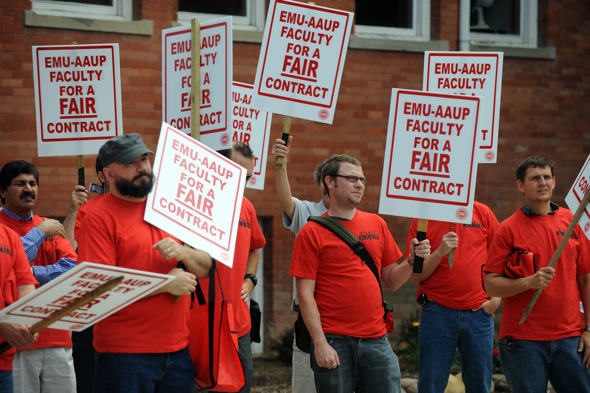
Members of the Eastern Michigan University faculty union listen during a rally last week for a new contract. The union and the administration reached a tentative agreement Tuesday morning. Lon Horwedel | AnnArbor.com
Eastern Michigan University faculty union President Susan Moeller sent a note to her members Monday evening expressing concern that no agreement had been reached on a new contract.
By mid-day today, she was standing in front of them, urging them to accept a tentative agreement with the university that will give them an 1 percent raise this year and a 2 percent raise next year.
It’s unclear exactly when the tide shifted - negotiators from both sides worked late into the night Monday - or what the tipping point was. But it's clear both sides made significant changes in what they were originally seeking and that neither side wanted to risk goodwill built after the university announced a zero percent increase in tuition, fees and room and board for students earlier this summer.
It's also evident neither side came out as the identifiable winner. Both the union and administration gave up key portions of their proposals in the final contract.
In the last week leading up to the current contract expiring, the sides seemed far apart on two key issues - pay raises and health insurance costs.
The union wanted raises of around 4 percent for each of the next three years. The administration wanted to give them no raise this year, and small raises the next two years, with an 1 percent raise all three years tied to enrollment growth and state aid growth.
That last provision was a major sticking point - with union members upset their pay would be based on things they couldn't control.
Administrators and the Board of Regents believed the move would allow the university to share its financial growth with the faculty, Provost Jack Kay said this afternoon.
“We really did want to reward the great work of the faculty,” he said. “We’re glad we have the ability to provide a pay raise. We were very interested in having a system where the faculty shared in the success. Clearly, we weren’t successful in convincing the union of that. It’s something we’ll have to look at (again).”
When administrators removed the incentive plan, union members agreed to accept the smaller raises.
The other point of contention centered on health care. Administrators said they looked at rising costs and national legislation extending benefits to dependents up to the age of 26 and determined they needed a larger contribution from employees - a move that didn’t sit well with union members.
After the administration agreed to a one-time $1,000 payment to all faculty members to cover the increased costs of insurance, the union supported the plan. It will cost a typical family about $2,950 a year in premiums, up from the current level of $1,139.
“We wanted to make sure that no member was taking a pay cut,” Moeller said. “Some of our members will be getting no increase when the health care cost is counted in.”
With those major issues resolved, the tentative agreement was struck mid-morning today.
Union members were briefed at noon in a meeting initially called to vote on a possible strike. They will vote on the tentative contract on Sept. 10, and it also will need to be approved by the Board of Regents.
“I think the members are happy that we have a contract,” Moeller said outside the meeting. “I think some members are disappointed that the Board of Regents and the administration weren’t willing to show more respect to the faculty.”
Several faculty members declined to comment on the contract when approached by AnnArbor.com outside the meeting, saying they needed more time to study the proposal.
But during the meeting, several union members expressed concerns that the regents had issued strict orders to the administration’s bargaining team about the contract.
Not true, Kay said.
“They set broad parameters, and we work within those,” he said.
Administrators and union officials both said they wanted a three-year contract, but the economic uncertainty made a two-year contract a better fit.
Both sides said they also felt momentum building for the university following good press after the Board of Regents adopted the "0, 0, 0" plan. They didn’t want to risk losing that if there was a job action such as a strike, even if no classes ended up being canceled.
“It says something very positive about our university and the relationship we have with our faculty,” Kay said. “It puts the focus back on the exciting start of the semester. I’m really glad we’re all going to be there.”
David Jesse covers higher education for AnnArbor.com. He can be reached at davidjesse@annarbor.com or at 734-623-2534.
Comments
stunhsif
Thu, Sep 2, 2010 : 9:30 a.m.
And Janeane Garofalo is a voice of "reason", NOT, she is a socialist. The fact that professors must hide behind a union to "get their way" makes them less than professional and inflates their value beyond what they are worth to the taxpayers/students and socitety at large. That is the nature of unions, the sheep they herd would never make what they make without the collective bargaining. For us in the private sector we make what we make based on our value to our companies and society.
Dante Marcos
Wed, Sep 1, 2010 : 6:20 p.m.
"To a right-winger, unions are awful. Why do right-wingers hate unions? Because collective bargaining is the power that a worker has against the corporation. Right-wingers hate that." Janeane Garofalo
northside
Wed, Sep 1, 2010 : 5:44 p.m.
I'm loving how the false "EMU profs average $90,000/year" has fast become fact among the anti-faculty group on this site. As the link showed $90K is the average salary for FULL professors, those at the tail end of their careers. For assistant professors the average is $30,000 less. Not everyone makes full professor; there are a lot of career hoops to jump through to reach it. Also conveniently neglected is that becoming a prof requires ten years of education: a four-year BA/BS, a MA/MS (2-3 years), and a PhD (3-6). That means the first ten years after high school the people who become profs at EMU are not earning squat. Quite the opposite they're often racking up huge loans. When you take that into consideration the salaries are modest. Who in the corporate world would get three degrees, spend ten years in college, and then think an average $75,000 salary is excessive?
Speechless
Wed, Sep 1, 2010 : 1:33 p.m.
"... Who wants to attend a so-called university where the faculty act like assembly line workers?" Without unions and tenure, university faculty would often be treated like non-union assembly line workers. That is, like replaceable cogs which can be tossed aside at the whim of administrators and regents. In recent years, for example, adjuncts and lecturers at EMU and other schools have formed unions and negotiated their own contracts, because they were tired of low pay, few benefits, and the insecurity of not knowing if they have a job next semester. "... I suppose it's no coincidence that EMU basically turns out teachers... who then join unions to hold our elementary school children hostage...." The Orwellian nature of this line of argument always stands out. In reality, democratically-run unions bring representative and direct democracy into traditional workplaces, which typically operate as top-down, autocratic hierarchies. Whether organized for the benefit of EMU faculty or assembly line workers or whomever else, labor unions are based on the concept that employees are actual adult human beings who have a moral and practical right to meaningful input on their daily working conditions. By right-wing thinking, the signers of the Declaration of Independence held King George III "hostage" through their thuggish demands that the monarchy share decision making and financial proceeds with its thirteen colonies. The Philadelphia signers brutishly disrespected their social betters, it seems.
katie
Wed, Sep 1, 2010 : 12:47 p.m.
[quote]"if a professor who makes $90,000.00 needs a union there is something really wrong." Care to explain a little more? Is it the 90K price point that's the cut off to you? Should they have gotten rid of the Uniion at 80K maybe? I'm just trying to figure out what your statement means. Is it becasue if you make 90K you shouldn't need a group protecting your rights?[/quote] Yes, that's the point. You DO need someone protecting your rights, if you are making a median income of $58,000. Or if you are making at the lower end of that 50% median range, $41,000. Just as many college instructors make $41,000 as make $83,600 the upper range of that median 50%. The unions are not just for full professors, that small minority who earn more than the middle 50% for this group. These are 2008 statistics, the most recent available. Of course, if you start out at the bottom of the US DOL BLS figure, of $23,000 you do need someone protecting your rights, since once you start to climb the ladder and earn more, once you get into the median range, you will likely get canned so they can hire someone else for $23,000. In fact, I know instructors who are part time and say that, given the amount of time they spend doing research and grading papers, etc. they'd make more at McDonalds. The only incentive to do this is to be able to eventually, after years of work, make a decent amount of money. Comparing current salaries with 1999 figures of $22,000 for per capita income is also suspect. However, if I earn 90K in 2010 dollars and have 3 children that I'm supporting, plus myself, that comes out to about $22,000 per capita income for my household. Adjusting for inflation, it would of course, be less than that. So, this still meets the middle class definition.
Kafkaland
Wed, Sep 1, 2010 : 12:24 p.m.
Unions for people who make a lot of money do exist - the National Football League Players Association is probably the best example. It is chartered as a union, representing the players in negotiations with owners and the league. And NFL players are paid a whole lot better than college professors.
Lokalisierung
Wed, Sep 1, 2010 : 12:10 p.m.
"if a professor who makes $90,000.00 needs a union there is something really wrong." Care to explain a little more? Is it the 90K price point that's the cut off to you? Should they have gotten rid of the Uniion at 80K maybe? I'm just trying to figure out what your statement means. Is it becasue if you make 90K you shouldn't need a group protecting your rights?
jondhall
Wed, Sep 1, 2010 : 11:52 a.m.
@ Katie Some people have a "Union Fever", if a professor who makes $90,000.00 needs a union there is something really wrong. There was a time when they met on the bridge, that unions were fine, but today they are like Coney island, long gone. Grow up protect yourself, the government sheep making deals with the government sheep. Baa
katie
Wed, Sep 1, 2010 : 11:44 a.m.
CMSMW said "SonnyDog: Remember, please that that's the average salary for a full professor, the highest possible rank. Most faculty at EMU rank lower than that. Be careful also when citing median incomes, as that includes everyone, including people who don't work for wages." I agree, CMSMW, very few college instructors make full professor. If you look at the number of part time instructors and adjuncts, they far outnumber the full professors. You cannot cite the highest paying jobs as typical. In my citation of the median incomes from the U.S. Depart of Labor Bureau of Labor Statistics, only people working at jobs for pay in that profession are included. They would ever not include people who do not work for wages. They have very strict guidelines. You have to look at the source of the statistics. Taking the median in this case is a very good measure, since the data are not unduly influenced by a few cases that are extremely high or low. When you are talking about the rich, I would not call upper middle class people rich, like those few full professors. They still need to work for a living. The real rich (those with vast fortunes, or even those who earn a million or more per year) are pretty much invisible in daily life. They don't need to work each day for a living. They are not interested in joining unions. They do want to increase their fabulous fortunes, but without going to a job each day. How do they do this? They try to weaken the unions for one thing.
Lokalisierung
Wed, Sep 1, 2010 : 11:14 a.m.
"katie, according to the AAUP, the average salary of a professor at EMU is $90K. That's rich. That's not middle class." As usuall the truth is between these; Upper middle class. People earning minimum wage might think 90K pre tax is rich I guess, I certainly don't.
CMSMW
Wed, Sep 1, 2010 : 10:56 a.m.
SonnyDog: Remember, please that that's the average salary for a full professor, the highest possible rank. Most faculty at EMU rank lower than that. Be careful also when citing median incomes, as that includes everyone, including people who don't work for wages.
CMSMW
Wed, Sep 1, 2010 : 10:49 a.m.
College professors are hardly rich, as katie points out. (Trust me -- I'm married to one.) Secondly, you may not be aware of this, but professors not only have to teach, but they also have to produce publishable research and contribute to the running of the university. Summers and holiday breaks are when they get much of those things done, in addition to planning for the next semester. "Summers off" is either a misconception or a lie, depending on the intent of the speaker.
SonnyDog09
Wed, Sep 1, 2010 : 10:39 a.m.
katie, according to the AAUP, the average salary of a professor at EMU is $90K. That's rich. That's not middle class. For comparison, median household income in Michigan is $48K. Per capita income (in 1999) was only $22K. You can keep singing solidarity forever with folks that make twice the average and tell yourself that they are not rich. http://chronicle.com/stats/aaup/index.php?action=result&search=&state=Michigan&year=2010&category=&withRanks=1 http://quickfacts.census.gov/qfd/states/26000.html
katie
Wed, Sep 1, 2010 : 10:31 a.m.
According to the U.S. Department of Labor, Bureau of Labor Statistics, show "Median annual earnings of all postsecondary teachers in May 2008 were $58,830. The middle 50 percent earned between $41,600 and $83,960." I wouldn't consider them rich. I don't see them buying private islands anywhere.
katie
Wed, Sep 1, 2010 : 10:14 a.m.
I don't see any rich people joining unions. When you find some, let me know. I do see unions protecting the middle class way of life. Look at the statistics for the widening gap between rich and poor in the U.S. and you will see what I mean. The teacher's unions stand against the politicians who cater to the rich. That's why teachers are under attack. Good luck when the rich take over. I hope that you are in the top 2% of the wealthy. The attack on teachers and their unions is the attempt to break the backs of the middle class. I stand by my statements.
Somewhat Concerned
Wed, Sep 1, 2010 : 10:02 a.m.
I feel no need for sympathy toward professors who want to act like assembly line workers but receive professorial pay, summers off, and lifetime tenure (can't be fired). We pay their salaries, benefits and summers off. They can be lazy, behind in their field, and they can't be fired - we just keep on paying them and they just keep on "educating" another generation of teachers to be just like them. I don't want to support that standard of living or conduct, and since that's what their union wants, I can't support their union, either. As for class warfare rhetoric, you probably don't really want a response.
SonnyDog09
Wed, Sep 1, 2010 : 9:49 a.m.
I hate to break this to you, but university professors are not "middle class."
katie
Wed, Sep 1, 2010 : 9:29 a.m.
Unless you are in the very top of the rich, it's not smart to be anti-union. I support the union and collective bargaining. The unions are one of the few forces that are helping maintain a middle class standard of living in this country. Unless you want to see the rich and super-rich get it all, and everyone else be poor, it's just not very smart. Unless you are very, very rich and can afford to build your own infrastructure on an island somewhere, it's not very smart to be against gov't services. I don't get the anti-gov't sentiment when it comes to local and even state gov't. While I don't always like what city or county gov't does, or what educators do, I do have the chance to vote against those I don't like. Local politicians have won by a very few votes. I can't help but shake my head about those who would like to see our standard of living decline while the rich get richer. Those who are against the middle class and for the rich and super rich. We need to tax those at the top and stop attacking unions. People need to stop listening to the anti-gov't rhetoric when the gov't is local or regional (the federal gov't is unduly influenced by the rich, but that's a different issue). Stop listening to the anti-union rhetoric, when the unions are what made a large middle class possible. Unless, of course, you are very rich, I say, "Get a clue" to those people.
liekkio
Wed, Sep 1, 2010 : 9:09 a.m.
@ Somewhat Concerned "I suppose it's no coincidence that EMU basically turns out teachers" Not true. Many of EMU's programs have nothing to do with teaching. Check the list of degrees, it's all there. "teachers who then join unions to hold our elementary school children hostage" How exactly can anyone "hold your child hostage", if you are at least "somewhat concerned"? Apart from regular public schools, you have the options of charter schools, private secular schools, private religious schools, homeschooling. If you do not want to learn about these options and use them, it's your choice, not teachers', unions', or EMU's.
Somewhat Concerned
Wed, Sep 1, 2010 : 8:32 a.m.
Will EMU stop advertising about its focus on educating students? It's run by a union that's no different than the UAW. They care about the students about as much as the Detroit Public School striking teachers cared about their students, and are almost as professional as the Teamsters. Who wants to attend a so-called university where the faculty act like assembly line workers? I suppose it's no coincidence that EMU basically turns out teachers, teachers who then join unions to hold our elementary school children hostage.
Speechless
Wed, Sep 1, 2010 : 7:31 a.m.
Management and labor stand far apart as the deadline looms. Long bargaining sessions generate much hot air, little else. Both sides declare exasperation, do hand wringing in public. Suddenly, an agreement appears, as if rising from the mist. Neither side is entirely happy, so limited grumbling ensues. Then, with pen & signature applied, everyone moves on. Looking upward, the sky continues not to fall.
mike from saline
Tue, Aug 31, 2010 : 11:16 p.m.
public employee's union negotiating contract with public employee's. Michigan tax payer....assume the position!
stunhsif
Tue, Aug 31, 2010 : 9:29 p.m.
Two years from now the union will be begging to get such a nice contract. Next go around will be what EMU wanted. Agree with InsideTheHall, EMU caved.
InsideTheHall
Tue, Aug 31, 2010 : 5:41 p.m.
EMU caved in. This is what happens when you have the government negotiating with their own. The monopoly rolls on.
Lokalisierung
Tue, Aug 31, 2010 : 4:19 p.m.
See that wasn't such a big deal was it? Not the end of the world, Pray Harrold isn't falling apart (well, from this anyway), just your standard little barganing session. Move along.