

Ann Arbor City Council needs to be involved in fire station decision
If the Ann Arbor Fire Department is falling well short of national standards for response times, any plan that gets more firefighters to the scene of a fire faster sounds promising.
That’s why we’re open to the reorganization plan being put forward by Fire Chief Chuck Hubbard even though it’s based on the counterintuitive proposition that reducing the number of fire stations will result in better fire protection.
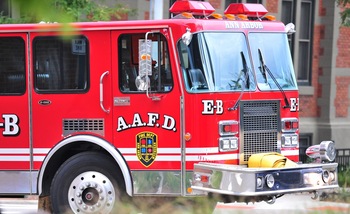
How good is good enough when it comes to fire response time? That's a question the community must ask -- and answer.
Ryan Stanton | AnnArbor.com
The plan is an attempt by the chief to make the best use of the personnel and equipment he has available to him -- understanding that the Fire Department has been cut from 94 FTEs to 82 since 2010.
Hubbard’s plan would close three of the city’s five fire stations and reopen Station 2, for a net reduction from five stations to three. The move would allow him to staff the remaining stations with at least four firefighters at each.
Getting four firefighters to a fire is key. Firefighters operate under a “two in, two out’’ protocol, which means they can’t enter a burning building until there are at least two firefighters to go into the building while at least two remain outside.
According to the National Fire Protection Association, departments should get four firefighters to the scene within four minutes 90 percent of the time. Ann Arbor falls well short of that standard and even if the chief’s reorganization is implemented, the city will still fall short.
Right now, the Fire Department only meets that standard 36 percent of the time, which ought to concern residents greatly. The department typically only has three firefighters on duty as most stations, so the first responding fire truck doesn’t put the necessary four firefighters on the scene.
Hubbard says under his plan, the department would meet the NFPA standard 72 percent of the time - a significant improvement.
But how good is good enough? That is a question the community must ask - and answer. The NFPA goal of 90 percent is the gold standard, but it would be hard to find a department that meets it.
The International City/County Management Association, which the city hired last year to study our Fire Department, doesn’t track average response times, because too many variables can influence that. It says what’s important is for each community to define the level of service it wants and work toward achieving that. In Ann Arbor, at a time when the city’s budget is stabilizing after two years of deep cuts to police and fire services, now is the appropriate time to have that discussion.
In the coming fiscal year, the city had anticipated having to cut more positions from the Fire Department, but now expects to at least keep staffing levels stable. The city even has the option of dipping into an expected surplus to hire more firefighters if it chooses to, but there’s some reluctance to do that, given that the forecast is for tighter budgets in the future, which means those new positions might have to be eliminated down the road.
The fire chief’s reorganization plan is designed to improve response times given the staffing he has now. When questioned at a recent City Council meeting, Hubbard said his ideal staffing level would be 88. In our view, the chief’s proposed reorganization looks like a sensible short-term plan, but we don’t see a long-term plan or any consensus around what level of fire service the community expects or deserves.
Last week, the city announced it would delay the fire reorganization plan at least until fall, primarily out of concern over how work on the Stadium bridges could delay response times. Between now and then, Hubbard will seek community input on the plan.
We think there has to be a larger discussion than that, and City Council needs to lead it. No one should find it acceptable that the department only meets response standards 36 percent of the time. But what makes 72 percent an acceptable number, just because that’s what the chief’s plan would achieve? ICMA strongly recommended that City Council develop a fire protection master plan for Ann Arbor, including measureable goals for response times. That’s what’s missing here.
The chief’s plan can be implemented administratively, without City Council approval. This is too important of an issue for council to sit out. Not only should it exercise its prerogative to deliberate and vote on this plan, it should do so within the context of clearly defined goals set with public input. How can council make good decisions about fire protection when neither it nor the community has defined what it’s trying to achieve?
(This editorial was published in today's newspaper and reflects the opinion of the Editorial Board at AnnArbor.com.)
Comments
Peregrine
Tue, Apr 24, 2012 : 11:12 p.m.
@Ranzini: Note that you switched from the term "scientific standard" to "scientific method". If you're asking whether there were any scientific inputs into the process, then there may very well have been. There are scientific inputs into baking bread, but that doesn't mean I'm using a "scientific recipe". If NFPA 1710 were a scientific standard, then there would be a scientific rationale for why: a. the turn out time is 1 minute rather than, say, 52 or 68 seconds (see side note below). b. the travel time is 4 minutes rather than, say, 3 min 48 sec. or 4 min. 12 sec. c. the timing achievement rate is 90% rather than, say, 87% or 93%. The fact is there is no formula, informed by actual data, that shows 4 minutes is the optimal value. It's a guess derived through a consensus process by a technical committee. I'll also point out that I Googled for "NFPA 1710" and "scientific standard" (using quotation marks in order to look for documents that contained both of those two-word phrases). Google did not find any such documents. So it looks like you're one of the few people (and perhaps the only person) referring to NFPA 1710 a scientific standard As a side note, according to this NFPA document (PDF link: http://tinyurl.com/6vop2u4), the NFPA 1710 turnout time for a fire response is 80 seconds. For an EMS response it's 60 seconds.
Stuart Brown
Mon, Apr 23, 2012 : 6:58 a.m.
Sabra, Since you represent my home in the First Ward, I'll direct my question to you. Why has the city waited so long to demand that UofM pay its fair share of the cost of providing Fire Safety services in Ann Arbor? I know what the real answer is--too many members of the council work for UofM or are indebted to them. Now that I've stated the real reason, why don't you give us the politically correct version of the answer.
Stuart Brown
Mon, Apr 23, 2012 : 6:46 a.m.
Stephen, There are two points that have not been made here: 1) Reducing the "buckets" from over 50 down to two (restricted and unrestricted) would free up millions to fund the fire department with. 2) The council should immediately send a letter to officials at the UofM stating that the city will no longer provide fire and other emergency services after a certain date to the UofM unless they operate there own Fire/Safety service and there is a mutual services pact in place between Ann Arbor and UofM. Another question for the council and in particular our current Mayor: why could the city of 2001 afford about 120 Firefighters when the city was getting less revenue from property taxes then than now? The reduction of the city's safety services is a major scandal that the Mayor and council majority has yet to take responsibility for; their roles in this matter have been truly egregious. Don't hold your breath waiting for any true commitment to repair the damage done.
LoveLife
Sun, Apr 22, 2012 : 9:33 p.m.
We all seem to be focusing on the words that are being spoken by the chief and city council. I think it might be more important to read between the lines and to focus more on the words that are NOT being spoken by the above mentioned. Just because additional trucks are in a smaller number of stations will they continue to SIT in the station or will they ACTUALLY ALL be staffed and ready to go at a moments notice, i.e. the supposedly new tower truck that is supposedly going to be purchased, etc. Let's try to find the small print and determine the real reason for the "super stations".
PrevoTownie
Sun, Apr 22, 2012 : 9:31 p.m.
Links for items mentioned earlier. http://www.emich.edu/cerns/downloads/papers/FireStaff/Tactical%20Operations/The%20Impact%20of%20Inadequate%20Staffing%20on%20Initial%20Fire%20Attack%20at%20the%20Pittsfield%20Township%20Fire%20Department.pdf http://www.nist.gov/el/fire_research/residential-fire-report_042810.cfm
PrevoTownie
Sun, Apr 22, 2012 : 9:43 p.m.
Ok, the link for the EMU Fire Staff and Command paper is not posting properly so google search for this and you should be able to find - "IMPACT OF INADEQUATE STAFFING"
Stephen Lange Ranzini
Sun, Apr 22, 2012 : 8:53 p.m.
--CONTINUATION FROM ABOVE-- "In the test situation, four-person crews completed laddering and ventilation necessary for occupant rescue and firefighter safety (should they need to bail out a second-story window) 30 percent faster than two-person crews and 25 percent faster than three-person crews. Meanwhile, three-person crews started a primary search and rescue 25 percent faster than the two-person crews. In this case, a 10 percent difference was equivalent to just over one minute, a critical number when considering toxicity and fire growth. In comparing four- and five-person crews collectively to two- and three-person crews, the average time difference to stretch a hose line to the fire to conduct suppression was 76 seconds. A four-person crew was 87 seconds faster at stretching a hose than a two-person crew, and a five-person crew was more than two minutes faster than a two-person crew. The five-person crews assembled an effective response force three minutes faster than the four-person crews, while the two- and three-person crews struggled to meet standards. Regardless of fire size, toxicity experienced by the occupant at the time of rescue varied significantly depending on the arrival time of different-sized crews. The test clearly showed that two-person crews could not complete essential fire ground tasks in time to rescue occupants without subjecting them to an increasingly toxic atmosphere." Isn't that the scientific method in action to prove the validity of the standard? I would also note that in all the standard writing activities that I've been involved in, the politics are fierce, just like the politics in academia are fierce. I have often had to listen patiently while some spend 2 hours quibbling over whether a sentence should use the word "shall" versus the word "may"!
Stephen Lange Ranzini
Sun, Apr 22, 2012 : 8:47 p.m.
@Peregrine: I've been involved in writing ANSI standards with NIST personnel for about 15 years now (in my case these were financial services and healthcare IT standards). The scientific method is used is writing all standards that I've been involved in. According to Wikipedia, "Scientific method refers to a body of techniques for investigating phenomena, acquiring new knowledge, or correcting and integrating previous knowledge. To be termed scientific, a method of inquiry must be based on gathering empirical and measurable evidence subject to specific principles of reasoning. The Oxford English Dictionary says that scientific method is: "a method or procedure that has characterized natural science since the 17th century, consisting in systematic observation, measurement, and experiment, and the formulation, testing, and modification of hypotheses." See: http://en.wikipedia.org/wiki/Scientific_method NIST's work as evidenced in their fire response time and motion study videos clearly fits in this paradigm. "In fact, Hubbard showed council members a video that demonstrated how adding just one extra firefighter to a crew makes a profound difference in fighting fires. [the following is a long extract from www.annarbor.com/news/ann-arbor-fire-chief-says-staffing-levels-make-a-big-difference-in-ability-to-fight-fires/] The video was produced by the National Institute of Standards and Technology and showed the results of an experiment where different-sized crews responded to simulated structure fires. The performances of two-, three-, four-, and five-person crews were measured. Overall, the four-person crews were 5.1 minutes faster from start to finish than the three-person crews, which NIST called a critical difference when lives are at stake. --CONTINUED--
PrevoTownie
Sun, Apr 22, 2012 : 5:53 p.m.
Well, where to start. The plan while good in the intent to take the initiative to improve response times based on percentages of calls, lacks the insight into reality. The citizens in the outlying areas pay taxes and deserve the best service possible. The city for many years has serviced those areas with stations in those areas and should continue. While having 4 firefighters ready and able to attack a fire is important, so is getting there as quickly as possible. Currently when there is a fire one of those outlying stations can get there with there 3 firefighters and start getting ready to attack the fire. Attack lines are stretched, water supply connected, and usually by then another truck arrives and you have your 2 in and 2 out satisfied. The proposal for the "super stations" takes away this ability not to mention for those calls where it is not a large fire. Some calls just don't require that amount of manpower. Also the 2 in 2 out rule does not apply to situations where immediate rescue of a person is needed. The more firefighters you have to accomplish the tasks of fighting fires has been proven to be more effective. There is a video done by NIST and a paper written by an EMU Fire Staff and Command graduate that did some evaluations on different staff levels with specific tasks. I do not have the links but you can do a google search for the info if really interested, that is how I found them before. Don't short change the citizens paying taxes in those outlying areas of the city by instituting this plan. Just my humble opinion.
Peregrine
Sun, Apr 22, 2012 : 3:25 p.m.
I would like to clear up another misunderstanding about NFPA 1710. Stephen Ranzini has repeatedly referred to it as a "scientific" standard. It is clearly not. Just looking at the standard there are compelling clues that it wasn't built through science. While firefighters come in whole units (3 or 4 but not 3.8), minutes can be fractional (4.2 minutes or 4 minutes 12 seconds). And percentages don't always come in multiples of 10 (90% vs. 93%). And yet the standard refers to 1 minute for turnout time, 4 minutes for travel time, and a 90% achievement goal. Had the standard been built through actual data, it is incredibly unlikely that these numbers would have fallen on such idealized boundaries. So if NFPA 1710 is not a scientific standard what type of standard is it? It is at best a consensus standard produced by a technical committee and then voted on by the members of the NFPA. Reading the history of how it was adopted and how controversial it was is very interesting. The minimum staffing levels and maximum times were the most controversial aspects of the standard and threatened to sink it. But the International Association of Fire Fighters, a firefighters union, was interested in establishing minimal staffing levels. So it was able to get its members to join the NFPA in large numbers, attend the May 2001 NFPA general assembly in Anaheim, California, and then vote for the 1710 standard. If you would like to read about the history, I would suggest _What's all the Confusion about NFPA 1710?_ by Ray Crouch, Sr., who works for the University of Tennessee (PDF link: http://tinyurl.com/7wcfe64). But I hope we can put an end to calling it a "scientific" standard.
Craig Lounsbury
Sun, Apr 22, 2012 : 7:47 p.m.
an interesting read. Thanks for the link Peregrine. I was fascinated by the notion of monitored smoke alarms on page 7. "The standard (NFPA 1710) allows compliance by having a four-person company arriving within four minutes. This does not take into account the fact that the occupants may not be at home, or that they are asleep. In either case, several minutes, up to half an hour, would have elapsed before the fire was detected and reported. If instead, new money was invested into monitored smoke alarms, the two person fire company arriving in less than 3 minutes would be able to extinguish the comparatively small fire, in relative safety and assist the family from their dwelling."
Peregrine
Sun, Apr 22, 2012 : 3 p.m.
Thank you for this editorial. I'm happy to see the key issues laid out concisely. And the central argument, that city council should be involved in this decision, is well justified. Certainly the fire department has to make plans and optimize its resources whether council takes up the issue or not, and I applaud Chief Hubbard for being proactive.
SonnyDog09
Sun, Apr 22, 2012 : 2:50 p.m.
Here is a "thinking outside of the box" solution. Instead of saying we have $x budget and each firefighter costs $y, so we can only have $x/$y firefighters, let us say we have $x budget and we want $z firefighteres, and this means that the total cost for each fireghter is now $x/$z. Have a nice day.
Craig Lounsbury
Sun, Apr 22, 2012 : 2:57 p.m.
Gracias por la sugerencia
Sabra Briere
Sun, Apr 22, 2012 : 12:52 p.m.
Dear Tony, Thank you very much for this editorial. This issue is, indeed, important enough to need a Council vote. I don't think anyone on Council is in a hurry for this proposed change. I know that, with Stadium and the Stadium Bridges going through construction this summer, both Margie Teall and Marcia Higgins have voiced concern that actual response time would increase for much of the 4th Ward. I've been told that our current station configuration is intended to provide emergency medical responses as well as fire coverage. But years ago the City contracted with Huron Valley Ambulance to cover medical emergency calls; fire fighters still go to some calls for medical services, but not all of them. I anticipate that there will be a number of community discussions -- formal and informal -- to begin talking about whether Ann Arbor should have a model based on responding to fires or responding to medical calls. A significant issue for me in the ICMA report was the time it takes between the initial call and the departure from the fire station. I know this and other issues related to response time are being evaluated. Each member of Council would like to see the City reach Chief Hubbard's preferred number (88 fire staff) this year. It's certainly good news that the City will bring the staffing back up to 82 (in the proposed budget) but finding a funding source for an additional 6 fire staff is the challenge. While the staff could be hired using general fund reserves, the City might be forced to reduce staffing again in two or three years if no sustainable funding is identified. There's only so long the City can operate using reserve funds for recurring expenses. After the budget is approved there will be opportunities for community meetings to talk about what we want the Fire department to do, and how we want it organized. I know that Council member Smith and I will host at least one town-hall meeting, although we haven't yet set dates.
PrevoTownie
Mon, Apr 23, 2012 : 1:07 a.m.
AAFD does not duplicate EMS services. They provide basic life support and HVA provides advanced life support and transports. When HVA units are tied up elsewhere, AAFD can get there and provide basic life support until paramedics arrive. They also assist Medics once they are there.
Kai Petainen
Sun, Apr 22, 2012 : 6 p.m.
Whether I agree or not with Briere, I'm happy to see that she's reading/listening and responding. That's nice to see, regardless of political views.
Craig Lounsbury
Sun, Apr 22, 2012 : 2:45 p.m.
""turnout time,'' which is the difference between when a fire unit is dispatched and when it leaves the station......The NFPA standard for turnout time is one minute, and the ICMA study found that on fire calls, the turnout time for the Fire Department was well over 2 minutes," What would account for that?
Tony Dearing
Sun, Apr 22, 2012 : 1:30 p.m.
Sabra: A couple of good points here. Because of the length of this editorial, we didn't address emergency medical calls, but that's an important issue. While we understand the value of emergency medical services, at some point the community has to ask what degree it wants the Fire Department duplicating the services of HVA when the department is not meeting response time standards on structure fires. When ICMA studied all fire calls from March 2010 through February 2011, it found that 71 percent were medical calls. You also raise a good point about what ICMA calls "turnout time,'' which is the difference between when a fire unit is dispatched and when it leaves the station. The NFPA standard for turnout time is one minute, and the ICMA study found that on fire calls, the turnout time for the Fire Department was well over 2 minutes, which definitely affects response times. We look forward to covering town halls on this issue.
Sparty
Sun, Apr 22, 2012 : 1:22 p.m.
Do you mean that the 4th Ward was actually represented at Council? I am Shocked! Between their absences at meetings and failure to respond to constituent contacts, these "members" surely deserve the "invisible women" moniker they get labeled with so often. Council should be revised so that resignations are required after missing a defined number of meetings, that attendance at election debates is required, etc. Who monitors whether constituent contacts are responded to or not?
jcj
Sun, Apr 22, 2012 : 12:51 p.m.
I never was a big fan of the new math that's been taught the last couple decades. They can spin and twist the numbers all they want. The bottom line is LESS is NOT better! Reducing the number of fire stations makes no sense. If those in city hall believe less is better... WHY not reduce their pay. their staff and the amount of money they spend on each of their chairs around the council table?
Brad
Sun, Apr 22, 2012 : 12:50 p.m.
"Last week, the city announced it would delay the fire reorganization plan at least until fall, primarily out of concern over how work on the Stadium bridges could delay response times." I don't know about everybody else, but I sure would like to hear what their plan is *before* the elections. Even if they delay implementation of the plan until after the bridge work is done, there's no reason to wait to formulate that plan. No good reason, anyway.
Stephen Lange Ranzini
Sun, Apr 22, 2012 : 12:17 p.m.
FYI, the ICMA study found: "it takes the Ann Arbor Fire Department 4.3 minutes on average just in travel time, plus another 1.8 minutes for dispatch time and 2.3 minutes for turnout time." See: www.annarbor.com/news/ann-arbor-fire-department-icma-final-report-on-response-times/ That was when the fire department had 18 more staff than the current level of 76 (82 is budgeted for this fiscal year, but the fire chief opted not to fill six positions), so it's certainly worse today.
Stephen Lange Ranzini
Sun, Apr 22, 2012 : 9:06 p.m.
@Peregrine: a really good question that needs to be addresed by analysis led by competent management. Many other cities can achieve this turn out time standard. Why not us?
Peregrine
Sun, Apr 22, 2012 : 2:36 p.m.
Why is Ann Arbor's turnout time 2.3 minutes when the goal is 1 minute? Is it a matter of training? Is it a matter of equipment? Is it because most of our stations are staffed by 3 rather than at least 4, which means the tasks involved in turnout are spread among fewer firefighters?
Fred Crothers
Sun, Apr 22, 2012 : 12:15 p.m.
Why is it that the two most IMPORTANT departments in a city are the ones that are battled over the most!! Fire and Police should be paramount then your "other" agendas. Why should there even be this confusion! I find it interesting that as our population grows, the council feels that we need less and less protection! Yet we continue to build LARGE buildings to call people to our city, yet we/YOU deem it not important enough to protect them!
Peregrine
Sun, Apr 22, 2012 : 5:32 p.m.
Isn't it the case that even with a 95 foot ladder, the highest floor it could reach with optimal truck positioning would be the 8th? Huron Towers is 13 stories. The Campus Inn 14 stories. University Towers 18 stories. And Tower Plaza is 26 stories. Far more important than reaching eight rather than six floors is building the structure to modern fire safety standards. That includes the sprinkler system and multiple secure stairwells.
Stephen Lange Ranzini
Sun, Apr 22, 2012 : 12:22 p.m.
Amen Fred! A new tall building began construction just this week at First and William. The city had the time and ability to issue the building permit, but what about ordering the needed replacement tower truck we've been promised so the fire department can again reach above six floors to rescue citizens from a tall building?
Stephen Lange Ranzini
Sun, Apr 22, 2012 : 11:49 a.m.
The link above got cut off. It is in this AnnArbor.com story: www.annarbor.com/news/ann-arbor-city-administrators-recommended-budget-increases-staffing-in-police-holds-line-on-fire/ and here is the full link (I hope it works better the second time): www.a2gov.org/government/financeadminservices/Documents/FY13%20Draft%20Budget.pdf
Kai Petainen
Sun, Apr 22, 2012 : 1:46 p.m.
Stephen, the new system on AnnArbor.com sucks for links. Try using www.tinyurl.com for making the links. That way, the link that you made, can look like this (this links to that pdf) http://tinyurl.com/6wahfbv
Stephen Lange Ranzini
Sun, Apr 22, 2012 : 11:45 a.m.
Interestingly, in the budget proposed by our city manager for fiscal year 2013, which begins July 1, 2013, the following goals are established against which the performance of the fire department is to be measured: Goal A is "Meet or exceed NFPA, ISO and OSHA standards", and the measures by which Goal A will be measured as accomplished or not is Measure A1, which is "First arrival for structure fires within four minutes with four people and 13 people within eight minutes." (See page 298 here: www.a2gov.org/government/financeadminservices/Documents/FY13%20Draft%20Budget.pdf) Hopefully the "13" people within eight minutes is a typo, since the NFPA standard is 15 people within eight minutes. The 8-minute goal for entire initial full alarm is critical because the progression of a structural fire to the point of "flashover" (the very rapid spreading of the fire due to super heating of room contents and other combustibles) generally occurs in less than 10 minutes. As there is a potential delay between fire ignition, discovery, and the transmission of an alarm it may be said that flashover is likely to occur within 8 minutes of firefighters receiving the alarm. NFPA 1710 established the standard response objectives for the initial full alarm using a task based analysis. Under the fire chief's three station and 82 employees plan, Ann Arbor would meet the full alarm standard just 53% of the time, not the 90% required. At any rate they can only hope to accomplish both of these important goals and meet scientific national standards for best practices on these two key response times by staffing 88 fire fighters across five fire stations.
Basic Bob
Sun, Apr 22, 2012 : 11:40 a.m.
Council has already had their say. They set the budget which caused this reduction in service. The chief's plan marginalizes all the citizens in the outlying areas of the city, while fulling protecting the assets of the University and historical neighborhoods. It seems like a plan the mayor could support, if he had the nerve.
Stephen Lange Ranzini
Sun, Apr 22, 2012 : 11:36 a.m.
"But how good is good enough? That is a question the community must ask - and answer. The NFPA goal of 90 percent is the gold standard, but it would be hard to find a department that meets it." Not true, this article www.annarbor.com/news/firefighters-union-pushing-ann-arbor-officials-to-increase-staffing-in-fire-department/ notes that similar sized Michigan cities in our area all meet one or both of the two key NFPA response standards: "But the firefighters union said it contacted fire chiefs in Livonia, Dearborn and Sterling Heights and found all three cities meet the major components of the NFPA standards. AnnArbor.com was able to reach the chiefs of two of those cities — Livonia and Sterling Heights — to confirm the numbers." Ann Arbor's population of 113,934 makes it the sixth largest city in Michigan. Livonia's population is 96,942 (#9), Dearborn has 98,153 people (#8) and Sterling Heights 129,699 (#4). Why can those SE Michigan cities afford fire safety meeting scientific national standards for best practices on these two key response times? FYI, adding the additional six firefighters required to be able to meet those standards would cost just $480,000 a year extra and the city is projecting a surplus in the general fund of $323,362. Otherwise, an excellent editorial!
Tony Dearing
Sun, Apr 22, 2012 : 1:21 p.m.
Stephen, you make a good point and I won't argue this one with you. I tried very hard to find statistical data that compared departments on response times, and it doesn't seem to exist on the state level or national level. What I was told was that there are too many variables. And response times can be measured in different ways. There are actually three different NFPA standards for response times. But the bottom line is that Ann Arbor is not meeting response time standards, and has to define its expectations. Thanks for weighing in.
Carole
Sun, Apr 22, 2012 : 11:48 a.m.
Excellent statement. At least four of the stations should be open -- downtown, Jackson Rd, Stadium, North Campus--and, the staff should be increased.
AACity12
Sun, Apr 22, 2012 : 11:34 a.m.
The fire department is down to 76 firefighters from 126. Budgeted for 82.