

Demolition of houses throughout Ann Arbor destroy a piece of history as well
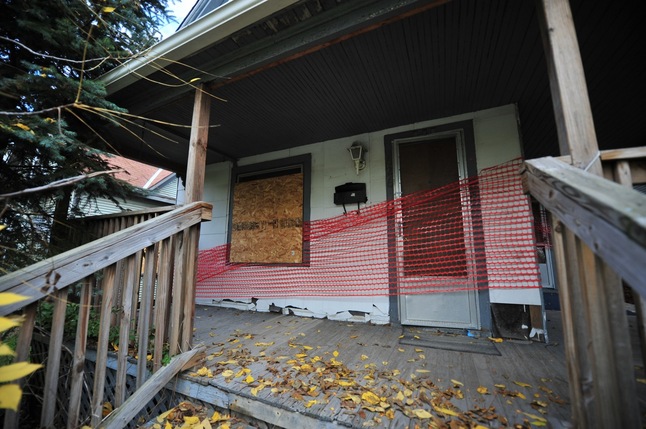
One of the houses on Ann Arbor's North Main Street that is considered a dangerous building and needs to be demolished.
Ryan J. Stanton | AnnArbor.com
We’d get going after school and walk to St. Andrew’s church, pausing on the way to buy a snack at Diroff’s, which is now Zingerman’s Deli. After reading in the church’s school rooms, we’d walk back to her house, sometimes passing 515 N. Fifth where her friend KK lived. I did this, sometimes twice a week, for four years. I became good friends with her family and we even had our portraits taken together at K-Mart! I have beautiful memories of those years from 1964-1968.
I was recently reminded of this because KK’s house at 515 N. Fifth Ave. is slated to be demolished to build a three-story condo and apartment building. It made me sad, thinking of this neighborhood’s black history disappearing with each continuing demolition, and the loss of the history of this house in particular.
Everyone was so proud of their uncle Ollie McLaughlin, who, as a radio announcer, disc jockey and record producer (he had three record labels named after his three daughters) had discovered some great rock ‘n’ roll talents including Barbara Lewis, Del Shannon, Ann Arbor-native Deon Jackson and the Capitols, who sang “Cool Jerk.” He’d even been nominated for some Grammy Awards! All this history is just swept away when a house isn’t there any longer to bear witness to the story.
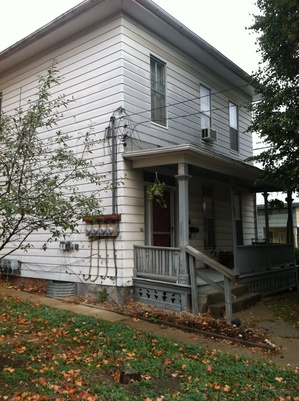
A house at 515 N. Fifth Ave. in Ann Arbor could be demolished for a multi-family development.
Lizzy Alfs | AnnArbor.com
It started out as a cube-shaped house with “Italianate” features, meaning it had brackets under the eaves and 4-over-4 windows (still there) and nice trim around the doorway. It began its life in 1860 as the home of Daniel Kierstad, a dealer in men’s clothing on Main Street but also the manufacturer of ‘slat window curtains’ (i.e., shutters) in the factory behind his house. He later switched to window shades and remained until the early 20th century. The neighborhood at the time was quite mixed, with many German Catholics living amongst the Irish and Italians who attended St. Thomas Church.
African Americans also built their churches here in the early 20th century, Second Baptist at Beakes Street and Fifth Avenue and Bethel AME on Fourth Avenue, just north of Beakes. With the implementation of zoning after World War I, this neighborhood was essentially restricted to Blacks though other ethnic groups like the Japanese after World War II and some Italian refugees found homes here too.
With the demolition of the Greek Orthodox Church on Main Street and the pending demolition of the small houses on North Main near Summit (all of which were associated with early Irish immigrants to Ann Arbor and most of which were built around the time of the Civil War), we lose all sense of the history of this neighborhood and of the many who have passed through it.
The black churches remain with new uses (one is a school and the other is condos) and can tell some of the neighborhood’s stories. They can tell of the bad old days and now the successes of integration and the progress we have made. Now the “old neighborhood” has become just another place for developers and speculators to cater to the needs of a new century. So, with the history of this neighborhood being erased, today is a bittersweet day for me.
Susan Wineberg is the author of the book "Lost Ann Arbor and Historic Buildings, Ann Arbor Michigan."
Comments
Alan Goldsmith
Tue, Jan 29, 2013 : 7:31 p.m.
Bob-- Thank you.
coachmrclean
Tue, Jan 29, 2013 : 6:51 p.m.
Kay Kay's address was 519 N. 5th Ave.... FYI
Bob Needham
Tue, Jan 29, 2013 : 5:29 p.m.
Ollie McLaughlin's name has been restored.
coachmrclean
Tue, Jan 29, 2013 : 3:46 a.m.
The neibhorhood you speak of is my home. We are celebrating 50 years of owning property on that unique parcel of land shaped like a triangle between Kingsley and Beakes street(Next to Coleman Jewett's home RIP)! My other family members also still own the property on the otherside of Beakes St. and have been there for over 75 years. We are proud to have survived the escalating taxes, the onslaught of City zoning issues and inspections, cost's that ran most families out. It's not easy maintaining a house that was built in 1890. I knew and loved this part of town but sadly the culture and Karisma is gone. The laughter of the children is gone. So the city has done us no favor's. Long live the Dunbar, Farmers Market and the hood!
pooh bear
Mon, Jan 28, 2013 : 9:21 p.m.
Ollie McLaughlin was mentioned in my original submission. the editors removed it.
Alan Goldsmith
Tue, Jan 29, 2013 : 2:02 p.m.
"Ollie McLaughlin was mentioned in my original submission. the editors removed it." Assuming you are the author, this makes no sense and is very insulting to Mr. McLaughlin's memory. If this was done, why?
Alan Goldsmith
Mon, Jan 28, 2013 : 3:34 p.m.
"Everyone was so proud of their uncle who, as a radio announcer, disc jockey and record producer (he had three record labels named after his three daughters) had discovered some great rock 'n' roll talents including Barbara Lewis, Del Shannon, Ann Arbor-native Deon Jackson and the Capitols, who sang "Cool Jerk." He'd even been nominated for some Grammy Awards! All this history is just swept away when a house isn't there any longer to bear witness to the story." You seem so concerned with history but don't take five seconds to actually mention this man's name? http://www.hitsvillesoulclubs.com/olliemclaughlin.htm His name was Ollie McLaughlin, a real Ann Arbor person. Hopefully next time you will include his name and not use him as a nameless prop in support of your argument.
richh
Mon, Jan 28, 2013 : 12:34 a.m.
The name of the uncle was Ollie McLaughlin his radio dayswere WHRV (waam Radio). Ollie use to have dances in the parking lot in the summer on 4th & williams, he had club for teenagers who came to the dance called the scooby doo club. I knew him cause he use to live with his brotheron the street I lived on when I was a child. I remember once the T.V. stars of Amos & Andy stopped at his house to see him.
Thaddeus
Sun, Jan 27, 2013 : 3:49 a.m.
Under ideal situations, gentrification does not involve the leveling of many buildings. Of course under ideal situations, the economy isn't allowed to be driven into/ under ground as it has been Nationwide over the last 30+ years either. Well-done gentrification can be very positive when it involves building updates, new facades, cleaned-up trash-littered lots, and changes that may give the area a newer look and feel. Changes that can make the existing building stock more usable, efficient, safe, and accessible. Or infrastructure additions/ modifications that make the area work better, but keep most of the history and building stock intact.... To see so many buildings that for a long time to come could have been very usable and livable; and in many cases of historic significance - rot into the ground/ just leveled is gut-wrenching.... While good news for the Ann Arbor area, even scarier and sadder is that Ann Arbor last I knew is still considered one of the ten best housing markets in the U.S. Meaning of course that almost anywhere else in the U.S. it is worse....
15crown00
Sat, Jan 26, 2013 : 10:07 p.m.
ah but that's progress.at least that's what they'll tell you.
justcurious
Sat, Jan 26, 2013 : 9:30 p.m.
Susan, thanks for informing people who have not been here very long what the significance of that neighborhood is. I too have memories of life in Ann Arbor since the late forties. The streets north of Miller Ave. had many proud black families. Later young educated whites bought up the homes and poured money into them. I believe a lot of the black families left as the "gentrification" proceeded. But none of it matters when someone comes from somewhere else with dollar signs in their eyes. I gave up on complaining about loss of character a while back. It's inevitable. But then, I suppose those before us felt the same way.
lorayn54
Sat, Jan 26, 2013 : 7:12 p.m.
the "joys" of gentrification. thanks for sharing this story.