

Owner of Ann Arbor's Georgetown Mall site seeking tax breaks on $30 million project
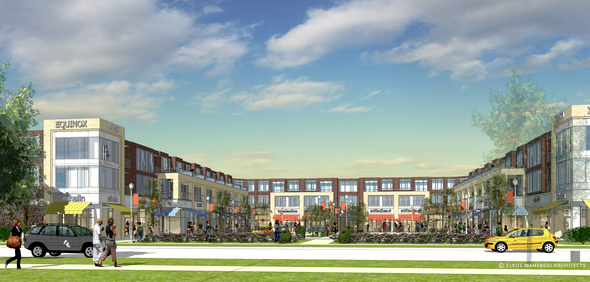
A conceptual drawing shows what the owner of Georgetown Mall envisions for the property on Packard. The developer is seeking tax breaks on the project.
From The Harbor Companies LLC
The owner of Georgetown Mall in Ann Arbor is seeking millions of dollars in tax breaks to help finance a $30 million redevelopment of the former strip mall site along Packard Street.
Bloomfield Hills-based developer Craig Schubiner made his case Monday night to the city's Brownfield Review Committee, which offered positive feedback on preliminary plans for tax-increment financing on a new mixed-use project called Packard Square.
According to plans, Packard Square would be a contemporary development comprised of 230 apartment units and 21,000 square feet of retail space in a pedestrian-friendly design that includes a central plaza, park space and a covered parking garage.
The committee gave the developer the go ahead to finish preparing a brownfield plan and report back on Feb. 28. The committee is made up of Ann Arbor City Council members Marcia Higgins, D-4th Ward; Sandi Smith, D-1st Ward; and Stephen Kunselman, D-3rd Ward.
City officials acknowledged Monday night the city is under no obligation to approve a brownfield plan. Higgins and Tom Crawford, the city's chief financial officer, said city officials will be looking at the project from one standpoint: What's the public getting out of this?
"We are going to be giving them an abatement on their taxes for a period of time," Higgins said. "So some of the things I look at is we're having public infrastructure really improved, whether that's new water lines, new sewers that will be put in, the environmental aspect of this is really important to me, and the streetscapes, and how all of that starts to connect."
Joining Schubiner for Monday's presentation inside the new Ann Arbor Municipal Center was Anne Jamieson of AKT Peerless Environmental and Energy Services.
Jamieson said the developer is seeking tax-increment financing in the amount of roughly $3 million to help pay for items like environmental cleanup, demolition and asbestos removal, which are eligible under the state's Brownfield Redevelopment Financing Act.
A brownfield property is one in which site conditions present an obstacle to redevelopment. In Michigan, that can include properties that are contaminated, blighted or functionally obsolete — and the developer of Packard Square is claiming all three conditions exist.
Through tax-increment financing, no existing tax revenues are abated. However, the incremental increases in tax revenues that result from improvements to a property are channeled back to the developer to help cover costs and incentivize the development.
Early estimates show that would be about $450,000 a year, which translates to an abatement period of roughly seven years. Capture of school taxes will require approval by the Michigan Economic Growth Authority Board and/or the state Department of Environmental Quality.
In addition to tax-increment financing, the developer is seeking Michigan Business Tax brownfield credits and other state grants and loans.
The developer's report to the city said the brownfield credits would be worth between $3.75 million and $4.5 million. However, Jamieson said Monday night that's looking more like $1.25 million to $2 million based on recent feedback from state officials.
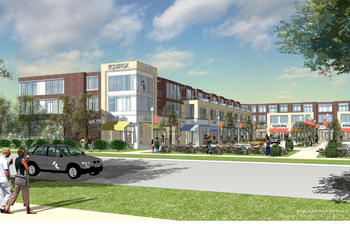
Another view of the proposed concept for Packard Square.
From The Harbor Companies LLC
Higgins offered praise for the project, but said she's anxious to hear more details from the developer at next month's meeting.
"I think you heard the whole committee say that we're very excited about this," she said. "I think it's a positive step forward. Now when we get into it next month — and we're really going through the facts and figures — that's when we'll see if we have any differences."
Jamieson said it's "imperative" the incentives are approved.
"Otherwise, we're throwing money out the door," she said. "You want to be able to make your rental rates affordable, basically for your commercial properties and for your residential. And so really this helps in various ways in being able to reduce those rental rates."
In terms of timing, the developer said the incentives could take up to three months for state approval. Schubiner hopes to start the project this summer and finish by fall 2012.
The Georgetown Mall site has been vacant since Kroger closed its grocery store there in fall 2009, leaving neighbors and both city and county officials concerned about the condition of the property. Regular meetings have been held to discuss the site's future ever since.
Back taxes owed on the property must be paid before the project can proceed. Those taxes totaled more than $277,000 in late December.
Matt Naud, the city's environmental coordinator, said the city is careful about approving brownfield plans, which also must be signed off on by the Washtenaw County Brownfield Redevelopment Authority. He said he looks at tax-increment financing dollars as money that wouldn't be there in the first place if not for the brownfield incentives.
"You wouldn't want to give these incentives to somebody who's going to make a 50 percent return on investment," he said. "You want to make sure that, without this investment, there'd either be no return and the project doesn't work, or just a reasonable return. And I think in this case, this site's been waiting a long time. I don't know that anyone is standing behind this developer with an equally good project that doesn't want any incentives."
Environmental concerns
Before Monday's meeting, the developer submitted a report to the city that outlines reasons why special remedial actions are necessary for the property.
The developer traces the source of the site's environmental contamination to a dry cleaning facility that once operated along the southern portion of the property. Previous investigations have identified both soil and groundwater contamination, including chlorinated solvents.
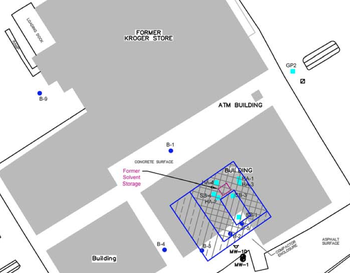
This drawing shows the location of where environmental contamination cleanup work is to be done on the former Georgetown Mall site.
Courtesy of AKT Peerless
After extensive groundwater sampling, the plume was found to be stable, and the last analysis indicated the chlorinated solvents were below any applicable cleanup criteria, according to the developer. Still, to meet DEQ requirements, continued groundwater monitoring is necessary to demonstrate the plume’s stability until remediation has taken place.
The developer has determined removal of 1,000 cubic yards of soil and some groundwater is necessary. However, the source area can't be accessed until demolition work has taken place. Those remedial activities are estimated to cost between $337,000 and $387,550.
The developer plans to demolish all existing buildings on the site. Prior to demolition, a survey will be performed to evaluate the site for any lead-based paint, asbestos-containing material and other hazardous materials to be abated.
In addition to environmental concerns, the developer claims many features of the existing buildings are functionally obsolete, including deteriorating facades. Also, the sizes of anchor retail spaces aren't conducive to a grocer like Kroger or a drug store chain like CVS.
The developer also notes many aspects of the existing development are blighted, and vandals have spray-painted the buildings and broken some windows. The parking lot is severely deteriorated and has numerous cracks and potholes.
The developer estimates the new project will support 285 construction jobs. After completion, it's estimated to support 40 retail jobs and five jobs related to operating the complex.
Most of the 230 units would be one and two bedrooms, with a small handful of three-bedroom units. Estimated rental rates are $786 to $926 a month for one-bedroom units, $1,056 to $1,140 a month for two-bedroom units, and $1,371 a month for three-bedroom units.
"Packard Square will provide a fresh, upscale living environment that includes amenities such as a gym, pool, reading room, video room, yoga room, conference room, recreation areas, and potentially a new AATA bus stop directly in front of the project," the project narrative states.
Schubiner declined to say Monday whether he'd consider revising plans based on feedback he received from Mary Krasan, a Georgetown Neighborhood Association spokeswoman.
"There's a bit of discomfort with the number of units," Krasan said during Monday's meeting, adding many nearby residents have concerns about potential increases in traffic and noise.
"So instead of 230 apartments, it would be maybe 190," she said, adding the neighborhood also would like to see more three-bedroom units included in the plans.
"We've been working on developing this site now for several years and we're excited about the plan," Schubiner said. "It meets the market needs, and architecturally it'll be great. And it's going to provide a great environment for people who live there as well as residents in the surrounding area, and the public elements of the plan will provide great gathering spaces."
Ryan J. Stanton covers government and politics for AnnArbor.com. Reach him at ryanstanton@annarbor.com or 734-623-2529.
Comments
CincoDeMayo
Thu, Jan 27, 2011 : 2:09 p.m.
I just don't get this conceptual drawing. I'm trying to imagine the same building, but tucked into the hillside there. I think that would look better (tucked in), and less domineering, anyway. @Tru2Blu76 I actually think that the "low, inclined elevation of the current property" is a plus. It is an interesting landscape for a commercial building to fit into and can actually add to the aesthetics of the whole design. (Although, again, I do not see that represented in this conceptual drawing at all.) I think delivery vehicles etc. do just fine in hilly terrain like Virginia, North Carolina and Colorado to name just a few areas with little malls tucked pleasingly into hillsides and valleys And, although it is not in a major retail zone, it is in a thoroughfare into town, and surrounded by fairly dense population. Those mainstays like grocery, post office / FedEx, tailor, drug store would do well there just as they do at other more "off the beaten track" malls like the ones at Plymouth and Nixon --- or even what I think may be called Northside Plaza further south on Plymouth Road at Broadway. I look around Briarwood and wonder how in the world so many of those types of stores can do enough business to survive....I wonder how much these stores are supported by their online business and chains. In any case, I'd like to see the topography of the Georgetown Mall property used to its advantage with a building design that takes advantage of the unique landscape.
Stuart Brown
Thu, Jan 27, 2011 : 4:45 a.m.
If back taxes are owed, the city should do a tax foreclosure and then sell the property. Some kind of new grocery store would be great.
Bob Bethune
Wed, Jan 26, 2011 : 5:45 p.m.
Here is a piece of Georgetown Mall history I just happened to run across today: 'Such a Find [Antiques, owned by Melanie Diana] started out six years ago in Georgetown Plaza, but had to relocate two years later because the mall's owners wanted to tear it down and rebuild. The plan eventually collapsed, but by the time it became clear nothing would happen, Diana and the other tenants were long gone. "They wanted us to move out for a year, then move back in, when they would have raised the rent," Diana says. "When they told all the tenants that, there was a mass exodus. [The idea of moving back] after being in limbo for a year was just really silly."' That's the management style in play here. How desirable does that sound? [URL: <a href="http://arborweb.com/articles/such_a_find_now_in_resale_row_full_article.html" rel='nofollow'>http://arborweb.com/articles/such_a_find_now_in_resale_row_full_article.html</a>]
Jay Thomas
Wed, Jan 26, 2011 : 10:05 a.m.
It's time to auction off this property and use the proceeds to pay Schubiner's tax bill.
Tru2Blu76
Wed, Jan 26, 2011 : 6:44 a.m.
Not mentioned (that I can find) is the low, inclined elevation of the current property. This was always a problem: you could drive by and not even notice there were stores or what kinds of stores. It's just a "poor landscape" which causes problems for delivery trucks and customers alike when there's snow, slush and ice on the paved areas. There were several serious slip and fall accidents too over the years. Small wonder there've been no offers from big retailers for the property: it's small, it's poorly landscaped and it's isolated from main retail zones. The retail zones on Washtenaw (north east) and Carpenter Road (East) are meant to serve that area: they're both just minutes away by car and provide all the services mentioned in people's want lists. Also: the Briarwood Mall was built about the same time as Georgetown Mall: the former has been solid while Georgetown has been downhill for over a decade.
Tru2Blu76
Wed, Jan 26, 2011 : 5:51 a.m.
Just to input what I've been hearing for years from neighbors of that property about the grocery store: First, quite a few complaints about the small store with limited selection. Next: a few "It's too dingy" comments. From Kroger's viewpoint, the size was a real drawback because the small store generates very few sales dollars compared to the now-standard "super market" designs. We must remember that "groceries" are distributed on a mass scale - multiple truck loads a few times per week, often daily. The former store got "split shipments" a couple times a week, causing extra trips over large distances for the trucks. This also brings in the competition aspect: all competing grocery chains are on the mass distribution platform. Stores that don't use that are not competitive. We are stuck (nationally) with the mass distribution concept: the entire infrastructure is now keyed on that. Our sincere desire for "neighborhood stores" just doesn't fit the reality. When the Georgetown complex was built (~1970) this trend was there but not nearly established as it is now.
Tru2Blu76
Wed, Jan 26, 2011 : 5:30 a.m.
1. Yes, "corporate welfare" is the watch word of the current era: ironic in that conservatives are always blathering about "evil big government" and the "perfection" of private enterprise. But businesses are constantly campaigning for tax "incentives" and low wages to do what private enterprise is supposed to be so good at doing! 2. It's not quite true that the owner "isn't serious": his previous plans called for the much-desired grocery store which residents are still "hoping for." Yet those same residents have voted down the owner's previous plans which included a grocer store space. With this design they get neither grocery store or pharmacy. In both 1 and 2 above: there's evidence that humans don't always know what's best or even "good for them." The overall situation is that property isn't a great location because it's isolated from the main commercial zones - an "out of the way location" is the way most people say it. But that doesn't admit that there are trends and risks in having all outlying commercial zones which apply force to factors like fuel consumption, road maintenance and cultural degradation.
Tru2Blu76
Wed, Jan 26, 2011 : 5:29 a.m.
1. Yes, "corporate welfare" is the watch word of the current era: ironic in that conservatives are always blathering about "evil big government" and the "perfection" of private enterprise. But businesses are constantly campaigning for tax "incentives" and low wages to do what private enterprise is supposed to be so good at doing! 2. It's not quite true that the owner "isn't serious": his previous plans called for the much-desired grocery store which residents are still "hoping for." Yet those same residents have voted down the owner's previous plans which included a grocer store space. With this design they get neither grocery store or pharmacy. In both 1 and 2 above: there's evidence that humans don't always know what's best or even "good for them." The overall situation is that property isn't a great location because it's isolated from the main commercial zones - an "out of the way location" is the way most people say it. But that doesn't admit that there are trends and risks in having all outlying commercial zones which apply force to factors like fuel consumption, road maintenance and cultural degradation.
pchbob
Wed, Jan 26, 2011 : 4:36 a.m.
Put in a central A2 Target and be done with it...you know it will work.
Barbara
Wed, Jan 26, 2011 : 3:47 a.m.
The Georgetown area is very underserved. I agree with a mall/shopping strip with practical businesses, like the Georgetown mall had,- drug store, post office, pizza place, grocery, tailor, etc. Mostly, the area needs a decent neighborhood LOCALLY owned eatery. There isn't one for miles, so it could definitely be successful. The mall is surrounded by apartment and condo complexes. Seems absurd to add more.
Tru2Blu76
Wed, Jan 26, 2011 : 6:14 a.m.
One one hand you and I might agree that the area is under served. But the reality is that both the Georgetown complex & that commercial strip 1/2 mile in the direction of downtown have not been supported by neighborhood shopping dollars. The only business that seems to be holding up is the sports bar. Even the bank branches have tottered. The Georgetown commercial plot is just too small as is the other one with Hollywood movie rentals. Otherwise: all those stores which were located in Georgetown would have provided revenue for that property and they'd still be there.
Stephen Landes
Wed, Jan 26, 2011 : 1:24 a.m.
After years working in environmental engineering and doing a few cleanups myself I can't see how this property qualifies for "brownfield" redevelopment credits. They need to clean up a relatively small area of contamination. If the developer is also the current owner of the property then he is responsible for the clean up -- essentially we know who the culprit is and that person is responsible. I see no reason to provide public money to help out a private responsibility. As for the number of rental units: why does the nearby homeowners association have a problem with the density on that site? Why is this their call? If the projected number of units is within the limitations of zoning then let the developer build it, provide housing for 40 more families, and have that much more revenue to make the project desirable without providing public money. If the neighborhood association wants the development to be 40 units smaller then let them assess themselves the present value of the lost revenue and provide it to the developer as their contribution to the design.
jns131
Tue, Jan 25, 2011 : 11:44 p.m.
Boy is that thing huge. It is going to wipe out the beautiful and tranquil area of the area to a mega mall. They need to tone it down a bit and then I would say go for it. Wow. Yes to the breaks but no to the design.
Tru2Blu76
Wed, Jan 26, 2011 : 6:21 a.m.
It's the too-small size of the property which is the real issue. Nothing but "mega sites" work in the present national retail scheme. Georgetown is no exception. Consumers (not neighborhoods) have "voted" for Wal-Marts and other mega store formats. Big chain stores are just responding to market forces, there's no "anti-neighborhood" agenda.
Mick52
Tue, Jan 25, 2011 : 9:17 p.m.
Couple of things to consider. Are any other developers hopping up and down for this property? If not, that limits the options. Some people note the owner here is letting it go further into blight, but I would not expect an owner that wants to demolish put a whole lot of $$ into repairs. Keep in mind that hotel out there at Jackson Rd and I 94. How long was that left vacant? I would not want that to happen here. I have a problem with the delinquent taxes. Surprised the city does not have something in the Charter that requires a property owner to have the taxes up to date before being able to propose any development. You want to know you aren't dealing with someone w/out the financial means to do this. Finally bike lanes and covered bike parking or no development for you. This is in an area with good bike lanes and any further development should include bike facilities.
JB
Tue, Jan 25, 2011 : 9:33 p.m.
To quote one of your previous comments: "Do you have any better ideas?" Perhaps you think that the city should just give the developer whatever he wants if there is no other developer currently interested in the site. I'm not inclined to agree with that. His is a track record of failure and until his taxes are paid up and he demonstrates that he has the financial backing to carryout such a project, I would not allow him to go forward. If he continues to be delinquent in his taxes, the city should take over the property and find a developer to sell it to.
Grant
Tue, Jan 25, 2011 : 9:12 p.m.
Schools will only lose with brownfield developments!!
jns131
Tue, Jan 25, 2011 : 11:46 p.m.
Schools are already loosing. Haven't you read that Ypslanti privatized the custodians and food service workers? Talk to UM as they take over Ann Arbor with their tax breaks. This is where the schools are loosing.
Bob W
Tue, Jan 25, 2011 : 8:52 p.m.
"Tax breaks are not the same as giving away money the city doesn't have." Sure it is. You're just giving away 'future' revenues.
timjbd
Thu, Jan 27, 2011 : 3:23 p.m.
"Sure it is. You're just giving away 'future' revenues." The future revenues from this guy with the property in its current state are apparently $0.00 (not sure why the city hasn't gone after him?).. If the property is redeveloped, the revenue will be more than $0.00- assuming the tax breaks he's after are for the taxes he currently owes.. I would certainly rather it be someone other than the same guy who let the property fall into its current state but so far, he's the only one who haas come up with a plan. Other's have now seen that the project will be supported by the community so maybe other plans will come forward if the city hints that they may take the property for the back taxes owed. I would love to see the site redeveloped, even if it's him. As long as he complete's it.
eastsider
Tue, Jan 25, 2011 : 8:25 p.m.
I'd like to see a history of this property - there have been many articles in the former AA News, plus here on AA com. Can AA com pull all this together? I recall at least 2 different proposals by Schubiner or his company for redevelopment over the last 5 years. I recall a sheriff's auction on the property that was called off - why? Obviously there are back taxes owed,but for how long and when was the last payment made? How about some information from former tenants about the condition of the property while they were there? Did the owner really run Georgetown Mall into the ground, as we all suspect? And if you haven't yet, check out the Bloomfield Park project as cited by timjbd. Same owner/developer as Georgetown Mall, and not what we want to see here on the east side. Is this developer too much of a risk? Will he just get the tax credits, pull some fancy accounting, take the money and then leave the place as bad off as ever, filing lawsuits and crying, "it's the other guy's fault!" Seems possible to me, but I'd like to see some details and back history on the place. These are questions that should be answered so we can make informed decisions.
Rose Garden
Tue, Jan 25, 2011 : 7:54 p.m.
Why give this developer a tax break? The City needs tax income. Find a developer who is able to pay the taxes.
Roadman
Tue, Jan 25, 2011 : 6:45 p.m.
Schubiner talks about creating 285 construction jobs - but for who? If this is a union project, the worker pool will be from Metro Detroit as opposed to local union members. I have seen numerous development projets locally run into all kinds of problems, get bogged down, and become a headache for all. Can Schubiner guarantee he can fill up his units in a bad economy where foreclosures are expected to hit another record in 2011? Does anyone remember Upland Green and other developments that had problems? If this can be successful, I am for it, but I have grave doubts.
John of Saline
Tue, Jan 25, 2011 : 6:20 p.m.
The picture makes it look like the site is level with the street. In reality, it slopes down away from the street quite significantly; the rendering is simply not realistic based on that alone.
HENDRIX242
Tue, Jan 25, 2011 : 8:04 p.m.
You may recall the story states a covered parking garage, which would probably be better than filling the slope in.
limmy
Tue, Jan 25, 2011 : 6:14 p.m.
Let me see....abandon your property, let it sit as an eyesore to the area for a couple years, then make a proposal that anyone would accept because they are so sick of looking at a dump in their neighborhood. Then all you have to do is present your big stick -- millions in tax discounts.
Candace Terhune
Tue, Jan 25, 2011 : 5:13 p.m.
We are excited about this project; however, we would like it to be a bit lower since a four-level apartment complex will tower over the nearby homes and condominiums and take away from the neighborhood feel of this area.
Matt Whale
Tue, Jan 25, 2011 : 4:22 p.m.
If this somehow gets through, does it need this much? "Packard Square will provide a fresh, upscale living environment that includes amenities such as a gym, pool, reading room, video room, yoga room, conference room, recreation areas, and potentially a new AATA bus stop directly in front of the project," the project narrative states." I live close to Georgetown Mall, and I would desperatly like it rebuilt soon but I do not think Mr. Schubiner should work on it as the many statements above. We are going to call it Georgetown Mall no matter what the name is. Like the Sears Tower is now called the Willis Tower.
Ron Granger
Tue, Jan 25, 2011 : 3:39 p.m.
So, shocking, yet another dry cleaner contaminates a site. I haven't read the back-story there, has the business owner been held accountable? Is anything being done to police the other dry-cleaners in ann arbor, to see if they are also contaminating?
Ron Granger
Tue, Jan 25, 2011 : 3:38 p.m.
A lot of "developers" are just middle men who make their profits from getting a project approved. I am unwilling to subsidize their schemes. If their projects and reputations are truly sound, they can get their own funding. If I am going to subsidize that property, turn it into a park. If they are behind on taxes, and the property is becoming blighted, the city or state should just take the property.
Pjohn3
Tue, Jan 25, 2011 : 2:55 p.m.
Absolutely do not trust this guy. ZERO credibility. Check out the link on timjbd's post and that will tell you what kind of guy this is. He doesn't give a darn about AA, he only wants our money to build a develop that may or may not work. I say we tell him to pound sand.
Mick52
Tue, Jan 25, 2011 : 9:11 p.m.
"he only wants our money" What money? He is asking for a tax break, if the property values increase. I would not agree to giving him any funding.
JB
Tue, Jan 25, 2011 : 2:44 p.m.
@Maksym -- You said "Why not let this guy renovate the property, make the city look nicer." It's not that simple. This developer is the same guy that allowed the property to become dilapidated in the first place. He also has failed to pay the property taxes. Are you aware of his track record with this property and the Bloomfield Park project? It's pretty abysmal. After you look at the BP project you can tell us if it's a good idea to allow him to attempt to "redevelop" this property. If you want to read about his previous travails, see my reply to Steve Hendel up thread. It might be better for the city to force a tax sale and find a new developer for the site.
Mick52
Tue, Jan 25, 2011 : 9:10 p.m.
You have a better idea? Another developer willing to buy the property and develop?
Basic Bob
Tue, Jan 25, 2011 : 2:43 p.m.
We have an ongoing problem with these brownfield sites. Property owners are consistently abandoning their property with no thought or attempt to make the site usable again. Then a developer comes in and asks for tax breaks to clean up someone else's mess. It should not be a surprise to anyone that a dry cleaner contaminated the soil to a large extent and closed up. It's just like the abandoned steel mills, machine shops, apartment buildings, and prisons that dominate the Michigan landscape. I guess we should give in to the developer or else let it get overrun by packs of wild dogs, rats, and drifters. It's not his fault that we let the former tenants at Georgetown Mall hog up the place.
John B.
Tue, Jan 25, 2011 : 9:06 p.m.
The curent owner has owned it for many years. He would be cleaning up *his own* mess....
Bob Bethune
Tue, Jan 25, 2011 : 2:08 p.m.
I see no reason for the city to play Mr. Nice Guy. The proposition should be very staightforward: pay your back taxes now, meaning NOW, and we won't force a sale of your property. THEN we'll consider your development plans, taking your track record fully into account. These are the same people who ran this perfectly viable property into the ground by consistent long-term mismanagement and neglect. Now they want a tax break? Get real.
johnnya2
Tue, Jan 25, 2011 : 10:37 p.m.
Obviously you are not familiar with how the LAW on this works. Nothing can start until back taxes are paid, but if the city wants to play like that, the OWNER can make the whole process last YEARS. I wonder how you would feel as a property owner if the city told you to pay back taxes or we will not let you fix up your property? So the city forecloses and waits, and waits, and waits, while your property goes into further arrears and disarray.
eastsider
Tue, Jan 25, 2011 : 1:53 p.m.
As the article points out, Craig Schubiner is the owner of this mall. He has repeatedly announced plans for redevelopment, only to have something go awry. Why is this plan different? And for how many years have the taxes gone unpaid? Have there been any payments? How can we feel confident he will pay the back taxes? The article also states, "The developer also notes many aspects of the existing development are blighted, and vandals have spray-painted the buildings and broken some windows. The parking lot is severely deteriorated and has numerous cracks and potholes." The developer owned this property *while* it was becoming blighted and the parking lot was deteriorating. This was happening when Georgetown Mall still had active tenants. So, the developer himself caused all this blight by not maintaining his own property. And now it qualifies for redevelopment credits because it is blighted? I'm all for redeveloping the site. I'm just not sure this owner is really serious about it.
timjbd
Tue, Jan 25, 2011 : 1:45 p.m.
Tax breaks are not the same as giving away money the city doesn't have. The city is earning nothing right now since the owners are in arrears $277K and someone is still maintaining it at SOME cost to the city. I would like to hear the developer explain exactly what happened with his Bloomfield Park project: <a href="http://www.detroityes.com/mb/showthread.php?8071-Bloomfield-Park-What-were-they-thinking" rel='nofollow'>http://www.detroityes.com/mb/showthread.php?8071-Bloomfield-Park-What-were-they-thinking</a> How he plans to keep that from happening again. Once he does that to everyone's satisfaction, I think it's a definite positive if it includes a small market, at least. NOT another ****ing CVS though. The neighbors support will make or break it. The developer should poll all the Georgetowners and find out what THEY think is missing from the neighborhood. I doubt CVS would be mentioned. I could see a diner doing well in there. The only dining available nearby is at crappy national chains like Olive Loaf and Craparoni Grill. Get Eve in there! Shop local! Bring back Steve's Lunch! (And move the Produce Station in there...)
Mick52
Tue, Jan 25, 2011 : 9:09 p.m.
Do you think it is fair to compare a project in Detroit to a project in Ann Arbor? Good point though. Since he is so far behind in paying taxes, I suspect the prospect of "fail" is a bit high.
Matt Whale
Tue, Jan 25, 2011 : 2:37 p.m.
Grand Traverse Pie Co. would be great as well. <a href="http://www.gtpie.com/" rel='nofollow'>http://www.gtpie.com/</a>
Brad
Tue, Jan 25, 2011 : 1:26 p.m.
As a nearby resident, I say "bring on the dozers!". I see that councilperson Higgins is now concerned about a lot of things on this project. It's about time she showed some interest in what's going on at that site. It is in her ward, after all.
Roadman
Tue, Jan 25, 2011 : 7:43 p.m.
Marcia Higgins took major flak last election from citizens who felt she was the "Invisible Woman" on City Council. She faces re-election this year and does not want her foes to point further inactivity. She has shown improvement as a councilperson.
DDOT1962
Tue, Jan 25, 2011 : 1:17 p.m.
The renderings are terrific! If only the final project looks so cool. What I really want to know is, how do they bring that development up to the street level of Packard, or am I interpreting those drawings incorrectly?
P.T.
Tue, Jan 25, 2011 : 1:17 p.m.
Are you kidding?? We need the work here.
Steve Hendel
Tue, Jan 25, 2011 : 1:08 p.m.
How much of their own money are the developers of this project going to risk or be liable for? Are they the same people who allowed the site to deteriorate to it's present state?
JB
Tue, Jan 25, 2011 : 2:27 p.m.
Yes, Craig Schubiner is the same developer that has owned the property for quite some time. I can't believe anyone would take anything he has to say seriously given his pathetic track record. The property has been in arrears on its property taxes since 2006 and he basically drove out the existing residents so that he could have the chance to redevelop the property. People should look back at what he's done (or not done) with this property and with the Bloomfield Park projects. Beyond pathetic. I'll include some links below to both: <a href="http://www.annarbor.com/business-review/georgetown-mall-visit-prioritizes-propertys-maintenance-until-its-demolition-or-redevelopment/">http://www.annarbor.com/business-review/georgetown-mall-visit-prioritizes-propertys-maintenance-until-its-demolition-or-redevelopment/</a> <a href="http://www.annarbor.com/business-review/georgetown-mall-owner-objects-to-someone-elses-ann-arbor-development/">http://www.annarbor.com/business-review/georgetown-mall-owner-objects-to-someone-elses-ann-arbor-development/</a> <a href="http://www.crainsdetroit.com/article/20091101/SUB01/311019973/developer-sues-for-51-2-million-over-bloomfield-park-projects-failure#" rel='nofollow'>http://www.crainsdetroit.com/article/20091101/SUB01/311019973/developer-sues-for-51-2-million-over-bloomfield-park-projects-failure#</a>
Bob W
Tue, Jan 25, 2011 : 1:01 p.m.
We need to stop fronting money we don't have. If these developers have good ideas, let them finance them themselves. If it is a going concern ONLY with taxpayer money, sounds pretty shaky to me.
Maksym Kloka
Tue, Jan 25, 2011 : 1:16 p.m.
@Bob W. We are not blowing money away. The city is not making any money on the property right now anyway. Why not let this guy renovate the property, make the city look nicer, increase your property tax if you live in Ann Arbor, and then Ann Arbor can collect on taxes after 7-8 years. What exactly are your objections to this?