

Q&A with Jane Lumm on being back on City Council: 'I do think it's quite a bit different now'
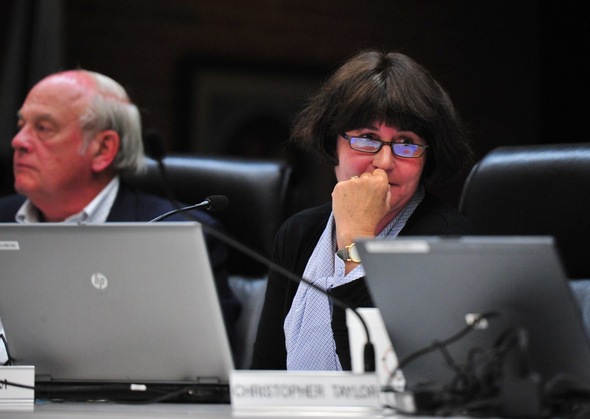
Ann Arbor City Council Member Jane Lumm, an Independent serving the 2nd Ward, said she fears the city isn't governed well these days. She looks back fondly on the 1990s when she served as a Republican under GOP Mayor Ingrid Sheldon and is critical of Democratic Mayor John Hieftje.
Ryan J. Stanton | AnnArbor.com
Monday night council meetings still last into the early morning hours sometimes, but Lumm, who recently returned to her seat after a 13-year hiatus, says things have changed.
"Now it seems as if debate isn't necessarily welcomed or encouraged," Lumm lamented in a recent interview with AnnArbor.com. "And particularly with positions like some of mine that are contrary to the views of the majority of council members."
After a little more than seven months back on council, Lumm has found little support for many of her proposals related to the city budget, public art, transit and safety services.
She's been on the losing side of 10-1 and 9-2 votes and characterized as a naysayer. On a number of occasions, the only people in her corner have been one or more of the council's three wild cards: Stephen Kunselman, Mike Anglin and Sabra Briere.
Lumm, who rocked the boat by taking on Democratic incumbent Stephen Rapundalo and beating him in November as an Independent, spoke candidly with AnnArbor.com about what it's like to be back at the council table, and being a minority voice going against the grain.
AnnArbor.com: What is it like being back on council after all these years? What do you think has changed between your time on council in the 1990s and now?
Lumm: I do think it's quite a bit different now. In the 1990s, council was often accused of bickering. There were Ann Arbor News editorials written about that. But I think that's because we did debate issues and alternative approaches publicly, often passionately, sometimes heatedly. But in the 1990s, all the information on an issue was provided to us in advance — the pros, the cons, alternative approaches, etc. It was easier then to engage on the front end and shape policy. And now we tend to receive a more completed product and I would say that alternatives are left to the imagination. So now it's more difficult to help shape policy.
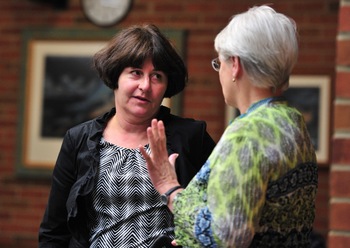
Lumm chats with Council Member Marcia Higgins, D-5th Ward, during a break in a recent council meeting.
Ryan J. Stanton | AnnArbor.com
And then there's been a significant shift in terms of what we're spending so much time focusing on. Most of the meetings since I've been back, there's an agenda topic related to transportation or the environment, whether it's AATA, pedestrian ordinances, idling ordinances, changing the configuration of streets to eliminate lanes for vehicles, stormwater mitigation proposals, the Greenbelt, train stations. Clearly that is a focus of the mayor and council and I think some other issues are not treated with the same degree of focus. When I was on council before, our primary focus seemed to have to do with housing and human services issues.
AnnArbor.com: Would you say council is more or less efficient now?
Lumm: I don't think it's good governance. Before there was more of an opportunity to get involved in things on the front end and to help shape policy. And when you come in on the back end and you can only amend things, you look like a bit of a naysayer and there are so many examples of this. I mean, I'm living it. It's just the way things are done now.
AnnArbor.com: Do you feel you're treated fairly as a minority voice on council? Do you feel your ideas are taken seriously by your colleagues or are you just getting stonewalled?
Lumm: You saw what happened with the budget. I think that there's nothing council does that's more important than setting priorities for city services. Through the budget, we establish priorities where we're going to be investing the taxpayers' money. And there wasn't a whole lot of back and forth on the budget, just at the meeting itself. Leading up to it, there was very little exchange between council members. The discussion side of it was certainly not robust and this is something I think we should be more proactive about.
AnnArbor.com: What proposals have you brought forward since being back on council that you wished had gotten through but were defeated?
Lumm: I brought forward the resolutions for police and fire. I asked for the magic number for police and fire because I wanted to know from the experts what was necessary for adequate levels of police and fire protection. So for police, I believe we should have started fiscal year 2013 on a three- to five-year plan to restore staffing to the chief's magic number. He said 150. At the time of the budget, that was 32 higher than the 118 we had. And I think with the addition of the one sworn officer, we're going to be at 119. The council didn't agree with me, so we added one, and I think the 30-year pace to the magic number is too slow.
AnnArbor.com: The police department fared positively in this budget compared to years past when the city was still cutting. Do you believe Ann Arbor is still a safe community? Does it have the best police department it can afford at the moment?
Lumm: Ann Arbor has a great police department and they do a great job with the staffing that we have. Can we do better? Absolutely. I'm not an expert, nor are my colleagues. That's why I asked the chief what his magic number is and he said 150 sworn officers, and we're at 119 today and I don't think that's adequate. It's all a matter of choices.
I agree with the principle that we shouldn't be adding expenditures that we don't support with recurring funding sources. And in my budget amendment, 83 percent of the funding offsets were permanently recurring, and 17 percent would have come from the rejection of the high-speed rail match, and that would be recurring for three-plus years.
AnnArbor.com: What about the fire department? What's your take on staffing levels over there and the proposed reorganization that would result in closing two fire stations?

The Ann Arbor Fire Department could see a net loss of two of its five stations soon if city officials go forward with a reorganization plan.
Ryan J. Stanton | AnnArbor.com
AnnArbor.com: You've continued to bring up for debate the issue of public art. Your colleagues have scoffed at you, rolled their eyes and argued it's an issue that's been debated and settled several times in the past. Why keep bringing it up?
Lumm: My budget amendment on public art was to temporarily suspend for fiscal year 2013 the transfers from water, sewer, stormwater and the street millage. That was a little over $300,000 when you add up all those dollar amounts. This goes back to 2007 when council first approved this earmark, and since then $2.2 million has been diverted.
So I think it's a simple question. Should a portion of the money the taxpayers are paying for these capital improvements for water and streets and sewer and solid waste be diverted from the projects themselves to public art? The issue isn't whether it's of value. We all agree it is. It's just how it should be paid for — public dollars versus other dollars. And I don't believe that public dollars — tax dollars or dollars from the water or sewer payments — should be used for this purpose, especially tax dollars from millages that are approved by voters who didn't contemplate this diversion. I mean, if the voters had a chance to weigh in on this diversion of funds, that would obviously be a different story, but they didn't.
There should be opportunities for private funding for public art and I see that as a largely untapped opportunity. I think if any community ought to be able to pay for a quality public art program privately and without public dollars, I think it would be Ann Arbor. So I'm sure these questions will continue to be raised and posed and you'll see the eyes roll.
AnnArbor.com: It's probably fair to say that you have an inquisitive mind. Observers of city politics have noticed you've made meetings last a little longer and I know you regularly fill the email inboxes of city staff with questions on a lot of issues. Some would argue you're trying to micromanage city departments. Others would say you're just asking the tough questions no one else is really asking. How do you see it? And are those efforts worthwhile?
Lumm: I do ask a fair amount of questions. I think I'm doing my job. If other council members asked similar questions, I would be more than OK with that. I know, like during the budget, someone came over to me and spoke to me about speaking too much and dragging out that meeting. But that's the most important thing we do, approve the city budget. But I do submit questions for each council agenda. That's something I did in the '90s. I just see it as part of doing my job. I'm actually surprised that other council members don't because, when I was on council before, that was something we all did. I also want to give staff a heads up about what my concerns are, so I always submit my questions in advance, and I will continue to do that.
AnnArbor.com: What are your priorities on council for the next year? I know you have a couple of budget-related issues you're still hoping to address.
Lumm: I think the city needs to transition from its defined benefit retirement plan to a defined contribution plan, and my resolution that I'll be bringing forward is to target placing newly hired nonunion employees on that plan effective in July 2013. And why is this important? Most employers have transitioned from defined benefit to defined contribution 401(k) sorts of plans. And with defined contribution plans, the costs to employers are lower, they're more predictable and sustainable, and the employer doesn't bear the financial risk.
And then in terms of the budget process, I'd like the budget committee to be a more robust group and to look at what has been happening over the last however many years where the city has essentially established these across-the-board targets for activities in the general fund. I just think we need to be more strategic about this and I think now is the right time.
And then I've been thinking about introducing nonpartisan elections and perhaps bringing forward, with some other council members, language to tighten up the city charter that speaks to parkland and when a voter referendum is required for repurposing of city parkland.
AnnArbor.com: Where would you say you stand right now on the vision for expanded public transit services in Washtenaw County?
Lumm: Expanded transit is a positive, but it's more a question of how and when. I think we can achieve expanded transit in a number of ways and the simplest, least-risky approach is for the out-county entities to adopt purchase-of-service agreements under the existing Act 55 authority (AATA). And it's far riskier to move to the new countywide authority under Act 196, and of course that's the path we're headed down. Equity for Ann Arbor taxpayers has been my primary guiding principle. Under any funding mechanism that anyone could envision under the new transit authority, Ann Arbor provides a majority share of the local funding and it doesn't have a majority control of the governing board. We've got seven of the 15 seats. I think there should be proportional representation based on local funding share.
AnnArbor.com: And what about a new train station?
Lumm: Of course I didn't vote for accepting the $2.8 million federal grant or putting forward the additional $196,000, even though that's not local tax dollars, because I was not convinced we would be getting a clean sheet look at the alternatives. I support upgrading the existing station and I'm not convinced that's going to be looked at in a clean sheet approach. I contacted Dearborn to find out how their system works, because the mayor has referred to the Dearborn train station, and basically theirs was built with $28.2 million in surplus money, and I found out also their operating costs are covered by federal dollars for the next 20 years.
AnnArbor.com: And you're afraid that our train station would not be fully covered by federal dollars? That we'd be pumping a lot of local dollars into it?
Lumm: I think we'd have to because right now the latest legislation that prevailed in Congress has no money set aside for this. There's a big fat zero. That takes a crystal ball that I don't have, but I think it would certainly require an infusion of local dollars.
AnnArbor.com: Give me the broader picture. How do you see the dynamics on council changing and what could this election year mean?
Lumm: It could change in a fairly significant way. We have two incumbents who are not running for re-election. I am more familiar with Sumi Kailasapathy who is running in the 1st Ward and Vivienne Armentrout in the 5th Ward. I have known them for a few years and I think you would just in general see more discussion at the council table with them, which would be great. I think they'd be great additions. I really do.
Ryan J. Stanton covers government and politics for AnnArbor.com. Reach him at ryanstanton@annarbor.com or 734-623-2529. You also can follow him on Twitter or subscribe to AnnArbor.com's email newsletters.
Comments
Tom Wieder
Wed, Jun 27, 2012 : 11:09 p.m.
I think this was a great interview! I think both Jane and Ryan are doing an excellent job in their respective positions. I worked on Jane's campaign - first time ever for a non-Democrat - and continue to be proud of having done so. And Ryan is as good a government/politics reporter as I've seen in the 43 years I've been in A2. Ryan's questions were good, and so were Jane's answers.
Kai Petainen
Wed, Jun 27, 2012 : 10:11 p.m.
This is a great interview... it comes across as a great honest, candid discussion. Whether I agree with her or not, this is a great interview, and it would be great if other council members did something similar.
justiceforeach
Wed, Jun 27, 2012 : 10:03 p.m.
I would like to add my voice to the chorus of support for Jane Lumm and any other like - minded individuals! JANE, you are invaluable and SO APPRECIATED in your efforts in doing the work of the people - WE THANK - YOU! You are asking the difficult, unpopular questions. Poor decisions have been made and large amounts of money have been wasted due to lack of a concerted group of insightful, like-minded (yes - sometimes oppositional) voices asking the difficult and unpopular questions of those for whom business as usual is uncomfortably comfortable. I would also encourage the Ann Arbor News to ask the hard, difficult questions so that the perception of the Ann Arbor.com is one of an all-seeing hawk keeping an eye on things. Jane is doing the work of the people with her work on Council. The Ann Arbor News/.com should join her in her efforts to convey the feeling of someone in the people's corner demanding and providing disinfecting sunlight on all things Ann Arbor. Go Jane! and go follow the leader, Ann Arbor.com!
Peter Nagourney
Wed, Jun 27, 2012 : 9:07 p.m.
What is the purpose of Ryan Stanton writing "the council's three wild cards: Stephen Kunselman, Mike Anglin and Sabra Briere"? Is this objective reporting? If Jane and these council members are wild cards does that mean the other council members aren't playing with a full deck?
Michigander74
Wed, Jun 27, 2012 : 8:51 p.m.
I would like to know how she maintains her composure at those meetings. It must be very difficult to be smart and responsible in those meetings.
Greg
Wed, Jun 27, 2012 : 7:24 p.m.
Sure, the current pleasant group that run things do not want any real debate. Why would they. Keep it up Lumm and make them work for their spending on art when neccessary functions are underfunded and more. Go girl...
Swordsman
Wed, Jun 27, 2012 : 6:38 p.m.
Nice job, Jane.
Diogenes
Wed, Jun 27, 2012 : 4:45 p.m.
At long last a small bit of light is being shed on the astonishing ways of City Council. After the revelations of scripting and vote arranging in the Council emails a few years ago, I had hoped that AA.com would have paid some attention to how they are doing their business. Did anyone really think that the supermajority would fundamentally change it's ways just because Greden and Easthope left? We've had a democracy that leans in the direction of the Soviet style for at least a decade now. It's no wonder that the city is managed for the benefit of the University and developers, as this is where the money is.
RUKiddingMe
Wed, Jun 27, 2012 : 4:37 p.m.
The fact that meetings last a little longer can almost be taken as proof that Ms. Lumm's is adding benefit to the people; we need less of the "all in favor of new taxes and higher rates? Aye, Aye, Aye, Aye" meetings and more of the "so wait, you want to spend $200,000 paying a company to send surveys to people to find out if they like the quality of our water? How about we use the money to replace a couple leaking mains?" meetings. Ms. Lumm, please, PLEASE stand fast; it seems useless and frustrating to be one of the only voices of reason ina room full of entrenched incompetence and/or corruption, but it will apparently be resolved with baby steps; we finally managed to get YOU in there, maybe next election we'll get someone ELSE in there, and eventually we'll have at least a half and half thing going on. It's important to stay the course when we make even a little bit of progress.
Alan Goldsmith
Wed, Jun 27, 2012 : 3:48 p.m.
Peter. Take the campaign of Eric Sturgis for example. You think if someone running opposed to the Mayor for a Council seat had potential voter registrations issues, had made false statements about his education record during a debate and didn't even know enough to print his campaign financial notification info on his website wouldn't have had their picture pasted all over our local Newhouse Family owed media outlet for the last few days, you would be dreaming. Somehow, if you are supported by the Council Party and the Mayor, these issues fall through the cracks and fail to get media attention. That, the fact the Mayor gets softballs questions AND this interview with Ms. Lumm, when taken as a whole, paint a very clear picture of what sort of journalist Mr. Stanton is.
Arborcomment
Thu, Jun 28, 2012 : 12:17 a.m.
Thanks Alan, (via Kyle) I was wondering there for a while that perhaps the "vote down" button was broke. Kyle demonstrated it is still operational.
Alan Goldsmith
Wed, Jun 27, 2012 : 4:31 p.m.
Perhaps AnnArbor.com will address my and other readers' concerns in the near future.
Kyle Mattson
Wed, Jun 27, 2012 : 4:27 p.m.
Alan- We understand your position on the interview after your many comments here, and ask that further comments be directed through more effective channels by contacting our editorial staff by phone or email. Site commentary is offered as a feature to build constructive discussion surrounding our coverage and we request readers to keep their focus on the topic at hand. Thank you for your understanding.
Alan Goldsmith
Wed, Jun 27, 2012 : 3:37 p.m.
Peter: This issue is not crossing the line, but the fact he somehow never 'crosses the line' when it comes to asking tough, probing questions of the Mayor, SPARK or anyone in power. His questions to those officials are usually timid, rarely cutting and usually are never following up. And I don't remember there being a mention of 'others are rolling their eyes' line. His reporting is weak, timid and overly respectful. The only time he's a tough guy is when he's repeating bullet points from the Mayor and Council Party to someone who has an opposing view. If he treated everyone the same, his questions here would not be an issue. But apparently he's unable to do that.
lou glorie
Wed, Jun 27, 2012 : 3:26 p.m.
Lumm could write a text book on how to be a city council REPRESENTATIVE. She's clearly dedicated to representing the interests of her fellow second warders and Ann Arbor citizens in general benefit from her diligence. Thanks Jane from the rest of us.
Jim Walker
Wed, Jun 27, 2012 : 3:18 p.m.
Jane Lumm has been a refreshing addition to the Council. If we could get five more like her, the changes to the way the city is managed would be clear and positive. Jim Walker, National Motorists Association, Ann Arbor, MI
Peter Eckstein
Wed, Jun 27, 2012 : 2:58 p.m.
There is a lot of wisdom in Jane Lumm's answers to Ryan Stanton's questions. It was a good interview and allowed Jane to make her case well. A good reporter will raise criticisms that have been made when interviewing an officeholder. This gives the interviewee a chance to answer those criticisms, which Jane did well. Or fail to answer them, which is not what Jane did. What would be objectionable would be a refusal to let the interviewee be heard--or arguing back at the answers. I do not believe Ryan crossed this line. I hope Ryan's critics will remember some of the interviews conducted by the now-sainted Tim Russert and his successor on Meet the Press, David Gregory. They crossed the line often, but I don't think Ryan did.
Patricia Lesko
Wed, Jun 27, 2012 : 2:15 p.m.
Councilmember Lumm's answers to these loaded (and sometimes outright disrespectful) questions were honest and a breath of fresh air in a room full of stale spin and think smoke used to hide information from Council members and the public. What she is saying, quite clearly, is that Council members were mostly incurious about spending $390M in budgeted dollars, don 't get information readily from staff and the Mayor's office. She also makes quite clear that discussions are discouraged. Stanton, shockingly, phrases a question which makes clear Council members are (again) acting like Middle Schoolers, as if Lumm and her pesky darn questions are the problems. Ward 1, in which I live, in extraordinarily lucky to have Ward 2 Council member Jane Lumm representing our best interests.
EyeHeartA2
Wed, Jun 27, 2012 : 1:57 p.m.
Jane seems to be a clear thinker. I'm left wondering why she doesn't seem to be getting on with the rest of the city council? Oh, wait, never mind.
Albert Howard
Wed, Jun 27, 2012 : 1:54 p.m.
feng shui- it might be helpful if the board would put down the laptops and make an effort to give each other eye contact. You notice the disconnect, division and distractions upon entering the room. Mayor John Hieftje's major distraction is the multi billion dollar corporation University of Michigan. Hieftje has been mayor for 12 years. How come we have never heard a formal complaint from the University of Michigan about John Hieftje? How come the mayor's office has never issued a formal complaint against the University of Michigan? But the facade is we have a perfect business relationship. Why is it that every week people complain about the mayor and city council during public comments? When will the mayor get back our tax revenue lost from Pfizer etc. from buildings that the University of Michigan has purchased? One solution that has been successfully implemented around the US, benifitting cash-strapped communities, is Payment in Lieu of Taxes assessed against entities that are listed as being not-for-profit, despite that they generate revenue. I like Jane Lumm's power comments: "The mayor's office is a bit of a clearing house now." "And then I've been thinking about introducing nonpartisan elections..." "When I was on council before, our primary focus seemed to have to do with housing and human services issues". Ann Arbor, Michigan should be a local 'government of the people, by the people and for the people'.
Sparty
Thu, Jun 28, 2012 : 3:42 a.m.
The State is responsible, by law, for funding fire protection services for public universities. Two, public universities are exempt from State and local taxes per the Michigan Constitution. Three, the former Pfizer property sat mpty for over a year, incurring costs and physically decaying, without any outside interested buyers. The State nd Pfizer stopped in and bogged UM to repurchase the property at a discount to redevelop it. By the end of the year, approximately 1,700 employees of the UM and 20 private businesses will work there. Jobs, income, taxes, money flowing through the economy.
talker
Wed, Jun 27, 2012 : 10:04 p.m.
Payments in lieu of taxes would be welcomed ways to bolster fire and police protection. I realize the U. of M. has some safety officers, I've never heard of a U. of M. fire department. Even the north campus fire station is actually part of the Ann Arbor Fire Department. Is the U. of M. paying enough, especially since U. of M. students are among the people who live on high floors and the trend to building up for students has increased.
Stephen Landes
Wed, Jun 27, 2012 : 1:10 p.m.
Jane Lumm: Well Done! You're doing what we in the Second Ward asked you to do: represent all of us at the Council table. We'll do our best to send help to you in the next election.
Brad
Wed, Jun 27, 2012 : 12:45 p.m.
With any luck we'll get you some company in November, Ms. Lumm. We've had enough of the current bunch. Just keep saying "nay" as appropriate until then. And Ms. Lumm continues to understand the "public art" issue better than the other council members. The money is being improperly diverted, and they all know it. They just don't want to admit it or do anything about it, because they are the "deciders" and they know better than us. And by now we all know how those "deciders" work out.
Alan Goldsmith
Wed, Jun 27, 2012 : 12:20 p.m.
The question bias in this article is not the main issue. Failing to have any courage and guts to ask the same type of questions to other political leaders in power (the Mayor, County Commissioners, others on City Council) is the problem. The promise of real journalism when AnnArbor.com was launched just wasn't fulfilled. I'll let others decide it's never happened. I won't pretend to read Mr. Stanton's mind and guess his motivations. But it's not journalism.
lou glorie
Wed, Jun 27, 2012 : 3:38 p.m.
It gets back to the psychology of bullies--who can never summon the courage to pick on someone bigger, better armed. They only have the minerals to go after someone they perceive to be powerless. Sometimes they're surprised. Little Jane is courageous and has wit enough to not take the bait. I would wish for Ann Arbor a more council reps like her and a pack of journalists who were not stricken with pusillanimity.
golfer
Wed, Jun 27, 2012 : 11:46 a.m.
i like her a lot. wish we had more of her on the board. remember at voting time.
yohan
Wed, Jun 27, 2012 : 11:37 a.m.
I agree with the above comments that in effect say the biased questions given by the reporter are nothing but disgusting. I congratulate Jane on not losing her cool under such a bigoted attempt at reporting
a2grateful
Wed, Jun 27, 2012 : 11:18 a.m.
"Observers of city politics have noticed you've made meetings last a little longer and I know you regularly fill the email inboxes of city staff with questions on a lot of issues. Some would argue you're trying to micromanage city departments." Suppose that Lumm is not micromanaging. Suppose that the current power structure IS micromanaging, pushing its agenda on staff, against their professionalism. Then, perhaps Lumm's struggle is against the "self-serving, micromanaging current." Imagine that Lumm's fact finding allows formulation of independent, intelligent understanding. Then imagine that Lumm is attempting to serve her constituents in a genuine, honest manner. My, what an agenda: Serving constituency vs serving hidden, pet project interests. We could use more representatives like Lumm, that do not follow the party line. Thank you Ms Lumm!
Stephen Lange Ranzini
Wed, Jun 27, 2012 : 11:10 a.m.
I would support a city charter amendment to make our city elections non-partisan. The current system where everyone must be a "Democrat" or "DINO" to get elected (except Jane Lumm) is producing many bad results. Of all the municipalities in Michigan only three: Ann Arbor, Ypsilanti and Ionia, have partisan elections. Anyone who is interested in working on this issue please contact me at ranzini@university-bank.com and if enough people are interested, perhaps we can form a committee to work on putting this on the ballot.
annarboral
Wed, Jun 27, 2012 : 1:24 p.m.
I need more information on how switching to "non-partisan" would have an impact. Seems like the same people would still get elected. Also, I live in Pittsfield Township. I'm interested.
Alan Goldsmith
Wed, Jun 27, 2012 : 10:55 a.m.
"Observers of city politics have noticed you've made meetings last a little longer and I know you regularly fill the email inboxes of city staff with questions on a lot of issues. Some would argue you're trying to micromanage city departments." Ok I have nothing else here. It's called DEMOCRACY Ryan. Get a clue!
say it plain
Wed, Jun 27, 2012 : 12:03 p.m.
Yes, and democracy, history shows, benefits greatly from a real press... and suffers when we have this sort of poor substitute...
mixmaster
Wed, Jun 27, 2012 : 11:33 a.m.
It's because the majority of council follow the Mayor like sheep.
Pickforddick
Wed, Jun 27, 2012 : 11:09 a.m.
Ryan is way out in left field and it is very evident.
Alan Goldsmith
Wed, Jun 27, 2012 : 10:53 a.m.
"You've continued to bring up for debate the issue of public art. Your colleagues have scoffed at you, rolled their eyes..." Attention AnnArbor.com. Can we get a reporter with a LITTLE less bias? Speaking of nutshells, this reflects why the reporting from your little Newhouse blog doesn't get any repsect. You ask these direct questions of someone on Council who's on the Mayor's 'oh she's a trouble maker list' but seem to lack the same sort of guts when it comes to the Mayor and Council Party (i.e. no bid contracts, conflicts of interest, his fear of appointing contrasting voices on City boards and commissions, his arrogance at Council meetings, etc.). Can someone please explain why that is?
Alan Goldsmith
Wed, Jun 27, 2012 : 10:49 a.m.
"The police department fared positively in this budget compared to years past when the city was still cutting. Do you believe Ann Arbor is still a safe community? Does it have the best police department it can afford at the moment?" Spoken like a true surrogate for The Mayor. Good job Ryan!
Alan Goldsmith
Wed, Jun 27, 2012 : 10:47 a.m.
"I think Mayor Sheldon led from a perspective that she was one of 11 and she erred on the side of inclusion and sharing information with everyone in advance. And Mayor Hieftje's style, I think, is different." Therein lies the problem in a nutshell.
Chip Reed
Wed, Jun 27, 2012 : 10:29 a.m.
I miss Ingrid Shelton. It's too bad the current version of the Republican party in our country isn't more like her.
Linda Peck
Wed, Jun 27, 2012 : 10:28 a.m.
I appreciate Jane Lumm and what she brings to the City Council. We definitely need her now! I appreciate her ideas in fire and police issues, and also the budget and the infamous art question. I agree with her on all points she brings forth and would support her in a bid for the big job of Mayor if she wanted it. I also like her idea to bring nonpartisan voting to the table. The time has come.