

City Council challengers say they're worried Ann Arbor's quality of life is declining
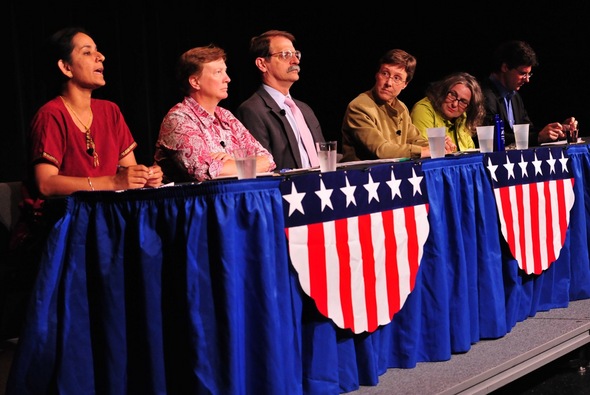
Three challengers seeking seats on the Ann Arbor City Council said this week they disagree with the direction the city is headed and want to reprioritize spending on basic services like police, fire, parks and roads.
Ryan J. Stanton | AnnArbor.com
Three challengers seeking election to the Ann Arbor City Council went head-to-head with the incumbents in a debate this week, saying the quality of life in Ann Arbor is starting to slip.
"Ann Arbor is great, but it sure is declining," said Sumi Kailasapathy, an accountant who is running against incumbent Sandi Smith in the 1st Ward. "And if we let this trend continue, businesses aren't going to come here."

Jack Eaton
Jack Eaton, an attorney challenging incumbent Margie Teall in the 4th Ward, agreed.
"What the government needs to do is make sure that employers who are attracted to Ann Arbor are not repelled by our horrible roads, our crumbling bridges, our reduced safety services, or our shabby looking parks," he said.
"We need also leadership that doesn't make us pay more for fewer services," he said. "Just a few years ago, we passed a solid waste millage. Now we're going to receive less service paying more taxes. For example, we'll no longer have the curbside leaf pickup."
Lou Glorie, a real estate agent who is seeking the 5th Ward seat held by Carsten Hohnke, said one problem is a lot of "pork" in the city budget. She said the city's current leadership is guilty of "betrayal of the trust of the people."
"This is why the citizens of this town have to take over," she said. "We have to say this kind of work is not just the work of politicians. We have to be involved in re-centering our government on us."
Kailasapathy, Eaton and Glorie are running as part of an unofficial slate alongside mayoral candidate Patricia Lesko. Together, they hope to overthrow the current council majority in the Aug. 3 Democratic primary election and take control of city hall.

Sumi Kailasapathy
Mayor John Hieftje is defending his seat along with Smith, Teall and Hohnke. They argue the city is making strides and doing relatively well considering the economy is in the doldrums.
"I have worked to tighten our city's budget year after year," Teall said. "We have reduced the size of our government by 25 percent since I have been on council, but we are still able to provide the core city services that our city residents rely on and to invest in critical infrastructure without having raised taxes."
But the challengers say the fact that the city has cut employee counts by 25 percent this past decade, while costs have not gone down, is cause for concern. They cited deep cuts to police, fire and parks.
"In the years just prior to the 2008 budget, our spending increased dramatically," Eaton said. "In those same years, we were cutting police and fire staffing. When the budget became tight, we went back and we cut police and fire staffing some more. I believe that we need to revisit those areas of the budget that grew during that expansive period and determine where we can cut other than in police and fire or parks."
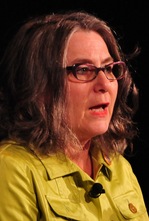
Lou Glorie
Kailasapathy cited figures that the fire department has been cut back from 122 to 90 employees since 2000, while the police department was reduced from 235 to 152. She also said the number of parks employees has dropped from 78 to 17, while the city administrator's office "tripled in size."
Kailasapathy's depiction of what has happened in police and fire is accurate, city officials say, but what's happened in other areas requires some clarification. City officials told AnnArbor.com that, through a restructuring several years ago, parks employees were split up and are now counted in multiple categories, including parks and recreation, park operations and forestry — so it's hard to make an apples-to-apples comparison today.
Teall refuted Kailasapathy's assertion that the city administrator's office staffing has tripled in size. She said the only reason it might appear that way on paper is because, again, the structure of who employees report to has changed.
"We have been cutting," Teall said. "We've been cutting for at least eight years, perhaps 10 years, and the city government has been restructured."
Glorie said residents she talks with are concerned.

Carsten Hohnke
"I hear about their worries and I share them as well," she said. "We see our government spending money, borrowing money for projects that we consider nonessential, while critical infrastructure like the Stadium bridge crumbles."
Kailasapathy said the city should be worried about its millions of dollars in unfunded pension liabilities.
"This is I think the most pressing issue that is facing the city government right now," she said. "We really need to renegotiate with the unions in honesty."
She also cited growing debt from projects like the police-courts building. AnnArbor.com recently reported that city debt rose more than 25 percent over three years, from $167.2 million in June 2006 to $209.9 million in June 2009
City records show the city's governmental activities spending also has increased from $96.9 million to $130.2 million from 2006 to 2009. That includes all of the city’s basic services like police, fire, public works, and general administration.
Records show a large portion of that increase happened between 2008 and 2009. About $9.9 million was due primarily to an increase in construction costs for the new police-courts building and for early retirement buyouts in the police department. And expenses for public safety increased by about $9.4 million due to increased wages and benefits and increased fleet costs.

Margie Teall
Hohnke said the city must continue to find ways to manage the cost side of the budget, which can be done by continuing to leverage technology and through regional collaboration with Washtenaw County and other municipalities.
Hohnke, who is still in his first term on council, said the city has accomplished a lot in the past two years.
"I'm particularly proud of the successful efforts that I've been able to lead with members of the community in rolling up our sleeves and providing real impacting solutions to problems on the ground in our neighborhood," he said. "Whether it's keeping Mack Pool open or the West Side Farmer's Market, whether it's securing county and city support for adding an Ann Arbor Skatepark to our recreational system, or improving the walking and biking infrastructure in our community, or expanding our recycling system to add plastics."
Smith, also in her first term, said as a small business owner, she knows firsthand how to trim excess fat from an operation. She said she also is a creative problem-solver and has found ways to make ideas work.
"I've accomplished many things, such as doubling the occupancy of the emergency shelter system last winter," she said. "I stopped the staff proposal to put parking meters in 1st Ward residential areas, I cut through red tape to bring a residential parking program to near-downtown neighborhoods, and I supported the expansion of our recycling system, saving the city $650,000 a year."

Sandi Smith
Hohnke said the city has taken steps to make it easier for downtown merchants to do business. For example, the council recently changed regulations to allow merchants to use sidewalk sandwich board signs to advertise their businesses. The council also halted loading zone changes that were unpopular.
Smith said attracting more businesses and expanding the tax base will help improve the city's bottom line. She said that's partly why she supported Heritage Row, a project that the challengers were glad to see defeated recently by council.
Smith said the project was going to add $250,000 to the tax rolls, and that's something that should be seriously considered.
"My opponent and her colleagues on the slate seem to oppose change, but change is inevitable," Smith said. "Ann Arbor does not look the same as it did when I got here. It doesn't look the same as it did 20 years ago and it doesn't look the same as it did 10 years ago. Change should be seen as an opportunity."
Ryan J. Stanton covers government and politics for AnnArbor.com. Reach him at ryanstanton@annarbor.com or 734-623-2529.
Comments
Otho
Wed, Jul 21, 2010 : 10:45 a.m.
@David Cahill: Yes, I know this. That is why I asked for a Ward 1 candidate who wants to /REMOVE/ the dam. The dam should go.
David Cahill
Sun, Jul 18, 2010 : 9:31 a.m.
Otho, both First Ward candidates want to keep the dam in.
Lisa
Sat, Jul 17, 2010 : 6:52 p.m.
@Bob "The quality of life seems fine." Sure, it is still very good, but all the trends are going the wrong way. Four years ago in their initial ranking the statistics at CNN/Money said we were the #24 city, two years ago we were #42, now we are #46. Were we in the top ten 10 years ago when Mayor Sheldon left office? After the cuts that are coming (or big tax increases - I hope not since my family can't afford any more money taxes) when the city runs out of money will we even be in the top 100? We are already above the average top 100 city for crime. For those people who are unemployed or who are losing their home, the quality of life isn't so great. When I walk around downtown I see and have the privilege of talking to lots of homeless people and pan handlers. Maybe you think that way because you have one of those high paying Ann Arbor city government jobs??
Otho
Sat, Jul 17, 2010 : 5:04 p.m.
I realize maybe this is low priority for many but how come nobody is talking about Argo Dam? I live directly across Main Street from the dam and I firmly believe it is in our best interests to remove it, mainly for environmental and personal health reasons. Where is my Ward 1 candidate who wants to REMOVE the dam?
Bob
Sat, Jul 17, 2010 : 10:46 a.m.
The quality of life seems fine. The quality of blogging, however, now that's something we should probably be concerned with...
Trepang674
Fri, Jul 16, 2010 : 8:54 p.m.
So the city will expect my neighbors to sweep the gutters and stuff it all in thier 94 gal rolling recycle bin. I think this kind of thinking is certainly an issue of paying taxes and getting services cut. It might be a good ideal, but in the NW AA we'll have huge drainage issues..garenteed.
AlphaAlpha
Fri, Jul 16, 2010 : 7:39 p.m.
Thank you stunhsif. Very much. Persist...succeed. Thank you Mr. Cahill for posting the skyrocketing city spending numbers. Up over 34% in four years is huge. And most is for labor... Mr. Ranzini, you are so right about the looming pension crisis. It is a shame most voters have no idea about it. They will, and soon. There is no way we can pay the enormous benefits to which our misleaders have committed us; the benefits must be cut, and the sooner the better, to give the workers extra time to try to adjust. Good luck to you.
AlphaAlpha
Fri, Jul 16, 2010 : 7:24 p.m.
Edward is very good at selective quoting. This selective quote: ""Compensation cost levels in State and local government should not be directly compared with levels in private industry..." relates to the fact that the mix of government occupations is different than the mix of civilian occupations, not that comparisons among similar occupations should not be made. Clearly, there are few manufacturing jobs per se within the government, though many many no doubt believe they do manufacture...something. Regardless, when comparing similar occupations, let's say teachers, we soon discover that each teacher in A2 is 'costing' the taxpayers an average of $102,000 this year in total compensation, er, cost, a level much much higher than the national average. So, while the mix of jobs is not identical, within the mix, there are many identical jobs, and the government workers are generally quite overpaid, almost without exception. There can be little doubt Edward is, was, or is directly related to, a civil employee, and he is behaving in a predictable fashion with respect to the compensation facts: deny, obfuscate, attempt to discredit. It's OK; at least 766 locals are bound to feel the same way. Edward's bigger concern is probably: how do the other 100.000+ locals feel? It is heartening to see the many responses supportive of fiscal sanity. "Median annual wages of kindergarten, elementary, middle, and secondary school teachers ranged from $47,100 to $51,180 in May 2008; the lowest 10 percent earned $30,970 to $34,280; the top 10 percent earned $75,190 to $80,970."
julieswhimsies
Fri, Jul 16, 2010 : 2:51 p.m.
Of course Ann Arbor is struggling, as are all the surrounding communities. We are in a recession.
Vivienne Armentrout
Fri, Jul 16, 2010 : 2:33 p.m.
Was the debate televised, and is there a repeat schedule?
speerhawk
Fri, Jul 16, 2010 : 1:37 p.m.
Yes Ann Arbor FD says they have 6500 calls per year but how many are actual Fire Fighting calls. Since Troy has a 35.5 square miles to deal with and ann arbor has roughly 28 square miles well you do the math. 250 responses to actual fires in 2009 the most of the rest were medical which were dealt with by various paramedics mainly HVA http://annarborchronicle.com/2010/01/02/starting-the-year-with-fire-and-ambulance/.
LiberalNIMBY
Fri, Jul 16, 2010 : 1:09 p.m.
Did anyone else see this gem hidden among the hot air? "...Expanding the tax base will help improve the city's bottom line." It's about time that councilmembers start being aggressive on us taxpayers' behalf. We CANNOT manage the recession only by cutting costs -- we must seize creative opportunities to increase revenue. It's so disappointing that only Sandi Smith realizes the impact of turning away investment in our community. Agree or disagree with her votes, but give Smith credit for looking at the other (and arguably, the most easily changed) half of the crisis.
Lokalisierung
Fri, Jul 16, 2010 : 12:42 p.m.
"They run 500 total calls per year. AA has around 6500 fire runs per year." Just adding, the difference is most likely the fact that Their FF do not work as first responders, so they aren't drawn to medical calls liek AA are.
AACity12
Fri, Jul 16, 2010 : 12:37 p.m.
Well you maybe able to pull up charts and compare pay but what has happend is that Fraser has come through and said, "ok we are laying off the people that did this job and that job, so we are going to need you to do all their work now too. BUT we will pay you more." Then he comes out to the public and says, "Look I cut the workforce way back!" But in the end there is no savings. They just laid off 3 firefighters but are pay overtime to fill their spots. NO SAVINGS! He just ruined the lives of 3 people just so he can say to you, well we cut three positions, even though it does not save a penny. @speerhawk - That system works great in Troy. Did you read that whole page? Check the Run Statitics. They run 500 total calls per year. AA has around 6500 fire runs per year.
HaeJee
Fri, Jul 16, 2010 : 11:41 a.m.
If the new candidates support Lesko, that is reason enough NOT to support them. Ann Arbor is not declining anymore than any other popular or wealthy city. I read in a past article that these candidates opposed more parking downtown due to the decrease of population in Ann Arbor. The was a true sign that these individuals were out of touch of what is needed. Regardless if the population is decreasing (not by much), many people from out of the city come to downtown on a daily basis to eat and walk around. The parks are nice in Ann Arbor, but they are not the draw from people out of the city to bring business in. How can you compete with the State or Metroparks? People come to Ann Arbor for business, culture, food, and entertainment. I love Ann Arbor and feel that it is the best city in Michigan to live in. I wouldnt vote for the city council challenger or Lesko due to their negative outlook on the city and everything related.
Top Cat
Fri, Jul 16, 2010 : 10:39 a.m.
And after all is said and done, I will bet that all the incumbents for Mayor and City Council are reelected.
speerhawk
Fri, Jul 16, 2010 : 10:17 a.m.
Just take a look at what Troy Does with there FD http://troymi.gov/faq/Fire.asp#q1 and they seem to to just fine
PittsfieldTwp
Fri, Jul 16, 2010 : 9:43 a.m.
Take a drive through the towns in the Western part of the state. Holland for example, has arguably been hit worse than AA with economic conditions, but the city is still clean and neat. They somehow are able to at least mow the medians and easements so that the city looks like a place where you want to be. If a person is looking for work, they usually have some means of presenting themselves neatly when looking for jobs despite lack of funds. AA needs to do the same. The first impression views from State St off of I-94 and Washtenaw off of Hwy 23 look as if someone is letting it go and no longer cares.
David Cahill
Fri, Jul 16, 2010 : 9:01 a.m.
The increase in governmental activities expenses is not just due to some one-shots, but is a steady trend. Here are the figures for each fiscal year, 2006 through 2009, from the city's comprehensive annual financial reports, available online: 2006 96,870,412 2007 97,548,949 2008 111,655,402 2009 130,177,876
Alfie
Fri, Jul 16, 2010 : 8:25 a.m.
Kailasapathy, Eaton and Glorie are strong supporters of Lesko, that alone should give anyone a warning sign of their thinking. They are reactionary, mis-informed and not afraid to distort the facts. They are extreme in their anti-development views. The conspiracy theories thrown out by this group are just anti-productive. Can they offer any solutions besides restoring Police and Fire positions? Have they even looked at other department's budgets? Have they looked at other departmental cuts over the years? Having seen Eaton in action at meetings he has much the same approach as Lesko, he would be a disaster on Council.
stunhsif
Fri, Jul 16, 2010 : 7:38 a.m.
@AlphaAlpha, sad to see the name calling toward you "simpleton" coming from one who says that "compensation costs levels in state and local government should not be directly compared to private industry"? What, why not? We in the private sector pay the wages and benefit packages that public sector workers enjoy. Are they not accountable to the taxpayer? Talk about dissembling and side stepping. Good Day
Stephen Lange Ranzini
Fri, Jul 16, 2010 : 7:24 a.m.
I am very pleased that finally at least one of the candidates for public office in Ann Arbor has mentioned the looming fiscal disaster posed by the fact that our City of Ann Arbor pension fund and retirement health care fund (Veba Trust) combined deficit as of June 30, 2009 had increased to $190 million, an increase in the deficit of $75 million in the 12 months to June 30, 2009. However, to win my vote, I require not just that a candidate understands that we are in trouble but a detailed description of what they plan to do about it! Be specific please! For those of you not yet aware of this problem, here are the background details: To put $190 million in context, the proposed city income tax would raise $9 million per year and would be insufficient to close the $190 million deficit. All of the city's (very high) property taxes raised a total of $70 million in 2009. Details on the deficits and links to the source documents are available at: http://www.annarbor.com/news/ann-arbor-deputy-police-chiefs-union-first-bargaining-unit-to-meet-citys-requests-for-concessions/index.php#comment-116840 The giant hole in the city's pension and healthcare retirement funds can be plugged only by increasing taxes (which is a very bad option in the current environment and would likely cause further problems and more job losses in the area) or by reducing benefits, reducing other spending or substantially increasing the annual contribution of cash from the city's coffers from some other source. I dont think the problem can be solved if we stay on the same policy path that were on and if changes of some type arent made, the city faces financial ruin.
westsider
Fri, Jul 16, 2010 : 7:13 a.m.
I have to compliment Teal and Smith for their work on Council. They are thoughtful in their analysis of issues and from what I see, working for creative solutions to allow Ann Arbor to evolve as successful Cities must everywhere. Tough to do in these economic times and the political climate we are faced with here but they are doing a great job. Keep up the good work!
Mr. Tibbs
Fri, Jul 16, 2010 : 5:36 a.m.
of course businesses are not going to come to a place so tolerant that people don't have to work for thier money as long as they feel good about themselves. if I were a business owner, you would earn your pay. you would not tell me "that's not my job" if I were a business owner, I wouldn't bring my money to a place that requires me to hire along the quotas regardless of who is qualified and who is not. If I were a business owner I would be taking my money to a place where people have ethics taught to them, not that they are owed something. If I were a business owner I would most certainly stay away from a place that is so full of NIMBY's even after the fact, as in the airport "nieghbors" who were dumb enough to gamble thier money by purchasing a home right at the end of a runway, and actually have the stupidity to hang thier ignorance out for all to see by making thier complaints public? Gee let me just show the world I was dumb enough to buy swamp land AND the Mackinac Bridge. If these are the people who live here, why would I bring my money and invest it in a place so brainless, so gullible, and with such a narrow focus that as long as it allows them to remain "blissful" they will accept antyhing else for anyone else, as long as thier little world isn't disrupted.... that sounds an awful lot like fashionable facism to me.
Speechless
Thu, Jul 15, 2010 : 9:27 p.m.
The August primary season has reached the point where I can now begin to recite each campaign slate's basic talking points in my sleep. An aspect of the debate over rising city costs is that it provides a means to refight the decision to finance the mostly-complete city hall addition. That can show one meaningful way in which city debt shot up just before the local economy went down. Pointing this out, though, won't help much for 2011-12. Let's do nuts & bolts. Each campaign slate can be very helpful to us, should they desire, by presenting draft ideas (with numbers) for specific changes to the next city budget. Tell us where we will go from here and how we'll get there. Why not present voters with a general overview for a full city budget draft for the next fiscal year, with notes describing significant proposed adjustments? It's now time for one side to retire the generic campaign platitudes calling for greater fiscal responsibility. The other side should cease endless repetition of claims about how well tree town has thus far avoided financial implosion. Also, if the challengers really are serious about repairing the city budget by cutting out thus-far untouched fat at city hall, they need to clean up their own end of things. They'd do the community a service by publicly throwing their massive, downtown greenway vision under the proverbial bus. If they want the city council majority to take a political fall due to the expense of huge side projects, then they shouldn't push one of their own behind the scenes.
stunhsif
Thu, Jul 15, 2010 : 9:12 p.m.
@Alpha Alpha, excellent posts and 100% accurate. I wonder where these "new" candidates think they are going to get more money to keep from cutting any more jobs and save the crumbling infrastructure. They need to cut pay and pensions which would be a good start. It is a slap in the taxpayers face to pay the average A2 government work a pay package of 103 grand.
Ryan J. Stanton
Thu, Jul 15, 2010 : 9:09 p.m.
According to the city's accounting manager, the Parks and Recreation FTE count is 19 for fiscal year 2010-11 and the Parks Operations part of Field Operations has 32 FTEs. So, if combined, those two areas total 51, which is much higher than the figure of 17 one of the candidates stated. Also, the city's accounting manager explained that the city administrator's office did not used to have clerks or communication reporting directly to him in his service area count, so once you add their historical counts back in, his count also has decreased.
AlphaAlpha
Thu, Jul 15, 2010 : 8:50 p.m.
Lokal - missed this one: " user-pic Lokalisierung Posted 3 hours ago "Perhaps the candidates are unaware that employee pay has skyrocketed in recent years." Ok, can you show me the data on that? It's just a claim with nothing to back it up. " Data? Links? Of course...same as above. Check it out. Maybe you can find a flaw in the data...good luck.
AlphaAlpha
Thu, Jul 15, 2010 : 8:45 p.m.
AACity 12 said: "When you ask 766 people to do the work of 1200 people you gotta pay them more. Its "Do more with less" not "do more FOR less."" Are you sure? It would be interesting to test your theory. With private sector wages much lower than public sector wages for similar jobs, perhaps we should try hiring low-cost replacements for current workers, just to see whether, in fact, we 'gotta pay them more". Many believe that we don't need to pay them any more than a fair wage, which averages about $58K/year wages and, ahem, benefits. Ready to try the experiment? That would be 'innovation'.
AlphaAlpha
Thu, Jul 15, 2010 : 8:36 p.m.
Hi Lokal - "Averages averages...always misleading. At least compare rates to other cities, or comparable fields in the private sector. " The US BLS has already done what you suggest; the links have been posted onsight; no matter the 'spin', our workers earn about 80% more than private sector workers in similar jobs. And, just so you know, averages are useful. They are used widely, with legitimacy. It would be helpful if the candidates would address this wage issue... it seems like it will resonate with the voters.
AlphaAlpha
Thu, Jul 15, 2010 : 8:30 p.m.
Mr. Stanton - Your comment is appreciated, however... Compensation is compensation. Pay is pay. Whether you get it all now in cash, or have some or even all of it deferred to the future, it all represents your earnings. Money for you and only you. Fiscal under-education is rampant in our society; we should not change basic FASB definitions because some folks don't 'get' that their benefits are, in fact, pay. Everyone should know benefits = pay, but many don't. That being said, yes, more clarity in the future...
Mick52
Thu, Jul 15, 2010 : 7:45 p.m.
I began to get excited when I saw these candidates make comments like "pork" and non-essentials, but alas not much in the way of examples. Perhaps there was no space in the article for the facts. At any rate, seems the majority of voters like the way A2 is being run by the incumbents. They did swipe a couple mill from DDA to balance the books. A2 is exactly like other cities, lower revenues due to depressed property values, lower state aid, but still is in much better shape than most of Michigan's cities. Perhaps next year's budget will be more interesting if the economy does not recover. So even though I am not a big fan, I have to tip my hat to those in office for the apparent health of the city in such turbulent times.
Craig Lounsbury
Thu, Jul 15, 2010 : 7:42 p.m.
"Just because other cities are hurting does that mean we have to be too?" Pretty much so. The thing is we live in the same state, country, hemisphere, planet, solar system no matter how much we like to think otherwise.
Lokalisierung
Thu, Jul 15, 2010 : 4:51 p.m.
"Our average city employee is now earning over $103,000 per year, while the average US wage earner only earns $58,000 per year. Similar jobs, very disimilar pay." Averages averages...always misleading. At least compare rates to other cities, or comparable fields in the privste sector.
Lokalisierung
Thu, Jul 15, 2010 : 4:48 p.m.
"Perhaps the candidates are unaware that employee pay has skyrocketed in recent years." Ok, cn you show me the data on that? It's just a claim with nothing to back it up.
AAJoker
Thu, Jul 15, 2010 : 4:44 p.m.
Forget boycotting Israel, it has NOTHING to do with the running of the City of Ann Arbor (the same goes for the laws of Arizona). I'm hopeful that this fall sees a major gutting of the inactive and misfocused City Council, I only wish we had a mayoral candidate worth voting for as I find Hieftje to be useless and Lesko to be down right frightening.
AACity12
Thu, Jul 15, 2010 : 4:28 p.m.
@alphaAlpha - When you ask 766 people to do the work of 1200 people you gotta pay them more. Its "Do more with less" not "do more FOR less."
Ryan J. Stanton
Thu, Jul 15, 2010 : 4:20 p.m.
@AlphaAlpha I appreciate you contributing to the conversation as always. But when you state the $103,000 figure, please note that you're talking about pay and benefits combined. The way you have been wording it here and in past threads could be confused for $103,000 in pay.
AlphaAlpha
Thu, Jul 15, 2010 : 4:12 p.m.
"...the city has cut employee counts by 25 percent this past decade, while costs have not gone down..." Perhaps the candidates are unaware that employee pay has skyrocketed in recent years. Our average city employee is now earning over $103,000 per year, while the average US wage earner only earns $58,000 per year. Similar jobs, very disimilar pay. At 766 employees, the city could save over $37 million per year paying competitive wages. Think about that...over $100,000 could be saved, every day...
Barb
Thu, Jul 15, 2010 : 3:46 p.m.
Good question @Vivienne. Maybe Ryan could update the actual article with that info. What I don't get is all this comparing to other cities. Yes, we know times are tough all over. But we aren't like most other cities. That's what makes us special... and neglecting our parks and roads only makes us look worse, not better. @Joan, I think you're misstating Jack's concerns. Pretty sure he's never mentioned putting a fence up but I'll check his past statements.
AACity12
Thu, Jul 15, 2010 : 3:34 p.m.
@A2Huron - Just because other cities are hurting does that mean we have to be too? I think the incumbents are just using that as an excuse for their incompetence.
Top Cat
Thu, Jul 15, 2010 : 3:28 p.m.
What is declining in quality is the depth and competence of all of these candidates.
Ryan J. Stanton
Thu, Jul 15, 2010 : 3:25 p.m.
@Vivienne Armentrout You're correct. The debate was Monday night and held by the League of Women Voters of the Ann Arbor Area.
Joan Lowenstein
Thu, Jul 15, 2010 : 3:19 p.m.
If Jack Eaton is afraid that employers won't come to Ann Arbor, it's because of people like him. His involvement in public life came when he opposed a developer who dared to want to invest in our city and build apartments near Eaton's neighborhood. There is a world of difference between Margie Teall, who cares about her constituents and is forward-thinking, and Jack Eaton, who wants to build a fence around the city.
a2huron
Thu, Jul 15, 2010 : 3:15 p.m.
Sumi and others need to open up something other than a local paper to learn that local govts everywhere are struggling. Of course so is AA, but not nearly as bad as others. These folks need to look beyond their own borders for a change. Of course, since many of them are supported by Lesko, the sky has to be falling.
Vivienne Armentrout
Thu, Jul 15, 2010 : 2:55 p.m.
I read and reread the story but was unable to find who sponsored this debate and when it was, other than "this week". Was this the League of Women Voters debate?