

Stadium bridges project likely to receive state grant funding, MDOT official tells Ann Arbor leaders
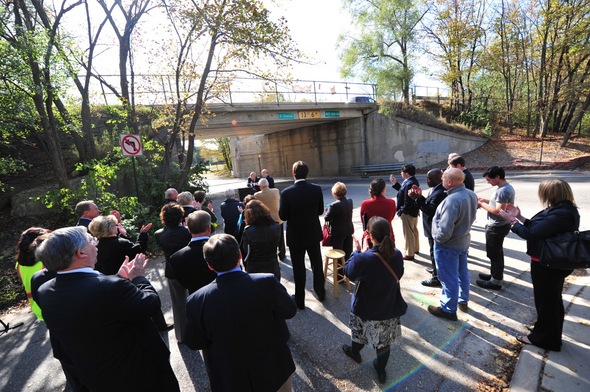
A crowd of about two dozen dignitaries gathered today near the East Stadium Boulevard bridge span above South State Street to celebrate the news that $14 million in federal grant funding will go toward the bridge reconstruction project.
Ryan J. Stanton | AnnArbor.com
The city of Ann Arbor received more good news today on funding for the reconstruction of the East Stadium Boulevard bridges, with a high-ranking official from the Michigan Department of Transportation hinting at more grant funds to come.
The city overcame seemingly insurmountable odds last week to land nearly $14 million in highly competitive federal grant funding to reconstruct the bridge spans over South State Street and the nearby railroad tracks, U.S. Congressman John Dingell, D-Dearborn, announced.
Today, during a press conference in the shadow of the 93-year-old span over South State Street, MDOT Deputy Director Jackie Shinn addressed a crowd of about two dozen dignitaries who gathered to celebrate the grant award.
In addition to the $14 million TIGER II grant from the U.S. Department of Transportation, the city is seeking $4.5 million in funding from the state to put toward the $23 million bridge reconstruction project. That includes $1.5 million through a federal enhancement program administered by the state and another $3 million in MDOT local bridge funds.
"Because of the timing, I can't quite announce, but the state of Michigan is going to be assisting in two areas with work on this bridge," Shinn said. "One is the local bridge program, which they'll have an application in — or do have — for additional funds to round this out. The other is what is called the enhancement program, and that will help fund portions of the bridge that are dedicated to the pedestrians who use this bridge. So hopefully here in early November, you'll also be hearing the state of Michigan marching up and matching some of these federal dollars."
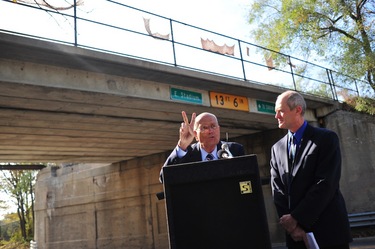
U.S. Congressman John Dingell, left, is joined at the podium by Mayor John Hieftje. Dingell said only two projects in Michigan received TIGER II grant funding from the U.S. Department of Transportation.
Ryan J. Stanton | AnnArbor.com
U.S. Department of Transportation officials said today they received nearly 1,000 grant applications for more than $19 billion worth of construction projects across the country — more than 30 times the $600 million pot of money available from the TIGER II grant program.
The DOT still has not formally announced a full list of grant recipients, though news of specific projects like the Stadium bridges has been leaked to the media by various sources.
The grants are being awarded on a competitive basis to projects that are expected to create jobs and have a significant impact on the economy.
Ann Arbor resident Ned Staebler, a vice president of the Michigan Economic Development Corp., said the Stadium bridges project will put about 450 people to work full-time during its peak and will open up a gateway to Ann Arbor's future.
"Why is this project so important? To be successful in transitioning our economy to one that is knowledge-based, based on high-skill, high-wage jobs, you have to have a hub," Staebler said at today's event. "Ann Arbor — with the University of Michigan that did over $1 billion in research last year and is part of the University Research Corridor that since 2007 has had close to $15 billion in economic impact on our state — and the innovation and entrepreneurship that's happening all around this city, serves as a great hub for that new economy."
A trail of letters obtained by AnnArbor.com show several entities — all the way up to the MEDC — went to bat for Ann Arbor in the final days before the U.S. DOT made its decision.
"This project sort of hung on the cusp for a while, and it is one of two I'm told that are going to be coming into this state," Dingell told today's crowd. "And I've got to say, I'm very proud because you all worked very hard. When the time came that we all had to pull together, you all pulled together. We got the letters and the help that we needed from everybody."
The city offered its own list of reasons back in June on why the project should receive federal funding. But knowing the federal government was interested in projects that offer the greatest economic impact, those who made a final push for the Stadium bridges replacement project in the last two weeks made sure to emphasize the importance of the bridges to U-M.
Mayor John Hieftje wrote a letter to Dingell two weeks ago, saying the Stadium bridges serve as a lifeline to U-M, an institution Hieftje called "integral to sustaining and improving the economic health and vitality of Ann Arbor, Washtenaw County and the state of Michigan."
"As you know, business leaders in Michigan often point to Ann Arbor with its high-tech research and development economies anchored by the University of Michigan as the model and best hope for revival in a state that has been hit hard by the long recession," Hieftje wrote, noting that just last year a national PBS report titled, "Ann Arbor, Michigan's Life Preserver," highlighted the vital role the city plays in the state's economy.
Hieftje also said in his letter the Stadium bridges support more than 48,000 vehicles per day. That includes the 28,000 that cross over them, and 20,000 that cross under them.
"The corridor and bridges serve U-M's Medical Center, the state's preeminent medical and research facility, and new Research Park, as well as the nation's largest athletic arena, The Big House, and also connect our region's downtown and business centers with one another as well as citizens of the region," Hieftje wrote. The loss of the bridges, he said, would have a "significant deleterious impact" on the regional economy and quality of life.
On the same day that Hieftje authored his letter, two other letters were sent to Dingell — one from Cynthia Wilbanks, U-M's vice president for government relations, and one from Diane Keller, president and CEO of the Ann Arbor/Ypsilanti Regional Chamber of Commerce.
Wilbanks said university officials forecast "very robust growth" in the future, and the deteriorating condition of the Stadium bridges "stand as a blight on the city’s infrastructure." She noted specifically that U-M intends to add up to 3,000 jobs at its North Campus Research Complex, the former Pfizer research site the university acquired last year.
"In addition, our C.S. Mott Children’s Hospital and Von Voightlander Women’s Hospital will add about 500 new health care jobs when they open in late 2011," she wrote, adding U-M's economic development activities produced close to 50 new companies in the last five years.
Keller wrote in her letter to Dingell that Ann Arbor has been one of the few bright spots throughout Michigan’s economic malaise.
"This is, in large part, due to the university, its research and development activities, business spin-offs, associated job creation, as well as our region’s focus on economic development, business incubation and support services, and overall entrepreneurial atmosphere," she wrote. "Suffice it to say that a healthy Ann Arbor area is key to a reinvigorated Michigan, and that these bridges are key to the Ann Arbor area’s continued health."
Gregory Main, president and CEO of the MEDC, wrote in a letter to Dingell last week that the Stadium bridges "serve a larger purpose for the economic development of Ann Arbor and Michigan through their role in facilitating access to the University of Michigan."
Main noted the research generated at U-M spurs spin-off business development in the areas of automotive engineering, health care and scientific development. He concluded the bridges serve as an example of "how critical infrastructure projects are to economic development in Southeast Michigan."
Dingell took all of those letters and, in turn, relayed the support to U.S. Secretary of Transportation Ray LaHood and Deputy Secretary John Porcari last week — just four days before the news of the grant award was announced.
Dingell made the case that "closing or obstructing access to Ann Arbor and U-M would be severely detrimental to one of the strongest and most successful parts of Michigan's economy."
"It is no surprise that Michigan's economy has suffered mightily during this recession," Dingell wrote. "We have been faced with the downsizing of the lifeblood of Southeast Michigan — the auto industry — and now are looking to attract new industries to our great state. No community has done a better job of this than the city of Ann Arbor and the U-M."
Ryan J. Stanton covers government and politics for AnnArbor.com. Reach him at ryanstanton@annarbor.com or 734-623-2529.
Comments
SillyTree
Fri, Oct 22, 2010 : 3:29 p.m.
@mike from saline I'm glad you understand economics. I simplified it horribly and I really don't have a full understanding of it. I think rational arguments can be made both ways, but I'm not sure how rational the economy is willing to be. It seems that hands off causes booms and busts; it seems hands on causes booms and busts. I know there are people with much more knowledge than I have who seem to be unable to deal with it.
mike from saline
Wed, Oct 20, 2010 : 5:53 p.m.
@Silly Tree I understand economics, and I understand your position. My comments were directed at Briegle, who keeps repeating the same question [over and over again]: "how is that trickle down working out for you?" [or something to that affect] no matter the thread, or subject. The more I thought about it the more I realized That the whole "free market," "a Riseing tide lift's all boats," "Supply and demand" system realy works quite well for the vast majority of Americans, and has for quite some time [long before anybody had ever heard of Ronald Reagan. It's made us the richest, most powerful country on the face of the earth, and given it's citizens the highest standard of living for all my life. Americans have realy never bought into that, "from each, acording to there abilities to each acording to there needs," "property is theft," "central planning" idea, have they? They seem to cling to the silly notion that wealth should be earned, saved, and spent, not redistributed. They tend to base there opinions on a comparison of the two realities ["free market, small government" vs. "central planning, wealth redistribution"], rather than free market reality vs. socialist acedemic therory. Given the history of socialism in the 20th century, it's a pretty easy choice, I'd say. Where am I wrong? So I'm willing to stand by what I wrote. the last sentence sums it all up; Does a rising tide lift all boats? From my experience [and for the vast majority of Americans], Yes it does, no doubt about it.
dennisd49
Wed, Oct 20, 2010 : 12:13 p.m.
If you really take the time to look at the project I'm sure you'll find it has more to do with the railroad than anything else. They've already put a $1.5 million dollar bridge over the railroad on Judd Rd. which is primarily a dirt road so that the rail company can haul taller cars. I recall that this bridge on Stadium Blvd. was in the works then along with another bridge in Ann Arbor. Federal Bridge Guidelines call for a min. of 23' clearance for these bridges.
SillyTree
Tue, Oct 19, 2010 : 2:59 p.m.
@mike from saline You are right. Trickle down is a perjorative name for supply side economics. It is used for a reason though. The idea behind economic stimulus is to either increase demand or to increase supply. Public works projects and other government sponsored stimulus programs are intended to(and do) increase demand by putting purchasing power in the hands of workers and thereby increasing the demand for a particular product at a particular price. Supply side economics move to reduce the taxes that businesses pay which in turn should (and does)increase the number of units a manufacturer is willing to produce at a particular price. This should increase purchasing because demand is higher at lower prices. The problem isn't that supply side does not work at all; the problem is that it doesn't work very well. The shifts in the supply curve due to tax reduction are small compared to the shifts in the demand curve due to stimulus. These small shifts lead to the name "trickle down." The money is better spent at the bottom. We know it will go up to the top. The reverse is not as true.
Ryan J. Stanton
Tue, Oct 19, 2010 : 2:16 p.m.
The funding breakdown is available in the citys TIGER II application at the following link: http://www.a2gov.org/government/publicservices/project_management/Documents/TIGERIIapp.pdf
SillyTree
Tue, Oct 19, 2010 : 1:45 p.m.
@ERMG People are very selective in what they say in their comments. I have noticed that the antibicycle crowd is all too aware of how the roads are funded, but their memories seem to fail when it comes to bridges.
Jeremy
Tue, Oct 19, 2010 : 12:46 p.m.
Never seen so many people so proud of a moment that proves they could not do something on their own.
Chad
Tue, Oct 19, 2010 : 12:15 p.m.
For all of you who think that my previous post was a bit "newbieish", to insinuate that Stadium Blvd was anything but a quiet little thoroughfare or (non- rim road), heres a little bit of history of the beloved Stadium Blvd, and the HEAVY use of it's bridges, beginning in 1927, and ending in 1956. And form that point on being used as heavily as they have been since with little or NO repairs. I made the mistake in my other post to erroneously make the mistake of referring to it as the US-12 bypass, when in actuality, it was the original route of M-17. Heres a word for word account according to Michigans OFFICIAL MDOT site of what happened to Stadium Blvd between it's inception, until 1956, using the SAME bridges we are needing to replace today. For the exact article please refer to this site : http://www.michiganhighways.org/listings/MichHwys10-19.html Skipping some parts that have nothing to do with us, heres the gist of what the site says. 1927 - A new southern Ann Arbor bypass is opened as M-17 along Boulevard Dr (present-day Stadium Blvd) from US-23/Washtenaw Ave southeast of downtown to US-12/Jackson Rd west of downtown. 1944 - With the completion of the northern portion of the Willow Run Expressway System at the Willow Run Bomber Plant east of Ypsilanti, M-17 is routed along 1.5 miles of new expressway built roughly along the route of Ecorse Rd from roughly the Wayne/Washtenaw Co line westerly. Just west of the county line, a new BYP US-112 routing joins the expressway, and together BYP US-112 and M-17 continue along the newly constructed southern expressway bypass of Ypsilanti (now part of present-day I-94). At US-112/Michigan Ave, BYP US-112 ends and M-17 continues due westerly along a new two-lane highway for 1.6 miles to US-23/Carpenter Rd. The M-17 designation then turns northerly with US-23 for 2 miles, returning to M-17's former alignment along Washtenaw Ave halfway between Ypsilanti and Ann Arbor. The former route of M-17 through downtown Ypsilanti is re-designated as BUS M-17. 1956 - With the completion of the new US-12 freeway bypass of Ann Arbor in mid-1956 ( which BTW became I-94 in 1960 according to that same site), US-12 and US-112 are re-routed onto the Ypsilanti bypass, taking the place of M-17 and BYP US-112. M-17 is routed back onto Ecorse Rd, Michigan Ave and Washtenaw Ave through downtown Ypsilanti along the former route of BUS M-17. (Concurrently-signed US-112 through town becomes concurrently-signed BUS US-112.) The western terminus of M-17 is also scaled back so that the highway now ends at US-23 (cnr Washtenaw Ave & Capenter Rd) between Ann Arbor and Ypsilanti. The former route of M-17 along Stadium Dr and Maple Rd around Ann Arbor is turned back to local control. I have my facts straight. And the final line is this. The infrastructure supporting the bridges on Stadium Blvd should have been replaced decades ago, and it wasn't. And now what choice does anyone have excpet to take things as they are presented, and fix it while theres something left to fix. Again to my original point. WHY are we hanging out to dry current administration for their efforts, when it clearly should be passed along several previous administrations who had better times do do such a project. Like most things I suppose that happen in many states besides ours tho, sticking our heads in the sand until the whole system shuts down, seems to be what the name of the game is. All I can say is I hope that the new bridge(s)over State and the Ann Arbor Railroad last 83 years like the ones have that are there now.
SillyTree
Tue, Oct 19, 2010 : 12:14 p.m.
@Chase My sincere apologies for any portion of my comment that was snide. I found your comment about the ways "you" get to and from town to be narrow minded in that you did not take other peoples preferences into account. I cannot give you details for the cost of a bridge. I do know that the bridge needs to be widened and that there is a narrow right of way. That requires retaining walls. I am not certain who provided you with information by the time you posted your last post. The only real information I found was provided by foobar417. I got to that same information by doing a google search of "stadium bridge ann arbor specs." As you know, there are people with 3 kidneys. That is true. There are also two headed cows.
a2huron
Tue, Oct 19, 2010 : 10:37 a.m.
A bit of fluff on the jobs estimate, eh? Need this bridge done and ASAP.
foobar417
Tue, Oct 19, 2010 : 10:01 a.m.
As has been noted many times on AA.com and on the city website, the city developed plans to rebuild the bridge and was scheduled to rebuild them starting in the spring, whether these grants were awarded or not. According to the posted project schedule, preliminary work with DTE is already underway. http://www.a2gov.org/government/publicservices/project_management/Pages/EastStadiumBridges.aspx The May 10, 2010 update to council covers most of the details in exhaustive detail. http://www.a2gov.org/government/publicservices/project_management/privatedev/Documents/council%20pp%20presentation%20-%20may%2010%202010%20(final%20version).pdf Also, as noted that presentation, if the grants had not been received, they would have had to use up two years of the street millage. With the grants, those monies can now go to rebuilding other streets, as originally planned. There's also an FAQ that addresses most of the questions posted in this thread.
leaguebus
Tue, Oct 19, 2010 : 9:56 a.m.
Oh the politics of it, Dingell announces the grant just before the election! What a coup! The bottom line is that he didn't need to get this money for Ann Arbor to win our vote. What are the chances that AA would vote en-masse for Steele, none. Why did the state money show up? Probably because the Feds kicked in their large chunk and MDOT could see that this project will now get done. I love the right wing mind set, they run the country for the last eight years, allow their Wall Street backers to crash the economy, raise the debt faster than any presidency in history, then blame Obama for all of this. At the same time, complain loudly when a Democrat brings $14M from Washington to fix a bridge in AA.
Grand Marquis de Sade
Tue, Oct 19, 2010 : 9:53 a.m.
Why the hell didn't somebody in a position to do something, you know, recognize that this bridge needed repair YEARS ago. There is absolutely no excuse for allowing a major bridge to deteriorate to the point where it can't support traffic and can't be repaired. And now these idiots are standing around patting themselves on the back? For what? For completely screwing the pooch and then lucking into some "state" money? Why wasn't this issue addressed when the City of Ann Arbor, Washtenaw County, and the State of Michigan were throwing money around on things like greenbelts and other useless crap? It seems like there was plenty of money to go around then! It's called prioritizing and it's something that the City, County, and State are clearly incapable of doing.
John
Tue, Oct 19, 2010 : 9:52 a.m.
Thanks to all who helped bring these much-needed funds to our community. "Does a rising tide lift all boats?" Not if the tide has other places to flow...
mike from saline
Tue, Oct 19, 2010 : 9:06 a.m.
Hey! where is the great big blown up check? I had my heart set on a 1footx2footer, at the least! @Briegle, YOU of all people want accuracy? Perhaps you should practice what you preach. You asked builder; "Are you enjoing that promised trickle down?" No Free market consevative or libertarian ever promised "trickle down ecconomics." The expression is a negative term, used by left- wingers to describe the Milton Friedman priciple "a rising tide lifts all boats". Does a rising tide lift all boats? From my experience [and for the VAST MAJORITY of Americans], Yes it does, no doubt about it.
lulumom9
Tue, Oct 19, 2010 : 8:36 a.m.
Whether this was a re-election ploy, or not, thank you John Dingell for getting the money. Had you not done this, who knows how long the city would have put off fixing the bridges. Probably not until all four lanes had to be shut down permanently. That being said, is there a timeline to get this project underway and completed? Has it been mentioned in any article? With all the time that the city has been waiting to hear if the funds were being awarded, I'm hoping that they have the plans drawn and bids secured and are ready to go. It's going to be painful for all no matter when it is scheduled, but it might be wise to have the project completed before next football season so it is not coinciding with the Main Street closure in front of the stadium.
Bob W
Tue, Oct 19, 2010 : 8:21 a.m.
"Ann Arbor resident Ned Staebler, a vice president of the Michigan Economic Development Corp., said the Stadium bridges project will put about 450 people to work full-time during its peak and will open up a gateway to Ann Arbor's future." Hmm, 450 full-time jobs? I'd like to see the details that support that estimate. It would be great if true, but any road projects I've seen in recent years, including those with bridge work, have suprisingly few warm bodies involved due to mechanization and highly specialized equipment. Just saying. Glad the work is moving forward though.
Chase Ingersoll
Tue, Oct 19, 2010 : 8:11 a.m.
Thanks to those who actually provided information in their comments, which were made more difficult to find by those whose comments contain nothing but snide remarks. Reminds me a story my father told how in 5th grade science class he raised his hand and advised the class that his father had 3 kidneys. The response from the teacher was, "Yeah, and I've got a cow with two heads." Guess who never shared in science class again. But that's okay, grandfather donated one of his 3 kidneys. So back to the relevant question: what is the scope of the project that justifies a budget of $23/4 million? I'm just not satisfied with "earthen berms" and "bridges cost lots of money". Further, I don't think anyone that would not ask these questions should complain about a government deficit, taxes, or lack of oversight when contracts run over initial estimated costs. I also think it is precisely the job of a free press to request such information and make it public for all of us.
A2G
Tue, Oct 19, 2010 : 7:41 a.m.
'Wilbanks said university officials forecast "very robust growth" in the future, and the deteriorating condition of the Stadium bridges "stand as a blight on the citys infrastructure." ' Funny how important this is to the U and it refused to do anything to help other than write a letter. These are the same folks who want to shut down Main Street and would like to have the city pick of that tab also.
KJMClark
Tue, Oct 19, 2010 : 7 a.m.
Demistify is right; local activists succeeded in beating up the people who actually got the funding and had been trying before they were beat up. And all of you who think Stadium isn't a rim-road are also off. The only problem is you have to go back a number of decades to make it obvious. Stadium is an early (1900?) southern bypass of downtown. The fact that there are large strip-mall shopping districts at either end doesn't really change that. Before the expressways, roads like Stadium were what rim-road bypasses of downtowns looked like. I'm glad we got the money, but it does sound like the application was embellished a bit. I just hope this isn't the usual "put in a six-lane deck to provide for future expansion" that engineers seem fond of.
Awakened
Tue, Oct 19, 2010 : 5:31 a.m.
Well thank goodness! Now Council can re-task the money in the road fund to something important. I'd suggest potholes but I'm gonna bet that they use it to fill the hole in the police/court building funding.
AlphaAlpha
Tue, Oct 19, 2010 : 4:28 a.m.
"Accuracy please." Agreed - touche. As you likely recognized, $20K / inch only covers actual bridged lengths. True cost is likely less than half that, ~$8K per inch. Thank you Mr. Briegel.
Speechless
Mon, Oct 18, 2010 : 9:11 p.m.
A "hint" that's expected to be worth seven figures? That sounds pretty good. When that hinted state money becomes official, it will present another big opportunity for certain local politicos, last seen as challengers in the August city primary, to offer a public apology. But most likely they'll remain silent. The one nagging ethical concern I have over use of federal and state money for new Stadium bridges is this:  Will any of the funding be earmarked as aid relief for victims of the recent wave of yarn bombings along the bridge?
demistify
Mon, Oct 18, 2010 : 8:53 p.m.
The self-centered and self-important tone of most of these posts is mind-boggling. The bridges desperately need to be reconstructed. For years, the city felt that the cost of doing it with local funds only was more of a hit than it could afford, and it kept begging without success for federal and state funds. Against expectations, the money is here. So, rejoice and shut up! Be gracious enough to say "Thank you" to the USDOT, to Dingell, to the state DOT, taking a break from sniping at them. Congratulate the Mayor and City Council on the good outcome for the city, whether you think they played it right or that it was dumb luck. And particularly, Roadman, forget the delusion that the decision-makers in Washington cared that you and a few friends were nasty to a couple of Council members.
treetowncartel
Mon, Oct 18, 2010 : 8:52 p.m.
I am happy that we got the bridge funding,hBut this kind of sounds like putting a high end kitchen in a dillapitated home on a road with moon crater potholes. Ann Arbor will do just fine with a standard, non immaculate new fandango bridge in this location. Our state as a whole, needs some capital expenditures in areas beyond the halo of the Stadium. With respect to the economic engine driving this decision, does this now mean truck traffic wil be able to use State street in this area, or will those big behemoths delivering gross domestic and imported products and durable goodsstill be prohibited from this strip of roadway? I always feel bad for those truckers who get a ticket there. They have probably never been down that road and would never imagine a main artery to town, with its own dedicated freeway entrance and exit, can not be traversed by their semis.
bugjuice
Mon, Oct 18, 2010 : 8:34 p.m.
It has to make one wonder where all the stingy penny pinching from the anti tax whiners is coming from for our measly little bridges here in Ann Arbor. You'd have a lot more to whine about if you lived in Pittsburgh, 446 bridges at last count. Think about those taxes! Gotta be thru the roof! How do those Pittburghers do it?
Roadman
Mon, Oct 18, 2010 : 8:27 p.m.
John Dingell, the congressman who supported the Vietnam War until 1971, is flashing a peace sign in the photograph of him with Hieftje in front of the bridge. How times have changed. Maybe GM can hire him for a job after he leaves Congress. Let's salute Chase Ingersoll, who has spoken for many 15th District residents at the candidate forum.
David Briegel
Mon, Oct 18, 2010 : 8:13 p.m.
Alpha, you need to recalculate. I think your computer is broke! 2 bridges and 2 approaches. Up the hill and down the hill. Bike paths. Walkways. Removal of existing. Accuracy please.
AlphaAlpha
Mon, Oct 18, 2010 : 7:35 p.m.
$23,000,000 : about $20,000 per inch. Excellent...
David Briegel
Mon, Oct 18, 2010 : 7:19 p.m.
Golly, If only John Engler were here to celebrate with us!! The conservative hero who cut the budget so much that this bridge could not be replaced as a routine matter! Mr builder, Are you enjoying that promised "trickle down"? Chase, everyone, even the homeless, know that the Stadium is owned and operated by the U of M! Except for the tantrum throwers!
Chris
Mon, Oct 18, 2010 : 7:08 p.m.
Chase, you're assuming the city hasn't made previous efforts to fund bridge reconstruction and, I believe, that would be wrong. As to timing, this bridge isn't part of the University - the football stadium work was funded through bonds sold by the U. I don't know the particulars about qualifying for the funds that are being used for the W. Stadium work, but I believe "shovel ready" has been used to determine if a project can qualify for the American Recovery and Reinvestment Act funds. I'm speculating the bridge project wasn't considered shovel ready and/or perhaps it fell outside the scope of the ARRA funds, but that's a complete WAG on my part.
sbbuilder
Mon, Oct 18, 2010 : 7:03 p.m.
Now the whole thing makes so much more sense. And to think all along that I thought we were just talking about a silly bridge, while what was really at stake was a bridge that would serve a City that is "knowledge-based, based on high-skill, high-wage jobs..." A City on a Hill, one gleaming in the light of a thousand high tech companies, and offering its jewels to the rest of our state. I had no idea that this bridge put so much of the success of our City at risk. Holy Cow. What a bridge! About all of the jobs about to be 'created': I'd like to know some numbers from the contractors who will be doing the work. Are they going to really hire more employees? If so, how many? Perhaps they will make do with the folks on hand? All this talk of job creation is beginning to make me a little woozy. You'd think by now that enough jobs would have been created to staff a small country. Can't even open a car door without hitting a new 'creation'.
SillyTree
Mon, Oct 18, 2010 : 6:55 p.m.
err...funding
SillyTree
Mon, Oct 18, 2010 : 6:54 p.m.
Oh yeah, the other projects were always part of the vision, but funiding is a lot easier for laying ashpalt than it is for a bridge. Brigdes are expensive; that is why people are mad about the bike/pedestrian bridge across U.S 23.
SillyTree
Mon, Oct 18, 2010 : 6:21 p.m.
@Chase Sorry, the others are correct. Think about the city as a whole instead of just where you reside. If you are on the northwest side and want to get to, oh let's say, Arborland, the way to go is Stadium Blvd. It isn't the shortest distance, but it's the shortest time. Did you look at a map. Did you wonder why Stadium is there in the first place? I forgot, the 60 x 60 thing. Did you look at the bridges? They are on an earthen berm that rises high enough to cross a railroad and a major thoroughfare. It's not just laying asphalt! I'm so sorry that the world doesn't revolve around you, but Stadium Blvd is there for a purpose regardless of your preferences. If nobody used it, nobody would care! Additionally, it is a popular route to the Stadium from the northwest and the east. The east has suffered some since the bridge fell into disrepair. Are you just looking for attention? Well you got it bro'. By the way, your babies are so cute! I hope you teach them to look at all angles.
bugjuice
Mon, Oct 18, 2010 : 5:57 p.m.
Stadium blvd a ring (rim) road? Only a newbie would make such a statement. The "ring road" around Ann Arbor is I-94, I-23, and M-14. Closer in, it's Ellsworth (south), Wagner( west), Carpenter (east) and Plymouth (north) roads. Local folks know that there is more to the city than the campus, the stadium and the "rim road" Stadium blvd that essentially is east/west and only connects areas from Washtenaw blvd to Maple on the west side.
bugjuice
Mon, Oct 18, 2010 : 5:49 p.m.
@chase ingersoll. Where have you been for the last couple of years when all of the discussions and fact finding was going on over the (two) bridges? All the details, the back and forth, the claims and recriminations leading up to this have been hashed over ad nauseum and finitum. And ask yourself if Dr Steele had been in office, would we have seen a single dollar from the feds or would he have even asked for a dime from the state? Or would he have scolded the progressive elected officials here in Ann Arbor to pay for it ourselves because we're spendthrift librulz and told them that we don't deserve it because we're just a bunch of librulz? Or would he have done the same thing as Dingell and taken the credit just before elections?
Roadman
Mon, Oct 18, 2010 : 5:38 p.m.
The true heroes of this saga are the local civic activists who put pressure on Hieftje, Higgins, Teall and the rest of A2 government the last few years to get someone to get this done. The bridge had been an eyesore for many years but was a back-burner issue for local politicians until these activists literally embarrassed elected officials such as Marcia Higgins and Margie Teall into placing due pressure into getting this dream of repair and restoration into an upcoming reality. I thank persons such as Jack Eaton, Hatim Elhady, Eric Lipson, Alan Goldsmith, Karen Sidney and many others who served as the impetus to get local pols off their respective duffs and forced them to addrees this impotant matter post-haste. These are unpaid civic leaders who form the backbone of our city's true leadership. Without them this happy ending could not have become a reality.
maallen
Mon, Oct 18, 2010 : 5:37 p.m.
Once again, Dingell's slick public relations team is at it again. "Dingell took all of those letters and, in turn, relayed the support to U.S. Secretary of Transportation Ray LaHood and Deputy Secretary John Porcari last week just four days before the news of the grant award was announced." Wow, just four days before the news of the grant award was announced Dingell forwarded all the letters to the appropriate people. And in 4 days the Department of Transportation made "the painstaking process of review" of the grant applications. That was some "painstaking" review of almost 1,000 applications! Besides delivering these letters that other people wrote, what exactly did Dingell do? There will be more slick public relations moments by Dingell in the very near future. Just wait and see!
Brad
Mon, Oct 18, 2010 : 5:36 p.m.
Hinted funds! Oh joy. You can't be serious.
Chase Ingersoll
Mon, Oct 18, 2010 : 5:11 p.m.
Ryan: could you please discuss the full scope of the project. If the span is only a 60ft x 60ft span, why is the cost $23 million? Also: I've not been in Ann Arbor for even 5 years, but Main, State Packard and Washtenaw, Liberty, Huron and Geddes are the ways I get too and from the University and downtown Ann Arbor. Stadium is more a rim road around the downtown and campus area. But this is a minor critique of the argument made for the funding. But here is another: why was this project not applied for and scheduled for when the other work was being done on W. Stadium and the renovations of the stadium, or as Phase I of the stadium reconstruction. Granted, some may consider these questions to be like asking "who stopped up the toilet" when all everyone wants is for it to be flushed, but I think that if you look around we have/had a lot of projects that "stop the toilet" and make little or no sense as far as their timing, costs or source of funds.
scooter dog
Mon, Oct 18, 2010 : 4:38 p.m.
If the state is so broke,where is the money comming from?