

Ann Arbor schools budget: the numbers behind proposals to cut $17.8 million
Related coverage: Closing Roberto Clemente, eliminating teachers, busing on the table to fix $17.8M Ann Arbor schools shortfall
After six months of discussion about a projected budget deficit of $14 million, then $16 million, now $17.8 million for the Ann Arbor Public Schools, parents and board members have been given a taste of how those numbers could play out in cuts and reductions.

A Roberto Clemente student reads from his text book during an African American studies summer-school program in July 2010. The alternative high school is on the chopping block as the Ann Arbor school district attempts to cut $17.8 million from its budget for 2012-13.
AnnArbor.com file photo
Deputy Superintendent of Operations Robert Allen estimated closing Roberto Clemente and moving its students to Ann Arbor Technological High School, the district’s other alternative secondary education program, would save AAPS about $400,000 in operational costs and $108,000 in transportation costs, for a total of $508,000.
Currently, both A2 Tech and Clemente are operating at 50 percent capacity or less, according to recent data released by the district. A2 Tech is 46.3 percent full.
In the fall of 2011, Clemente enrolled 100 students, while A2 Tech had 138 students — making it impossible for Clemente, based on the numbers, to absorb A2 Tech’s population.
The same but different
While it seems logical to combine the two half-full schools with similar goals and student populations, which are overwhelmingly African American (58.3 percent), some distinct differences in the programs lead to unanswered questions.
For example, what will happen to the eighth-graders at Roberto Clemente, considering A2 Tech is a 9-12 building? Will the programs merge, or remain separate under one roof? And what about Clemente’s teachers and the well-established success of Principal Ben Edmondson?
At last week's school board meeting, Allen said the projected $400,000 savings included building costs as well as teacher and administrator salaries. However, it is not clear at this time how many staff positions could be cut.
According to the district’s web site, there are 20 staff members at Roberto Clemente and 38 at A2 Tech.
Clemente is a “choice” school, whereas A2 Tech’s students are directed to the school via a principal at one of the comprehensive high schools.
Both programs cater to underachieving and economically disadvantaged students, but they do so in very different ways.
The motto at Ann Arbor Tech is “Credentials Matter.” The mission on the school’s web site talks about “a targeted effort to bring the culture of college” into the lives of its students with the help of staff and an onsite graduation coach.
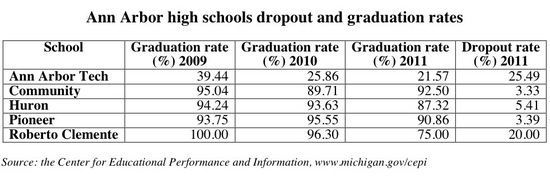
Despite the coach, A2 Tech consistently has the lowest graduation rate and the highest student dropout rate in the district. Clemente, on the other hand, has the highest graduation rate.
Clemente's mission and philosophy, as stated on its web site, is a commitment to “nurturing the human spirit” and to providing “a positive atmosphere for growth — intellectually, emotionally, socially and physically.”
Trustees Simone Lightfoot and Susan Baskett cautioned the Board of Education last week to carefully consider the impact that closing Roberto Clemente would have on Ann Arbor’s at-risk student population.
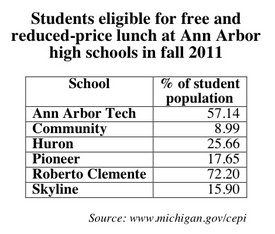
At A2 Tech, 57 percent of its current population qualifies for free or reduced-price lunch. At Roberto Clemente, that number is greater, 72 percent, according to the Center for Educational Performance and Information. Both percentages far exceed the district average of 23.28 percent.
“These are the students that are in the gap and that have challenges. I’m concerned, because I thought these were the students we said we wanted to help.”
Evaluating equity
Overall, the Board of Education displayed an openness to the budget reduction plans Allen laid before them last Wednesday.
The least aggressive option would involve slashing the district’s expenditures by $7.364 million and using $4.436 from Ann Arbor’s $19.7 million fund balance.
Six million in estimated revenue from Schools of Choice, Medicaid reimbursement and Gov. Rick Snyder’s Best Practices and proposed funds to offset teacher retirement costs also would contribute to reducing the deficit.
The district’s total operating budget for the current academic year is $183.5 million.
“I’m OK with what has been proposed,” said Trustee Irene Patalan.
“With one exception, I don’t think there is anything there that would cause me to not sleep at night,” added Secretary Andy Thomas.
He said the one exception for him would be eliminating an additional 32 teaching positions, one per building. AAPS was supposed to cut the equivalent of 62 teachers in 2011, but ended up cutting 50.
“I think we need to look at why we couldn’t get the other FTEs last year,” said Vice President Christine Stead. “Because in my gut I think if you could have done it, you would have done it. But I can’t imagine there is a whole lot of wiggle room left.”
Although Ann Arbor has cut teaching positions the past couple of years, the district has been fortunate enough to do it through attrition and retirements rather than layoffs, Allen said.
As of Wednesday, 31 teachers — just one fewer than Allen proposed cutting — have submitted retirement notices, stating they will not return in the fall.
District spokeswoman Liz Margolis said currently, AAPS offers an incentive program from February until April for teachers who submit their notices early. They could pocket an extra $750 to $1,500 depending on the timeline, Margolis said.

How much to dip into its savings is a question the Ann Arbor Public Schools will need to answer in the coming months.
Photo illustration
Thomas said because the district has heard from families continuously about class sizes and their impact on children’s learning, he would like AAPS to hire replacements for some — if not all — of its retirees this year. Last year, AAPS only spent $810,000 of its fund equity. But the staff reductions increased class sizes district-wide by two or three pupils per class, administrators said in October.
Thomas rallied in support being more aggressive with the district’s fund balance than the plans called for. But Stead and Patalan were in opposition.
"This is not our rainiest day," Stead said. "I don't see the political will in our House (of Representatives), in the Senate or in our governor to make any changes. ... I think we can only expect school funding in the state to get worse."
Patalan was just as cautious.
“I do worry about fund equity and I do worry about dipping into it more,” Patalan said. “What really makes our security blanket no longer secure at all is an important piece for me.”
She remembers when, in the day before Proposal A restructured school funding, if parents wanted more money to reduce class sizes, they could just “vote yes” and pass a bond.
“That was before restrictions,” she said. “We gave our kids anything that we could.
“But we can all do that little piece right now,” she continued, referring to the upcoming technology millage proposal. “We (could) keep the money where the teachers are because (the voters) are willing to give the money to technology.”
Ann Arbor Public Schools is asking residents to consider a $45.8-million bond for technology improvements in the May 8 election. If passed, the proposal would levy an additional .45 mills (or 45 cents per $1,000 of taxable value) from taxpayers beginning in July 2012.
The preliminary budget presentation Allen gave Wednesday was based on the technology bond passing, he said. If the bond does not pass, an additional $3 to $4 million will need to be squeezed out of somewhere for a few key infrastructure upgrades.
Lightfoot and Baskett said they were pleased the administration was looking at possibly cutting middle school athletic directors. They said analyzing the high school athletic director positions as well might be a way to find more money.
Finding discretion
Another fund that may hold some solutions is the district-wide discretionary budget, which Allen said Wednesday is about $5 million.
“This actually really concerns me,” said President Deb Mexicotte. “And here I always thought we didn’t have any really big chunks in our budget. But that’s a big chunk … and for discretionary funds.
“I’m sure its all being used very, very well. But even if we could get $3 million out of there, that’s 32 teachers.”
Allen said each building is allocated some money from the discretionary budget, and some is used for conferences, travel and office supplies. Another large portion of the discretionary budget is for hourly or temporary employees, he said.
He told the board he would look into it more to determine what else comes out of the discretionary fund and whether more money could feasibly be cut from it.
His preliminary budget presentation called for reducing the fund by $250,000.
Staff reporter Danielle Arndt covers K-12 education for AnnArbor.com. Follow her on Twitter @DanielleArndt or email her at daniellearndt@annarbor.com.
Comments
Andrew Smith
Mon, Apr 30, 2012 : 12:37 p.m.
Can someone help me understand the math? If we have a $45 million dollar bond, financed for twenty years, that would mean that more than half of the property tax paid would go for interest, and not actually to the schools?
Danielle Arndt
Mon, Apr 23, 2012 : 6:37 p.m.
Just a note on the graduation rates reflected in the story, since many readers seem to be intrigued by them. 2011 was the first class of students impacted by the new, tougher graduation requirements under the Michigan Merit Curriculum. This was not mentioned in the story, but we had an earlier post about how graduation rates for the class of 2011 dropped slightly statewide due to the higher standards. If you are interested in further reading on graduation rates, the AP story can be found here: http://www.annarbor.com/news/michigans-high-school-graduation-rate-dips-slightly-for-2011/
say it plain
Mon, Apr 23, 2012 : 3:48 p.m.
Is AA.com going to do a story on how it could be that the BOE President didn't know there was a $5million discretionary fund?! How can we trust that anybody from Balas is being straight with us even on the questions they allegedly answer (I say allegedly because on the questions of the true costs of Community, of the Varsity Athletics programs, and others it is clear they are not sharing all the info) if that can happen? I will still vote YES on the Tech Bond because there is no doubt that kids will suffer if they don't have that money and it's not very much extra per taxpayer but it might reduce the quality of the schools and thusly property values by a *lot* if they do what they threaten to--increase class sizes yet farther! They'll do it at the high schools, where it will matter least to test scores but will be felt by the kids and the teachers and will *hurt our students*. It won't hurt the central administrators, just the people in the actual school buildings. Balas won't even kick themselves, I suspect, about the lousy job they did in selling the need for it; after all, they have the lousy economy onto which they can tack anti-tax sentiment. But we clearly need to stop voting for BOEs that do not question the administration! That's got to be a priority, obviously! With the budget outlook we have, we can expect the need to *pore over every spending line* for years to come, and you can't have the foxy administrators guarding that hen-house, BOE!!
Local Lady
Mon, Apr 23, 2012 : 1:04 p.m.
My father was a school business administrator for decades and he called it "other people's money" and we often discussed how easy it is to spend OPM. I think it is time to look at the state mandates and look at what makes sense in today's economic times versus what felt right when money was flowing. Time to rethink everything that is in the budget. Everything. Like do we really need intermediate school distr
Stephen Smith
Mon, Apr 23, 2012 : 11:47 a.m.
At what point can we at least partially blame Snyder and Lansing http://thinkprogress.org/economy/2012/01/09/400584/snyder-guts-schools/ tax cuts and underfunded schools
Stuart Brown
Mon, Apr 23, 2012 : 5:25 a.m.
Let me get this straight: the proposal affects the two schools with the highest concentration of African American students. One school has a 75% graduation rate the other has a 25% graduation rate, so which one is on the chopping block? Why the one with the highest graduation rate! Of course, this is Ann Arbor and we have standards! The best part is that the new, improved and much more expensive admin hired, Superintendent Green (whose increased cost along with her minions in tow would cover the savings from the closing) has stated that improving the achievement gap is a top priority. Go figure!
r treat
Mon, Apr 23, 2012 : 1:03 a.m.
The last one out be sure to turn off the lights! Oh, never mind, DTE took care of that problem.
jcj
Sun, Apr 22, 2012 : 10:39 p.m.
I can't believe JRW is the ONLY one to express dismay at the staff to student ratio! If this were the case at a business they would go broke. OH wait I guess we are going broke! Is it any wonder?
Robin
Sun, Apr 22, 2012 : 9:44 p.m.
I wonder why instead of cutting teachers why administration take a pay cut. As long as I can remember the administration has never taken a pay cut just a pay freeze. Another thing is how can they cut teachers when the district is getting ready to go to an all day kindergarten program? If the kindergarten goes all day then more teachers will be needed. Why is it that when ever cuts are being discussed everyone wants to start with the little people like transportation, custodians and grounds? Where is the support for these people? These people are your background people who make sure students get to school everyday no matter what the weather is and the custodians make sure every student is taught in a clean environment plus they make sure everything is running properly in the building, grounds people also help in the clearing of snowy side walks and parking lots among other things. These people play an important part in the lives of students too.
alarictoo
Mon, Apr 23, 2012 : 6:10 p.m.
Steve is correct. Todd Roberts took a voluntary 8% pay cut, and members of his cabinet (including Robert Allen) took 4%. Of course, since the BoE decided AAPS needed to pay nearly $250K for their newest superintendent (approx. $70K more than Todd Roberts made), and then Ms. Green decided that her cabinet members needed 1:00 a.m. raises, that attitude of sacrifice is officially dead now.
Steve Norton, MIPFS
Mon, Apr 23, 2012 : 4:50 p.m.
Well, all central administrators took a cut in the 2010-11 school year, led by Todd Roberts who took an 8% pay cut. So it did happen not long ago. But that's not to say that it should be off-limits.
JRW
Sun, Apr 22, 2012 : 9:37 p.m.
There are 100 students in Clemente and 20 staff, for a student-teacher ratio of 5 to 1. And 138 students at Tech with 38 staff, for a student-teacher ratio of 3.7 to 1. Yet, in 2011, in spite of these teacher-student ratios, Tech had a drop out rate of 25% and a graduation rate of 22%. Clemente in 2011 had a drop out rate of 20% and a graduation rate of 75%. Someone needs to explain these numbers in light of the extremely low student-teacher ratios and attendant costs. Given the huge size of these staffs at these two schools compared to the low number of students, the success rates should be much higher.
JRW
Sun, Apr 22, 2012 : 8:54 p.m.
So, you have 100 students in Clemente and 20 staff, for a student-teacher ratio of 5 to 1. And 138 students at Tech with 38 staff, for a student-teacher ratio of 3.7 to 1. What is the justification for nearly double the number of staff for only about 1/3 more students at Tech? Something is very wrong with this picture. These ratios are way out of line. How about AAPS explain specifically why these two schools have an excessive number of staff. Close Clemente, merge with Tech. 238 students = 20 staff. A student-teacher ratio of 12 to 1 is much more acceptable.
Kathy Sabol
Sun, Apr 22, 2012 : 7:59 p.m.
As a parent of a Roberto student, it's VERY clear which school should NOT be closed, looking at those graduation rates. Dr. Edmondson and the rest of the staff have done wonderful things for the students at Roberto Clemente. My daughter's grades making a complete turn around are proof of that. They were able to miraculously make her care about her education and her future when she didn't think it looked so bright for her; they instilled a new hope in her.
alarictoo
Mon, Apr 23, 2012 : 6:03 p.m.
"I don't know if Dr. Edmondson could make the same improvement at Tech as he did at Scarlett and Clemente, but should they decide to combine Clemente and Tech, I can't think of a better man for the job." "And what about Clemente's teachers and the well-established success of Principal Ben Edmondson?" Seriously? Did you look at the statistics they gave in the article? The graduation rate dropped by more than 20% the year Ben Edmondson took over Clemente. Over 20%! Interestingly, 20% was the dropout rate that year. This, to me, does not add up to a positive change in the school's culture. To me, this does not look like "well established success". It looks like failure. Unless there is something wrong with the graduation data in the table Danielle Arndt posted...
SallyDay
Sun, Apr 22, 2012 : 7:17 p.m.
How environmentally wise is it to cut busing? How many students does this affect? How many more cars does that put into morning rush hour? And into the city limits? How many very expensive gallons of gas does that waste when parents, especially those of us on the far edges of the district, have to drive their kids to school instead of putting them on the school bus? Is anyone calculating the carbon emissions of this cut? On the personal level, I cannot afford the gas for 180 days of a 30-mile roundtrip. And I'm about to be a Community parent. It's good to know I'll be affluent then—and politically well connected.
alarictoo
Mon, Apr 23, 2012 : 6:01 p.m.
@DogGuy - Actually, if you read through her post again, you will see that she is talking about both economy and ecology. Unfortunately, minimizing A2's carbon footprint will not help AAPS deal with their deficit.
JRW
Sun, Apr 22, 2012 : 8:57 p.m.
Community is a choice. Find a school closer to home.
Dog Guy
Sun, Apr 22, 2012 : 8:53 p.m.
Sally is talking economy not ecology, Brad, but Happy Earth Day to you! Earth Day Anthem Joyful joyful we adore our Earth in all its wonderment Simple gifts of nature that all join into a paradise Now we must resolve to protect her Show her our love through out all time With our gentle hand and touch We make our home a newborn world Now we must resolve to protect her Show her our love through out all time With our gentle hand and touch We make our home a newborn world
Brad
Sun, Apr 22, 2012 : 7:38 p.m.
Environmental wisdom would also dictate that your child go to the nearest school rather than require petroleum-based transportation to some school that's a 30-mile roundtrip.
KeepingItReal
Sun, Apr 22, 2012 : 6:34 p.m.
It is absolutely amazing to me that the discussion about closing schools does not include Community. It seems to me that everything should be on the table for discussion so that when the board approves a budget, the district and the community will have a good feel for what the priorities are can then support or not support the decision. If something is automatically off the table then how do we know whether that particular item is contributing to the overall educational values of our children. It seems that Community High students have the pick of the lit because they can take classes and any of the comprehensive schools and they get special bus service to and from their school. Is it because the parents of students at Community High are more affluent and politically connected and would tear this town up is the Board even entertains a discussion about Closing Community.
alarictoo
Mon, Apr 23, 2012 : 5:58 p.m.
@dotdash - Look at the percentage of free and reduced lunch students at Community, then tell me that the "lottery" is really random.
dotdash
Sun, Apr 22, 2012 : 8:42 p.m.
The reason no one talks about closing Community is that people don't generally like to shoot themselves in the foot, especially their good foot. On the bright side, closing Community would be a boon to Greenhills and Rudolph Steiner and the IB high school in Ypsi. And it's good to remember that Community has a lottery, so any great affluence or connections among CHS parents is by self-selection, not discrimination.
maestra27
Sun, Apr 22, 2012 : 6:32 p.m.
At what point do we start holding our politicians in Lansing accountable for the drastic cuts being forced upon school districts? Remember the $1 billion taken from the School Aid Fund last year to give businesses a tax break? Are you aware that the School Aid Fund is "expected to finish the year with $142 million in savings, and potentially $222 million in the black in a year?" Our public school system should not be run like a business. The money in the School Aid Fund is there for a reason . . . to educate Michigan's kids! The goal shouldn't be to have a surplus (or a deficit). We should be breaking even by spending every penny of that money for it's intended purpose. If the surplus in the School Aid Fund was rightly distributed to school districts across the state, then we wouldn't have to make these drastic cuts. We've gone way too far! It's time to put the money earmarked for public education back in the schools. http://www.mlive.com/education/index.ssf/2012/02/state_report_school_aid_fund_e.html?utm_source=feedburner&utm_medium=feed&utm_campaign=Feed%3A+michigan-elections+%28Michigan+Elections+News%29
DonBee
Mon, Apr 23, 2012 : 11:01 a.m.
Even if AAPS had the 3 percent (yes, that was the size of the cut last year) that was cut, they would still be in the hole. A 3 percent raise on their state money is less than $5 million dollars. Don't get me wrong - that is real money, but it would still mean a cut of roughly $12-13 million. The state helped make this problem worse, but it did not cause the problem.
Susie Q
Mon, Apr 23, 2012 : 12:16 a.m.
Thanks for reminding us of that bait and switch tactic. You are right. The School Aid Fund had never been raided for Higher Ed use EVER. Thanks to the gov and his friends....a SURPLUS in the School Aid Fund was used to give money to the colleges. The surplus meant that the public schools in Michigan DID NOT HAVE to be cut last year.
Brandon Angelini
Sun, Apr 22, 2012 : 4:51 p.m.
Proposed cuts are designed to get response out of the community, to see what they value and gauge support for causes. Support your cause, and support the school board members who listen to the population instead of saying that they're "avoiding making the tough choices" (Poster named "Local"). They're doing the right thing in taking time to make smart cuts, instead of cutting necessary things that people care about. I support our school board and their efforts.
skigrl50
Sun, Apr 22, 2012 : 3:39 p.m.
I seriously wonder about the 100% Clemente graduation rate. If students aren't doing everything demanded of them and if their parents can't or won't participate in their part of the program, they are sent back to their home high school. I would like to see the graduation rates of every student that has attended Clemente at some point during their high school career to see what those graduation rates are. My thought is if a student isn't being successful at Clemente, they are sent back to their home school, A2 Tech or to the Way program. I have also heard of students not being able to attend because they don't have the funds to purchase the required clothing. I know of a teacher at one of the large high schools that took a studnet shopping to buy the clothing so the student could attend. I personally of know of several students that weren't successful there and did not graduate, so where does the 100% graduation rate come from??? Once these students weren't successful there they were told they could not return. God forbid if they were to mess up Ben Edmondson's statistics.
Robin
Sun, Apr 22, 2012 : 9:26 p.m.
As far as if students can't or won't participate in the program and sent back to their home school I think you will find that's untrue. Kids are sent to Clemente because they are failing in their home school. If a student gets one E for a grade in 1 one class for the marking period and don't bring it up then they are sent to Clemente. Clemente is not a choice school. Sometimes kids are forced to go there. AA Tech however is a choice school and serves all of Washtenaw county kids. Anyone who lives in Wastenaw county can go there and graduate and move on to college.
skigrl50
Sun, Apr 22, 2012 : 5:30 p.m.
@ Dr I Emsayin - But right now there are 2 programs with administrative staffs and 2 buildings that even when combined would only be several students larger than our smallest elementary schools. Financially, that makes no sense. Clemente with a highly paid administrator for 108 students and A2 Tech with 160 students... ALso Clemente is on the far southeast corner of the district and they have their own bussing seervice that covers the entire district. If a student misses the bus they are out of luck because there is no bus service past Meijer unless they walk from Meijer to the school... It makes total financial sense to put the 2 programs under one roof, since the A2 Tech building has room. I have heard but can't verify that Clemente and A2Tech do not particiapte in the common assessments that the comprehensive high schools use, where essentially each student in ALgebra 1 has the same exams to show mastery of the content area. So, my question - is the curriculum at Clemente and A2Tech watered down? Why is it that some of the students that need this type of education, can't get in, clearly there is room in the building??
Dr. I. Emsayin
Sun, Apr 22, 2012 : 4:19 p.m.
Students do not graduate from Clemente, they graduate from their home school. Clemente is a program that the high schools can recommend for their students. Being accepted to the Clemente program is difficult; most who apply do not get in for various reasons. If ALL students who needed a program like Clemente could get in and be successful (in very small classes with a very high staff to student ratio), then it would be wonderful for many more students. Students who attend and their families are happy with Clemente's small school atmosphere with the tri-mester program where students can earn credit more easily for courses they have failed in their home school. However, whenever AAPS tries to combine programs or recreate programs in other schools, the program gets watered down and eventually disappears.
skigrl50
Sun, Apr 22, 2012 : 3:49 p.m.
My mistake, I was only looking at the 1st colume of graduation rates inthe past, but my comment is still valid in that kids that aren't successful at Clemente are asked to leave. They are sent back to the large schools or A2 Tech or The Way program. The large high schools hands are tied and have to take them back knowing they don't have the small class sizes and small student population to help these students be successful.
CindyY
Sun, Apr 22, 2012 : 3:02 p.m.
So the cost savings to close Roberto Clemente is about $508,000. Does anyone remember what occurred just last year? Green was hired and given a $70,000 raise over her predecessor. Without consulting with the Board, Green hired Flye and Linden, adding over $250,000 in administrative salary load. Then last December, the Board gave Allen and Comsa administrative raises to 140,000 each, to reach "parity" with Flye. If you add up this additional administrative salary load (not including the additional cost of fringe benefits), all ADDED within the last year, it approximates the savings by closing Clemente. So, we get well-paid administrators in exchange for closing Clemente. What's wrong with this scenario? Is our collective memory that short? And now the Board wants a tech millage too, to buy laptops for the staff? The AAPS is run to pay salaries and fringe benefits -- the core educational mission is a lower priority, and sometimes simply expendable, like Clemente.
Steve Norton, MIPFS
Mon, Apr 23, 2012 : 4:43 p.m.
I was disappointed by the raises as well, even though I know these are good people. But let's be fair: everyone, including the school board, knew that it was imperative to fill the Deputy Super for Instruction and Asst Super for Elementary positions. These hires were not hidden from the board - the only thing that was really at issue was the increase in salary for the new people. But we want intelligent and energetic leaders for our schools, no? I personally think that both A2 Tech and Clemente are very important programs. Whether they can be combined into one building, I'm not so sure but willing to listen. And the tech millage is not to buy laptops for staff - at least not until the current ones need to be replaced in 4-5 years. It IS for better infrastructure and replacing lab computers that are already 5-6 years old and no longer run current software.
Stephen Landes
Mon, Apr 23, 2012 : 2:31 a.m.
Right on target. We also have a superintendent earning about double what she should earn. I can't believe her job is worth twice the job of City Manager of Ann Arbor.
tmo
Sun, Apr 22, 2012 : 6:30 p.m.
Amen Cindy.
Educator
Sun, Apr 22, 2012 : 3:48 p.m.
@CindyY - Well put! Thank you for showing us the districts priorities.
Dr. I. Emsayin
Sun, Apr 22, 2012 : 2:50 p.m.
Due to the way the district has to fund special education, there are many special education teachers who do not have more than 12-15 students per case load. Except in a few cases of severely impaired students, they do not have their own classrooms, except perhaps as an academic support class for a period a day in the middle and high schools. These teachers are included in the "average" number of students per teacher, but in reality they should not be counted because, at best, they are co-teachers in already staffed classrooms (hence bringing the number of students per teacher down, but not the number of students per classroom). The district cannot cut the number of special education teachers because of the state formula.
Steve Norton, MIPFS
Mon, Apr 23, 2012 : 4:37 p.m.
Feel free to ask for numbers from the district. But off the top of my head: special ed teachers in classrooms; teacher consultants and others working with at-risk kid; media specialists; specials teachers; and so on. The list of "teachers" includes everyone working in the district who is certified to teach. Many of these people do not have their own regular classrooms. This difference is especially notable at the elementary level.
DonBee
Mon, Apr 23, 2012 : 10:59 a.m.
So, Dr. - How many classroom teachers are in the 1,000 and how many non-classroom teachers? To get to an increase of 2 per classroom, 500 of the teachers would have to be non-classroom teachers today. Please provide the numbers and a link to them.
dotdash
Sun, Apr 22, 2012 : 2:43 p.m.
We need to get out of PropA. Ann Arbor residents might be more willing to step in to replace missing state funding than close schools and have high class sizes -- but our hands are tied. This is the downside of ceding local control. Why is the state government dictating our class sizes?
Steve Norton, MIPFS
Mon, Apr 23, 2012 : 4:17 p.m.
Prop A was never enacted in fear of federal oversight. Don't know where that particular piece of made-up "history" comes from. Prop A was in part a reaction to the closure of the Kalkaska public schools after several failures to pass local operating fund millages. This lit a fire under the "equal funding" issue. It had political legs because the administration of Gov. Engler was looking for a way to deliver on his campaign promises to cut property taxes. Prop A as enacted made certain to cut property taxes; its moves towards complete equity were substantial but far less dramatic. A 2004 Senate Fiscal Agency analysis showed that nearly all local school districts would have had more money that year under the old system than they did under Prop A rules. But we would be paying more property taxes.....
dotdash
Sun, Apr 22, 2012 : 8:34 p.m.
I'd like to see funding decisions made at the local level where they belong. I understand that the state has an interest in make sure we fund our local school at some minimal level -- fine. But we are not allowed to exceed that level? That's where it gets ridiculous.
DonBee
Sun, Apr 22, 2012 : 5:55 p.m.
dotdash - The state is not, the contracts signed at a local level dictate costs. Costs dictate what you can do. As to Proposition A - it was done to avoid the same kind of federal oversight in funding that several other states were headed to. So instead of the state government providing money, how about a Federal Court deciding? Sound like fun? I can promise you if it comes to Federal Oversight, that you will get the same or less than other districts, not more.
thecompound
Sun, Apr 22, 2012 : 2:21 p.m.
Still no mention of cutting consultants like Glenn Singleton and PEG?? Meanwhile nickel and dime other things. What other consultants are on the dole that could be done away with in an effort to reduce the budget?
DonBee
Sun, Apr 22, 2012 : 5:53 p.m.
PEG and the Southfield Mafia are in the $5 million discretionary fund that was a surprise to the BOE. It is the consulting slush fund, among other uses.
Dog Guy
Sun, Apr 22, 2012 : 2:20 p.m.
The AAPS budget discussion is political theater aimed at passing the technology millage. My household budget for 2013 totals $1 million, but by not giving each of our kids a Bentley Continental Flying Spur Speed Sedan I'll reduce it to what I can afford. I offer my fantasy in fair exchange for the AAPS fantasy budget. The $50 million bond will pass by its beneficiaries' votes and, once again, the technology fantasy will dissipate with the money. "Technology" is used as a sales pitch to the local tech-worshipping population only because a "Wide-eyed furry kitty and puppy" bond issue would take up too much room on the ballot. Now I'll put on a sad face to inform the kids of my hard choice about the Bentleys.
Dog Guy
Sun, Apr 22, 2012 : 8:47 p.m.
The students can walk or take AATA or buy their own Bentleys.
Anonymous
Sun, Apr 22, 2012 : 5:39 p.m.
Offer a viable solution for the students instead of just complaining.
A2comments
Sun, Apr 22, 2012 : 1:26 p.m.
Those graduation stats show pretty clearly that one school doesn't fit. And grad rate is plummeting. Tech bond voting timetable is a) designed to get low voter turnout and b) causing wasted money by having its own election. Another fund that may hold some solutions is the district-wide discretionary budget, which Allen said Wednesday is about $5 million. "This actually really concerns me," said President Deb Mexicotte. "And here I always thought we didn't have any really big chunks in our budget. But that's a big chunk … and for discretionary funds. Really? She really said this? Really? And the school district didn't cut what they said they would cut and the board is just learning this? Really? Vote NO on the Technology Millage. Plenty of waste still to clean up.
alarictoo
Mon, Apr 23, 2012 : 5:28 p.m.
@Basic Bob, Danielle Arndt, et al. - "I don't know if Dr. Edmondson could make the same improvement at Tech as he did at Scarlett and Clemente, but should they decide to combine Clemente and Tech, I can't think of a better man for the job." "And what about Clemente's teachers and the well-established success of Principal Ben Edmondson?" Seriously? Did you look at the statistics they gave in the article? The graduation rate dropped by more than 20% the year Ben Edmondson took over Clemente. Over 20%! Interestingly, 20% was the dropout rate that year. This, to me, does not add up to a positive change in the school's culture. To me, this does not look like "well established success". It looks like failure. (But maybe it's just that 'New Math'...)
Basic Bob
Sun, Apr 22, 2012 : 1:46 p.m.
Many of the students at Tech are the cast-offs from the main high schools. If even 20% of these graduate, it is better than zero. I don't know if Dr. Edmondson could make the same improvement at Tech as he did at Scarlett and Clemente, but should they decide to combine Clemente and Tech, I can't think of a better man for the job. Ann Arbor is becoming a boutique school system. It's only good for those who are good enough.
DonBee
Sun, Apr 22, 2012 : 12:51 p.m.
Another "promise" by the board: "But we can all do that little piece right now," she continued, referring to the upcoming technology millage proposal. "We (could) keep the money where the teachers are because (the voters) are willing to give the money to technology." The last time was "If you pass the sinking fund, we will be able to pay for technology out of the general fund". It follows along with: "We will only need 19 new staff members to fully staff Skyline" And many other broken promises from the administration of AAPS, and the BOE. Cut administration first, look at the list I posted in the other article. This is the second in a series of scare articles by the BOE to get more money from the technology millage, which like the sinking fund and bond fund will not be spent the way the public was told it would be. Just think $12 million in sinking fund and bond fund money that could have paid for about 1/3 of the technology millage issues this year was instead spent on Varsity Athletic facilities that are OFF Limits to most high school students.
DonBee
Sun, Apr 22, 2012 : 12:45 p.m.
I find this crazy: Thomas said because the district has heard from families continuously about class sizes and their impact on children's learning, he would like AAPS to hire replacements for some — if not all — of its retirees this year. Last year, AAPS only spent $810,000 of its fund equity. But the staff reductions increased class sizes district-wide by two or three pupils per class, administrators said in October. There are about 1,000 members of the AAEA (Teacher's union) - 50 teachers retired or were laid off. There are 16 thousand and change students. Pre-layoff that is a student to teacher ratio of roughly 16. With 50 teachers fewer, the student to teacher ratio is closer to 17. If the classroom counts went up by 2 to 3 students, then what are the rest of the teachers union members doing? To do this would mean that roughly 100 to 150 teachers are no longer in the classroom. The math does not work. But then neither does "Everyday Math" that the district uses.
Stephen Lange Ranzini
Sun, Apr 22, 2012 : 12:44 p.m.
"Another fund that may hold some solutions is the district-wide discretionary budget, which Allen said Wednesday is about $5 million. 'This actually really concerns me,' said President Deb Mexicotte. 'And here I always thought we didn't have any really big chunks in our budget. But that's a big chunk … and for discretionary funds.'" Wow. Just wow. This is the *President* of the school board...
DonBee
Sun, Apr 22, 2012 : 1:12 p.m.
Mr Ranzini - The current board decided a long time ago, not to get into or understand the details, but to support the administration. Now you being to understand the issue, the inmates are running the...!
Catalia Flowers
Sun, Apr 22, 2012 : 12:40 p.m.
Well, well, well! Where can I began? Cuts you say? Maybe start at the top within the administration building and work down. Nepotism and favoritism due to friendships has kept a large percentage of AAPS employees working. There are social workers, OTs, PTs, Speech Therapists as well as teacher consultants that sit on their laurels a great part of the school year until assessment time rolls around! Don't get me wrong there are plenty of wonderful, compassionate, professional folks in the district. Quality employees is where the money should be spent, not just given to someone because they have multiple degrees. Ever hear the term "educated fool"? Money is spent so frivolously and so many things are swept under the carpet. I could go on, but I think I'll stop here for now.
Catalia Flowers
Tue, Apr 24, 2012 : 10:43 a.m.
Believe me! I see it everyday! The proof is right in my face! Oh the trained seals of AAPS...SMH
Steve Norton, MIPFS
Mon, Apr 23, 2012 : 4:05 p.m.
Most of the positions you describe are professionals who provide specialized services to special education students. Some of them are contracted employees. Others deal with at-risk students. I've never met any that "sit on their laurels a great part of the school year." Aside from the fact that most of these folks provide services that are mandated by Federal and State law, why are they so expendable? And where is your evidence that "nepotism and favoritism" are so prevalent in today's AAPS? We need to base our decisions of the reality of today, not the scuttlebutt of years ago.
Wondering
Mon, Apr 23, 2012 : 12:51 a.m.
There are many special education staff employees who are so overloaded that they are working with students from bell to bell. When you address those who have "multiple degrees" keep in mind that teachers do not have a choice when it comes to continued education (which leads to "multiple degrees"). Visit with some of the special education staff in different buildings prior to calling them out. By the way, they are working with and advocating for the most needy students.
Beth
Sun, Apr 22, 2012 : 12:26 p.m.
I don't understand why the proposal is to cut one teacher per building. That makes no sense at all - a large school like Pioneer could deal with that loss much more easily than a small school like Pittsfield. I can't think what my kids' elementary would do if they had to cut another teacher - class sizes in the upper grades are already big, and I can't imagine them getting bigger. Making lower-el class sizes large would make it much more difficult to get those kids reading and writing at grade level. I can see the district saying they need to cut a certain number of positions, but surely it would make the most sense to look at where those cuts could be made while having the least impact on students, not just reducing by one teacher perschool. AnnArbor.com or anyone from AAPS, can you give some information on the reasoning behind this decision?
Susie Q
Mon, Apr 23, 2012 : 12:11 a.m.
I don't know if the plan is posted anywhere, but my friends that work in the AAPS have all heard this from the principals.
Susie Q
Mon, Apr 23, 2012 : 12:10 a.m.
The article indicates 32 positions, which would be about one per building. However, the folks at the 3 comprehensive high schools have been told that each high school will lose 5 teachers; for a total of 15 of the 32. Middle schools will each lose one and the other buildings will be assessed on a building-to-building basis.
sh1
Sun, Apr 22, 2012 : 1:57 p.m.
"One teacher per building" is in the article. Special teachers were streamlined last year so there is no more room to cut them. Elementary does not have anyone else to cut.
DonBee
Sun, Apr 22, 2012 : 1:49 p.m.
sh1 - Where is this plan? Please provide a link to it.
sh1
Sun, Apr 22, 2012 : 1:27 p.m.
The current plan is to cut a classroom teacher at each elementary, not a specials teacher, who are already maxed out. It is cheaper to stack the classes with 30+ students and pay a small overage fee to the teachers than to staff at the previously negotiated levels.
DonBee
Sun, Apr 22, 2012 : 1:05 p.m.
Beth - I doubt they would actually cut one teacher per school, though they may cut the "specials" teachers for elementary, which move between schools, which would equal one teacher per grade school. They are using it as an "average" and this article is designed to get you to vote yes on the 8th of May. I doubt they would cut full time classroom teachers at the elementary schools at all, unless the class sizes dropped (e.g. Northside will likely drop again in student count next year, given recent history).
Basic Bob
Sun, Apr 22, 2012 : 12:06 p.m.
Community needs to be on the table.
DonBee
Mon, Apr 23, 2012 : 10:56 a.m.
Robin - Wrong, Free and Reduced lunch is a qualification, not how students actually buy lunch. It is who is eligible. Sorry, nice try.
Wondering
Mon, Apr 23, 2012 : 12:42 a.m.
Community does not even offer food "on campus" so free and reduced students would not have an option unless they were handed money to go buy food.
thecompound
Mon, Apr 23, 2012 : 12:30 a.m.
Who would want school lunch over fast foods? Those that can't afford to eat at the downtown eateries! School food is better than no food.
Robin
Sun, Apr 22, 2012 : 9:10 p.m.
@ DonBee the reason why Community high school has a low count of kids with reduced lunch or free lunch is because the students are allowed to go off campus and buy lunch. Who would want school lunches over fast food?
Anonymous
Sun, Apr 22, 2012 : 5:37 p.m.
Then Sonny have an opinion based on knowledge of the school system, not on "I'm a taxpayer so I have a right to complain", just for the sake of complaining and having an opinion. If you don't know what the school does, or have a child in the program, or a direct relationship with the school system, then at least base your opinions on facts or personal view points. I do!
SonnyDog09
Sun, Apr 22, 2012 : 3 p.m.
"are you in anyway involved in education or have kids in the system? " That's the mindset of the Educational Industrial Complex that really cheeses me off. Taxpayers are just supposed to "send more money and shut the hell up." All taxpayers are involved in education. We pay the bills!
thecompound
Sun, Apr 22, 2012 : 2:32 p.m.
People want to help the neediest of kids......until it starts getting too close for comfort (i.e. even considering Community for one hot minute).
DonBee
Sun, Apr 22, 2012 : 1:03 p.m.
Anonymous - Also Community has the LOWEST level of free or reduced price lunch. Half of Pioneer's and 1/3 of Huron level of free or reduce price lunch. One would expect that the level of dropouts should reflect that lower level, but it does not, the rate of drop out is almost identical to Pioneer and more than 1/2 of Huron. The ratio between Pioneer and Huron closely reflects the difference in low income students (based on free and reduced price lunch). So maybe Community is not as much better as a program as people would like to think. It may be that it is actually a worse program (statistically) than Pioneer is based on the starting population of students. No one has done an actual study, so I don't know. What I do know is based on the one statistic provided, Community should be better at graduation than it is in comparison to Huron and Pioneer. I suspect that this post will draw a lot of flak, I am not supporting closing Community, only pointing that the statistics in the article point at some issues with Community.
Anonymous
Sun, Apr 22, 2012 : 12:33 p.m.
Bob, are you in anyway involved in education or have kids in the system? Or, did you see the stats above. Community has the highest graduation rate and lowest drop out rate. They have an excellent program that has proven its success year after year. We need more Community! There is a huge waiting list. What do you have against Community? There is zero logic in removing that program. Maybe that's why it is not now, nor will ever be, on the chopping block.
local
Sun, Apr 22, 2012 : 12:11 p.m.
Like I said in an earlier post, those families would lose their mind if this happened. I agree with you though. The sale of the property would help with the general fund and savings on running an older facility could be saved. But these are the tough decisions that need to be made, but in this case, won't be.
Basic Bob
Sun, Apr 22, 2012 : 11:58 a.m.
The Clemente building is in prime location for a charter school. It has easy access to neighborhoods in Ypsilanti and Lincoln schools. It's close to thousands of homes in AAPS who are threatened by U-M educational experiments in the Scarlett area. In the best interest of these families, AAPS should close the building and lease it out for a charter school, since they have no interest in servicing the southeast part of the district. It will also make it easier for parents when they shut down the buses.
Educator
Sun, Apr 22, 2012 : 3:44 p.m.
You should be ashamed --or maybe not depending on how forward publicly you are about robbing from those who have the least in our community. Let me translate your post: "What the hell is the district doing putting black and brown poor kids in a school building that could be used for our high potential white kids. Privatize the schools so we can just get rid of these poor people once and for all."
skigrl50
Sun, Apr 22, 2012 : 3:27 p.m.
I disagree. Have you ever been in Clemente? The building was designed with very small classrooms. Unless a charter is designed to have very small classrooms or is willing to do a major renovation, it would be tough.
boo
Sun, Apr 22, 2012 : 3:04 p.m.
agree. well stated. But if the district was smart, they would find a way to run it as a satellite program and draw in schools of choice kids. not sure if that is legal..... or with in the schools of choice rules.
local
Sun, Apr 22, 2012 : 11:52 a.m.
Seems like the board and Ann Arbor public schools in general have a tough time making these tough decisions. Folks, you have two buildings running at 50% capacity, this seems like a no-brainer. However, you have to have to courage to make the tough choice, even though it might affect our most under privileged kids. The same goes with any decision you make, someone is going to be upset, but you often still need to make it because it is in the best interest of the WHOLE district. Why not cut 5th grade instrumental music? Because music people will be upset. Why not close/sell Community? Because those folks will be upset. Why not slash high school athletics and find funds through fundraisers or outside sponsors? Because those families involved in athletics will be upset. These are tough times and our board and others need to make these tough decisions. But by going round and round with many of these ideas, my kids elem. class size continues to grow at a rate that will have them at 35 kids in the near future. The point is, these folks where elected to make these tough decisions, it is time to grow up and make them!
local
Sun, Apr 22, 2012 : 5:06 p.m.
Brandon you are telling me that you would be okay with 40 kids in an elementary classroom over possibly cutting 5th grade instrumental music? Wow, you do realize they could still take music in middle school, I never said cut that. As for boo, my kids are already making the sacrifice, they are in classes with 25-29 kids (which has risen consistently over the past three years) , kids who have behavior issues, and teachers with little resources to help. My kids are already feeling the affect! My point is simply that programs and things have to be cut, and we can't cut by nickel and diming things. Some big ticket items are necessary, and if consolidating schools is one of those big tickets items, the BOE needs to have the courage to do it.
Brandon Angelini
Sun, Apr 22, 2012 : 4:44 p.m.
Dear Local, You start with a fantastic point and appear to be above the rest of us with your open minded approach to cutting without playing any kind of favorites, but finish in one of the most ironic fashions I've ever seen, telling about how you're motivated for change because you're upset that these changes have affected you, and you're back into the selfish lot with the rest of us. The process works because each person attempts to protect what they can, and the school board can gauge the reactions, finding out how important aspects are to the population. As for me, elementary class size can reach 40 for all I care, as long as there's other programs (5th grade music) that allow kids to shine. Athletics and Music can be cut to some degree, but those in charge of the programs should be the ones telling what can be cut, and not those who sit in offices (or even better, those who sit and home and read the newspaper Mrs. Local)
boo
Sun, Apr 22, 2012 : 3:02 p.m.
And maybe one sacrifice is that your child's class will rise to 35 students. Are you willing to accept that tough decision? It's easy to talk about cuts..... SOMEWHERE ELSE.
DonBee
Sun, Apr 22, 2012 : 12:55 p.m.
Local - I agree. There are 58 staff members in the two programs and a building cost of more than $200,000 in each building (custodial services, heat, lighting, etc). The $400,000 cut is building cost plus 2 staff members (at the average COST - not salary) to AAPS for staff. I would suggest that the programs could continue to run side by side in the building with little in the way of combining classes. Both programs are critical to the success of people who need help (look at the free lunch levels vs Community). This is a rational change to the two programs.
Carole
Sun, Apr 22, 2012 : 11:43 a.m.
How much is in the rainy day fund? And, maybe it is time to dip into it a little. Also, the technology milleage might not pass. The most important item is keeping a"well balanced educational experience for all of our children.