

U-M health system plans to have stake in Midland-based organization
Editor's note: This story has been edited to indicate UMHS will have part ownership in MidMichigan Health.
The University of Michigan Health System is planning to have a stake in its newest affiliate — the first time UMHS would have ownership in a partner organization, officials announced Tuesday.
The agreement, which in many ways is in anticipation of the nearly 2 million Michigan residents under the age of 65 that could gain insurance coverage by 2014 under the Patient Protection and Affordable Care Act, could mean less competition for treatment at UMHS' Ann Arbor location as patients in mid-Michigan receive more specialty care locally.
The heads of both organizations have signed letters of intent for an affiliation, and plan to have a completed agreement within 120 days.
Under the agreement, UMHS would exchange its services and brand for less 10 percent of a stake in the MidMichigan Health system, which has hospitals in Midland, Alma, Clare and Gladwin.
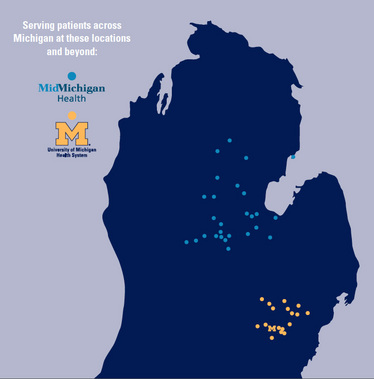
A new affiliation between the University of Michigan Health System and the MidMichigan Health system will give more patients in the middle of the state access to UMHS' clinical trials and new treatments for cancer and cardiovascular problems.
Courtesy of the University of Michigan Health System
“This would be the first time that we could say we own a part of another hospital,” said Dr. Ora Hirsch Pescovitz, executive vice president for medical affairs at U-M and CEO of UMHS. “It is a continuation of our strategy to collaborate with other hospitals throughout the state of Michigan.”
MidMichigan Health is a private, nonprofit health system that covers 10 counties. With its headquarters in Midland, MidMichigan has an A1 Moody’s bond rating and an A+ rating from Standard & Poor.
In addition to its four hospitals, it has urgent care centers, home care, nursing homes, physicians, medical offices and other specialty health services.
In the past year, MidMichigan has added about 50 physicians and several new clinics.
Federal reforms under the Affordable Care Act spurred MidMichigan’s pursuit of an alliance, said Richard M. Reynolds, president and CEO of MidMichigan Health.
“Under the new health reform, there … is more risk assumed by provider groups in health systems, and we felt like we needed more expertise,” Reynolds said.
Reynolds said the health system did not have enough “critical mass” — meaning a wide scope of services — to handle the future health care environment.
Reynolds said MidMichigan Health considered a number of different health systems across the Midwest before choosing UMHS. A financial relationship between the two health systems is one that Reynolds said he hopes will be “mutually beneficial.”
Though there is no time limit to the affiliation at this point, there will be a five-year checkpoint when either party could exit, Reynolds said.
Part of the agreement will involve a complex set of performance metrics that could increase UMHS’ share in MidMichigan, Reynolds said.
“It’s a contribution of the brand as well as a number of services, and then the opportunities to earn additional services,” Reynolds said of the agreement.

Ora Pescovitz
UMHS
The affiliation does not change the geographic reach of UMHS because the health system already receives many referrals from that part of the state. Rather, it solidifies the relationship UMHS has with physicians in the area, Pescovitz said.
Reynolds said it’s difficult for patients referred to UMHS to get care there because of high demand. The new affiliation is one he hopes will give MidMichigan patients better access to UMHS treatment.
“The UMHS logo is the premium brand and is nationally recognized when considered for physician excellence and expertise,” Reynolds said. “We’re hopeful this alliance can expedite referrals there.”
MidMichigan will retain local control of its health centers. Whether the U-M logo is added remains to be seen in the agreement details. Reynolds said MidMichigan hopes to be a regional cancer center in the future.
“We’d like to have more specialized care up here … but we don’t have enough volume to maintain specialists in cancer treatment,” Reynolds said.
The affiliation will mean UMHS specialists will travel to MidMichigan health centers to see patients and save them a trip to Ann Arbor, Reynolds said. It will help ease the patient load on the high-demand Ann Arbor hospital — a move Pescovitz supports.
Pescovitz emphasized that the affiliation with MidMichigan would mean UMHS would be seeing “only the patients that need to be seen” for specialty care by extending a higher level of treatment options to providers in outlying areas, noting a shortage of beds at the Ann Arbor location.
The overall goal is to decrease the cost of medical care in Michigan by reducing the number of re-admissions to the hospital though maximized local care, Pescovitz said.
However, offering a certain level of expensive specialized care — like transplant procedures and pediatric surgeries — in hospitals across the state “does not make sense,” Pescovitz said.
“There are certain things that need to be consolidated centrally,” Pescovitz said.
Patients in the MidMichigan Health system will have better access to advanced cancer and cardiovascular treatments at UMHS, especially in regard to clinical trials and cutting-edge treatments.
UMHS has a long list of organizations and health systems with which it partners, but has not invested in them financially. UMHS has a signed partnership with Trinity Health System, as well as two alliances it has helped to create with other health care providers in Michigan. The health system also has agreements for specialized care in several other Michigan hospitals.
Amy Biolchini covers Washtenaw County, health and environmental issues for AnnArbor.com. Reach her at (734) 623-2552, amybiolchini@annarbor.com or on Twitter.
Comments
a2trader
Wed, Aug 29, 2012 : 1:15 a.m.
Hey AnnArbor.com, can you find out how much public money is going into this venture? The last time I checked, UMHS was part of a public university. It would be interesting to learn how this public/private venture might work. @MichiganMan, the U of M attracts patients from far across Michigan. You might be surprised how many people travel all the way to UMHS for care. Its a lot.
bhall
Wed, Aug 29, 2012 : 12:40 a.m.
^ So you're against allowing children to be on their parents insurance until they're 26? Or you think people should be denied insurance because of pre-existing conditions? Or you're against providing subsidies so the uninsured can buy private insurance through the market? Maybe you're against negotiating Medicare savings with hospitals and health systems? There's something you don't like... Can't figure it out, tho.
brucef
Wed, Aug 29, 2012 : 1:16 a.m.
Children on parents' insurance - fine. Didn't take Obamacare to do that (though it increases cost) Denied insurance for pre-existing conditions. I gather you're also in favor of being able to get fire insurance after your house burns down. Why buy insurance if you can just get someone else to pay for it? Subsidies for uninsured - just another form of tax. Let's call it a tax and vote on that. Negotiating savings with hospitals and health systems - read force them to accept whatever the government deems worthy of payment. We've been doing that anyway without Obamacare. The health care system has problems. There are increasing costs and there is unfairness in the system. The problem is that Obamacare has not fixed it thus far and I don't see how it will fix it. HTH
Goober
Tue, Aug 28, 2012 : 11:35 p.m.
I would venture a guess that they are either rolling in the dough of cash flow, or have large profits due to Obama care coming soon. In any case, who can effectively reject and contest any increase in health care cost that they mandate of their populace? We are powerless, unless we see a change in the leadership in our US government. God Save the Queen – oops, wrong country! God Save Obama – oops! God, I hope we change leadership before we go bankrupt. God save us from ruin!
Michigan Man
Tue, Aug 28, 2012 : 11:30 p.m.
This seems like a stretch. This alliance will fall apart in due course. Just cannot see Ann Arbor academic physicians moving to Clare, Gladwin and Midland. Cannot also see patients from that part of Michigan driving 150+ miles, past countless other Michigan hospitals so that they can marvel at U of M. Weird business relationship.