

U-M led ALS stem-cell trial poised to take major step forward
A University of Michigan-led clinical trial involving the injection of stem cells into the spines of patients with Lou Gehrig’s disease is poised to take a major step forward, Neuralstem Inc., the private sponsor of the trial, announced today.
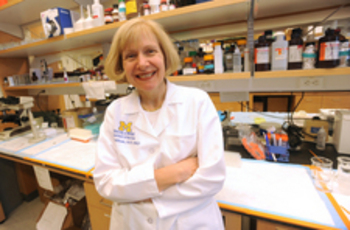
Dr. Eva Feldman
Amyotrophic lateral sclerosis, a fatal neurological condition also called Lou Gehrig’s disease, robs its victims of their ability to speak, move and eventually breathe, while leaving their minds alert, according to the Centers for Disease Control and Prevention.
The first patient is expected to undergo the procedure in November, Feldman said.
“In that area of the spinal chord are the large nerve cells that allow you to breathe normally,” Feldman said. “If by injecting stem cells, we can provide the integrity of the large nerve cells that permit breathing, we hopefully will be able to enhance the lifespan and the longevity of patients with ALS.”
Neuralstem said the first 12 patients tolerated the procedure well, with no major complications.
The study is being conducted at Emory University in Atlanta with Feldman, the director of the A. Alfred Taubman Medical Research Institute, on board as a an unpaid consultant to the trial’s sponsor. The safety trial got under way in January 2010.
Participants are singing its praises.
A 38-year old ALS patient weighed in on the results in September, telling CNN he had to walk with a cane and had trouble breathing when he went to the mail box before entering the trial, but has not had to use a cane and can breathe better since the stem cell injections.
"It's been nothing short of miraculous," Ted Harada told CNN. "I cannot begin to explain the difference it has made."
The hope is the treatment being studied will pave the way for procedures that could halt the destruction of nerve cells by the disease.
Roughly 30,000 Americans are afflicted with the disease and 5,600 diagnosed each year, according to the ALS Association.
Juliana Keeping covers general assignment and health and the environment for AnnArbor.com. Follow special project Viking's War on Facebook and Twitter
Reach her at julianakeeping@annarbor.com or 734-623-2528. Follow Juliana Keeping on Twitter
Comments
BhavanaJagat
Wed, Oct 26, 2011 : 4:31 p.m.
Unpaid Consultant : I would request AnnArbor.com to provide some clarity while they write or describe a story. Why is this information included in this story? Does it provide any understanding of this clinical trial and the actual role of the participant? This trial involves the use of human embryos. I want to know about the method and procedures, rules or regulations involved in the transportation of human embryos from one State to another State. Would it be correct to describe this Consultant as a Medical Courier who is involved in the transportation of live, biological tissues from State of Michigan to Atlanta? How does this person travel and what are the contents of her 'baggage'? The author of this story has stated: "The hope is the treatment being studied will pave the way for procedures that could halt the destruction of nerve cells by the disease." What is the rational basis for this hope or expectation? We do not know as to what causes this disease. This procedure or clinical trial simply involves injecting of foreign cells in the hope that they may serve the purpose of the host organism and work in place of the dead nerve cells. The unknown disease process which initiated the death of nerve cells may continue to exert its influence and may destroy the newly injected foreign cells. If that etiological factor or agency has stopped its operation, the immune defense mechanisms of the host may detect the presence of injected foreign cells and may attack them and eventually destroy them. To claim any early success in this trial, I need to know about the change in the clinical picture, the signs and symptoms that are manifested by conducting a proper clinical examination of each research subject.
BhavanaJagat
Tue, Oct 25, 2011 : 5:12 p.m.
A STEP IN WRONG DIRECTION : This story does not reveal the basic information that would help a reader to know the direction of this research work. A patient has communicated his subjective feelings of improvement in an interview conducted by CNN. If the improvement is recorded by a physician who is not a participant of this study, I would have appreciated the objective findings of the physician. The role of U of M in this study is not clear. Who are these patients? How did U of M get involved in their management? Why are they being managed at Emory? What is the intention of conducting this trial outside the State of Michigan? Have they chosen this venue to defeat the stringent Laws of Michigan that interfere with the use of Stem Cells derived by destroying Human Embryos? Transplanted tissues and cells eventually evoke an immunological response from the Host organism and it is too early to comment about the success of a transplant. What evidence they have to show that the transplant has not failed due to rejection?
Ross Dunbar
Tue, Oct 25, 2011 : 1:57 a.m.
This is wonderful news! Eva Feldman is an incredible researcher, doctor, caretaker, mentor, and leader in our community in the battle against ALS. You are truly a blessing Dr. Feldman. And a big thank you also to everyone in the Ann Arbor area that participates in the Big House Big Heart charity race every year, much of which goes towards ALS research. Go Blue! The Leaders and Best!
Salinemary
Mon, Oct 24, 2011 : 8:41 p.m.
Keep up the good work, Dr. Feldman and her fellow researchers!
Sparty
Mon, Oct 24, 2011 : 8:30 p.m.
Dr. Feldman is terrific and I'm sure there will be many more successes coming from her and her team's endeavors!
Mr. Ed
Mon, Oct 24, 2011 : 7:21 p.m.
Good news.