

Wall Street residents say U-M parking garage will take toll on neighborhood
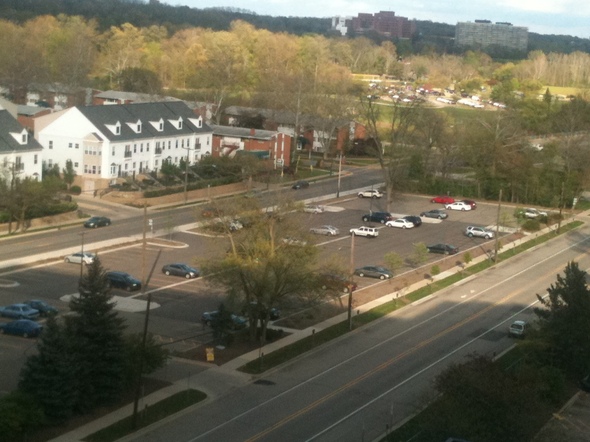
University of Michigan is building a $34 million 700-space parking structure atop this lot on Wall Street.
Kellie Woodhouse | AnnArbor.com
Koli has watched as it the University of Michigan has slowly acquired land in the area, built the Kellogg Eye Center and paved much of the landscape.
"This used to be a neighborhood. It's been slowly leveled and cleaned out and bought out by U-M," Koli said.
"When I first started the grill in 1993 there were houses all down Wall Street and now they're all parking lots," Koli added later. "People here are very aware of how the university can change a neighborhood."
Twenty-six-year resident Brenda Giers, a former University of Michigan hospital staffer, too has seen the landscape change.
"I’ve seen everything torn down," she said. "I've seen everything disappear."
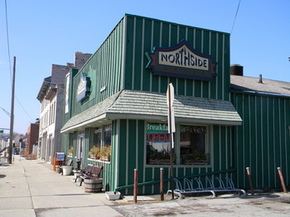
Northside Grill
Koli, Giers and roughly 20 other individuals —Ann Arbor residents and school officials— discussed U-M's plans to build a 700-car parking garage atop an existing 200-car parking lot on Wall Street during a meeting Thursday night.
According to university planner Sue Gott, U-M held the meeting as a good faith measure.
Gott agreed that the landscape of the Wall Street corridor would surely change, but said that the university —with the input of residents— can make the new structure as aesthetically pleasing, environmentally sensitive and residentially useful as the school's $34 million budget allows. She said U-M plans to honor "the experience that one deserves to have in this community" by designing something that "is not only environmentally sensitive but great."
The university is in the beginning stages of designing the four- or five-story garage but preliminary plans have small park areas at either end of the park. Gott said U-M is looking into putting sidewalks and trees along the lengths of the garage that abut Wall Street and Maiden Lane. Responding to residents' concerns that the low elevation of the Wall Street corridor will cause toxic runoff, Gott said the university is planning a storm water drainage system that "wouldn't do anything other than improve today's conditions."
Project architect Neil Martin said he is working to determine a facade "that doesn’t feel enormous and feels pedestrian friendly." He said his firm, SLAM, is working on a design that will minimize light and noise pollution into surrounding neighborhoods.
Residents expressed concern about traffic on Maiden Lane, a roadway they say is already highly congested during rush hour.
"You’re taking 500 additional cars and dumping them all on Maiden Lane, the majority of them within a half hour or 45 minute period," Koli said.
Wall Street resident Tim Mortimer, president of the Riverside Park Place Condo Association board of directors, said pedestrian safety, "especially of the children and elderly residents of our neighborhood," is also a concern.
U-M Community Relations Director Jim Kosteva said the health system's master plan includes construction of a second parking deck on Wall Street and a total of 700,000 to 900,000 square feet of clinical research space. He said there are no imminent plans to construct any other structures or buildings in the Wall Street corridor.
Eliana Moya-Raggio, another Wall Street resident, called the university's plans to further build on Wall Street "awful."
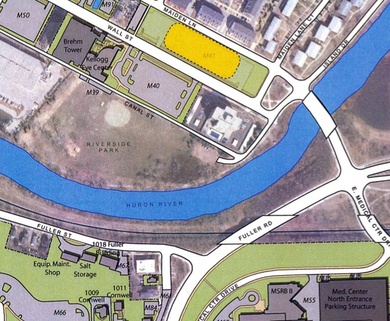
The proposed site for the Wall Street parking structure.
"You don't destroy a neighborhood to place cars in it," she said.
U-M Health System associate director of operations Tom Peterson stressed the need for additional parking, saying patient capacity at UMHS has risen 19 percent in the past five years and staff has increased by 9.4 percent over the past four years.
The growth, he said, is leading to a mounting UMHS parking shortage.
"We have really grown" since the U-M Board of Regents first passed plans for a Wall Street Parking structure in 2008. After receiving fierce criticism from Wall Street area residents, those plans were scrapped a year later in favor of the Fuller Road station, a collaboration with the city for 997-spot parking structure. However university officials announced earlier this year they were canceling plans for the Fuller Road deck due to the city's inability to pay it's agreed upon portion of the garage and adhere to a quick construction timetable.
U-M regents once again approved a Wall Street parking structure at their monthly meeting on April 19.
"This was a project and an activity that was first incorporated in the university's master plan for the medical center in 2005," Kosteva said during the Thursday meeting, adding that planners foresaw UMHS quick growth. "Those expectations have been filled and thus we continue to have a strong need to meet parking demands in this area."
Mortimer and Koli said praised the university for, in their view, being more communicative than it was when it first proposed a Wall Street parking structure in 2008.
"They're being a lot more open this time," Koli said. "Last time it had gotten kind of knocked down the road a little bit before we found out. I think they were surprisingly interested in the residents' response."
Gott said the university will continue to hold meetings with Wall Street area residents throughout the design and construction process.
Moya-Raggio said the inclusion makes her "feel better" about the structure and said residents would hold the university to its promise of additional meetings.
"Because you are not building on campus you need to listen to us and you need to incoporate us in the process," she told Gott. "It's our right."
Kellie Woodhouse covers higher education for AnnArbor.com. Reach her at kelliewoodhouse@annarbor.com or 734-623-4602 and follow her on twitter.
Comments
A2Momx2
Fri, Apr 27, 2012 : 9:49 p.m.
This parking deck is for employees. Are these employees going to walk up to the hospital or are they going to use a UM shuttle? If they are using a shuttle, it doesn't matter where the parking deck is. They can be shuttled from North Campus or from the old Pfizer location. Yes the medical students, residents and faculty do live in the apartments and condos and leave and return at all hours of the day. These parking decks are known to attract some undesirables and crime thereby possibly making some unsafe conditions for the people walking to and from the hospital. These parking decks will not be for the medical students, residents or faculty living on Maiden Lane. They too will have to buy parking passes.
GB
Fri, Apr 27, 2012 : 8:28 p.m.
The "U" will do what it want's.... The neighborhood about to be eliminated means little to the "U" and less to City Council.... Keep voting the current council group into office... and maybe your neighborhood will be next!
justcurious
Fri, Apr 27, 2012 : 6:17 p.m.
U of M gutted this old historic neighborhood ages ago. Note the photo above. They do whatever they want to do. It's simple. Always have and always will.
Marshall Applewhite
Fri, Apr 27, 2012 : 4:15 p.m.
To call that area a "neighborhood" is quite a stretch. It's all medical student ousing anyways, it only makes sense that a parking structure be built to accommodate them and patients.
blahblahblah
Fri, Apr 27, 2012 : 4:01 p.m.
"....the health system's master plan includes construction of a second parking deck on Wall Street and a total of 700,000 to 900,000 square feet of clinical research space." Sounds like the current parking structure plan may just be the tip of the iceberg. While the land is still available, the U should consider converting Maiden Lane into a divided boulevard with "michigan left turns". Besides improving traffic flow, the median could be planted with trees to provide a larger and more attractive buffer between the parking garage(s) and the residents across Maiden Lane.
Tintin Milou
Fri, Apr 27, 2012 : 2:37 p.m.
Widen Maiden and add more lanes. That will solve the problem. According to the comments on AA.com most people love cars and parking and they can't wait to get more of both. It is kind of schizophrenic that this particular neighborhood suddenly protests against a new parking lot. They should be happy! They will see more cars, and I guess they can also sneak into the parking lot to park their car, get off the car, get back in the car, drive around a bit, and park again. The ultimate pleasure for AA citizens.
John of Saline
Fri, Apr 27, 2012 : 2:26 p.m.
The Kellogg Eye center was there in 1993, because I was treated there before that. Just sayin'.
Ron Granger
Fri, Apr 27, 2012 : 2:05 p.m.
Mary Sue Coleman called. She says she doesn't care what the community thinks, and to just be glad they haven't evicted you yet and torn your residence down.
aabikes
Fri, Apr 27, 2012 : 12:59 p.m.
If the problem is too many people are driving in to work. Could a goal be to entice more people to live closer? I always remember a trip to Houston where I was amazed that their entire downtown is offices and parking structures. After 5pm, the city vacates. An extremely eerie reality down there...
5c0++ H4d13y
Sat, Apr 28, 2012 : 3:17 p.m.
I know a lot of people I work with at the hospital have both parents working and so one or the other but not both can live where they work. You must be thinking we live the Brady Bunch era of employment.
Dog Guy
Fri, Apr 27, 2012 : 4:07 p.m.
Yes indeed, aabikes, people should move to Ann Arbor to pay the constantly increasing property taxes that we who live on taxes vote ourselves. Such a wonderful Keynesian system!
oyxclean
Fri, Apr 27, 2012 : 3:57 p.m.
Los Angeles is the same way. It is kind of creepy.
Stephen
Fri, Apr 27, 2012 : 12:53 p.m.
Why don't they build it near the U of M medical school? They have about an acre of land at Zina Pitcher and Ann street.
justcurious
Fri, Apr 27, 2012 : 6:15 p.m.
That land is already slated for new research buildings. Research is where the money is.
oyxclean
Fri, Apr 27, 2012 : 3:56 p.m.
I work at the med school and have heard that land will be a) new 'gateway' to the med school (ie fancy offices for all the med school admins), b) another BSRB building, or c) the location of the new and improved University Hospial expansion. Pretty safe to assume there will be no parking there :(
Stephen Lange Ranzini
Fri, Apr 27, 2012 : 12:24 p.m.
@LesGov wrote: "Once again it comes back to the City of Ann Arbor....the City Council, etc....failure to accomplish things in a timely fashion." Yes, it took my bank 39 months to get approval to add 13 parking spots in a field behind our bank's headquarters on Washtenaw Avenue. Why should it take "the patience of Job", $50,000 of wasted engineering, two neighborhood charettes, and three or four plan revisions to do something simple that other towns would approve in 60 days!
Stephen Lange Ranzini
Fri, Apr 27, 2012 : 12:14 p.m.
As a former resident on Wall Street, one of the problems with the traffic on Maiden Lane that I observed is that it is one of the longest blocks in the State without *any* side streets. The University should pay for paving the alleyway between Maiden Lane and Wall Street where Nielsen Court currently ends and expanding it into a street. By extending Nielsen Court to Wall Street then at least some of the local traffic could flow onto Wall Street and away from Maiden Lane at the busiest times. While the improvement might be modest, at least for the local residents, it might help offset some of the increased traffic when Maiden Lane is stopped bumper to bumper.
doglover
Fri, Apr 27, 2012 : 11:45 a.m.
1953? I'm pretty sure Northside hasn't been there more than 30 years.
Kellie Woodhouse
Fri, Apr 27, 2012 : 12:10 p.m.
Thanks so much for catching this. It's been open since 1993.
yohan
Fri, Apr 27, 2012 : 11:33 a.m.
The rape of Wall Street continues "You don't destroy a neighborhood to place cars in it," she said. UM does it all the time. Wall Street is not the only neighborhood that the university ruined and continues to do so. When you have bought and control the mayor and his council lemmings you can do as you like.
Alan Goldsmith
Fri, Apr 27, 2012 : 10:44 a.m.
"Northside Grill owner Jim Koli recalls a time when Wall Street was nothing more than a residential neighborhood in northeast Ann Arbor." Some local historians suggest the shift came when the Cloverleaf Restaurant was bounced from their neighborhood location to make room for a business with deeper pockets who convinced the building's landlord into not renewing the Cloverleaf lease too.
justcurious
Fri, Apr 27, 2012 : 6:12 p.m.
Interesting take on it.
oyxclean
Fri, Apr 27, 2012 : 3:49 p.m.
oh snap!
1bit
Fri, Apr 27, 2012 : 10:38 a.m.
Sorry, Wall Street folks, the U is going to do what it needs to do. Although not "imminent", the master plan from 2005 is unchanged and the entire Wall Street corridor will become part of the health campus in a bigger way. You might not like it but your only recourse will be to do what your neighbors did years ago - move and sell your property to U of M. Although I don't think highly of the City Council, I do believe this structure would have been built eventually even if the Fuller Road project had gone forward.
Chip Reed
Fri, Apr 27, 2012 : 10:30 a.m.
Lower Town has had a tough time since Anson Brown died in the 19th century. This was the industrial part of town (Ann Arbor Implement, etc.). When I was a boy, homeless people (hoboes) lived in Riverside Park. The apartments where the florist used to be were built because it is so close to the medical center. These are some things that I don't like about the U-M, but perhaps they have created some neighborhoods, in addition to destroying others.
justcurious
Fri, Apr 27, 2012 : 6:12 p.m.
Ann Arbor Implement was on First Street near the Blind Pig, not across the bridge. Not only has the U of M destroyed neighborhoods, they have even taken over cemeteries. Wall Street had historical significance in Ann Arbor. They thumbed their nose at the townies for years, all the while not paying taxes.
Les Gov
Fri, Apr 27, 2012 : 10:21 a.m.
Once again it comes back to the City of Ann Arbor....the City Council, etc.....failure to set priorities that are important to the citizens of Ann Arbor and failure to accomplish things in a timely fashion. Believe it or not, parking decks should not take years and years to build. (the parking deck downtown is a great example of extremely poor project management.) If the Wall Street residents don't like the parking deck that U of M is building they need to look directly at AA's City Council. This parking deck could have been avoided. " university officials announced earlier this year they were canceling plans for the Fuller Road deck due to the city's inability to pay it's agreed upon portion of the garage and adhere to a quick construction timetable." U of M made the right move in dumping the City of AA government and moving forward on their own. Maybe those elected officials sitting at the Council table will learn a lesson.
Stephen Lange Ranzini
Fri, Apr 27, 2012 : 12:23 p.m.
@LesGov wrote: "Once again it comes back to the City of Ann Arbor....the City Council, etc....failure to accomplish things in a timely fashion." Yes, it took my bank 39 months to get approval to add 13 parking spots in a field behind our bank's headquarters on Washtenaw Avenue. Why should it take "the patience of Job", $50,000 of wasted engineering, two neighborhood charettes, and three or four plan revisions to do something simple that other towns would approve in 60 days!