

Ypsilanti Housing Commission director retires as HUD says agency faces 'significant, unrecoverable' shortfall in funding
Ypsilanti Housing Commission Director Walter Norris retired on Aug. 4, within two weeks after the agency received a notice from the U.S. Department of Housing and Urban Development that said its Section 8 Voucher Program is facing a “significant and unrecoverable” shortfall in funding.
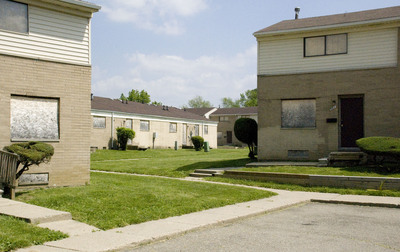
Hamilton Crossing Apartments are still undergoing renovations.
Tom Perkins | For AnnArbor.com
The shortfall totals $228,407, according to HUD documents, which also came with a warning in a financial review that the YHC "did not provide sound financial management."
It's the latest in a series of federal concerns raised over the YHC's finances over the past year.
Now, the housing commission faces default on its obligations, HUD says, and the federal agency is seeking to move the city's subsidized housing vouchers to the oversight of a different agency.
And the Ypsilanti City Council will hold a special meeting at 5:30 p.m. Tuesday at City Hall to discuss the YHC's issues.
The housing commission is responsible for administering the low-income public housing and Section 8 programs within Ypsilanti. The YHC operates as a separate legal entity from the city and manages properties such as Paradise Manor and Hamilton Crossing Apartments at the corner of South Hamilton and Harriet streets.
The YHC's revenue in 2011 was $4.68 million, according to an audit.
The YHC operates 218 public housing units, 26 of which are designated for senior housing. Interim Director Eric Temple said the commission has 271 Section 8 vouchers -- not including the 68 that have yet to be made available for people seeking to live at Hamilton Crossing.
Hamilton Crossing - the former Parkview Apartments at South Hamilton and Harriet - is owned by the housing commission, which participated in a $16 million renovation of the property financed by state and federal funds.
YHC ‘blown away’ by findings
In its financial management review and shortfall letter, HUD says the YHC is over-committed and there are no funds available to cover the additional expenses for 68 project-based voucher units at Hamilton Crossing.
“I have been blown away by these findings,” Commissioner Deborah Strong said. “… We’re bringing in external auditors.”
Director of the Office of Public Housing Willie Garret wrote to YHC Board Chair Ma’ Cheryl Jones that at current Housing Assistance Payments levels, the YHC will be able to pay approximately only one-third of its current HAP obligations in November 2012 and none in December.
“YHC will have no option but to default on its obligations,” Garret wrote.
The financial management review uncovered “inappropriate use” of HAP funds and believes the YHC used the funds to cover excess costs. The findings also say the YHC under-reported administrative expenses by $27,477.
Garret wrote that the YHC was considering two options to resolve the shortfall: drastically reducing HAP expenses by means of a Payment Standard Waiver and other cost saving measures or transferring the program to another housing authority with sufficient funds to properly administer the program.
Reducing the payment standard of the Section 8 voucher program would have resulted in the average participant family paying 73 percent of its monthly income for rent instead of the 30 percent generally provided for under the voucher program.

Council Member Ricky Jefferson is concerned with the way the Housing Commission operates.
Jeffrey Smith | AnnArbor.com
As an example, a family of two in a two-bedroom home would face a rent increase from $625 per month to $978 a month.
In addition to that, Garret wrote that 18 families would be effectively terminated from the program because their HAP will be reduced to $0. Twenty-two families would have their share of rent increased to more than 100 percent of their monthly income.
The changes would remain in effect indefinitely, according to Garret, until the program “shrinks sufficiently through attrition.”
If the YHC decided to choose that option, it had until Aug. 1 to notify participant families or the changes would have been pushed back to Oct. 1 and the cuts would have been deeper.
Temple said residents have been kept abreast of the ongoing proposed changes.
The second option would allow the YHC to voluntarily move to transfer the entire Section 8 program to another public housing authority.
In the letter, Garret said the alternative would allow current participant families to remain at current levels and the YHC’s obligation to provide project-based voucher assistance for Hamilton Crossing would be met.
Temple and Strong said neither option was appealing to the YHC.
“It would have caused residents great stress,” Temple said. “The housing commission, along with HUD, does not want to see that happen.”
Just this week, after Norris retired, HUD put another offer on the table. HUD said if the YHC agreed to give up the 68 vouchers for Hamilton Crossing and give them to another housing authority, the YHC would be able to avoid the more severe changes.
“They would interview and select the families,” Temple said. “The monies that we would normally get for those vouchers would go to the other agency.”
However, details are still being negotiated.
“We have not received any news,” Temple said. “The Detroit HUD office wants all of us to sit together. We have not gotten any final decisions.”
Norris retires, Temple appointed director amid troubles
Temple, the former YHC administrative specialist, was appointed interim director of the commission by the YHC board after Norris submitted a letter stating his intent to retire.
“We received a letter from Norris indicating he would like to retire,” said Strong. “It became effective Aug. 4.”
Norris could not be reached for comment. Temple's appointment became effective Aug. 4.
When asked whether the HUD report had anything to do with Norris’s retirement, Strong told AnnArbor.com it “was not part of the conversation.”
“He thanked us for the time engaged in the role and did not say that was the motivation,” Strong said. “We are trying to process him out right now.”
Mayor Paul Schreiber said HUD made it “pretty clear” that the YHC needed to make several changes.
“When the person responsible is the executive director, at some point the executive director has to be held responsible,” Schreiber said.
“Mr. Norris realized he was responsible and he thought a way to fix this was to retire. I think a number of people talked to him about what some of the options were, but in the end, this was his decision.”
Per his contract, Norris received a base annual salary of $105,686.88, a full health care package, the use of a vehicle and possible “incentive compensation.”

Walter Norris
When Norris was hired in 2003, he was paid $70,000. He received $35,000 in raises over the course of eight years.
In a September 2011 sustainability report, HUD labeled Norris’s salary as “excessive.”
Council Member Pete Murdock told AnnArbor.com at the time that the salary was “over the top and outrageous” but, despite outrage from several council members, there was little the council can do about Norris’s salary.
The YHC and Norris's salary is funded entirely by HUD and his salary is determined and voted on by the board of commissioners, which is a separate legal entity from the city. The city council cannot decide how much Norris makes.
The commissioners are nominated by Schreiber and approved by city council.
Norris may be entitled to a severance package, although Strong stopped short of calling it that.
“I don’t know if I would call it that but when you retire, you have sick leave, vacation time and a lot of things that are due to you just because you’ve accrued them,” Strong said. “We tried to capture that and be as accurate as we can and not be punitive in this process. I would say that we are cashing him out based on time served.”
Strong said the commission has projections of what the “package” would amount to but said the amount is not concrete yet.
“We’re working right now with the accountant and there are a lot of things that we have to process,” she said. “We have some projections but no accurate numbers.”
As Temple takes over, city officials are divided over his new role. Council member Ricky Jefferson has expressed concern over Temple being appointed interim director.
“For the best interest of the city, I am not in agreement with Mr. Temple being appointed as interim director,” Jefferson said. “I made it clear to him and (City Manager) Ralph Lange that I have no assurance that he is capable of turning this around.”
In April, AnnArbor.com reported that Temple, who has been employed with the housing commission since 2004, was convicted of felonious theft in 2004 for writing a bad check for a new car in his former hometown of Missouri City, Texas.

Eric Temple
Courtesy photo
Schreiber said he believes Temple is the right person for the job.
"He knows the housing commission better than anyone else," Schreiber said. "That would enable the commission to make the changes it needs to as quickly as possible. It will enable the financial deails to be executed quickly."
Strong said she hopes the community gives Temple a fair opportunity to turn the YHC around.
“I just hope people ... see that he’s trying to establish a relationship and not base this on his past,” Strong said.
Jefferson met with Temple and Lange this week to discuss the status of the Section 8 program and his appointment. Jefferson said council still has yet to receive any written notification regarding the standing of the Section 8 program or any plans to address the “crisis.”
Strong said the YHC is doing a lot of fact finding to prove that the commission has the funds to make up for the shortfall. She did not specify where the funds would come from.
“We have non-HUD resources that should be able to cover that and that’s what we’re trying to pull together right now,” Strong said. “Having a shortfall is not unusual and it happens to a number of agencies. We’re trying to document for HUD to show we have resources available to close the shortfall.”
Moving forward
As one of its concerns, HUD wrote that recordkeeping improvements are needed in order for the YHC to become sustainable.
“There were several instances where the Quality Assurance Division staff requested needed supporting documents, and we found that the documents that were provided did not provide sufficient information or the information was in a format that was difficult to follow,” HUD wrote.
Strong acknowledged the need to improve the commission’s accounting.
“Everyone makes mistakes, including HUD,” she said. “Maybe they didn’t see a piece of paper. We really acknowledge there have been some mistakes on the housing commission’s side.”

Paul Schreiber
Temple also believes there may have been an error in HUD’s reporting.
“Yes, we’ve made some errors but there have been some on both ends and we’re working to straighten them out,” Temple said. “We still believe it was an error in some way of the reporting. There may have been an error in our system and we have to make sure we’re looking to get more detail.”
Jefferson expressed concerns with transparency. Strong said the commission is devoted toward becoming more transparent with council and the community.
"None of this work can be done in a vacuum," Strong said. "... You’re never going to appease everyone but it won't be because we didn’t try."
Yet Murdock said the report is "devastating and critical" and council is in the "dark" in terms of the next step to correct the issues.
"I think the total administration has not been doing a good job. It's clear they haven’t," he said. "We have limited options obviously and we’ve gone through this before. Just eight months ago, another report from HUD had all these criticisms and they were in the process of correcting it and in light of this new report, it obviously hasn’t happened."
See the HUD documents here:
- Walter Norris's contract.pdf
Katrease Stafford covers Ypsilanti for AnnArbor.com. Reach her at 734-623-2548 or KatreaseStafford@annarbor.com. You can also follow her on Twitter @KatreaseS.
Comments
pseudo
Mon, Aug 13, 2012 : 4:14 p.m.
Following on to what some others have asked: how many public housing units are in Ypsilanti in total? It is my understanding that there are 2 - 3 other agencies doing the same thing so the number of public housing units + section 8 vouchers is ????
Jay Thomas
Mon, Aug 13, 2012 : 3:04 a.m.
A convicted thief appointed to oversee missing money... what could go wrong? Anyway, I just wanted to say that Ypsi has WAY TOO MUCH rental housing as it is (A majority of its housing in fact... which is abnormal by a mile). These public housing projects always fall apart after just so many decades because the residents do not take very good care of them. Instead of constantly throwing new money at rebuilding them why not let the residents go elsewhere and watch your crime rate drop dramatically. It's like Ypsi wants to stay poor or something...
Jay Thomas
Tue, Aug 14, 2012 : 5:02 a.m.
Follow my advice and when the crime rate drops I might just do that. Too bad you have the proper order of action mixed up when it comes to rejuvenating a city. You say, "move here and get mugged like the rest of us... or keep your yap to yourself." I say get the projects OUT and people will want to come.
Basic Bob
Mon, Aug 13, 2012 : 12:42 p.m.
Feel free to buy a house in Ypsi, fix it up, and live in it. Also encourage your friends to do the same. These make excellent starter homes and are nice enough for retirees. Otherwise it is just an opinion from the 'wouldn't be caught dead in Ypsi' crowd.
greg, too
Mon, Aug 13, 2012 : 12:49 a.m.
"I just hope people ... see that he's trying to establish a relationship and not base this on his past," Strong said." If we can't base our lack of desire to have him on the job based on his past as a criminal, why should we be expected to base any hope of him doing well on his supposed experience doing his job? The man was arrested for knowingly bouncing checks and has received payment in the past for time he wasn't in the office. And this is the guy we want to fix a corrupt commission?
martini man
Mon, Aug 13, 2012 : 12:29 a.m.
To the liberals running things, the solution is simple ..just raise taxes !!! I am sure the working people of Ypsilanti would be more than glad to pay higher taxes. Maybe throw in an ART TAX as well, like Ann Arbor is trying to do. It just keeps getting better and better doesn't it ????
AdmiralMoose
Mon, Aug 13, 2012 : 11:21 a.m.
Somebody's been listening to too much AM talk radio and not paying attention to reality. Ypsilanti voters rejected a city income tax. Darn them libruls fer not acting like Rushbo sez.
genetracy
Mon, Aug 13, 2012 : 12:03 a.m.
Another unqualified federal bureaucrat who could not balance a checkbook. Who would have thought?
Ron Granger
Sun, Aug 12, 2012 : 8:54 p.m.
Council member Ricky Jefferson has expressed concern over Temple being appointed interim director. "For the best interest of the city, I am not in agreement with Mr. Temple being appointed as interim director," Jefferson said. "I made it clear to him and (City Manager) Ralph Lange that I have no assurance that he is capable of turning this around." In April, AnnArbor.com reported that Temple, who has been employed with the housing commission since 2004, was CONVICTED OF FELONIOUS THEFT in 2004 for writing a bad check for a new car in his former hometown of Missouri City, Texas. --- Well, it sounds like the transition should be very seamless.
greg, too
Mon, Aug 13, 2012 : 12:45 a.m.
Replacing one crook with another. Brilliant.
Ron Granger
Sun, Aug 12, 2012 : 8:52 p.m.
"The financial management review uncovered "inappropriate use" of HAP funds and believes the YHC used the funds to cover excess costs. The findings also say the YHC under-reported administrative expenses by $27,477." Bring in the auditors and begin the criminal investigation!
Jack Campbell
Sun, Aug 12, 2012 : 6:28 p.m.
A la Detroit.
Basic Bob
Sun, Aug 12, 2012 : 3:13 p.m.
What a great contract! It doesn't specifically address retirement or resignation by the employee. Since it is not a "just cause" termination voted on by the commission, one might believe that his lawyer will argue he he is entitled to six months pay with no job duties. That sure makes it tougher to wipe out a shortfall.
RUKiddingMe
Sun, Aug 12, 2012 : 2:16 p.m.
Hmm. A giveaway program mismanaged by incompetent and/or corrupt people. Weird.
xmo
Sun, Aug 12, 2012 : 1:33 p.m.
Typical Government Management of a program! Broke, high salaries for administrators and the ones who are supposed to be helped get little or nothing!
Fred Altenbernt
Sun, Aug 12, 2012 : 1:19 p.m.
Have to love stories like this, the people these people are suppose to help get the shaft and the person responsible will ride away without a care. Instead of doing an audit to see if he had done things wrong, maybe bring charges against him to recover some of the money. And you put an ex-felon in temp. charge to turn things around. Yeah, good idea, i do believe in giving someone a chance, but at the top? Has this person been vetted and what experience does he bring to the table. The housing commision should be investigated for having a rubber stamp in their hand and saying "Yes, they are doing a good job, they told us so" Have them sent reports that on what is going on, hire an outside auditor, make the person in charge keep them abreast of what is going on. Ask questions instead of sitting at meetings nodding, going yes, yes, yes. Maybe they are a big part of the problem.
walker101
Sun, Aug 12, 2012 : 1:10 p.m.
Just another failed Federal program with corrupt and incompetent employees.
Tom Todd
Sun, Aug 12, 2012 : 2:35 p.m.
Wouldn't expect better from Bain capital.
Chase Ingersoll
Sun, Aug 12, 2012 : 1 p.m.
Look at the lack of racial, gender, educational and professional diversity on the commission. I doubt any of them could get hired as a retail manager in the private sector.
Mike
Sun, Aug 12, 2012 : 8:47 p.m.
Those jibs are set aside in general especially for people of Mr. Norris's age. Not saying he was given this position becaause of that, I'm just saying set aside quotas have been in effect for the last 40 years in the government while more capable persons may be oevrlooked.
raberwhitetail
Sun, Aug 12, 2012 : 12:30 p.m.
Time to hold these people accountable for their work habits and thievery. Why do we reward them with tax payer retirements?
raberwhitetail
Sun, Aug 12, 2012 : 12:04 p.m.
This just proves that the city of Ypsilanti is falling into the same trap that brought Detroit down.
motorcycleminer
Sun, Aug 12, 2012 : 10:30 a.m.
The victims here are those who rent and the taxpayers that pick up the tab..wonder how nice a golden parachute norris set up for himself....sadly the typical " milk the cow and run " additude of too many " public servents " and when the taxpayers see fit to put " managers " into cities and venues that mismanage and misuse those funds there are protests to beat hell ....duh...
Mike
Sun, Aug 12, 2012 : 8:45 p.m.
There are going to be more and more taking the money and running as things get worse.I know a number of "public servants" who are retiring to get there pension "locked in". Greta system. It will eventually fall apart because we are running out of money as a nation.