

Ypsilanti Township uses task force to clean up hundreds of blighted properties
On Stevens Drive in Ypsilanti Township, a 31-unit apartment building sat crumbling for more than a year after a September 2009 fire. Neighbors complained and it became a dangerous attraction for kids.
On Verna Street, a vacant house was growing mold stalagmites several feet long. Authorities identified six different mold species growing in the house. Neighbors began to get sick.
On Stony Creek Road, a man turned a residential property into a junkyard with a variety of snowmobiles, cars and other vehicle and vehicle parts amassed on the land.
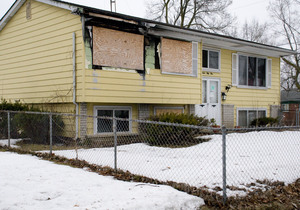
Ypsilanti Township officials are making use of a fire insurance escrow account to help addressed abandoned, burned homes like this one on Rolling Court.
Tom Perkins | For AnnArbor.com
These properties are just three of more than 100 the township has cleaned up since the Office of Community Standards developed a task force to tackle the problem of blighted property.
"Before developing ... this program, houses would stay burned out or neglected for years and there was no enforcement; they were not on the radar,” said Township Supervisor Brenda Stumbo. “Now, we have developed a process to preserve and protect our neighborhoods and business districts. This program is a good investment of taxpayers' money that has impacted all areas of the township. “
Blight issues came to the township's attention in 2007 when officials began receiving a growing number of complaints from longtime residents about the condition of single-family rental homes.
After taking stock of the township's housing, officials were surprised to discover nearly 1,800 rental homes — not including apartment buildings — and far more vacant houses than they imagined. Rentals accounted for 12 percent of their single-family home properties, and in the West Willow area, the township's largest neighborhood with 1,400 homes, rentals accounted for 35 percent of the stock.
It was a shock for a township with a solid tradition of home ownership until the closing of its major industrial employers in recent years. At the same time, the foreclosure rate in Ypsilanti Township spiked and remains one of the highest in the county.
"We quickly realized the scope of the issues," said Mike Radzik, director of the Office of Community Standards. "They were having a negative impact on the neighborhoods, but at first we didn't have a handle on how serious the situation was."
Since forming the OCS and community stabilization program, township officials have identified a list of 180 properties, which are considered the most serious cases. Of those, 110 cases have been closed, but the list grows weekly. The township has also corrected nearly 13,000 code violations, and Radzik said the rental housing stock is "significantly safer and better maintained" because of the program.
The OCS’s first undertaking in 2008 was the cleaning up of the deteriorating Ypsilanti Mobile Village trailer park on East Michigan Avenue, which, after two years, is nearing a successful conclusion. The condemnation of the Liberty Square condominium complex off Grove Road is another long-term effort.
Of the structures on the OCS’s public nuisance abatement list, 104 are classified as having structural blight issues, 60 have sustained significant fire damage and another 16 are improperly zoned.
Aside from extreme examples like Liberty Square or Ypsilanti Mobile Village, "common" structural blight issues include mold infestations or hoarding, Radzik said.
In one instance, the OCS responded to complaints about the odor from an apartment of a woman hoarding cats in Roundtree Apartments. Upon inspecting, ordinance officers discovered dozens of cats and found the floor soaked in the animals' urine.
The interior was condemned for its unsanitary conditions, and because the woman refused to clean it, the township filed suit in circuit court. A judge ordered the woman to bring the property up to code.
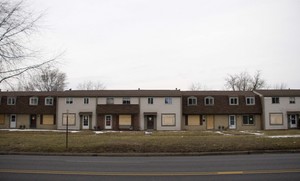
A view of Liberty Square from Grove Road.
Tom Perkins | For AnnArbor.com
In a recent zoning case, a man had taken over township property that bordered his back yard and built a makeshift “factory” to manufacture 55-gallon barbecue pits. He then placed signs along adjacent Ford Boulevard.
The man ignored multiple township requests to cease and desist operating, leading the township to sue. The owner agreed to dismantle the operation after one hearing, and, following the court case, Township Planning Coordinator Joe Lawson was able to locate a site properly zoned for a barbecue pit factory.
Radzik said the township has made good use of a state law allowing officials to request insurance companies place a portion of money paid out after a house fire into a fire escrow account. If an owner doesn't clean up the property or rebuild, the township can pull the money from the account to clean up the property. So far the fire insurance escrow fund has either paid for or encouraged owners to clean up seven properties.
Radzik said officials also address more routine issues such as abandoned cars, lawns that need mowing or garbage-related issues.
“We try to keep up with those, too,” he said. “We pride ourselves on doing same-day service if the call gets there early in the day. Someone will try to respond and within 24 hours to 14 days, we can have it taken care of. We don’t have to go to court on probably 95 percent of cases.”
Though officials have encountered situations in which people were living in a condemned structure, Radzik said the township never forces anyone onto the street.
“That’s something we won’t do,” he said.
In one case, ordinance officer Bill Elling used his personal credit card to purchase a cartload of groceries for a woman who had been dislocated from her condemned home and had no money.
“You would never hear him tell that story because he’s not looking for a pat on the back, but we’re fortunate to have people like that working for us,” Radzik said.
In all cases, Radzik said, officials first urge property owners to address blight voluntarily.
“Our goal is always voluntary compliance for a couple reasons. It is infinitely less work for us and it costs taxpayers much less,” Radzik said. “There have been innumerable cases where the property owner stepped up and we didn’t need to get attorneys involved."
Township building inspector Ron Fulton said that approach is also a good strategy financially. “We would much rather have the building rehabbed and put back as an active member of the tax roll,” he said.
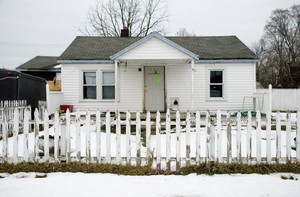
Township officials have 180 properties, like this one on Moeller Street, on their nuisance abatement list.
Tom Perkins | For AnnArbor.com
Although some residents have complained about the legal costs associated with the effort, officials said the return far outweighs the investment, and the cost of nearly every demolition has been covered through grant money or owner funds. A federal Neighborhood Stabilization Program grant for more than $300,000 paid for 14 demolitions and another 12 were funded by owners. Only two were funded by the township under special circumstances.
Aside from attorneys' fees, township officials must factor in how much time OCS officials dedicate when considering the cost. Although Radzik said there is no figure available, officials believe they get a return on their investment.
"The alternative, in the end, is more costly with falling values of real estate," Fulton said.
Radzik said property values and appearances are not the only considerations. He pointed to the Verna Street mold infestation. Officials orchestrated a controlled burn with the Fie Department to safely bring down the structure. Although the township paid for the demolition, a lien has been placed on the property.
"How do you quantify residents' health?" Radzik asked.
John Pappas was one of the residents living near the Verna Street home who had complained about the infestation.
"They were burning something that was only 14 feet from my house so we were concerned," Pappas said. "But they planned it, put up barrier walls, and wrapped everything. We were just happy to see it gone. ... They did a good job with it and I have nothing but praise for them."
Editor's note: The number of homes in the West Willow neighborhood has been corrected.
Tom Perkins is a freelance writer for AnnArbor.com. Reach the news desk at 734-623-2530. For more Ypsilanti stories, visit our Ypsilanti page.
Comments
Barbara
Thu, Mar 3, 2011 : 12:13 a.m.
SEE: "What happens when a bank begins to foreclose on a property, then changes its mind?" by Justin Sondel @ <a href="http://bit.ly/i5z3Py" rel='nofollow'>http://bit.ly/i5z3Py</a>. It is crucial for lawmakers to probe lawyers who file bankruptcy court and civil court foreclosure proceedings. Banks, lenders, and servicers cannot accomplish legitimate or illegitimate repossessions or foreclosures WITHOUT A LAWYER FILING SOME TYPE OF PLEADING. Even for non-judicial foreclosures, lawyers record deeds as a result of purported foreclosures. When foreclosed property deeds are illegal, future buyers encounter all sorts of problems down the line –even when buying fixer-up blighted properties! Fabricated deeds also enable lenders to claim unentitled mortgage insurance claims, file false IRS 1099-A's –and still force upon communities blight and rodents. Untold numbers of families are homeless WHO HAVE NEVER LOST OWNERSHIP of their homes –some of those people are probably in those stories. Further, thousands are unconscionably assessed "DEFICIENCY JUDGMENTS" and garnishments from foreclosures, but they actually do not owe that debt!! Please demand that law makers, Attorneys General, and Congress NOT ONLY examine lenders & servicers, but moreover foreclosure LAWYERS & MILLS. *SEE: <a href="http://www.change.org/petitions/view/request_for_congressional_foreclosure_panel_to_examine_foreclosure_lawyers#" rel='nofollow'>http://www.change.org/petitions/view/request_for_congressional_foreclosure_panel_to_examine_foreclosure_lawyers#</a>
klovejoyroe-ytownclerk
Tue, Feb 22, 2011 : 8:20 p.m.
Please call 734.485.3943 to report suspected illegal business operations in residential areas or any suspected ordinance violations. Some home businesses are legal but auto repair is not a legal residential home business occupation in Ypsilanti Township. We need the help of eyes and ears of all our residents to support our neighborhoods and keep them safe. Please call the above number in our Office of Community Standards or go to our website at <a href="http://www.ytown.org" rel='nofollow'>www.ytown.org</a> and click on ordinance to file a complaint or see our ordinances. Report what you think is wrong, it is better to be safe than sorry. It is the only way we can help keep our property values up, protect the stability of our great neighborhoods and keep everyone safe is by working together. Thanks to all who commented on this article.
Atticus F.
Tue, Feb 22, 2011 : 4:47 p.m.
Ypsi township should be looking for solutions to help the poor in their community, by looking for ways to provide jobs and education to it's residents. Kicking the current resident's out on the street, in the hopes of confiscating people's property and then selling it to 'well to do' investors, is NOT a sustainable solution to the townships problems. And I believe it to be morally wrong.
Angela Barbash
Tue, Feb 22, 2011 : 4 a.m.
While in theory that may sound like a good idea, but I don't think it would be practical. A neighborhood incorporating itself with a Homeowner's Association is an interesting idea. It would require fees though, and might economically scare off otherwise stable owners and investors. What we're trying to do here (West Willow) is get the investors involved with the homeowners, to get them familiar with what the issues are, how quality of life is suffering and ultimately to find a win-win for everyone. If you as an investor get involved, make the neighborhood a better place to live, then you'll attract more stable rental income, you'll get Bill and the gang off your back and ultimately the value of your investment may return at a higher rate than it would have otherwise. The icing on the cake is for investors to consider turning some properties and good tenants back into homeowners through land contracts and lease to own options... Hopefully this collaboration will result in fewer abandoned properties, blight and nuisance tenants.
Too.Tall
Tue, Feb 22, 2011 : 2:05 a.m.
I agree. Mike, Bill and Ron are doing excellent work and I wholeheartedly support them!!! Blight is not always caused by renters, but seems to be more often than not. Is it possible.... to create a zoned "residential rental neighborhood" where all single family homes would be rental units separate and apart from home owner units? This would alleviate the burden to homeowners of having to deal with "temporary neighbors"; those who do not have a stake in the stability and upkeep of the property and neighborhood. Is it possible that neighborhoods that are being encroached on by investors, as is the case in West Willow, could change to an association and write in the bylaws to prohibit rental units or at least minimize the number or percentage of rental units per total unit count? Could the township propose such regulation? I bet homeowners outnumber investors and could get this passed by a landslide! Reducing the number of rental units or corralling them to one location would also reduce the effort, time and $$ spent by Mike, Bill and Ron. When the "not in my backyard" starts showing up in my backyard, then I start thinking about those other backyards...
toofmullets
Tue, Feb 22, 2011 : 3:21 p.m.
I've been under the impression that they do that around the EMU area by zoning out renting in some areas. I might be wrong though, I just heard that when I lived over in that area.
Soothslayer
Tue, Feb 22, 2011 : 2:01 a.m.
People don't get sick from mold. That's absurd, it's everywhere.
djacks24
Mon, Feb 21, 2011 : 9:51 p.m.
"Although some residents have complained about the legal costs associated with the effort, officials said the return far outweighs the investment, and the cost of nearly every demolition has been covered through grant money or owner funds." It amazes me that even when use of our tax dollars has absolute value and transparency like in this situation, there still has to be a select few that are never satisfied with anything. Let all the whiners move if they don't approve. I for one am glad to see my tax dollars well spent this way. Money well spent!
Monica R-W
Mon, Feb 21, 2011 : 8:52 p.m.
Loving the job that the Ypsilanti Township Board of Trustees and Atty. Doug Winters is doing to control neighborhood blight! They need to keep the pressure on these 'owners' to improve the property of tear it down! We have to keep our community presentable!
Monica R-W
Mon, Feb 21, 2011 : 8:57 p.m.
Correction, or tear it down! If appointed to the Board of Trustees to fill former position of Dee Sizemore, I plan to continuing to fully support this effort in Ypsilanti Township. Monica Ross-Williams Candidate for Ypsilanti Township Board of Trustee Appointment Video of my speech (along with 17 other candidate) before the Board of Trustees on 2/15 <a href="http://www.YTownCan.com" rel='nofollow'>http://www.YTownCan.com</a>
gamebuster
Mon, Feb 21, 2011 : 5:47 p.m.
This is the right thing to do. Thanks for the township and related people's effort. When the housing fund is tight, it's smart to use tax dollars in a right way. Considering the overall local housing situation, please don't overlook how the officials approved money to North Main Affordable Housing handled by Avalon Housing. The cost for one apartment is over $330,000. Besides, Avalon Housing is going to demolish 1500 Pauline which was originally planned for rehab. Go visit that place, you will know that they still look really good. Avalon Housing borrow $8 million to build new. The community shows concerns the real need to rebuild (demolish 47, then rebuild 32, plus using over $8 million), or the big non-profit (Avalon Housing) got too overwhelmed by the "Developer fee" kicked back by the contractor? Though with tight housing funds, I applaud the ypsilanti officials doing a great job & enhance better quality of life for their people.
Concerned Citizen
Mon, Feb 21, 2011 : 3:49 p.m.
Here here to AA. "Restore 'Single Families' to our neighborhoods". Please! Just because people are working in cars out of their garages instead of the driveway (which is against the blight ordinance) does not mean they are running a business in a residential area. There are zoning violations and probably IRS violations going on. The ordinance department only seems to care about the "blight" aspect of these situations, and getting this business into people's garages. That is not enough!
Concerned Citizen
Mon, Feb 21, 2011 : 3:51 p.m.
CORRECTION: "does not mean they are not running a business"
washtenawresident
Mon, Feb 21, 2011 : 3:39 p.m.
" following the court case, Township Planning Coordinator Joe Lawson was able to locate a site properly zoned for a barbecue pit factory." Hahaha......I happen to know, Joe Lawson did not locate the site...but this sure makes it look like he was out there searching for this guy a great place for his business, lol ;)
AA
Mon, Feb 21, 2011 : 3:24 p.m.
Then they run businesses out of the garages (i.e. working on lawn mowers, snow plows, maintaining equipment related to there business) I have two homes like this on my street. The garage windows are blacked out (and in some cases the front bay windows) so you cannot see all the CONSTANT traffic and activity. Also in one year the driveway is blackened with oil from a endless stream of coming and going cars and parked cars. Please help Bill. Restore 'Single Families' to our neighborhoods. Please.
Gerald
Mon, Feb 21, 2011 : 3:39 p.m.
AA: I think you can use this link to give them the information or call 485-4393. <a href="http://ytown.org/government/township-departments/ordinance-department/report-ordinance-violation" rel='nofollow'>http://ytown.org/government/township-departments/ordinance-department/report-ordinance-violation</a>
AA
Mon, Feb 21, 2011 : 3:23 p.m.
Bill Elling is a great asset to the Ypsilanti Twp. community. Now if we could just solve one more important issue . . . .Single Family Homes" that house as many as 5 families or upwards of 20 to 30 residents. They are able to skirt the single family aspect because #1 They share a common kitchen and #2 No rental codes or enforcement. I would argue that this is even worse than abandoned homes. At one single family residence (1600' -2000' sq. ft.) you have 3-5 families of adults and kids, adults working on cars in driveways daily, 7-10 cars occupying a driveway, all of there combined freinds and relatives coming and going 24/7 365.
wait.think
Mon, Feb 21, 2011 : 2:51 p.m.
Excellent article. It's good to know that there is a process in place to help eliminate blight and promote safety. Very small correction: The spelling of 'Stony' in Stony Creek Road does not include an 'e'. Both spellings are correct in the dictionary. It's a very common error - even people who have lived on the road for decades have spelled it incorrectly in all their legal documents! Again, great article
watchingypsi
Mon, Feb 21, 2011 : 2:28 p.m.
I think the township is doing the right thing! Not only is the township improving property values, but more importantly they are protecting the poor from being hurt or killed in one of these rat traps. I hope a few more rental properties on East Michigan Avenue like the other mobile home park and those brick apartments right next to them get cleaned up or fined soon. I think The City of Ypsilanti should get some training from Bill Elling and the township on how to enforce their ordinance codes. I have often wondered if the City of Ypsilanti lets landlords get away with everything because it has a college within it's borders? Does the City of Ypsilanti just not care people have run down health hazards rental homes because they think only college kids rent them? That doesn't seem to be the case in Ann Arbor.
glimmertwin
Mon, Feb 21, 2011 : 1:07 p.m.
Ypsilanti Township is the greatest windfall that Attorney Winters and his firm could have ever asked for.
Angela Barbash
Mon, Feb 21, 2011 : 1:05 p.m.
Good article Tom, thanks for reporting. And Jondhall -- are you by chance the Jon Hall that is a primary investor in West Willow? If so, can you give me a call -- 734-260-3095. I've been meaning to touch base with you. Thanks, Angela
Angela Barbash
Mon, Feb 21, 2011 : 12:59 p.m.
Correction Tom: it's actually a bit over 1200 homes in West Willow
Tom Perkins
Mon, Feb 21, 2011 : 4:05 p.m.
Thanks, Angela. The story has been corrected.
jondhall
Mon, Feb 21, 2011 : 11:26 a.m.
A correction is necessary there are not 14,000 homes in West Willow I suggest 1400. Great article , great program , and Bill Elling is an asset to the township . I would strongly suggest this program be expanded to cover multi family rentals . OCS is doing a fine job, all are a pleasure to work with , keep up the great work !
Tom Perkins
Mon, Feb 21, 2011 : 4:06 p.m.
Thanks, jondhall. The story has been corrected.