

Topping off wild animal week with rattlesnakes: Yes, they are in southeast Michigan, too
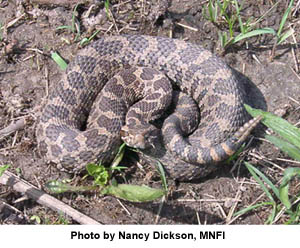
A Massasauga rattlesnake
Photo by Nancy Dickson
Yesterday, while walking with my dogs in the field beside my house, I nearly tripped over a large black snake that was streaming through the grass in front of us. Just that morning I had been reading on AnnArbor.com about coyote and fox sightings causing people to fear for their pets' safety.
It reminded me of a phone call I received last summer from a client who thought that her dog had been bitten by a rattlesnake.
She was calling from animal emergency and was quite sure that her dog had been bitten by a rattlesnake on a hiking trail along the Raisin River in Manchester. She was right.
The problem was that the vets at the clinic had not encountered a case before and were dubious that it was actually a snake bite. Vital time was lost due to unfamiliarity. I want to be clear that this post is not to promote any blame or shame; we were all caught off guard, and that is the point.
What ensued was a frightening game of beat-the-clock and a crash course in snake bite preparedness.
Blood work eventually confirmed that Daisy had indeed been bitten by a Massasauga rattler, a snake that is native to the Lower Peninsula of Michigan and, although not common, definitely present in the woods and fields here in the southeast part of our state.
While we scrambled to locate a dose of anti-venom, Daisy's status grew more dire. We called (literally) every vet in the area to find that none of them stocked the anti-venom. We then called the hospitals, who did stock it, but, despite our desperate pleas, said “because of legalities” they could not provide it to us.
It was one of those times when you feel like you are in a slow motion nightmare and need something to happen — right now — but it just can't.
Daisy's face and throat swelled hideously, and she became alarmingly lethargic. Everyone was worried.
Finally an outdated dose of anti-venom was located at the Toledo Zoo, and Daisy's owner rushed down to pick it up (for no small fee, I might add). But, by the time it got to Daisy, the appropriate window of time to administer it had passed, and there was concern on the part of the vets (rightfully so) that giving it to her at that point might further complicate her condition, so it went unused.
Daisy ended up undergoing a blood transfusion and spent a couple of “touch and go” days in the emergency room. She eventually pulled through, but the experience left its mark on all of us. Mostly, it served as an eye-opener to the fact that this is so rare in our neck of the woods, so when it does happen there is no predetermined course of action and very few available resources.
I am not an expert on the subject, so I invite any of our area vets to chime in and offer readers advice on what kind of effective action a pet owner can take in the event of a poisonous snake bite, but here is what I can offer.
- First of all, those of you who like to hike trails and traverse wooded spaces with your dog should be familiar with the topography that is attractive to rattlers and, since a Massasauga rattlesnake's (the only poisonous snake in Michigan) “rattle” is a warning system, you should know what it sounds like. It isn't the classic “chika-chika” that you hear in cowboy movies, it is more of a buzz than a rattle. Think of the sound of a cicada or a loud bee. If you hear this coming from the ground, move away and rein in your dog. Don't start looking for the cicada!
- If your dog jumps back or yelps while sniffing in the grass or brush, cautiously take notice of anything you see moving and then inspect her immediately. Look for tiny drops of blood on her snout, lip or leg. If your dog has short fur, it could be anywhere. Don't think that you have to see two punctures to confirm a snake bite; it is very possible for a snake to hit your dog with one fang.
- If you do suspect a snake bite, head to the vet immediately. Even if it's a false alarm, time is of the essence. Although most dogs don't die from rattlesnake bites, you could save yourself and your dog a lot of trauma and expense by acting quickly.
- If you can wrap the puncture tightly (not on the nose, of course) with a piece of material and keep your dog as calm as possible (meaning that you have to keep your cool too!) it will help keep the venom from spreading throughout your dog's system.
- If you are a believer in homeopathics (which I happen to be, based on personal experience), having a few appropriate remedies on hand as a first course of action is a good idea.
- If you do see a snake, try to keep a mental picture for the sake of identification. From a regional standpoint, what I am talking about is the “Massasauga” in Michigan, but you could be anywhere with your dog and a solid I.D. would help a vet solve the problem of selecting the right medicine.
Anyone who is planning to reside or spend a significant amount of time in a region where there is a considerable population of poisonous snakes should consider “snake-proofing” their dog through training.
Over all of the years that I have spent around dogs and “dog people,” I have never personally known anyone whose dog was attacked by a coyote or a fox. I do know of, now two, snake bite incidents that were perplexing and resulted in a notable health crisis for the dog.
I thought it may be worth mentioning.
While it is important to be aware of the threat from wild animals, a much greater threat to you and your pets are other people and their pets. Wild animals usually do a pretty good job of clearing the way for we humans; we need to be respectful and careful around them.
John Spieser is a professional dog trainer and owner of Dogheart. He can be reached at john@doghearta2.com.
Comments
Rork Kuick
Tue, May 31, 2011 : 11:58 a.m.
"If you are a believer in homeopathics (which I happen to be, based on personal experience)..." I believe - I believe they contain water and little else.
treetowncartel
Tue, May 31, 2011 : 2:48 a.m.
I have seen various snakes throughout Michigan and I would pass on that the smaller rattler snakes have a much more lethal dose of venom. That 12" baby rattler may look like something fun to pick it up, but it can actually do more damage than a 2' to 3' adult. And I have to add, I hate snakes, respect them for their place in the ecosystem, but a garter snake or blue snake can make me jump as far as a rattler.
miradee4
Tue, May 31, 2011 : 12:12 a.m.
@ adam j, I have always wanted to see one! I go to the Botanical Gardens often and Parker Mill. I've seen a northern water snake at botanical, I didn't know a Massasauga had been spotted there. I've seen some sort of garter snake at Parker Mill. With the second I was resting on the wooden path, and behind me I heard the wind rustle grass. Then I heard it again, and turned and it was right next to me. It was awesome, especially when I realized it wasn't the rattler that time! hah
Lorrie Shaw
Mon, May 30, 2011 : 10:15 p.m.
Once again, John, excellent job! Your insight and wisdom is so helpful. And I agree... in this age, getting a cellphone snapshot would be helpful.
julieswhimsies
Mon, May 30, 2011 : 6:32 p.m.
Massasuagas are present in the area. I've seen them on horseback. Local physicians deny their existence. Lyme disease is present in the area, as well (My dog was tested and treated for Lyme last summer. I was told by an entomologist that the type of tick does not exist in SE Michigan. They were wrong.
julieswhimsies
Mon, May 30, 2011 : 10:46 p.m.
I need to proofread before I post. My bad.
SonnyDog09
Mon, May 30, 2011 : 12:33 p.m.
"If you do see a snake, try to keep a mental picture for the sake of identification. " Since this is now 2011, you might also want to whip out your phone and take a picture of the snake. That way you can show the picture to others.
John Spieser
Mon, May 30, 2011 : 12:42 p.m.
Yeah ! Good idea Sonnydog. (wish I had thought of it) My personal relationship with my cell phone is limited.
PQ
Mon, May 30, 2011 : 8:12 a.m.
I swear I saw a big ol rattler with my nephew out there at Pickerel right at the beach right at the water. That big ol thang slowly zig zagged across the populous beach, taking his sweet time and then rattled away in the brush. All the hippies there were completely unfazed of course....I talked to some so called experts later who pooh-poohed my sighting (hearing) as some "look-a-like" supposedly quite common in Michigan. I think it was one of these babies....
jeanette
Mon, May 30, 2011 : 2:30 a.m.
In 2003 a man went to court for killing one at Pickerel Park in the Pinckney Rec. area......all I know about it...........
jeanette
Mon, May 30, 2011 : 2:18 a.m.
The snake lives and thrives along the Huron river. A fact I've learned while living along side Huron Metro Park. The neighbor's dog was bitten by a massasauga in their backyard. I've seen one myself on the road, just four houses down from mine. My husband saw one across the street on this side of the park fence. Another neighbor has told the story of when his daughter was young, and almost stepped on one, while playing in the park.
Boo Radley
Sun, May 29, 2011 : 10:06 p.m.
Massasauga rattlesnakes are very common in some areas (including parks) in the Dexter area. It should also be noted that they are classified as a threatened and thus, protected species. It is against the law to harm them, or to relocate them away from their original habitat. Folks walking their dogs in areas known for rattlesnakes should also re-consider the use of those 30+ feet retractable leashes that allow their dogs to roam far in front of them. Of course, I am speaking of those dog owners who are at least responsible enough to use some type of leash ....
Adam Jaskiewicz
Sun, May 29, 2011 : 10:02 p.m.
I saw one at the U of M botanical gardens, right in the middle of one of the walking paths in the woods. I heard it rattle and kept my distance as it calmly moved into the bushes. They don't want to bite you, they just want to be left alone. Keep your dog on a short leash when you're in snake habitat.
shrewdrealist
Sun, May 29, 2011 : 9:18 p.m.
Massasauga rattlers, Mountain Lions, and Coyotes exist in Southeast Michigan. Period. "No way, you must be confused there's no such thi...." I've seen them all here, they exist. Moral of the story is the experts don't know anything. People may be smart but nature is smarter.
kissthecobra
Sun, May 29, 2011 : 8:47 p.m.
There was a case some 15-20 years ago where a gentleman had been bitten by a Massasauga rattlesnake down near Three Rivers, Michigan (south of Kalamazoo) and was told emphatically by hospital emergency room personnel that rattlesnakes did not exist in Michigan and therefore, anti-venom was not given. He suffered a fair amount of permanent damage to his leg, as a result. All of this makes me wonder to what extent area emergency rooms are aware of rattlesnakes in Michigan and if anti-venom is available?