

As Borders contracts, what will happen to Ann Arbor's independent bookstores?
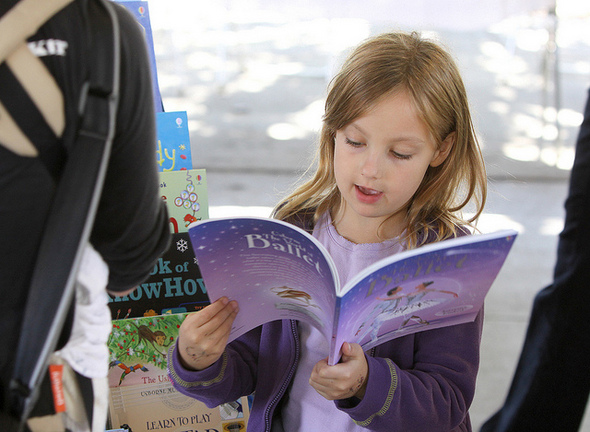
Fionnuala Mackercher of Ann Arbor at last year's Kerrytown BookFest. "Ann Arbor is still a book place," says Nicola Rooney of Nicola's Books.
AnnArbor.com file photo
Nicola Rooney, owner of Ann Arbor's popular and independent Nicola's Books, directed my attention recently to an ad placed by 15 San Francisco-area bookstores that are still in business in the wake of Borders' store closings.
“We’re still here!” it proclaims.
“Many naysayers seem to believe the end of bookstores is near at hand …we respectfully beg to differ,” the ad reads, pointing out that customers seem to appreciate the care that independent stores take in choosing their stock, and in customer service.
Rooney and two other successful Ann Arbor bookstore owners told me recently that they share the ad's sentiment. Rooney admits that she has felt the impact of book industry changes, but says that there's still a place for independent bookstores in our community.
“Bookstores will make it through these dark ages. We certainly will,” says Bill Zirinsky, co-owner of Crazy Wisdom Bookstore and Tea Room in downtown Ann Arbor.
Surviving competition
Competing with bigger and often cheaper options is one piece of the challenge facing independent stores: “It is hard to compete with Walmart and Amazon, no doubt about that. It takes focus, commitment and capital,” Zirinsky says.
And a keen business sense, Rooney adds.
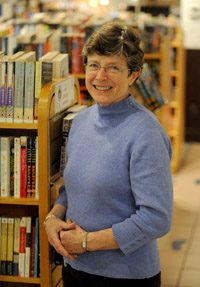
Nicola Rooney
Angela Cesere | AnnArbor.com
“I think our peak year was about 2002, and then it has been stable and steadily declining — in terms of sales — ever since then. In terms of profitability, I’ve gotten cleverer. We don’t do a lot of things that we used to do that were not worth doing. Sadly, very sadly, I say this, a lot of advertising, particularly with NPR — underwriting, which was very expensive, it was the right thing to do, but unfortunately not very economically justifiable. We used to advertise regularly 3 to 4 times a week in the Ann Arbor paper. We don’t do that now.”
Robin Agnew, co-owner of Aunt Agatha’s on South Fourth Avenue, sells new and used books. She says that used book sales are a key piece of her survival during winter months, particularly.
“Used books keep our doors open in the slow months and … get customers in the door,” Agnew says.
The all-important niche
Beyond that, it helps to have a specialized focus. Zirinsky knows what makes Crazy Wisdom unique: “Crazy Wisdom has painstakingly built a local and regional market for itself.
"If you're interested in our core subject areas — integrative medicine and holistic health, spiritual traditions across the globe, and psychological insight — then there are very few bookstores in the country with our depth of inventory.
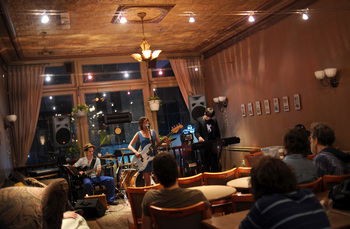
Crazy Wisdom Bookstore and Tea Room often hosts live musical acts and other performances at its space in downtown Ann Arbor.
Melanie Maxwell | AnnArbor.com file photo
"And, as body/mind/spirit bookshops go, none of them match CW for beautiful woodwork and attention to aesthetics.”
Specialty bookshops in Ann Arbor tend to have a steady following. Stores like Common Language and Our Lady of Grace Bookstore have certainly carved out a niche, catering to LGBT and Catholic readers, respectively.
Other Ann Arbor book sellers, such as Dawn Treader, and Motte & Bailey deal in used books.
Meanwhile, used-bookseller David's Books and Crossroad Christian bookstore in Pittsfield Township have closed this year.
Book people
Robin Agnew agrees that independent booksellers offer something special.
“The big-box stores may be on the way out and what's left may be boutique-type stores like ours, offering specialized service and collector's items like signed books. Meeting and talking to an author is a special thing and it's something that just can't be replicated.”
Nicola’s does not offer any specialty, per se, but Rooney feels that there is something her shop has over the bigger corporate companies: book people.
Rooney proudly says that Nicola’s staff, herself included, is knowledgeable and passionate about books.
“I think we added it up and we said that we have nearly 200 years’ worth of book-selling experience between 15 people,” she says.
She believes that marks the difference between an independent and a corporate-run store like Borders.
“Everyone says how wonderful Border’s used to be. There is a lot of sadness, and fondness for how it was. It used to be the kind of place where you could walk in and ask them for anything and they would know what you wanted. I think they dug their own grave unfortunately by getting rid of all the people who knew anything about books because the upper levels seemed to feel that you didn’t need to know anything about books in order to run a bookstore, and I think they’ve been proven wrong,” she says.
When asked what it takes to survive as an independent bookseller, Rooney says, “I think it’s knowing who your customers are and making sure you have what they want, and you behave to them as they would wish you to behave.”
Agnew agrees that it’s the personal service that keeps people shopping: “We can help people with very specific and personal recommendations, one of my favorite parts of my job.”
What about e-books?
Another threat to the brick-and-mortar bookstore is technology.
Rooney says she feels the threat of new technologies, but does not feel it will eradicate the bookstore industry.
“It’s stable, but yes, we’re under threat, definitely,” she says.
Rooney says she feels the competition from Internet book sales and e-book readership.
Though Nicola’s website offers both tech-friendly options, neither is a main piece of their business.
“We don’t see a place for us in the e-book business, because our customers, in general, are real book people, although you can buy e-books on our website, we are not going to promote them.”
Crazy Wisdom, on the other hand, is looking forward to offering Internet sales and e-book sales via an upgraded website beginning this summer. The store is teaming up with the American Booksellers Association to offer more online capabilities and “level the playing field a bit.”
A unique market
Despite the difficulties and industry changes, all three bookstore owners affirmed that there is just something unique about Ann Arbor that makes success more possible. Agnew helps oversee Ann Arbor’s Kerrytown BookFest every September.
Its goal is to highlight involvement in books and the printing arts in the region. The event’s yearly success shows that there are readers in Ann Arbor that make efforts to support the industry.
“I appreciate meeting a lot of the really unique and intelligent people who live here ... I'm always amazed by the things our customers do,” Agnew says.
Zirinsky explains, “In terms of our customer base, Ann Arbor has a disproportionate number of highly educated people who believe in the value of psychotherapy, who have nuanced understandings of the ingredients of day-to-day spirituality, and who place great importance on living in a conscious and healthy way. So, we can thrive in Ann Arbor to a degree that would be unimaginable in any other small city of our size in the Midwest, except perhaps for Madison, Wisconsin.”
“Ann Arbor is still a book place, but anyone who is a book person now has many more choices as to where to get a book,” Rooney adds. “If it doesn’t matter to enough people, we shouldn’t be here — we don’t have a divine right to exist. We are only here if we are providing a service that enough people want at the price that we have to charge in order to stay in business. If that equation doesn’t work, then you go out of business.”
Angela Smith is a freelance contributor to AnnArbor.com. You can contact her at angieannarbor@gmail.com.
Comments
Nicola Rooney
Mon, May 9, 2011 : 2:01 p.m.
One of the challenges any bricks and mortar store faces is the customer who comes in to check out the merchandise, use the expertise of the staff and then goes home to order the item on line. Bricks and mortar stores will not survive on hopeful platitudes from customers like these. So just don't you dare to complain about the demise of your favorite browsing store that you exploit to help you choose what to buy on line. If you use the services offered by a real store, consider balancing the equation by buying your merchandise from the actual store.
Ann English
Sat, May 7, 2011 : 10:07 p.m.
Unlike Kindle, no electricity is needed in order to read a physical book. Daytime power outages limit what can be read on a computer; batteries need recharging. I haven't heard of a solar-powered I-Pad.
eagleman
Sat, May 7, 2011 : 3:31 p.m.
What killed Borders was not lack of knowledge of books, but the rock bottom prices that Amazon offers through second hand dealers. If you want to sell books and make a profit, become an online book dealer through Amazon. I buy most of my books that way and I have saved a bundle by doing so. I've probably purchased 200 books on Amazon over the past 5-6 years. Amazon is a terrific website. That said, I definitely hope these independent shops find a way to survive. There is something relaxing about leisurely searching through book stacks for that right book. I still that from time to time.
Jon Saalberg
Sat, May 7, 2011 : 2:41 p.m.
I'm an avid computer user, and love technology, but I will never read books on a screen. The whole point of reading a book is to sit back and relax, and remove oneself from our frantic, computerized world, and e-books don't do that. And yes, I have used an iPad, which certainly has the most sophisticated, elegant-looking, e-reader interface.
northside
Sat, May 7, 2011 : 2:30 p.m.
Bookstores large and small have been hit by a troubling cultural change: people simply read fewer books. The change has picked up pace since the internet but started decades earlier. What has to be most troubling for booksellers is the attention deficit of the young text message generation. So many of them can't pay attention to anything for more than a few minutes, much less get through a 300-page book.
Christy Summerfield
Sat, May 7, 2011 : 4:27 p.m.
I don't agree that kids today don't read real books. Not one of my adult kids owns a tablet reading device, and only one of my friends does. So my grandkids love real books and enjoy getting them as gifts. I have several young friends who also read real books. And every time I'm at the library, I'm impressed by the number of kids, ranging from very young to high school age, I see there. I have two grandkids living in Shanghai for a couple of years and one of the things that excites my 12-year-old grandson the most about living there, is the large number of book stores.
Linda Peck
Sat, May 7, 2011 : 1:02 p.m.
Just because Borders is failing, we should not presume all book stores will fail. They are not the benchmark for book stores in my opinion. Supermarket bookstores are about as appealing as Kindle, and just don't have the charm of the small shops. I am totally amazed at the selection of magazines and local lore at Nicola's. It is truly a jewel of a shop.
Christy Summerfield
Sat, May 7, 2011 : 4:22 p.m.
I was struck by the statement from Borders' new CEO in an article earlier this week that he didn't understand why the Ann Arbor community didn't rally around Borders. I was here when Borders first opened. The Borders brothers were friends, one was also a neighbor and our kids went to school together. Borders was a matter of home-town pride as they began to expand a bit. However, when the Borders brothers sold out and the book stores exploded all over the country, the store became just another of a big chain. I was pretty devastated when Shaman Drum closed and I figured if an institution the size of U of M couldn't keep an amazing bookstore like Shaman Drum going, there was little hope for independent bookstores here. I'm so happy there still are independent bookstores in town. I root for them and I use them, just as I shop at local music stores. I live on a fixed income and seldom buy books anymore except as gifts. I rely on the library. I admit it's sometimes difficult to avoid the temptation to buy online if the choice is that or not buying at all. It's not an easy world these days.
Susan Montgomery
Sat, May 7, 2011 : 12:42 p.m.
In the paragraph near Nicola's picture - "I think our peek year..." should be "peak year" - Thanks.
Christy Summerfield
Sat, May 7, 2011 : 4:06 p.m.
No, thank you. I think the Ann Arbor News and now AnnArbor.com could have used a proof-reader or two, or three. I often wonder if the people who write the articles ever proof the articles themselves. Some people may think this is nit-picking, but how will today's kids learn how to write if they see silly mistakes like this. And, today's kids do need to learn how to write correctly and coherently, no matter how much they text their friends.
Kelly Davenport
Sat, May 7, 2011 : 1:19 p.m.
Thanks, Susan. I fixed that.
Craig Lounsbury
Sat, May 7, 2011 : 12:07 p.m.
I fear being in the book sales business may be as dicey as being in the slide rule business was a few years ago....or the white out business. Anybody know where I can get a ribbon for my typewriter?
Dcam
Sun, May 8, 2011 : 12:43 p.m.
Odd you should mention slide rules - I happened to take out my old Faber-Castell 62/82 (my original pocket calculator. 6" compared to my lost 12" model) yesterday, after reading something that jogged my memory. I then looked up the history of the slide rule, one nice thing about the internet, and it turns out that the last slide rule by Faber was made in 1976, and slide rules haven't been made since 1979 by anyone. All in all, however, I prefer an electronic calculator to a slide rule. But a slide rule does help discipline the mind to not take the answers for granted because the display says so.