

Jennifer Granholm claims she met 'my promise' of extending broadband Internet throughout Michigan
Gov. Jennifer Granholm said Tuesday that an economic stimulus project run by an Ann Arbor nonprofit would fulfill her goal to "have every corner of Michigan connected online," an objective she laid out in her 2004 State of the State address.
“I’ve only got four more months left," she said at a press conference in Ann Arbor, "and I’m glad my promise from 2004 is actually going to happen."
A closer look at that promise, though, shows that the original goal was not met.
During that State of the State speech in 2004, Granholm said, "By 2007 we will have brought high-speed internet service to every corner of our state, through the work of the Michigan Broadband Development Authority," according to text of the speech still available on the state's website.
But the new funding Granholm praised Tuesday -- $111 million provided to Ann Arbor-based Merit Network to construct fiber optic networks in underserved areas throughout the state -- comes from the federal government, not the state. And thousands of residents -- including many in western Washtenaw County -- are likely to be without viable broadband options after the project is complete.
Granholm suggested that Merit's program -- which involves construction of more than 2,000 miles of fiber optic networks in the Lower and Upper Peninsulas in summer 2011 -- would help bridge the gap to Michigan's unserved households.
"Michigan will be connected with high-speed Internet no matter where you live," Granholm said Tuesday.
But Granholm, whose second and final term expires Jan. 1, acknowledged that Michigan's budget crisis prevented the state from helping to fund broadband Internet access improvements.
"All the revenue cratered because of everything that's happened in Michigan, and we haven't had the means to invest," she said Tuesday.
Merit Network's projects, albeit wide-ranging and perhaps worthwhile, won’t provide high-speed access to all residents in Michigan. In fact, many rural residents are likely to remain without viable broadband options for their home.
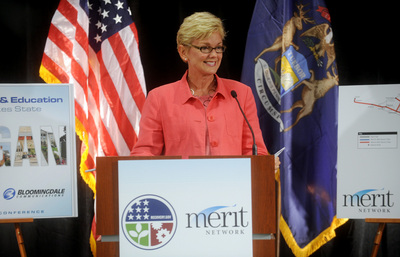
Gov. Jennifer Granholm speaks at a press conference Tuesday to celebrate Ann Arbor nonprofit Merit Network's $111 million in stimulus funding.
Melanie Maxwell | AnnArbor.com
Some 4.6 percent of Michigan households still don't have access to land-based broadband Internet, according to a Connect Michigan study conducted this spring and funded by the Michigan Public Service Commission.
Most of those homes are located in rural areas that Internet service providers don't attempt to reach because providing high-speed service to those regions is not profitable. (View a map showing where high-speed Internet is and is not available throughout Michigan.)

Merit said its project, which involves constructing fiber networks measuring more than 2,000 miles, could improve access for 525,000 households and 49,000 businesses throughout the Lower and Upper Peninsulas. Merit said its fiber would "pass over" 525,000 households.
Most experts agree that affordable access to high-speed Internet is vital to helping businesses innovate and create jobs.
"Just as 50 years ago we used the strength of steel to link our two peninsulas, we will now use the power of this new technology to link every community in our state to economic opportunity," Granholm said in 2004. "Broadband will be this generation's Mackinac Bridge."
Merit Network's primary mission with the project is to improve high-speed Internet access at 569 "community anchor institutions" such as universities, libraries and schools.
Improving access to homes is a side effect of Merit's efforts to lay more fiber optic cables, which a few private companies will pay to access.
The economic stimulus funding awarded to Merit by the U.S. Department of Commerce's National Telecommunications and Information Administration will support the construction of the advanced fiber optic networks.
Several private sector firms have agreed to invest about $30 million in Merit's project in exchange for access to some of the fiber strands laid by Merit. They will turn around and use the strands to sell high-speed Internet access to businesses and residents.
But the broader challenge of extending high-speed Internet access to rural residents and companies largely remains.
In western Washtenaw County, for example, many residents don't have viable high-speed Internet options.
That's a key reason why community activists, government officials and business leaders formed the county's municipal wireless initiative several years ago.
The program, called Wireless Washtenaw, successfully created a 100-square-mile wireless cloud, but it covers about 1/7th of the county and the service had only about 500 daily users as of earlier this year. Wireless Washtenaw's federal stimulus funding application was rejected earlier this year.
That effectively means that residents and businesses in underserved areas hoping for high-speed access are at the mercies of governmental initiatives or market forces.
Government investment in broadband infrastructure is critical to hastening access to high-speed Internet, said Larry Strickling, the assistant secretary for communications and information at the Department of Commerce and administrator of the NTIA.
"These investments are going to lay the groundwork for sustainable economic growth in the state by connecting and upgrading areas of the state that for too long have been without" high-speed access, Strickling said.
Contact AnnArbor.com's Nathan Bomey at (734) 623-2587 or nathanbomey@annarbor.com. You can also follow him on Twitter or subscribe to AnnArbor.com's newsletters.
Comments
a2ete
Thu, Aug 26, 2010 : 9:06 a.m.
@Rod in Chelsea.... I know how you feel... I live on a major road and according to the map of areas served, I unfortunatly live in one of the spaces between the areas of service. Same song and dance... cable is not available, satellite is WAY too expensive, so I must also use a broadband card with a 5 gig limit. Yep, Granholm blew us all away alright. Hope she goes back to Canada from where she came.
runbum03
Wed, Aug 25, 2010 : 5:42 p.m.
Rod in Chelsea Porn, Pot, and Penny slots. Granholm's vicious circle of vice and legacy of shame. Get real: porn eats up the most bandwidth on the web. The Michigan elite loafer class follows their primal instincts. Michigan will not be denied!!!!
Speechless
Wed, Aug 25, 2010 : 12:08 p.m.
Yes, in what was probably an attempt to save face, Granholm definitely overstates her case. Still, the Merit Network's projects are a big step in the right direction, despite falling well short of bringing broadband access to all corners of the state, as the governor over-promised half a decade ago. Merit will expand broadband to any number of localities that have yet to see it after all these years, going places that the private sector has chosen to ignore for so long. Barring the necessary progressive restructuring of this state's taxation system, additional federal funding will be required to achieve full broadband access throughout Michigan. Unless Google does it for us.
ChelseaGirl
Wed, Aug 25, 2010 : 11:07 a.m.
I live in southwest Washtenaw county and was told by AT&T back in 2007 that the were installing a highspeed hub 1/2 mile from my home in April of 08. I switched to their service just for that reason. To date no hub, no highspeed. Chelsea has it and Manchester has it and Im smack dab in the middle, how did they miss me?
MjC
Wed, Aug 25, 2010 : 10:49 a.m.
I admired Granholm up until the final two years of her administration. The promises she made were nothing more than the usual talking game that politicians do so well. My family is still angry over the loss of the "Promise Scholarship." The State having "promised" my daughter $4,000 in tuition support if she successfully completed all those mandated State exams AND attended a Michigan college. She held her end of the bargain, and Granholm didn't.
JSA
Wed, Aug 25, 2010 : 9:59 a.m.
What did anyone think she was going to say. My administration was and is a disaster and I am the worst governor in the history of the State of Michigan? She does what all politicians do when they have no accomplishments do. They lie.
Rod in Chelsea
Wed, Aug 25, 2010 : 9:37 a.m.
runbum03........why did you bring porn into this discussion? No one said anything about downloading porn!! Is that what you do maybe? Trying to ease your guilty conscience? All of us would just like to have access to reliable, secure and affordable High Speed Internet. Period.
braggslaw
Wed, Aug 25, 2010 : 9:18 a.m.
Jenny is trying to save her legacy. Nobody has been "blown away" by her economic policies and her entrenched relationship with special interests.
Nathan Bomey
Wed, Aug 25, 2010 : 9:04 a.m.
@JustWondering, Yes that's supposed to be 100 square miles. Thanks for catching that! Fixing now.
runbum03
Wed, Aug 25, 2010 : 8:53 a.m.
All of Michigan should not be denied the "right" to download porn at 6.3 gigs per second. 12-31-2010 Granholm Freedom day. Climb on your broomstick and fade into the sunset. Thank God.
dading dont delete me bro
Wed, Aug 25, 2010 : 8:40 a.m.
glad to see jenny's got her priorities straight. while many are out of work and home values are far from stellar, we will be able to have broadband internet state wide. oh, i guess the unemployed can use this to file their claims and look for work. ok, i understand now.
Stephen Landes
Wed, Aug 25, 2010 : 8:18 a.m.
Based on many of the comments so far I would say the map provided by a link in the article is at best optimistic and at worst just plain wrong.
Rod in Chelsea
Wed, Aug 25, 2010 : 8:01 a.m.
We also live in Western Washtenaw County. In fact, we can see the Sylvan Township hall and have been told repeatedly by "Wireless Washtenaw" that there is no room for us on the network. DSL nor Cable come to us and the SAtellite is, like McGiver said, expensive, slow AND unreliable!! They also cut your speed if you use too much bandwidth in a given month! We are forced into using an air card which limits us to 5 GB of usage a month at cost of $60!! I complain constantly to AT&T and Verizon. We are 1/2 mile off of old 12 right by I94!! We are nowhere near "in the sticks" so to speak and still cannot get anything.
alarictoo
Wed, Aug 25, 2010 : 7:54 a.m.
@MsWebster: Broadband does not necessarily equate to a wireless network. They are separate technologies. As for the ill-fated "Wireless Washtenaw" network, the funding model proposed to develop and support the network was never realistic. I attended the initial "Stakeholders Meeting". After asking several questions about their funding model that they either avoided, or could not answer, it became obvious that the project would never successfully be completed. As far as Granholm's "delivering on her promise", as is obvious from this article, the state had very little to do with Merit's success in this area, and Jenn is now trying to pad her resume' by riding on their coat tails. As Nathan's article says, Merit's focus is on getting high-speed broadband access to universities, schools and libraries. Any improvement for businesses and homes is purely coincidental.
MsWebster
Wed, Aug 25, 2010 : 7:37 a.m.
REALLY? Does Jennifer know how to read a map? Maybe she can come over to my house in Webster Township and help me find the wireless network, I can't seem to locate it. Dial up is the only option.
Paula Gardner
Wed, Aug 25, 2010 : 7:26 a.m.
The MITC "building" is not in foreclosure. The MITC was leasing space in South State Commons from MAV Development. The foreclosure appears to be on the group's assets, not real estate.
justwondering
Wed, Aug 25, 2010 : 7:23 a.m.
"The program, called Wireless Washtenaw, successfully created a 100-square-foot wireless cloud" - I think the metrics are wrong???
Soothslayer
Wed, Aug 25, 2010 : 6:55 a.m.
lol wut? Jenny approved funding cuts at the MITC where they held the press conference yesterday and that building went into receivership. Anyone not see this from http://annarborchronicle.com/2010/07/15/um-regents-approve-purchase-of-mitc-assets/ At their July 15, 2010 meeting, University of Michigan regents approved a $1.25 million purchase of assets from the Michigan Information Technology Center Foundation (MITC), located in the South State Commons on Oakbrook Drive. According to a cover memo, the sale is through a voluntary turnover foreclosure. Tim Slottow, UMs CFO, told regents that MITC is not succeeding in their mission.
McGiver
Wed, Aug 25, 2010 : 6:52 a.m.
I live in western Washtenaw County. The only internet options we have are satellite (expensive and slow) and Sprint 3G (slow - only marginally better than dial up) 4G is, so far, the only realistic thing to be hopeful for as Sprint salespeople claim is coming to the area by the end of the year. Suppose to be 10 times faster than 3G. Experience has led me to be skeptical of these claims, but I'll take that 'promise' over anything the governor has promised.
Awakened
Wed, Aug 25, 2010 : 6:07 a.m.
I have two friends who have had to cancel their internet and cable at home for their families because of cutbacks in hours or pay at work. This is a laudable goal. But perhaps not the first priority. With four months to go it sounds like she is pushing for a legacy and a bullet on her resume.