

$2M in water and sewer rate increases included in Ann Arbor's tentative budget
Ann Arbor residents are likely to see more water and sewer rate increases starting July 1 under a tentative budget plan unveiled Monday night.
Budget projections presented by the city's staff show revenues from "water sales" ticking up roughly $800,000 or 3.8 percent to $21.8 million.
Revenues from "sewer sales" are projected to go up $1 million or 4.7 percent to $22.2 million, while revenues from "stormwater sales" go up roughly $200,000 or 3.4 percent to $6 million.
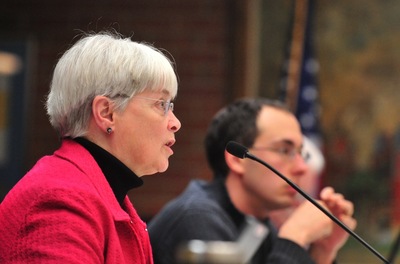
Council Member Marcia Higgins, D-4th Ward, speaks about the city's budget during Monday night's council work session.
Ryan J. Stanton | AnnArbor.com
The City Council last year approved nearly $1.8 million worth of increases in water, sewer and stormwater rates.
Mayor John Hieftje suggested the City Council will have little choice but to approve the new increases to pay for projects like the $120 million rebuild happening now on Ann Arbor's Wastewater Treatment Plant, and another project on the horizon to replace a good portion of the city's Water Treatment Plant.
The costs aren't known for the Water Treatment Plant project yet, but city officials acknowledge it's likely to be tens of millions of dollars.
"When you take a look at what's going on, we've got the largest project I believe in the history of the city going out there, replacing a wastewater plant that was built in the 1930s, and I think the city has done an admirable job of keeping it going all these decades," Hieftje said. "And then we're going to have to do pretty much the same thing coming up in water, and that's been planned."
Large operating surpluses are shown in each of the city's major funds outside the general fund. The water fund is projected to operate at a $3.5 million surplus next year, while the sewer fund operates at a $1.7 million surplus, and the stormwater fund operates at a $400,000 surplus.
Craig Hupy, the city's public services administrator, said those annual savings are planned to pay for needed capital improvements to each system.
After subtracting out funds already restricted for specific purposes and minimum balance requirements, the budget sheets Hupy presented to the City Council during Monday's work session show the water fund has an available balance of $12.6 million, the sewer fund has an available balance of $8.7 million, and the stormwater fund has an available balance of $4.5 million.
While that might seem like a comfortable situation, Hupy told council members it's not so comfortable once you look at the capital needs that exist within each of those areas.
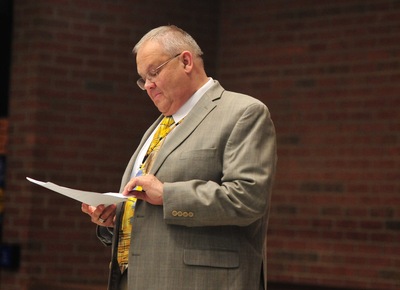
Craig Hupy, the city's pubic services administrator, said annual savings shown in the city's water and sewer funds are planned to pay for needed capital improvements to each system.
Ryan J. Stanton | AnnArbor.com
Meanwhile, $26.9 million in capital needs are identified in the sewer fund during the next three years, and $10.4 million in needs are identified in the stormwater fund.
Another $1 million in unfunded and deferred street tree maintenance is identified as a concern in the stormwater fund. Street tree responsibilities were transferred to the fund in 2011-12.
The city's solid waste program, funded by a special millage that is expected to bring in $11.4 million next year, is projected to break even each of the next two years.
After subtracting out funds already restricted for specific purposes and minimum balance requirements, the solid waste fund has an available balance of $8.6 million.
Hupy said millions of dollars could be needed for landfill maintenance in the coming years, while replacement of the city's drop-off station potentially could cost $4.9 million.
He pointed out restoration of fall leaf pickup services would increase annual costs in the solid waste fund by $285,000 and the city would incur a one-time cost of $395,000 to do that. He said restoration of holiday tree collection services would increase annual costs by another $26,000.
Council Member Jane Lumm, an Independent who represents the 2nd Ward, fought unsuccessfully to restore those services in the city's budget last year.
The city's major and local street funds are projected to break even operationally with $8.8 million coming in and going out each of the next two years. That primarily covers filling potholes, doing surface repairs, street sweeping, winter maintenance, pavement marking, traffic engineering, fiber optic installation and maintenance, and traffic sign/signal installation and maintenance.
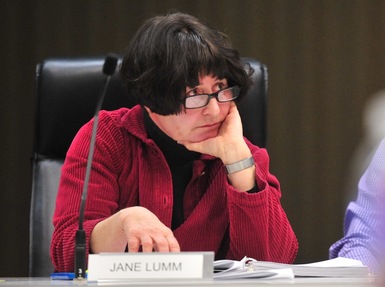
Council Member Jane Lumm, who fought unsuccessfully to restore fall leaf pickup services in the city's budget last year, raised the issue again Monday night.
Ryan J. Stanton | AnnArbor.com
The city's street millage fund, which is expected to bring in $9.9 million in revenue next year, has been operating at a deficit each of the last two years — a trend expected to continue.
That's because the city deferred some street projects in recent years to ensure it had a backup source of funding in case state and federal dollars didn't come through for the new East Stadium Boulevard bridges. With those funds secured, the city is spending down its own dollars.
The street millage fund had an overall surplus totaling $4 million during 2009-10 and 2010-11, then it ran a $4.2 million deficit in 2011-12.
A $9.9 million deficit is planned for the current fiscal year ending June 30, which the city now expects to follow up with a $4.9 million deficit in 2013-14, and a $1.1 million deficit in 2014-15.
Street millage fund expenditures hit a high of $19.7 million this past year, but that's expected to tick down to $14.8 million in the next fiscal year, and $11.1 million the year after.
Not counting $9 million that's required as a minimum balance, the street millage fund had $14.1 million in cash reserves available to spend as of last June.
The fund is expected to pay for improvements along Pontiac Trail and Stone School Road in the coming year, with improvements along Geddes Avenue and Pauline the following year. Millions more will be spent resurfacing other streets as well.
In addition to the street millage fund, deficits also are projected in the city's parks maintenance and capital improvement millage fund, which already is operating at a $2.7 million deficit this year. Deficits closer to $100,000 are expected each of the next two fiscal years.
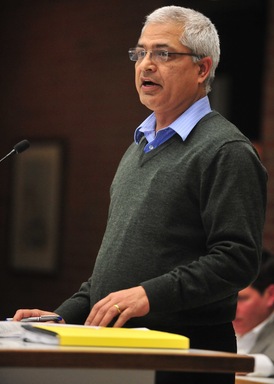
Sumedh Bahl, the city's community services administrator, addresses the City Council Monday night.
Ryan J. Stanton | AnnArbor.com
Though the city has pots of money outside the general fund with millions of dollars available, Hieftje said the city can't tap dedicated funds with specific purposes to pay for general fund activities.
"We would be in deep trouble — not only financially but legally — if we were to begin to start raiding other fund areas, for instance, to put them into police and fire," he said. "There are very strict guidelines that we are required to follow and there's really nothing we can do about that."
The city is forecasting a $1.12 million (2.3 percent) increase in general fund property tax revenues in the next fiscal year starting July 1 — up from $49.4 million to nearly $50.6 million. That includes a $9.5 million pass-through to the Ann Arbor Transportation Authority.
General fund property tax revenues are projected to grow to $51.4 million in 2014-15, $52.7 million in 2015-16, and $54 million in 2016-17.
The city also is budgeting an 18 percent increase in municipal service charges in the next year, going from $2.97 million to $3.5 million. Those are fees the city's general fund charges to funds like water and sewer and streets for overhead costs provided by finance and human resources.
Council Member Sumi Kailasapathy, D-1st Ward, asked city staff what justifies the 18 percent increase and whether the general fund is providing increased services to other funds.
Tom Crawford, the city's chief financial officer, explained it had been a number of years since the city last conducted an evaluation of what the general fund's true costs were for services provided to outside funds, and a new study revealed the municipal service charges should be higher.
The City Council is expected to vote on a final budget at its May 20 meeting. Between now and then, the schedule includes a March 11 work session, another work session March 25 if needed, release of the city administrator's recommended budget April 15, and public hearings May 6.
Ryan J. Stanton covers government and politics for AnnArbor.com. Reach him at ryanstanton@annarbor.com or 734-623-2529. You also can follow him on Twitter or subscribe to AnnArbor.com's email newsletters.
Comments
PhillyCheeseSteak
Wed, Feb 27, 2013 : 3:34 p.m.
I thought that the recent rate increases were supposed to go towards replacing aging infrastructure? Just on my small street, a water main has broken twice within a year. My understanding is that water mains are breaking all over the city. Then crews have to be called in at any time of the day or night to repair - how much is that costing taxpayers? What is the city's plan to replace this failing infrastructure? (Or is there no plan - just fix as needed?)
Sam S Smith
Wed, Feb 27, 2013 : 3:33 p.m.
Tim Crawford show us the studies!
Sam S Smith
Wed, Feb 27, 2013 : 3:22 p.m.
What's in your wallet? People forget we'll be bailing Detroit, Flint, Saginaw, etc. out. So let's keep pretending there's no deficit and everyone has tons of money! Let's all close our eyes and dream big! Forget the million dollar sump pump debacle which could have helped pay for the updates and repairs of the Water facility, let's spend money on art with an illegally funded program and hire an art coordinator or whatever they call the title, build a mega million train station and... Keep the tab running high! And when our paychecks are becoming less and less as we have to pay more and more for cost of living and in taxes and companies are lowering wages (some out of necessity, some out of greed) we can all tell the story to our children of how we failed!
outdoor6709
Wed, Feb 27, 2013 : 1:32 p.m.
It seems like the good people of AA do not understand the relationship between the people they vote for and increased spending. If you vote for the mayor, he thinks that means his pet projects are the best ideas in the world. We get increased taxes and fees as a result. It is time to quit voting for someone just because they gave you a new Stadium St bridge. Nothing in life is free or have mothers quit teaching that to their children?
RUKiddingMe
Wed, Feb 27, 2013 : 11:02 a.m.
I thought the water dept. had been sitting on an ever-increasing surplus in preparation for this treatment plant project. If memory serves, there were several comments about that the last time they raised rates; they explained that they were being raised, even in the face of a flush/surplus department, in anticipation of this project (which was especially enraging because the whole public art shave was coming off of that as well, for that awesome "fountain" we now have). I want my property tax money to stop going to poorly-executed public art, and payment to people who poorly execute it. I'd also like to know of Christman, or whoever that undeground lot construction place was, is going to be doing ANY of the work on either of these projects. Or some company associated in some way with them.
G. Orwell
Wed, Feb 27, 2013 : 5:03 a.m.
These Democrats are really putting it to the poor and the middle class. The increase in the water bill will hit them the hardest. Add in the 2% Obama payroll tax (yet another broken promise while giving too big to fail banks trillions of dollars in bailout) and many families will have hard time making ends meet. These politicians are absolutely heartless.
Peregrine
Tue, Mar 5, 2013 : 4:51 a.m.
@G. Orwell: That's a dishonest claim about Pres. Obama. The 2% payroll tax holiday was intended to be temporary and referred to itself as a "holiday" in the legislation. It was to last for one year. It was extended for a second year and then allowed to expire. There is no broken promise. There is no new tax or raise in taxes. It was a temporary tax holiday from its inception. Please be honest!
Indymama
Thu, Feb 28, 2013 : 12:54 a.m.
....and they don't really care, they just vote themselves a pay raise! The rest of us can't do that!!
G. Orwell
Wed, Feb 27, 2013 : 5:17 p.m.
@sam, I know both parties are corrupt. In fact, we have a one party system pretending to be two separate and opposing parties to give us the impression we have representation. At the same time using the two party system to divide and conquer. However, it is the Democrstic party that constantly spouts about fighting for the working class. The Democratic Party is the one that has actually done more harm to the working class than the Republicans. It is because they, the Democrstic party, can and get away with it. That is because they have fooled the public into believing they are working for them when they actually work for Wall St.
Sam S Smith
Wed, Feb 27, 2013 : 4:18 p.m.
It's both Republicans and Democrats and other parties for that manner! One way or another, we're gonna get it! There are far too few ethical politicians. After the perks and power, they forget what it's like to be a caring yet common sense citizen! It becomes a self serving, mafia games arena and we lose!
Ms1215919
Wed, Feb 27, 2013 : 2:31 a.m.
sooooooooooooo tired
deb
Wed, Feb 27, 2013 : 1:55 a.m.
We got money for a train station!!!!
Jack
Wed, Feb 27, 2013 : 1:45 a.m.
Because I just finished reading the article on the U of M asking the state for more money and noticed all the negative votes on comments that insinuated that UM was not serving Michigan residents well and that their rates were too high, I have to wonder if any of the people commenting here, who think the water rates are too high, are the same people who think it is just fine for the UM to have one of the highest rates of out-of-state students in the country. Our water rates do seem to go up regularly, but, so far, I can't say that we pay an exhorbitant amount for clean water, especially since we are going to need updated facilities soon.
Sam S Smith
Wed, Feb 27, 2013 : 3:01 p.m.
"Similar increases are projected in the following year as well, continuing a trend of rate increases to pay for improvements being made to the city's utility systems." Sump pump debacle, an illegally funded art program, a train station that will most likely exceed its proposed cost of 400 million, that we will have to bail out Detroit, Flint, Saginaw and... and... and... But before anyone gets too excited, what do you think you'll be bringing home with your paycheck?
JBK
Wed, Feb 27, 2013 : 12:48 a.m.
Here is a thought! Instead of all the whining, etc. vote the Council out as well as the Mayor. Real simple. If you do not like the current policy direction of the City, then vote all of them out and start fresh!:) It is called Democracy.
Indymama
Thu, Feb 28, 2013 : 12:50 a.m.
We need to keep trying!! .and keep the "heat" on everyone in Council about every penny they spend!! When we have to send our water/sewage bill payments to Detroit, and we know that Detroit is corrupt...we need to do some "digging" into how our dollars are actually spent!!
Sam S Smith
Wed, Feb 27, 2013 : 1:45 a.m.
Some of us tried!
DJBudSonic
Wed, Feb 27, 2013 : 12:40 a.m.
Forestry is now part of stormwater? How does that work? I am sure I am not alone in wondering how all this cost center and budget shuffling helps hide unnecessary city expenditures. I am counting on our new council CPA to help straighten this out, and try to save us some money. $4.9 million for a new drop off station? But we can't get $26,000 together to pick up christmas trees, which are chipped and sold back to us as mulch?
Nicholas Urfe
Wed, Feb 27, 2013 : 12:35 a.m.
I won't pay it! I won't! I am turning my shed into an outhouse and using my well.
uabchris
Tue, Feb 26, 2013 : 10:28 p.m.
Just tax the middle class right out of the city...this will raise revenue when all the rich move in. How many more times are we to be taxed at the Fed, State, and City level while still on a down economy...enough is enough!
DJBudSonic
Wed, Feb 27, 2013 : 12:24 a.m.
I agree consume less but what is your point to this conversation? I consider myself a pretty low-volume consumer, all that saves me is a little sales tax.
Tom Todd
Wed, Feb 27, 2013 : 12:07 a.m.
Consume less
Dog Guy
Tue, Feb 26, 2013 : 9:58 p.m.
Considering the longtime diversion of Water Utilities funds to administration and to any art that might get wet, passing "rate increases to pay for improvements being made to the city's utility systems" gives that warm "pants on fire" feeling.
dotdash
Tue, Feb 26, 2013 : 10:13 p.m.
I agree. The city has low credibility in terms of the integrity of the buckets they have created. One gets the feeling that as it's easier to increase water rates than millage, they will move all general costs they can onto water rates. And that's sad. If they were more honorable about what money came from where and went to where, we'd have more trust in their governance.
John
Tue, Feb 26, 2013 : 9:53 p.m.
These are all good news.... Let's double increase these numbers so everyone can get a bonus on their paychecks as well.
Sam S Smith
Tue, Feb 26, 2013 : 9:28 p.m.
If the money that was used on the sump pump debacle was used to update/repair/replace parts of Water Treatment facility, would our rates be so high or have to go up as often as they do?
lynel
Wed, Feb 27, 2013 : 3:16 a.m.
I'd like to reply about the sump pump debacle, but my posts about it usually get deleted. Someone should follow that money trail!
dotdash
Tue, Feb 26, 2013 : 9:19 p.m.
The city can't fine $26,000 to pick up Christmas trees, when they can do it so much more easily and cheaply than 10,000 households can individually find vehicles and time to get 10,000 trees to the dump? Come on, throw us a bone.
amlive
Tue, Feb 26, 2013 : 9:15 p.m.
I don't want water rate increases any more than anyone else, especially if it's not really necessary to continue providing adequate service or if funds are still being diverted to absolutely unrelated areas like Argo Swamp. That said, to anyone who says our water rates are currently to high, where on earth are you making comparison to? Everyone in my house take long showers or frequent baths, every faucet and toilet in my house leaks, run a flow-through humidifier all winter and water several gardens through the summer, and it's extremely rare that I end up spending more than $30-$35 a month on my water/sewer/storm bill. That's a high rate? Try calling someone up in Flint and ask what they pay a month.
amlive
Wed, Feb 27, 2013 : 10:56 a.m.
Thanks JBK and Ryan. I should make clear that I don't want to see a hike in rates any more than the next household, especially if it's not made clearly transparent why it's necessary, where all the money is currently going, and where it is truly needed for new money to be spent. I'm just saying that comparatively speaking, our current rates do not seem terribly high, especially when you consider places like Flint where an article from last year estimated the average household water bill to be $168 (compared to my $30-35). Granted, they have some serious problems that preclude them from being a fair benchmark, but I'm just sayin'.
JBK
Wed, Feb 27, 2013 : 12:24 a.m.
amlive - I recently moved to A2 in mid summer. My old water bill had a baseline of $40 per month and you were charged for 6 cf of water whether you used it or not. I moved from Clinton Twp which got their water from Detroit's system. It appears from all of the comments that A2 gets it from some place other than Detroit. Ryan - the Detnews.com and Freep.com ran a comparison roughly a year ago when all of the corruption was discovered at the Detroit water & sewage plant. I would guess you could google it and find it rather easily. It is a .pdf file that is easily downloaded.
JimmyD
Tue, Feb 26, 2013 : 11:56 p.m.
Ryan - thank you! Transparency supports Democracy!
Ryan J. Stanton
Tue, Feb 26, 2013 : 10:08 p.m.
The mayor likes to point out the comparison between Ann Arbor's rates and other cities' rates. He has asked city staff for an updated rate comparison. I'll report what it shows when it's out.
Steve Bean
Tue, Feb 26, 2013 : 8:40 p.m.
"General fund property tax revenues are projected to grow to $51.4 million in 2014-15, $52.7 million in 2015-16, and $54 million in 2016-17." Ryan, to what are those projected increases attributed? Property values will likely top later this year (following the stock market, which recently topped) and fall drastically through 2017. Commodities are also in a long-term downtrend, which doesn't bode well for recycling revenues.
Ryan J. Stanton
Tue, Feb 26, 2013 : 9:51 p.m.
Those are the figures Tom Crawford, the city's CFO, presented to council last night. Here are the reports if you want to download them: BUDGET OVERVIEW http://www.annarbor.com/budgetoverview_022513.pdf GENERAL FUND http://www.annarbor.com/generalfund_022513.pdf OTHER MAJOR FUNDS http://www.annarbor.com/majorfunds_022513.pdf
brimble
Tue, Feb 26, 2013 : 8:16 p.m.
The place to start when looking at budget shortfalls is always with the manner in which funds are being spent. Improving the water and sewer treatments systems are necessary expenditures, fundamental to the core of City services. Having those improvements paid for via water and sewer use charges makes fine sense as well. Diverting slivers of those revenue streams for "administration" or "art" or other ancillary purposes, though, is disingenuous. "The city also is budgeting an 18 percent increase in municipal service charges in the next year..." Why? Will the increase in those "overhead" charges improve police, fire, roads, parks, and so on in a measurable way? If not, what justifies the increase? $500,000 here and $500,000 there....
LXIX
Tue, Feb 26, 2013 : 8:15 p.m.
Having watched a lot of this on CTN your followup reporting is a very helpful reference. Briere had an excellent suggestion, too. Show past allotments in the budget along with what was actually spent. Sometimes excess funds are also shuffled around or "repurposed" by administrators. Rainy day funds are saved up and used as credit risk reduction. An overspending example Obama;s DoD budget for last year fy 2012 was $671 billion. People might assume that that was how much was to be spent in 2012. Nope. $925 billion was ultimately delivered from Congress. The same"overspending" has been going on since 9/11 (About half the national debt came from the DoD being at war), Maybe the city expenditures grow beyond the original budget too?
Ryan J. Stanton
Tue, Feb 26, 2013 : 8:08 p.m.
Here's the link to our other budget story out of last night's meeting: http://www.annarbor.com/news/police-chief-asking-ann-arbor-city-council-for-boost-to-overtime-budget/
Jack Eaton
Tue, Feb 26, 2013 : 7:53 p.m.
The requested water rate increase will generate an additional $800,000, the planned sewer rate increase will bring in about $1 million, while revenues from the stormwater increase will add about $200,000. These are all described as necessary increases to allow important improvements to be made to our infrastructure. Yet, at the same time the City will divert a large portion of this $2 million increase to its administrative charges. In other words, unnecessary projects like the new addition to the City Hall require increased charges to these other funds, but don't really provide any additional services to those departments. Our water, sewer and storm rates are already too high. It is time for the City to restrain these automatic increases. Perhaps there are some nonessential projects in the capital improvement budget that could be eliminated to help us live within our means. The Fuller Road Amtrak station and the airport expansion come to mind. I'm sure there are others.
Sam S Smith
Wed, Feb 27, 2013 : 3:26 p.m.
Can you run for mayor next election? (PLEASE)
Steve Bean
Tue, Feb 26, 2013 : 8:43 p.m.
The airport runway expansion is the best option for elimination and savings. Air travel is declining, and most people and businesses won't be able to afford it in less than a decade. Fuel will be scarce shortly thereafter.
Arboriginal
Tue, Feb 26, 2013 : 8:13 p.m.
Yep.