

Ann Arbor City Council needs to change pedestrian safety ordinance for everyone's safety
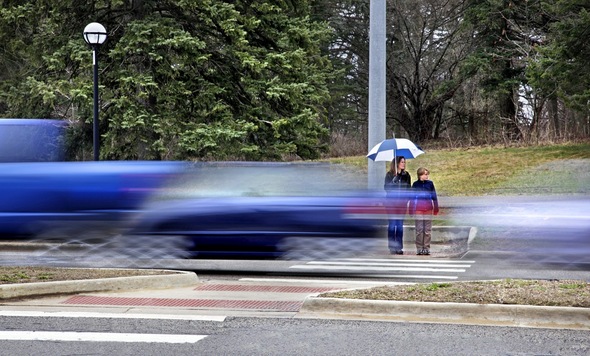
Courtesy of Aaron Kiley
Two weeks ago, council members voted 10-0 to take the first step in revising the ambiguously worded ordinance so that drivers will have a clearer understanding of when they are obligated to stop in order to allow pedestrians to cross the street. The proposed change is expected to come back to council for final approval in December.
Unpopular though the ordinance has been, we agree with City Council’s decision to improve it, rather than scrap it. The intent of the ordinance is as valid as the state law that underpins it.
At any pedestrian crosswalk not controlled by a traffic signal, the state’s Uniform Traffic Code recommends that motorists should be required to stop for a pedestrian who enters the crosswalk.
In Ann Arbor, as in many places, motorist rarely stop for pedestrians at crosswalks. On some busy roads, an attempt to cross the street can feel like a game of Frogger. In an attempt to address this concern, advocates persuaded the Ann Arbor City Council to adopt a pedestrian safety ordinance last year. Enforcement of the ordinance began in September - and immediately met with a public outcry.
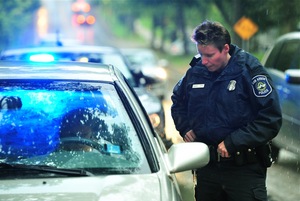
An Ann Arbor police officer tickets a motorist for violating the city's pedestrian safety ordinance.
Ryan J. Stanton | AnnArbor.com
We agree with those who say the language of the local ordinance is confusing. It asks a motorist to guess the intent of a pedestrian in the vicinity of a street crossing. Acknowledging that concern, City Council Members Sabra Briere, Margie Teall and Christopher Taylor offered a change that requires motorists to stop for any pedestrian “stopped at the curb or ramp leading to a crosswalk.’’
Such a change is needed, even though supporters of the ordinance initially resisted it. They point to the city of Boulder, Colo., where they have claimed that an ordinance with the same requirement to stop for a pedestrian “approaching’’ a crosswalk has worked well. But that’s not the case.
That vague language has caused similar problems in Boulder, and prompted the police department there to request a change because the wording was too confusing to motorists and difficult to enforce. Boulder officials tried to amend the ordinance, but couldn’t find any consensus. This past week, the city traffic engineer in Boulder told AnnArbor.com that his city still needs to fix its ordinance. Asked if he had a preferred solution, he said the language change just proposed in Ann Arbor is the best idea he’s seen yet.
While clear, more direct language would go a long way in improving the ordinance, that’s only part of the solution.
Recently, criticism of the ordinance has begun to focus more on the number of rear-end car crashes on busy four-lane roads, such as Plymouth Road, where motorists who stopped at pedestrian crosswalks were slammed into by motorists behind them who didn’t stop. These accidents underscore the inadequacy of the ordinance, by itself, to protect the safety of either pedestrians or motorists on multi-lane roads with higher speed limits.
On two-lane streets -- such as Seventh Street or Liberty Street through the Old West Side -- the ordinance seems well-suited to control traffic and allow pedestrians to cross safely.
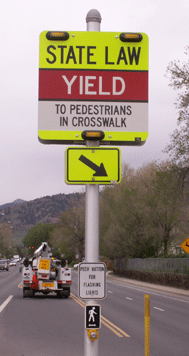
An example of a pedestrian crossing signal with flashing yellow lights in Boulder, Colorado.
Courtesy of City of Boulder
Boulder, which has had a pedestrian safety ordinance since the 1989, recognizes this. It has found that the ordinance isn’t enough, and has made it a practice to install flashing yellow lights or HAWK signals at pedestrian crossings on four- or five-lane roads.
Ann Arbor should do the same. Motorists here have adjusted well to the HAWK signal installed on Huron Street, across from the YMCA. A HAWK signal looks similar to a regular traffic light, and a pedestrian waiting to cross at that location can activate it by pressing a button. The result has been a much safer situation. Meanwhile, many other, similar locations in Ann Arbor remain a serious risk for pedestrians. That won’t change until Ann Arbor commits to some system of flashing yellow lights or other more visible traffic control at dangerous locations.
When the pedestrian safety ordinance was approved a year ago, we sensed from its supporters a certain smugness that it was the right thing to do and motorists just needed to get used to it. The vociferous feedback from the community in recent weeks makes it clear the ordinance is flawed and needs to be fixed. The sooner City Council makes changes, the safer our streets will be for both those who drive them and those who try to cross them on foot.
(This editorial was published in today's newspaper and represents the opinion of the Editorial Board at AnnArbor.com.)
Comments
WLD1
Tue, Nov 22, 2011 : 12:21 a.m.
First of all a lot of these laws are just stupid. It is making americans stupider. Common sense tells you that Stop before crossing, wait for cars to pass. sometimes you might have to wait a while if traffic is bad. Unless there is a traffic control device. If you start blaming everything on the driver. people are going to forget about common sense, become less observant and more problems will arise. The I know people want a socialism but not admit it. How ever if the government tries to control everything people will stop thinking.
Joe
Mon, Nov 21, 2011 : 11:23 p.m.
We need an ordinance requiring the city to clean up all the broken glass and car parts at crosswalks since this ill-conceived law was enacted.
leezee
Mon, Nov 21, 2011 : 4:30 p.m.
Please stop using the Erica Briggs picture. It really is a gross misrepresentation of the car speed on that road.
Jon Wax
Mon, Nov 21, 2011 : 1:13 p.m.
Tell ya what... I'll start stopping for pedestrians the year that NOBODY jaywalks in front of my car and that includes the lil generation eNtitlement kids of uofm, all the home games and any other random implant who thinks its ok for them to just cross here, just cuz they need to. You fix the jaywalking and ill start stopping for pedestrians. Until then... I'll be jetting through those intersections at full speed. Had some moron the other day slam on their brakes at the last minute because the guy at the bus stop may or may not have been a pedestrian. It wasn't. Law is stupid. Another thing and i mean this in all sincerity: exactly WHY do pedestrians have the right of way? Where does that come from? I'm in a machine, i paid taxes to use it, paid taxes for the roads, the gas, paid the insurance. As a person on the go, I have more invested in the community as a car user, then you do as a pedestrian. Green? pffft. Take that nonsense to some other location. It doesn't make sense to me why a slow moving person on foot would have right of way over a fast moving steel and glass machine? I'm not saying folks shouldn't walk but if you do, that doesn't make you "better" then the folks in a car. I dunno man. I've lived here since the 70s. Never has there been this much micromanagement of the locals over such trivial issues. Downtown, the pedestrians have unmonitored access to walk and run as they please. Outside of that, the rest of the town belongs to the Locals and this Local ain't stopping. Peace
Mark Salke
Sun, Nov 20, 2011 : 10:38 p.m.
A city ordinance that is redundant regarding state law is one thing. One that makes enforcement ambiguous is worse. Pedestrians must be protected at crosswalks, for sure. Let's use common courtesy and common sense. I know... both are wanting from many motorists.
48104
Sun, Nov 20, 2011 : 10:08 p.m.
As a driver of a car that was nearly rear-ended by someone who didn't notice I was stopped with a turn signal on waiting to turn left, it's NOT the ordinance and it's NOT the pedestrians. It's inattentive and hurried drivers.
snapshot
Sun, Nov 20, 2011 : 11:07 p.m.
So you're OK with adding an additional distraction?
Mick52
Sun, Nov 20, 2011 : 8:15 p.m.
I agree with the proposal that if the city wants to continue with this folly, they need to install the HAWK signals or more traffic lights so a pedestrian can make traffic stop or a red light. That makes sense, even though it will impede traffic. Otherwise repeal it completely since there is no problem crossing streets in Ann Arbor. The other option would be get the state to pass a new law.
snapshot
Sun, Nov 20, 2011 : 5:13 p.m.
Pedestrians should "stop,look, and listen"........city council should do the same.
snapshot
Sun, Nov 20, 2011 : 4:41 p.m.
"A certain smugness" by advocates, I'd say an outright misrepresentation of the "Boulder" facts to get their "special interest" way while callously ignoring and further endangering both drivers and pedestrians alike. No matter what changes or modifications are made it will not alleviate the fact that Ann Arbor is central hub for drivers throughout the state and even out of state due to the population served by the university and the medical community. These drivers will adhere to state law that they are tested on when receving a drivers license. Deviating from standard driving laws accepted nationally creates a hap-hazard and dangerous situation. People coming to Ann Arbor for medical attention, spending money, trying to heal themselves, will be greeted with rear end collisions, fines, and increased insurance rates because a few "radicals" want to impose their beliefs upon everybody, and it so happens these "radicals" are in city government operating in their own self interests.
John Q
Mon, Nov 21, 2011 : 3:44 a.m.
But no one has been able to produce any statistical evidence showing this to be true.
Jim Walker
Sun, Nov 20, 2011 : 4:38 p.m.
A National Motorists Association member in Massachusetts, John Carr, has extensively researched the issue of pedestrian safety and written two articles that readers might find of value to read. Regards the dangers of using cherry-picked data to make policy: <a href="http://blog.motorists.org/these-cherries-are-delicious-but-deadly/" rel='nofollow'>http://blog.motorists.org/these-cherries-are-delicious-but-deadly/</a> Regards the dangers of laws that falsely make people think they are safer than they are: <a href="http://blog.motorists.org/the-danger-in-making-people-feel-safer/" rel='nofollow'>http://blog.motorists.org/the-danger-in-making-people-feel-safer/</a> A great deal of traffic safety engineering is counter-intuitive, which is what makes it so hard to teach. James C. Walker, NMA
justcurious
Sun, Nov 20, 2011 : 4:11 p.m.
Anyone else notice the Boulder sign says "State Law yield to pedestrians IN crosswalk"? So, what's with that? Just like here, the sign does not reflect what they will ticket you for. Are we copy-cat stupid?
BornNRaised
Sun, Nov 20, 2011 : 4:04 p.m.
Welcome to the sovereign state of Ann Arbor. Where the residents feel that they can make their own laws that people from 'foreign lands' must memorize before being granted access. Is there any wonder why everyone laughs at Ann Arbor?
Jim Walker
Sun, Nov 20, 2011 : 4 p.m.
Ann Arbor adopted the Uniform Traffic Code, so it IS part of our city code. Attempts to use rules not uniform with the UTC is a dangerous mistake. The applicable UTC section says: R 28.1702 Rule 702. Pedestrians; right-of-way in crosswalk; violation as civil infraction. (1) When traffic-control signals are not in place or are not in operation, the driver of a vehicle shall yield the right-of-way, slowing down or stopping if need be to so yield, to a pedestrian crossing the roadway within a crosswalk when the pedestrian is on the half of the roadway on which the vehicle is traveling or when the pedestrian is approaching so closely from the opposite half of the roadway as to be in danger, but a pedestrian shall not suddenly leave a curb or other place of safety and walk or run into a path of a vehicle that is so close that it is impossible for the driver to yield. (2) A person who violates this rule is responsible for a civil infraction. Most serious traffic safety issues occur when rules, ordinances and enforcement practices are NOT uniform with most other venues. When a city like ours with many visitors and temporary residents adopts ordinances and/or uses enforcement practices that are DIFFERENT than other venues in our state (or many other states), it invites and virtually guarantees both high rates of non-compliance and significantly reduced real safety for all of our citizens and visitors. True safety comes from drivers and pedestrians who instinctively understand and use common sense to apply rules that come from systems like the UNIFORM Traffic Code and the Michigan Manual of UNIFORM Traffic Control Devices. The word "Uniform" includes the MEANING of the traffic rules, not just the size, shape and color of the controlling signs. If we seriously taught and enforced the UTC rule instead of trying to reinvent the wheel, we would have greater safety. James C. Walker, National Motorists Association, <a href="http://www.motorists.org," rel='nofollow'>www.motorists.org,</a> Ann Arbor, MI
Joy Bash
Sun, Nov 20, 2011 : 2:17 p.m.
Growing up I was taught to look both ways before crossing the street. Since moving to Ann Arbor I see people walking out onto the road without even looking either way. With all the so called educated people in Ann Arbor they don't seem smart enough to look before you cross. So we spend all this time coming up with some stupid law so that people can walk out into the road and not look for their own safety. Seems to me Ann Arbor City Council and the Police Department should have more pressing items on the agenda at a time when the budget has to be cut and people are losing their jobs. The city needs to get a grip and teach people to look first then proceed to walk. That would be a law everyone should be able to understand. Only in Ann Arbor. This is just crazy. Like a bicyclist who rides in the middle of a lane where the speed limit is 45 and the car has to slow down and traffic backs up because a bike can't go as fast as a car or do the speed limit.
Phillip Farber
Sun, Nov 20, 2011 : 4:13 p.m.
The additional seconds it requires of you to pass safely are appreciated by us cyclists. We've just people like you trying to get from A to B on the local streets we've all paid for with our property taxes. Not all of us can afford to own and operate a car.
rusty shackelford
Sun, Nov 20, 2011 : 2:04 p.m.
As someone who crosses 7th several times a day everyday, I can say that literally 0 cars have obeyed this ordinance on that street in my experience.
leezee
Mon, Nov 21, 2011 : 4:18 p.m.
And yet you still made it across the street.
Wolf's Bane
Sun, Nov 20, 2011 : 2:01 p.m.
Ignore the signs and the ordinance. Drive slowly and carefully. Common sense NEEDS to prevail, not more legislation. Peace.
G. Orwell
Sun, Nov 20, 2011 : 1:47 p.m.
If it isn't broke, don't fix it! Particularly when lives at at stake. It worked fine for the past 50 plus years without this idiotic ordinance. This ordinance, or any version of it will make it LESS safe for pedestrians. On roads, 5,000 pound cars going 40 mph should have the right of way. Why is AA.com pushing this stupid ordinance? Is there an agenda?
Ming Bucibei
Sun, Nov 20, 2011 : 7:23 p.m.
AA has long had an anti-car agenda!! Ming Bucibei
G. Orwell
Sun, Nov 20, 2011 : 3:16 p.m.
"There is an agenda - to make our roads safer for pedestrians." Then how come they are making it more dangerous for pedestrians with this ordiance.
Ron Granger
Sun, Nov 20, 2011 : 2:49 p.m.
There is an agenda - to make our roads safer for pedestrians.
Vivienne Armentrout
Sun, Nov 20, 2011 : 1:45 p.m.
Thank you for this thoughtful discussion. I agree that the proposed changes in the ordinance are useful and appropriate and I applaud CM Briere, Taylor and others who have worked together to make a workable compromise. Your point about distinguishing between two-lane and especially busy four-lane roads is also good. We need more signalization on these roads, including HAWK but also (especially on Plymouth) regular stop lights with a pedestrian call signal attached. I have seen these in use in Madison, Wisconsin and they can be set so that the timing doesn't go off in a way to impede traffic unduly. Friday I was crossing at Fourth and Catherine and again experienced (in broad daylight) the phenomenon of drivers coming into the intersection and impatiently proceeding toward the pedestrian in the opposite crosswalk. This is a 4-way stop and the law should be very clear about right-of-way. The difficulty is that no law seems to be able to curb the impatience and feeling of entitlement of some drivers.
Tony Dearing
Sun, Nov 20, 2011 : 6:24 p.m.
We agree, HAWK signals are an ideal solution for the most hazardous locations, though they are fairly expensive, costing $75,000 to $100,000. A flashing signal similar to the one pictured in the editorial costs about $15,000, so I could see the city opting for those in some locations as a less costly alternative.
KJMClark
Sun, Nov 20, 2011 : 1:43 p.m.
Why can't you just say there is no state law for this? You already have two of the first five comments saying "enforce the state law" when there isn't one. Yes, it makes a difference. There isn't a state law, there is a recommended set of ordinances, that has an ordinance for this situation. Michigan is one of the most unfriendly states for pedestrians and cyclists. We should start all of these conversations with an understanding of how backward the state is in this area. Crashes were inevitable. People in Michigan like to bully other people with their cars, and tailgaters were bound to hit other cars - that's the problem with tailgating. Did you leave out the crash numbers because you finally checked and found there are lots of rear-end crashes in town every year anyway? I noticed that you left out that we've had pedestrian fatalities in Ann Arbor. As someone who advocated for Council to adopt the UTC version years ago, and *enforce* it, I'm not one of the people you are accusing of smugness here. Frankly, that comment was unnecessarily petty and vindictive. You would have been better off without that sentence.
MIKE
Tue, Nov 22, 2011 : 5:19 a.m.
"Mike, they were within the last decade. Is one year a magic amount of time or something?" No magic, just wondering is it was an ongoing issue or an isolated incident.
ReallyAA
Mon, Nov 21, 2011 : 2:46 p.m.
It's not just the Chief and "some members of Council" who believe there is a state law requiring motorists to yield to pedestrians within the crosswalk--not one single member of city council refuted the presumption that there is, in fact, a state law covering this. So even if what Clark is saying is true, it further begs the question--why in the world are the city council and chief of police be discussing the interplay between the local ordinance and the state law, when no one has apparently even looked into whether there is a state law in existence in the first place? The state police have recommended a law. City council should adopt that law and be done with it. The city should then spend its time and money on improving the crosswalks by adding HAWK signals, clearly marking them, and adding lights to them so motorists can see the pedestiran "within" the crosswalk. BUT, the council does not need to further legislate beyond the recommended state police law.
KJMClark
Mon, Nov 21, 2011 : 1:47 p.m.
Tony - thank you. I appreciate AA.com's efforts to educate people. Townie, again, you've successfully verified that the Chief and some members of council have misstated things. Doesn't matter how many people misstate something, it doesn't make it a law. Mick, actually, I had a hand in writing those brochures, and that was one of the things I think I recommended they correct. They didn't - not my fault. 612 applies to signalized intersections. Tony's reply to my comment is right on target. It matters because there *should* be a state law. The fact that there isn't tells you something about Michigan's attitude toward pedestrians. Mike, they were within the last decade. Is one year a magic amount of time or something?
townieA2
Mon, Nov 21, 2011 : 8:59 a.m.
I have verified that both City Council and the Ann Arbor Chief of Police recognize there is a state law that covers this. Don't believe me, watch the city council meeting from November 10, 2011 <a href="http://a2gov.legistar.com/LegislationDetail.aspx?ID=996070&GUID=925131B0-B68E-4BF1-AD26-CBFABD70929A&Options=&Search=" rel='nofollow'>http://a2gov.legistar.com/LegislationDetail.aspx?ID=996070&GUID=925131B0-B68E-4BF1-AD26-CBFABD70929A&Options=&Search=</a> beginning at 2:04 into the meeting, Councilman Taylor asks the Chief of Police if the Ann Arbor police can issue a ticket under BOTH the local ordinance and the STATE law, to which the police chief replies, "Yes. I believe we can." The exchange is about the interplay between the local ordinance and STATE LAW goes on for several minutes. Now, if our city council and chief of police are both wrong about the uniform state law being enacted, then that only begs the question: why not enact the state police RECOMMENDED uniform law? What is the need for over-legislating this with a separate, more dangerous ordinance?
townieA2
Mon, Nov 21, 2011 : 8 a.m.
If there is no state law on this, then the police chief and the city council are both mistaken on this issue. Go back and watch the police chief's comments at the last city council meeting where the revised ordinance was proposed. They were both, clearly talking about an additional law that covered pedestrians "within" the crosswalk.
MIKE
Sun, Nov 20, 2011 : 8:59 p.m.
"I noticed that you left out that we've had pedestrian fatalities in Ann Arbor." That is horrible! How many pedestrians have died at these locations in the 12 months preceding this ordinance?
Mick52
Sun, Nov 20, 2011 : 8:10 p.m.
I don't know why the law is such as issue: <a href="http://www.miwats.org/wats/leftside/pubpresn/brochures/pedestrian.pdf" rel='nofollow'>http://www.miwats.org/wats/leftside/pubpresn/brochures/pedestrian.pdf</a> It is clear, vehicles must yield to pedestrians.
Billy Bob Schwartz
Sun, Nov 20, 2011 : 7:21 p.m.
I'm afraid to stop at red lights (when I'm in the right hand lane) and stop signs. People no longer seem to consider these things to be mandatory. Many don't even curtsy as they make their right turns or roll through the stop sign. I'm afraid to stop on any kind of red because the person behind me expects me to drive the same way they do and run right on through. How much more do I fear rear-enders when I have to slam on my breaks because someone on the phone or typing out a text message suddenly turns onto and walks into a crosswalk? When I walk in AA, I try to look where I'm going and not cross in front of cars, except on campus, where you are pretty safe because if you don't look directly at the driver, the car usually will not run you over.
Tony Dearing
Sun, Nov 20, 2011 : 6:20 p.m.
There has been a mistaken impression about the existence of a state law, and we regret that we've contributed to that by incorrectly referring to a state law in some of our past stories. There is not a state law regarding this. The State Police's Uniform Traffic Code includes recommended language for local communities to adopt, but that is a recommendation, not a state law. We were careful in the way we described this in today's editorial, and we'll continue to seek to clarify this for readers in our ongoing coverage.
KJMClark
Sun, Nov 20, 2011 : 5:31 p.m.
Townie - no there isn't. As they more-or-less correctly point out in the article, there is a state police recommended ordinance. Not the same as a state law. Go find the law. Not my fault the Chief misstated it.
townieA2
Sun, Nov 20, 2011 : 4:32 p.m.
Yes, there is a state law. And, the chief of police even admitted so at the last city council meeting where the proposed change to the ordinance was debated (just a couple weeks ago). At issue: whether the police could issue "two points" under the state law for failing to stop while a person is "within" a cross walk, while also issuing a ticket under the city ordinance, which would not require two points, but would require a ticket and fine. Chief of police's answer to city council: Yes, both the state law and ordinance can coexist. So, ticket and fine under local ordinance for anyone "stopped at" the crosswalk-- PLUS second ticket, fine, and points under state law for anyone "within" the crosswalk. Watch the city council meeting on cable TV--it's quite enlightening. The local ordinance is not necessary if we simply enforce the state law.
Brad
Sun, Nov 20, 2011 : 1:38 p.m.
"It's been working in Boulder, Colorado, for 22 years, but maybe it'll take a little while here," said Mayor John Hieftje, a supporter of the pedestrian safety ordinance. Such a change is needed, even though supporters of the ordinance initially resisted it. They point to the city of Boulder, Colo., where they have claimed that an ordinance with the same requirement to stop for a pedestrian "approaching'' a crosswalk has worked well. But that's not the case. So which is it, mayor and council? And can we stop hearing about Boulder now (and don't even get me started on The Hague!)? One more thing - can you stop using that same photo that makes it look like the cars are passing the pedestrians somewhere near the speed of light?
David Cahill
Sun, Nov 20, 2011 : 1:32 p.m.
It is a mystery to me why lobbying groups and City Council are so frequently fixated by what Boulder, Colorado does. Boulder is merely one of countless mid-sized college towns. How many of these towns have stupid pedestrian ordinances? AnnArbor.com should do a survey. "Smugness" is an apt description of the groups that think pedestrians and cyclists are morally superior to drivers. These groups overlook the obvious fact that in Michigan there can be nothing wrong with the car.
Sparty
Sun, Nov 20, 2011 : 1:26 p.m.
Repeal the law and try to begin focusing on the will of the citizens for a change. We are secure enough in ourselves to follow State law. We are not Boulder, Palm Springs, San Antonio or any other city in the United States and I for one am sick of hearing about what they can do or have done. If our City Council or certain residents are so enamoured of Boulder, then please, just move there and put us out of our misery! We are Ann Arbor, we love Ann Arbor, and live here because of what makes Ann Arbor unique. To suggest we need to model ourselves on another city continuously is lazy, unimaginative, and fails to consider local solutions to local issues.
The Watchman
Sun, Nov 20, 2011 : 1:09 p.m.
Can't we just use state law like every other city in the state? What is it about this city that has to place them above the rest. As a driver, I have to wait at red lights and in traffic. Is it really asking to much of the pedestrian to make sure it is safe to cross before he/she does? Instead of passing stupid ordinances let's get back to running the city!
Rod Johnson
Tue, Nov 22, 2011 : 3:44 a.m.
I think you mean Ron, Ed.
Edward R Murrow's Ghost
Sun, Nov 20, 2011 : 8:07 p.m.
@Rod; I'll do 1984 one better. Yes, it is WAY too much to ask drivers to read the minds of pedestrians as they are APPROACHING a crosswalk, which is what the ordinance essentially requires as drivers are to stop for pedestrians who look to be about to enter the crosswalk. Good Night and Good Luck
GoBlue1984
Sun, Nov 20, 2011 : 3:41 p.m.
@Ron "Is it really asking too much of the drivers to make sure they comply with the law and stop for pedestrians?" If the drivers are from out of town, which many in this city are, they have no idea that this law even exists and they follow the state law that everyone knows... so when I (an Ann Arborite) stop to let a pedestrian go I risk getting rear ended because Ann Arbor was stupid enough to pass one the most ill thought through ordinances I've ever seen! Wake up city council... we will vote you all out 1 by 1!
Ron Granger
Sun, Nov 20, 2011 : 2:47 p.m.
"Can't we just use state law like every other city in the state? What is it about this city that has to place them above the rest." -- We have a lot of pedestrian traffic and we encourage it. We value being able to walk and bike around town safely. We aren't Dearborn, Detroit, Livonia, Canton, etc. "Is it really asking to much of the pedestrian to make sure it is safe to cross before he/she does?" Is it really asking too much of the drivers to make sure they comply with the law and stop for pedestrians?
Rod Johnson
Sun, Nov 20, 2011 : 2:43 p.m.
What state law? Cite please.
Ming Bucibei
Sun, Nov 20, 2011 : 12:37 p.m.
Repeal this idiotic law!! Ming Bucibei
townieA2
Sun, Nov 20, 2011 : 12:37 p.m.
If city council is determined to make their own ordinance rather than just enforcing the state law, then the newly proposed language will still cause problems for motorists and pedestrians until there are pedestrian-activated signals at the crosswalks, and all bus stops are moved away from the area of the crosswalk. The pedestrian-activated cross walk signals need to be at all crosswalks that traverse the middle of block. Not only are Plymouth Rd., Stadium Blvd, and other multiple-lane roads dangerous for drivers and pedestrians trying to follow the "revised" ordinance, but so are other roads such as Nixon Road next to Clague middle school, where there are trees and no lights obscuring any potential person who may be crossing. Further heightening the problem is the issue at night, where it is nearly impossible to see whether a person is standing at a cross walk on your own side of the road, let alone the other side of the road. This is true even for the "lit" crosswalk signs over Plymouth road. The dim light does not extend to the sides of the road, so it is extremely difficult to see people on the side of the road. Further, the proposed ordinance should be revised so a motorist has time to "safely stop" for a pedestrian at a cross walk. Without adding "safely stop," a motorist is required to slam on his or her breaks as soon as someone is stopped at the crosswalk. We have much safer laws for cars at intersections--that's why the yellow light was invented. And even 4-way stops without overhead lights give cars a warning that a stop is coming. A crosswalk sign, and even signal, do not do the same because the motorist only has to stop at a crosswalk sometimes (when someone is ready to cross)--imagine doing this at night, on Plymouth Road, especially where the speed limit is 45 miles per hour at the Georgetown intersection. Cars that are 3-4-5 back from the initial car that is stopping cannot see ahead to know whethe
Roaring_Chicken
Sun, Nov 20, 2011 : 11:58 a.m.
Mr. Dearing: Well said. Thank you. And, interesting to hear that Boulder didn't experience an immediately successful application of its ordinance. Perhaps our two communities can engineer a Win-Win with two sets of results from similar situations.
1bit
Sun, Nov 20, 2011 : 11:49 a.m.
Thanks for posting this, Tony. It sums things up very nicely. In one of the many threads on this topic, a poster went through the actual physics of trying to see the pedestrian, gauge their intent, then stop. It obviously takes time for all of the above to occur, even with good conditions. On the busy 4-lane roads, pedestrians deserve better protection than a tiny sign, an ordinance, and a prayer.