

Ann Arbor school board prepares to tackle financial goal for 2012-13
Ann Arbor's Board of Education will set the groundwork Wednesday for tackling a financial goal the board set in August.
At its Committee of the Whole meeting at 5:30 p.m. at Scarlett Middle School, the board will discuss a direction for how to impact the school funding problem that Ann Arbor Public Schools and every other district in Michigan has been experiencing.
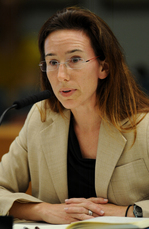
Christine Stead
Board Secretary Andy Thomas said he expects the bulk of Wednesday's conversation to be about how AAPS will pass a budget in coming years. With dwindling funds from the state and the board's decision to use money from Ann Arbor's savings to pass the current 2012-13 budget, he said the entire board is concerned AAPS will have to make some incredibly tough decisions next year.
"I think the sense of urgency is there and … we wanted to get (the thought process) started early," Thomas said.
But Vice President Christine Stead has a slightly different hope about where Wednesday's conversation might lead. She is more in favor of "big-picture" advocacy, and plans to discuss a broad-scale approach to getting people within the district and surrounding districts on the same page.
Stead said the Washtenaw Alliance for Education, a group comprised of superintendents and school board representatives that formed in January, met during the summer to brainstorm ways for the alliance to serve in more of an advocacy role as it pertains to state education funding.
She said she hopes Ann Arbor school board members will discuss the level of interest they have in volunteering for that kind of work. She said this advocacy could include writing to legislators and proposing amendments to Proposal A — the existing legislation that mandates how money for the Michigan School Aid Fund is generated — or other legislation that could give schools the local power to raise mills for funding children's education.
"This may require some research and some legal advice. … I have a couple of things in mind that I'd be happy to volunteer for but I want to make sure my colleagues think it's important work," Stead said. "I think we're to the point where we all have similar perspectives and agree we need to start thinking about what's really happening with school funding and how we, as Ann Arbor, can take a leadership role in the community."
Thomas said most of the legislators from this area are already on board with what the AAPS district is trying to advocate.
"But I don't know how we would go about changing the minds of (legislators) from Grand Rapids or Traverse City, for example, enough to get anything passed in a reasonable amount of time," he said.
Stead agreed she doesn't know whether the district and Ann Arbor-area legislators could be influential enough to make a change in how schools are funded by the next budget cycle or not.
"I think it'll depend on the results of the November election. ... If one of the (legislative) bodies became more democratically run, you might be able to get more of a conversation going in Lansing about school funding reform," she said. "But I think you can't stop doing what you think is the right thing to do and fighting for the students and their futures."
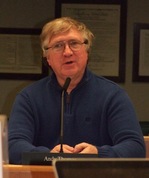
Andy Thomas
Stead said the county has never been able to successfully get its residents on the same page in terms of the value residents place on education. She added Washtenaw needs to do what Kalamazoo County did with the Kalamazoo Promise program and put education in the context of economic development.
"What was important about that program was they were able to create a really compelling conversation about education and how … the residents can see home values increase and families moving back into the area. … It's been pretty successful. They are the only county in the state that has passed three consecutive countywide schools millages. … That level of conversation hasn't ever been done here, but we could lead it," Stead said.
Danielle Arndt covers K-12 education for AnnArbor.com. Follow her on Twitter @DanielleArndt or email her at daniellearndt@annarbor.com.
Comments
brimble
Wed, Oct 3, 2012 : 12:52 p.m.
The very suggestion of asking taxpayers for a little more juice is offensive. It isn't about the revenue, but it is very much about the expenses. The simple litmus test is this: does spending '$x' on 'y consultant/administrator/capital project' directly improve the quality of education for students in this district or school? If the answer is 'no', then don't do it. It isn't that residents don't value education. Ms. Stead is incorrect on that point. But it is that residents don't value throwing money around with no return on investment. It is that residents are paying much more for their own health insurance (if they have it at all) and being asked to subsidize teachers' and administrators' plans which are much better than their own. It is that residents see construction, high administration salaries, and useless consultants, and reject the premise that the next tax increase has anything to do with valuing education.
Nick Danger
Wed, Oct 3, 2012 : 12:26 p.m.
Mark Ouimet has never been a friend to education and has voted to cut educational funding.As a result,Pioneer,Huron and Community classrooms have 35+ students in core classes.If you want an educated population you have to pay for it
sandy schopbach
Wed, Oct 3, 2012 : 9:10 a.m.
I have a question. Wasn't the lottery money supposed to be earmarked for education? If that's the case, where is that money going NOW, Mr. Governor?
towncryer
Thu, Oct 4, 2012 : 12:40 p.m.
So you are saying the lottery money went to education up until Snyder took office? I need google when he changed that from Granholm's policies.
snapshot
Wed, Oct 3, 2012 : 1:37 a.m.
thank you Ms. Stead for helping me to decide to vote Republican. You have formed a cabal to dig further into MY pocket rather than living within your means. I suggest you start lobbying the teacher's unions to get that 85% percent of tax revenue that goes to salaries, pensions, and benefits down to 60% and you'll have plenty of funding. Instead you want me to fork over more property taxes which you think is OK. why is it that government employees don't want to give up any financial ground but think it's OK to keep increasing taxes for all of us non governmental folks?
andy kelly
Wed, Oct 3, 2012 : 11:14 a.m.
Snapshot, before you aim your loaded gun at teachers, try to trim the administrative budget first and see what happens. Teachers have given up great amounts over the past five years while the administration has unnecessarily grown larger. Trimming more teachers by cutting their salary and benefits equates to a lower quality teacher pool. Of course these conversations are like speaking to a brick wall as the board will not do anything radical to the administration because of their beloved Dictator Green and her quarter of a million dollar salary.
RUKiddingMe
Wed, Oct 3, 2012 : 11:03 a.m.
You can't argue with Ann Arbor democrats, especially when someone says the word "school" or "kids." It's just one of those places. Logic and math don't really have a place here. Just more taxes that will never go away and will most likely do nothing but pay salaries and increase staff and waste, and no lessons learned. It's VERY frustrating and sad.
snapshot
Wed, Oct 3, 2012 : 4:48 a.m.
Hey, just out of curiosity for those 2 of you that voted me down........Michigan is 54 BILLION dollar in debt for UNFUDED public employees benefits....that's UNFUNDED.....so you geniuses want to tell me why we should INCREASE the debt before we pay off the OLD debt? also tell me how much per person that that amount comes to with 9,800,000 residents in Michigan? Wait, maybe that's why the "kids" can't do any math....the teachers can't do any math. Go ahead, make my day and explain 54 Billion dollars away....for the good of the "kids".
Stephen Landes
Wed, Oct 3, 2012 : 1:25 a.m.
So Stead wants a legislature that is more "democratically run"? What she really means is she wants a Democrat controlled legislature; one that will spend like there is no tomorrow and then blame someone else when the state becomes totally unmanageable again (like the glorious Granholm years).
aataxpayer
Wed, Oct 3, 2012 : 12:12 a.m.
I suggest a two step process. First - engage in zero base budgeting so he process gains credibility. Every dollar spent outside the classroom, especially admin, must be carefully examined. Second, propose a county wide millage. The county as a whole will benefit from schools that are much better than average. This approach is better than state wide lobbying. Local values demand local solutions.
AKinA2
Tue, Oct 2, 2012 : 11:51 p.m.
The board used much of their reserves to avoid drastic cuts last year and class sizes at many schools are still higher than ever. There are fewer offerings of upper level classes for high school students, including some languages past the required 2nd year. Many of us moved to Ann Arbor in part for its great schools. I fear what drastic cuts could do to the education of our students. Applications at private schools are already at an all time high. More cuts will only create a downward spiral for our schools. I agree that we need to push the state to reconsider Prop A. But, that will take time and in the meantime, I would support a millage to protect the strength of our schools.
Wake Up A2
Tue, Oct 2, 2012 : 11:09 p.m.
Well they could get rid of the 3.5 million worth of "new" admin jobs as a start. 24 "district chairs". All of this when we couldn't/can't afford it.
tom swift jr.
Tue, Oct 2, 2012 : 11:07 p.m.
How about a county wide school district, one administration instead of 10, economy of scale in purchasing, elimination of 10 negotiation processes, equality of educational opportunities for students throughout the county. We could probably roll WISD into the mix as well.
RUKiddingMe
Tue, Oct 2, 2012 : 10:11 p.m.
J. H. C. "such as potentially spearheading a second attempt at a countywide education millage or lobbying state lawmakers to amend Proposal A and allow districts to levy their own taxes for operational expenses" Trim the fat. Too much non-teacher staff. Does everyone in this town think that there is no waste in the spending of AAPS money? Didn't Pioneer just build some big new thing? Didn't they just build an ENTIRE NEW HIGH SCHOOL? Where is the financial difficulty when they can just ask for a new millage and get it? How can they dip into Ann Arbor's savings? What happened to the all-powerful and untouchable BUCKETS?
RUKiddingMe
Thu, Oct 4, 2012 : 10:45 a.m.
Alarictoo, thanks for the info; so what are these "Ann Arbor savings" they're talking about dipping into? Is this a pool of money available only to schools? I'm confused by the name "Ann Arbor savings."
alarictoo
Wed, Oct 3, 2012 : 1:57 p.m.
@RUKiddingMe: "How can they dip into Ann Arbor's savings? What happened to the all-powerful and untouchable BUCKETS?" Perhaps you are not aware, but the Ann Arbor Public Schools are a completely separate entity from the City of Ann Arbor. They have ZERO access to the city's funds, and vice versa. As for the "big new thing" at Pioneer and the "entire new high school", those were approved by the voters in previous millages. I do agree with some of your sentiments in regard to wastefulness, etc., however.
Angry Moderate
Tue, Oct 2, 2012 : 10:44 p.m.
We have a brand new high school building. We have THREE alternative schools with few students. We have 5-figure raises for administrators...not to mention having more non-teacher employees than basically any other district our size.
leaguebus
Tue, Oct 2, 2012 : 9:51 p.m.
One person that could go is Mark Ouimet. He voted for the monied interests over schools. We have waited 12 years for the Bush tax cuts for the wealthy job creators to raise employment, but nothing to be seen yet, except the wealthy offshoring their money so they don't have to pay taxes on it. Demand is what creates jobs and cutting education 15% last year is no way to create demand. Laid off teachers quit buying things. Same with public safety workers. It's time to turn off the Stockman "starve the beast" mentality and get real with our economy.
Basic Bob
Wed, Oct 3, 2012 : 10:07 a.m.
And the union promises of raising the poor into the middle class has worked so well. At the expense of non-union formerly middle class workers.
Angry Moderate
Tue, Oct 2, 2012 : 10:42 p.m.
Are you referring to the Bush tax cuts that Obama extended in 2010? As opposed to the tax cuts that Obama signed as part of the stimulus bill--which was two-thirds spending, one-third tax cuts?
antikvetch
Tue, Oct 2, 2012 : 7:33 p.m.
""This may require some research and some legal advice..." YEAH!!! More consultants - that'll do it!